
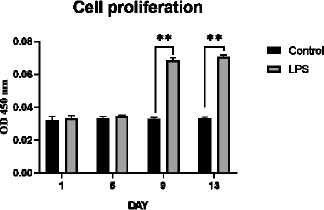
Fig. 1.
Effect on splenocyte proliferation in weaned piglets induced by lipopolysaccharide (LPS) challenge. Data represent the mean ± standard deviation (n = 6 in each group)
** – highly significant difference (P-value < 0.01)
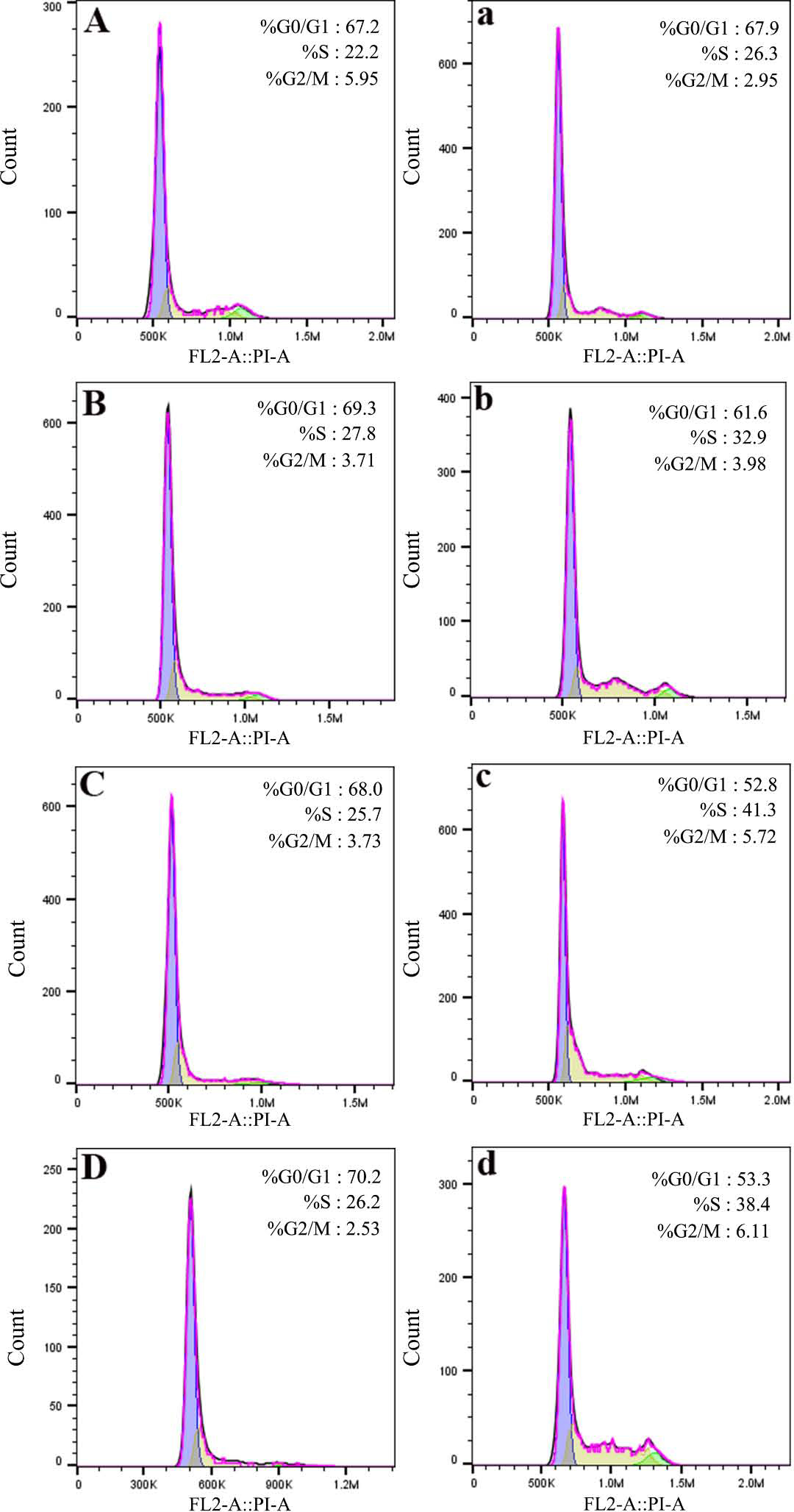
Fig. 2.
Flow cytometry results of evaluation of weaned piglet splenocyte cell cycle distribution after lipopolysaccharide (LPS) challenge. A, B, C and D show the splenocytes of saline-treated piglets on day (d)1, d5, d9 and d13, respectively; a, b, c and d show the splenocytes of LPS-treated piglets on the same days; G0 – cells in resting phase; G1 – cells in gap 1 phase; S – cells in synthesis phase; G2 – cells in gap 2 phase; M – cells in mitosis phase; FL2-A – total relative fluorescent intensity in channel 2; PI-A – total fluorescent intensity from propidium iodide
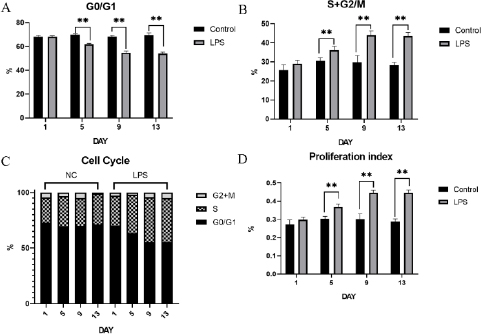
Fig. 3.
Effect of lipopolysaccharide (LPS) challenge to weaned piglets on the cell cycle distribution and proliferation index (PrI) of splenocytes. A – percentage of splenocytes in the resting phase (G0) and gap 1 phase (G1); B – percentage of splenocytes in the synthesis (S), gap 2 (G2) and mitosis (M) phases; C – cell cycle phase distribution of splenocytes (NC – negative control group); D – Proliferation index. Data represent the mean ± standard deviation (n = 6 in each group)
** – highly significant difference (P-value < 0.01)
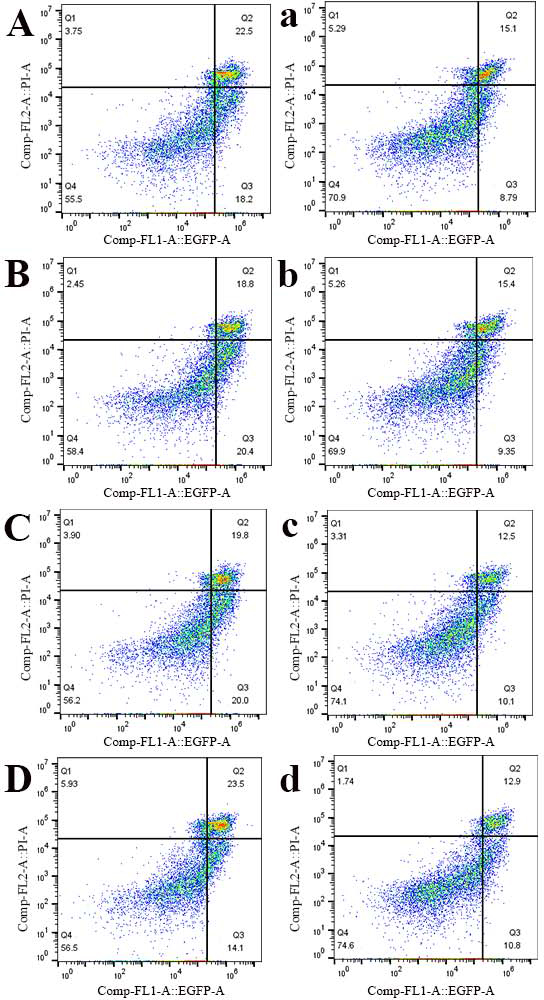
Fig. 4.
Percentages of apoptosis in splenocytes detected using Annexin V-enhanced green fluorescent protein (EGFP)/propidium iodide staining by flow cytometry. Apoptosis was affected by lipopolysaccharide (LPS) challenge to weaned piglets. A, B, C and D show the splenocytes of saline-treated piglets on day (d)1, d5, d9 and d13, respectively; a, b, c and d show the splenocytes of LPS-treated piglets on the same days; Q – quadrant; Comp – compensated; FL1/2-A – total relative fluorescent intensity in channel 1/2; PI-A – total fluorescent intensity from propidium iodide; EGFP-A – total fluorescent intensity from enhanced green fluorescent protein
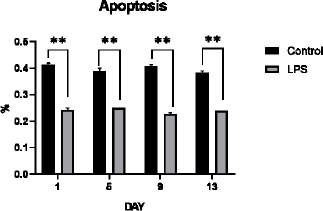
Fig. 5.
Effect of lipopolysaccharide (LPS) challenge to weaned piglets on the percentage of apoptosis in splenocytes. Data represent the mean ± standard deviation (n = 6 in each group)
** – highly significant difference (P-value < 0.01)
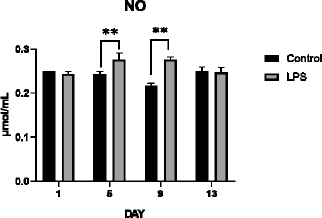
Fig. 6.
Effect of lipopolysaccharide (LPS) challenge to weaned piglets on the nitric oxide secretion in splenocytes. Data represent the mean ± standard deviation (n = 6 in each group)
** – highly significant difference (P-value < 0.01)