
Table 1.
Detailed clinical information on cats from central Slovakian animal shelters or veterinary clinics with signs of feline panleukopenia
| Group | Sample ID | Breed | Sex | Age | FPV vaccination | Anamnesis |
|---|---|---|---|---|---|---|
| I. clinical signs (n = 21) | 1 | crossbreed | female | 3 months | no | vomiting, diarrhoea |
| 2 | crossbreed | male | 3 months | no | vomiting, diarrhoea, lethargy | |
| 3 | crossbreed | female | 2 months | no | vomiting, diarrhoea, fever | |
| 4 | ESH | female | 6 months | no | lethargy, anorexia, fever | |
| 5 | ESH | female | 5 months | no | lethargy, anorexia | |
| 6 | crossbreed | female | 2 months | no | vomiting, diarrhoea | |
| 7 | crossbreed | male | 3 months | no | vomiting, lethargy | |
| 8 | crossbreed | female | 3 months | no | lethargy, fever | |
| 9 | crossbreed | female | 3 months | no | vomiting, diarrhoea, fever | |
| 10 | ESH | female | 3 years | no | lethargy, fever | |
| 11 | crossbreed | female | 4 months | yes | vomiting, lethargy, fever | |
| 12 | ESH | female | 3 years | no | vomiting, lethargy, anorexia | |
| 13 | crossbreed | male | 7 months | no | vomiting, lethargy, fever | |
| 14 | crossbreed | male | 6 months | no | diarrhoea, fever, vomiting | |
| 15 | crossbreed | male | 5 years | yes | diarrhoea | |
| 16 | ESH | male | 3 months | no | vomiting, lethargy, fever | |
| 17 | ESH | male | 5 months | no | vomiting, lethargy, fever, diarrhoea | |
| 18 | crossbreed | male | 5 months | no | vomiting, lethargy, fever | |
| 19 | ESH | male | 6 months | no | vomiting, lethargy, fever | |
| 20 | crossbreed | male | 1 year | no | vomiting, diarrhoea | |
| 21 | crossbreed | male | 3 months | no | diarrhoea, vomiting | |
| II. close contact with parvovirus-infected animal (n = 29) | 1 | crossbreed | female | 4 years | yes | healthy |
| 2 | crossbreed | female | 6 months | no | healthy | |
| 3 | crossbreed | male | 4 months | no | healthy | |
| 4 | crossbreed | female | 4 years | yes | healthy | |
| 5 | crossbreed | female | 5 years | yes | healthy | |
| 6 | ESH | female | 2 years | no | healthy | |
| 7 | ESH | female | 1 year | no | healthy | |
| 8 | ESH | female | 4 years | yes | healthy | |
| 9 | crossbreed | male | 5 years | yes | healthy | |
| 10 | ESH | female | 4 months | no | diarrhoea | |
| 11 | crossbreed | female | 3 months | no | diarrhoea | |
| 12 | crossbreed | male | 2 months | no | diarrhoea | |
| 13 | crossbreed | female | 3 months | no | diarrhoea, vomiting | |
| 14 | crossbreed | male | 3 months | no | healthy | |
| 15 | ESH | female | 1 year | no | healthy | |
| 16 | crossbreed | male | 5 months | no | healthy | |
| 17 | crossbreed | male | 2 years | yes | healthy | |
| 18 | crossbreed | male | 2 years | yes | intermittent diarrhoea | |
| 19 | crossbreed | female | 5 months | no | diarrhoea, overcame FPL | |
| 20 | ESH | female | 5 years | no | healthy | |
| 21 | crossbreed | male | 2 years | yes | intermittent diarrhoea | |
| 22 | crossbreed | female | 4 months | no | healthy | |
| 23 | ESH | female | 2 years | no | healthy | |
| 24 | crossbreed | female | 1 year | no | healthy, overcame FPL | |
| 25 | crossbreed | male | 1 year | yes | healthy | |
| 26 | crossbreed | female | 5 months | no | diarrhoea, overcame FPL | |
| 27 | crossbreed | male | 4 months | no | vomiting | |
| 28 | crossbreed | female | 3 years | yes | healthy | |
| 29 | crossbreed | female | 6 months | no | healthy, overcame FPL | |
| III. clinically healthy (n = 9) | 1 | ESH | male | 1 year | yes | healthy |
| 2 | ESH | female | 2 years | yes | healthy | |
| 3 | crossbreed | male | 7 months | yes | healthy | |
| 4 | crossbreed | female | 3 years | yes | healthy | |
| 5 | crossbreed | male | 3 months | yes | healthy | |
| 6 | crossbreed | male | 5 months | yes | healthy | |
| 7 | crossbreed | female | 1 year | yes | healthy | |
| 8 | crossbreed | female | 2 years | yes | healthy | |
| 9 | ESH | male | 1 year | yes | healthy |
Table 2.
Antigen-based detection of parvovirus infection in rectal swab samples of European shorthair and crossbred cats in central Slovakia grouped by feline panleukopenia status
| Group | Sample ID | CPV antigen test |
|---|---|---|
| I. clinical signs (n = 21) | 1–21 | + |
| II. close contact with parvovirus-infected animal (n = 29) | 1–9; 11–26; 28, 29 | - |
| 10, 27 | + | |
| III. clinically healthy (n = 9) | 1–9 | - |
Table 3.
Summary of parvovirus infection findings in rectal swab samples of European shorthair and crossbred cats in central Slovakia grouped by feline panleukopenia status
| Groups | CPV antigen test | PCR test | Total positive | ||
|---|---|---|---|---|---|
| Ag+ | Ag- | PCR+ | PCR- | ||
| I. clinical signs (n = 21) | 21 | 0 | 21 | 0 | 21 (100%) |
| II. close contact with parvovirus-infected animals (n = 29) | 2 | 27 | 2 | 27 | 2 (6.89%) |
| III. clinically healthy (n = 9) | 0 | 9 | 0 | 9 | 0 |
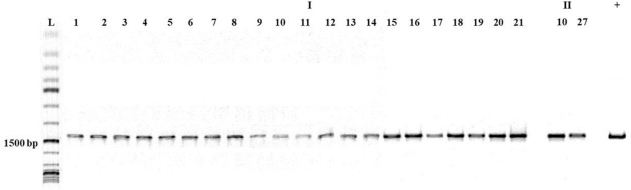
Fig. 1.
Amplicons of the full-length VP2 gene of canine parvovirus 2 (CPV-2) (1,755 bp) resolved on agarose gel as confirmation of parvovirus infection in European shorthair and crossbred cats in central Slovakia based on the presence of this gene in rectal swab samples. L – GeneRuler 1 kb DNA Ladder; I – group with clinical signs of parvovirus infection; II – group with close contact with parvovirus-infected animals; + – positive control (CPV-2-positive sample)
Table 4.
Sequences producing significant alignments with the VP2 gene amplicons of investigated rectal swab samples from European shorthair and crossbred cats in central Slovakia. Sequence analysis used the National Center for Biotechnology Information BLASTn algorithm
| Scientific name | Pairwise identity (%) | Query coverage (%) | GenBank accession number |
|---|---|---|---|
| Feline panleukopenia virus | 100.00 | 100 | MK671185.1, MK671183.1, MK671171.1, MK671170.1, MK671156.1, MK425504.1, MK425500.1, MK425499.1, MK425498.1, MK425497.1, KP019621.2, MG764511.1, MG764510.1, MF541133.1, MF541132.1, MF541119.1, KX685354.1, KX900570.1, KT240130.1, KT357491.1, OP796716.1, OP796714.1, KP682520.1, KP019617.1, OM638042.1, MW091486.1, MW091487.1, MZ712026.1, MZ322607.1, MZ357122.1, MZ357120.1, MZ357119.1, MW017627.1, MT270583.1, MW331496.1, MN419003.1, MT274378.1, HQ184201.1, FJ936171.1, DQ474238.1, DQ474237.1, DQ474236.1, EU221281.1, AY606131.1, DQ099430.1, AY955826.1, DQ003301.1, AB054227.1, AB054226.1, AB054225.1 |
| Feline parvovirus | 100.00 | 100 | MK266790.1, MK266788.1, MK295775.1, OM885375.1, ON646210.1, MZ442303.1, OR211675.1 |
| Feline panleukopenia virus | 99.78 | 100 | OQ863619.1, OQ863618.1, OQ863617.1, OQ863615.1, MZ508524.1 |
| Feline parvovirus | 99.78 | 100 | OR198066.1, OQ869254.1, OQ868569.1, OQ868568.1, OQ868566.1, OQ868565.1, OQ868564.1, OQ868562.1, OQ868554.1, OQ868553.1, OQ868552.1, OQ868550.1, OQ868548.1, OQ868547.1, OQ868542.1, OQ868536.1, OQ868535.1, OQ868534.1, OR194134.1, OR194132.1, OR194130.1, OR194129.1, OR194128.1, OR194125.1, OR194122.1, OQ535514.1, OQ535513.1, OQ535511.1, OQ535510.1, OQ535509.1 |