
Introduction
In recent years, the incidence of neoplastic lesions in companion animals, especially dogs, has been steadily increasing (1, 8, 9, 10, 13, 28). Skin tumours, which rank first among neoplastic lesions in dogs, are diagnosed most frequently (8). They are characterised by a vast array of histological types and constitute the most heterogeneous group of tumours. This is associated with the structure of the skin, as all of its components can undergo neoplastic transformation. According to the WHO classification, neoplasms of epithelial origin represent various histological types and originate from the epidermis and its adnexal structures. This group comprises epidermal tumours, hair follicle tumours, sebaceous gland tumours with their modifications, and apocrine sweat gland tumours and their derivatives (11). Another large group comprises mesenchymal and melanocytic tumours divided into benign and malignant neoplasms (11, 14). Epidemiological studies in veterinary oncological medicine are particularly important, as they expand the knowledge of the prevalence and development of neoplastic lesions and provide valuable information on individual types of tumours prevailing in different regions of the world. As shown by literature reports, the prevalence of specific histological types of skin tumour differs between geographic areas. Mast cell tumours have been mainly diagnosed in the UK, the USA, Thailand, Australia, Switzerland, and Brazil (2, 7, 12, 19). In turn, histiocytomas are most frequently diagnosed in India, whereas lipomas are dominant in another Asian country, i.e. South Korea (7, 24). This is certainly associated with the impact of various carcinogenic factors in a given geographical area. To date, few studies have addressed the epidemiology of canine skin tumours in Poland and generally they have reported the frequency of neoplastic skin lesions or presented research on the histological types of skin tumours (17, 26). In the available world literature, there are no epidemiological analyses of the risk of malignant versus benign canine skin tumours with reference to the breed, age or sex of dogs or tumours’ anatomical locations; such analyses may nevertheless be an important source of information in tumour prognosis. The unavailability of pertinent data was the rationale for undertaking the present research. The aim of this study was to determine the risk of malignant and benign canine skin tumours taking into account how their histogenesis differed depending on breed, sex and age and the anatomical location of tumours. The second objective was to compile data on the frequency and distribution of canine skin tumours.
Material and Methods
The analysis covered 3,139 skin tumour samples collected in 2016–2021 at the Department of Pathomorphology and Forensic Veterinary Medicine, University of Life Sciences in Lublin, Poland. They were collected from dogs undergoing surgical removal of skin tumours carried out at the Veterinary Clinic of the University of Life Sciences in Lublin and in private veterinary clinics in Poland. The study involved 35 breeds, crossbreed dogs, and breeds aggregated into an „other” group represented by fewer than nine individuals. Clinical data on the breed, age and sex of the dogs and the location of the tumour were obtained from referrals delivered to the Department of Pathomorphology and Forensic Veterinary Medicine together with the tissue material intended for histopathological examination. Only dogs with a full data set qualified for the study. Multiple tumours diagnosed in one individual were assessed separately. In terms of tumour location, 10 anatomical areas were distinguished: the head, neck, torso, thoracic limbs, axilla, pelvic limbs, inguinal area, perineum, anus, and tail. The dogs were divided into four age groups: 0–3 year-olds, 4–6 year-olds, 7–10 year-olds and 11–20 year-olds. Slides for microscopic examination were routinely stained with haematoxylin and eosin. Immunohistochemical staining (anti-vimentin, anti-cytokeratin, anti-CD3, anti-CD79α and anti-Melan A) was additionally used in doubtful cases, and toluidine blue was applied to stain mast cells. The histopathological analyses of skin tumours were based on the amended WHO classification (11, 14, 27). The data were analysed statistically, and the values of qualitative variables were presented with the use of frequency and percentage. Multivariate logistic regression analysis was employed to estimate the risk of malignant versus benign skin neoplasms depending on the breed, sex and age of the dog and the location of the tumour, taking into account the concurrent effects of all variables. Significance was assumed at the level of P < 0.05. The analysis was performed using Statistica 9.1 (StatSoft, Tibco, Palo Alto, CA, USA). An identical procedure was adopted for assessment of the risk of malignant versus benign epithelial tumours and malignant versus benign mesenchymal neoplasms.
Results
The analysis of the results of the five-year study showed the highest number of skin tumours in the last year of the study (2021), with a frequency of 25.61%, and the lowest number in 2017 with a frequency of 11.41%. The number of diagnosed tumours was noted to increase gradually every year (Fig. 1).
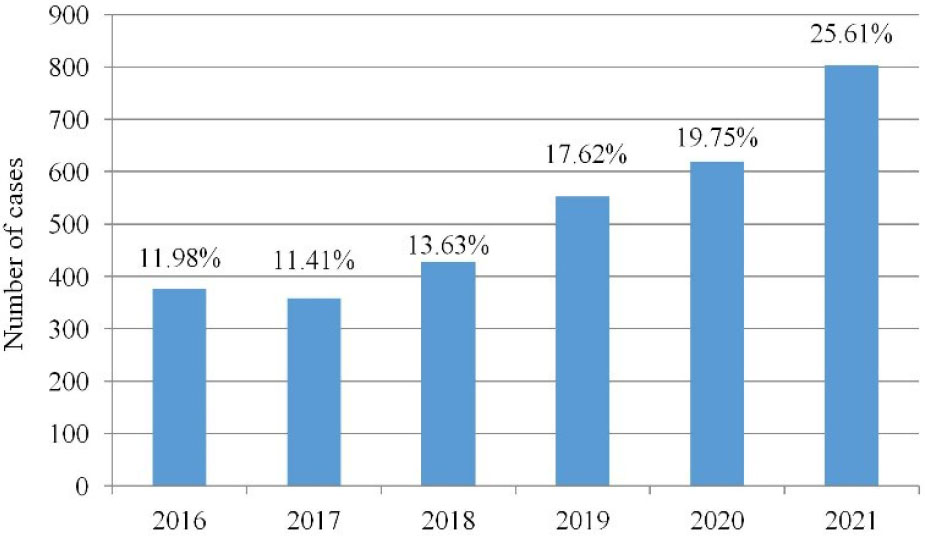
Fig. 1.
The incidence of skin tumours in dogs in 2016–2021
The highest percentage of skin tumours was diagnosed in Labrador retrievers (7.13%), German shepherds (5.60%), and Yorkshire terriers (4.96%). The crossbreed dogs also constituted a large group affected by tumours (38.70%) (Table 1).
Table 1.
Frequency of canine skin tumours depending on gender, age, breed and anatomical location
| n | % | |||
|---|---|---|---|---|
| Sex | Female | 1,483 | 47.24 | |
| Male | 1,656 | 52.76 | ||
| Age | 0–3 y | 390 | 12.43 | |
| 4–6 y | 500 | 15.93 | ||
| 7–10 y | 1,381 | 43.99 | ||
| 11–20 y | 868 | 27.65 | ||
| M ± SD | 8.23 ± 3.60 | |||
| Me (Q1–Q3) | 9 (6–11) | |||
| min–max | 0.5–20 | |||
| Breed | Crossbreed | 1,215 | 38.71 | |
| Labrador retriever | 224 | 7.14 | ||
| German shepherd | 176 | 5.61 | ||
| Yorkshire terrier | 156 | 4.97 | ||
| Spaniel | 119 | 3.79 | ||
| Bulldog | 104 | 3.31 | ||
| Schnauzer | 95 | 3.03 | ||
| Boxer | 83 | 2.64 | ||
| Shih tzu | 80 | 2.55 | ||
| Golden retriever | 77 | 2.45 | ||
| Bernese dog | 73 | 2.32 | ||
| American Staffordshire terrier | 63 | 2.01 | ||
| Beagle | 56 | 1.78 | ||
| Maltese | 55 | 1.75 | ||
| Dachshund | 48 | 1.53 | ||
| Siberian husky | 43 | 1.37 | ||
| Other terriers | 40 | 1.27 | ||
| West Highland white terrier | 31 | 0.99 | ||
| Bull terrier | 25 | 0.80 | ||
| Cane Corso | 23 | 0.73 | ||
| Rhodesian ridgeback | 10 | 0.32 | ||
| Chihuahua | 10 | 0.32 | ||
| Pointer | 20 | 0.64 | ||
| Pekingese | 19 | 0.60 | ||
| Fox terrier | 19 | 0.60 | ||
| Pug | 17 | 0.54 | ||
| Setter | 14 | 0.45 | ||
| Alaskan Malamute | 14 | 0.45 | ||
| Bavarian mountain hound | 12 | 0.38 | ||
| Dobermann | 12 | 0.38 | ||
| Poodle | 12 | 0.38 | ||
| Shar pei | 12 | 0.38 | ||
| Polish hunting dog | 11 | 0.35 | ||
| Pinscher | 10 | 0.32 | ||
| Black Russian terrier | 9 | 0.29 | ||
| Flat-coated retriever | 9 | 0.29 | ||
| Other | 143 | 4.56 | ||
| Location | Torso | 861 | 27.43 | |
| Head | 736 | 23.44 | ||
| Thoracic limb | 466 | 14.84 | ||
| Pelvic limb | 456 | 14.53 | ||
| Anus | 213 | 6.79 | ||
| Neck | 165 | 5.26 | ||
| Tail | 71 | 2.26 | ||
| Axilla | 70 | 2.23 | ||
| Perineum | 62 | 1.98 | ||
| Inguinal area | 39 | 1.24 |
Significantly greater numbers of skin tumours were diagnosed in male dogs (52.75%). They were most frequently diagnosed in the group aged 7–10 years (43.99%), where the median patient age was 9 years. They were located on the torso (27.42%) and head (23.44%) (Table 2). Microscopic analysis showed a significant predominance of benign tumours, with a frequency of 65.02%, as well as of mesenchymal and melanocytic tumours with a frequency of 59.58% (Table 2). Mast cell tumours accounted for the largest percentage of the entire tumour population, i.e. 13.79% of all skin tumours. The second largest group was constituted by histiocytomas (11.82%), including round cell tumours. The other tumours were lipomas (6.40%), haemangiopericytomas (5.96%) and malignant melanomas (4.65%). In turn, the most frequent epithelial tumours were sebaceous adenomas (4.24%), followed by trichoblastomas and trichoepitheliomas, constituting 3.70% of the examined tissue samples. Squamous cell carcinomas were the third most frequent epithelial tumours (2.93%) (Table 2).
Table 2.
Frequency of occurrence of a particular histological types of skin tumours in dogs
| N | % | N | % | ||
|---|---|---|---|---|---|
| Benign | 2,041 | 65.02 | Malignant | 1,098 | 34.98 |
| Epithelial | 784 | 24.98 | Epithelial | 485 | 15.54 |
| Sebaceous adenoma | 133 | 4.24 | Squamous cell carcinoma | 92 | 2.93 |
| Trichoblastoma | 116 | 3.70 | Hepatoid epithelioma | 88 | 2.80 |
| Trichoepithelioma | 116 | 3.70 | Meibomian epithelioma | 85 | 2.71 |
| Hepatoid adenoma | 92 | 2.93 | Sebaceous epithelioma | 63 | 2.01 |
| Papilloma | 73 | 2.33 | Apocrine adenocarcinoma | 48 | 1.53 |
| Keratoacanthoma | 68 | 2.17 | Basal cell carcinoma | 31 | 0.99 |
| Pilomatricoma | 65 | 2.07 | Sebaceous adenocarcinoma | 30 | 0.96 |
| Apocrine adenoma | 52 | 1.66 | Malignant trichoepithelioma | 15 | 0.48 |
| Meibomian adenoma | 50 | 1.59 | Hepatoid adenocarcinoma | 13 | 0.41 |
| Tricholemmoma | 13 | 0.41 | Anal sac gland tumour | 10 | 0.32 |
| Ceruminous adenoma | 6 | 0.19 | Ceruminous adenocarcinoma | 7 | 0.22 |
| Meibomian adenocarcinoma | 3 | 0.10 | |||
| Mesenchymal | 886 | 28.23 | Mesenchymal | 984 | 31.35 |
| Histiocytoma | 371 | 11.82 | Mast cell tumours | 433 | 13.79 |
| Lipoma | 202 | 6.43 | Haemangiopericytoma | 187 | 5.96 |
| Fibroma | 108 | 3.43 | Malignant melanoma | 146 | 4.65 |
| Haemangioma | 64 | 2.04 | Fibrosarcoma | 77 | 2.45 |
| Plasmacytoma | 43 | 1.37 | Peripheral nerve sheath tumour | 34 | 1.08 |
| Melanocytoma | 43 | 1.37 | Haemangiosarcoma | 21 | 0.67 |
| Fibrolipoma | 41 | 1.31 | Liposarcoma | 20 | 0.64 |
| Lymphangioma | 8 | 0.25 | Myxosarcoma | 16 | 0.51 |
| Myxoma | 4 | 0.12 | Cutaneous lymphoma | 13 | 0.41 |
| Hibernoma | 1 | 0.03 | Histiocytic sarcoma | 33 | 0.15 |
| Neurofibroma | 1 | 0.03 | Malignant histiocytosis | 4 | 0.13 |
| Total: n = 3,139 | |||||
The statistical analysis revealed that the risk of a tumour being malignant rather than benign was 1.212 times higher in the female than in the male dogs. The odds ratio (OR) for the occurrence of a malignant tumour in the group of the youngest dogs aged 0–3 years was 0.24, which indicates a fourfold lower risk of development of malignant tumours than for dogs aged 4–6 years. The risk of development of malignant neoplasms on the neck was 1.850 higher than the risk of benign neoplasms in this location. It was found that the following breeds of dogs faced a higher risk of developing malignant tumours than crossbreed dogs: golden retrievers (OR 2.096), boxers (OR 2.255), German shepherds (OR 1.878) and Maltese (OR 2.926) (Table 3).
Table 3.
Odds ratios (ORs) and 95% confidence intervals (CIs) of malignant canine skin neoplasia in relation to benign ones by sex, age, tumour location and breed
| OR | 95% CI | P-value | ||
|---|---|---|---|---|
| Sex (reference: male) | Female | 1.211 | 1.033–1.419 | 0.018 |
| Age (reference: 4–6 years) | 0–3 y | 0.245 | 0.177–0.339 | <0.001 |
| 7–10 y | 0.659 | 0.528–0.823 | <0.001 | |
| 11–20 y | 0.530 | 0.413–0.679 | <0.001 | |
| Location (reference: torso) | Head | 0.454 | 0.363–0.568 | <0.001 |
| Thoracic limb | 0.493 | 0.382–0.635 | <0.001 | |
| Perineum | 0.950 | 0.552–1.637 | 0.855 | |
| Pelvic limb | 0.804 | 0.630–1.026 | 0.080 | |
| Neck | 1.850 | 1.296–2.642 | <0.001 | |
| Anus | 0.236 | 0.155–0.360 | <0.001 | |
| Tail | 1.259 | 0.759–2.090 | 0.373 | |
| Inguinal area | 1.472 | 0.754–2.873 | 0.257 | |
| Axilla | 0.604 | 0.356–1.026 | 0.062 | |
| Breed (reference: crossbreed) | Golden retriever | 2.096 | 1.297–3.386 | 0.003 |
| Bull terrier | 1.148 | 0.490–2.689 | 0.750 | |
| Boxer | 2.255 | 1.405–3.620 | <0.001 | |
| Bulldog | 0.628 | 0.371–1.065 | 0.084 | |
| West Highland white terrier | 0.911 | 0.405–2.050 | 0.822 | |
| German shepherd | 1.878 | 1.342–2.628 | <0.001 | |
| Pekingese | 0.823 | 0.283–2.389 | 0.720 | |
| Black Russian terrier | 0.706 | 0.160–3.114 | 0.646 | |
| Other terriers | 0.720 | 0.338–1.536 | 0.396 | |
| Yorkshire terrier | 0.997 | 0.695–1.431 | 0.988 | |
| American Staffordshire terrier | 0.959 | 0.551–1.669 | 0.882 | |
| Shih tzu | 0.469 | 0.263–0.836 | 0.010 | |
| Beagle | 0.624 | 0.326–1.193 | 0.154 | |
| Schnauzer | 0.983 | 0.626–1.544 | 0.940 | |
| Labrador retriever | 0.842 | 0.616–1.153 | 0.284 | |
| Spaniel | 0.607 | 0.380–0.969 | 0.037 | |
| Maltese | 2.926 | 1.634–5.239 | <0.001 | |
| Bavarian mountain hound | 0.261 | 0.055–1.244 | 0.092 | |
| Siberian husky | 0.732 | 0.363–1.476 | 0.383 | |
| Bernese mountain dog | 0.717 | 0.417–1.234 | 0.230 | |
| Flat-coated retriever | 3.685 | 0.887–15.309 | 0.073 | |
| Dobermann | 0.159 | 0.020–1.289 | 0.085 | |
| Poodle | 0.321 | 0.067–1.541 | 0.156 | |
| Dachshund | 0.313 | 0.136–0.720 | 0.006 | |
| Fox terrier | 0.912 | 0.330–2.520 | 0.859 | |
| Shar pei | 0.597 | 0.153–2.328 | 0.458 | |
| Cane Corso | 1.194 | 0.488–2.922 | 0.698 | |
| Polish hunting dog | 0.427 | 0.088–2.065 | 0.290 | |
| Setter | 0.734 | 0.219–2.463 | 0.617 | |
| Pug | 2.315 | 0.794–6.753 | 0.124 | |
| Alaskan Malamute | 0.376 | 0.096–1.470 | 0.160 | |
| Rhodesian ridgeback | 0.907 | 0.243–3.392 | 0.885 | |
| Pointer | 0.881 | 0.330–2.351 | 0.801 | |
| Pinscher | 0.000 | – | 0.998 | |
| Chihuahua | 0.351 | 0.068–1.808 | 0.211 | |
| Other | 1.036 | 0.709–1.516 | 0.854 |
In the group comprising only epithelial tumours, a higher risk of development of malignant versus benign tumours was found in the female dogs, with an OR of 2.087, and breeds characterised by a greater risk of these tumours included boxers (OR 4.091), German shepherds (OR 4.085) and flat-coated retrievers (OR 43.596) (Table 4).
Table 4.
Odds ratios (ORs) and 95% confidence intervals (CIs) of malignant canine epithelial skin tumours in relation to benign ones by sex, age, tumour location and breed
| OR | 95% CI | P-value | ||
|---|---|---|---|---|
| Sex (reference: male) | Female | 2.087 | 1.294-3.366 | 0.003 |
| Age (reference: 4–6 years) | 0-3 y | 0.358 | 0.151-0.847 | 0.019 |
| 7-10 y | 0.922 | 0.469–1.814 | 0.814 | |
| 11-20 y | 0.740 | 0.345–1.589 | 0.440 | |
| Location (reference: torso) | Head | 0.115 | 0.051–0.260 | <0.001 |
| Thoracic limb | 0.343 | 0.152–0.776 | 0.010 | |
| Perineum | 0.733 | 0.154–3.481 | 0.696 | |
| Pelvic limb | 1.179 | 0.624–2.227 | 0.611 | |
| Neck | 1.928 | 0.743–5.002 | 0.177 | |
| Anus | 0.105 | 0.024–0.454 | 0.003 | |
| Tail | 0.509 | 0.134–1.932 | 0.321 | |
| Inguinal area | 1.144 | 0.122–10.762 | 0.906 | |
| Axilla | 2.444 | 0.610–9.798 | 0.207 | |
| Breed (reference: crossbreed) | Golden retriever | 1.275 | 0.340–4.775 | 0.718 |
| Bull terrier | 0.000 | - | 0.998 | |
| Boxer | 4.091 | 1.607–10.416 | 0.003 | |
| Bulldog | 0.210 | 0.027–1.651 | 0.138 | |
| West Highland white terrier | 1.355 | 0.164–11.224 | 0.778 | |
| German shepherd | 4.085 | 1.866–8.942 | <0.001 | |
| Pekingese | 0.000 | - | 0.998 | |
| Black Russian terrier | 3.181 | 0.310–32.684 | 0.330 | |
| Other terriers | 0.517 | 0.062–4.295 | 0.541 | |
| Yorkshire terrier | 0.552 | 0.184–1.660 | 0.290 | |
| American Staffordshire terrier | 0.000 | - | 0.997 | |
| Shih tzu | 0.000 | - | 0.995 | |
| Beagle | 0.947 | 0.203–4.422 | 0.945 | |
| Schnauzer | 0.917 | 0.260–3.241 | 0.893 | |
| Labrador retriever | 1.516 | 0.581–3.957 | 0.395 | |
| Spaniel | 0.000 | - | 0.994 | |
| Maltese | 2.220 | 0.417–11.819 | 0.350 | |
| Bavarian mountain hound | 0.000 | - | 0.998 | |
| Siberian husky | 0.000 | - | 0.997 | |
| Bernese mountain dog | 1.130 | 0.303–4.218 | 0.856 | |
| Flat-coated retriever | 43.596 | 2.982–637.459 | 0.006 | |
| Dobermann | 0.000 | - | 0.999 | |
| Poodle | 0.000 | - | 0.999 | |
| Dachshund | 0.000 | - | 0.996 | |
| Fox terrier | 0.000 | - | 0.998 | |
| Shar pei | 0.000 | - | 0.998 | |
| Cane Corso | 0.746 | 0.079–7.034 | 0.798 | |
| Polish hunting dog | 0.000 | - | 0.998 | |
| Setter | 3.627 | 0.317–41.574 | 0.300 | |
| Pug | 0.000 | - | 0.999 | |
| Alaskan Malamute | 0.000 | - | 0.998 | |
| Rhodesian ridgeback | 8.452 | 0.502–142.217 | 0.138 | |
| Pointer | 0.000 | - | 0.998 | |
| Pinscher | 0.000 | - | 0.998 | |
| Chihuahua | 0.000 | - | 0.999 | |
| Other | 0.998 | 0.326–3.057 | 0.997 |
The statistical analysis of the occurrence of mesenchymal neoplasms showed no statistically significant differences between the sexes. In comparison with the torso, the tail (OR 4.563) and anus (OR 8.235) locations were associated with a higher risk of neoplasm development. In terms of the breed, a higher risk of malignant mesenchymal tumours was found in Golden retrievers (OR 4.693), boxers (OR 2.342), bulldogs (OR 3.469) and Maltese (OR 2.757) (Table 5).
Table 5.
Odds ratios (ORs) and 95% confidence intervals (CIs) of malignant canine mesenchymal skin tumours in relation to benign ones by sex, age, tumour location and breed of dogs
| OR | 95% CI | P-value | ||
| Sex (reference: male) | Female | 0.875 | 0.708–1.082 | 0.218 |
| Age (reference: 4–6 years) | 0–3 y | 0.851 | 0.484–1.495 | 0.574 |
| 7–10 y | 0.542 | 0.400–0.733 | <0.001 | |
| 11–20 y | 0.488 | 0.348–0.684 | <0.001 | |
| Location (reference: torso) | Head | 2.468 | 1.698–3.587 | <0.001 |
| Thoracic limb | 0.541 | 0.400–0.730 | <0.001 | |
| Perineum | 1.301 | 0.620–2.730 | 0.486 | |
| Pelvic limb | 0.742 | 0.550–0.999 | 0.049 | |
| Neck | 2.218 | 1.388–3.543 | <0.001 | |
| Anus | 8.235 | 2.431–27.896 | <0.001 | |
| Tail | 4.563 | 1.703–12.221 | 0.003 | |
| Inguinal area | 1.151 | 0.543–2.440 | 0.715 | |
| Axilla | 0.387 | 0.213–0.704 | 0.002 | |
| Breed (reference: crossbreed) | Golden retriever | 4.693 | 1.913–11.514 | <0.001 |
| Bull terrier | 1.910 | 0.575–6.339 | 0.290 | |
| Boxer | 2.342 | 1.171–4.684 | 0.016 | |
| Bulldog | 3.469 | 1.137–10.584 | 0.029 | |
| West Highland white terrier | 1.479 | 0.420–5.207 | 0.542 | |
| German shepherd | 1.546 | 0.995–2.400 | 0.053 | |
| Pekingese | 1.060 | 0.298–3.774 | 0.928 | |
| Black Russian terrier | 0.576 | 0.069–4.814 | 0.611 | |
| Other terriers | 1.168 | 0.372–3.667 | 0.790 | |
| Yorkshire terrier | 1.465 | 0.854–2.511 | 0.165 | |
| American Staffordshire terrier | 0.843 | 0.439–1.618 | 0.607 | |
| Shih tzu | 0.771 | 0.362–1.645 | 0.501 | |
| Beagle | 0.543 | 0.240–1.229 | 0.143 | |
| Schnauzer | 1.361 | 0.726–2.549 | 0.336 | |
| Labrador retriever | 0.635 | 0.438–0.923 | 0.017 | |
| Spaniel | 1.520 | 0.705–3.276 | 0.285 | |
| Maltese | 2.757 | 1.218–6.243 | 0.015 | |
| Bavarian mountain hound | 0.415 | 0.070–2.452 | 0.332 | |
| Siberian husky | 0.674 | 0.295–1.541 | 0.350 | |
| Bernese mountain dog | 0.712 | 0.351–1.442 | 0.345 | |
| Flat-coated retriever | 1.987 | 0.341–11.583 | 0.445 | |
| Dobermann | 0.101 | 0.012–0.873 | 0.037 | |
| Poodle | 0.258 | 0.044–1.529 | 0.136 | |
| Dachshund | 0.565 | 0.202–1.579 | 0.277 | |
| Fox terrier | 1.317 | 0.343–5.061 | 0.688 | |
| Shar pei | 1.076 | 0.208–5.556 | 0.930 | |
| Cane Corso | 1.620 | 0.406–6.466 | 0.495 | |
| Polish hunting dog | 0.638 | 0.101–4.027 | 0.633 | |
| Setter | 0.257 | 0.059–1.123 | 0.071 | |
| Pug | 3.684 | 0.755–17.976 | 0.107 | |
| Alaskan Malamute | 0.495 | 0.096–2.556 | 0.401 | |
| Rhodesian ridgeback | 0.373 | 0.078–1.781 | 0.216 | |
| Pointer | 0.896 | 0.215–3.735 | 0.880 | |
| Pinscher | 0.000 | – | 0.999 | |
| Chihuahua | 0.377 | 0.053–2.684 | 0.330 | |
| Other | 1.143 | 0.672–1.943 | 0.622 |
Discussion
The highest prevalence of skin tumours was observed in the last year (2021) of the five-year study, with a frequency of 25.60%, and the lowest number was recorded in 2017 (11.41%). The number of diagnosed tumours was found to increase gradually each year. As it would seem from the literature data, the prevalence of tumours in companion animals, mainly dogs, has been growing in recent years (8). Certainly, the present results confirm this, but factors must also be taken into account for a true interpretation of tumour incidence data, e.g. the progress in diagnostics and, primarily, the introduction of novel therapeutic methods that require thorough histopathological examination. Tumorous lesions can easily be noticed by the owner and the veterinarian when on the skin, and these are the tumours most often removed and subjected to microscopic analysis. Very similar results to ours were obtained in a pedigree dog population in Portugal, where the highest frequency of tumours by location was recorded on hindlimbs (12.1%) and forelimbs (8.6%). By breed, tumours were detected most in Labradors (13.7%), German shepherds (3.9%) and Yorkshire terriers (3.3%) (20). In the present study, the torso (27.42%), the head (23.44%) and the limbs were the most frequent tumour locations. A very similar anatomical distribution of tumours was reported in Japan, with the highest number of neoplasms observed on the head (13.87%), hindlimbs (10.52%), and forelimbs (8.1%) (16). The present statistical analysis also showed other locations with the highest risk of malignant tumour development. In the neck area, the risk of such tumours developing was 1.850 higher than the chance of benign ones appearing in this area. The neck and anal areas were also characterised by an increased risk of development of malignant mesenchymal tumours.
Benign tumours were the most numerous in the analysed group of neoplasms (65.02%), as in other reports from Europe (6, 13, 20). In contrast, in Asia different proportions with a predominance of malignant tumours were recorded, e.g. in Japan (16). Mast cell tumours (MCTs) accounted for 13.7% of all collected skin tumour samples. A similar prevalence of 13.24% was reported in previous studies covering a ten-year observation period up to 2013 (26). Similar results were also reported in Greece (13.8%) (15). However, higher values than those presented in this study were reported in epidemiological studies carried out in Australia (16.1%), Japan (16.24%), Poland (17.17%), and northern Portugal (20.59%) (7, 8, 16, 20). Lower values were reported from Austria (9.7%), the USA (10.98%), and South Korea (10.9 %) (18, 24, 29). Literature data (26, 29) indicate that MCTs accounted for 7–21% of skin tumours, and this range is confirmed by the present study. As demonstrated by epidemiological studies, MCTs are not the most frequent canine tumours in all regions. For example, lipomas were reported to predominate in Korea (11.36%) and North America (27.44%), haemangiosarcomas (19.1%) were the most frequent tumours diagnosed in Grenada, and soft tissue sarcomas were found to dominate in Japan (18.40%) (7, 16, 24, 29). The differences derive from multiple factors, e.g. appropriate selection of the study group or geographical location and, primarily, environmental factors. This is exemplified by the high incidence of haemangiosarcomas in Grenada, where excessive sun exposure is an important factor in the pathogenesis of these tumours (7). Regardless of the differences, these results contribute considerably to the expansion of the knowledge of the epidemiology of skin tumours in dogs and highlight the importance of environmental factors in the development of neoplastic lesions.
The highest number of skin tumours was diagnosed in dogs aged 7–10 years, with the median animal age being 9 years. Similarly, over 50% of dogs examined in a study conducted in Switzerland were 8–11 years old, and the median age in Japan was similar, i.e. 10 years (12, 16). Our results are consistent with previous findings, which confirmed a greater probability of skin tumour development in older dogs (12, 16, 20). However, in respect of the health consequences of tumours, no statistically significant differences were shown in the risk of malignant versus benign growths in the analysed age groups. The only difference was the fourfold lower risk of malignant tumour development in the group of the youngest dogs, those aged 0–3 years. As shown by literature data, benign histiocytomas affected dogs under 5 years of age most frequently (7, 20). In a study conducted in Australia, the average age of dogs diagnosed with histiocytoma was 3.9 years (7). In the present study, this tumour type ranked second in terms of frequency (11.8%), which may have influenced the results of the statistical analysis.
When sex is the factor of interest instead of age, the results of analyses of the development of tumours are highly diverse. Some studies have shown no sex dependence of the tumour risk, whereas other reports have confirmed one (12, 16, 20). The present statistical analyses indicated for the first time an increased risk of malignant neoplasms and skin tumours in female dogs. No relationship between dogs’ sex and skin tumour malignancy had been documented prior to this. We had no data on the sterilisation or castration status of the dogs to determine the effect of sex hormones. It is generally agreed that castration can reduce the risk of development of malignant tumours of the reproductive system. However, contrasting reports show that castration and sterilisation increase the risk of MCT development (30). Therefore, the present results can serve as a reference point for further studies.
It has been reported in the literature that golden retrievers face an increased risk of malignancies, with which our observations are in agreement (1, 29). Previous studies confirmed their predisposition to develop soft tissue sarcomas, lymphomas, mast cell tumours and melanomas, i.e. tumours mainly of mesenchymal origin (5). Similarly, studies conducted in Japan also reported an increased risk of skin tumour development in this breed (16). However, the vast majority of literature data on this breed reflect the occurrence of mast cell tumours (21, 26, 30). Molecular studies on the genome of this breed demonstrated a relationship between the presence of polymorphisms in the GNAI2 gene and hyaluronidase genes and the risk of MCT development (3). The boxer is another breed with an increased risk of development of malignant skin tumours. The present statistical analysis revealed an increased risk of occurrence of malignant tumours and a fourfold higher risk of epithelial malignancy compared to crossbreed dogs (OR 4.091). Additionally, this breed was shown to be more susceptible to malignant mesenchymal tumours. A higher prevalence of skin tumours in this breed has been reported in one investigation (16). The majority of literature data confirm the breed-related predisposition to development of mesenchymal tumours, and the majority of epidemiological data confirm the frequency of MCT in boxer dogs (21, 25, 26, 29, 30). Additionally, their predisposition to the development of angiosarcomas or melanomas has been shown (16, 22, 29). Very similar results were obtained in an analysis of German shepherds, where an elevated risk of skin malignancies and skin tumours was observed. In a study conducted in north-western Italy, a very high incidence of neoplastic lesions was noted in this breed (4). Additionally, an increased risk of angiosarcomas and hair follicle tumours was found in German shepherds (20). Our study is the first to confirm the increased risk of development of skin tumours in boxers and German shepherds, and may be a basis for future genetic investigations in this field.
Besides being identified in golden retrievers, an increased risk of mesenchymal malignancies was also found in the bulldogs. The studied group comprised both French and English bulldogs, which are breeds phylogenetically related to the boxer. An increased risk of MCT in these dogs has been confirmed by the available literature data (21, 23). A high prevalence of histiocytic hyperplasia in this breed was shown in one of the reports (20). In the current investigation, an increased risk of skin tumour development was also observed in the Maltese breed. There are no data on the prevalence of tumours in this breed, and the elevated risk of skin neoplasms in these dogs has been reported for the first time. The result concerning the risk of skin tumours in flat-coated retrievers should be treated with caution. The high value of OR 43.596 and the wide range of 95% CI (2.982–637.459) may be related to the small number of cases available for statistical analysis, as this breed is rare in Poland. However, it should be emphasised that more than half of the population of dogs of this breed studied by Adams et al. (1) died of cancer of the kind developing these tumours; hence, the risk of the disease may be high.
The present study extends the current knowledge on the prevalence of canine skin tumours and disseminates new data. These data provide additional knowledge of the clinical nature of skin tumours and breed-, age-, and location-related predispositions. The results presented here may also serve as a reference point for further studies of the complex biology of these tumours and as prognostic factors.
Notes
[2] Conflicts of interest Conflict of Interests Statement: The authors declare that there is no conflict of interests regarding the publication of this article.
[3] Financial disclosure Financial Disclosure Statement: This study was funded by the University of Life Sciences in Lublin, Poland.
[4] Animal Rights Statement: None required.