Have a personal or library account? Click to login
Acrylamide-induced changes of granulopoiesis in porcine bone marrow Cover

Acrylamide-induced changes of granulopoiesis in porcine bone marrow

Open Access
|Jul 2021

Figures & Tables

Table 1

The average number of cells from the granulocytic cell line per 1,000 porcine bone marrow cells (mean ± SD) before acrylamide administration

Cell typeControl groupLow dose groupHigh dose group
Myeloblasts2.720 ± 0.5042.980 ± 0.3362.820 ± 0.344
Promyelocytes2.080 ± 0.6562.160 ± 0.6722.240 ± 0.192
Myelocyte3.600 ± 0.1203.520 ± 0.1443.200 ± 0.240
Metamyelocyte6.500 ± 1.0006.360 ± 0.5686.360 ± 0.888
Band neutrophils15.180 ± 2.58413.620 ± 1.06414.520 ± 1.576
Neutrophilic granulocytes12.400 ± 2.20013.380 ± 2.22412.820 ± 2.296
Eosinophilic myelocytes1.740 ± 0.4161.320 ± 0.3841.620 ± 0.264
Eosinophilic metamyelocytes1.960 ± 0.5522.260 ± 0.5682.200 ± 0.280
Band eosinophils2.640 ± 1.7282.820 ± 1.6242.780 ± 1.176
Eosinophilic granulocytes1.300 ± 0.7201.560 ± 1.2721.960 ± 1.632
Basophilic myelocytes0.0000.0000.000
Basophilic metamyelocytes0.060 ± 0.0480.020 ± 0.0320.080 ± 0.064
Band basophiles0.280 ± 0.1360.320 ± 0.1840.375 ± 0.225
Basophilic granulocytes0.360 ± 0.1920.280 ± 0.1360.300 ± 0.160
Hypersegmented granulocytes0.0000.0000.000
Total granulocytes50.820 ± 1.18450.600 ± 2.7651.220 ± 0.896
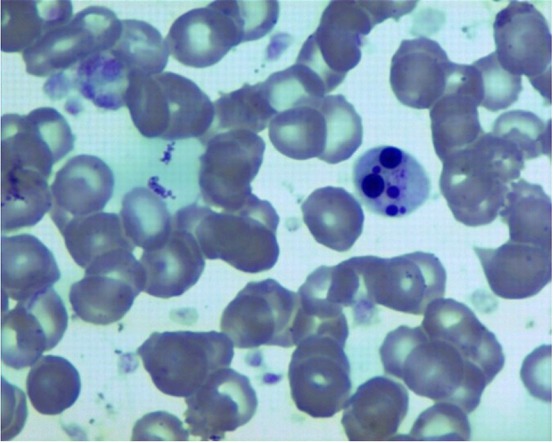
Fig. 1

Representative cytological image of a bone marrow smear stained using the May–Grunwald–Giemsa method showing condensation and fragmentation of the nucleus of a neutrophil in the HD group. Magnification 1,000×
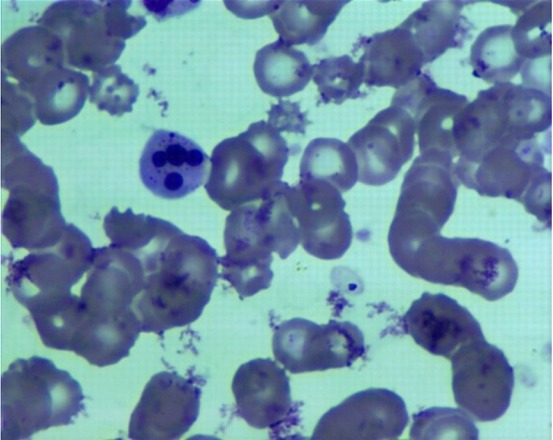
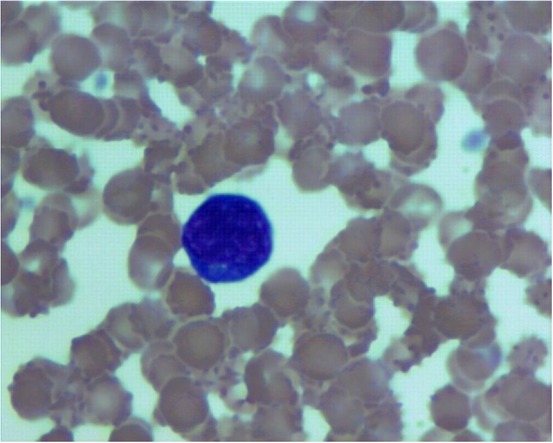
Fig. 2

Representative cytological image of a bone marrow smear stained using the May–Grunwald–Giemsa method showing condensation and fragmentation of the nucleus of a neutrophil in the HD group. Magnification 1,000×
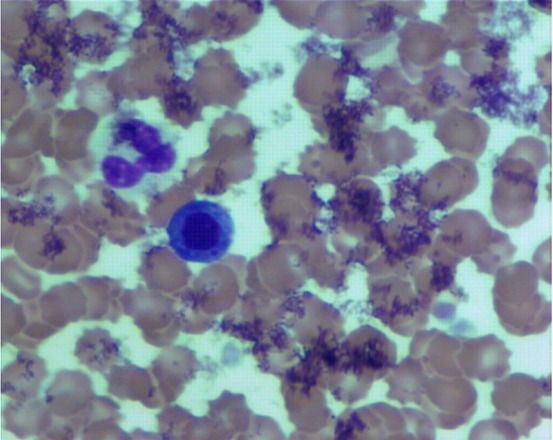
Fig. 3

Representative cytological image of a bone marrow smear stained using the May–Grunwald–Giemsa method showing a basophilic myelocyte in the C group. Magnification 1,000×

Table 2

The average number of cells from the granulocytic cell line per 1,000 porcine bone marrow cells (mean ±SD) on the 28th day of the experiment

Cell typeControl groupLow dose groupHigh dose group
Myeloblasts2.680 ± 0.576a, b1.160 ± 0.512a1.080 ± 0.104b
Promyelocytes2.100 ± 0.68a, b1.460 ± 0.728a1.320 ± 0.504b
Myelocyte3.540 ± 0.088a2.180 ± 0.896a, c3.300 ± 1.600c
Metamyelocyte6.540 ± 1.208a, b3.840 ± 1.568a, c3.120 ± 1.824b, c
Band neutrophils15.940 ± 2.872a, b8.620 ± 1.304a, c6.520 ± 1.944b, c
Neutrophilic granulocytes12.460 ± 2.192b10.920 ± 1.104c18.680 ± 9.016b, c
Eosinophilic myelocytes1.740 ± 0.4561.180 ± 0.7760.820 ± 0.384
Eosinophilic metamyelocytes2.220 ± 0.4642.320 ± 1.4640.840 ± 0.568
Band eosinophils2.960 ± 1.952b3.300 ± 2.200c1.420 ± 1.112b, c
Eosinophilic granulocytes2.000 ± 1.480a2.460 ± 1.632a, c2.120 ± 1.096a, c
Basophilic myelocytes0.020 ± 0.0320.0000.000
Basophilic metamyelocytes0.080 ± 0.0640.0000.040 ± 0.048
Band basophiles0.260 ± 0.192a, b0.060 ± 0.072a, c1.420 ± 1.112b, c
Basophilic granulocytes0.320 ± 0.184 a, b0.040 ± 0.064a, c0.080 ± 0.064b, c
Hypersegmented granulocytes0.000b0.000c0.500 ± 0.640b, c
Total granulocytes52.860 ± 2.528a, b37.520 ± 8.784a44.680 ± 3.144b

a statistically significant difference between control and low dose group (P ≤ 0.05)

b statistically significant difference between control and high dose group (P ≤ 0.05)

a statistically significant difference between control and low dose group (P ≤ 0.05)

b statistically significant difference between control and high dose group (P ≤ 0.05)

a statistically significant difference between control and low dose group (P ≤ 0.05)

b statistically significant difference between control and high dose group (P ≤ 0.05)

a statistically significant difference between control and low dose group (P ≤ 0.05)

b statistically significant difference between control and high dose group (P ≤ 0.05)

a statistically significant difference between control and low dose group (P ≤ 0.05)

a statistically significant difference between control and low dose group (P ≤ 0.05)

c statistically significant difference between low dose and high dose group (P ≤ 0.05)

c statistically significant difference between low dose and high dose group (P ≤ 0.05)

a statistically significant difference between control and low dose group (P ≤ 0.05)

b statistically significant difference between control and high dose group (P ≤ 0.05)

a statistically significant difference between control and low dose group (P ≤ 0.05)

c statistically significant difference between low dose and high dose group (P ≤ 0.05)

b statistically significant difference between control and high dose group (P ≤ 0.05)

c statistically significant difference between low dose and high dose group (P ≤ 0.05)

a statistically significant difference between control and low dose group (P ≤ 0.05)

b statistically significant difference between control and high dose group (P ≤ 0.05)

a statistically significant difference between control and low dose group (P ≤ 0.05)

c statistically significant difference between low dose and high dose group (P ≤ 0.05)

b statistically significant difference between control and high dose group (P ≤ 0.05)

c statistically significant difference between low dose and high dose group (P ≤ 0.05)

b statistically significant difference between control and high dose group (P ≤ 0.05)

c statistically significant difference between low dose and high dose group (P ≤ 0.05)

b statistically significant difference between control and high dose group (P ≤ 0.05)

c statistically significant difference between low dose and high dose group (P ≤ 0.05)

b statistically significant difference between control and high dose group (P ≤ 0.05)

c statistically significant difference between low dose and high dose group (P ≤ 0.05)

b statistically significant difference between control and high dose group (P ≤ 0.05)

c statistically significant difference between low dose and high dose group (P ≤ 0.05)

a statistically significant difference between control and low dose group (P ≤ 0.05)

a statistically significant difference between control and low dose group (P ≤ 0.05)

c statistically significant difference between low dose and high dose group (P ≤ 0.05)

a statistically significant difference between control and low dose group (P ≤ 0.05)

c statistically significant difference between low dose and high dose group (P ≤ 0.05)

a statistically significant difference between control and low dose group (P ≤ 0.05)

b statistically significant difference between control and high dose group (P ≤ 0.05)

a statistically significant difference between control and low dose group (P ≤ 0.05)

c statistically significant difference between low dose and high dose group (P ≤ 0.05)

b statistically significant difference between control and high dose group (P ≤ 0.05)

c statistically significant difference between low dose and high dose group (P ≤ 0.05)

a statistically significant difference between control and low dose group (P ≤ 0.05)

b statistically significant difference between control and high dose group (P ≤ 0.05)

a statistically significant difference between control and low dose group (P ≤ 0.05)

c statistically significant difference between low dose and high dose group (P ≤ 0.05)

b statistically significant difference between control and high dose group (P ≤ 0.05)

c statistically significant difference between low dose and high dose group (P ≤ 0.05)

b statistically significant difference between control and high dose group (P ≤ 0.05)

c statistically significant difference between low dose and high dose group (P ≤ 0.05)

b statistically significant difference between control and high dose group (P ≤ 0.05)

c statistically significant difference between low dose and high dose group (P ≤ 0.05)

a statistically significant difference between control and low dose group (P ≤ 0.05)

b statistically significant difference between control and high dose group (P ≤ 0.05)

a statistically significant difference between control and low dose group (P ≤ 0.05)

b statistically significant difference between control and high dose group (P ≤ 0.05)

Fig. 4

Representative cytological image of a bone marrow smear stained using the May–Grunwald–Giemsa method showing a myeloblast in the LD group. Magnification 1,000×

DOI: https://doi.org/10.2478/jvetres-2021-0040 | Journal eISSN: 2450-8608 (formerly 2300-3235)
Language: English
Page range: 323 - 327
Submitted on: Feb 1, 2021
Accepted on: Jun 30, 2021
Published on: Jul 22, 2021
Published by: National Veterinary Research Institute in Pulawy
In partnership with: Paradigm Publishing Services

© 2021 Dominika Grzybowska, Anna Snarska, published by National Veterinary Research Institute in Pulawy
This work is licensed under the Creative Commons Attribution-NonCommercial-NoDerivatives 3.0 License.