
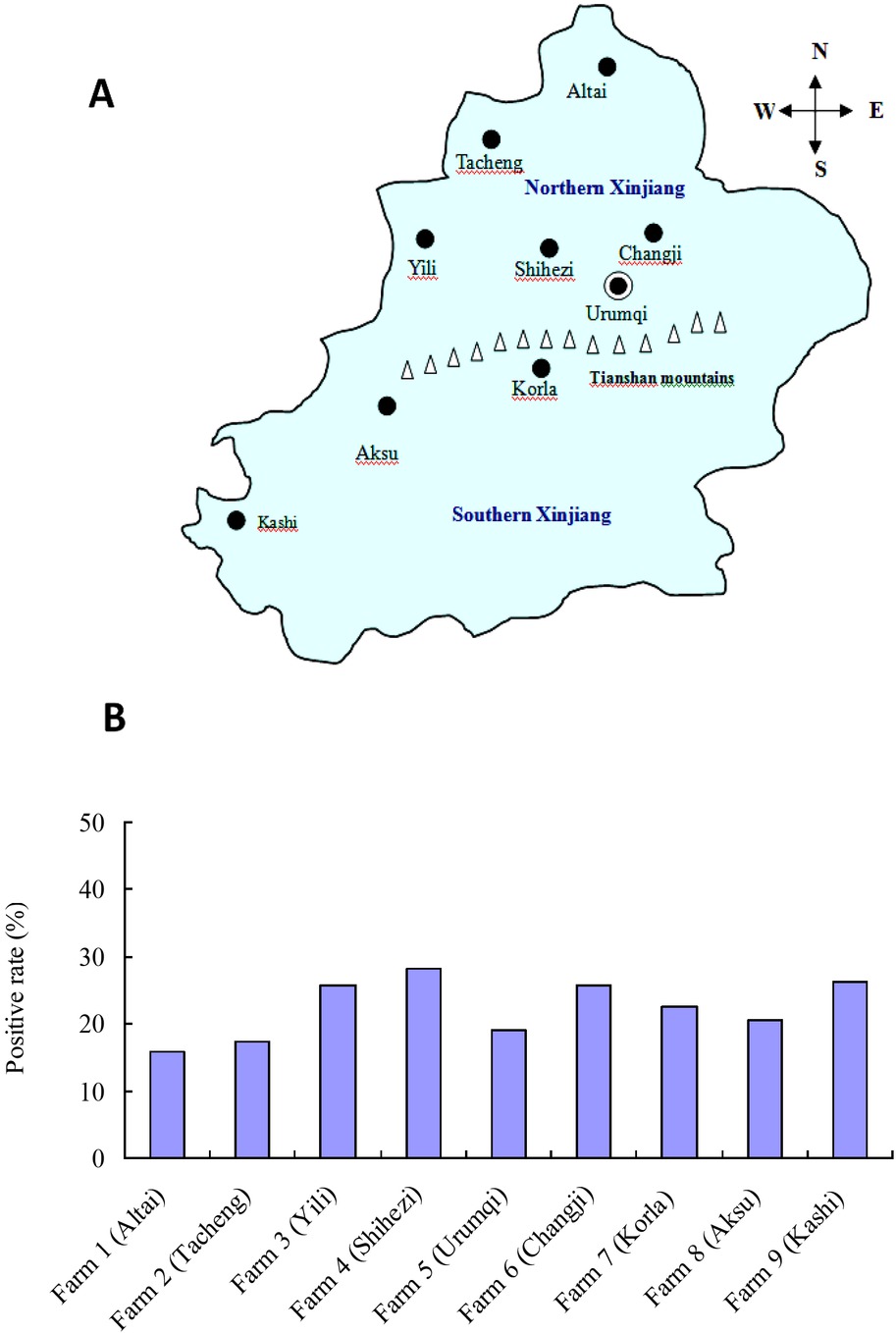
Fig. 1
A – geographic distribution of sampled farms, B – positive rates of PCV3 infection in different commercial pig farms in Xinjiang province, China
Note: Positive rate was determined based on PCR analysis of clinical samples.
Table 1
GenBank accession numbers of PCV3 strains
| Strain | Accession number |
|---|---|
| 2164 | KX458235 |
| PCV3-US/MN2016 | KX898030 |
| PCV3-US/SD2016 | KX966193 |
| PCV3/CN/Fujian-5/2016 | KY075986 |
| PCV3/CN/Henan-13/2016 | KY075988 |
| PCV3/CN/Jiangxi-62/2016 | KY075989 |
| PCV3/CN/Chongqing-150/2016 | KY075992 |
| CN/Hubei-618/2016 | KY354039 |
| CCV-A | KY363870 |
| CCV-B | KY363871 |
| CCV-C | KY363872 |
| PCV3-China/GD2016 | KY418606 |
| PCV3/KU-1601 | KY996337 |
| PCV3/KU-1604 | KY996340 |
| PCV3/KU-1606 | KY996342 |
| PCV3/KU-1608 | KY996344 |
| PCV3/KU-1609 | KY996345 |
| P1705SCYC/2017 | MF063070 |
| 16R927/2016 | MF063071 |
| PCV3-BR/RS/6 | MF079253 |
| PCV3/CN/Jiangxi-B1/2017 | MF589107 |
| PCV3/CN/Jiangxi-S1/2017 | MF589133 |
| PCV3/CN/Guangdong-CH/2016 | MF589112 |
| PCV3/CN/Guangdong-X1/2016 | MF589118 |
| 309 | MF589652 |
| JX-1/CH/2017 | MF677838 |
| 1621_Italy_2017 | MF805719 |
| 4332-5_Denmark_2017 | MF805723 |
| 4332-7_Denmark_2017 | MF805724 |
| DE2.8 | MG014377 |
| DE19.15 | MG014367 |
| DE27.16 | MG014370 |
| PCV3/HU/Szerencs/2017 | MG595741 |
| PCV3-RU/TY17 | MG679916 |
| PCV3-JSXY-201701 | MG868940 |
| PCV3-HBWH-201703 | MG868941 |
| PCV3-SH-201705 | MG868945 |
| SD | MG947596 |
| PCV3-CN2018HLG-5 | MH277111 |
| PCV3-CN2018JL-1 | MH277112 |
| PCV3-CN2018LN-3 | MH277117 |
| COL/Cundinamarca2/2018 | MH327785 |
| CN/Xinjiang-AK16/2018 | MK562412 |
| CN/Xinjiang-AL5/2018 | MK562413 |
| CN/Xinjiang-CH29/2018 | MK562414 |
| CN/Xinjiang-KA2/2018 | MK562415 |
| CN/Xinjiang-KO17/2018 | MK562416 |
| CN/Xinjiang-SH6/2018 | MK562417 |
| CN/Xinjiang-TA36/2018 | MK562418 |
| CN/Xinjiang-UR22/2018 | MK562419 |
| CN/Xinjiang-YI7/2018 | MK562420 |
| 29160 | NC031753 |
Table 2
List of primer sequences used in this study
| Primer name | Nucleotide sequence | Position in reference | Product size |
|---|---|---|---|
| (5′→ 3′) | sequence | (bp) | |
| FP1 | CCGTAGAAGTCTGTCATTCCAG | 1383–1404 | |
| RP1 | AAGCCCTGGCACGCCAACCAC | 1796–1816 | 434 |
| FP2 | TTAGAGAACGGACTTGTAACGA | 1343–1364 | |
| RP2 | ATGAGACACAGAGCTATATTCAG | 1965–1987 | 645 |
Table 3
Detection of PCV3 infection in different samples from commercial pig farms in Xinjiang province, China
| Clinical samples | Number of samples | Number of positive samples | Positive rate (%) of PCV3 |
|---|---|---|---|
| Lymph nodes | 79 | 29 | 36.71 (29/79) a |
| Spleen | 93 | 22 | 23.66 (22/93) a |
| Lung | 62 | 9 | 14.52 (9/62) b |
| Pleural effusion | 57 | 13 | 22.81 (13/57) a |
| Serum | 102 | 15 | 14.71 (15/102) b |
| Total | 393 | 88 | 22.39 (88/393) |
[i] Note: Different superscript letters (a, b) in one column means significant difference (P < 0.05)
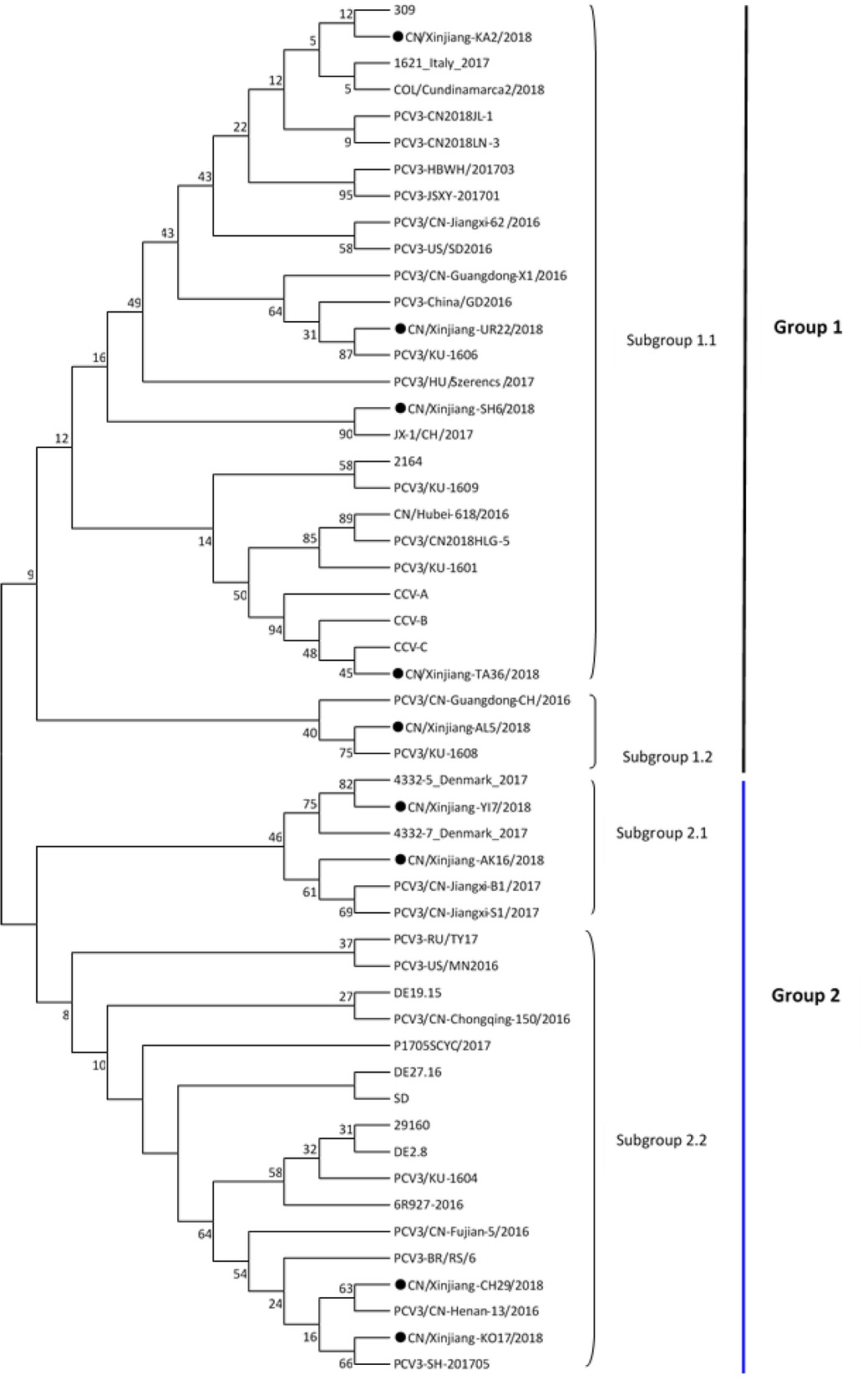
Fig. 2
Phylogenetic analysis of PCV3 strains based on the full-length cap gene using the neighbour-joining method
Note: The nucleotide sequences of cap gene of PCV3 strains obtained in this study and available in GenBank were used to construct a phylogenetic tree by the neighbour-joining method. Bootstrap values were calculated with 1,000 replicates. Vertical lines are used to indicate groups (or subgroups) which were referred to in the text. Filled circles indicate the PCV3 strains identified in this study
Table 4
Genetic diversity of PCV3 strains circulating in commercial pig farms in Xinjiang province, China
| PCV3 strains | Group | Subgroup |
|---|---|---|
| CN/Xinjiang-SH6/2018 | 1 | 1.1 |
| CN/Xinjiang-TA36/2018 | 1 | 1.1 |
| CN/Xinjiang-AL5/2018 | 1 | 1.2 |
| CN/Xinjiang-UR22/2018 | 1 | 1.1 |
| CN/Xinjiang-YI7/2018 | 2 | 2.1 |
| CN/Xinjiang-CH29/2018 | 2 | 2.2 |
| CN/Xinjiang-AK16/2018 | 2 | 2.1 |
| CN/Xinjiang-KO17/2018 | 2 | 2.2 |
| CN/Xinjiang-KA2/2018 | 1 | 1.1 |