
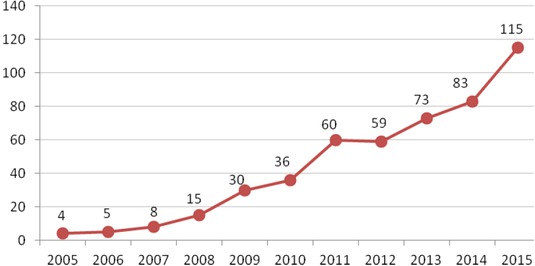
Fig. 1
Number of cases of Lyme borreliosis in Ternopol region (Western Ukraine), in 2005–2015. y axis – number of cases; x axis – years. (http://realno.te.ua/novyny/на-тернопільщині-лютує-страшна- недуг/)
Table 1
Number of the tested ticks and the place of collection
| Area (Western Ukraine) | Number of Ixodes ricinus ticks | ||||
|---|---|---|---|---|---|
| Female | Male | Nymph | Total | ||
| Ternopil Oblast | Konuchy | 17 | 9 | 0 | 26 |
| Biłokrynycia | 19 | 6 | 0 | 25 | |
| Skala-Podilska | 4 | 21 | 4 | 29 | |
| Papirnya | 15 | 10 | 0 | 25 | |
| Monastyryska | 15 | 10 | 6 | 31 | |
| Total | 70 | 56 | 10 | 136 | |
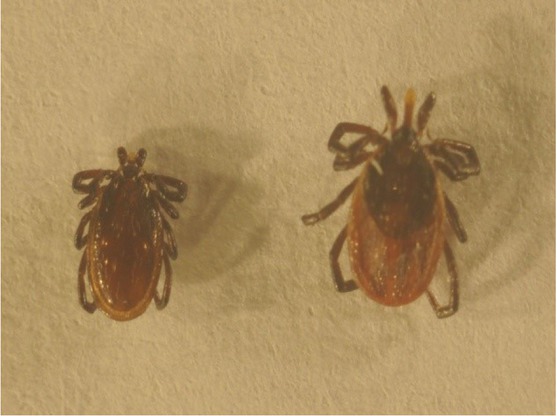
Fig. 2
Ixodes ricinus: male on the left, female on the right
Table 2
Number and percentage of ticks infected with Borrelia burgdorferi s. l.
| Gender and form | Number of ticks | Number and % of infected ticks |
|---|---|---|
| Nymph | 10 | 1 (10%) |
| Male | 56 | 2 (3.6%) |
| Female | 70 | 3 (4.3%) |
| Total | 136 | 6 (4.4%) |
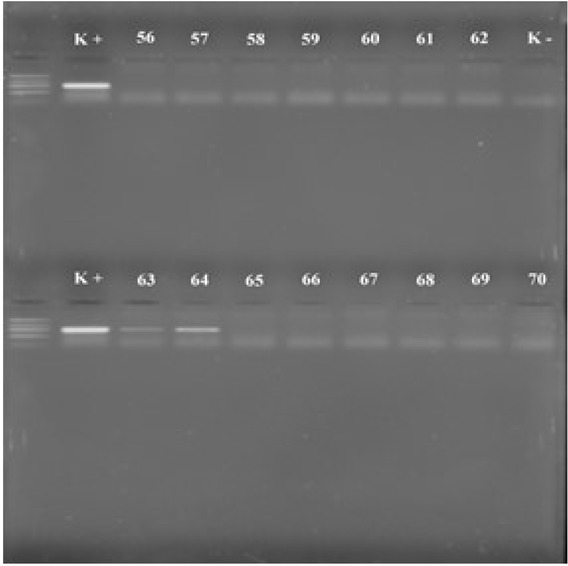
Fig. 3
Electrophoresis gel (K+ positive control, K− negative control, 56–70 test samples, 63–64 positive samples)
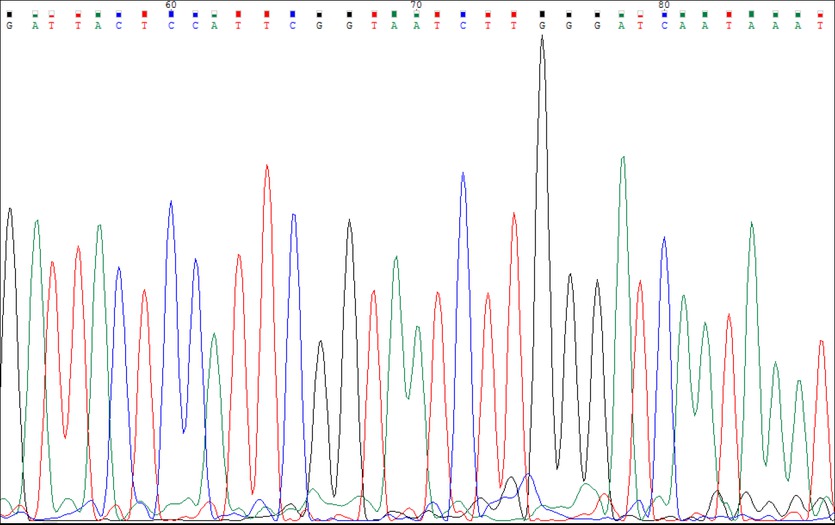
Fig. 4
Fragment of the fluorogram in Borrelia afzelii DNA sequencing