
Background and Introduction
With increased demand for energy efficiency and sustainability, there has been a development of the smart grid, which is a new approach to infrastructure that combines communication technologies with power-distributing structures. Smart grids use sensor systems and information technology for enhancing energy network management, decreasing loss and absorbing renewable power sources (Shahat and Elragal, 2021). A data-driven decision-making use case. These advancements are the application of management information systems for realtime decision-making and organizational performance. MIS systems capture, transform and disseminate massive volumes of data produced by smart grids, which are used as the basis for decision-making by energy providers (Akhavan-Hejazi and Mohsenian-Rad, 2018). An assessment of paradigm shift barriers and prospects. Smart grids have a number of problems that include distribution losses, demand and supply volatility, and fluctuations in renewable energy production. MIS stakeholders minimize these challenges and establish flexible energy networks. Research done has established that the integration of MIS tools blended with the assistance of machine learning algorithms and predictive analytics increases the reliability and sustainability of the energy systems (Lévy, 2024). There are certain limitations to the frameworks that are still impelling the large-scale adoption of those paradigms, including the high cost of implementation and problems of data security. These challenges therefore need to be addressed to enable optimal capitalization on MIS for smart grid purposes (Quiroga-Parra et al., 2021). The current energy supply networks are being gradually transformed by smart grids, which are new systems based on digital technologies to manage power networks and enhance reliability. Management Information Systems have a central function in this change as they provide a basis for decision-making (Ning, 2021). A smart grid is a system for a power grid that appears to enhance utilization of existing resources in power generation in a way that greatly discourages energy loss. MIS provides a competitive edge in energy management because it enables monitoring, prognostics, and optimal resource distribution (Ketter, 2018). MIS demand forecasting is provided, which does not leave the threat of possible mismatches between supply and demand and stabilization of the grid (Li et al., 2021). MIS facilitates the fine compatibility of renewable power supplies, which are vital in the transformation to a sustainable power system. This paper explores the role of using management information systems in the enhancement of energy distribution in smart grids (Zhao et al., 2020).
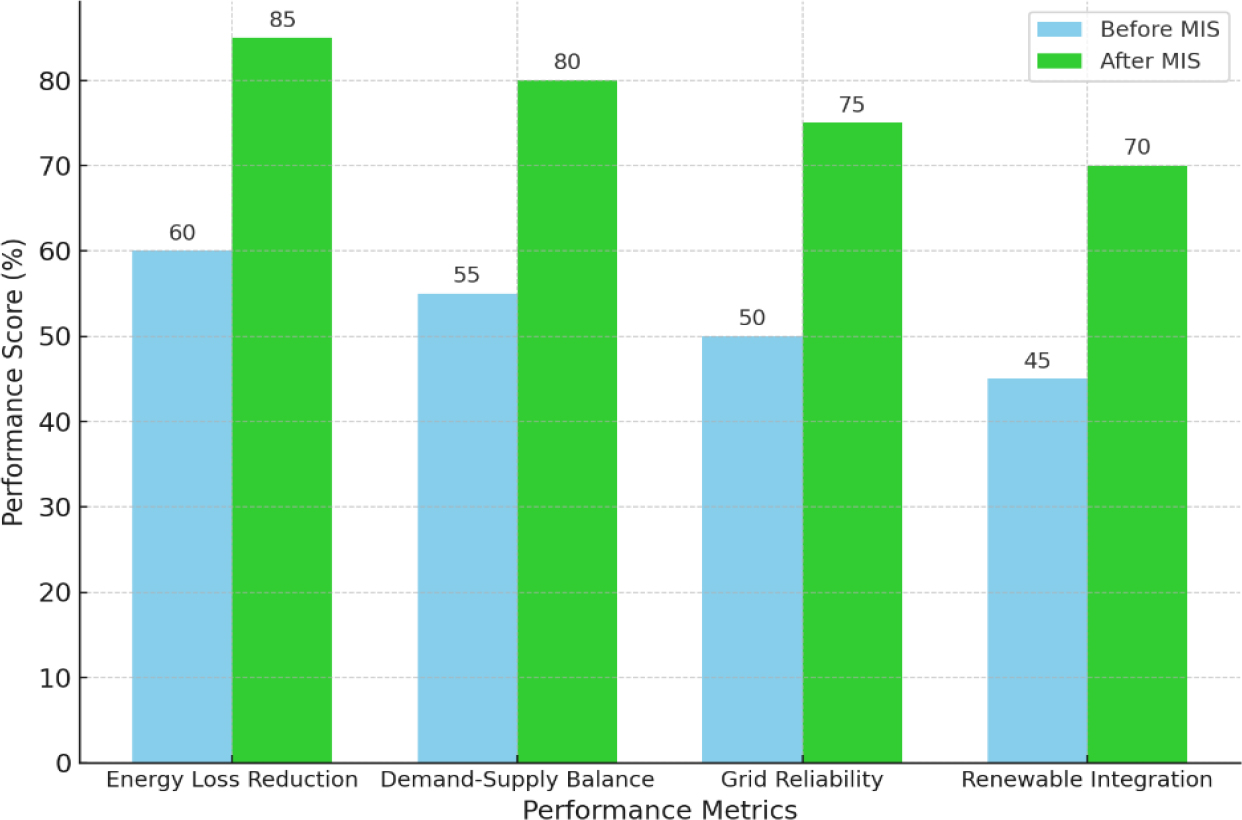
Figure 1.
Impact of MIS on smart Grid Performance.
Literature Review
The Evolution of Smart Grids
Smart grids are now an important part of the development of the new energy systems and are widely seen as a solution to many of the problems of the conventional grids that are based on information and communication technologies. According to (Kang and Green,2023). Smart grid is a developing technology that adds more reliability, effectiveness, and sustainability to the energy distribution network. This way, using aspects of two-way communication and data analysis, smart grids facilitate an actual regulation of energy flows, thus enhancing the overall performance of the grid (Avancini et al., 2019).
Role of Management Information Systems in Energy Distribution
MIS is very central in the organization of electricity within smart grids. They handle huge amounts of data from sensors, meters, and other components of the grid for purposes of decision-making. The studies of (Naser and Shobaki, 2016) facilitated that MIS improves the performance of smart grids in aspects such as predictive and preventive maintenance, demand planning, and fault diagnosis. MIS frameworks applied machine learning and artificial intelligence for performing energy flow optimization and minimizing losses (Al Shobaki and Naser, 2016).
MIS and Demand-Supply Optimization
The most critical application of MIS in smart grids is in demand and supply management (Wang et al. 2023) stress that such insights provide pivotal information on conditions in real-time that is useful in the elimination of energy mismatches, which are the primary causes of energy wastage). MIS facilitates analysis of consumption patterns and future demands for energy, hence reducing instances of inadequate supply of energy (Dandl et al., 2021).
Integration of Renewable Energy Sources
Smart grid design cannot leave out the integration of renewable energy as a key practice in sustainable development. MIS helps address such issues as fluctuation in renewables’ production through issues such as storage costs. Referring to prior work done by (Husin and Zaki, 2021). contends that MIS systems present means of incorporating RE while maintaining the stability of the grid. For example, existing complex analytics forecast changes in wind and solar power availability and adjust energy supply correspondingly (Weitemeyer et al., 2015).
Role of MIS in Energy Distribution
The concept of management information systems is innovative in improving energy distribution, especially in the case of smart grids. It is noteworthy that these systems facilitate the effective centralized and decentralized management of energy resources and coping with vital issues, including energy losses, imbalances in demand and supply, as well as effective integration of renewable energy sources (Pakma et al., 2011). MIS supports SCADA for automated data acquisition as well as monitoring using sensors, smart meters, and many more grid components. With such data, there is a possibility to monitor the performance of the grid and notice any defects, which are useful for decision-making (Green et al., 1974). Pointed out that through MIS, the enhanced real-time analytics enhance the reliability of the grid by offering measurement and understanding of the energy flow and state of the systems. Another important task of MIS is the adequate management of energy flow within the grid. By integrating complex computations, MIS systems are capable of studying various consumption behaviors, estimating maximal requirements, and optimizing energy distribution in real time, thus reducing inefficiency and increasing effectiveness (Altındal et al., 2003). There are the energy MIS tools in which energy demand and supply are balanced based on analysis using predictive models. Depending on the dynamic load balancing considered critical for grid stability and to avoid blackouts during periods of high consumption, historical consumption data and other variables such as weather conditions are assessed (Jadhav and Patne, 2017). MIS has a significant function in the implementation of renewable energy in the grid system. Renewable energy is intermittent and presents some problems; nevertheless, regarding the MIS frameworks, these latter contain forecasting models that allow the anticipation of renewable energy’s generation and the consequent planning of the grid (Shahbaz et al., 2020). It detects lagging grid sections and proposes timely maintenance schedules to minimize downtimes and enhance productivity (Loock and Thiesse, 2013). MIS has the potential of reducing costs and developing sustainability through efficient allocation of resources, minimization of energy losses, and overall lower emission of carbon dioxide. According to (Karadeniz and Serin, 2005). MIS is very important in serving the targets of sustainable electricity as it supports proper incorporation of renewable resources in addition to managing the reliability of the power grid. MIS frameworks integrate security features to shield the grid information from violation and isolate faults instantly for maintaining the continuity of energy delivery. the involvement of MIS in energy distribution becomes necessary in the current world to transform distribution networks, in order to address the increasing demand and need for effective, reliable and sustainable power. MIS builds the energy gird as smart networks for adapting today and tomorrow challenges through using the modern technologies and using the IT-based strategies (Walker and Day, 2012).
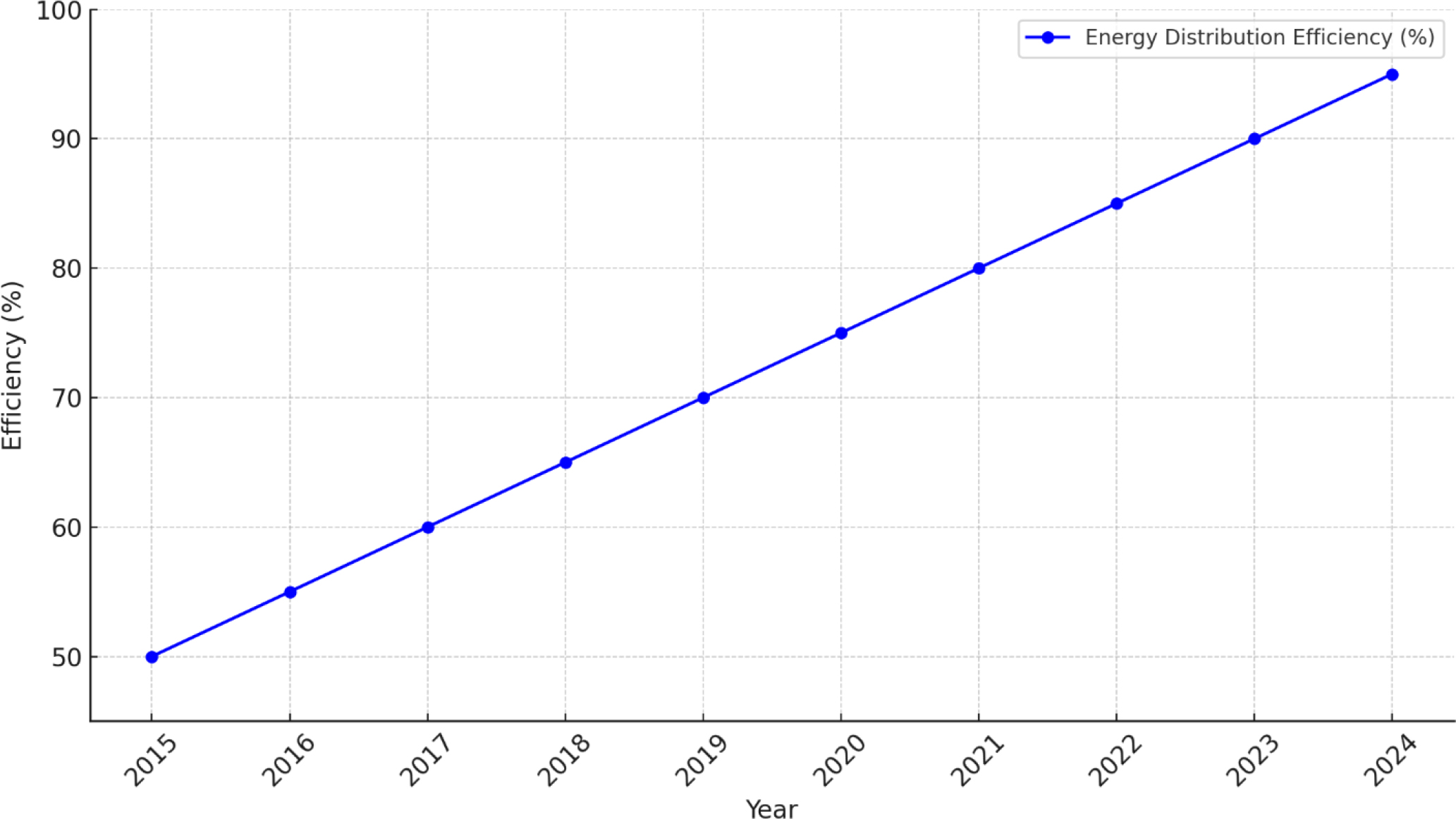
Figure 2.
Trends in Energy Distribution Efficiency with MIS(2015-2024).
Objectives of the Study
Investigate how Management Information Systems (MIS) facilitate the efficient allocation and distribution of energy in smart grids.
Examine the contribution of MIS in real-time monitoring, predictive analytics, and optimization of energy demand-supply balances.
Explore the potential of MIS to integrate renewable energy sources seamlessly into the grid while addressing variability challenges.
Evaluate the technical, financial, and security barriers associated with implementing MIS in smart grids.
Quantify improvements in grid efficiency, reliability, and sustainability resulting from MIS-based decision-making frameworks.
Develop insights and strategies for stakeholders, including energy providers, regulators, and technologists, to enhance MIS adoption in smart grids.
Methodology
Research Design
Mixed-methods research is utilized in this study to analyze the way and extent to which MIS facilitate energy distribution in smart grids. The quantitative analysis involves data on the grid performance metrics, exploring pattern recognition, optimization of energy distribution, and minimizing loss using methods such as statistical analysis and machine learning. The case study and the expert interviews give a more qualitative analysis of MIS with emphasis on practical challenges prevailing and lessons learned on smart grid. This blended method provides a clear picture on the otherwise complex ways through which MIS supports efficiency and sustainability of power supply.
Data Collection
Secondary data for this study is collected from empirical and peer-reviewed journals, industry reports, and international case studies. From these sources, management information systems (MIS) implementation and its global performance in enhancing the distribution of energy through smart grids are well explained. It assists in putting into perspective important primary data and justifies the MIS in improving efficiency and sustainability of the grid.
Analytical Techniques
The significance of MIS in smart grids in managing energy distribution is used in the study. Statistical analysis is typically applied in an attempt to uncover the anomalies and trends concerning the grid and energy distribution. For the demand for prediction and fault identification, machine learning techniques are used, giving the dictates of the energy requirement and even the possible faults of the power grid. Thematic synthesis is performed with the interview data and case studies to identify specific themes regarding the operationalization of MIS and the associated issues in smart grid management. These techniques afford an examination of both quantitative and qualitative data and an improved understanding of MIS’s influence on the efficiency of energy distribution.
Table 1.
The evolution of MIS in real-time decision-making and its key developments leading up to 2024
| Year | Development | Impact on Real-Time Decision-Making |
|---|---|---|
| 2010 | Emergence of Cloud-Based MIS | Enabled remote access to data, reducing decision delays and improving collaboration across distributed teams. |
| 2012 | Integration of Mobile Technologies | Empowered decision-makers to access MIS data and reports on the go, facilitating timely responses to dynamic situations. |
| 2015 | Big Data Analytics in MIS | Allowed organizations to process vast datasets, gaining deeper insights and predictive capabilities for strategic decisions. |
| 2017 | Adoption of IoT for Real-Time Data | Provided real-time monitoring in industries like logistics, manufacturing, and healthcare through connected devices. |
| 2019 | Artificial Intelligence in MIS | Enhanced decision-making with predictive analytics, automation, and prescriptive recommendations based on data trends. |
| 2020 | Rise of Remote Work and Collaboration Tools | Accelerated the adoption of MIS integrated with tools like Slack, Zoom, and Teams for real-time coordination and reporting. |
| 2021 | Advanced Cybersecurity Measures in MIS | Strengthened real-time data protection, ensuring secure and uninterrupted decision-making processes. |
| 2022 | Machine Learning Models in MIS | Improved adaptive decision-making, with systems learning from historical data to refine outcomes in real-time scenarios. |
| 2023 | Increased Focus on Sustainable MIS Solutions | Incorporated environmental metrics in real-time dashboards to support decisions aligned with sustainability goals. |
| 2024 | AI-Driven Real-Time Decision Systems | Achieved seamless integration of AI with MIS, offering autonomous decision-making capabilities in dynamic business environments. |
Findings and Discussion
MIS and Real-Time Decision-Making
Information technology is central to the implementation of robust management information systems that make it easy for organizations to collect timely data, analyze it, and help in decision-making by automating other processes. The use of dashboards, predictive models, and IoT devices to present MIS-based information for the timely support of vital operations across various industries, including finance and healthcare, as well as the supply chain. For instance, in logistics, sensor data gained in real-time improve supply chains and track inventory, while in healthcare it permits to promptly coordinate management of patients. Nevertheless, some limitations, such as the data overload problem, cybersecurity issues, and high implementation costs, should be solved for real-time decision-making to be fully effective. MIS remains at the forefront of adaptive solutions in today’s rapidly evolving business environment due to the emergence of artificial intelligence, cloud computing, and predictive analytics.
Predictive Analytics in Demand Forecasting
Forecasting in predictive analytics uses past data, statistical models, and real-time data in order to estimate the future demand of a certain product or service, which guide the business on the right inventory to order or the resources to employ in production. Using linear regression techniques, feedforward neural networks, and decomposition of time series, companies are able to pinpoint patterns and, moreover, fluctuations in seasons or a certain market. Cognition techniques make results more accurate and less expensive since they prevent overstocking or running out of stock of certain commodities, which will not be pleasing to the customers. Nevertheless, there are still some operational issues, such as data quality, instability in the market environment, and high costs of integrating the tools. Predictive analytics is being used in different sectors like retail, manufacturing, health care, and logistics to enhance operations and decision-making in existing models.
Renewable Energy Integration
Renewable Energy Integration refers to the process of integrating energy systems through renewable sources of power; these include the sun, wind, water, and heat energy. All these works to improve energy security, mitigate greenhouse gas emissions, and align the world towards a low-carbon economy. Effective management of variable REN supply depends on strategies such as smart grid integration, energy storage like batteries, and advanced methods of supply forecasting. It involves changes in upgrade, development of political policies, enactment of legal frameworks, and cooperation between the governmental and non-governmental sectors at large and the communities at large. Through increased integration of renewable energy sources, a nation fosters and unlock substantive economic growth, energy security, and environmental stewardship for a stability that is structurally sound in form and content.
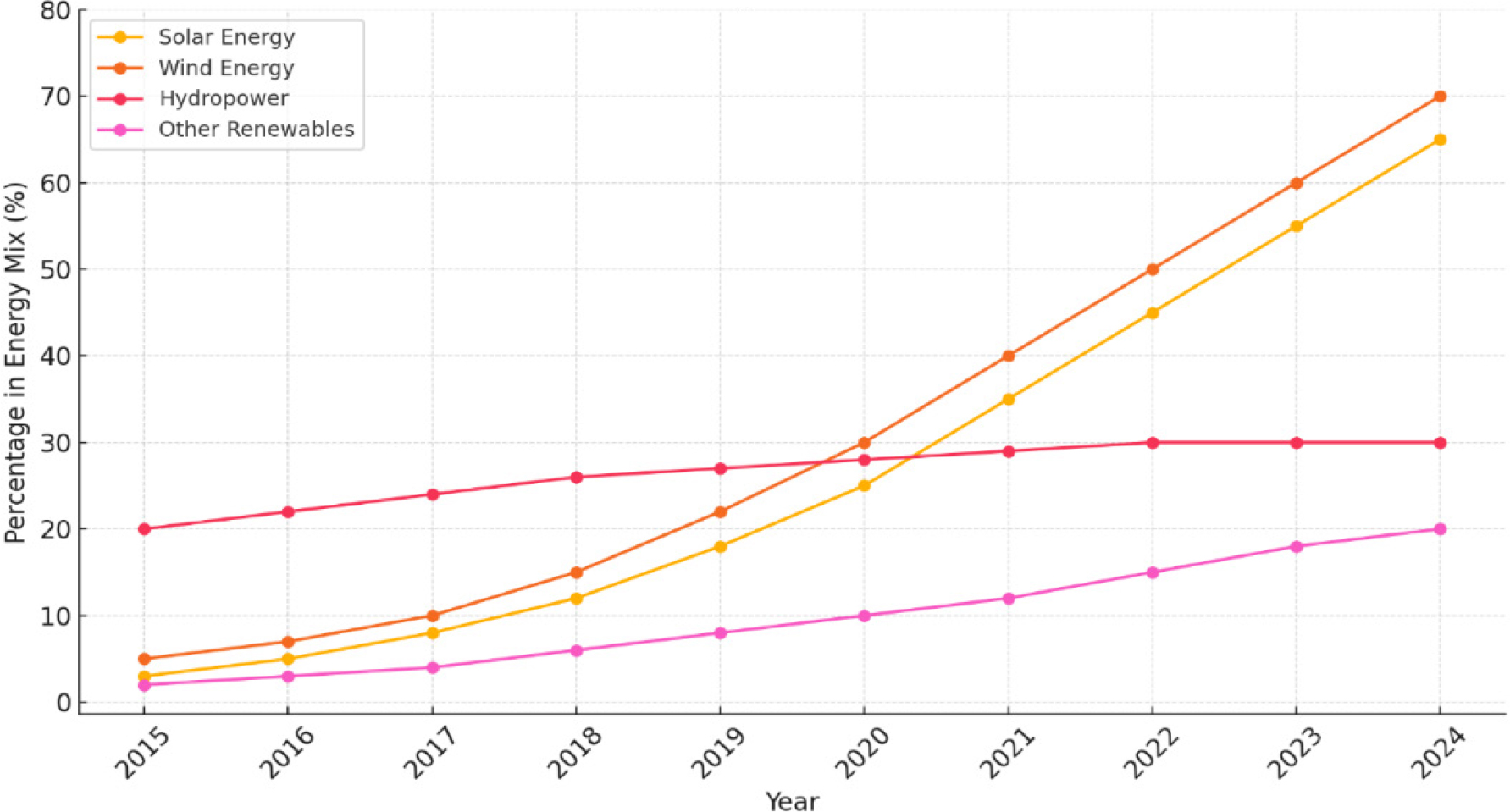
Figure 3.
Renewable Energy Integration over time (2015-2024).
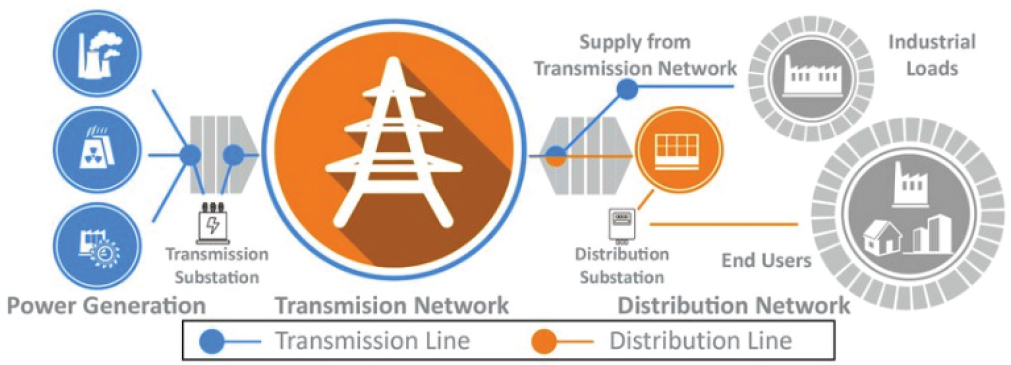
Figure 4.
Integrated transmission and distribution (T&D) model
Energy Transmission & Distribution
Transmission and distribution networks enable the dissemination of electricity from the generation plants to the consumers: transmission, which is long distance, through a high-voltage transmission line, and distribution, a short distance, through a low-voltage distribution line. These systems depend on substations, transformers and grids in order to support the systems’ reliability and efficiency. Realms including energy losses, infrastructure degradation, and incorporation of distributed generations or renewable energy call for upgrades through innovative solutions through products like HVDC, smart grids and energy storage systems. Modern trends to decentralize T&D systems, digitize the power grid, and increase share of renewable energy sources, as well as the sustainable development goals, affect the systems.
Transmission and Distribution (T&D) Data Communication
T&D Data Communication means data exchange of the electric power systems that are used for real-time monitoring and control of the electrical energy distribution from the point of generation to the point of consumption. Proper flow of data in transmission and distribution systems is essential in contributing to reliability and operationally efficient systems for managing renewable power sources in today’s power grids. This includes the exchange of data between the substation, transformer, sensors, and control center with SCADA, IoT devices, and smart meters. The emergence of modern communication standards like IEC 61850 and other trends, including fiber optic, 5G, or satellite communication, enabled the T&D systems to monitor power systems in real-time and detect faults, as well as make decisions on their own. They improve the efficiency of the grid through gaining information about power and energy flow, voltage control, and load demand. Furthermore, a sound data communication architecture facilitates the connection of distributed energy, such as photovoltaic and battery storage, and enhances cybersecurity to counter threats. As modern energy demands continue to experience advancements, T&D systems are getting smarter, more efficient, and integrating advanced data communication technologies to adapt to the increasing challenges.
Data Acquisition and Management
Data acquisition and management in energy systems involves gathering, interpreting, archiving, and utilizing data from the elements involved in the energy network with the aim of enhancing the functionality, dependability, and adaptability of the main grid in energy systems. The data acquisition process involves the collection of real-time information from sensors, smart energy meters, transformers, and other devices of the transmission and distribution network. Such information includes voltage levels, power flow information, temperature, and system performance data. Proper management of this data helps to make it easily retrievable and safely stored to help utilities watch the performance of the grid, how it fails, and in the process of optimally delivering energy. SCADA, IoT, and cloud computing make data handling and integration much easier. Moreover, high data processing and machine learning functionalities convert large volumes of data into invaluable forms that help in decision-making concerning maintenance, demand, and renewable energy. By integrating effective data capture and utilization, energy systems meet changing needs, improve the robustness of the electricity network, and contribute to the development of the smart grid environment.
Grid Effectiveness Pillars
There are seven principles of energy grids that include reliability, efficiency, flexibility, resilience, sustainability, and digitalization. Reliability is about reducing power outages and providing people with power continuously, while efficiency is about reducing energy losses and getting the maximum result using the highest technologies, such as HVDC and energy storage. Flexibility allows for the modulation of grid requirements and the incorporation of reel-out sources by employing smart grid features and decentralized systems. Reliability encompasses the ability of grids to maintain or restore operations after an outage resulting from natural disasters, cybercrimes, etc., underpinned by proactive maintenance and secure systems. Sustainability focuses on minimizing carbon emissions through integration of renewable power sources together with green chemistry; on the other hand, digitalization employs the use of IoT AI and big data for monitoring and decision-making. These pillars enable the transition of the legacy grid system to a smart grid system more capable of responding to modern energy needs.
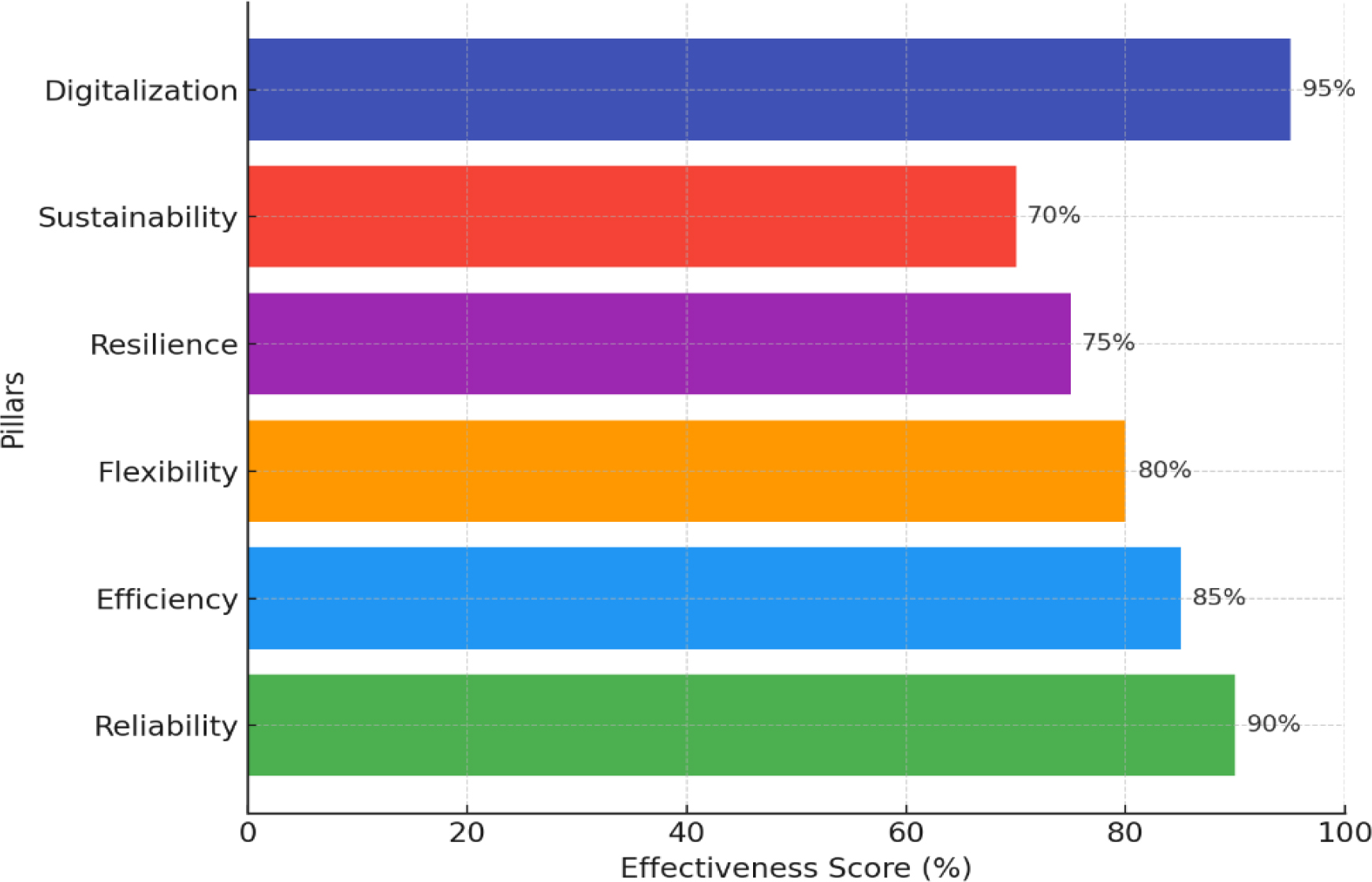
Figure 5.
Grid Effectiveness Pillar and Their Hypothetical Scores.
Technical Impact of Energy Theft
Energy theft therefore has severe technical consequences for power systems since it erodes efficiency, reliability and safety. It raises technical losses in transmission and distribution by overloading transformers as well as infrastructure and results in grid fluctuation due to uncontrolled power demand. This results in voltage swell, frequency shift and low operating efficiency on account of challenges in demand prediction and control of load. Equipment overload shortens the useful life of equipment and boosts maintenance costs; unauthorized connections compromise the safety standards; hence, there is a higher tendency of fire outbreaks and electrocution. Energy theft has an impact on integrating renewable power sources into the grid because it distorts load data that is essential for load balancing. In response to such problems, the utilities are using smart meters, data analytics, and machine learning to fight theft of electricity and stabilize the grid.
Table 2.
Energy Theft Detection Model
| Notation+ F6:G13 | Description |
|---|---|
| Pi | Power consumption recorded by the smart meter at consumer iii. |
| P pred, i | Predicted power consumption for consumer i based on historical patterns. |
| ΔPi | Difference between recorded and predicted power (ΔPi=Pi– Ppred, i) |
| Ti | Theft indicator for consumer i Ti=1T_i = 1 if theft is detected, 0 otherwise. |
| θ | Threshold value for acceptable deviations in consumption data. |
| V | Voltage levels monitored at various grid points. |
| I | Current levels monitored at various grid points. |
| Lloss | Total technical losses calculated for the grid. |
Energy Theft Strategies
It is important that energy theft strategies be effective in improving the capacity of a grid, cutting losses, and providing safe operation. They include the installation of smart metering systems with functionality for detecting if the meters have been tampered with and the usage of analysis for detecting irregularities in consumption rates. Energy audits and remote monitoring using the Internet of Things technology help to check the divergence from the established efficiency indicators. Tamper-proof technologies and predictive maintenance themselves detect risks and threats, whereas the activities aimed at energy theft prevention introduce the common public to potential risks and the eventual outcomes. Policy enforcement mechanisms have been reinforced, cooperation with law enforcement agencies has been enhanced, while smart grid technologies such as blockchain go further in preventing illicit energy usage and increase the level of information disclosure. Together, these initiatives allow utilities to protect assets, improve performance, and assure fiscal stability.
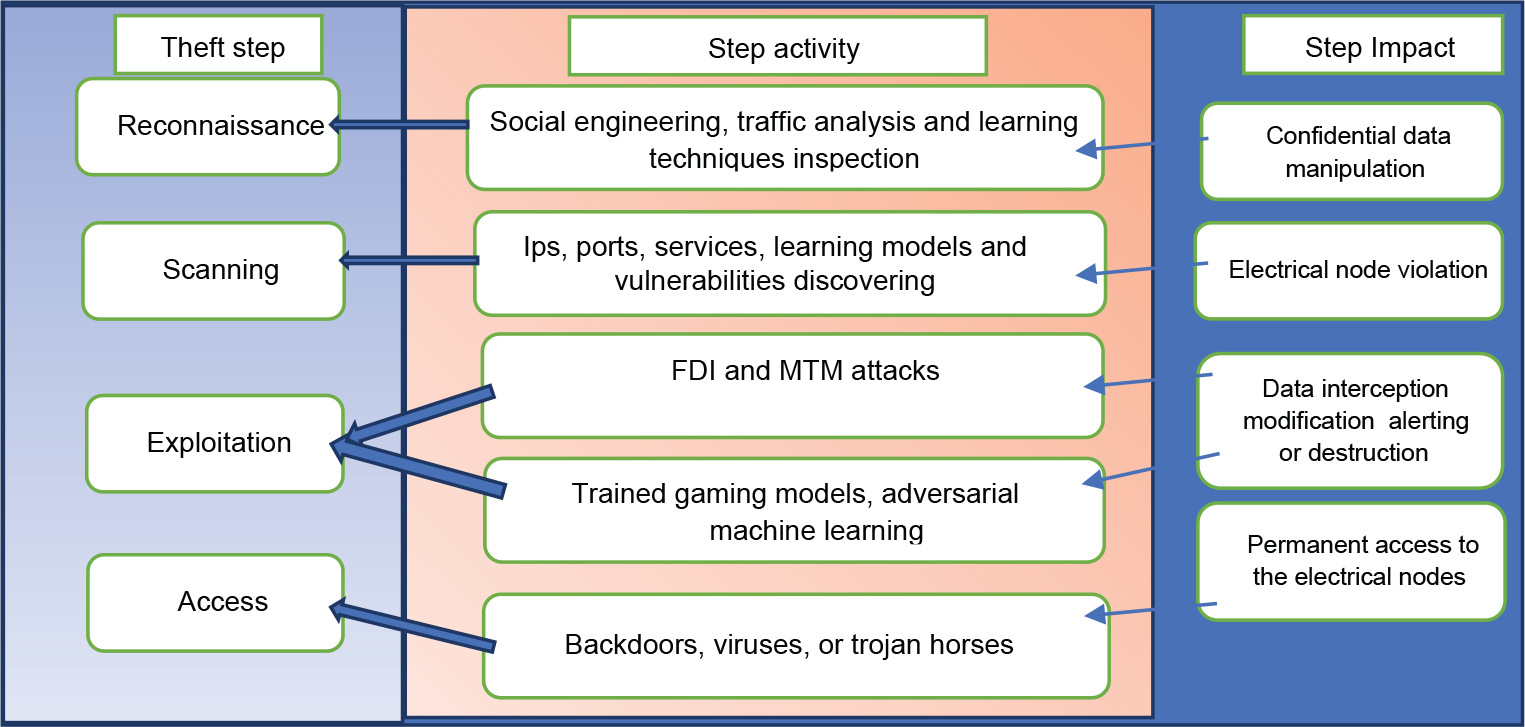
Figure 6.
Steps and associated activities in cyber-physical attacks enabling energy theft.
Data-Driven Detection Methods
Modern detection methods for energy theft rely on big data and follow different approaches like machine learning, predictive analysis, and real-time analysis. These methods process data collected from smart meters, grid sensors, or earlier consumption data to look for anomalies. Measures such as anomaly detection, time-series analysis, and predictive modeling work through contrast of expectations of usage to real means, where discrepancies are cues to the acts of theft. Data fusion fuses various data to obtain a higher detection rate compared to individual reports, while behavioral profiling studies consumption patterns looking for anomalies. Online monitoring of networks prevents customers from overly deviating voltage and power flow and another function of machine learning algorithms is enhancing accuracy as more data is experienced. They help utilities to detect theft, cut costs, optimize the grid and hence always achieve reliable results.
Classification-Based Detection
Classification-based detection is among the sophisticated techniques of energy theft detection whereby energy consumption patterns are categorized by machine learning models into abnormal or normal behavior. This approach uses historical data and looks for characteristics that are in the form of time series consumption and different customers’ behavior in addition to the unorthodox indicators as sudden anomalous rise and fall in demand. A few classification approaches such as decision trees, random forests, support vector machines k-nearest neighbors and logistic regression are used to classify energy data for theft detection. In the present study, supervised learning is applied in the models to train them on features of legitimate and fraudulent usage. Classification-based detection gives these advantages: higher accuracy, possibility to work with large amounts of data, ability to detect suspicious activities in real time. However, old problems like the quality of data and the fact that a model has to be updated periodically are still there. This method is applicable in smart grids as well as energy-provider systems, as preventive monitoring and timely revenue losses be detected where unusual patterns of energy usage are seen in extensive regions.
Conclusion
The data-driven technologies for energy theft detection have pointed out the significance of using powerful solutions to demand facilities to reduce energy theft because it creates many technical, economic, and social problems both for companies in the utilities industry and energy infrastructure. Method approaches computed include statistical, machine and deep learning, anomaly detection, and hybrid model approaches have been found to be very effective in detecting suspicious consumptions and consequently checking fraudulent exercises. These methods improve detection accuracy through large datasets, including real-time and historic energy usages; allow intervention before the event occurs; and help in efficient use of resources. This integration provides broad protection and flexibility for each, with the centralized detection system responsible for meter tampering and the distributed systems for unauthorized tapping. But the current study reveals some shortcomings, including data quality issues, the dynamic nature of theft tactics, and the need for model updates more frequently. The study calls for increased support in smart grid investments, adequate security infrastructure, multi-sector partnership for enhancement of energy systems, and minimal revenue leakage. It is clear that data-driven detection methods contain the promise of a new way forward for utility providers to optimize operations, promote energy equity, and pave the way to smarter energy systems of the future.
Table 3.
Overview of the data-driven energy theft attacks
| Category | Strategies | Infrastructure | Resources | Attack Effect | Remarks |
|---|---|---|---|---|---|
| Prevention & Detection | - Smart Metering Systems: Use of tamper-resistant meters. | - Smart Grids: Intelligent grids with real-time monitoring. | - Skilled Workforce: Engineers, data scientists, and cybersecurity experts. | - Revenue Losses: Loss of income due to undetected theft. | - Proactive Monitoring: Continuous surveillance and real-time analysis are essential for quick detection. |
| Data Analytics & ML | - Data Analytics: Using AI algorithms for anomaly detection. | - IoT Devices: Sensors to monitor energy flow. | - Investment in Technology: Funding for smart meters and AI-powered detection systems. | - Grid Instability: Voltage fluctuations, outages, or overloads caused by unauthorized usage. | - Collaboration with Law Enforcement: Necessary for addressing criminal activity associated with theft. |
| Anomaly Detection | - Setting usage thresholds to flag irregular data. | - Communication Networks: Secure channels for meter-to-system data transfer. | - Big Data Infrastructure: Systems to process large volumes of meter and sensor data. | - Increased Operational Costs: High costs from efforts to detect and mitigate theft. | - Public Awareness: Educating consumers about the impacts of energy theft and responsible consumption. |
| Tamper Detection | - Using advanced tamper-proof meters. | - Real-time Monitoring: Continuous monitoring tools to identify irregularities promptly. | - Cybersecurity Resources: Investments in securing smart grid systems from cyber threats. | - Decreased Efficiency: Distorted data disrupts energy forecasting and grid management. | |
| Predictive Maintenance | - Using predictive analytics to anticipate potential points of theft. | - Advanced Metering Infrastructure (AMI): Infrastructure that supports real-time data transmission. | - Data Analysts & Technicians: Experts to interpret data and apply predictive models. | - Customer Discontent: Increased rates to offset losses, leading to consumer dissatisfaction. |
Table 4.
Overview of the data-driven energy theft detection methods
| Category | Techniques | Nature | Distribution | Attack Infrastructure | Attack Type | Data |
|---|---|---|---|---|---|---|
| Statistical Methods | - Outlier Detection | - Supervised Learning | - Centralized (Energy Company Servers) | - Smart Meters, Energy Distribution Networks | - Unauthorized usage | - Consumption Data (time-series, load profiles) |
| Machine Learning (ML) | - Decision Trees, Random Forests, SVM, KNN | - Supervised/Unsupervised Learning | - Distributed (Edge Devices, IoT Sensors) | - Smart Meters, Communication Networks | - Meter tampering, Load manipulation | - Historical Consumption, Customer Profiles, Anomalous Data |
| Neural Networks (Deep Learning) | - Artificial Neural Networks (ANN) | - Deep Learning | - Centralized and Distributed (Cloud and Edge Computing) | - Smart Meters, Data Storage, Real-time Monitoring Systems | - Data manipulation, Sub-metering | - Real-Time Consumption Data, Sensor Data, Voltage Fluctuations |
| Anomaly Detection | - Isolation Forest, Autoencoders, DBSCAN | - Unsupervised Learning | - Distributed across regions, real-time monitoring | - IoT Devices, Smart Meters, SCADA systems | - Stealthy usage or consumption bypass | - Historical and Real-Time Consumption, Load Profiles |
| Time-Series Analysis | - Trend Analysis, Seasonal Decomposition, ARIMA | - Supervised/Unsupervised Learning | - Distributed (Regional, Smart Grid Level) | - IoT Sensors, Smart Meters, Grid Data | - Energy load shifts, Consumption spikes | - Time-Series Energy Usage Data, Historical Load Patterns |
| Data Mining | - Clustering, Association Rule Mining, Support Vector Machines | - Supervised/Unsupervised Learning | - Centralized with periodic updates from local meters | - Smart Meters, Utility Databases, Communication Systems | - Non-compliance with usage regulations, Unauthorized tapping | - Energy Usage Data, User Profiles, Consumption History |
| Hybrid Models | - Combining multiple techniques (e.g., ML + Anomaly Detection) | - Mixed/Hybrid Learning | - Distributed and Centralized (Real-Time, Cloud-based Analysis) | - Energy Grid Infrastructure, Smart Meter Networks | - Complex attack schemes, Multiple Data Manipulation | - Real-Time Energy Data, Customer Usage, Historical Consumption |
Future Directions
The given study provides direction for prospective research and development in the domain of energy theft detection and introduces novelty and generalizability as research questions. Integrated use of AI algorithms that are able to predict theft in addition to identifying fraudulent actions beforehand, considering behavioral profile and environment condition. Integration of edge computing and IoT support a direct process of data analysis and detection within the network and diverse devices, which improve efficiency and decrease response time. Blockchain technology provides the benefits to ensure that energy transactions recorded safely and accurately with limited risk of tampering. Privacy-preserving techniques introduced in the framework to the detection models will ensure data security and safeguard the privacy of the users, hence gaining consumers’ trust. It will be important for utilities, governments, and technology providers to work closer to create reference architectures and to provide compliance between utilities smart grid solutions. With more focus towards renewable energy systems and prosumer systems, theft detection has to expand its possibilities to detect such new forms of energy exchanges as P2P trading. Collectively, these innovations will help in the development of improved, more resilient and better energy management systems that will in the future lead to the theft of immune energy delivery systems.