
The order Dorylaimida Pearse, 1942 is one of the most diversified taxonomic groups in nematode systematics. However, its taxonomy has been and is a matter of controversy (Peña-Santiago, 2014). Subdivisions within the order Dorylaimida were first proposed by Andrássy (2009). The recent inferences from molecular data have also shown a low congruence between genetic relationships and classical morphology-based dorylaimid systematics (Holterman et al., 2008; Peña‐Santiago and Álvarez‐Ortega, 2014; Vu et al., 2025). Consequently, Peña-Santiago (2014) amended the subdivisions of the order Dorylaimida to comprise of two suborders, i.e., Nygolaimina Ahmad and Jairajpuri, 1979 and Dorylaimina Pearse, 1942, with the family Actinolaimidae Thorne, 1939 being one of the members of the latter. Among the representatives of the family Actinolaimidae, the genus Egtitus Thorne, 1967 is one of the richest in species, with its geographical distribution limited to tropical and subtropical regions (Asia: India and China; Oceania: Seychelles Islands, Papua New Guinea, New Hebrides, and New Zealand; Central and South America: Puerto Rico, Hawaii, Surinam, Guayana, Peru and Chile; and Africa: Congo, South Africa, and Mauritius) and some temperate countries such as Korea and Japan (Andrássy, 2012).
Egtitus is characterized by the general features of the “Paractinolaimus” genus group, including smooth cuticle devoid of longitudinal ridges, moderately sclerotized buccal structure, with the cheilostome comprising four simple uni-tipped onchia; comparatively short odontostyle (as long as or only slightly longer than lip region diameter), ventromedian supplements arranged in a continuous series, and the dissimilar tails in sexes (Andrássy, 2012). However, Egtitus is differentiated from the other closely related genera (Paractinolaimus Meyl, 1957, Westindicus Thorne, 1967, Nothactinolaimus Loof, 1973 and Stopractinca Khan, Ahmad and Jairajpuri, 1994) by the labial chamber being wider than dental chamber, absence of rasp-like denticles in the dental chamber, vulva mostly a short longitudinal slit with sclerotized inner lips and the small number of spaced ventromedian supplements (Andrássy, 2012). Currently, the genus comprises 28 nominal species and the key and diagnostic compendium to the species of the genus was detailed by Andrássy (2012). Since then, little attention has been given to the genus, with no new records or new species described. Two species of the genus, Egtitus arcuatus Choi and Khan, 2000, and Egtitus koriensis Khan, Park and Choi, 1999 have their type localities in Korea.
In a nematological survey conducted in 2025 in natural pine forest ecosystems in Korea, an undescribed population of Egtitus was recovered from the litter layers of soil sampled around nematode-infected black pine tree (Pinus thunbergii Parl). The new species, herein designated as Egtitus invaginatus n. sp., is described using both morphological and molecular phylogenetic comparisons.
1. Materials and methods
1.1. Nematode extraction
Litter soils were collected around a dead pinewood nematode-infected black pine, Pinus thunbergii from natural pine-forest in Jeju Island, Republic of Korea. The nematode specimens were extracted from the litter soil using the Baermann funnel method (Baermann, 1917). Egtitus invaginatus n. sp. specimens were individually handpicked from the nematode suspension under a Nikon SMZ 1000 stereomicroscope (Nikon) and characterized based on morphological characters, morphometrics as well as molecular DNA data.
1.2. Morphological identification
Female and male specimens of the population were heat-killed and fixed with formalin-glycerin and processed to anhydrous glycerin according to Seinhorst (1959) as modified by De Grisse (1969). The processed specimens were subsequently mounted on permanent glass slides for observation under the light microscope. Morphometric data and light micrographs were taken using a Zeiss imager Z2 microscope (Carl Zeiss) fitted with Axio-vision, a material science software for research and engineering (Carl Zeiss). Line drawings of Egtitus invaginatus n. sp. were initially made using a drawing tube attached to a BX51 DIC Microscope (Olympus Optical, Tokyo, Japan) before being redrawn using CorelDRAW® software version 24. Species delimitation was done following the diagnostic species compendium presented by Andrássy (2012).
1.3. Molecular identification
Genomic DNA was extracted from morphometrically confirmed heat-relaxed single female and male specimens according to Mwamula et al. (2026). Polymerase chain reaction (PCR) was performed using WizPure™ Taq DNA Polymerase kit in accordance with the manufacturer’s instructions. Two gene fragments (18S-rRNA gene and the D2–D3 expansion segment of 28S-rRNA gene) were successfully amplified and sequenced. The nearly full-length 18S-rRNA gene was amplified as two partially overlapping fragments using two sets of primers: 988F (5′-CTCAAAGATTAAGCCATGC-3′) and 1912R (5′-TTTACGGTCAGAACTAGGG-3′), 1813F (5′-CTGCGTGAGAGGTGAAAT-3′) and 2646R (5′-GCTACCTTGTTACGACTTTT-3′) (Holterman et al., 2006); and the primer set D2Ab (5′-ACAAGTACCGTGAGGGAAAGTTG-3′) and D3B (5′-TCGGAAGGAACCAGCTACTA-3′) (De Ley et al., 1999) was used to amplify the D2–D3 expansion segment of 28S-rRNA gene. PCR was performed with a thermal cycler model T100™, Bio-Rad. The thermal cycling profiles using the primer sets 988F/1912R, 1813F/2646R, and D2Ab/D3B were as described by Mwamula et al. (2023). The amplified PCR products were purified using QIAquick PCR Purification Kit (Qiagen) and quantified using a quickdrop spectrophotometer (Molecular Devices). The purified DNA products were directly sequenced in both directions using the same primers as specified above. The process of DNA sequencing was performed at Macrogen Inc. Korea. The newly obtained sequences were edited and submitted to the NCBI GenBank database.
1.4. Phylogenetic analysis
The newly obtained sequences (18S-rRNA and 28S-rRNA gene) were compared with those present in the NCBI GenBank database using the Basic Local Alignment Search Tool (BLAST). Homologous sequences of the genus and sequences of species from other related genera published in GenBank (Holterman et al., 2006, 2008; Álvarez-Ortega and Pena-Santiago, 2012; Álvarez-Ortega et al., 2013; Nedelchev et al., 2014; Vinciguerra et al., 2016; Kagoshima et al., 2019; Swart et al., 2020; Imran et al., 2021; Mwamula et al., 2024a, 2024b, 2025) were retrieved and aligned using ClustalX (Thompson et al., 1997). Outgroup taxa for the two datasets were selected according to the results of previous published data on dorylaims (Mwamula et al., 2024a), i.e., Laevides cf. laevis (Thorne, 1939) Heyns, 1968, Paravulvus hartingii (De Man, 1880) Heyns, 1968, and Nygolaimus cf. parvus Thorne, 1974 for 18S-rRNA gene and Mononchus tunbridgensis Bastian, 1865 and Anatonchus tridentatus (De Man, 1876) De Coninck, 1939 for 28S-rRNA gene. The sequence datasets were analyzed with Bayesian inference (BI) using MrBayes 3.2.7 (Ronquist et al., 2012), with GTR + I + G model selected for both datasets. BI analysis was run with four chains for 1 × 10⁶ generations, and Markov chains were sampled at intervals of 100 generations. After discarding burn-in samples, consensus trees were generated with the 50% majority rule, and the branch supports were indicated by posterior probabilities. The generated trees were edited using FigTree v1.4.4 software. Interspecific and intraspecific sequence variations were determined using PAUP* v4.0a169 (Swofford, 2003)
2. Results
2.1. Systematics
The morphometrics of Egtitus invaginatus n. sp. are presented in Table 1, and the line drawings and light micrographs are presented in Figs 1 and 2, respectively.
Table 1
Morphometrics of Egtitus invaginatus n. sp. from Korea
| Character | Holotype ♀ | ♀♀ | ♂♂ |
|---|---|---|---|
| n | 19 | 1 | |
| L | 1,858 | 1,880 ± 109.7 (1,671–2,124) | 1,485 |
| a | 44.8 | 42.8 ± 3.4 (36.6–48.4) | 42.9 |
| b | 4.0 | 4.3 ± 0.3 (3.8–5.0) | 3.6 |
| c | 13.5 | 14.8 ± 1.2 (12.5–17.5) | 54.0 |
| c′ | 5.8 | 5.3 ± 0.5 (4.7–6.9) | 1.2 |
| V | 52.2 | 51.9 ± 0.8 (50.1–53.4) | — |
| G 1 | 17.0 | 15.1 ± 1.6 (12.0–17.6) | — |
| G 2 | 16.7 | 15.2 ± 1.5 (12.1–17.5) | — |
| Lip height | 8.5 | 9.1 ± 0.6 (8.5–10.0) | 9.5 |
| Lip diam. | 21.5 | 21.0 ± 0.7 (19.5–22.0) | 20.0 |
| Anterior to guiding ring | 15.5 | 15.9 ± 0.3 (15.5–16.5) | 15.5 |
| Odontostyle | 20.0 | 20.2 ± 0.6 (19.0–21.0) | 19.5 |
| Odontophore | 21.0 | 19.9 ± 1.8 (16.5–22.0) | 19.0 |
| Total spear | 41.0 | 40.1 ± 1.8 (36.5–43.0) | 38.5 |
| Anterior to nerve ring | 135 | 138.4 ± 8.3 (123–158) | 126 |
| Pharynx length | 469 | 442.7 ± 18.4 (410–476) | 414 |
| Glandularium length | 227 | 215.1 ± 11.7 (198–231) | 203 |
| Cardia length | 21.0 | 16.5 ± 3.7 (9.0–24.5) | 15.0 |
| Maximum body diam. | 41.5 | 44.1 ± 3.9 (37.0–49.0) | 34.5 |
| Prerectum | 61.0 | 52.1 ± 14.0 (31.5–70.0) | 98.0 |
| Rectum | 36.5 | 34.7 ± 3.1 (26.0–39.0) | 44.0 |
| ABD or CBD | 24.0 | 23.9 ± 1.4 (22.0–27.0) | 26.0 |
| Tail length | 138.0 | 127.4 ± 10.4 (114.5–151.0) | 27.5 |
| Spicules | — | — | 46.5 |
| No. of ventromedian supplements | — | — | 7 |
Note: All measurements are in μm and in the form: average value ± SD (range). G 1 and G 2 were calculated using overall length of genital branches, excluding flexures.
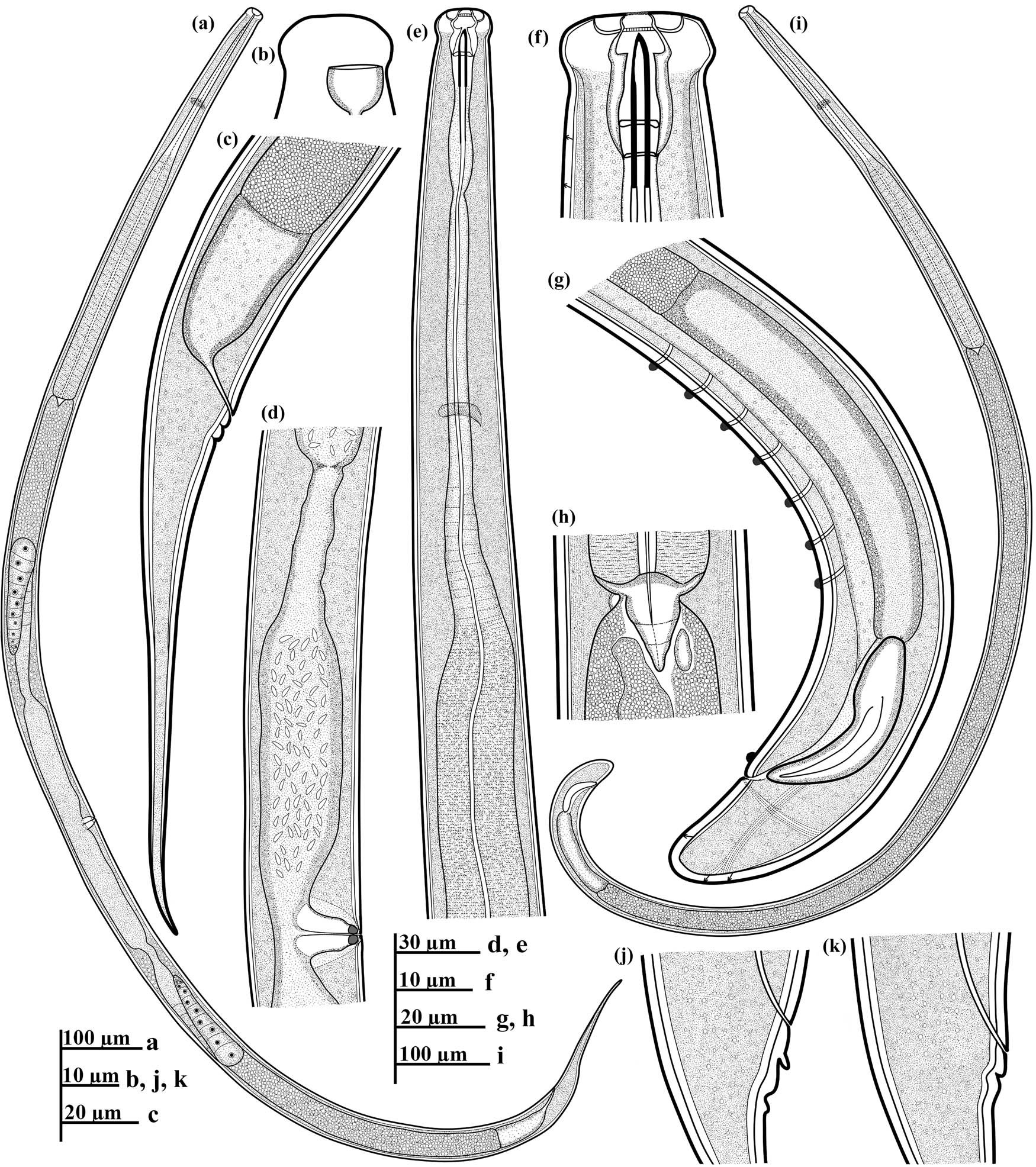
Figure 1
Line drawings of Egtitus invaginatus n. sp. (a) Female whole body; (b) anterior end, surface view with amphid; (c) female posterior region; (d) partial female reproductive system (vulval region and uterus); (e): female anterior region; (f) head region; (g) male posterior region; (h) pharynx–intestine junction; (i) male whole body; (j and k) female anal region with variation in invaginations.
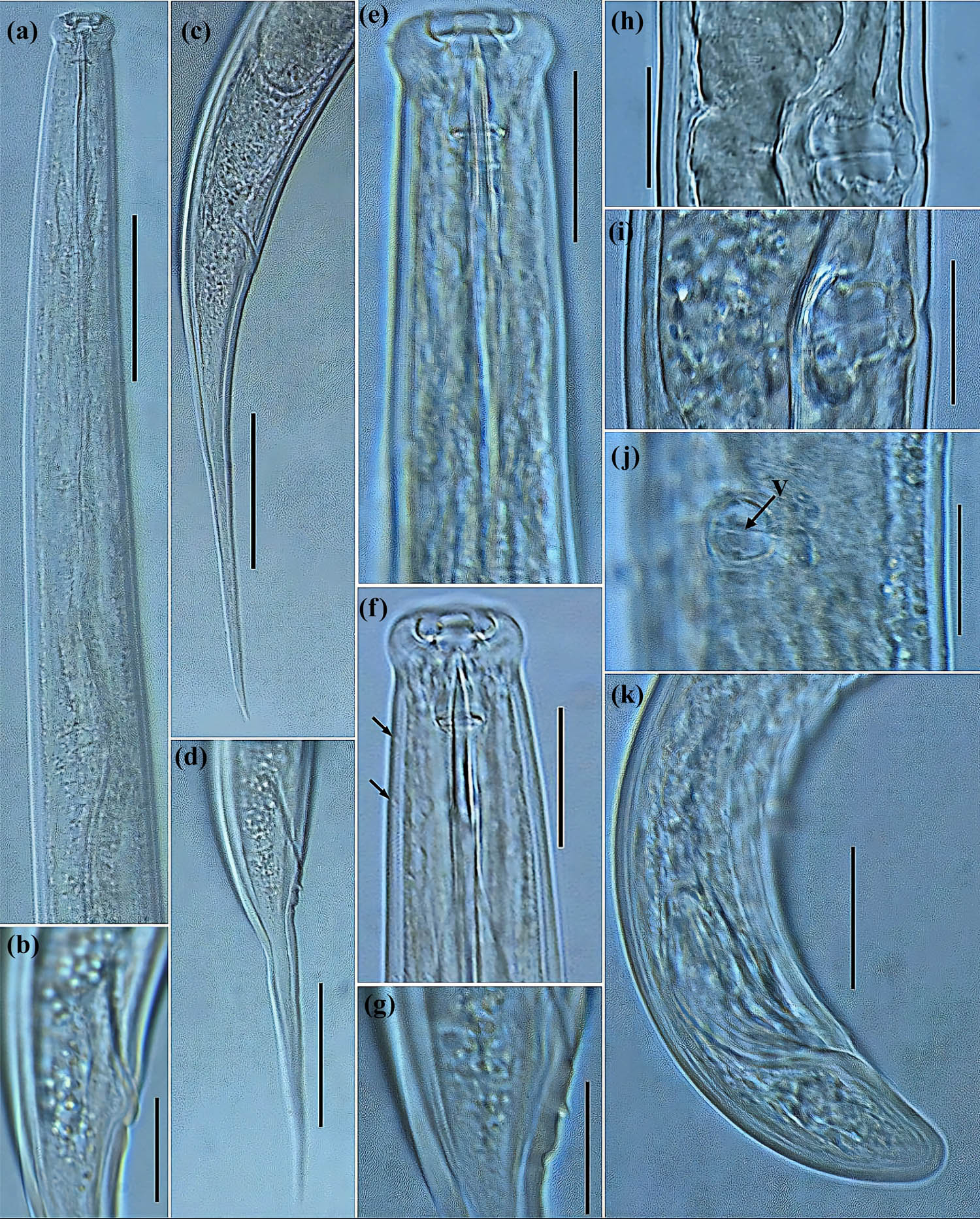
Figure 2
Light micrographs of Egtitus invaginatus n. sp. (a) Female anterior region; (b and g) female anal region with variation in invaginations; (c and d) female tail region; (e and f) anterior pharyngeal region (arrows indicate the position of body pores); (h and i) vulval region in lateral view; (j) vulval region in ventral view (arrow indicates the transverse vulva); (k) male posterior region with copulatory apparatus (Scale bars: a, c, and d = 50 μm; b and e–k = 20 μm).
2.2. Description
2.2.1. Female
Body medium sized, 1.67–2.12 mm long. General habitus ventrally curved to nearly straight when heat-killed and fixed. Cuticle smooth, 2.0–2.5 μm thick at level of guiding ring, 3.0–3.5 μm at mid-body, and 3.0–4.5 μm at anal level. Lateral chords occupy about one-fifth of corresponding body diameter. Lip region expanded, 2.1–2.5 times as wide as high, anteriorly truncate, with rounded to angular sides, offset by a depression. Vestibular ring is corrugated. Labial and dental chambers are well separated, the former is 10.0–12.0 μm, while the latter is 6.5–7.5 μm wide. Cheilostome has four simple uni-tipped onchia, with no rasp-like denticles. Amphids are stirrup-shaped, with a wide aperture, occupying ca half or more than half of the corresponding body diameter (49–55%). Odontostyle is massive, as long as the lip region diameter (0.9–1.0 times the lip region diameter). Odontostyle aperture occupy 31–41% of odontostyle length. Odontophore is simple and rod-like. Guiding ring is double, located at less than lip region diameter or 15.5–16.5 μm from anterior end. Post extension constriction of esophagus is present at about 40.0 μm from base of odontostyle. Two to three ventral body pores are present in pharyngeal region, obscure in some specimens. Pharynx is muscular, consisting of a slender anterior region, gradually increasing in diameter. Nerve ring encircling the slender part of corpus at 28–35% of the total pharynx length from anterior end. The glandularium (the expanded part of the pharynx) begins as a gradual expansion at 41.0–59.0 μm behind the nerve ring, attaining full expansion at 62.0–107 μm from the nerve ring, and occupy 44–52% of the total neck length. The location of pharyngeal gland nuclei in most specimens with respect to total pharynx length (%) is obscure. They were observed in three specimens as follows: D = 51.7–52.2, AS1 = 73.3–74.7, AS2 = 74.6–76.9, and PS = 86.1–88.6 (for formulae and terminology, see Loof and Coomans (1970), and Andrássy (1998)). A thin basal shield of pharynx is present in some specimens. Cardia is variable in length, 9.0–24.5 μm long, conoid, and projects into the intestine. Reproductive system didelphic-amphidelphic, well-developed, with anterior and posterior branches of nearly equal length. Each branch basically arranged from a fully developed and reflexed ovary to gonoduct. Anterior branch is 295–462 μm long or occupy 12.0–17.6% of total body length, and the posterior branch is 298–467 μm long or occupy 12.1–17.5% of total body length; oocytes arranged first in two to several rows and then in a single row. Oviduct outstretched, uterus–oviduct junction weakly marked. Uterus simple, almost cylindroid with no convolutions, 99.0–117 μm long, with a narrow distal part and an enlarged proximal part often with well-developed sausage to spindle-shaped sperm. Vagina perpendicular to body axis, occupying 30–60% of corresponding body diameter. Pars proximalis vaginae is 9.5–17.5 μm long, pars refringens vaginae with two closely spaced, irregularly ovoid to D-shaped pieces in lateral view, 2.0–4.0 μm deep and 2.0–4.5 μm wide, with a combined width of 6.5–10.0 μm; and pars distalis vaginae is reduced, 1.0–2.0 μm thick. Vulva lips are sclerotized, vulva flush with body contour in lateral view, a transverse slit in ventral view, vulva opening equatorial, or slightly post-equatorial. No pre- or postvulval papillae was observed in all specimens examined. Prerectum is variable, 31.5–70.0 μm ca 1.2–3.1 times anal body diameter (ABD) long, and the rectum is ca equal or more than ABD long (1.0–1.8 times ABD). One to three ventral cleft-like invaginations present at 4.0–6.0 μm posterior to anal opening in all examined specimens, forming papilla-like outgrowth in some specimens (Figs 1c, j, and k, and 2b, d, and g). Also, a ventral pore is present at 20.0–22.0 μm anterior to anal opening. Tail is generally long, straight, or slightly curved ventrad. Anterior fourth (from anal opening) convex conoid, continuing gradually, and tapering to a straight middle part, and to a finely rounded or pointed tail terminus. Tail length is 12.5–17.5 times ABD.
2.2.2. Male
Very rare but present. General morphology similar to that of females except for sexual characters and conoid to a broadly rounded tail. Body curved ventrally to a J-shape when heat-killed and fixed. Genital system is diorchic, testes symmetrical, well-developed, with well-developed sausage to spindle-shaped sperms. Spicules massive, ventrally curved, 46.5 μm long, or 1.8 times cloacal body diameter (CBD). Lateral guiding pieces are 13.0 μm long. Supplements consist of a precloacal pair located at 4.0 μm from cloacal opening and a series of seven spaced ventromedian supplements. Ventromedian supplements start at 112.0 μm from cloacal opening, spaced 8.0–10.0 μm apart (measured between ducts), and occupy 65.0 μm of the ventral contour length, with posteriormost ventromedian (nearest to cloacal opening) located at 47.0 μm from cloacal opening. Ventrolateral (submedian) papillae in the precaudal region were not observed. Intestine–prerectum junction is located just beyond the range of supplements. Prerectum and rectum are 3.8- and 1.7-times CBD long, respectively. Tail is almost as long as CBD (1.1 times CBD), conoid to broadly rounded, with three distinct pairs of caudal pores: two dorsal and one ventral.
2.3. Diagnosis and relationships
Egtitus invaginatus n. sp. is characterized by a medium-sized body 1.67–2.12 mm long, lip region expanded, 2.1–2.5 times as wide as high, anteriorly truncate, with rounded to angular sides, offset by a depression, vestibular ring corrugated, labial and dental chambers well separated, Cheilostome with four simple uni-tipped onchia, with no rasp-like denticles. Amphids are stirrup-shaped, with a wide aperture, 2–3 ventral body pores in pharyngeal region, odontostyle massive, 19.0–21.0 μm long or as long as the lip region diameter, a small basal shield of pharynx present; well-developed, didelphic-amphidelphic female reproductive system; pars refringens vaginae with two small irregularly ovoid to D-shaped pieces, vulva flush with body contour in lateral view, a transverse slit in ventral view, vulva opening equatorial, or slightly post-equatorial (V = 50.1–53.4); one to three ventral cleft-like invaginations are present at 4.0–6.0 μm posterior to anal opening, forming papilla-like outgrowth, tail straight or slightly curved ventrad, 12.5–17.5 times ABD; spicules 46.5 μm long, seven spaced ventromedian supplements, and male tail conoid to broadly rounded, almost as long as CBD.
By having a medium-sized body, lip diameter of 19.5–22.0 μm, straight odontostyle, with its aperture occupying 31–41% its length; long female tail, straight or slightly curved ventrad, gradually tapering and ending in a finely rounded or pointed tail terminus, vulva opening equatorial or slightly post-equatorial and male with less number of ventromedian supplements, Egtitus invaginatus n. sp. is closely similar to four known species of the genus, i.e., E. koriensis Khan, Park and Choi, 1999, E. elaboratus (Cobb, 1906) Thorne, 1967, E. itanagrus Khan, Ahmad and Jairajpuri, 1994, and E. andhricus Khan and Jairajpuri, 1994 (including its probable synonym, E. naunii Khan and Jairajpuri, 1994) (refer Andrássy, 2012). However, the new species differs from E. koriensis by the presence of 2–3 ventral body pores in pharyngeal region vs absent, shorter prerectum (31.5–70.0 μm vs 80.0–94.0 μm; 1.2–3.1 vs 3.5–4.0 times ABD), shorter rectum (26.0–39.0 μm vs 44.0–49.0 μm), vulva flush with body contour vs elevated from body contour, and presence of ventral cleft-like invaginations posterior to anal opening vs absent; from E. elaboratus and E. andhricus by the presence of 2–3 ventral body pores in pharyngeal region vs absent, vulva a transverse slit vs longitudinal, and presence of ventral cleft-like invaginations posterior to anal opening vs absent; and from E. itanagrus by shorter odontostyle (19.0–21.0 μm vs 24.0–28.0 μm), the presence of 2–3 ventral body pores in pharyngeal region vs absent, uterus with no Z-differentiation vs present, shorter prerectum (31.5–70.0 μm vs 89.0–143.0 μm), vulva a transverse slit vs “star-shaped,” and presence of ventral cleft-like invaginations posterior to anal opening vs absent.
2.4. Type habitat and locality
The type population was recovered from soils sampled around a dead pinewood nematode-infected black pine, Pinus thunbergii from natural pine-forest in Jeju Island, Jeju province, Republic of Korea (GPS coordinates: 33°15′34˝N, 126°13′52˝E).
2.5. Type material
Holotype female, 13 female, and 1 male paratypes were deposited in the National Institute of Biological Resources of Korea (slide numbers: NM430–NM434), and 6 female paratypes were deposited in the Nematode Collection of Kyungpook National University, Republic of Korea.
2.6. Etymology
Egtitus invaginatus n. sp. is a species with distinctive cleft-like invaginations present on the ventral side posterior to anal opening. The species epithet invaginatus describes this distinguishing character.
2.7. Molecular characterization and phylogeny
The Bayesian analysis of the partial 18S-rRNA gene and 28S-rRNA gene included 72 and 70 sequences of Dorylaimid species, respectively, together with the newly obtained sequences and outgroup taxa. Phylogenetic relationships, as inferred from Bayesian analysis of the dataset with GTR + I + G substitution model for both genes are shown in Figs 3 and 4. The montaged two partially overlapping fragments of the 18S-rRNA gene yielded approximately 1,700 bp long sequences. No intraspecific sequence variation was recorded in the two newly obtained 18S-rRNA gene sequences (PX578408 and PX578409) of Egtitus invaginatus n. sp. Sequences of Egtitus invaginatus n. sp. were identical to the sequence data accessioned PV169319 and deposited as E. prodenticulatus (Heyns and Argo, 1969) Andrássy, 2012 from China with no recorded interspecific variation. In the 18S-rRNA gene phylogeny, sequences of Egtitus invaginatus n. sp. were also closely related to sequences of other related actinolaims including Paractinolaimus uljinensis (PQ044581 and PQ044583), Paractinolaimus sp. (OQ682610), Trachactinolaimus nanjingensis (ON054242 and ON054246), and Paractinolaimus macrolaimus (AY993978 and KJ636378), differing by 14 bp (0.8%), 17 bp (1.0%), 18–19 bp (1.1%), and 20–22 bp (1.2–1.3%), respectively.
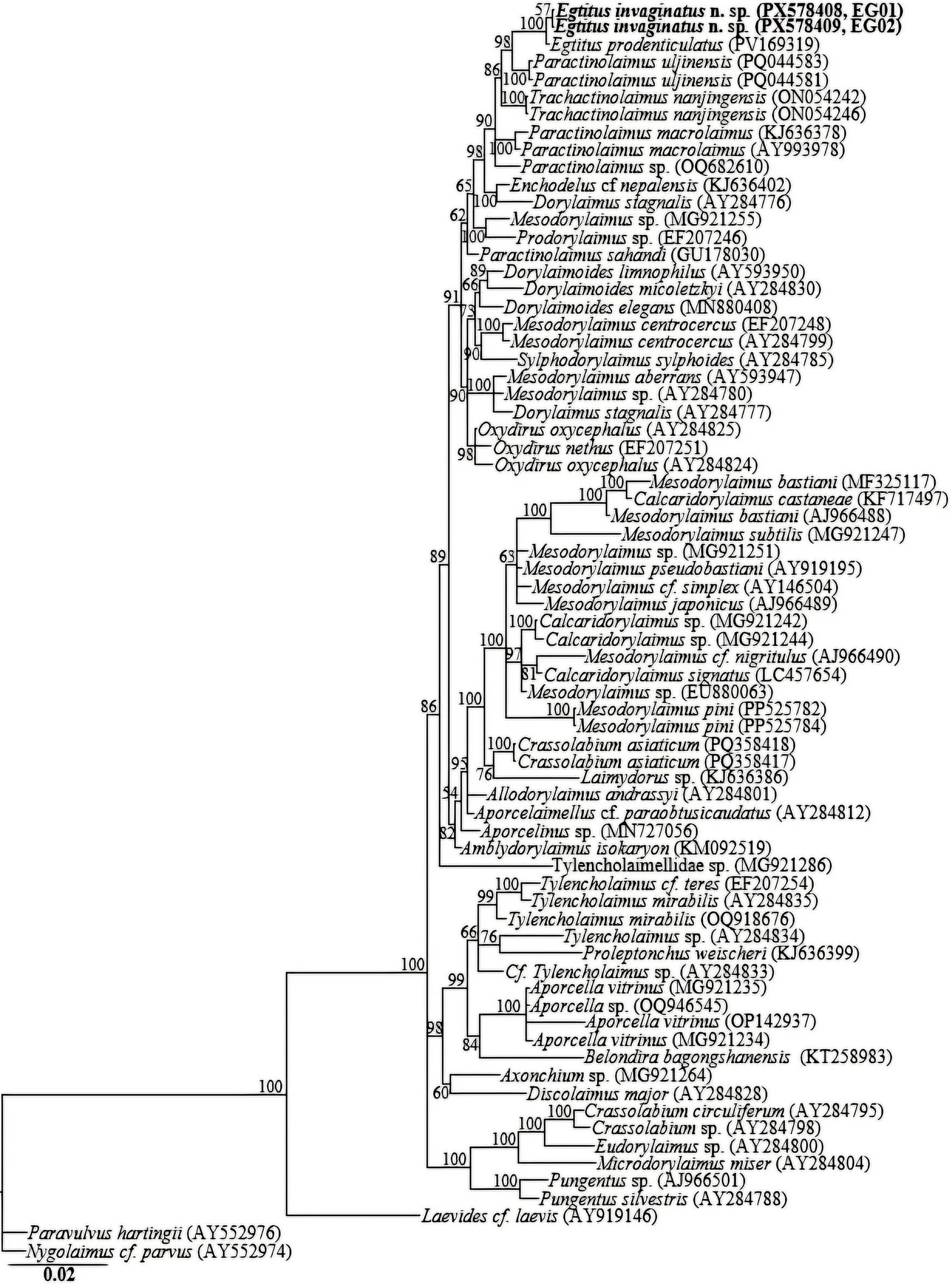
Figure 3
Bayesian tree inferred under the GTR + I + G model from 18S-rRNA gene sequences of Dorylaimid species. Posterior probability values exceeding 50% are given on appropriate clades. The newly obtained sequences are indicated in bold text.
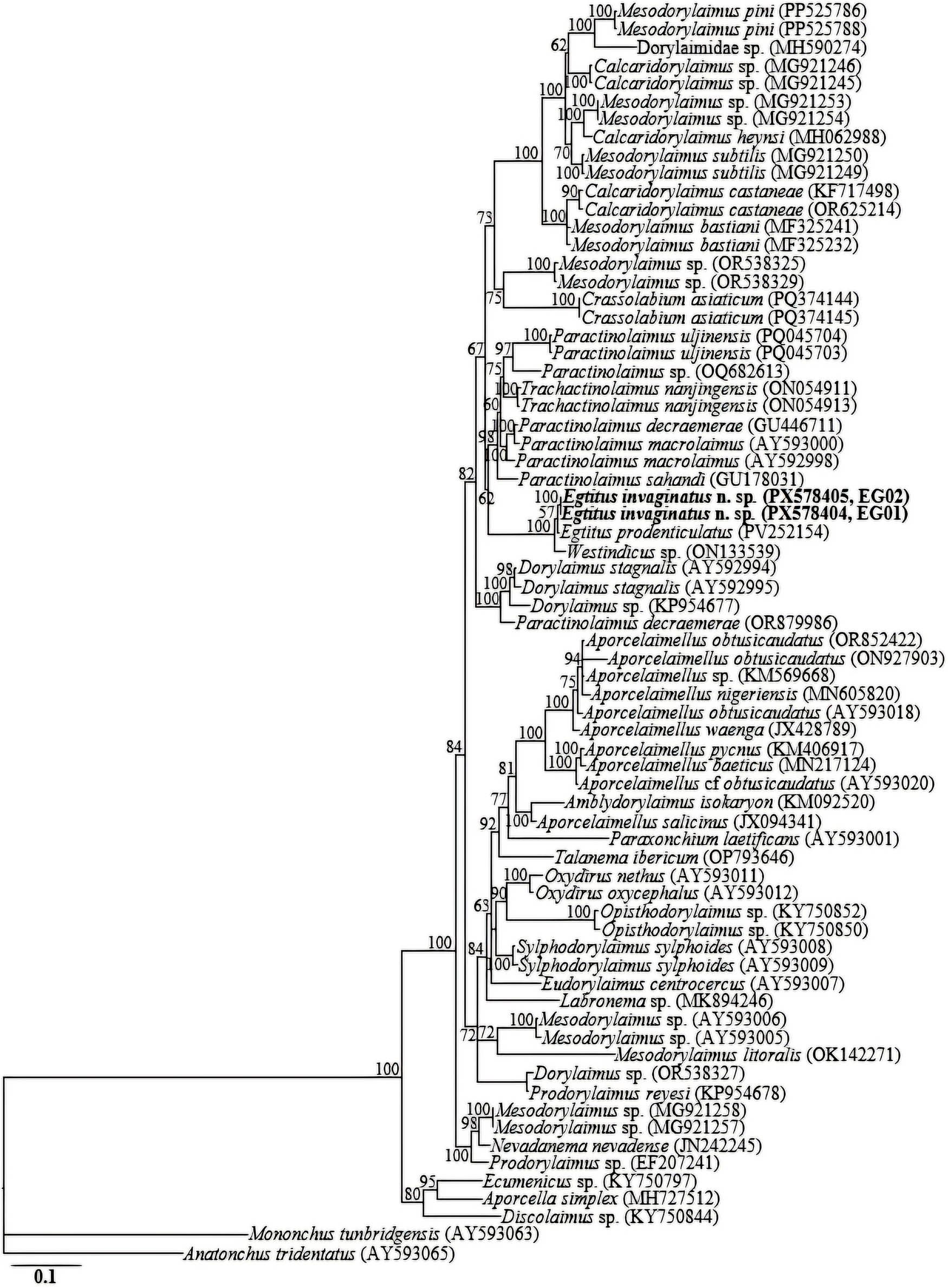
Figure 4
Bayesian tree inferred under the GTR + I + G model from 28S-rRNA gene partial sequences of Dorylaimid species. Posterior probability values exceeding 50% are given on appropriate clades. The newly obtained sequences are indicated in bold text.
The amplified D2–D3 region amplicons yielded fragments of approximately 750 bp. The two D2–D3 sequences of Egtitus invaginatus n. sp. (PX578404 and PX578405) were also identical, with no intraspecific sequence variation. Similar to 18S-rRNA gene, sequences of Egtitus invaginatus n. sp. were highly identical to sequence data of an isolate of Egtitus (PV252154) deposited as E. prodenticulatus from China and an unidentified isolate accessioned ON133539 and deposited as Westindicus sp. from China, differing by 2 bp (0.2%) and 11 bp (1.5%), respectively. In the 28S-rRNA phylogeny, the two sequences of Egtitus invaginatus n. sp. were grouped in an independent moderately supported subclade with the two closely identical sequence data (PV252154 and ON133539), and these were also closely related to sequences of Paractinolaimus sp. (OQ682613), P. sahandi (GU178031), P. decraemerae (GU446711), P. macrolaimus (AY592998 and AY593000), Trachactinolaimus nanjingensis (ON054911 and ON054913), and P. uljinensis (PQ045703 and PQ045704), differing by 59 bp (8%), 61 bp (8%), 63 bp (8.3%), 62–64 bp (8.1–8.4%), 64–65 bp (8.6–8.7%), and 66 bp (8.7%), respectively.
3. Discussion
The genus Egtitus generally comprises members of the “Paractinolaimus” group that possess short longitudinal vulval slit with sclerotized inner lips (Andrássy, 2012). Egtitus invaginatus n. sp. and E. koriensis are among the only few species within the genus with a non-longitudinal vulval slit. The two species are closely similar morphometrically. However, unlike E. koriensis, the new species possesses post-anal invaginations in addition to other qualitative and morphometric differences. Based on the two reconstructed phylogenies (18S-rRNA, and D2–D3 expansion of 28S-rRNA), Egtitus invaginatus n. sp. is genetically similar to the only Egtitus gene sequences available in GenBank database. The two sequences, PV169319 (18S-rRNA) and PV252154 (28S-rRNA), deposited as E. prodenticulatus (Heyns and Argo, 1969) Andrássy, 2012 are identical to the newly obtained sequences of the new species. However, Egtitus invaginatus n. sp. significantly differs from E. prodenticulatus by its narrow lip diameter (19.5–22.0 μm vs 25.0–28.0 μm), shorter odontostyle (19.0–21.0 μm vs 27.0 μm), vulva a transverse slit vs pore-like, presence of ventral cleft-like invaginations posterior to anal opening vs absent, and relatively shorter spicules (46.5 μm vs 50.0–60.0 μm). Unfortunately, the sequence data were deposited in GenBank with no affiliated morphological data for comparison. These accessions probably belong to Egtitus invaginatus n. sp. Additionally, the 28S-rRNA sequence data accessioned ON133539 and identified as Westindicus sp. is also highly similar to the newly obtained sequence data and probably belong to closely related undescribed species. Inferences from the two phylogenies corroborate the close morphological relationships between Egtitus and Paractinolaimus as detailed by Andrássy (2012).
The biology, identity, and phylogeny of Egtitus spp. have been discussed by various taxonomists (Coomans, 1965; Thorne, 1967; Heyns and Argo, 1969; Khan et al., 1994; Andrássy, 2012; Andrássy and Esquivel, 2012). However, species delimitation within the genus is challenging due to phenotypic similarities within the key diagnostic characters that often show only slight differences among closely related species. This is even exacerbated by insufficient morphometric data in some of the published literature, which limits comprehensive comparisons according to the current demands of the discipline. For instance, of the 28 species of the genus, 7 were described without morphological data of males. And as stated by Andrássy (2012), these seven species of Egtitus where males are unknown may belong to a closely similar Neoactinolaimus Thorne, 1967. The two genera are mainly separated by the arrangement of male ventromedian supplements (arranged in series in Egtitus and fascicles in Neoactinolaimus). Integrated identification using both morphological characters, morphometrics, and molecular phylogenetic inferences provide a well-supported approach in delineating species and conspecific populations. Unfortunately, DNA sequence data of most species of the group is still unavailable and thus, thorough species comparison, especially among several known cryptic species of the genus is still challenging. Therefore, accurate resolution of the taxonomic positions of the various species of the genus requires further molecular characterization of the species of the genus and other related groups. This will supplement and resolve the current generic compendia within this taxonomically confounded group of nematodes.
Acknowledgments
This study was carried out with the support of grant from the National Institute of Biological Resources (NIBR), funded by the Ministry of Environment (MOE) of the Republic of Korea (NIBR202602106).
Author contributions
D. W. Lee and Y. D. Lee conceived the study; All authors carried out field sampling; A. O. Mwamula analyzed the data; A. O. Mwamula and D. W. Lee wrote the first draft, which all other authors revised.
Conflict of interest statement
The authors state no conflicts of interest.
Data availability statement
All necessary data links have been included in the article as GenBank accession numbers.