
Table 1:
Genome assembly statistics of H. medicaginis and other Heterodera species.
| Assembly statistic | H. medicaginis | H. glycines (PRJNA381081)a | H. schachtii (PRJNA522950)a | H. humuli (PRJNA1048471)a | H. carotae (PRJNA774818)a | H. filipjevi (PRJNA1113137)a |
|---|---|---|---|---|---|---|
| Read type | Nanopore | PacBio/Illumina | PacBio/Illumina | PacBio | Illumina | PacBio RS/Illumina |
| Total length | 112,910,497 | 157,978,452 | 179,246,932 | 90,806,450 | 95,115,141 | 134,189,547 |
| Number of contigs/Number of Scaffolds | 1,383/1,383 | 2,121/9 | 1,682/395 | 1,487/1,487 | 17,835/17,835 | 1,208/661 |
| Largest contig | 1,183,061 | 23,985,585 | 6,046,013 | 568,746 | 113,425 | 30,258,874 |
| Number of contigs (≥25,000 bp) | 927 | 9 | 309 | 871 | 699 | 210 |
| Number of contigs (≥50,000 bp) | 655 | 9 | 269 | 559 | 103 | 63 |
| GC (%) | 37 | 37 | 33 | 36 | 39 | 36.76 |
| N50 | 148,984 | 17,907,690 | 1,273,070 | 111,383 | 13,935 | 11,883,475 |
| L50 | 220 | 4 | 40 | 231 | 1,836 | 4 |
| Number of N’s per 100 kbp | 0 | 1,062 | 2,756 | 0 | 0 | 564.5 |
| RNA-seq evidence used for annotation | No | Yes | Yes | No | No | Yes |
| Coding genes | 17,779 | 22,465 | 26,739 | 15,428 | 18,781 | 13,352 |
| bCDS | 20,698 | 23,917 | 32,600 | 16,848 | 20,104 | 13,352 |
| Proteins | 20,698 | 23,917 | 32,600 | 16,848 | 20,104 | 13,352 |
| Predicted protein BUSCO analysis (Nematoda_odb10) | ||||||
| cComplete BUSCOs (C) | 1,757 (56.1%) | 1,884 (60.2%) | 2,080 (66.4%) | 2,030 (64.9%) | 1,301 (41.5%) | 1,873 (59.8%) |
| Complete and single-copy BUSCOs (S) | 1,696 (54.2%) | 1,612 (51.5%) | 1,675 (53.5%) | 1,590 (50.8%) | 1,237 (39.5%) | 1,805 (57.6%) |
| Complete and duplicated BUSCOs (D) | 61 (1.9%) | 272 (8.7%) | 405 (12.9%) | 440 (14.1%) | 64 (2%) | 68 (2.2%) |
| Fragmented BUSCOs (F) | 108 (3.4%) | 47 (1.5%) | 69 (2.2%) | 66 (2.1%) | 124 (4%) | 102 (3.3%) |
| Missing BUSCOs (M) | 1266 (40.5%) | 1,200 (38.3%) | 982 (31.4%) | 1,035 (33%) | 1,706 (54.5%) | 1,156 (36.9%) |
| Total BUSCO groups searched | 3,131 | 3,131 | 3,131 | 3,131 | 3,131 | 3,131 |
| Predicted protein BUSCO analysis (Eukaryota_odb10) | ||||||
| cComplete BUSCOs (C) | 297 (77.3%) | 199 (78%) | 224 (87.8%) | 221 (86.6%) | 160 (62.8%) | 205 (80.4%) |
| Complete and single-copy BUSCOs (S) | 194 (76.1%) | 176 (69%) | 200 (78.4%) | 174 (68.2%) | 156 (61.2%) | 194 (76.1%) |
| Complete and duplicated BUSCOs (D) | 3 (1.2%) | 23 (9%) | 24 (9.4%) | 47 (18.4%) | 4 (1.6%) | 11 (4.3%) |
| Fragmented BUSCOs (F) | 20 (7.8%) | 20 (7.8%) | 15 (5.9%) | 13 (5.1%) | 52 (20.4%) | 13 (5.1%) |
| Missing BUSCOs (M) | 38 (14.9%) | 36 (14.2%) | 16 (6.3%) | 21 (8.3%) | 43 (16.8%) | 37 (14.5%) |
| Total BUSCO groups searched | 255 | 255 | 255 | 255 | 255 | 255 |
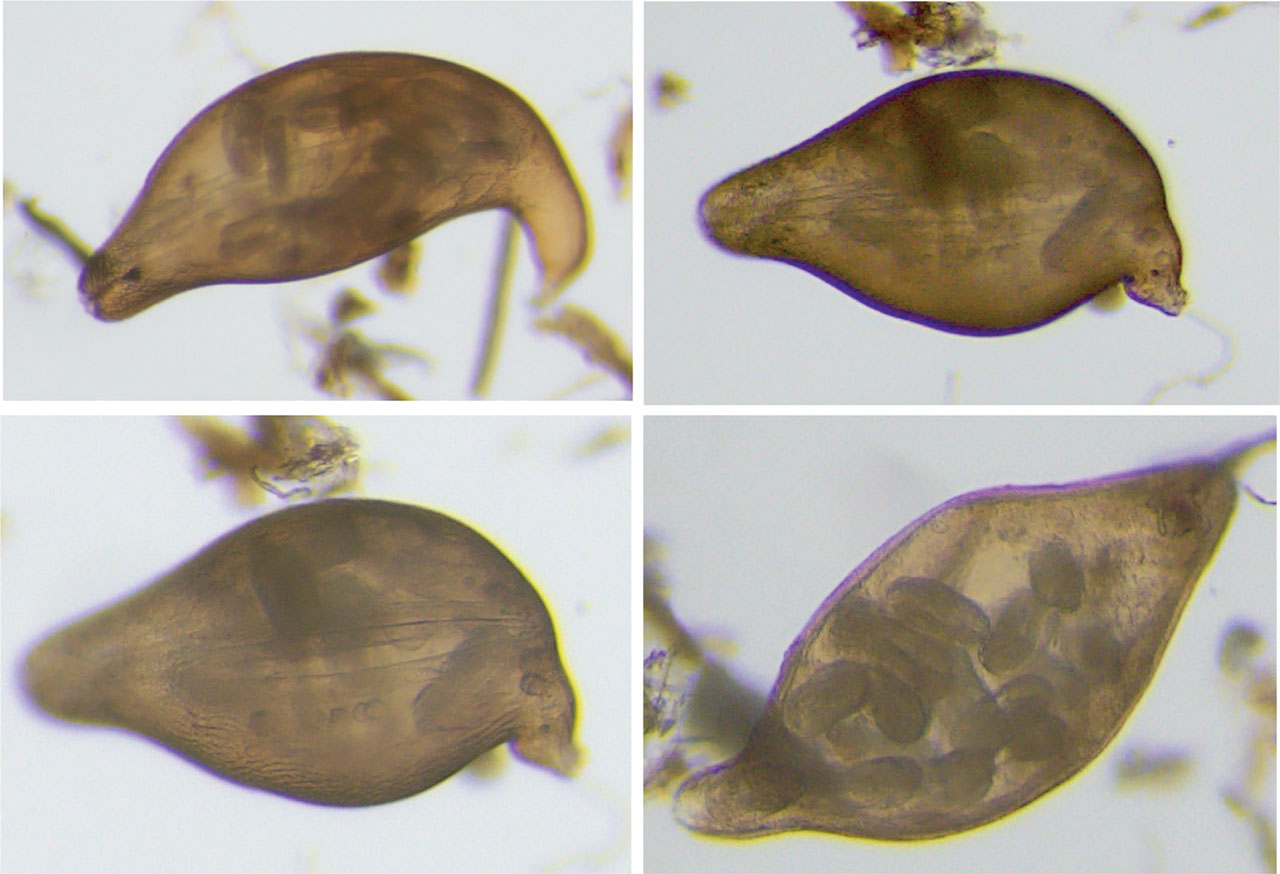
Figure S1:
Example of the Heterodera medicaginis cysts with eggs extracted from the soil of infected alfalfa plants used in this study.
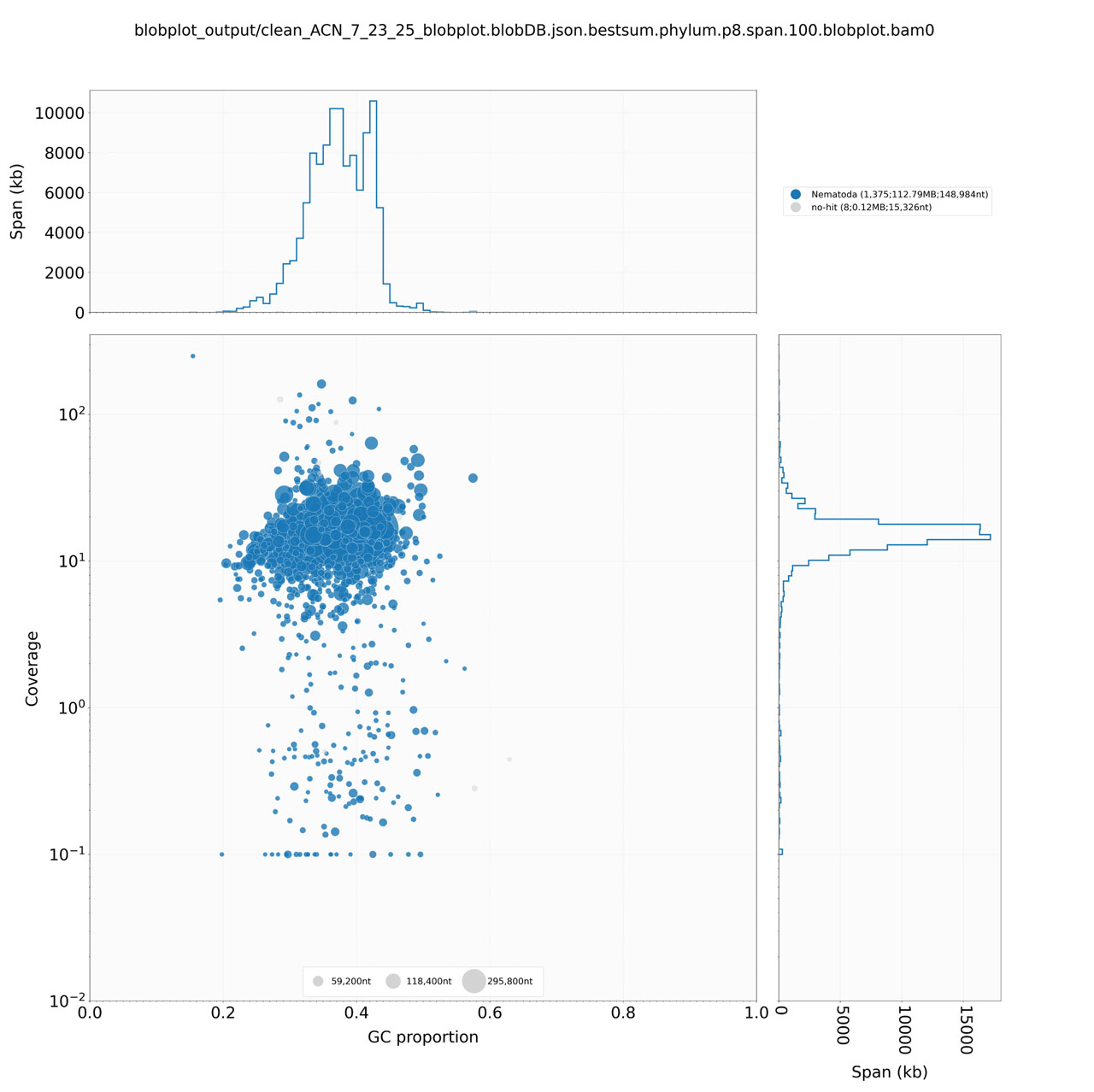
Figure S2:
Visualization of the final assembly of Heterodera medicaginis. Utilizing blobtools (Laetsch and Baxter, 2017) the genome assembly was visualized with contigs represented as circles and their placement on the x and y axes reflecting GC% and contig coverage based on raw data respectively. Contig size is reflected in circle size.
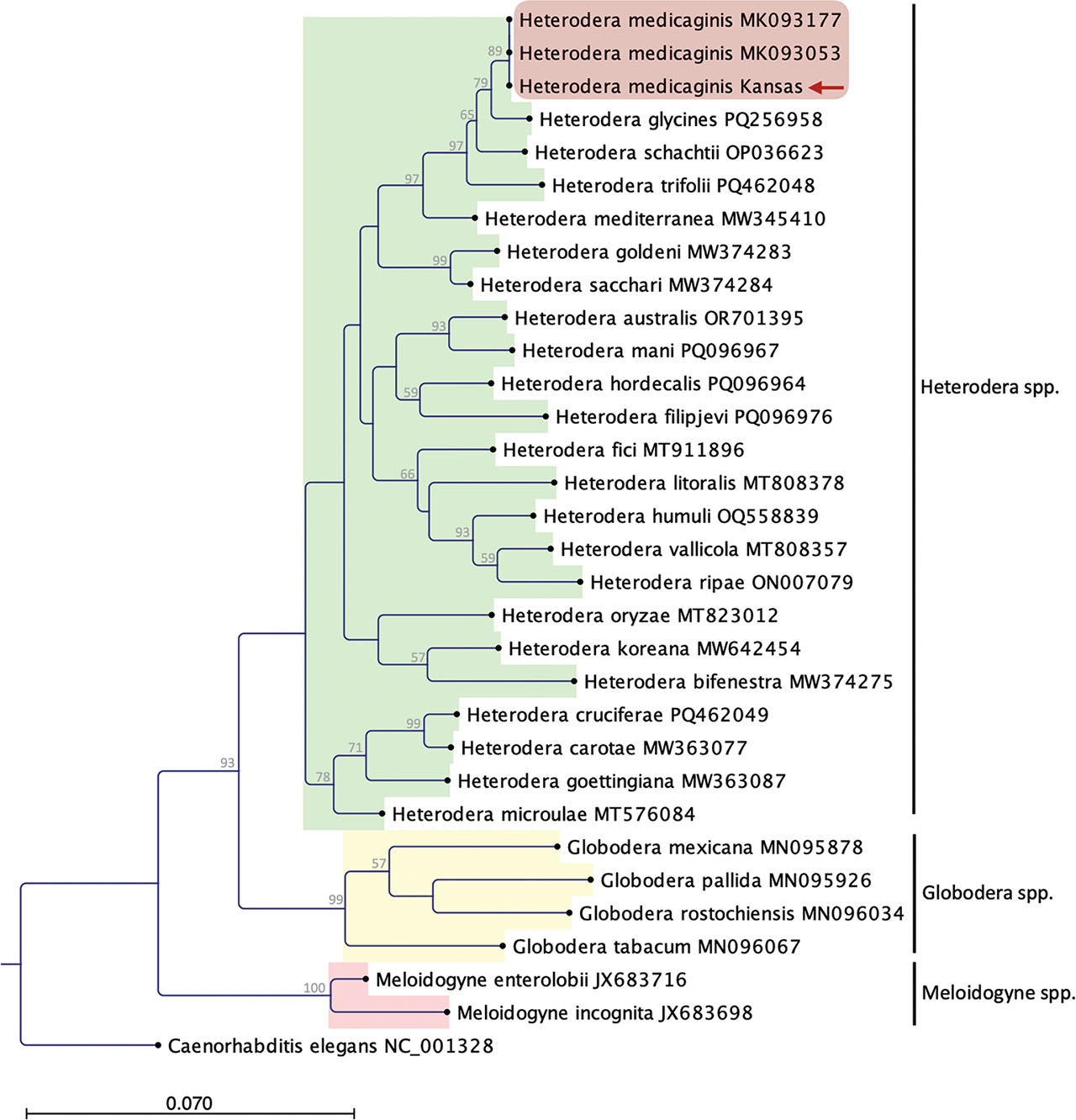
Figure S3:
Phylogenetic tree of isolate from the current study of Heterodera medicaginis cytochrome c oxidase subunit 1 (coxI) gene in relation to other Heterodera species. The coxI gene was extracted from the final assembly and aligned with two coxI sequences on NCBI for H. medicaginis, a random selection of coxI accessions from other Heterodera species, Meloidogyne species and Caenorhabditis elegans as an outgroup. A Maximum likelihood phylogenetic tree was generated from the alignment using CLC Genomic Workbench v 24. Bootstrap values (>50) are indicated on branch points in this tree and the placement within the tree of H. medicaginis coxI from this study highlighted with a red arrow. NCBI accessions for the sequence used are listed next to each species in the tree.
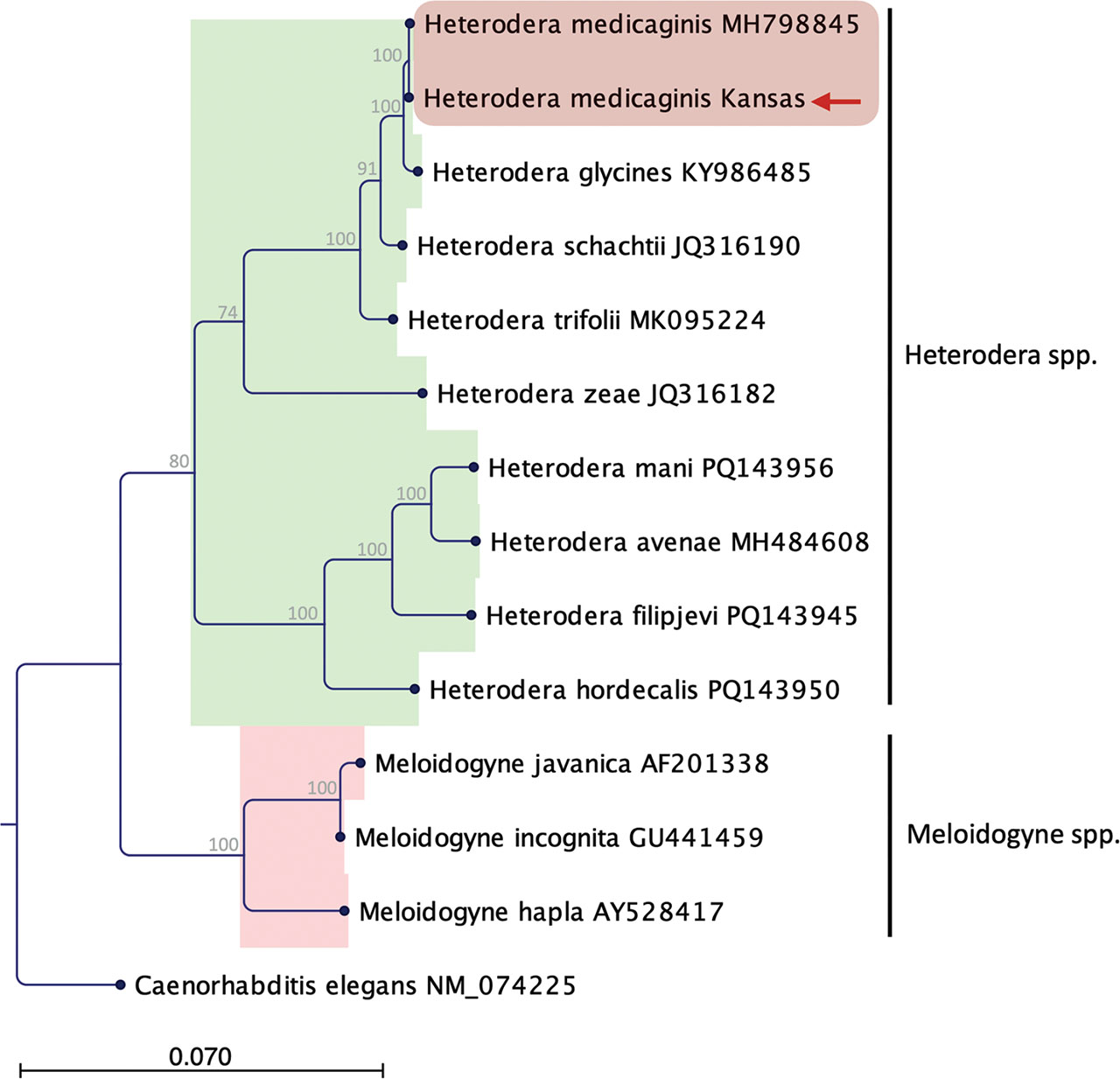
Figure S4:
Phylogenetic tree of isolate from the current study of Heterodera medicaginis heat shock protein 90 (hsp90) gene in relation to other Heterodera species. The hsp90 gene was extracted from the final assembly and aligned with hsp90 sequences from NCBI of eight Heterodera species, two H. medicaginis accessions, three Meloidogyne species, and Caenorhabditis elegans as an outgroup. A Maximum likelihood phylogenetic tree was generated from the alignment using CLC Genomic Workbench v 24 with 1,000 bootstrap alignments. Bootstrap values (>50) are indicated on branch points in this tree and the placement within the tree of H. medicaginis hsp90 from this study is highlighted with a red arrow. NCBI accessions for the sequence used are listed next to each species in the tree.