
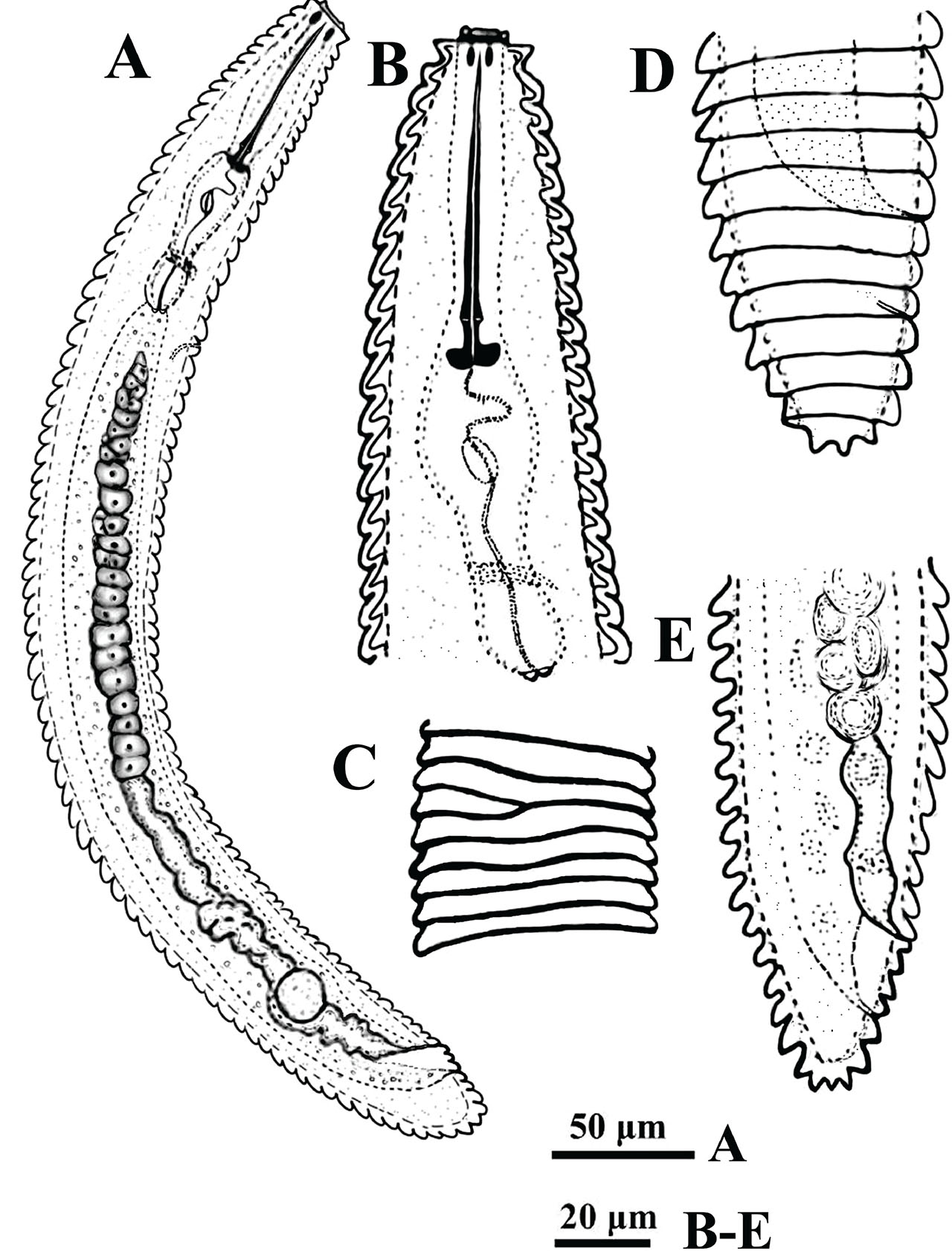
Figure 1:
Line drawings of Criconemoides iraqicus n. sp. from Iraq. Female. (A) Entire body; (B) Anterior body region; (C) Cuticular annuli showing anastomosis; (D,E) Posterior body region.
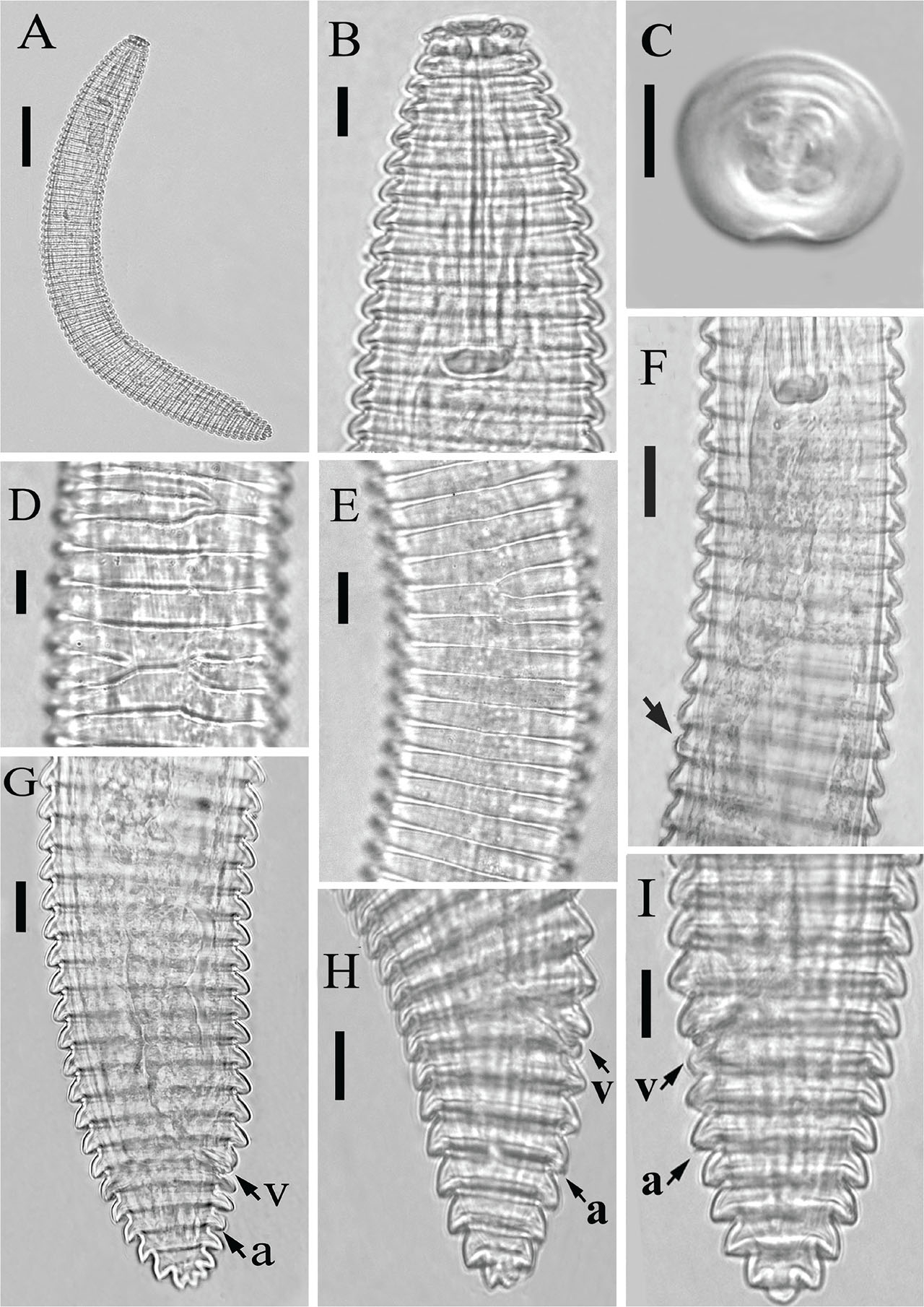
Figure 2:
Light photomicrographs of Criconemoides iraqicus n. sp. from Iraq. Female. (A) Entire body; (B) Anterior body region; (C) En face view; (D,E) Cuticular annuli showing anastomosis; (F) Pharyngeal region (the arrow indicates the excretory pore); (G–I) Posterior body region. Arrowheads showing position of vulva (v) and anus (a). Scale bars: A = 50 μm; B–I = 10 μm.
Table 1:
Morphometrics of Criconemoides iraqicus n. sp. from Misan province, Iraq.
| Character | Holotype Female | Paratypes | |
|---|---|---|---|
| Females | Juveniles | ||
| n | 1 | 5 | 6 |
| L | 455 | 474.2 ± 21.8 (443–496) | 292.3 ± 26.5 (278–321) |
| a | 10.3 | 10.3 ± 0.9 (9.4–11.6) | 13.1 ± 0.3 (12.4–13.6) |
| b | 3.5 | 3.8 ± 0.2 (3.5–4.2) | 3.5 ± 0.3 (3.3–4.1) |
| c | 25.3 | 29.3 ± 2.7 (24.9–33.3) | 23.4 ± 1.6 (21.3–25.2) |
| c′ | 0.8 | 0.7 ± 0.1 (0.6–0.8) | 0.8 ± 0.2 (0.7–0.9) |
| o | 8.6 | 8.4 ± 0.3 (7.8–8.9) | 6.8 ± 0.2 (6.3–7.2) |
| DGO | 6.5 | 6.1 ± 0.4 (5.3–6.8) | 3.7 ± 0.4 (3.1–4.3) |
| V | 92.3 | 91.5 ± 0.3 (91.2–92.5) | – |
| Stylet length | 75.3 | 68.2 ± 3.6 (64.6–75.3) | 47.4 ± 0.5 (46.6–50.3) |
| m | 79.7 | 81.9 ± 2.4 (78.6–85.3) | 78.2 ± 2.6 (73.2–81.4) |
| Stylet Knob height | 4.5 | 4.6 ± 0.3 (4.2–5.3) | 3.7 ± 0.3 (2.8–4.1) |
| Stylet Knob width | 12 | 10.8 ± 0.5 (10.2–12.2) | 8.9 ± 0.3 (7.8–10.2) |
| Anterior end to excretory pore | 134 | 132.4 ± 2.8 (129–137) | 90.6 ± 1.2 (87–95) |
| Body width | 44.2 | 45.2 ± 2.2 (43.2–47.6) | 25.5 ± 1.6 (23.2–28.7) |
| Anal body width | 23 | 22.3 ± 1.2 (20.5–23.8) | 14.1 ± 0.9 (12.8–15.4) |
| Vulval body width | 32 | 30.7 ± 1.6 (27.7–33.8) | – |
| Lip region-vulva | 420 | 442.3 ± 27.8 (396–470) | – |
| Vulva-tail terminus | 30 | 34.8 ± 1.2 (29.4–38.9) | – |
| First lip annulus diam. | 11.5 | 11.4 ± 0.9 (10.0–12.9) | 10.4 ± 0.6 (9.6–11.8) |
| Second lip annulus diam. | 15.2 | 13.2 ± 1.1 (11.6–15.7) | 12.7 ± 1.2 (10.4–14.6) |
| First body annulus diam. | 18 | 16.7 ± 1.2 (14.3–18.5) | 15.3 ± 1.3 (13.5–17.2) |
| Second body annulus diam. | 21.5 | 20.6 ± 2.3 (17.5–22.8) | 18.8 ± 1.5 (16.4–20.1) |
| Pharynx length | 128 | 121.8 ± 4.1 (117–130) | 89.2 ± 3.2 (87–93) |
| Annulus width | 6.8 | 8.1 ± 0.3 (6.3–8.7) | 3.2 ± 0.1 (2.8–3.6) |
| Tail length | 18 | 16.8 ± 1.5 (14.3–19.1) | 16.5 ± 1.2 (13.4–18.9) |
| R | 79 | 77.8 ± 2.2 (76–79) | 82.7 ± 2.1 (77–84) |
| RSt | 14 | 13.2 ± 0.8 (12–15) | 12.2 ± 0.8 (11–13) |
| ROes | 21 | 19.5 ± 1.4 (20–24) | 23.5 ± 1.9 (20–25) |
| Rex | 23 | 21.6 ± 1.3 (22–25) | 25.2 ± 2.1 (22–27) |
| RV | 7 | 8.4 ± 0.6 (7–9) | – |
| RVan | 3 | 2.5 ± 0.5 (2–3) | – |
| Ran | 4 | 3.6 ± 0.4 (3–4) | 3.9 ± 0.5 (3–5) |
| VL/VB | 0.9 | 1.0 ± 0.1 (0.9–1.3) | – |
| St%L | 16.5 | 16.1 ± 0.3 (14.2–17.2) | 15.7 ± 0.4 (15.4–16.6) |
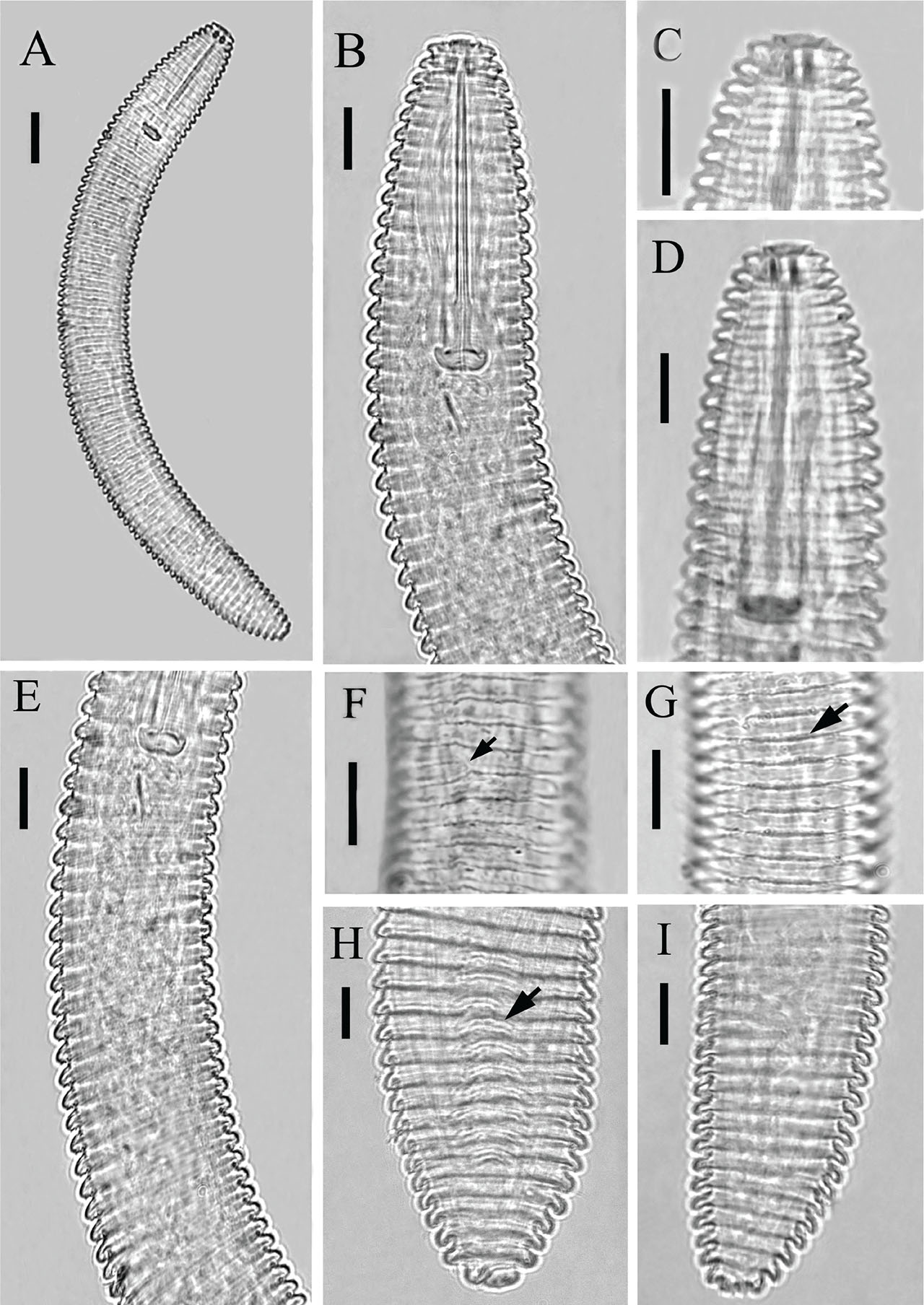
Figure 3:
Light photomicrographs of Criconemoides iraqicus n. sp. from Iraq. Juveniles. (A) Entire body; (B–D) Anterior body region; (E) Pharyngeal region; (F–H) Cuticular annuli showing anastomoses and ornamentation; (I) Posterior body region. Scale bars: A = 20 μm; B–I = 10 μm.
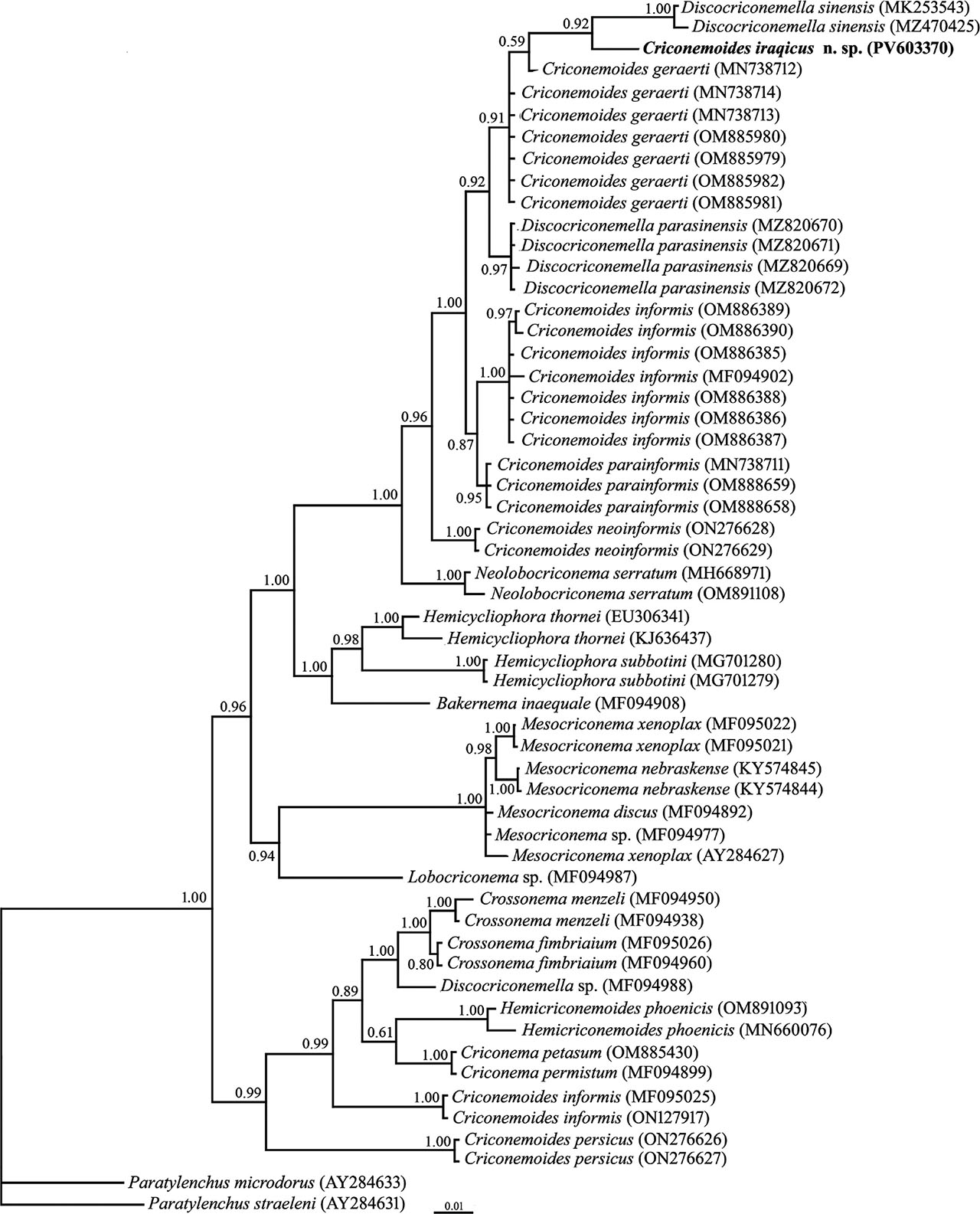
Figure 4:
Bayesian 50% majority rule consensus tree inferred from analysis of the SSU rDNA sequence of Criconemoides iraqicus n. sp. under the GTR + G + I model. BPP values more than 0.50 are given for appropriate clades. New sequence is indicated in bold. BPP, Bayesian posterior probability.
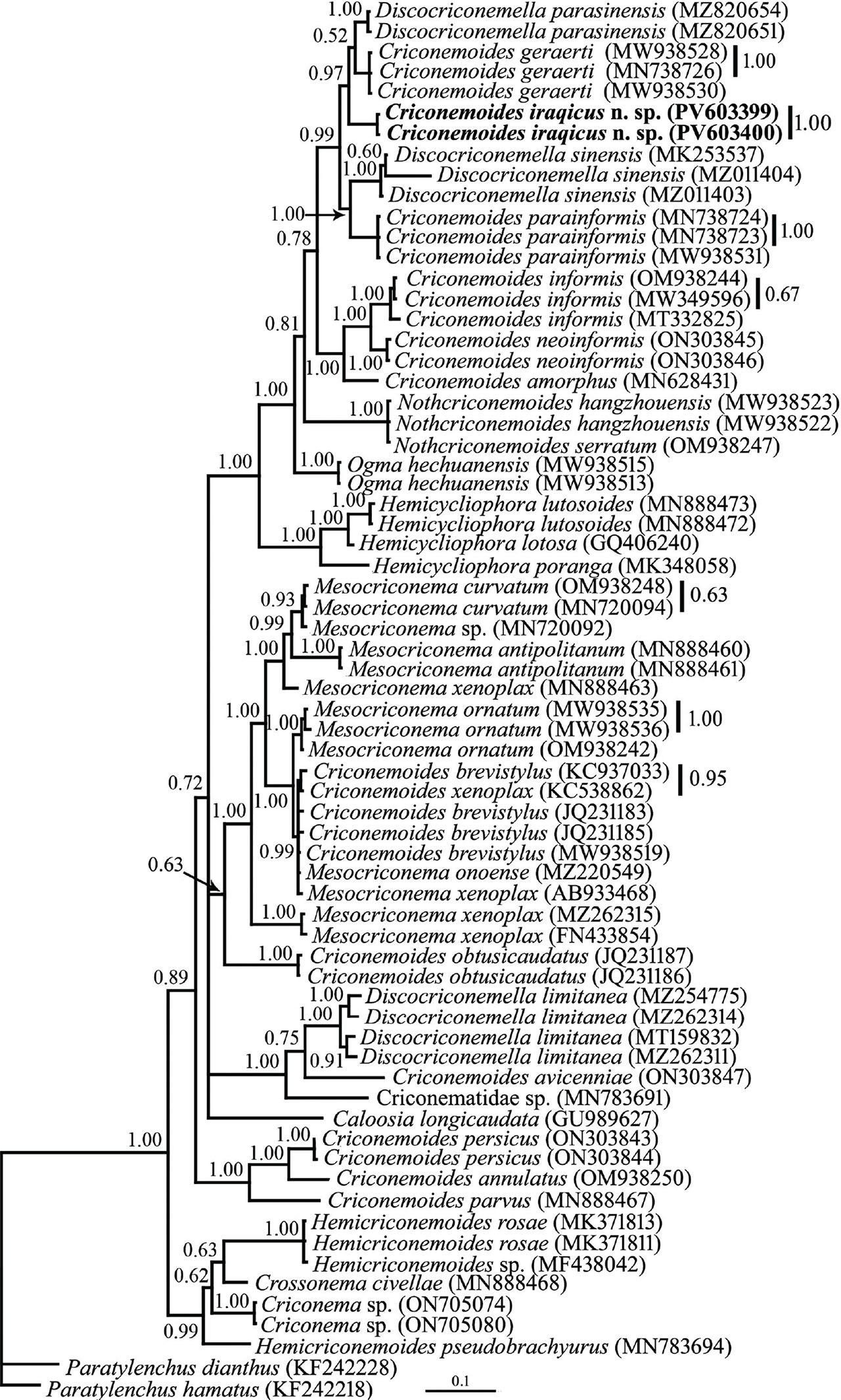
Figure 5:
Bayesian 50% majority rule consensus tree inferred from analysis of the D2–D3 domains of the LSU rDNA sequences of Criconemoides iraqicus n. sp. under the GTR + G + I model. BPP values more than 0.50 are given for appropriate clades. New sequences are indicated in bold. BPP, Bayesian posterior probability.
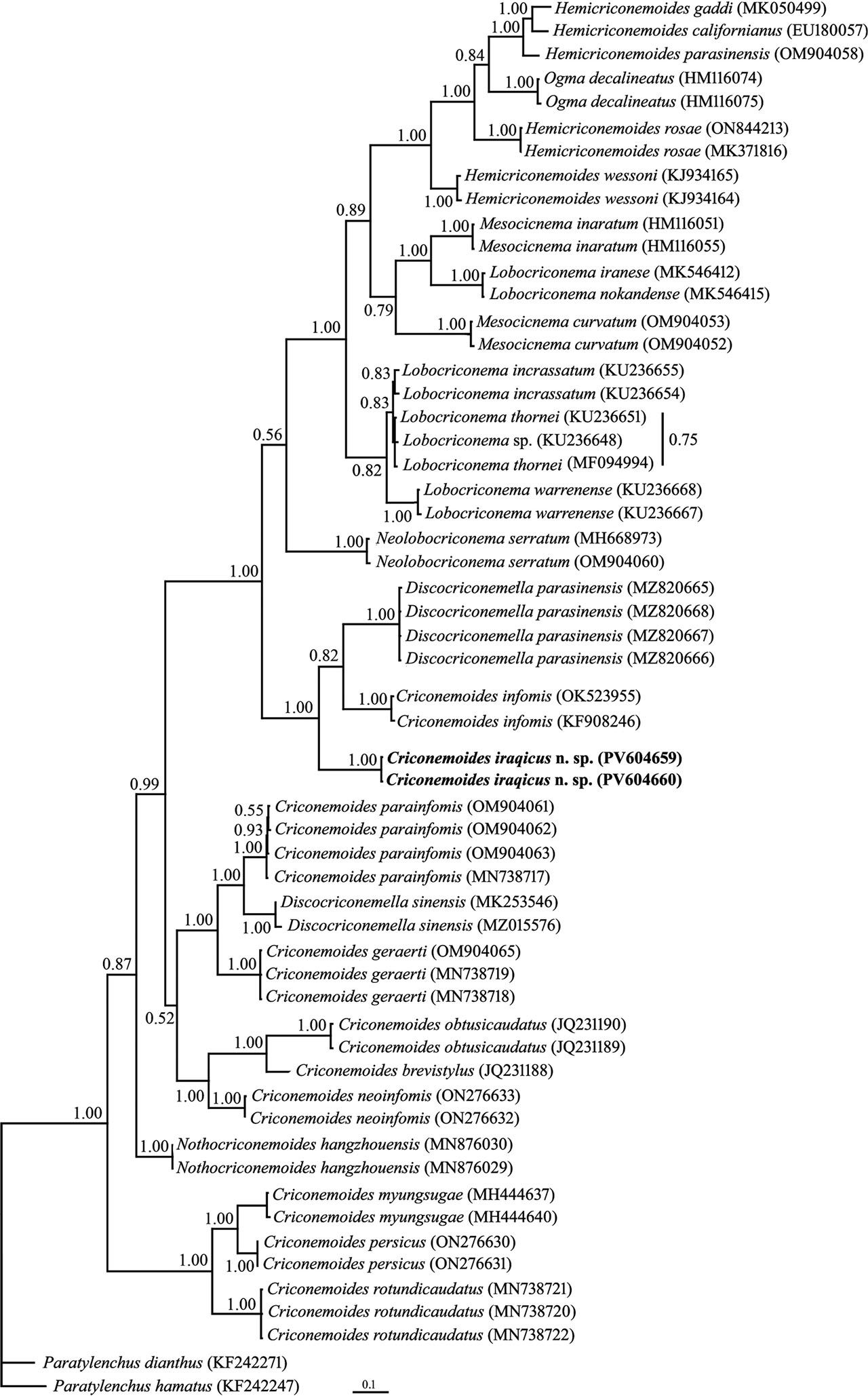
Figure 6:
Bayesian 50% majority rule consensus tree inferred from analysis of the ITS rDNA sequence of Criconemoides iraqicus n. sp. under the GTR + G + I model. BPP values more than 0.50 are given for appropriate clades. New sequences are indicated in bold. BPP, Bayesian posterior probability.