
Table 1:
Entomopathogenic nematode strains used in virulence experiments
| Entomopathogenic nematode | Strain | Abbreviation in manuscript | Commercial availability |
|---|---|---|---|
| Heterorhabditis bacteriophora | VS | Hb (VS) | Yes |
| H. floridensis | K22 | Hf (K22) | No |
| H. georgiana | Kesha | Hb (Kesha) | No |
| H. indica | HOM1 | Hi (HOM1) | Yes |
| Steinernema carpocapsae | All | Sc (All) | Yes |
| S. rarum | 17C+E | Sr (17C+E) | No |
| S. riobrave | 355 | Sr (355) | Yes |
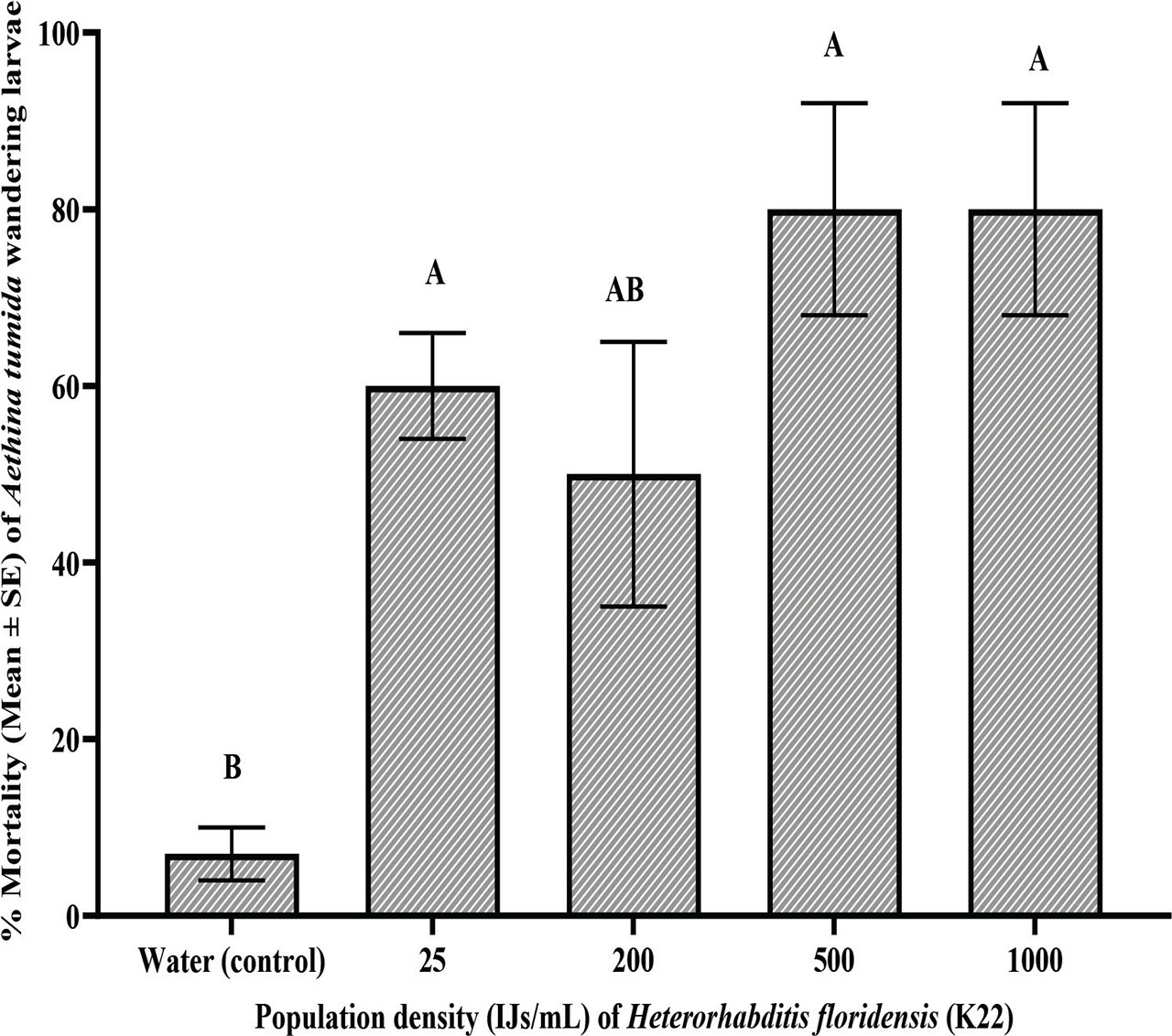
Figure 1:
Percent seven-day mortality (Mean ± s.e.) of Aethina tumida wandering larvae after treatment with four population densities of Heterorhabditis floridensis (K22). The data were graphed with one-way ANOVA using Tukey’s Kramer multiple comparison test. Different letters above the bars indicate significant differences (P < 0.05).
Table 2:
Mortality (%) of Aethina tumida wandering larvae after treatment with one of seven entomopathogenic nematodes (EPN) species after one of five inoculation days (1-, 2-, 3-, 7-, or 14-days post inoculation).
| Days post inoculation | Mean ± S.E. | |||||||
|---|---|---|---|---|---|---|---|---|
| Water (control) | Heterorhabditis bacteriophora (VS) | Heterorhabditis floridensis (K22) | Heterorhabditis georgiana (Kesha) | Heterorhabditis indica (HOM1) | Steinernema carpocapsae (All) | Steinernema rarum (17c+e) | Steinernema riobrave (355) | |
| 1 | 0 | 0 | 3 ± 3 | 0 | 0 | 0 | 0 | 0 |
| 2 | 0 | 3 ± 3 | 10 ± 5 | 8 ± 4 | 5 ± 5 | 5 ± 3 | 0 | 3 ± 3 |
| 3 | 0c | 13 ± 4abc | 10 ± 5abc | 8 ± 4abc | 5 ± 3bc | 25 ± 7ab | 30 ± 8a | 5 ± 3bc |
| 7 | 3 ± 3d | 53 ± 5bc | 88 ± 4a | 44 ± 8c | 53 ± 12bc | 100a | 80 ± 8ab | 88 ± 6a |
| 14 | 10 ± 3d | 70 ± 5bc | 100 ± 4a | 78 ± 6ab | 45 ± 10c | 100a | 78 ± 11ab | 93 ± 5ab |
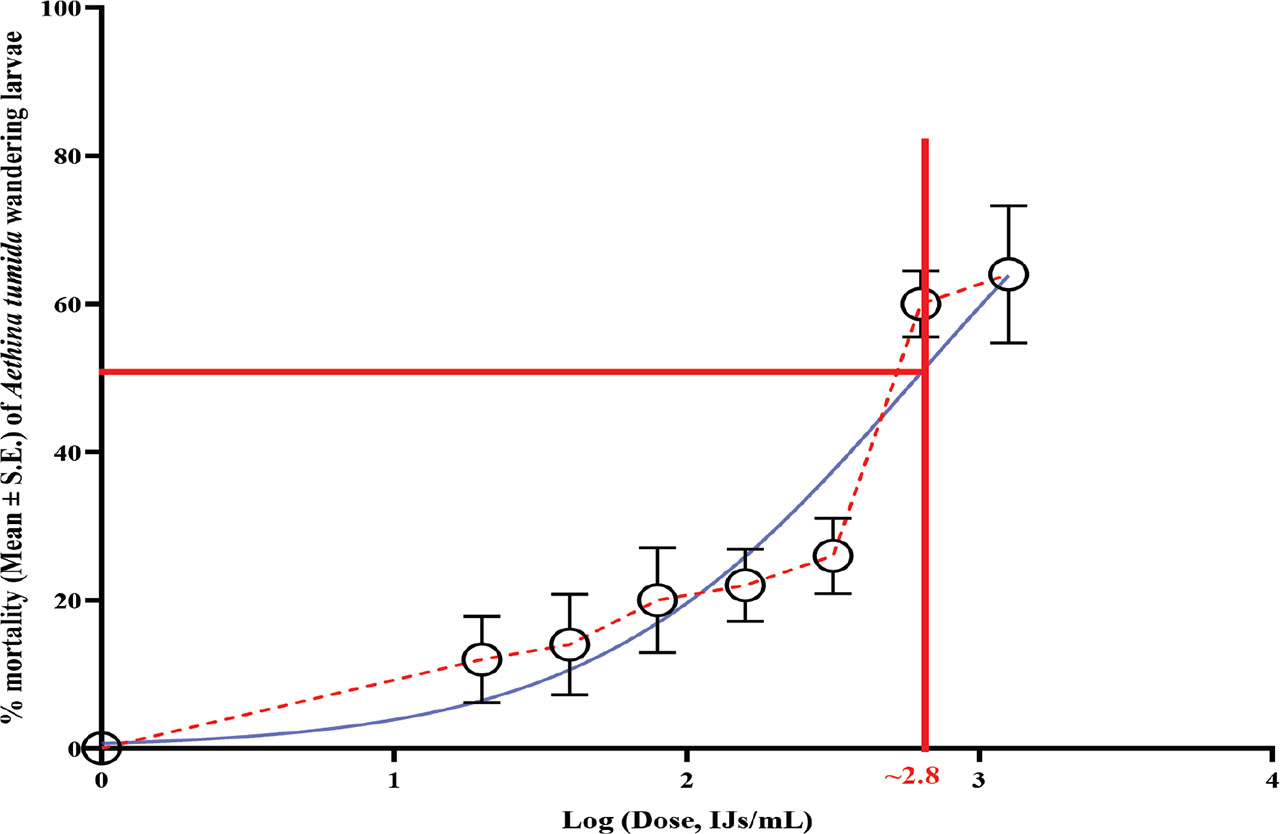
Figure 2:
Dose-response curve showing the mortality of Aethina tumida wandering larvae given increasing doses of Heterorhabditis floridensis (K22). The dashed red curve represents actual observations. Solid red lines show the intersection of the log dose and 50% mortality to find the LD50, represented by the black star. The model fit was evaluated with R2 = 0.70.
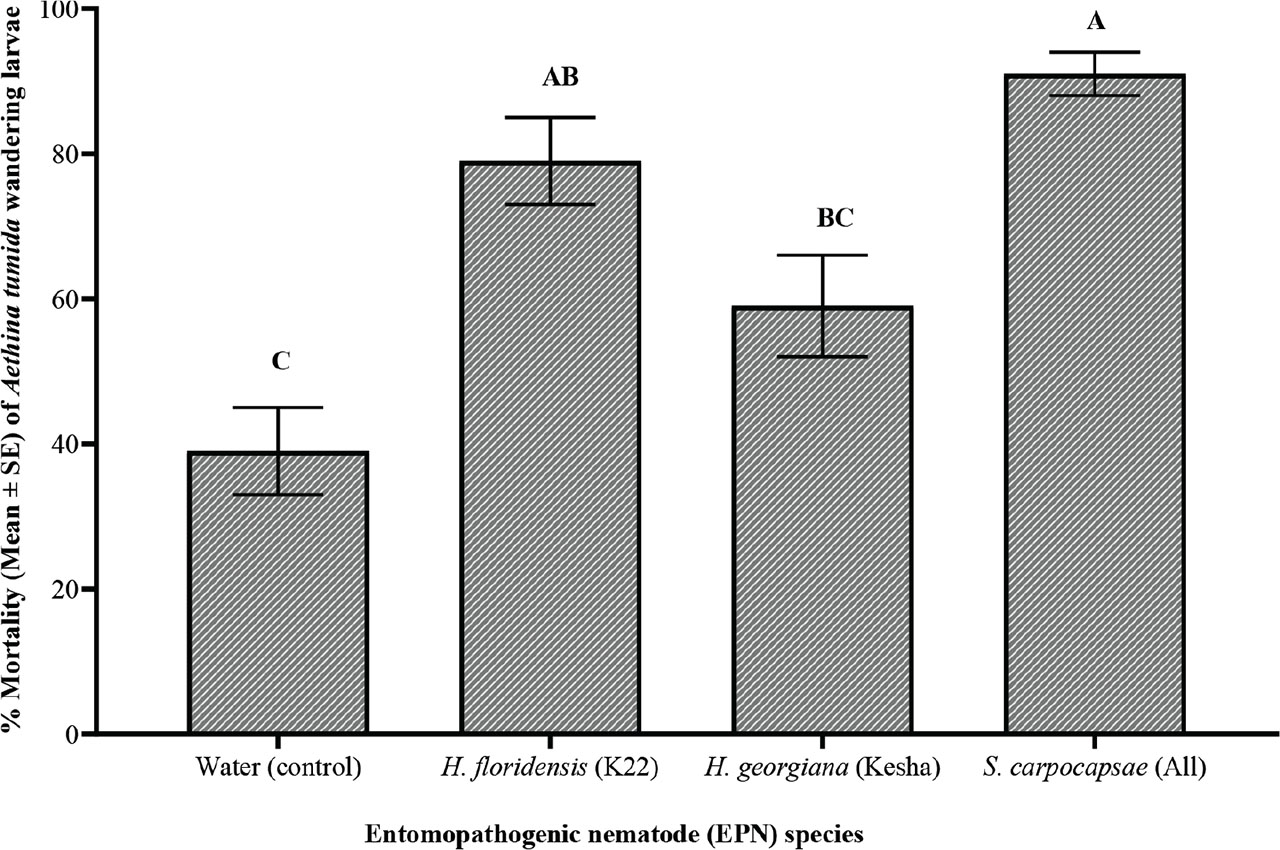
Figure 3:
Percent mortality (Mean ±SE) of Aethina tumida wandering larvae after treatment with one of three entomopathogenic nematodes (EPN) species: Steinernema carpocapsae (All), Heterorhabditis floridensis (K22), and H. georgiana (Kesha) after different inoculation weeks (3, 4, 5, or 6 weeks post-inoculation) in the laboratory persistence experiment. The data were graphed with one-way ANOVA using Tukey’s Kramer multiple mean comparison test. Different letters above the bars indicate significant differences (P < 0.05).
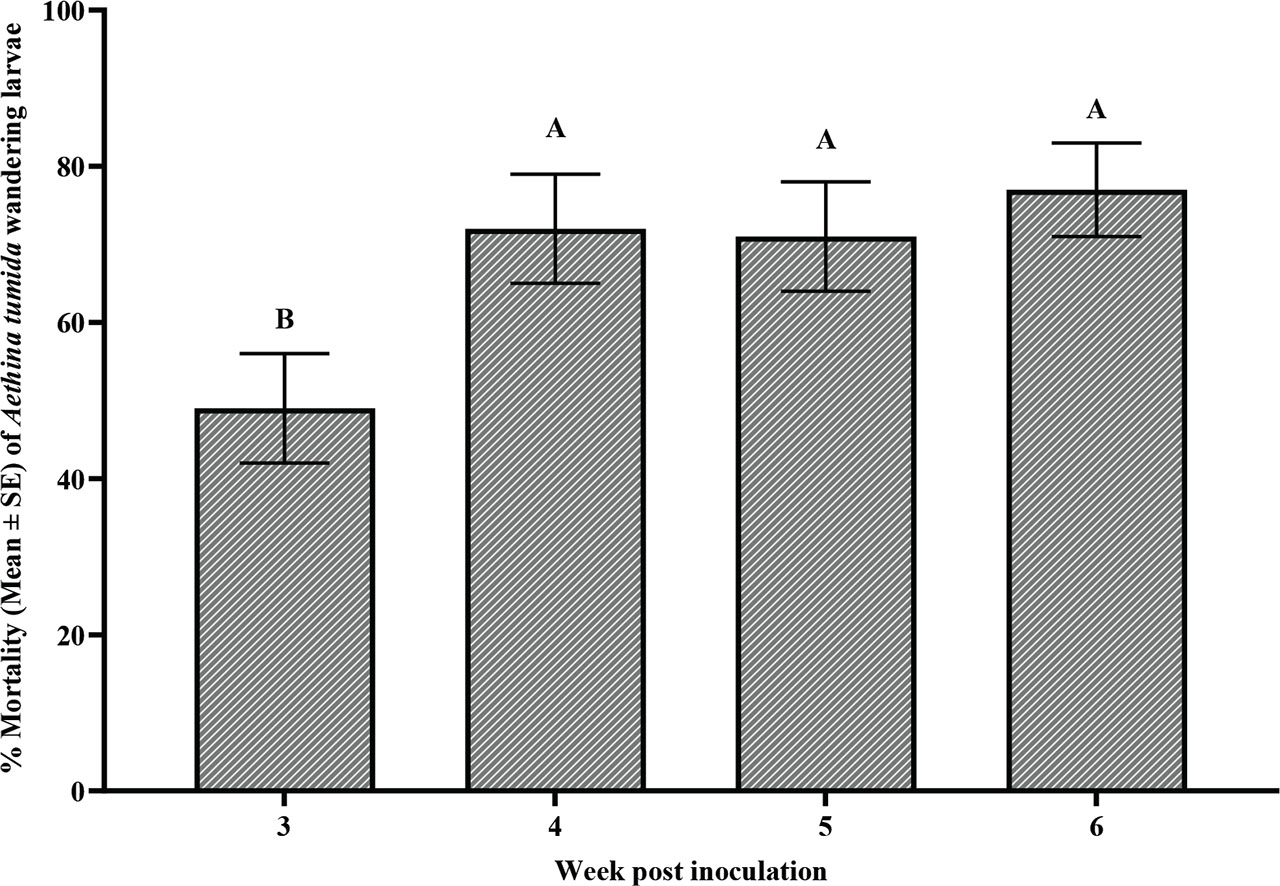
Figure 4:
Percentage mortality (Mean ±SE) of Aethina tumida wandering larvae following inoculation with entomopathogenic nematodes infective juveniles after four different inoculation weeks (3-, 4-, 5-, or 6-weeks post inoculation) in the laboratory persistence experiment. The data were pooled utilizing three nematode strains. Different letters above bars indicate significant differences (P < 0.05, Tukey’s Kramer multiple mean comparison test).
Table 3:
Mean percent mortality (± s.e.) of Aethina tumida wandering larvae after treatments with two entomopathogenic nematodes (EPN) species after six incubation weeks (1-, 2-, 3-, 4-, 5-, and 6 weeks post-inoculation) in the greenhouse persistence experiment.
| Week post inoculation | Water (control) | Heterorhabditis floridensis (K22) | Steinernema carpocapsae (All) |
|---|---|---|---|
| 1 | 28 ± 10.1aB | 70.6 ± 6.27bA | 86 ± 6.86abA |
| 2 | 28 ± 10.1aB | 84 ± 5.31abA | 85.33 ± 4.42abA |
| 3 | 28 ± 10.1aB | 100 ± 0.00aA | 98.66 ± 0.81aA |
| 4 | 44 ± 23.1aA | 72.66 ± 3.71bA | 69.33 ± 3.85bcA |
| 5 | 44 ± 13.2aA | 68 ± 5.22bA | 56.66 ± 5.27cA |
| 6 | 44 ± 13.2aB | 93.33 ± 1.05aA | 94.66 ± 2.70aA |
[i] Means followed by different lowercase letters in each column are significantly different (P < 0.05) among EPN strains within each incubation week. Means followed by different uppercase letters in each row significantly differ (P < 0.05, Tukey’s test) among incubation weeks within each EPN strain.