
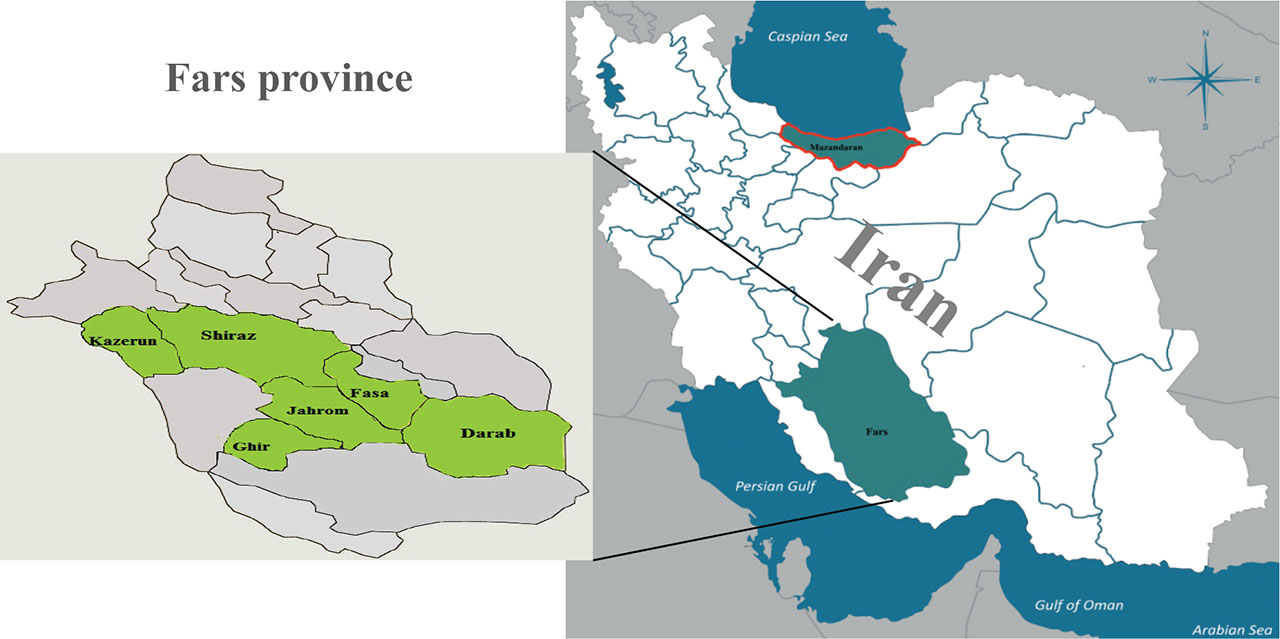
Figure 1:
Geographical location of the sampled areas. The majority of the samples were collected in the citrus-growing regions (known as the citrus belt) of Fars province, southern Iran (shown in green: Kazerun, Shiraz, Ghir, Jahorm, Fasa and Darab). Two samples were also collected from Mazandaran province in northern Iran (shown with red border).
Table 1:
The sampling sites of Tylenchulus semipenetrans the corresponding GenBank accession numbers for ITS, D2-D3 expansion segments of 28S and COI mtDNA sequences obtained in this study.
| Soil sample codes | GPS location | Locality | Host (Citrus spp.) | rDNA genes | Mt DNA COI | ||
|---|---|---|---|---|---|---|---|
| latitude | longitude | D2–D3 | ITS | ||||
| 25 | 28.6694 | 53.60647 | Qotb Abad, Jahrom | C. limetta | OP723626 | OP722727 | OP739535 |
| 32 | 28.52135 | 53.67221 | Jahrom | C. sinensis | OP723604 | OP722708 | OP739514 |
| 42 | 29.57487 | 51.73012 | Ahmad Abad, Kazerun | C. sinensis | OP723627 | OP722728 | OP739536 |
| 112 | 28.95546 | 53.60143 | Phase-e5, Fasa | C. sinensis | OP723629 | OP722729 | OP739537 |
| 411 | 29.62299 | 51.58779 | Hasan Abad, Kazerun | C. sinensis | OP723616 | OP722718 | OP739524 |
| 678 | 28.99909 | 53.12713 | Aliabad, Khafr | C. aurantium | OP723630 | OP722730 | - |
| 682 | 28.98881 | 53.15637 | Balashahr, Khafr | C. sinensis | - | - | - |
| 698 | 28.51967 | 53.60683 | Heydarabad, Jahrom | C. limetta | OP723597 | - | OP739507 |
| 707 | 28.53547 | 53.65353 | Najib Abad, Jahrom | C. aurantium | OP723610 | OP722704 | OP739510 |
| 710 | 28.5391 | 53.53022 | Maghsudabad, Jahrom | C. limetta | OP723606 | OP722696 | OP739515 |
| 712 | 28.5397 | 53.53049 | Maghsudabad, Jahrom | C. aurantium | OP723631 | OP722731 | OP739538 |
| 716 | 28.47551 | 53.49098 | Mill, Jahrom | C. aurantium | OP723607 | OP722710 | OP739516 |
| 717 | 28.66863 | 53.60608 | Qotb Abad, Jahrom | C. limetta | OP723591 | OP722698 | OP739501 |
| 720 | 28.66878 | 53.6059 | Yousofabad, Jahrom | C. limetta | OP723592 | OP722699 | OP739502 |
| 733 | 28.93138 | 53.60712 | Kazemabad, Fasa | C. sinensis | OP723601 | OP722705 | OP739511 |
| 735 | 28.97311 | 53.63675 | Banyan, Fasa | C. sinensis | OP723613 | OP722715 | OP739521 |
| 737 | 28.95768 | 53.5981 | Phase-e5, Fasa | C. sinensis | OP723614 | OP722716 | OP739522 |
| 743 | 29.03657 | 53.64304 | Akbarabad, Fasa | C. bigaradia | OP723615 | OP722717 | OP739523 |
| 746 | 28.668855 | 54.665161 | Bagh-e Morakabat, Darab | C. sinensis | OP723628 | OP722722 | OP739529 |
| 749 | 28.72201 | 54.57227 | Naghsh Shapour, Darab | C. sinensis | OP723632 | OP722732 | OP739539 |
| 755 | 28.67927 | 54.65618 | Jannat Shahr, Darab | C. bigaradia | OP723639 | OP722738 | OP739546 |
| 759 | 28.64105 | 54.64284 | Deh Kheyr Payin, Darab | C. sinensis | OP723633 | OP722733 | OP739540 |
| 763 | 28.75331 | 54.44562 | Sharak-e Sarollah, Darab | C. sinensis | OP723618 | OP722719 | OP739526 |
| 765 | 28.95749 | 53.60026 | Hasan Abad, Darab | C. limetta | OP723634 | - | OP739541 |
| 771 | 28.786689 | 54.339938 | Fasarood, Darab | C. aurantium | OP723593 | OP722700 | OP739503 |
| 772 | 28.687654 | 54.647131 | Zein Abad Sangi, Darab | C. sinensis | OP723608 | OP722712 | OP739517 |
| 773 | 28.76994 | 54.22515 | Eij, Darab | C. sinensis | OP723602 | OP722706 | OP739512 |
| 777 | 28.445396 | 53.042906 | Gandoman, Karzin | C. reticulata | OP723594 | OP722701 | OP739504 |
| 780 | 28.442301 | 53.143399 | Emam Shahr, Ghir | C. limetta | OP723596 | OP722702 | OP739506 |
| 785 | 28.34352 | 53.25282 | Tang-e Ruein, Ghir | C. aurantium | OP723636 | OP722735 | OP739543 |
| 789 | 28.452529 | 53.127036 | Deh Beh, Ghir | C. aurantium | OP723609 | OP722711 | OP739518 |
| 793 | 28.285395 | 53.074062 | Mand, Karzin | C. bigaradia | OP723619 | OP722720 | OP739527 |
| 795 | 28.328269 | 53.038029 | Eslam Abad, Karzin | C. aurantium | OP723620 | OP722721 | OP739528 |
| 801 | 29.56717 | 51.75703 | Ahmadabad, Kazerun | C. aurantium | OP723611 | OP722713 | OP739519 |
| 802 | 29.56924 | 51.75969 | Ahmadabad, Kazerun | C. aurantium | OP723637 | OP722736 | OP739544 |
| 812 | 29.79435 | 51.57338 | Ganjeii, Kazerun | C. sinensis | OP723640 | OP722739 | OP739547 |
| 818 | 29.7594 | 51.55155 | Sheykhi, Kazerun | C. sinensis | OP723642 | OP722741 | OP739549 |
| 821 | 29.72973 | 51.53522 | Anarestan, Kazerun | C. sinensis | OP723612 | OP722714 | OP739520 |
| 882 | 29.56109 | 51.77738 | Zavali, Kazerun | C. aurantium | OP723638 | OP722737 | OP739545 |
| 908 | 29.00358 | 53.11102 | Karadeh, Khafr | C. aurantium | OP723603 | OP722707 | OP739513 |
| 921 | 28.92434 | 53.33666 | Khavaran, Khafr | C. sinensis | OP723641 | OP722740 | OP739548 |
| 740-2 | 28.89014 | 53.68479 | Dastjeh, Fasa | C. sinensis | OP723617 | - | OP739525 |
| Ami | 28.96260 | 54.04458 | Darab | C. aurantium | OP723621 | OP722723 | OP739530 |
| ARE | 29.61910 | 52.57446 | Sardaran, Shiraz | C. limetta | OP723635 | OP722734 | OP739542 |
| Beh | 28.47110 | 53.03187 | Karzin | C. aurantium | OP723622 | OP722724 | OP739531 |
| Behz-Greenhouse | 29.63544 | 52.52485 | Eram Garden, Shiraz | C. aurantium | OP723623 | OP722725 | OP739532 |
| Sh1 | 36.613791 | 53.258824 | Behshahr1, Mazandaran | C. sinensis | OP723624 | - | OP739533 |
| Sh2 | 36.625476 | 52.931576 | Behshahr2, Mazandaran | C. sinensis | OP723625 | OP722726 | OP739534 |
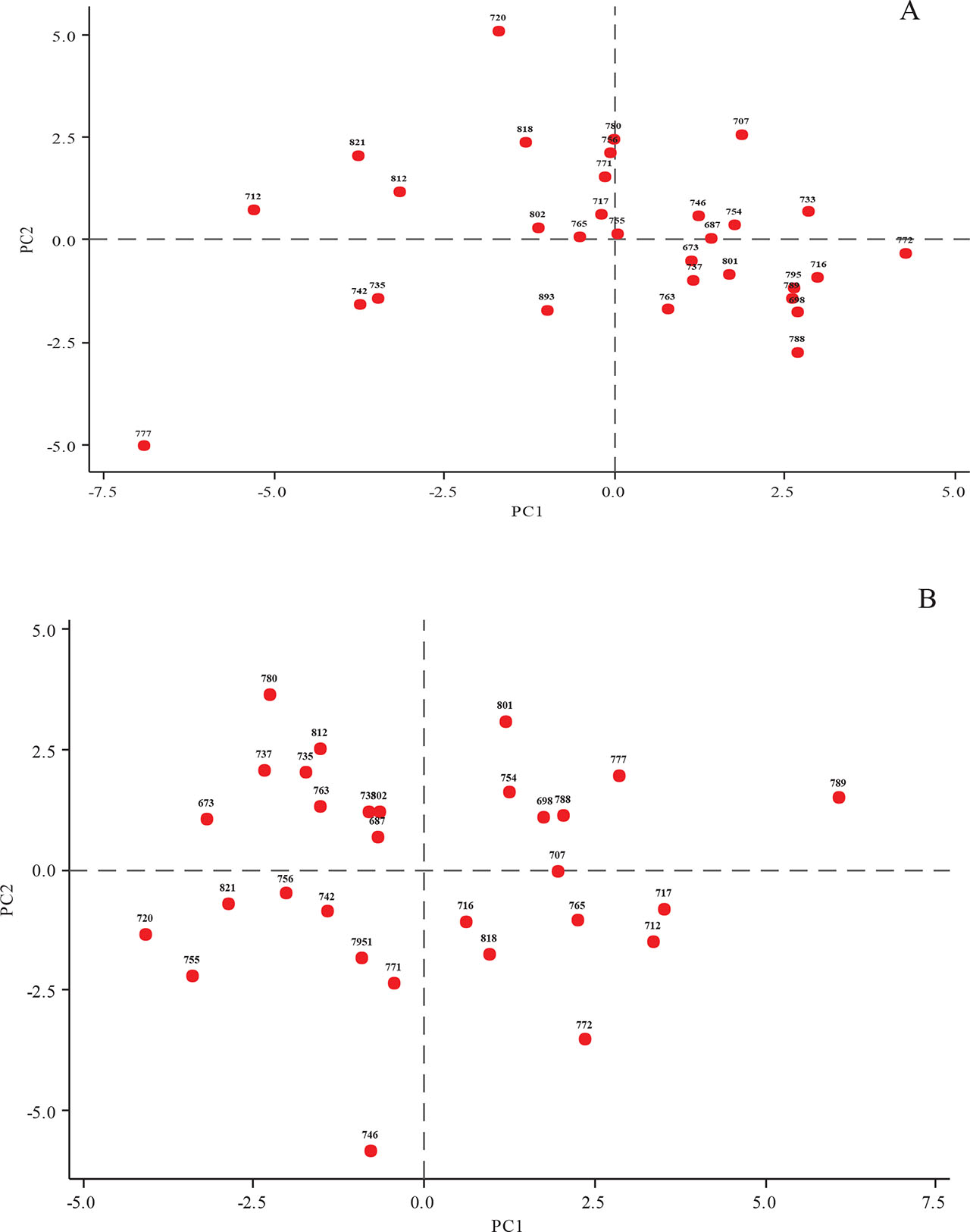
Figure 2:
Principal Component Analysis (PCA) performed on populations of Tylenchulus semipenetrans collected from citrus orchards in Fars province, focusing on the morphometric characteristics of the second-stage juveniles (A) and males (B).
Table 2:
The primers used in this study for identification and genetic diversity of Tylenchulus semipenetrans populations.
| Primer code | Primer sequence (5′-3′) | Product size (bp) | Target region | References |
|---|---|---|---|---|
| 18S | TTGATTAGGTCCCTGCCCTTT | 967 | ITS1-5.8S-ITS2 | Marek et al., 2010 |
| 21S | TTTCACTCGCCGTTACTAAGG | |||
| TW81F | GTTTCCGTAGGTGAACCTGC | 809–841 | ITS1-5.8S-ITS2 | Tanha Maafi et al., 2003 |
| AB28R | ATATGCTTAAGTTCAGCGGGT | |||
| Ts2-IF | TTCGAGAAACTTGGGGATTGGC | 770 | ITS1-5.8S-ITS2 | Present study |
| Ts2-IR | CAGGGACCTATGATCAAGTGCT | T. semipenetrans specific | ||
| D2AF | ACAAGTACCGTGAGGGAAAGTTG | 774–777 | 28S D2-D3 | Subbotin et al., 2006 |
| D3BR | TCGGAAGGAACCAGCTACTA | |||
| COI-F5 | AATWTWGGTGTTGGAACTTCTTGAAC | 790 | Cytochrome oxidase subunit I | Powers et al., 2014 |
| COI-R9 | CTTAAAACATAATGRAAATGWGCWACW | |||
| ACATAATAAGTATC- |
Table 3:
Summary information of single nucleotide variations (SNV) and/or single nucleotide polymorphism (SNPs) analysis in this study for identification and genetic diversity of Tylenchulus semipenetrans populations from Fars province, Iran.
| Locus | No. of sites | Segregating sites or SNVs | SNPs | No. of haplotypes | Nucleotide diversity | Tajima’s D | Sequence conservation | Min recombination |
|---|---|---|---|---|---|---|---|---|
| COI | 603 | 16 | 11 | 10 | Pi: 0.00767 | D: 0.89661 | C: 0.973 | 1 |
| D2D3 | 676 | 24 | 12 | 33 | Pi: 0.00535 | D: −1.02740 | C: 0.964 | 6 |
| ITS | 597 | 17 | 11 | 16 | Pi: 0.00515 | D: −0.89706 | C: 0.972 | 2 |
Table 4:
Morphometrics of males of 30 populations (five specimens each) of Tylenchulus semipenetrans, collected from citrus orchards of Fars Province, Iran. Data are given as mean ± standard deviation (range) of population means or specimens. Measurements are in μm.
| Characters | Means of populations | Specimens |
|---|---|---|
| n | 30 | 143 |
| L | 346 ± 13.2 (318.3–375) | 347 ± 21 (296–424) |
| a | 34.9 ± 1.9 (31.7–39.7) | 34.9 ± 2.8 (29.6–44.9) |
| b | 3.4 ± 0.2 (3.1–3.8) | 3.5 ± 0.2 (2.8–4.3) |
| c | 9.7 ± 0.5 (8.5–10.8) | 9.7 ± 0.7 (8.0–12.1) |
| c’ | 4.7 ± 0.3 (4.1–5.5) | 4.7 ± 0.5 (3.5–6.1) |
| Stylet | 8.4 ± 0.4 (7.7–9.2) | 8.4 ± 0.6 (7–11.1)a |
| Conus | 4.9 ± 0.3 (4.3–5.7) | 4.9 ± 0.5 (3.5–6.4) |
| Anterior end to the center of the median bulb | 43.7 ± 3.2 (34.2–50) | 43.7 ± 4.6 (31–64) |
| Pharynx length | 100 ± 4.8 (90–111) | 101 ± 7.6 (83–123) |
| Anterior end to hemizonid | 65.6 ± 2.8 (58.6–70.6) | 65.6 ± 4.1 (52–77) |
| Anterior end to nerve ring | 61.1 ± 3.0 (53.0–66.7) | 61.1 ± 4.2 (48.5–72.5) |
| Secretory-excretory pore (S. E. pore) to cloaca | 100 ± 6.1 (87–110) | 101 ± 8.9 (75–119.5) |
| Anterior end to S. E. pore | 231 ± 20.7 (198–279) | 229 ± 44 (161–333) |
| S. E. pore from the anterior end (% of L) | 66.9 ± 5.3 (58.0–78.) | 66 ± 12 (54–91.2) |
| Median bulb width | 4.5 ± 0.6 (3.2–5.6) | 4.5 ± 0.7 (2.7–6.2) |
| Median bulb length | 11.2 ± 0.9 (9.3–13.0) | 11.2 ± 1.4 (7.1–14) |
| Median bulb length/diam. Ratio | 252 ± 30.3 (199–328) | 251 ± 41 (176–385) |
| Max. body width (BW) | 10.0 ± 0.5 (9.1–11.0) | 10.0 ± 0.8 (8.3–13) |
| BW in Pharynx | 8.8 ± 0.4 (8.0–9.6) | 8.8 ± 0.6 (7.3–10.7) |
| Anal BW | 7.7 ± 0.5 (7.3–10.2) | 7.7 ± 0.9 (6.7–16.4) |
| Spicules (curved median line) | 16.6 ± 0.7 (15.5–17.8) | 16.6 ± 1.1 (14–20) |
| Gubernaculum | 3.7 ± 0.3 (3.1–4.3) | 3.7 ± 0.5 (2.5–5.0) |
| Tail | 36.0 ± 2.4 (33.1–42.0) | 36 ± 3.4 (29–47.5) |
| M | 0.6 ± 0.0 (0.5–0.6) | 60 ± 6 (41–77) |
| Stylet / L (%) | 2.4 ± 0.1 (2.2–2.6) | 2.4 ± 0.2 (2.1–3.2) |
| S. E. pore / L (%) | 66.9 ± 5.3 (58.0–78.7) | 66 ± 12 (53.9–91.2) |
Table 5:
Morphometrics of the second-stage juveniles of 31 populations (five specimens each) of Tylenchulus semipenetrans, collected from citrus orchards of Fars Province, Iran. Data are expressed as mean ± standard deviation (range) of population means or specimens. Measurements are in μm.
| Character/Population code | Means of populations | Specimens |
|---|---|---|
| n | 31 | 154 |
| L | 331 ± 12.1 (304–349) | 332 ± 18 (276–376) |
| a | 27.6 ± 1.1 (24.3–29.7) | 28 ± 2 (22.4–34.7) |
| b | 3.5 ± 0.1 (3.2–3.7) | 3.5 ± .2 (3.1–4.1) |
| Stylet | 11.4 ± 0.3 (11–11.8) | 11.4 ± .4 (10.4–12.4) |
| Conus | 6.1 ± 0.2 (5.5–6.7) | 6.1 ± .4 (4.8–7.3) |
| Anterior end to the center of the median bulb | 46.7 ± 1.6 (43.4–49.5) | 46.8 ± 2.4 (39.9–53) |
| Pharynx length | 94 ± 3.7 (85–103) | 95 ± 5 (76–106.5) |
| MB | 49.3 ± 1.2 (45.5–51) | 49 ± 2 (41–55) |
| Anterior end to hemizonid | 66.1 ± 2.2 (61.3–70.4) | 66 ± 3.4 (58–77) |
| Anterior end to secretory-excretory pore (S. E. pore) | 183 ± 7.5 (168–196) | 183 ± 12 (147–222) |
| Anterior end to nerve ring | 61.1 ± 2.3 (57.1–66.6) | 61 ± 3 (51–71) |
| S. E. pore to genital primordium (GP) | 19.4 ± 2.8 (12.8–24.9) | 20 ± 4.2 (12–32) |
| Anterior end to GP | 200 ± 6.7 (184–212) | 200 ± 10 (165–222) |
| GP length | 12.6 ± 1.6 (9.8–17.4) | 13 ± 2 (8.5–21) |
| GP to the posterior end | 118 ± 7.4 (101–130) | 119 ± 11.7 (90–155) |
| Excretory pore from the anterior end (% of L) | 56.2 ± 2.1 (53.2–60.4) | 56 ± 3 (47–64) |
| Anterior end to GB (% of L) | 60.6 ± 1.3 (58.4–63.2) | 60 ± 2 (54–67) |
| Median bulb width | 6.2 ± 0.3 (5.4–6.6) | 6 ± .5 (4.9–7.5) |
| Median bulb length | 13.2 ± 0.9 (11.9–16) | 13 ± 1.4 (10–18) |
| Median bulb length/diam. ratio | 211 ± 16.5 (182–262) | 212 ± 26 (104–282) |
| body width (BW) in Pharynx | 11.2 ± 0.4 (10.3–11.9) | 11 ± .6 (9.6–13) |
| Max. BW | 12.0 ± 0.4 (10.7–12.6) | 12 ± .6 (10–14) |
| M | 0.5 ± 0.02 (0.5–0.6) | .5 ± 0 (.4–.7) |
| Stylet / L (%) | 3.5 ± 0.1 (3.2–3.9) | 3.4 ± .2 (3–4) |
| S. E. pore / L (%) | 55.4 ± 2.1 (51.8–60) | 55 ± 3 (47–64) |
Table 6:
Single nucleotide polymorphism in the alignment of the citrus nematode (Tylenchulus semipenetrans) ITS of rDNA gene partial sequences.
| 32 | 37 | 46 | 71 | 92 | 122 | 139 | 151 | 159 | 161 | 162 | 188 | 225 | 354 | 405 | 423 | 523 | ||
|---|---|---|---|---|---|---|---|---|---|---|---|---|---|---|---|---|---|---|
| T. semipenetrans JN112270.1 | CD1_cl2 | A | G | G | T | C | A | G | C | A | C | T | T | C | T | C | C | C |
| TsA (n = 20) | 37, 42, 112, 678, 706, 716, 717, 733, 743, 755, 763, 777, 778, 789, 795, 821,882, 921 BEHZ & SH2 | A | G | G | T | C | A | G | C | A | C | T | T | C | T | C | C | C |
| TsB (n = 6) | 707, 710, 754, 801, 818 & ARE | C | A | G | A | C | A | G | C | A | C | T | T | C | T | C | C | C |
| TsC (n = 1) | 812 | C | A | G | T | C | A | G | C | A | C | C | T | C | T | C | C | C |
| TsD (n = 3) | 720, 773 & 802 | C | A | A | A | C | A | C | C | A | C | T | T | C | T | C | C | C |
| TsE (n = 1) | 785 | C | A | G | A | C | A | A | C | A | C | T | C | T | T | C | C | C |
| TsF (n = 1) | 759 | C | A | G | A | T | A | A | C | A | C | T | C | C | T | C | C | C |
| TsG (n = 6) | 712, 735, 737, 749, 771, & 908 | A | G | G | T | C | A | G | C | A | C | C | T | C | T | C | C | C |
| TsH (n = 1) | 25 | C | A | G | A | T | A | A | C | A | T | T | C | C | T | C | C | C |
| TsI (n = 1) | BEH | A | G | G | T | C | A | G | C | A | C | T | T | T | T | C | C | C |
| TsJ (n = 1) | AMI | A | G | G | T | C | A | G | C | A | C | T | C | C | T | C | C | C |
| TsK (n = 1) | 746 | C | A | G | A | T | A | A | C | A | C | T | C | C | A | T | C | T |
| TsL (n = 1) | 793 | C | A | G | A | C | A | G | C | G | C | T | T | C | T | C | C | C |
| TsM (n = 1) | 411 | C | A | G | T | T | A | A | C | A | C | T | C | C | T | C | C | C |
| TsN (n = 1) | 772 | C | A | G | T | C | A | G | T | T | C | T | T | C | T | C | T | T |
| TsO (n = 1) | 32 | C | A | G | A | T | G | A | C | A | C | T | C | C | T | C | C | C |
| TsP (n = 1) | 780 | C | G | G | T | C | A | G | C | A | C | C | T | C | T | C | C | C |
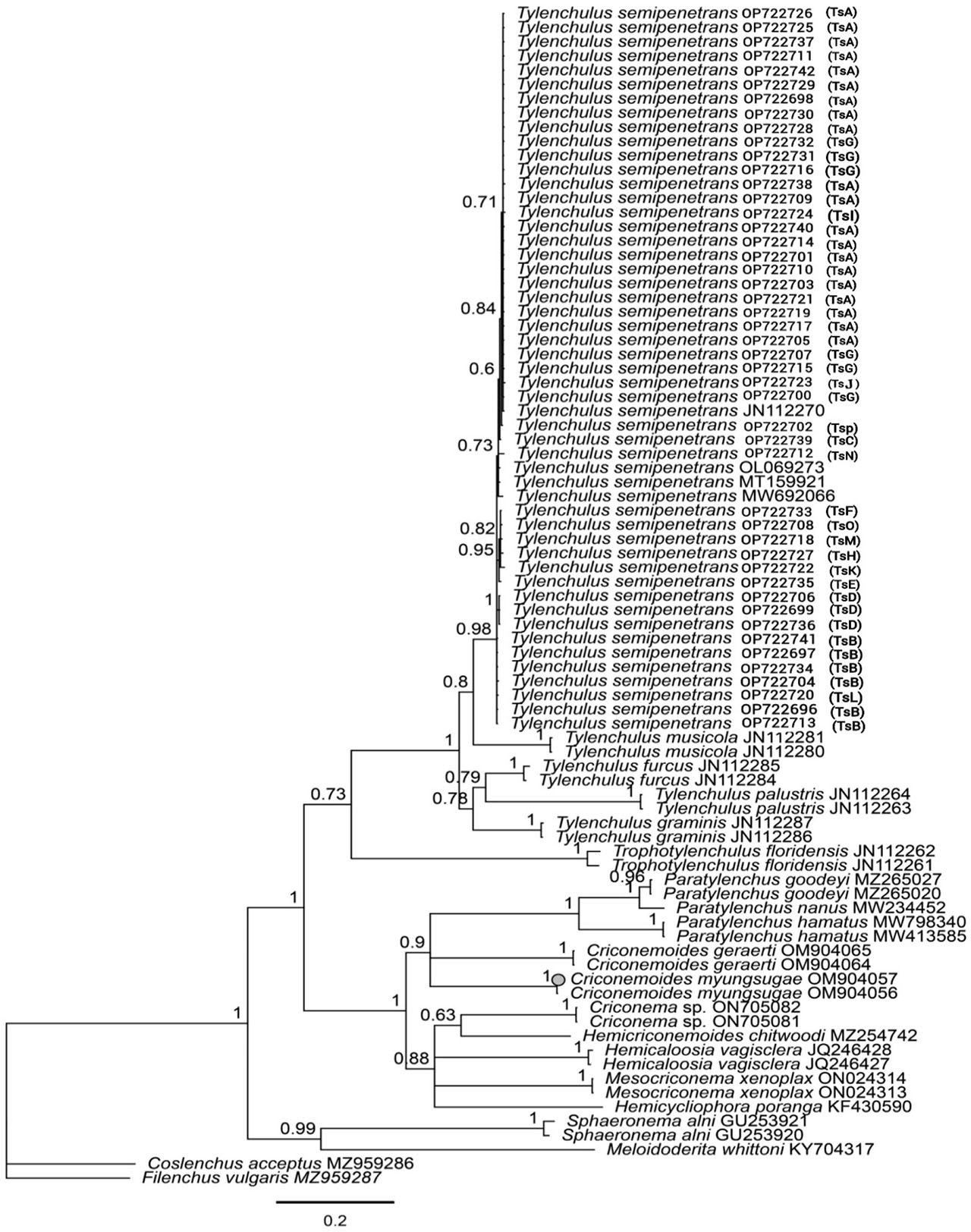
Figure 3:
Bayesian phylogenetic tree of Tylenchulus semipenetrans isolates from citrus orchards in Fars province based on the ITS of rDNA sequences, analyzed under the General Time Reversible with a gamma distribution (GTR + G) model. Numbers at nodes are posterior probability values. Sequences with codes in the parentheses generated in this study. The codes in parentheses indicate the haplotype of the relevant population.
Table 7:
Single nucleotide polymorphism in the alignment of the citrus nematode (Tylenchulus semipenetrans) D2-D3 of 28 S rDNA gene.
| 34 | 55 | 59 | 73 | 84 | 94 | 104 | 113 | 119 | 125 | 157 | 167 | 223 | 238 | 260 | 263 | 340 | 355 | 369 | 456 | 497 | 502 | 616 | 661 | ||
|---|---|---|---|---|---|---|---|---|---|---|---|---|---|---|---|---|---|---|---|---|---|---|---|---|---|
| T. semipenetrans KM598334.1 | ES-Jirof2 | G | C | T | C | C | T | A | G | G | A | C | G | T | T | C | C | G | C | G | A | C | T | G | A |
| Ts1 (n = 6) | 720, 773, 32, 759, 765 & 818 | G | C | T | C | C | T | A | G | G | A | C | G | T | T | C | C | G | C | G | A | C | T | G | A |
| Ts2 (n = 2) | BEH & 921 | G | C | T | C | T | T | A | G | G | A | C | C | T | T | C | C | T | C | G | A | T | T | G | A |
| Ts3 (n = 2) | AMI & 812 | G | C | T | C | T | T | A | G | G | A | C | C | T | T | C | C | T | C | G | A | C | T | G | A |
| Ts4 (n = 1) | 755 | G | C | T | C | C | T | A | G | G | A | C | G | G | C | C | C | G | C | G | G | C | T | G | A |
| Ts5 (n = 1) | 882 | G | C | T | C | C | T | A | G | G | A | C | G | T | C | C | C | G | C | G | G | C | T | A | A |
| Ts6 (n = 1) | 802 | G | C | T | C | T | T | A | G | G | A | C | G | T | T | C | C | T | C | T | A | C | T | G | A |
| Ts7 (n = 1) | 785 | G | C | T | C | C | T | A | A | G | A | C | G | T | T | C | C | G | C | G | A | C | T | G | A |
| Ts8 (n = 1) | ARE | G | C | T | C | T | T | A | G | G | A | C | C | T | T | C | C | T | T | G | A | T | T | G | A |
| Ts9 (n = 2) | 740 & 749 | G | C | T | C | C | T | A | G | G | G | C | G | T | T | C | C | G | C | G | A | C | T | G | A |
| Ts10 (n = 1) | 712 | G | C | T | C | C | T | A | G | G | G | T | G | T | T | C | C | G | C | G | A | C | T | G | A |
| Ts11 (n = 1) | 678 | G | C | T | C | T | T | A | G | G | A | C | G | T | C | C | C | G | C | G | A | C | T | G | A |
| Ts12 (n = 2) | 112 & 777 | G | C | T | C | T | T | A | G | G | A | C | C | T | T | C | T | T | C | G | A | T | T | G | A |
| Ts13 (n = 1) | 746 | G | C | T | C | C | T | T | G | G | G | T | G | T | T | C | C | G | C | G | A | C | T | G | A |
| Ts14 (n = 1) | 42 | G | C | T | C | T | T | A | G | G | A | C | G | T | T | C | C | T | C | G | A | C | T | G | A |
| Ts15 (n = 1) | 25 | G | C | T | C | C | T | A | G | T | G | C | G | T | T | C | C | G | C | G | A | C | T | G | A |
| Ts16 (n = 9) | 717, 698, 706, 716, 789, 821, 743, 763 & SH2 | G | C | T | C | C | T | A | G | G | A | C | G | T | C | C | C | G | C | G | G | C | T | G | A |
| Ts17 (n = 2) | 733 & SH1 | G | C | T | C | C | T | A | G | G | A | C | G | T | C | C | G | C | G | A | C | T | G | A | |
| Ts18 (n = 1) | BEHZ | G | C | T | C | C | T | A | G | G | A | C | C | T | T | C | C | T | C | G | A | C | T | G | A |
| Ts19 (n = 1) | 795 | G | C | T | C | T | T | A | G | G | A | C | G | T | C | C | C | T | C | G | A | C | T | G | A |
| Ts20 (n = 2) | 754 & 793 | G | C | T | C | C | T | A | G | G | G | T | G | T | T | T | C | G | C | G | A | C | T | G | A |
| Ts21 (n = 1) | 411 | G | C | T | C | C | T | A | G | G | A | C | G | T | T | C | C | G | C | G | A | C | C | G | A |
| Ts22 (n = 1) | 737 | G | C | T | C | T | T | A | G | G | A | C | G | T | T | C | C | G | C | G | A | C | T | G | A |
| Ts23 (n = 1) | 735 | G | C | T | C | T | T | A | G | G | G | T | G | T | T | C | C | T | C | G | A | C | T | G | A |
| Ts24 (n = 1) | 801 | G | C | T | C | T | T | A | G | G | A | C | C | T | T | C | C | T | C | T | A | T | T | G | A |
| Ts25 (n = 1) | 707 | G | C | T | C | T | T | A | G | G | A | C | G | T | C | C | C | G | C | T | A | C | T | G | A |
| Ts26 (n = 1) | 772 | T | C | C | G | T | T | A | G | G | A | C | G | T | T | C | C | T | C | G | A | C | T | G | A |
| Ts27 (n = 1) | 710 | G | C | T | C | T | T | A | G | G | A | C | C | T | T | C | C | G | C | G | A | C | T | G | A |
| Ts28 (n = 1) | 37 | G | T | C | C | C | T | A | G | G | A | C | G | T | T | C | C | G | C | G | A | C | T | G | A |
| Ts29 (n = 1) | 908 | G | C | T | C | C | C | A | G | G | G | C | G | T | T | C | C | G | C | G | A | C | T | G | A |
| Ts30 (n = 1) | 788 | G | C | T | C | T | T | A | G | G | A | C | G | T | C | C | C | G | C | G | G | C | T | G | A |
| Ts31 (n = 1) | 780 | G | C | T | C | C | T | A | G | G | G | T | G | T | T | C | C | G | C | T | A | C | T | G | A |
| Ts32 (n = 1) | 778 | G | C | T | C | T | T | A | G | G | A | C | C | T | C | C | C | G | C | G | A | C | T | G | A |
| Ts33 (n = 1) | 771 | G | C | T | C | C | T | A | G | G | G | T | G | T | T | C | C | G | C | G | A | C | T | G | C |
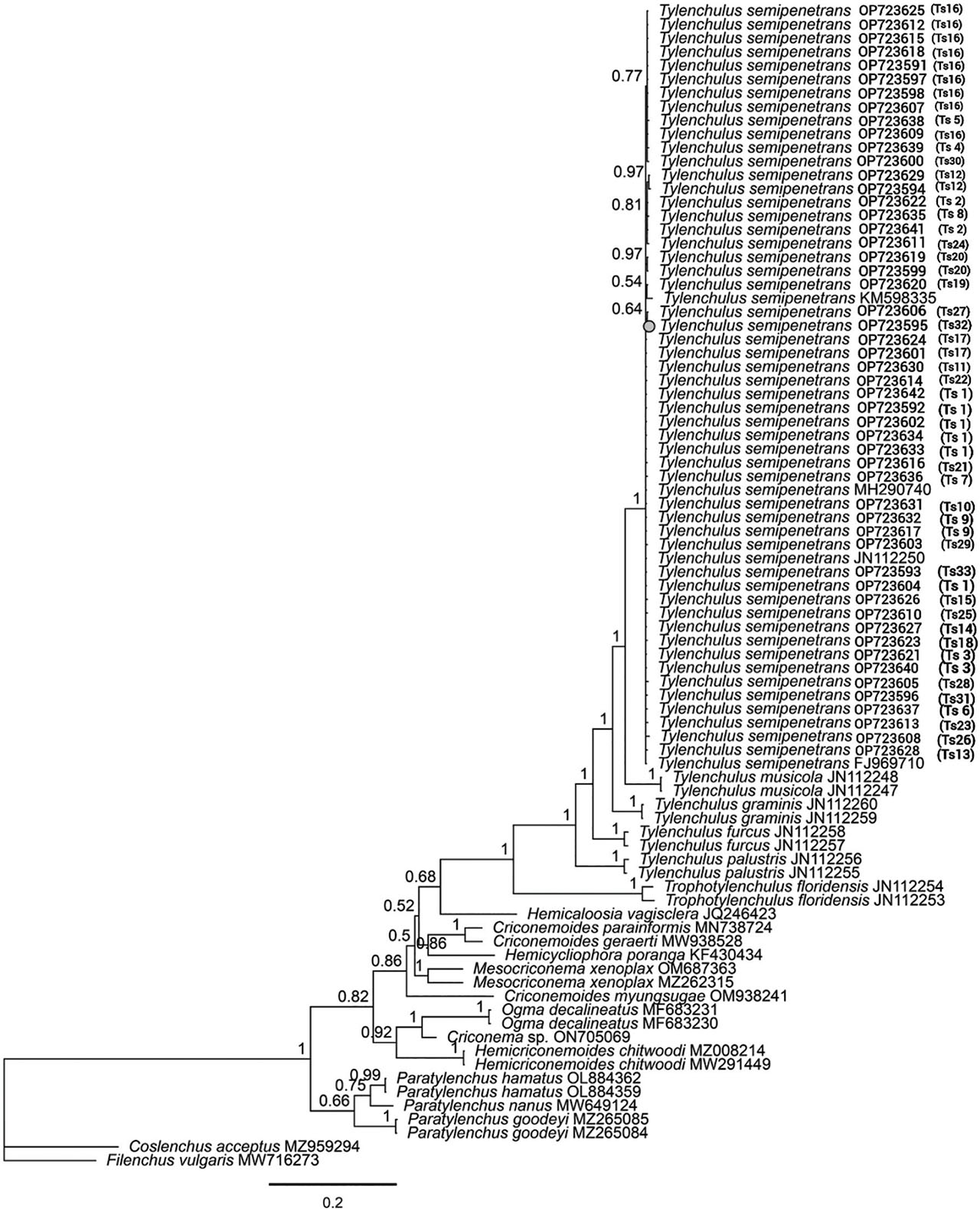
Figure 4:
Bayesian phylogenetic tree of Tylenchulus semipenetrans isolates from citrus orchards in Fars province based on D2-D3 28S rDNA partial sequences, analyzed by the General Time Reversible (GTR) model. The numbers shown at the nodes are posterior probability values. Sequences with codes in the parentheses generated in this study. The codes in parentheses indicate the haplotype of the relevant population.
Table 8:
Single nucleotide polymorphism (SNPs) in the alignment of the citrus nematode (Tylenchulus semipenetrans) COI mtDNA partial gene.
| 49 | 250 | 353 | 385 | 393 | 406 | 425 | 448 | 469 | 481 | 515 | 532 | 535 | 562 | 574 | 580 | ||
|---|---|---|---|---|---|---|---|---|---|---|---|---|---|---|---|---|---|
| TsI (n = 21) | 771, 908, 32, 710, 801, 735, 737, 793, 795, 746, AMI, BEHZ, 25, 42, 112, 749, 759, ARE, 802, 25 & 812 | C | G | A | T | A | A | T | A | T | A | A | G | A | C | A | T |
| TsII (n = 10) | 698, 754, 707, 733, 716, 763, BEH, 712, 765 & 921 | T | A | A | C | A | A | T | A | A | A | A | A | A | C | A | T |
| TsIII (n = 11) | 720, 772, 773, 821, 743, 411, SH1, SH2, 785, 755 & 818 | T | A | A | T | A | A | T | T | A | G | A | A | G | T | G | T |
| TsIV (n = 1) | 740-2 | T | A | A | C | A | A | T | T | A | G | A | A | G | T | G | T |
| TsV (n = 1) | 789 | T | A | A | C | A | A | T | A | A | A | A | A | A | T | G | T |
| TsVI (n = 1) | 706 | C | G | A | T | A | A | T | A | T | A | G | G | A | C | A | T |
| TsVII (n = 1) | 780 | C | G | A | T | C | G | T | A | T | A | A | G | A | C | A | T |
| TsVIII (n = 1) | 778 | C | G | C | T | A | A | T | A | T | A | G | G | A | C | A | T |
| TsIX (n = 1) | 777 | C | G | A | T | A | A | T | A | T | A | A | G | A | C | A | G |
| TsX (n = 1) | 717 | C | G | A | T | A | A | G | A | T | A | A | G | A | C | A | T |
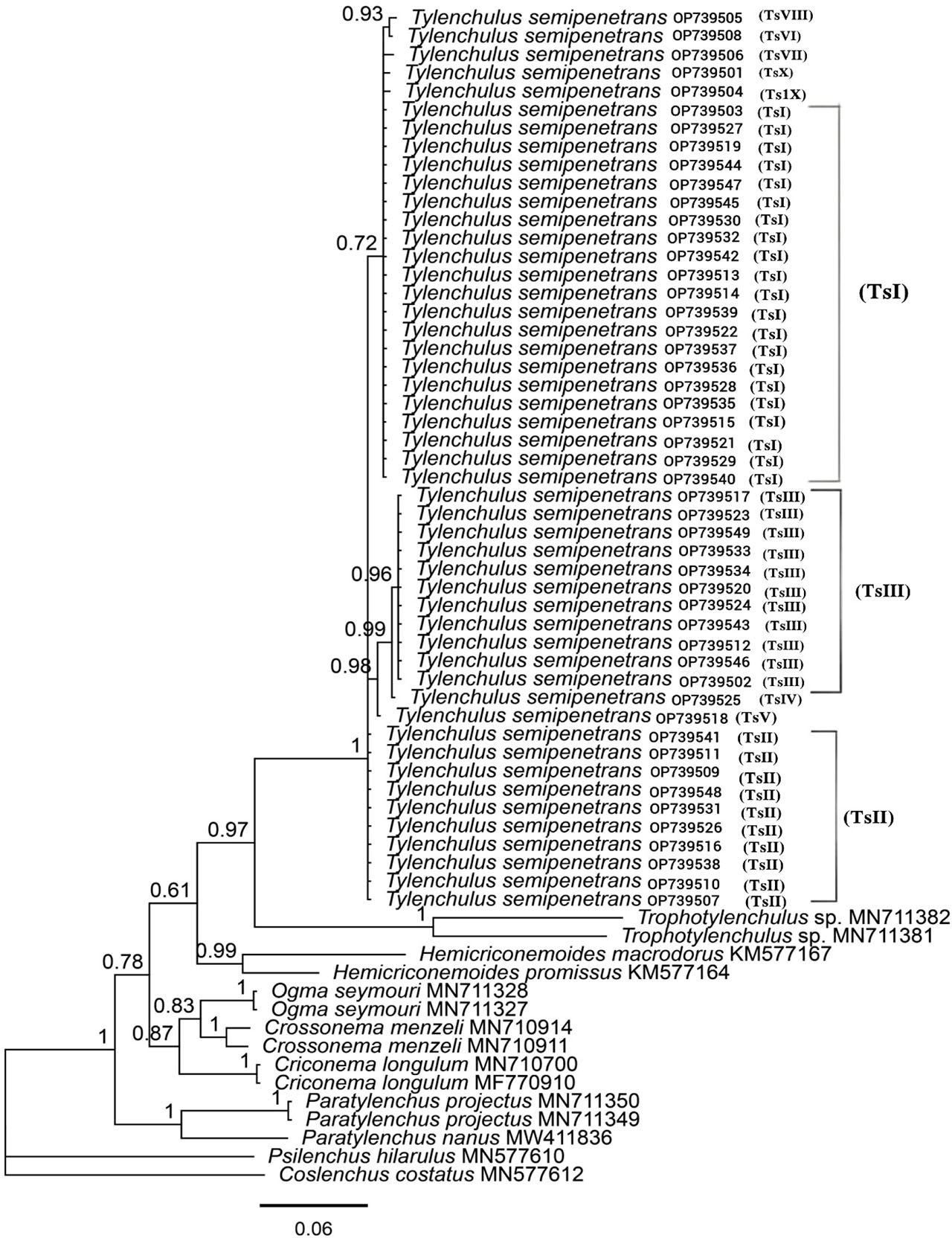
Figure 5:
Bayesian phylogenetic tree of Tylenchulus semipenetrans isolates from citrus orchards of the Fars Province based on COI mtDNA partial sequences, analyzed under the General Time Reversible (GTR) Model. Numbers shown on nodes are posterior probability values. All T. semipenetrans sequences were produced in this study. The codes in parentheses indicate the haplotype of the relevant population.
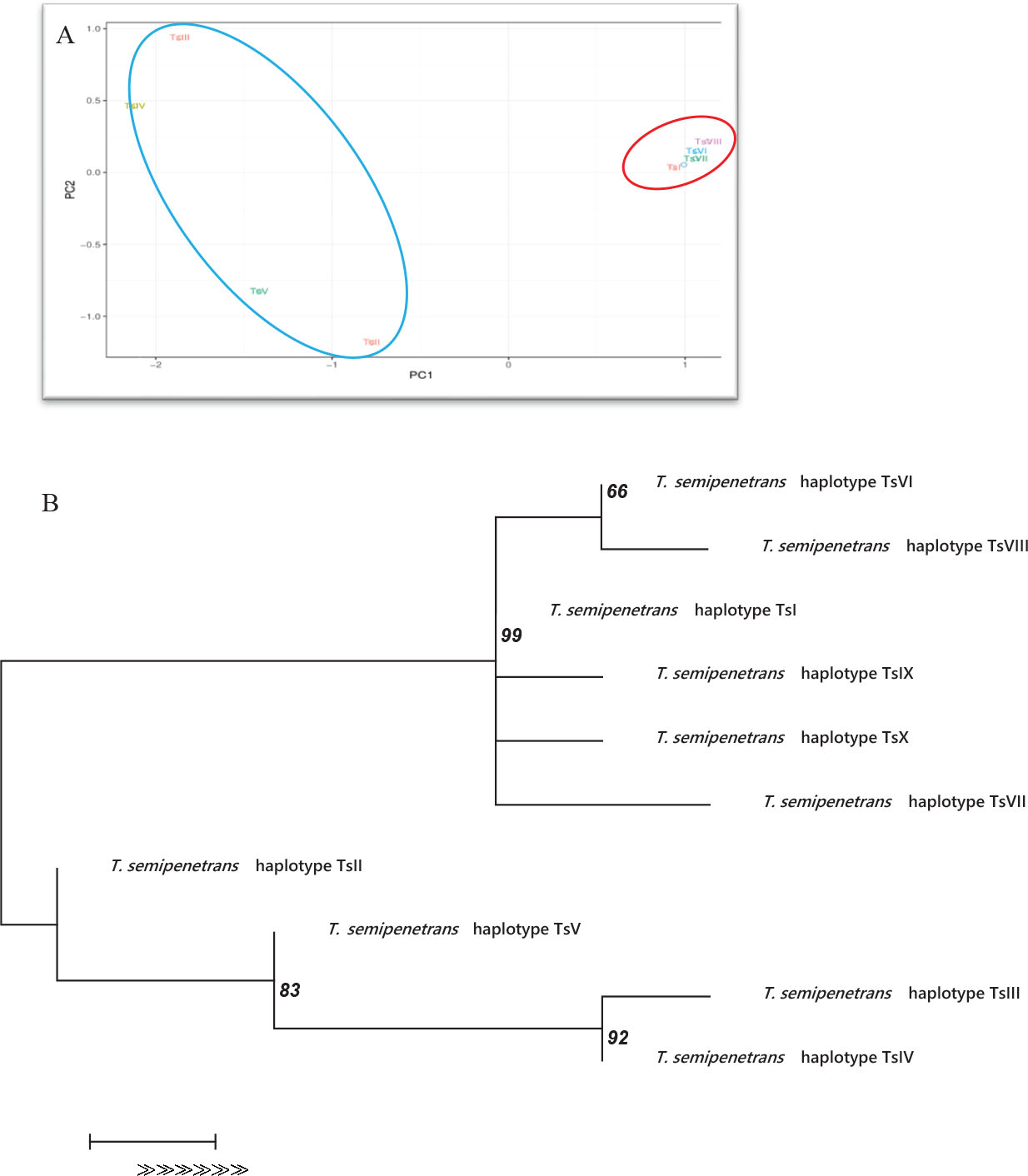
Figure 6:
A: principal component analysis (PCA) generalized linear modeling of Tylenchulus semipenetrans haplotypes from citrus orchards of the Fars province based on COI mtDNA, and B: the corresponding phylogenetic tree, analyzed under the Hasegawa Kishino Yano (HKY) model in MEGA 7. Numbers shown on nodes are posterior probability values.
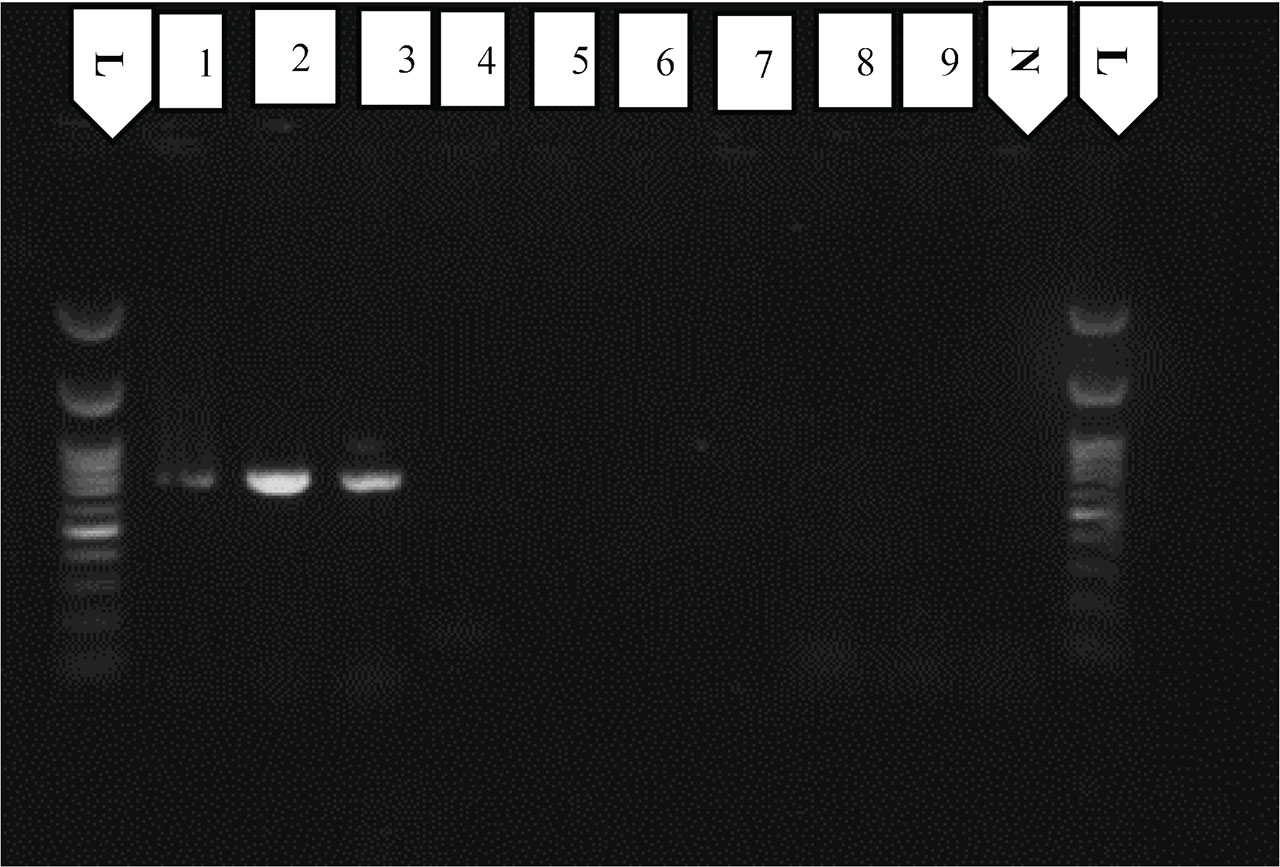
Figure 7:
Agarose gel electrophoresis verification of amplified products of ITS rDNA reactions using forward Ts2-IF and reverse Ts2-IR. The lane labeled as follows: Negative control (N), T. semipenetrans (1–3), Tylenchorhynchus sp. (4 & 5), Mesocriconema sp. (6 & 7), Hemicycliophora sp. (8 & 9), and DNA ladder (L).
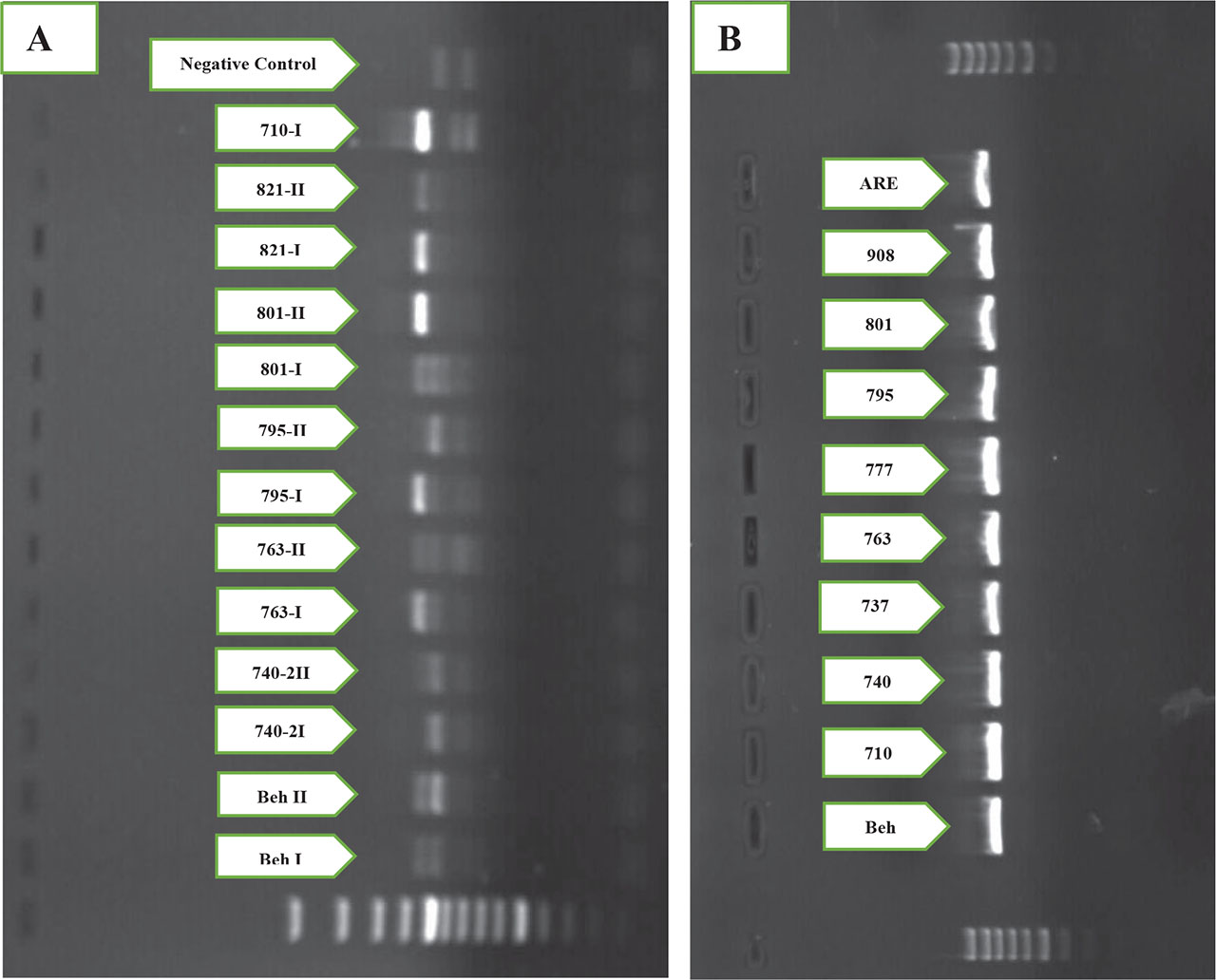
Supplementary Figure 1:
Ethidium bromide-stained gels containing reaction products of ITS rDNA region of T. semipenetrans following PCR amplification with A) the primers forward 18S and reverse 21S and B) the newly designed primer set: forward Ts2-IF and reverse Ts2-IR. The amplification product of the 18S and 21S primer sets was more than 1000 bp, and these primers inefficiently amplified the target region from most of the isolates, whereas the new primer set properly amplified a smaller region of the ITS gene from all isolates of the citrus nematode.
Supplementary Figure 2:
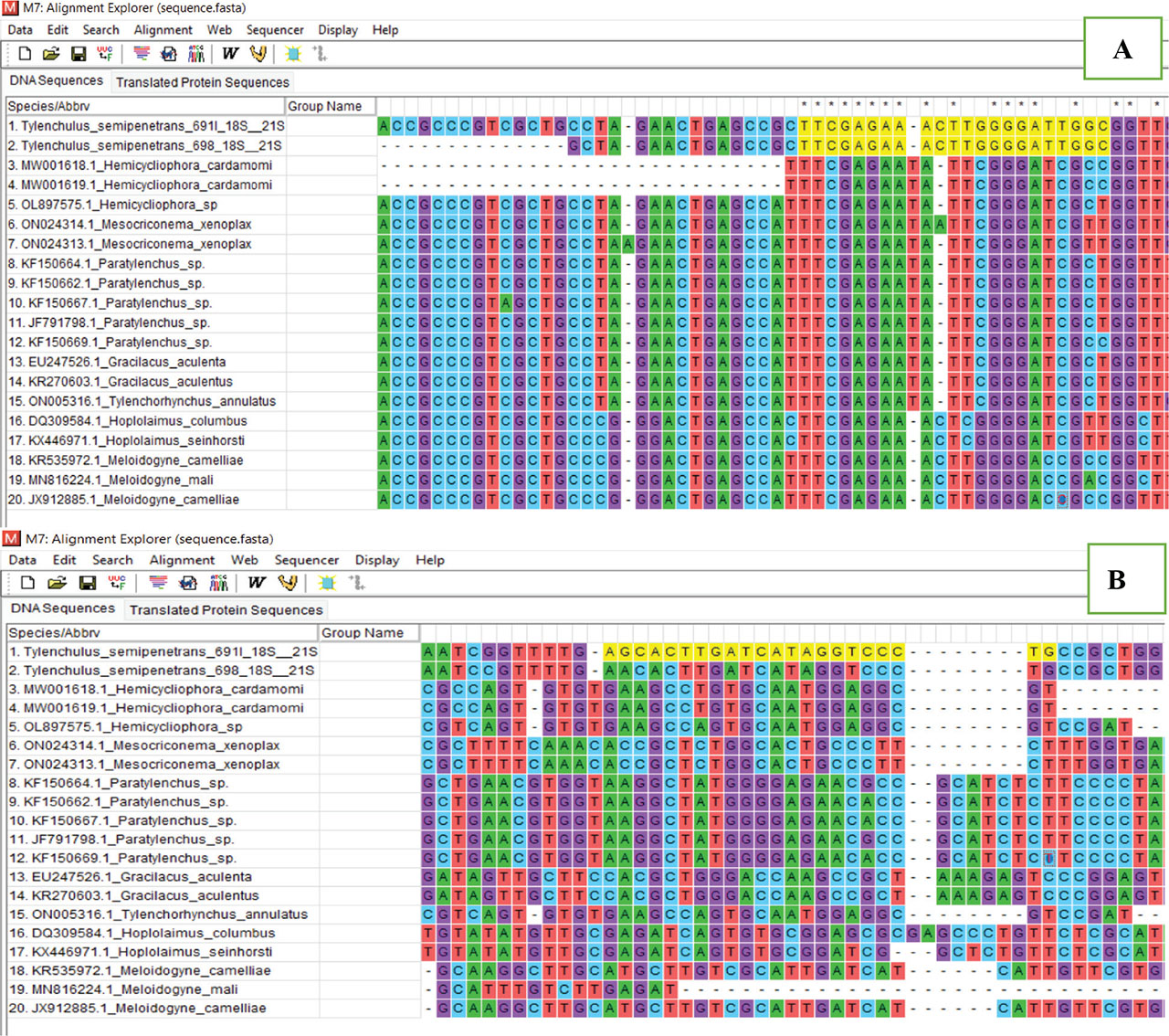
Alignment results of ITS rDNA gene sequences, at the area of designed primers of common plant-parasitic nematode taxa in citrus orchards, using Mega 7. A) Forward primer search B) Reverse primer search.
Supplementary Figure 3:
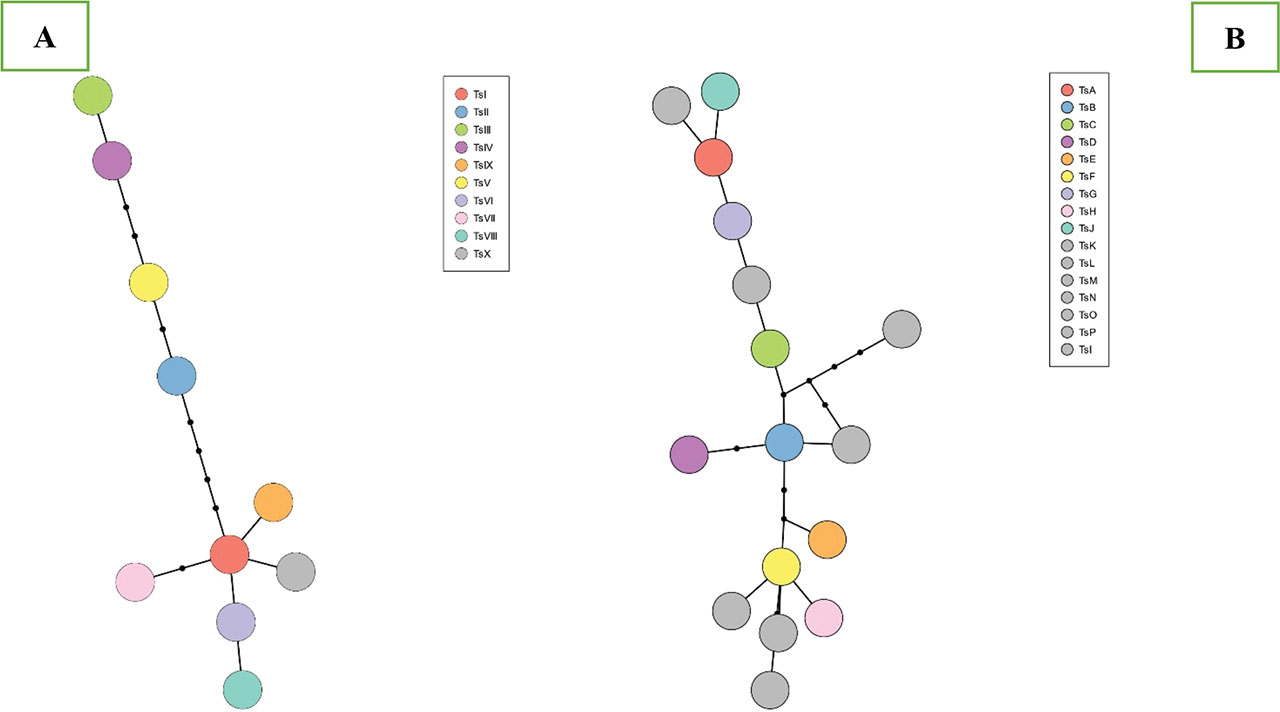
Haplotype genealogy graph for COI (A) and ITS (B) sequences based on TCS network analysis. Each circle represents a haplotype.