
Table 1.
Meloidogyne incognita, M. hapla, and Pratylenchus penetrans densities in soil and roots of ornamental tree and shrub.
| Host plant | Number of nematodes recovered from soil | Number of eggs recovered from roots | Number of nematodes recovered from roots | |||
|---|---|---|---|---|---|---|
| M. incognita | M. hapla | P. neglectus | M. incognita | M. hapla | P. neglectus | |
| Acer campestre | 35,640 ± 425 ba | 17 ± 371 a | 8,360 ± 222 b | 49,595 ± 869 bc | 5628 ± 122 a | 4,050 ± 373 c |
| Thuja occidentalis | 11,528 ± 141 a | 30 ± 38 a | 20,592 ± 627 bc | 485 ± 109 a | 6,409 ± 70 a | 113 ± 15 ab |
| Buxus sempervirens | 13,904 ± 119 ab | 11 ± 222 a | 0 ± 0 a | 3,094 ± 354 b | 1,935 ± 37 a | 81 ± 21 a |
| Quercus alba | 59,576 ± 868 b | 24 ± 383 a | 15,004 ± 360 bc | 132 ± 14 a | 5,938 ± 98 a | 821 ± 126 b |
| Quercus garryana | 30,008 ± 362,3 ab | 24 ± 383 a | 9,856 ± 312 bc | 108 ± 14 a | 1,660 ± 22 a | 80 ± 13 a |
| Rhododendron catawbiense | 23,584 ± 213 ab | 13 ± 150 a | 3,344 ± 450 b | 3,864 ± 334 b | 1,311 ± 16 a | 71 ± 12 d |
| Controlb | 799,128 ± 8,126 c | 561 ± 4,689 b | 149,547 ± 18,878 d | 32,048 ± 319 c | 77,391 ± 659 b | 445,350 ± 25,049 d |
Table 2.
Final Meloidogyne incognita, M. hapla, and Pratylenchus penetrans densities and reproductive factor (RF)a values in ornamental trees and shrubs.
| Host plant | Final population density | RFa | ||||
|---|---|---|---|---|---|---|
| M. incognita | M. hapla | P. neglectus | M. incognita | M. hapla | P. neglectus | |
| Acer campestre | 85,235 ± 118 bb | 22,524 ± 492 a | 12,410 ± 214 c | 28 ± 4 b | 8 ± 2 a | 5 ± 9 cd |
| Thuja occidentalis | 12,013 ± 104 a | 36,945 ± 485 a | 20,705 ± 627 ab | 4 ± 5 a | 12 ± 16 a | 8 ± 3 d |
| Buxus sempervirens | 16,998 ± 105 ab | 13,375 ± 259 a | 81 ± 211 a | 6 ± 4 ab | 5 ± 9 a | 0 ± 0 a |
| Quercus alba | 59,708 ± 869 b | 30,226 ± 480 a | 15,825 ± 357 bc | 20 ± 3 b | 10 ± 16 a | 6 ± 1 cd |
| Quercus garryana | 30,116 ± 362 ab | 11,614 ± 175 a | 9,926 ± 311 ab | 10 ± 1 ab | 4 ± 6 a | 4 ± 1 bcd |
| Rhododendron catawbiense | 27,448 ± 231 ab | 14,335 ± 166 a | 3,415 ± 45 b | 10 ± 8 ab | 5 ± 6 a | 1 ± 18 bc |
| Controlc | 831,176 ± 8,044 c | 638,805 ± 5,291 b | 594,897 ± 3,696 d | 277 ± 27 c | 213 ± 176 b | 238 ± 148 e |
Table 3.
Host suitability of trees and shrubs seedlings for Meloidogyne incognita, M. hapla, and Pratylenchus penetrans.
| Host plant | Host suitabilitya | ||
|---|---|---|---|
| M. incognita | M. hapla | P. neglectus | |
| Acer campestre | S | S | MS |
| Thuja occidentalis | MS | S | S |
| Buxus sempervirens | S | MS | R |
| Quercus alba | S | S | S |
| Quercus garryana | S | MS | MS |
| Rhododendron catawbiense | S | MS | MS |
| Controlb | S | S | S |
a Host suitability was categorized as good [susceptible; S] when final population density (Pf)/initial population density (Pi) > 5.0, fair [moderately susceptible; MS] if 5.0 ≥ Pf/Pi > 1, poor [moderately resistant; MR] if 1 > Pf/Pi > 0, and non-host [resistant; R] when Pf/Pi = 0 (Zhang and Schmitt, 1994).
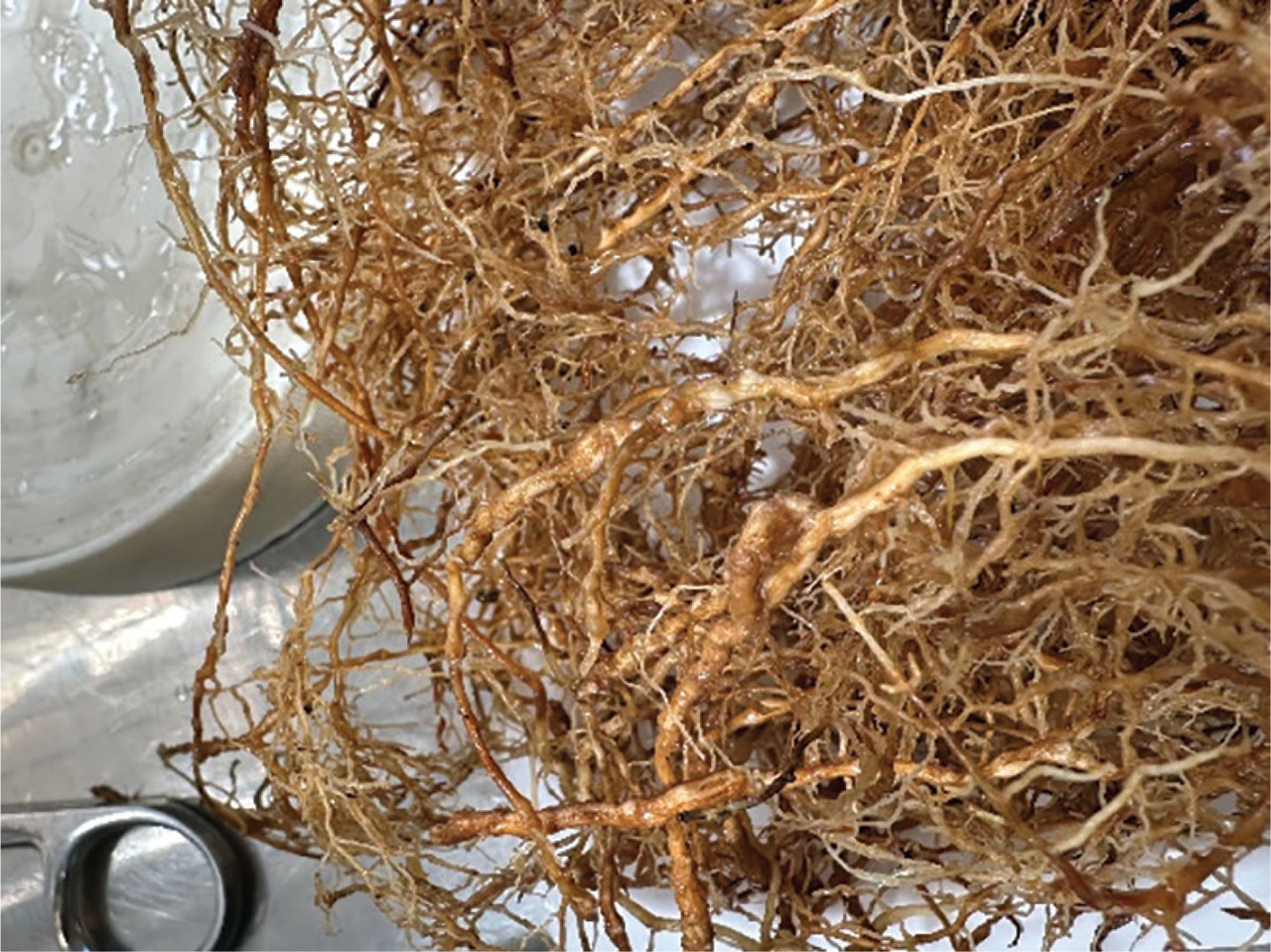
Figure 1.
Meloidogyne incognita galls on Acer campestre roots.