
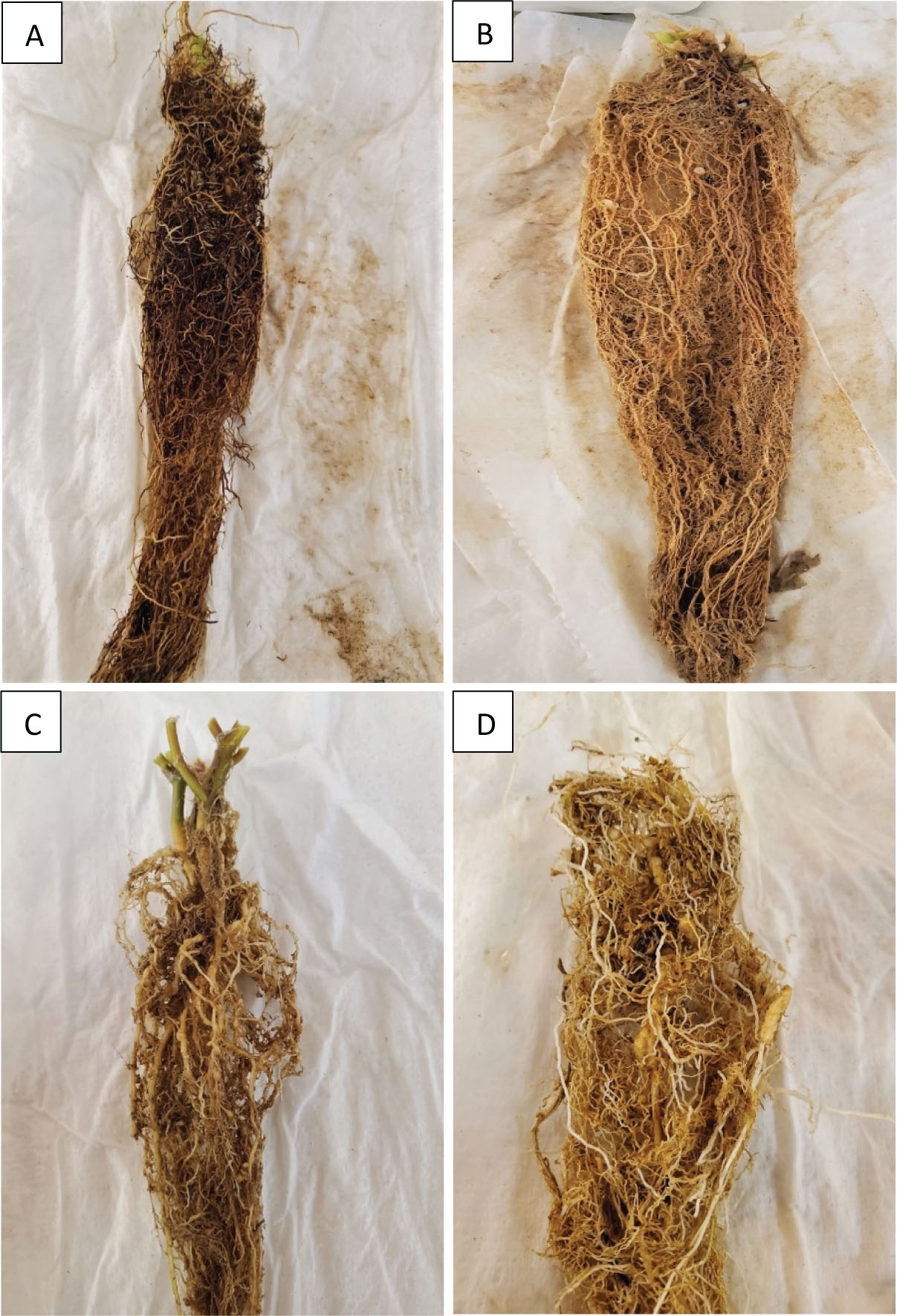
Figure 1:
(A) Sicklepod (Senna obtusifolia) resistant to Meloidogyne incognita race 4. (B) Resistant large crabgrass (Digitaria sanguinalis) inoculated with M. enterolobii showing no nematode gall formation. (C) Pink purslane (Portulaca pilosa) infected with M. incognita race 4; susceptible host displaying galling damage. (D) Entireleaf morningglory (Ipomoea hederacea) susceptible to M. enterolobii with galling symptoms.
Table 1:
Host status of 10 weed species common in North Carolina, USA to the RKN Meloidogyne enterolobii in two separate greenhouse trials. Weed plants were inoculated with 5,000 eggs of M. enterolobii and evaluated for egg production and root galling 60 days post inoculation. Values are the mean of five replicate plants per trial. Values followed by the same letter within the column are not significantly different at the α = 0.05 level.
| Weed Species | Rfa | Gall Ratingb | R/S | ||
|---|---|---|---|---|---|
| Trial 1 | Trial 2 | Trial 1 | Trial 2 | ||
| Palmer amaranth (Amaranthus palmeri) | 2.69b | 3.35b | 5b | 5b | S |
| Yellow nutsedge (Cyperus esculentus) | 0.13a | 0.09a | 0a | 0a | R |
| Purple nutsedge (Cyperus rotundus) | 0.53a | 0.44a | 0a | 0a | R |
| Jimsonweed (Datura stramonium) | 0.08a | 0.06a | 0a | 0a | R |
| Large crabgrass (Digitaria sanguinalis) | 0.06a | 0.07a | 0a | 0a | R |
| Entireleaf morningglory (Ipomoea hederacea) | 5.36b | 5.14b | 14b | 20b | S |
| Pitted morningglory (Ipomoea lacunosa) | 8.26b | 8.03b | 19b | 10b | S |
| Pink purslane (Portulaca pilosa) | 9.64b | 7.18b | 50b | 25b | S |
| Sicklepod (Senna obtusifolia) | 0.15a | 0.10a | 0a | 0a | R |
| Prickly sida (Sida rhombifolia) | 0.07a | 0.05a | 0a | 0a | R |
a Reproduction factor, Rf= final total egg count/initial inoculum egg count. Rf values less than 1 are considered resistant (R) and a poor host; those greater than 1 are considered susceptible (S) and a host or good host. No non-host weed species were observed in this study.
b Root gall severity rating (the visual estimate of the percent of the root system affected by galls, following the schematic of Bridge and Page, 1980).
Table 2:
Host status of 10 weed species common in North Carolina, USA to the RKN Meloidogyne incognita race 4 in two separate greenhouse trials. Weed plants were inoculated with 5,000 eggs of M. incognita and evaluated for egg production and root galling 60 days post inoculation. Values are the mean of five replicate plants per trial. Values followed by the same letter within the column are not significantly different at the α = 0.05 level.
| Weed Species | Rfa | Gall Ratingb | R/S | ||
|---|---|---|---|---|---|
| Trial 1 | Trial 2 | Trial 1 | Trial 2 | ||
| Palmer amaranth (Amaranthus palmeri) | 2.84c | 3.48c | 9b | 5b | S |
| Yellow nutsedge (Cyperus esculentus) | 0.24a | 0.24a | 0a | 0a | R |
| Purple nutsedge (Cyperus rotundus) | 12.87c | 4.36c | 5a | 5b | S |
| Jimsonweed (Datura stramonium) | 0.06a | 0.04a | 0a | 0a | R |
| Large crabgrass (Digitaria sanguinalis) | 0.08a | 0.05a | 0a | 0a | R |
| Entireleaf morningglory (Ipomoea hederacea) | 4.14c | 4.40c | 5a | 10b | S |
| Pitted morningglory (Ipomoea lacunosa) | 14.23c | 9.84c | 10b | 10b | S |
| Pink purslane (Portulaca pilosa) | 8.79c | 11.31c | 60b | 35c | S |
| Sicklepod (Senna obtusifolia) | 0.08a | 0.07a | 0a | 0a | R |
| Prickly sida (Sida rhombifolia) | 1.80b | 2.04b | 5a | 5b | S |
a Reproduction factor, Rf= final total egg count/initial inoculum egg count. Rf values less than 1 are considered resistant (R) and a poor host; those greater than 1 are considered susceptible (S) and a host or good host. No non-host weed species were observed in this study.
b Root gall severity rating (the visual estimate of the percent of the root system affected by galls, following the schematic of Bridge and Page, 1980).