
Table 1:
Hemp cultivars evaluated with their given use and geographical origin.
| Cultivar | Origin | Use |
|---|---|---|
| Cherry Blossom | USA | CBD |
| Cherry Blossom × T1 | USA | CBD |
| Gold | USA | CBG |
| Panacea | USA | CBG |
| Bama | South China | DUAL |
| Carmagnola | Italy | DUAL |
| Carmagnola Selezionata | Italy | DUAL |
| Helena | Serbia | DUAL |
| Tygra | Poland | DUAL |
| Yuma-2 | South China | DUAL |
| Eletta Campana | Italy | FIBER |
| Fibranova | Italy | FIBER |
| Puma-3 | South China | FIBER |
[i] Use: Fiber (tall, slender varieties used for materials and textiles), Dual (produce a large number of seed to use for grain products but also have a stalk that is used in fiber hemp production), CBD (cannabidiol, a cannabinoid extract), and CBG (cannabigerol, a cannabinoid extract).
Table 2:
Nematode reproduction on six European hemp cultivars after 60 days with a mixed population of M. incognita and M. javanica (Trial 1).
| J2/stained root | Gall Index (0–10) | Eggs/Whole Root | Eggs/g of Dry Root | J2s/pot | |
|---|---|---|---|---|---|
| Helena | 15b | 2.4 | 292,020 | 53,600 | 600 |
| Tygra | 6b | 2.6 | 523,300 | 138,700 | 1,500 |
| Fibranova | 22ab | 2.0 | 333,600 | 49,010 | 1,550 |
| Eletta Campana | 45ab | 2.6 | 468,960 | 56,250 | 990 |
| Carmagnola | 41ab | 2.8 | 401,410 | 52,420 | 350 |
| Carmagnola Selezionata | 60a | 3.0 | 498,940 | 71,710 | 430 |
| Cucumber* | 45 | 7.0 | 460,800 | - | 225 |
| P value | 0.008 | 0.630 | 0.557 | 0.501 | 0.114 |
[i] J2s/stained root were evaluated after 7 days. Gall index scale: 0–10; 0= no galls, 10= 100% galls. Eggs and J2s rounded to nearest ten. Factor levels not connected by the same letter are significantly different according to Tukey’s HSD with P ≤ 0.05; cucumber data are given as comparison and were not included in the analysis.
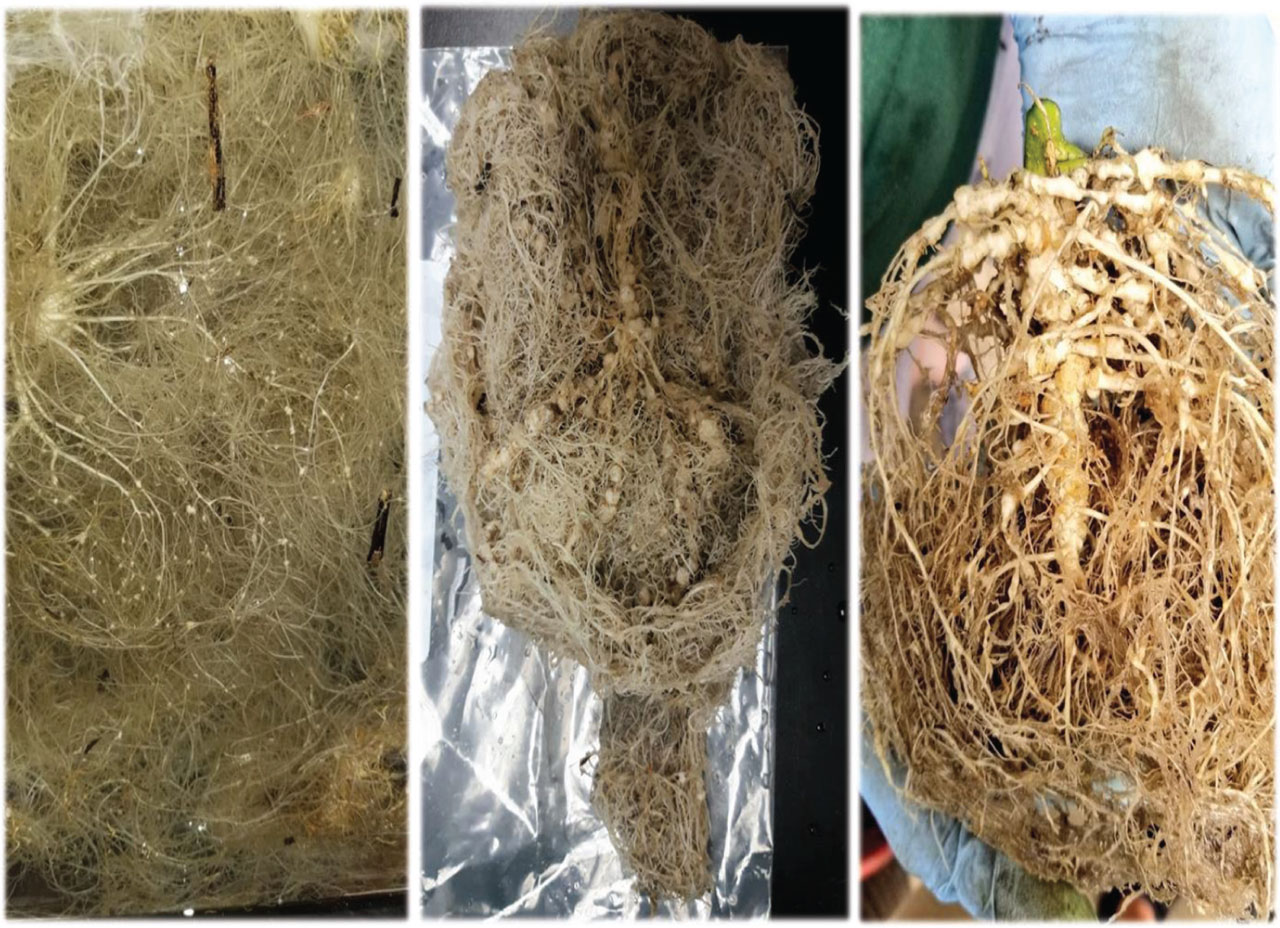
Figure 1:
Root galls caused by RKN (M. javanica and M. incognita mixed population) on hemp roots (cv. Carmagnola Selezionata, left) compared to cucumber roots (cv. Dasher II, middle) (Trial 1) and cv. Cherry Blossom × T1 (right; Trial 2) (Photos J. Coburn).
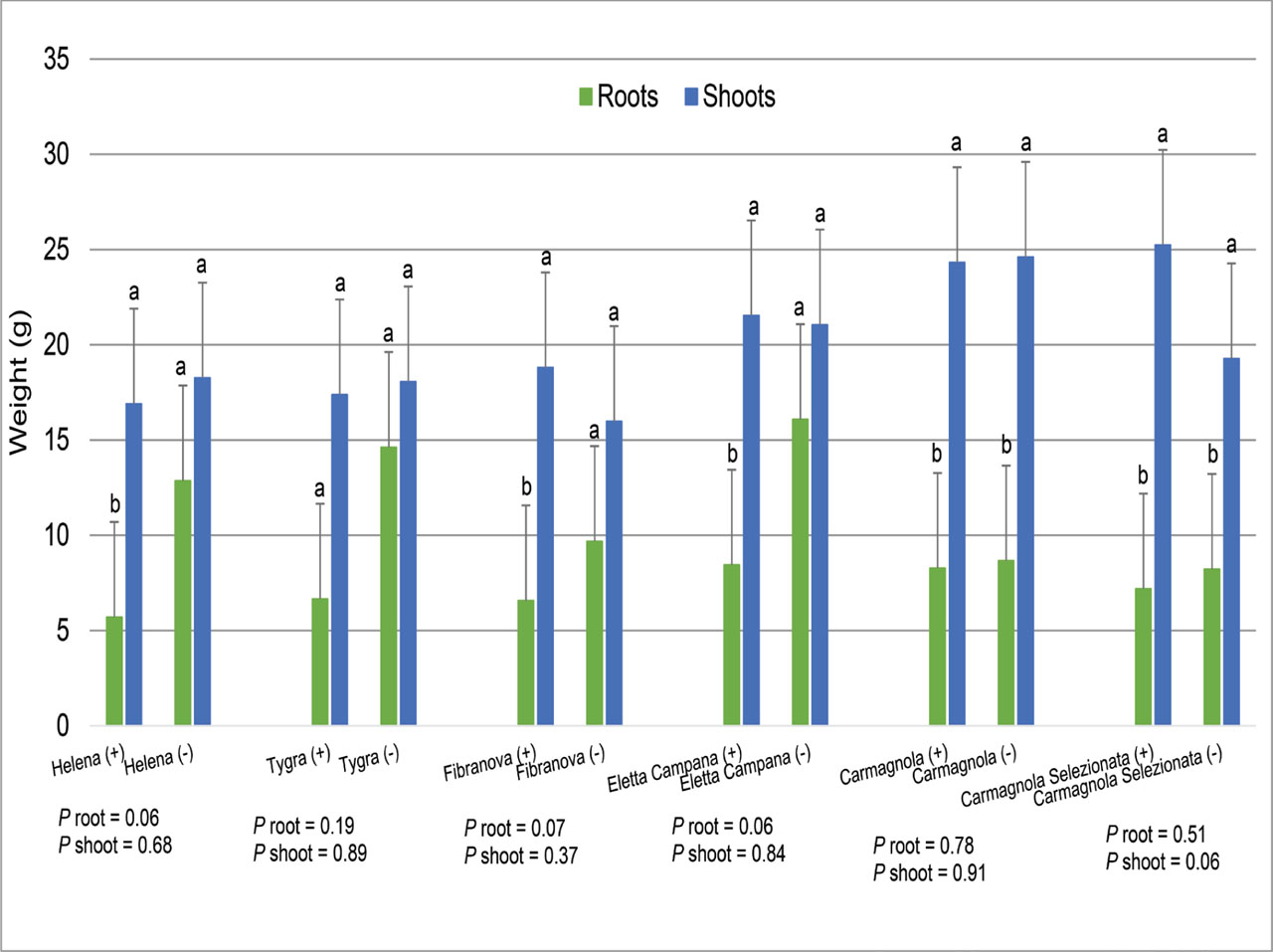
Figure 2:
Hemp plant dry weights (g) for inoculated (+) and uninoculated (−) plants with a mixed population of root-knot species and six European hemp cultivars. Factor levels not connected by the same letter are significantly different according to Tukey’s HSD with P ≤ 0.05 (Trial 1).
Table 3:
Nematode reproduction on 11 hemp cultivars (European, Chinese and American, fiber, dual-use and CBD) after 60 days with a mixed population of M. incognita and M. javanica (Trial 2).
| J2/stained root | Gall Index (0–10) | Eggs/Whole Root | Eggs/g of Dry Root | J2s/pot | |
|---|---|---|---|---|---|
| Helena | - | 5.2a | 211,100 | 172,680 | 19,530ab |
| Tygra | - | 5.8a | 107,530 | 62,640 | 18,930ab |
| Fibranova | - | 3.8b | 271,710 | 136,540 | 14,310b |
| Eletta Campana | - | 4.8a | 197,730 | 86,940 | 23,720a |
| Carmagnola | - | 4.8a | 172,330 | 57,310 | 17,000b |
| Carmagnola Selezionata | - | 4.8a | 101,680 | 34,650 | 15,220b |
| Yuma-2 | 43 | 4.4b | 270,980 | 43,590 | 15,810b |
| Bama | 45 | 3.4b | 153,540 | 29,740 | 8,600b |
| Puma-3 | 48 | 3.8b | 180,480 | 31,580 | 7,420b |
| Cherry Blossom × T1 | 83 | 4.2b | 187,900 | 51,740 | 11,490b |
| Cherry Blossom | 74 | 1.8c | 68,160 | 21,320 | 4,000b |
| Cucumber* | - | 7.2 | 218,260 | - | 9,702 |
| P value | 0.01 | <0.001 | 0.599 | 0.093 | 0.014 |
[i] J2s/stained root were evaluated seven days after inoculation. Gall index scale: 0–10; 0= no galls, 10= 100% galls. Eggs and J2s rounded to nearest ten. Factor levels not connected by the same letter are significantly different according to Tukey’s HSD with P ≤ 0.05; cucumber data are given as comparison and were not included in the analysis.
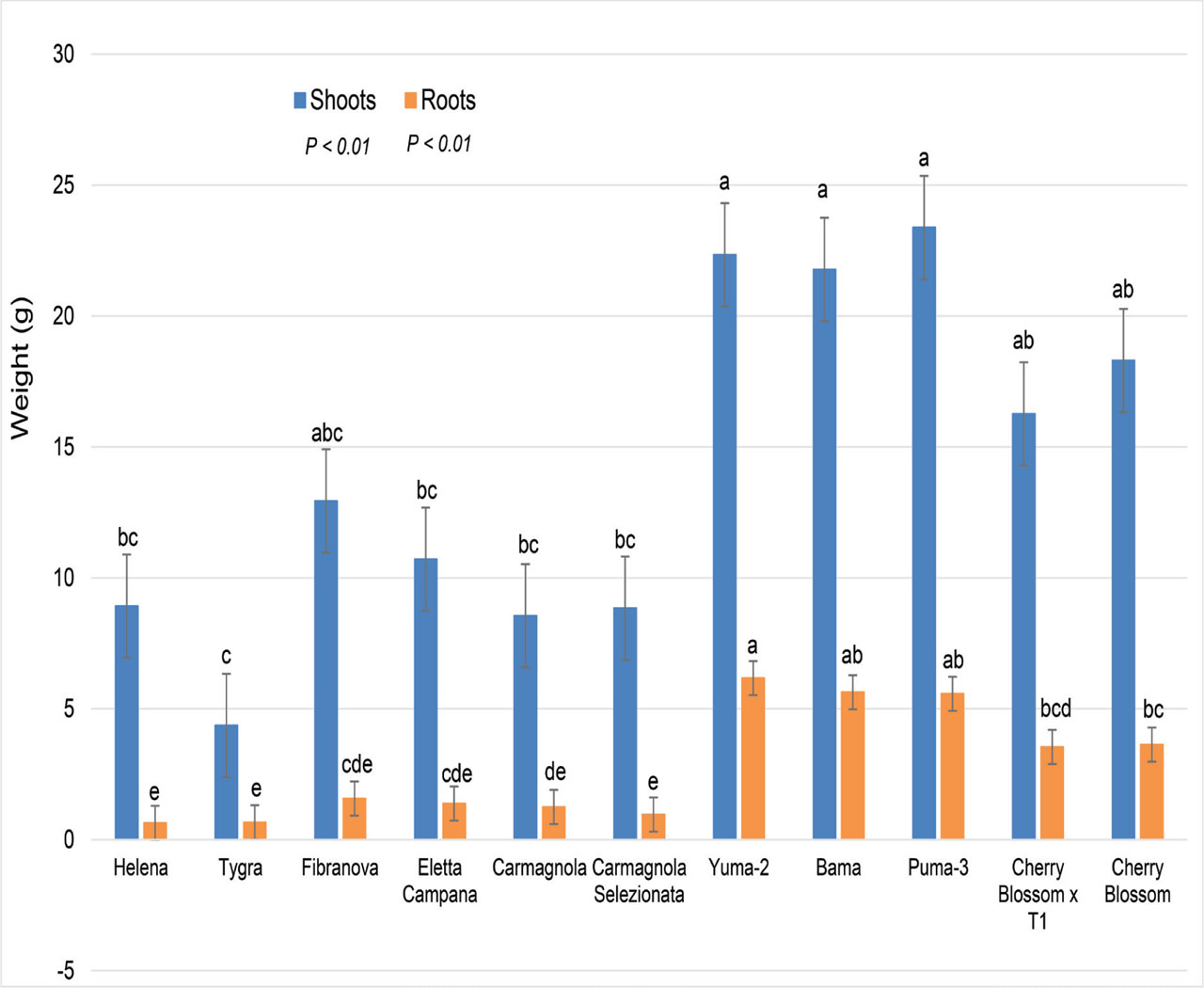
Figure 3:
Hemp plant dry weights (g) with a mixed population of root-knot species and 11 hemp cultivars; all plants were inoculated with 10,000 RKN eggs. Factor levels not connected by the same letter are significantly different according to Tukey’s HSD with P ≤ 0.05 (Trial 2).
Table 4:
Nematode reproduction on two Chinese fiber and two CBD hemp cultivars after 60 days with a mixed population of M. incognita and M. javanica (Trial 3).
| Gall Index (0–10) | Eggs/Whole Root | Eggs/g of Dry Root | J2s/pot | Reproduction Factor (Rf) | |
|---|---|---|---|---|---|
| Bama | 1.8 | 580 | 250 | 1,350 | 0.193 |
| Puma-3 | 1.8 | 250 | 220 | 3,320 | 0.357 |
| Cherry Blossom × T1 | 1.4 | 280 | 240 | 3,470 | 0.376 |
| Cherry Blossom | 1.2 | 260 | 190 | 2,740 | 0.299 |
| Cucumber* | 4.0 | 27,520 | - | 8,298 | 3.58 |
| P value | 0.633 | 0.341 | 0.624 | 0.657 | 0.694 |
[i] Gall index scale: 0–10; 0= no galls, 10= 100% galls. Eggs and J2s rounded to nearest ten. Reproduction factor (Rf = Pf/Pi) where Pf is total number of J2s and eggs after 60 days and Pi is 10,000 RKN eggs. Factor levels not connected by the same letter are significantly different according to Tukey’s HSD with P ≤ 0.05; cucumber data are given as comparison and were not included in the analysis.
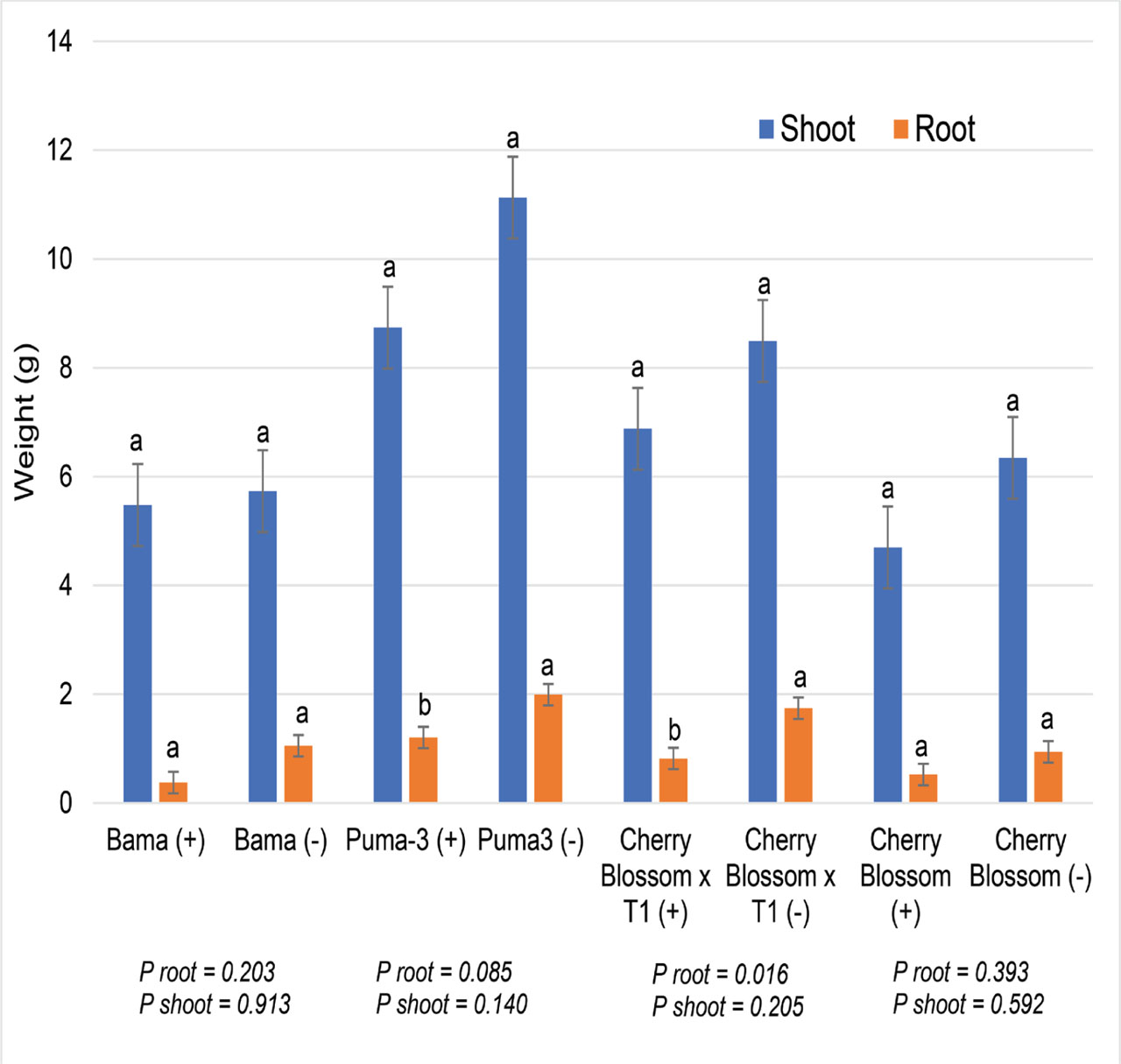
Figure 4:
Hemp plant dry weights (g) for RKN inoculated (+) and uninoculated (−) plants with two CBD and two Chinese fiber hemp cultivars. Factor levels not connected by the same letter are significantly different according to Tukey’s HSD with P ≤ 0.05 (Trial 3).
Table 5:
Nematode reproduction on two cannabigerol (CBG) hemp cultivars after 60 days with a mixed natural field population of M. incognita and M. javanica with and without nematicide (V) application (Trial 4).
| Gall Index | Total Eggs/Root | Eggs/g Dry Root Wt. | J2s/Pot | Pf | |
|---|---|---|---|---|---|
| Gold | 6.8b | 253,600 | 192,620a | 30,620b | 284,230ab |
| Gold (V) | 3.4de | 82,980 | 68,710ab | 19,980b | 102,960b |
| Panacea | 5.2c | 113,640 | 47,430b | 14,240b | 127,880b |
| Panacea (V) | 2.3e | 47,100 | 24,400b | 9,040b | 44,910b |
| Tomato | 8.2a | 235,600 | 122,800ab | 65,540a | 301,140a |
| Tomato (V) | 4.4cd | 184,640 | 103,280ab | 23,270b | 207,910b |
| P value | < 0.0001 | 0.099 | 0.041 | < 0.0001 | 0.0002 |
[i] Gall index scale: 0–10; 0= no galls, 10= 100% galls. Eggs and J2s rounded to nearest ten. Pf is total number of J2s and eggs after 60 days. V = Velum (a.i. fluopyram). Factor levels not connected by the same letter are significantly different according to Tukey’s HSD with P ≤ 0.05.
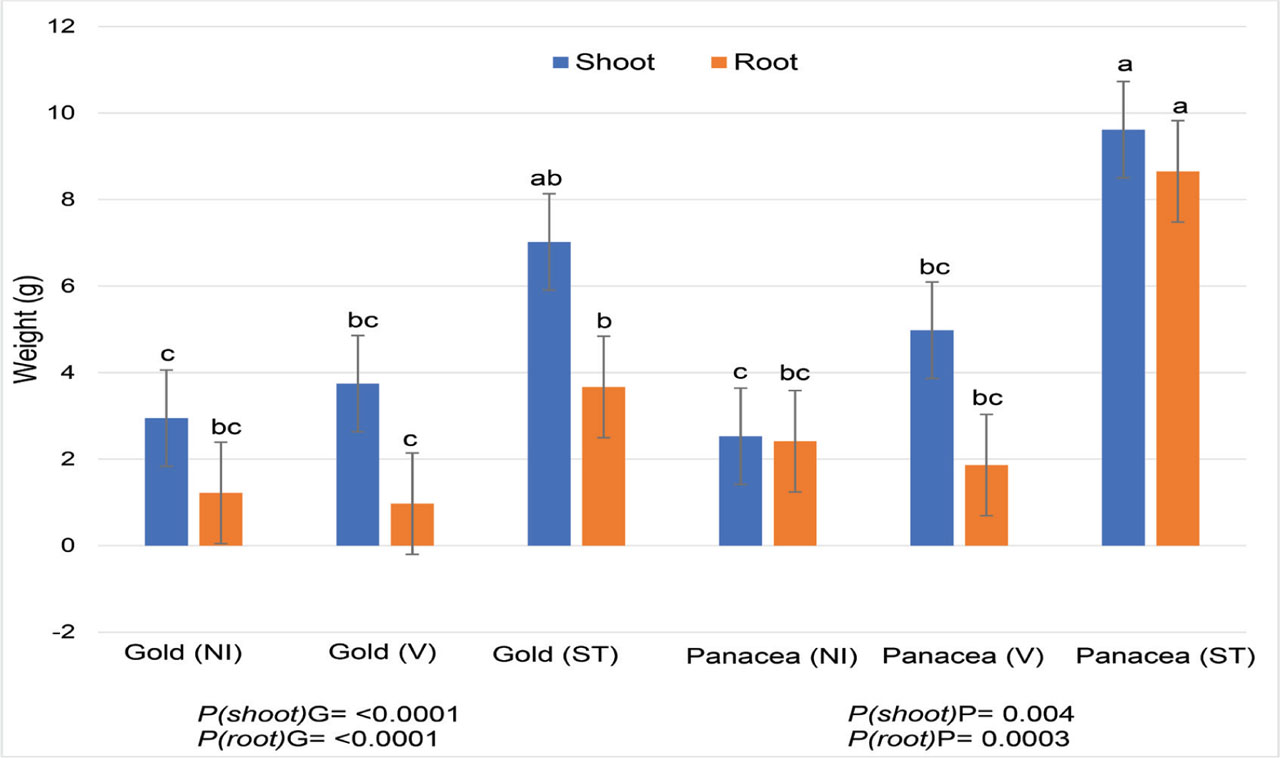
Figure 5:
Hemp plant dry weights (g) for two cannabigerol (CBG) hemp cultivars and a nematicide in naturally RKN-infested soil. P values (P ≤ 0.05) represent significant differences between cultivars by treatment (PG = Gold, PP= Panacea; NA = naturally infested soil, V = Velum, ST = steamed soil.). Velum was applied at 0.48 kg a.i./Ha. Factor levels not connected by the same letter are significantly different according to Tukey’s HSD with P ≤ 0.05 (Trial 4).
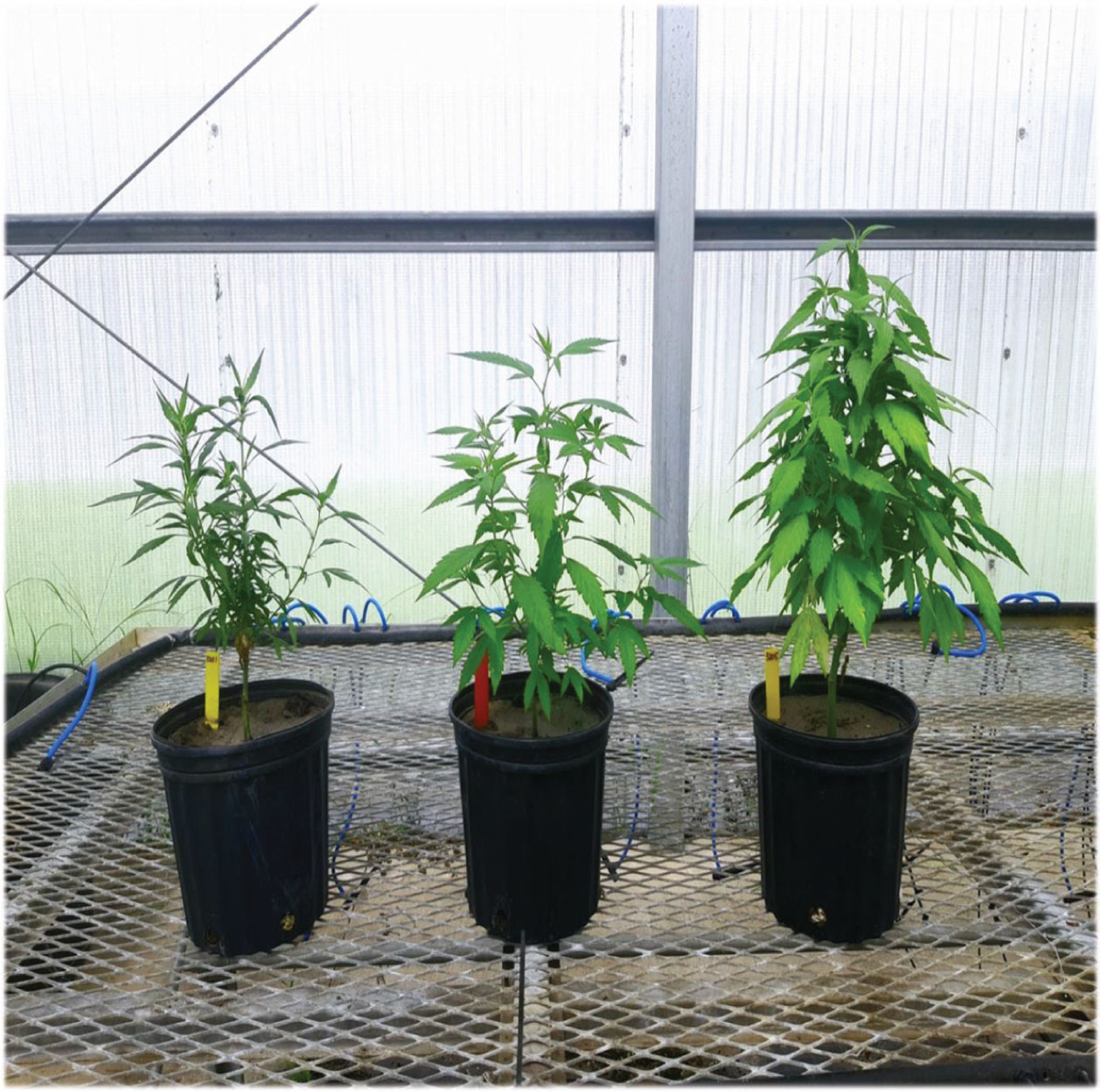
Figure 6:
Cannabis sativa (cv. Panacea) 60 days after planting in RKN-infested field soil. (Left) naturally infested soil, (middle) nematicide-treated (fluopyram) soil, (right) steamed soil (Photo J. Coburn).
Table 6:
Nematode reproduction of M. enterolobii and M. hapla on a CBD and fiber cultivar after 60 days (Trial 5).
| Gall Index (0–10) | Eggs/Whole Root | Eggs/g of Dry Root | J2s/pot | Reproduction Factor (Rf) | |
|---|---|---|---|---|---|
| CBD - Cherry Blossom × T1 (+ Me) | 1.4b | 2,600 | 1,710 | 770b | 0.338 |
| Fiber - Eletta Campana (+ Me) | 2.0b | 16,300 | 7,475 | 1,300b | 1.759 |
| Cucumber (+ Me) | 3.8a | 27,030 | 16,850 | 4,860a | 3.189 |
| P value | 0.004 | 0.188 | 0.187 | 0.046 | 0.158 |
| CBD - Cherry Blossom × T1 (+ Mh) | 1.8b | 3,470a | 1,490a | 4,400 | 0.787 |
| Fiber - Eletta Campana (+ Mh) | 1.0b | 1,640b | 790ab | 5,860 | 0.750 |
| Cucumber (+ Mh) | 3.8a | 500b | 130b | 5,880 | 0.638 |
| P value | < 0.0001 | 0.003 | 0.025 | 0.773 | 0.871 |
[i] Gall index scale: 0–10; 0= no galls, 10= 100% galls. Eggs and J2s rounded to nearest ten. Reproduction factor (Rf = Pf/Pi) where Pf is total number of J2s and eggs after 60 days and Pi is 10,000 RKN eggs. Factor levels not connected by the same letter are significantly different according to Tukey’s HSD with P ≤ 0.05.
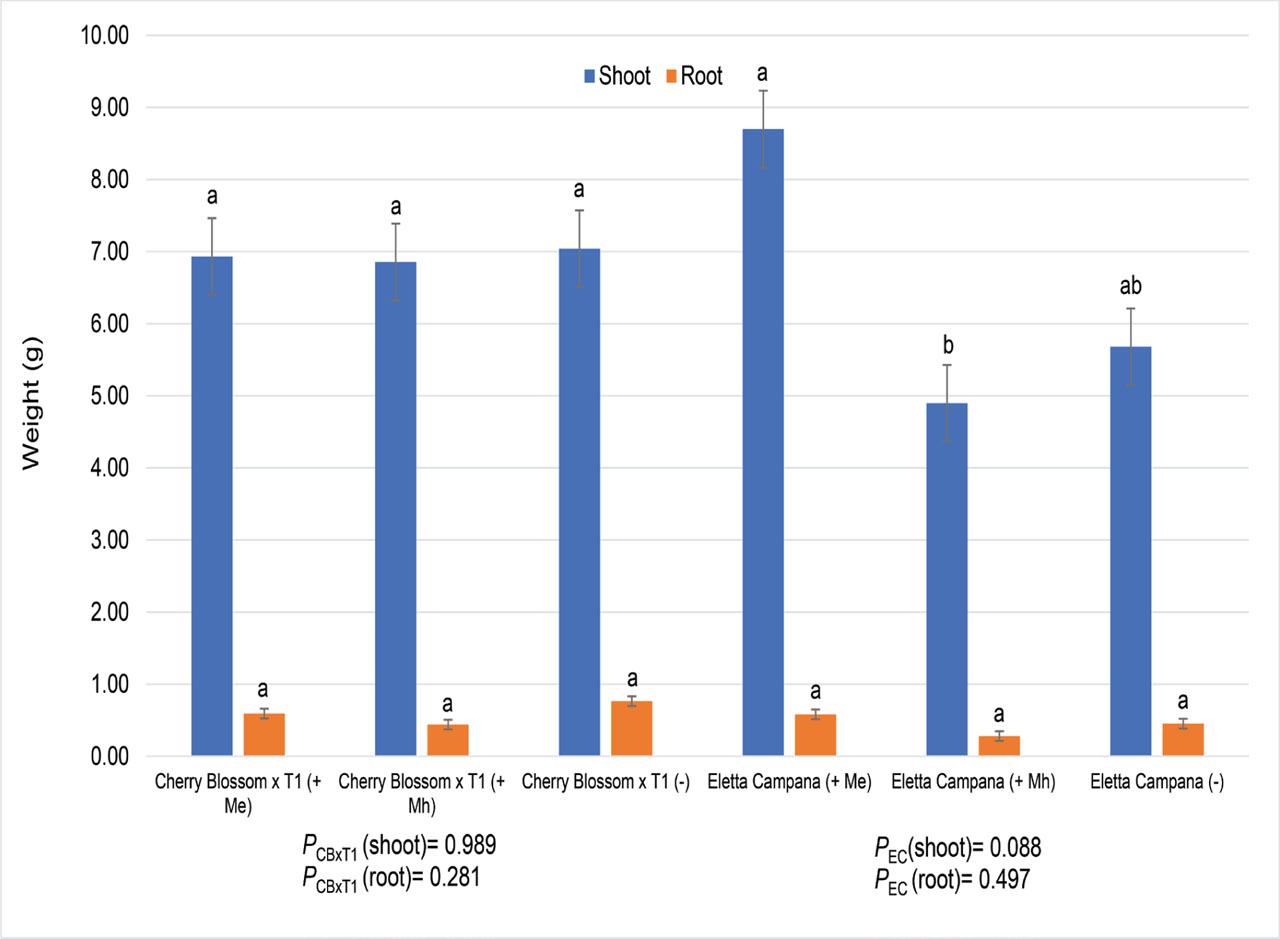
Figure 7:
Hemp plant dry weights (g) two hemp cultivars (Eletta Campana = fiber, Cherry Blossom × T1 = CBD) exposed to two RKN species, M. enterolobii and M. hapla. Factor levels not connected by the same letter are significantly different according to Tukey’s HSD where P ≤ 0.05. PCBxT1 = Cherry Blossom × T1, PEC = Eletta (Trial 5).