
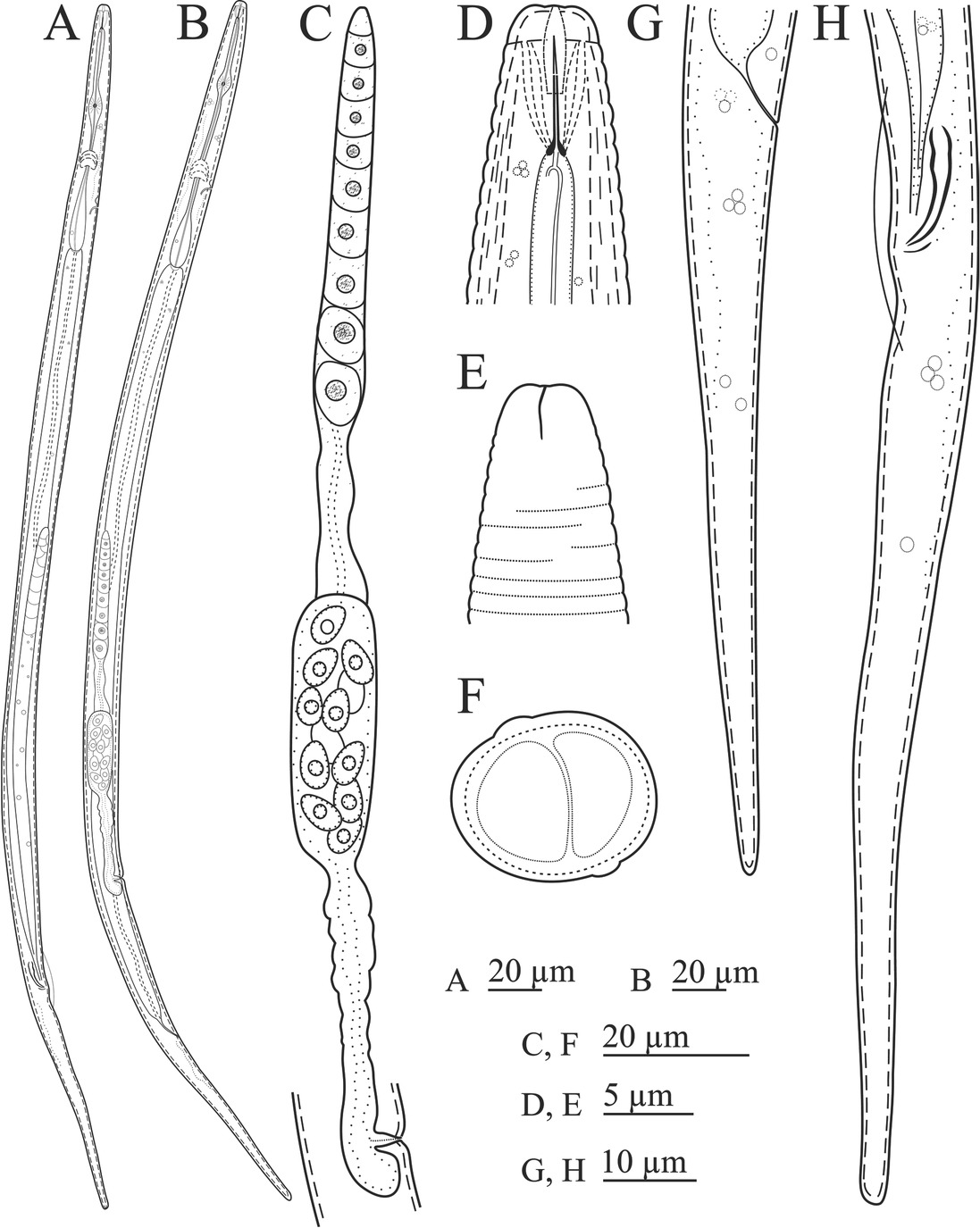
Figure 1
Line drawings of Ottolenchus isfahanicus n. sp. (A, H: Male; B–G: Female). (A, B) Entire body. (C) Reproductive system (D) Anterior body region (E) Amphidial aperture. (F) Cross section at mid-body. (G, H) Tail and posterior body region.
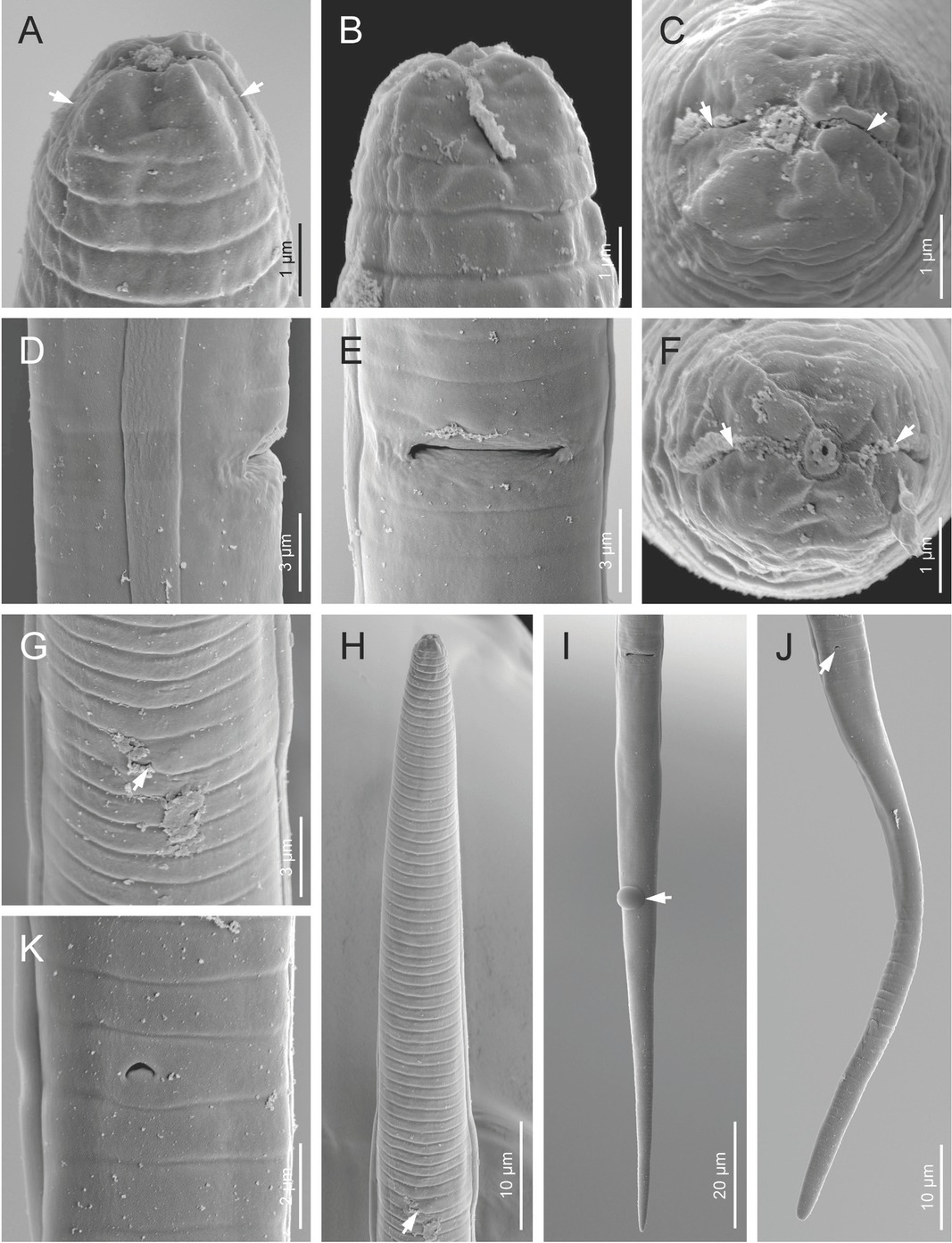
Figure 3
Scanning electron microphotographs of Ottolenchus isfahanicus n. sp. (Female). (A–C, F) Lip region in ventral, lateral and face views, respectively (arrows pointing to the amphidial apertures). (D, E) Vulva in lateral and ventral views, respectively. (G) Excretory pore (arrow). (H) Anterior body region in ventral view (arrow pointing to the excretory pore). (I) Posterior body region (arrow pointing to the anus with liquid feces). (J) Tail (arrow pointing to the anus).
Table 1
Morphometrics of Ottolenchus isfahanicus n. sp. All measurements are in μm and in the form mean ± SD (range).
| Female | Females | Males | |
|---|---|---|---|
| N | 13 | 3 | |
| L | 505 | 493.2 ± 12.1 (477-515) | 430.3 ± 12.4 (416-438) |
| L’ | 420 | 409.6 ± 10.3 (392-428) | 353.3 ± 12.4 (339-361) |
| a | 36.0 | 36.0 ± 2.2 (32.5-39.6) | 37.8 ± 1.8 (35.7-39.1) |
| b | 6.0 | 5.4 ± 0.2 (5.2-5.7) | 4.9 ± 0.2 (4.7-5.0) |
| c | 6.0 | 5.9 ± 0.4 (5.3-6.7) | 5.6 ± 0.2 (5.4-5.6) |
| c’ | 9.0 | 8.8 ± 0.7 (7.5-9.7) | 9.7 ± 0.7 (8.9-10.2) |
| V or T | 71.0 | 70.8 ± 1.0 (69.4-72.3) | 80.0 ± 0.0 (81-82) |
| V’ | 85.0 | 85.2 ± 1.0 (83.3-86.6) | - |
| Lip region height | 2 | 1.6 ± 0.2 (1.3-1.9) | 1.7 ± 0.1 (1.5-1.7) |
| Lip region width | 5 | 4.4 ± 0.3 (4.0-4.9) | 4.5 ± 0.1 (4.4-4.6) |
| Stylet | 6 | 6.3 ± 0.4 (5.7-6.9) | 6.1 ± 0.3 (5.8-6.4) |
| Conus | 2 | 1.8 ± 0.2 (1.5-2.2) | 2.1 ± 0.2 (1.9-2.3) |
| Excretory pore | 77 | 75.6 ± 2.2 (72-79) | 68.3 ± 2.1 (66-70) |
| MB | 38 | 37.5 ± 2.4 (32-40) | 37.3 ± 2.5 (35-40) |
| Pharynx | 91 | 91.3 ± 2.3 (88-95) | 88.0 ± 5.3 (82-92) |
| Anterior end-vulva | 358 | 394.2 ± 8.3 (337-361) | 353.3 ± 12.4 (339-361) |
| Body width (BW) | 14 | 13.7 ± 0.8 (13-15) | 11.4 ± 0.2 (11.1-11.6) |
| Anal body width | 10 | 9.5 ± 0.5 (9-10) | 8 ± 0.6 (7.52-8.6) |
| Vulva-anus | 62 | 60.5 ± 4.8 (55-68) | 77 ± 0 (77-77) |
| Tail length | 85 | 83.5 ± 6.0 (72-92) | 11.1 ± 0.6 (10.5-11.5) |
| Tail/V-A | 1 | 1.4 ± 0.2 (1.1-1.7) | - |
| PUS | 15 | 14.3 ± 1.2 (12.2-16.4) | - |
| Spicules | - | - | 11.1 ± 0.6 (10.5-11.5) |
| Gubernaculum | - | - | 2.2 ± 0.9 (1.2-2.9) |
| Bursa length | - | - | 20.3 ± 1.0 (19.3-21.2) |
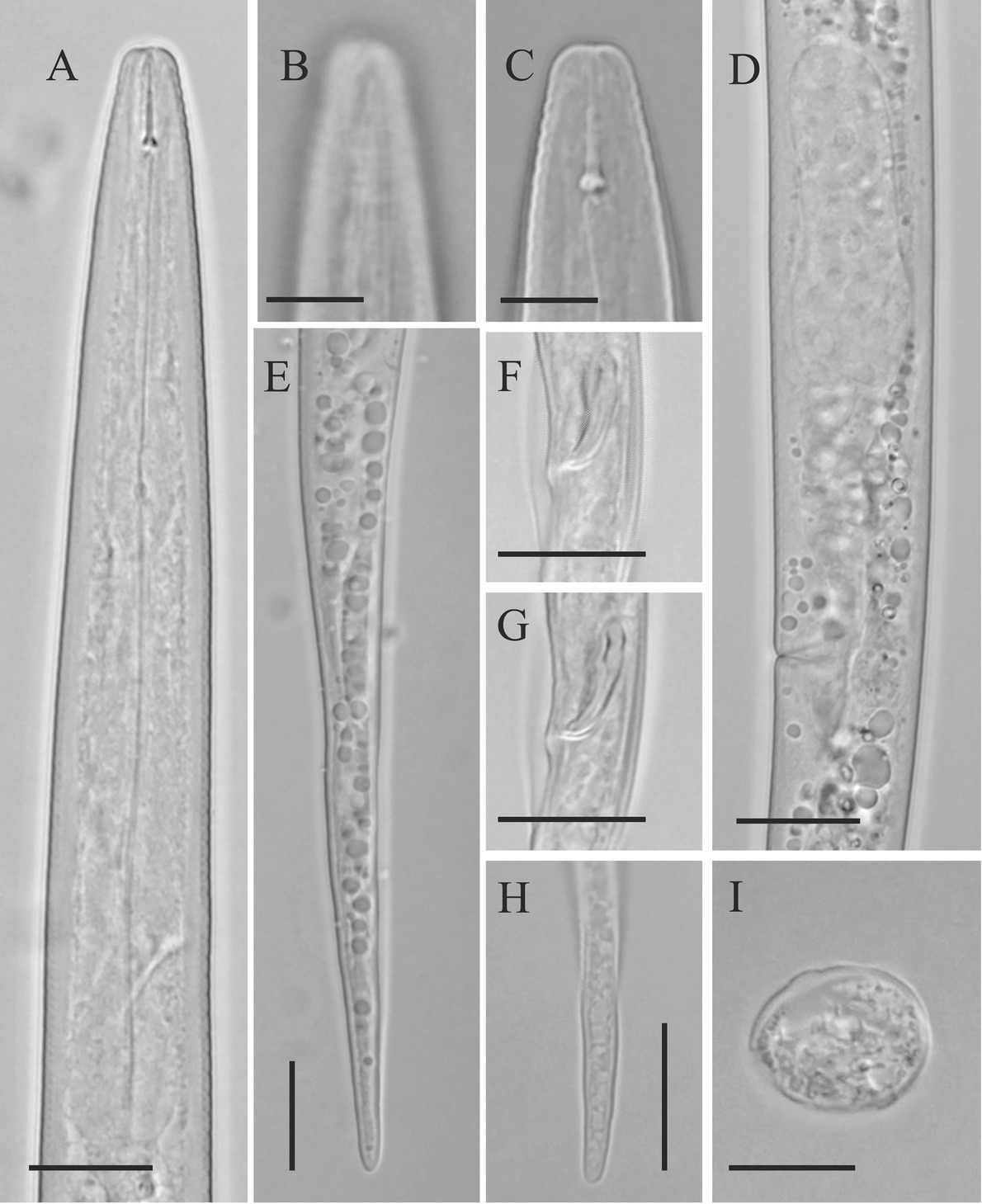
Figure 2
Light microphotographs of Ottolenchus isfahanicus n. sp. (A–E, I: Female; F, G, H: Male). (A–C) Anterior body region showing pharynx, amphidial aperture and stylet, respectively. (D) Spermatheca. (E, H) Tail and tail tip (F, G) Spicule and bursa. (I) Lateral field at midbody. (All scale bars: B, C = 5 μm, rest = 10 μm).
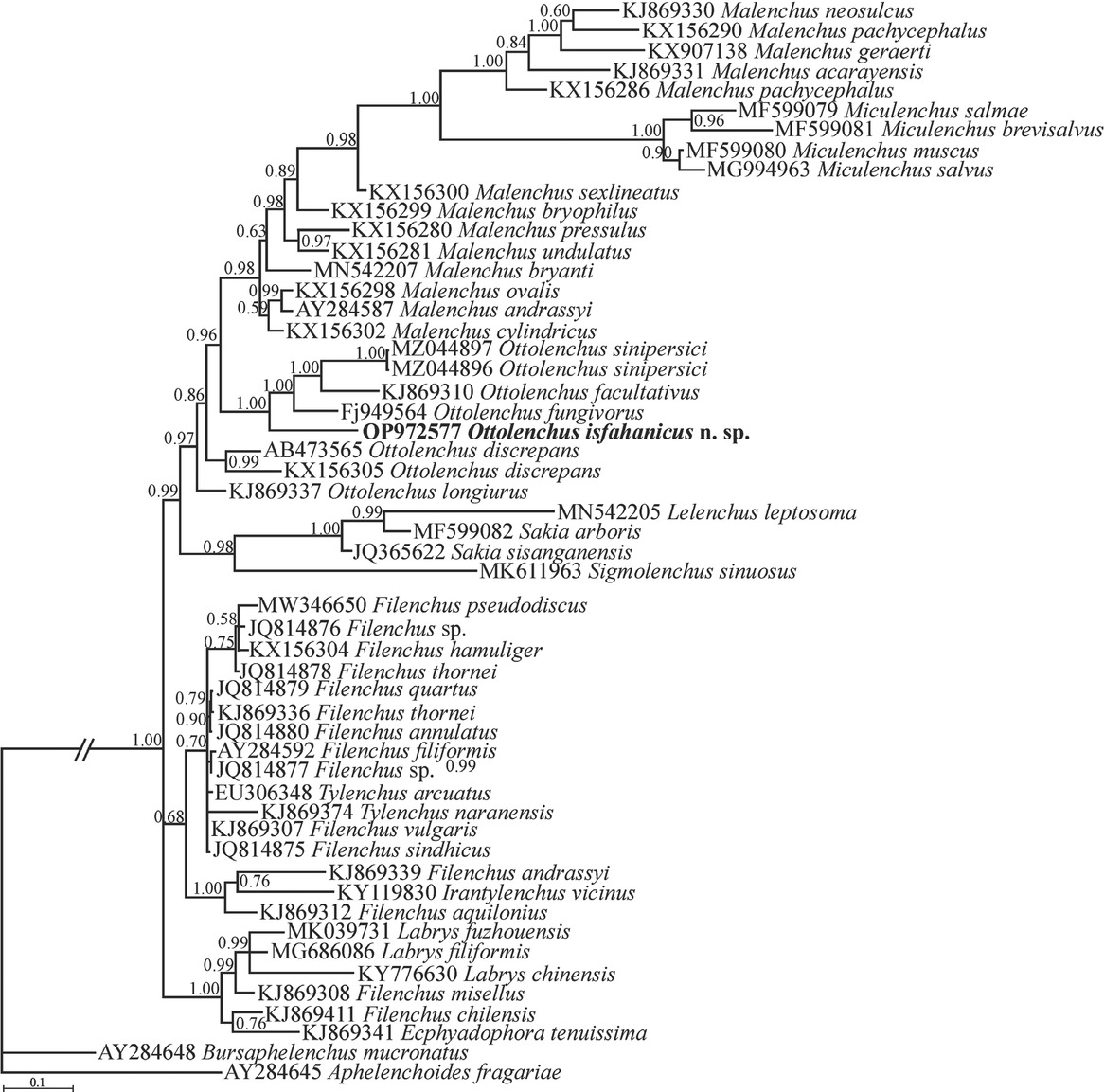
Figure 4
Bayesian 50% majority rule consensus tree inferred from the SSU rDNA of Ottolenchus isfahanicus n. sp. under the GTR + G + I model (-ln L = 22872.6152; freq A = 0.1925; freqC = 0.2759; freqG = 0.3011; freq T = 0.2305; R(a) = 1.1309; R(b) = 2.9105; R(c) = 1.1816; R(d) = 0.9105; R(e) = 4.1153; R(f) = 1.0000; Pinva = 0.2877; Shape = 0.4556). Bayesian posterior probability values are given for corresponding clades. The new species is in bold font. GTR, general time-reversible; G, gamma; I, invariant; rDNA, ribosomal DNA; SSU, small subunit.
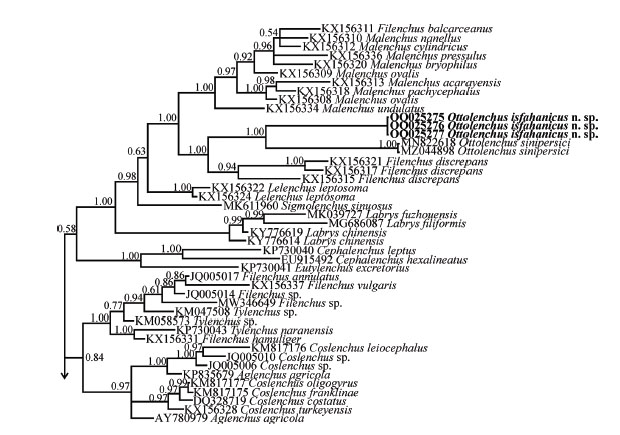
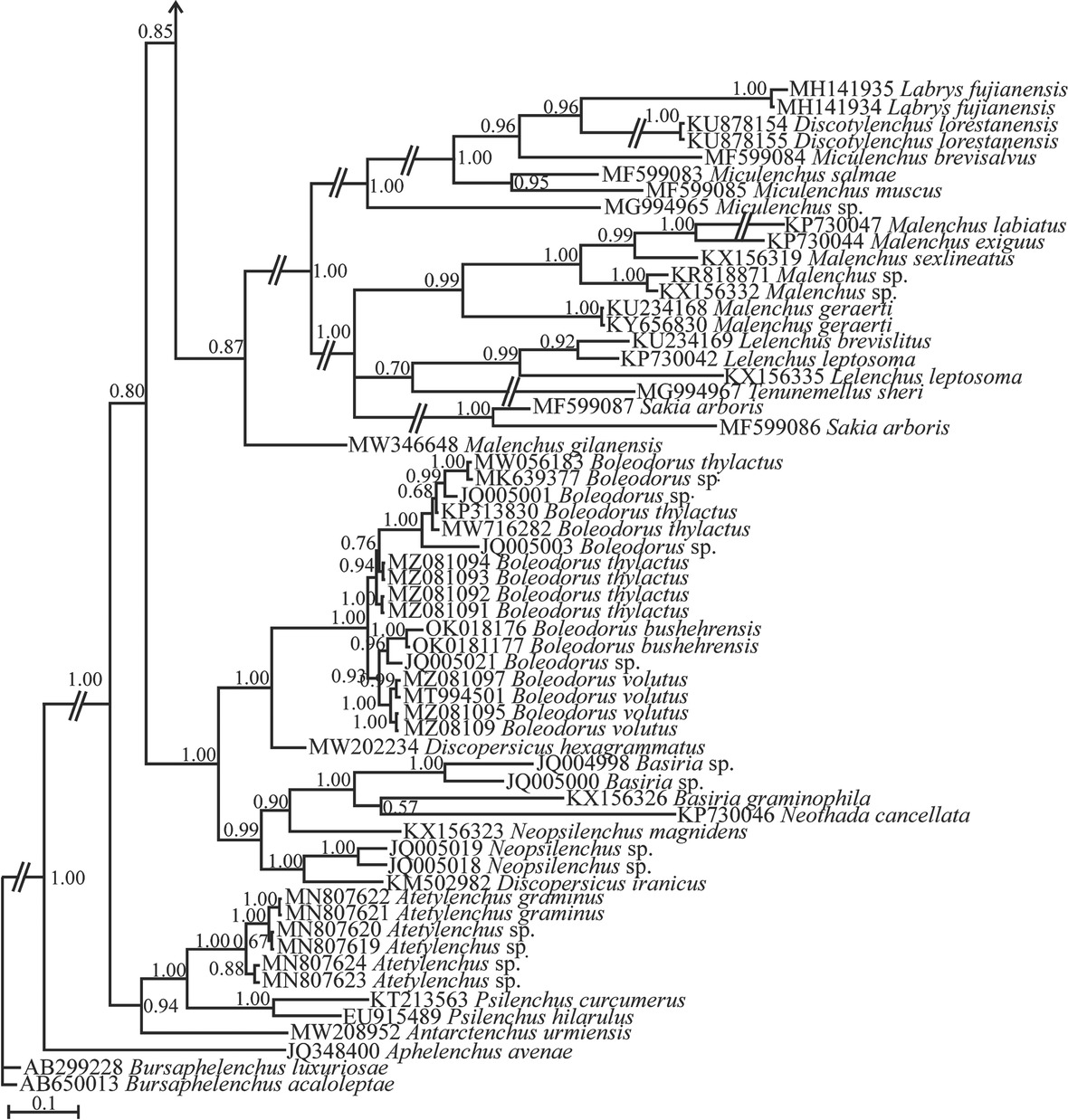
Figure 5
Bayesian 50% majority rule consensus tree inferred from the LSU rDNA D2–D3 sequences of Ottolenchus isfahanicus n. sp. under the GTR + G + I model (-ln L = 24658.7734; freq A = 0.1395; freqC = 0.2523; freqG = 0.3373; freq T = 0.2709; R(a) = 1.1364; R(b) = 3.0722; R(c) = 1.3293; R(d) = 0.7313; R(e) = 3.9786; R(f) = 1.0000; Pinva = 0.1104; Shape = 0.6954). Bayesian posterior probability values are given for the corresponding clades. The new species is in bold font. GTR, general time-reversible; G, gamma; I, invariant; LSU, large subunit; rDNA, ribosomal DNA.