
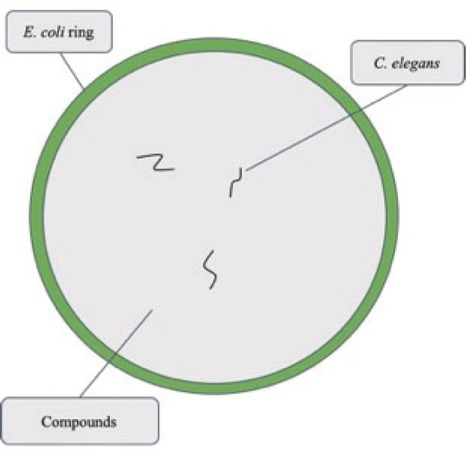
Figure 1
Ring assay plate.
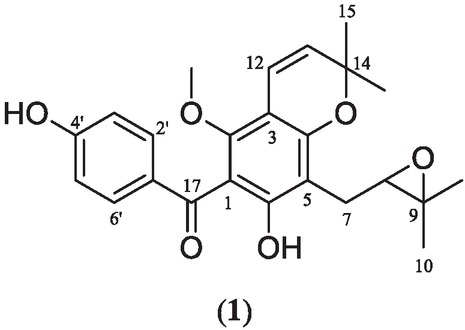
Figure 2
Compound isolated from Vismia guianensis. 8,9-epoxyvismiaphenone F (1).
Table 1
1H and 13C NMR data for 8,9-epoxyvismiaphenone F (1) in CDCl3.
| Position | δC | δH (J in Hz) |
|---|---|---|
| 1 | 107.5 | |
| 2 | 160.3 | |
| 3 | 103.8 | |
| 4 | 153.1 | |
| 5 | 110.4 | |
| 6 | 152.9 | |
| 7a | 26.0 | 2.65 (dd, 17.3, 5.6) |
| 7b | 2.90 (dd, 17.3, 5.2) | |
| 8 | 69.0 | 3.70 (dd, 5.2, 5.6) |
| 9 | 77.6 | |
| 10 | 21.6 | 1.10 (s) |
| 11 | 24.2 | 1.2 (s) |
| 12 | 116.8 | 6.50 (d, 9.9) |
| 13 | 127.4 | 5.52 (d, 9.9) |
| 14 | 77.6 | |
| 15 | 28.0 | 1.44 (s) |
| 16 | 28.1 | 1.44 (s) |
| 17 | 193.9 | |
| 1′ | 131.6 | |
| 2′ | 132.1 | 6.80 (d, 8.8) |
| 3′ | 115.2 | 7.75 (d, 8.8) |
| 4′ | 160.3 | |
| 5′ | 115.2 | 7.75 (d, 8.8) |
| 6′ | 132.1 | 6.80 (d, 8.8) |
| OCH3 | 63.4 | 3.67 (s) |
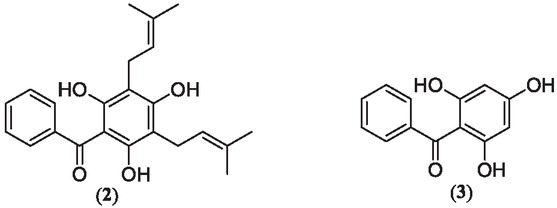
Figure 3
Clusiaphenone B (2) and benzophenone (3).
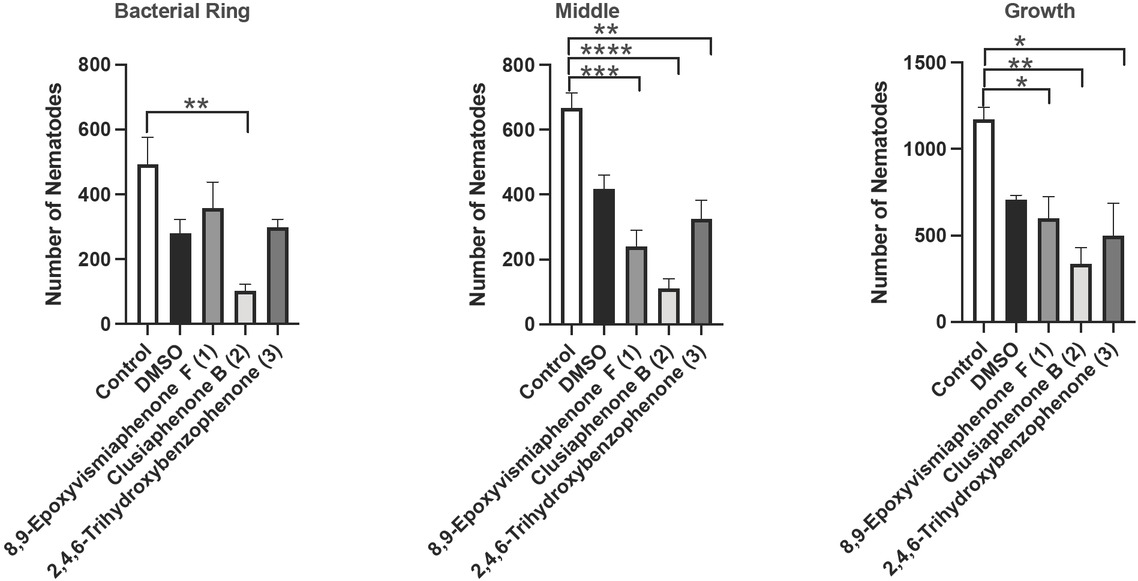
Figure 4
Effects of 8,9-epoxyvismiaphenone F (1), clusiaphenone B (2), and 2,4,6-trihydroxybenzophenone (3) on nematode chemotaxis and growth. (A) Nematodes in the bacterial ring. (B) Nematodes in the compound. (C) Nematode growth on day 3. Chemotaxis and growth decreased with 3-d exposure to 8,9-epoxyvismiaphenone F (1), clusiaphenone B (2), and 2,4,6-trihydroxybenzophenone (3). Nematodes were placed in the middle of nutrient growth agar plates in compounds (1, 2, 3) for 3 d. Nematodes in the bacterial ring and middle of ring assay plates were counted on day 3. Clusiaphenone B (3) decreased the number of nematodes in the bacterial ring compared to control on day 3 when conducting a one-way ANOVA (P-value <0.05). 8,9-Expoxyvismiaphenone F (1) and 2,4,6-trihydroxybenzophenone (3) did not significantly decrease nematodes in the bacterial ring on day 3 when compared to control (P-value >0.05). 8,9-Epoxyvismiaphenone F (1), clusiaphenone B (2), and 2,4,6-trihydroxybenzophenone (3) decreased nematodes in the middle of ring assay plate when compared to control on day 3, and the corresponding P-values are 0.0005 (***), <0.0001 (****), and 0.0026 (**), respectively. On day 3, all live nematodes on ring assay plates were counted and the number demonstrates growth. 8,9-Epoxyvismiaphenone F (1), clusiaphenone B (2), and 2,4,6-trihydroxybenzophenone (3) decreased nematode growth when compared to control on day 3, and the corresponding P-values are 0.0314 (*), 0.0028 (**), and 0.012 (*), respectively. Significance was determined under a one-way ANOVA and Tukey’s post-hoc test. Data are presented as the mean ± SEM for A–C for three independent replicates, each containing three ring assay plates per treatment group, n = 9.
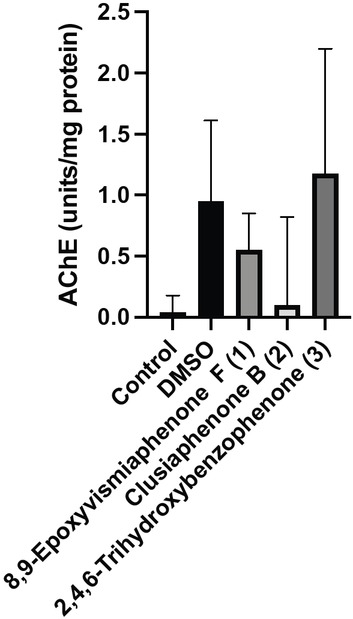
Figure 5
Effects of 8,9-epoxyvismiaphenone F (1), clusiaphenone B (2), and 2,4,6-trihydroxybenzophenone (3) on acetylcholinesterase activity. 8,9-Epoxyvismiaphenone F (1), clusiaphenone B (2), and 2,4,6-trihydroxybenzophenone (3) had no effect on nematode acetylcholinesterase activity. C. elegans were exposed to compounds for 3 d. All nematodes were preserved and subjected to acetylcholinesterase activity assay. No significant difference was found when test compounds were compared to the control one-way ANOVA and a Tukey’s post-hoc test (P > 0.05). Data are presented as the mean ± SEM for A–C for three independent replicates, each containing three ring assay plates per treatment group, n = 9.