Have a personal or library account? Click to login
Non-fumigant Nematicides are Promising Alternatives to Fumigants for the Management of Meloidogyne enterolobii in Tobacco Cover

Non-fumigant Nematicides are Promising Alternatives to Fumigants for the Management of Meloidogyne enterolobii in Tobacco

By: M. S. Alam,  C. Khanal,  W. Rutter and  J. Roberts  
Open Access
|Nov 2022

Figures & Tables

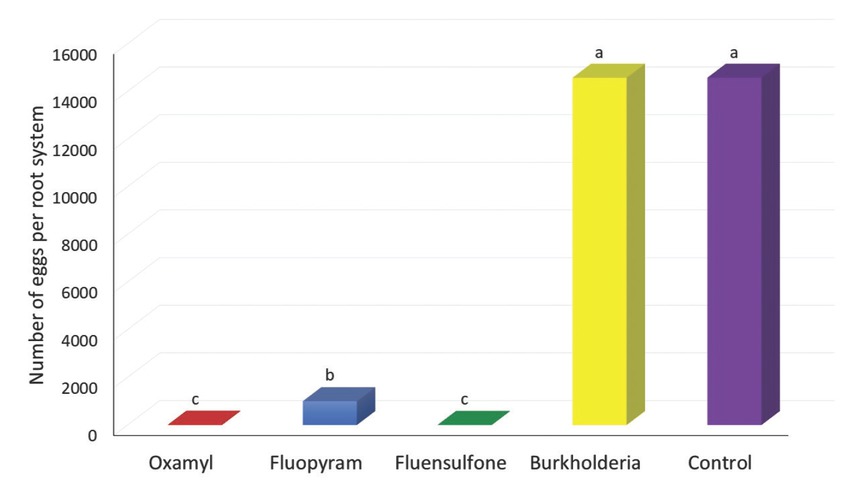
Figure 1

Reproduction of Meloidogyne enterolobii expressed as number of eggs per root system of tobacco inoculated with 1,000 freshly hatched second-stage juveniles, treated with non-fumigant nematicides, and harvested at 60 d after inoculation. Data were combined over two experiments and are means of 10 replications. Within columns, means followed by a common letter are not significantly different according to Tukey’s HSD test (P ≤ 0.05). Burkholderia refers to Burkholderia rinojensis strain A396 secondary metabolites.
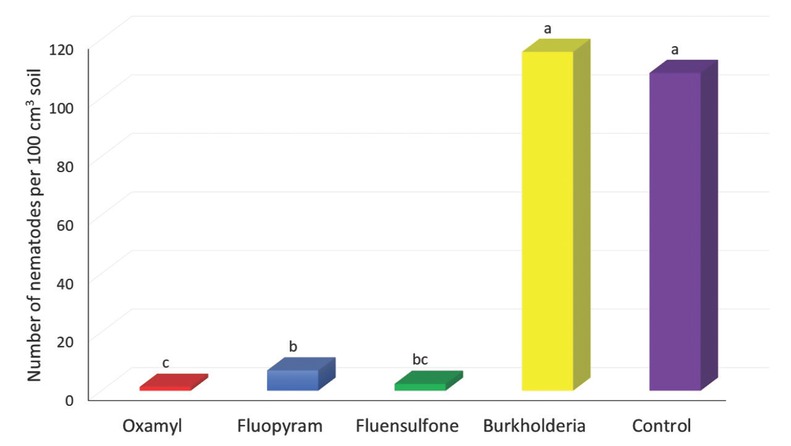

Figure 2

Reproduction of Meloidogyne enterolobii expressed as number of second-stage juveniles per 100 cm3 of soil containing tobacco inoculated with 1,000 freshly hatched second-stage juveniles, treated with non-fumigant nematicides, and harvested at 60 d after inoculation. Data were combined over two experiments and are means of 10 replications. Within columns, means followed by a common letter are not significantly different according to Student’s t-test (P ≤ 0.05). Burkholderia refers to Burkholderia rinojensis strain A396 secondary metabolites.
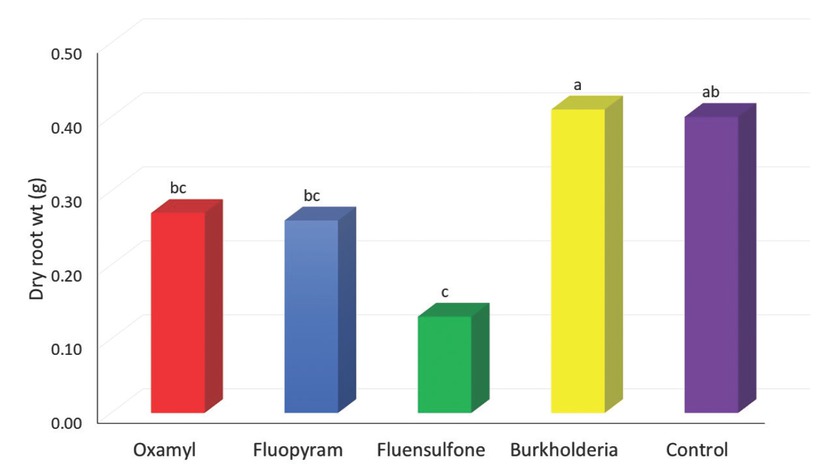

Figure 3

Dry weights of tobacco roots 60 d after inoculation with 1,000 freshly hatched second-stage juveniles of Meloidogyne enterolobii and application of non-fumigant nematicides. Data are means of 10 replications. The plant material was dried at 45°C for 2 wk. Bars with common letters are not significantly different according to Tukey’s HSD test (P ≤ 0.05).

Non-fumigant chemical and biological nematicide treatments and their recommended application rates used in the current study_

TreatmentApplication rate (L/ha)
Oxamyl4.68
Fluopyram0.50
Fluensulfone4.09
Burkholderiaa18.71
Untreated control
DOI: https://doi.org/10.2478/jofnem-2022-0045 | Journal eISSN: 2640-396X | Journal ISSN: 0022-300X
Language: English
Submitted on: May 11, 2022
Published on: Nov 9, 2022
Published by: Society of Nematologists, Inc.
In partnership with: Paradigm Publishing Services
Publication frequency: 1 issue per year

© 2022 M. S. Alam, C. Khanal, W. Rutter, J. Roberts, published by Society of Nematologists, Inc.
This work is licensed under the Creative Commons Attribution 4.0 License.