
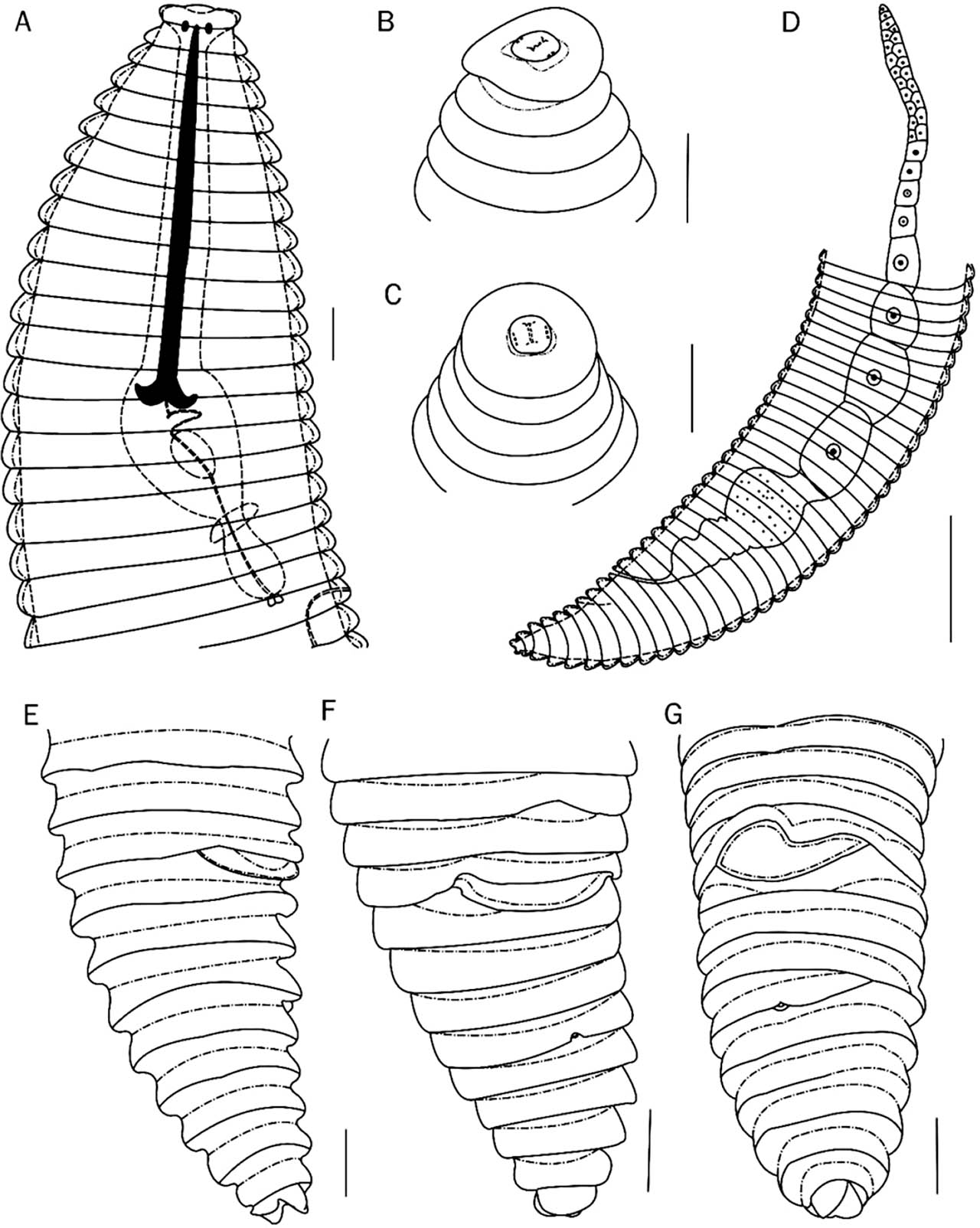
Figure 1
Line drawings of D. parasinensis n. sp. Female. (A) Esophageal region; (B, C) En face view of lip region; (D) Gonad; (E–G) Posterior region showing position of vulva and anus (Scale bars: A–C, E–G = 10 μm, D = 50 μm).
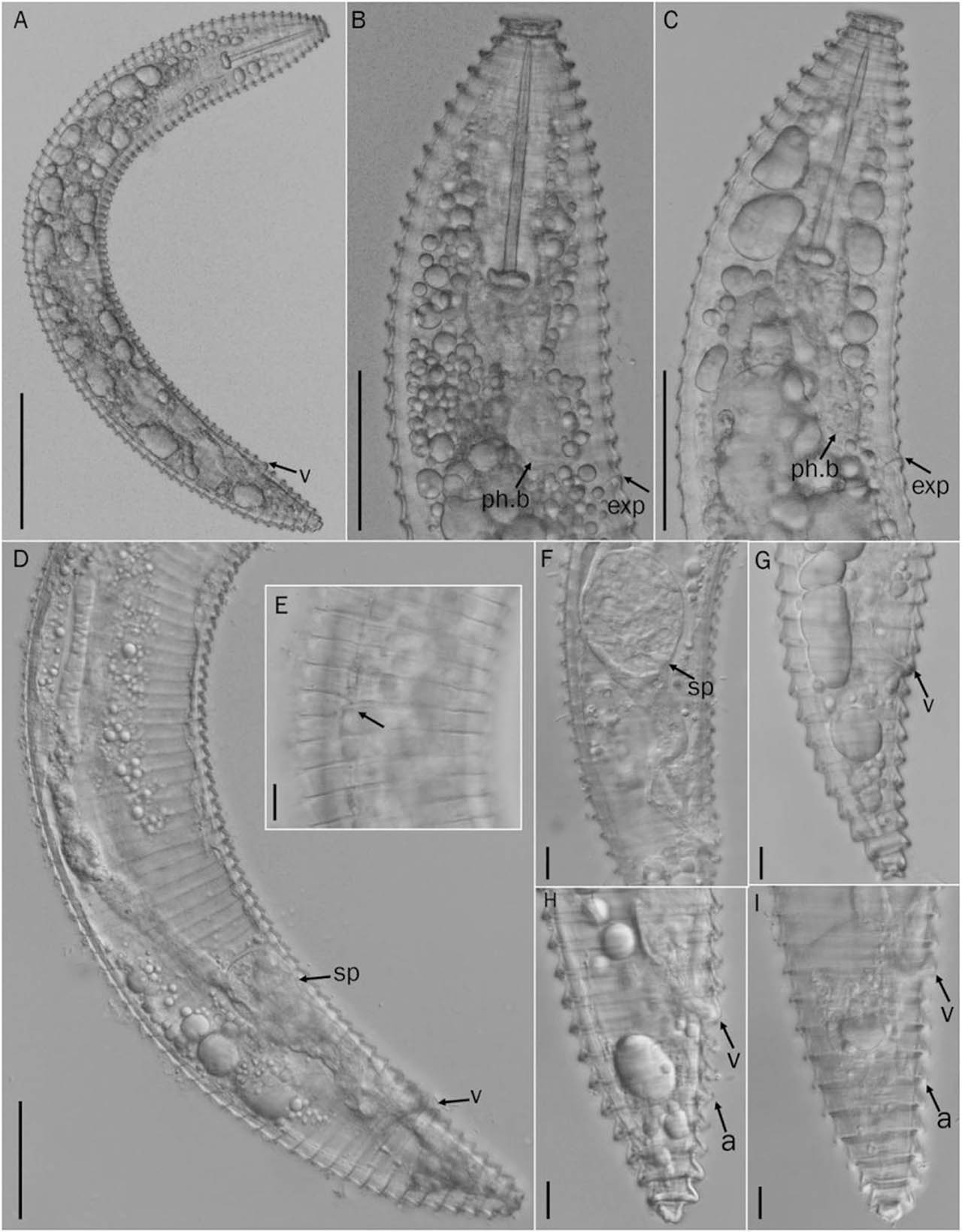
Figure 2
Light photomicrographs of D. parasinensis n. sp. Female. (A) Entire body, arrowhead indicating position of vulva (v = vulva); (B, C) Esophageal region arrowheads indicating position of base of esophageal bulb (ph.b) and excretory pore (exp); (D) Posterior region showing entire gonad arrowheads indicating position of vulva (v) and spermatheca (sp); (E) Mid-body (arrowhead pointing anastomoses); (F) Vulval region arrowhead showing spermatheca (sp); (G–I) Tail region, arrowheads showing position of vulva (v) and anus (a) (Scale bars: A = 100 μm, B–D = 50 μm, E–I = 10 μm).
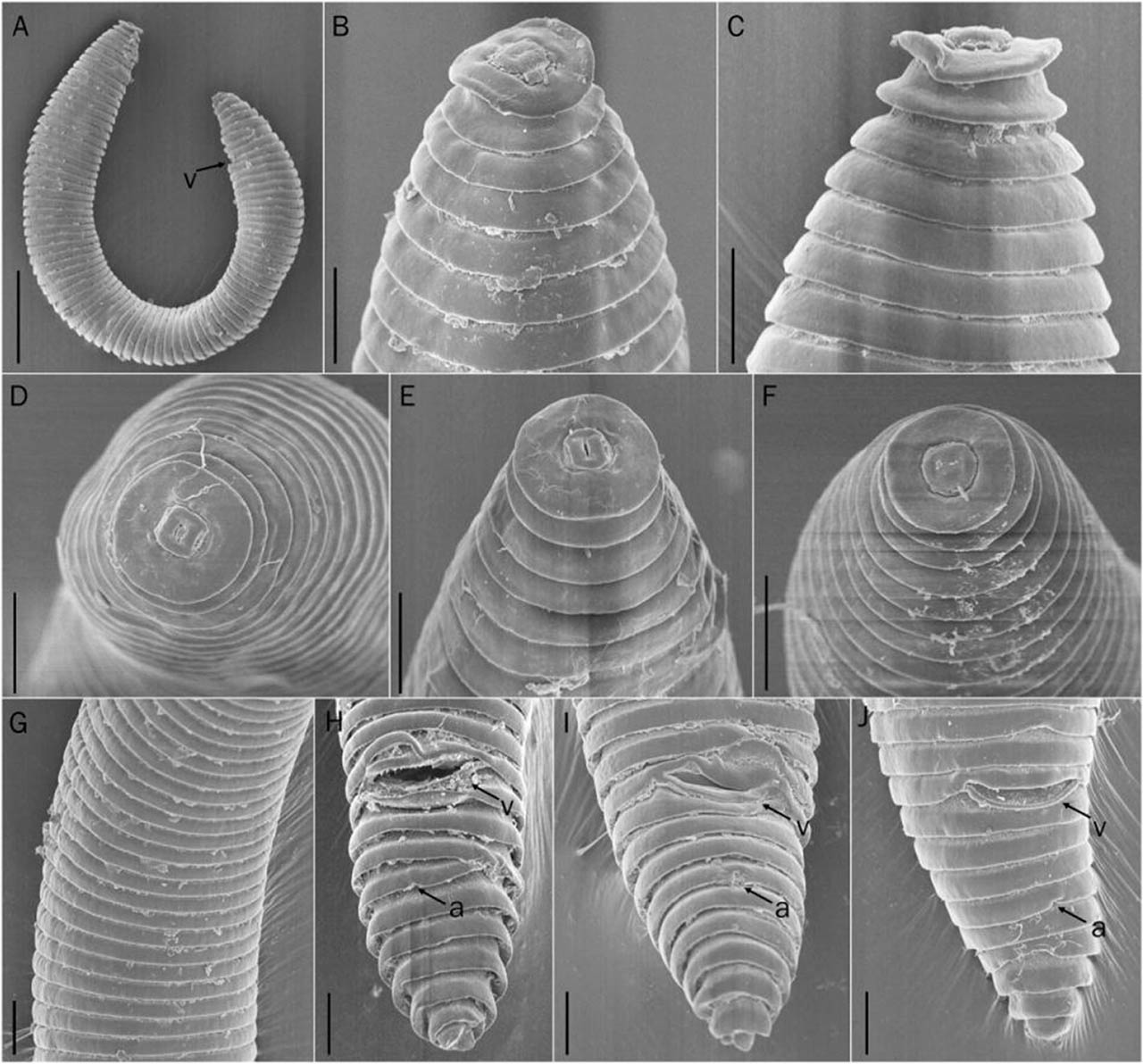
Figure 3
Scanning electron micrographs of D. parasinensis n. sp. Female. (A) Entire body, arrowhead indicating position of vulva (v = vulva); (B–F) Lip regions; (G) Cuticular annuli at mid-body; (H–J) Tail region, arrowheads showing position of vulva (v) and anus (a) (Scale bars: A = 50 μm; B–J = 10 μm).
Table 1
Morphometric data of female of D. parasinensis n. sp.
| Character | Holotype | Paratype |
|---|---|---|
| n | – | 15 |
| L | 477.0 | 486.1 ± 37.6 (382–556) |
| a | 7.8 | 7.7 ± 0.5 (6.7–9.0) |
| b | 4.0 | 4.3 ± 0.3 (3.6–4.6) |
| c | 15.5 | 16.4 ± 2.0 (13.8–20.6) |
| c′ | 1.1 | 1.0 ± 0.1 (0.9–1.3) |
| V | 89.6 | 89.6 ± 0.8 (88.0–91.0) |
| VL/VB | 1.3 | 1.2 ± 0.1 (1.1–1.5) |
| R | 82 | 82.6 ± 1.9 (80–86) |
| Rex | 22 | 22.0 ± 0.7 (21.0–23.0) |
| RV | 10 | 10.1 ± 0.4 (9–11) |
| RVan | 3 | 2.9 ± 0.2 (2–3) |
| Ran | 6 | 6.1 ± 0.3 (6–7) |
| Lip height | 9.0 | 7.8 ± 0.6 (7.0–9.0) |
| Lip diam. | 19.0 | 20.0 ± 1.0 (18.0–22.0) |
| Stylet length | 68.0 | 68.3 ± 4.9 (59.0–76.0) |
| Stylet (% L) | 14.3 | 14.1 ± 1.3 (12.3–16.8) |
| Pharynx | 119.0 | 114.0 ± 5.8 (103.0–123.0) |
| Max. Body diam. | 61.0 | 63.2 ± 6.3 (51.0–72.0) |
| Vulval body diam. | 38.0 | 40.9 ± 3.6 (33.0–47.0) |
| Vulva to tail terminus | 49.0 | 50.4 ± 4.4 (41.0–56.0) |
| Anal body diam. | 28.0 | 30.0 ± 3.5 (24.0–35.0) |
| Tail length | 31.0 | 30.0 ± 3.9 (23.0–36.0) |
[i] All measurements are in μm and in the form of mean ± SD (range).
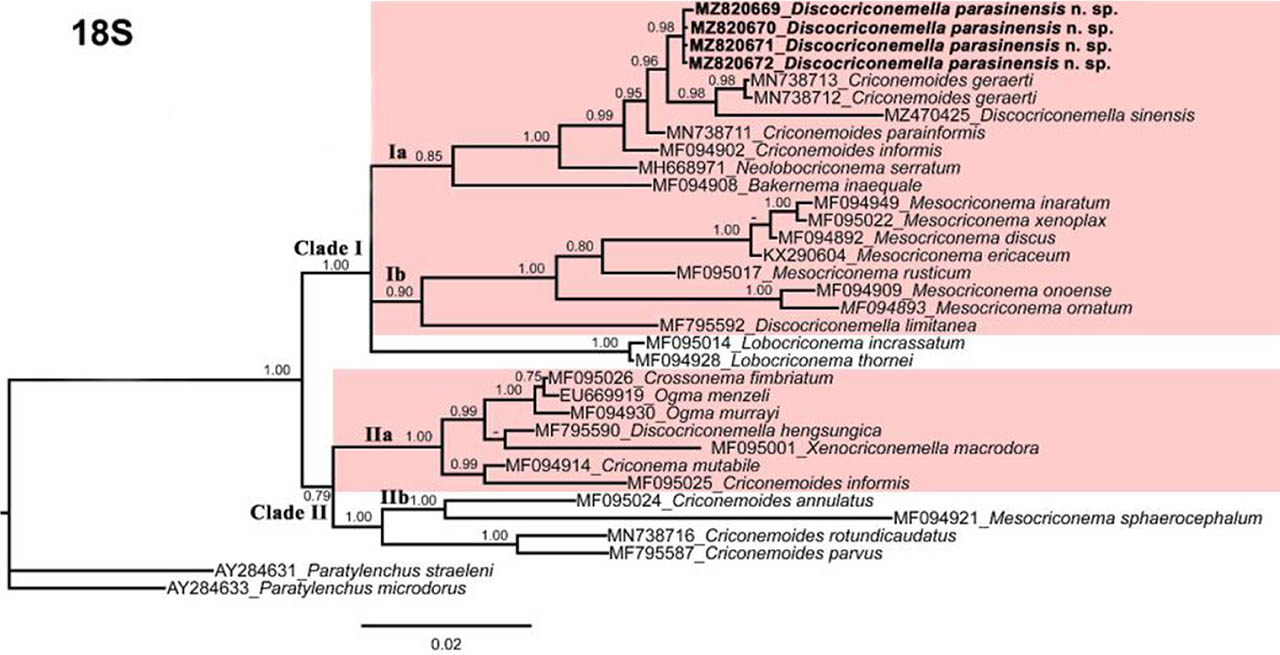
Figure 4
Phylogenetic relationships of D. parasinensis n. sp. with other criconematids species as inferred from Bayesian analysis using the 18S rRNA gene sequence dataset with the TIM1+I+G model. Posterior probability >70% is given for appropriate clades. Newly obtained sequences are indicated in bold.
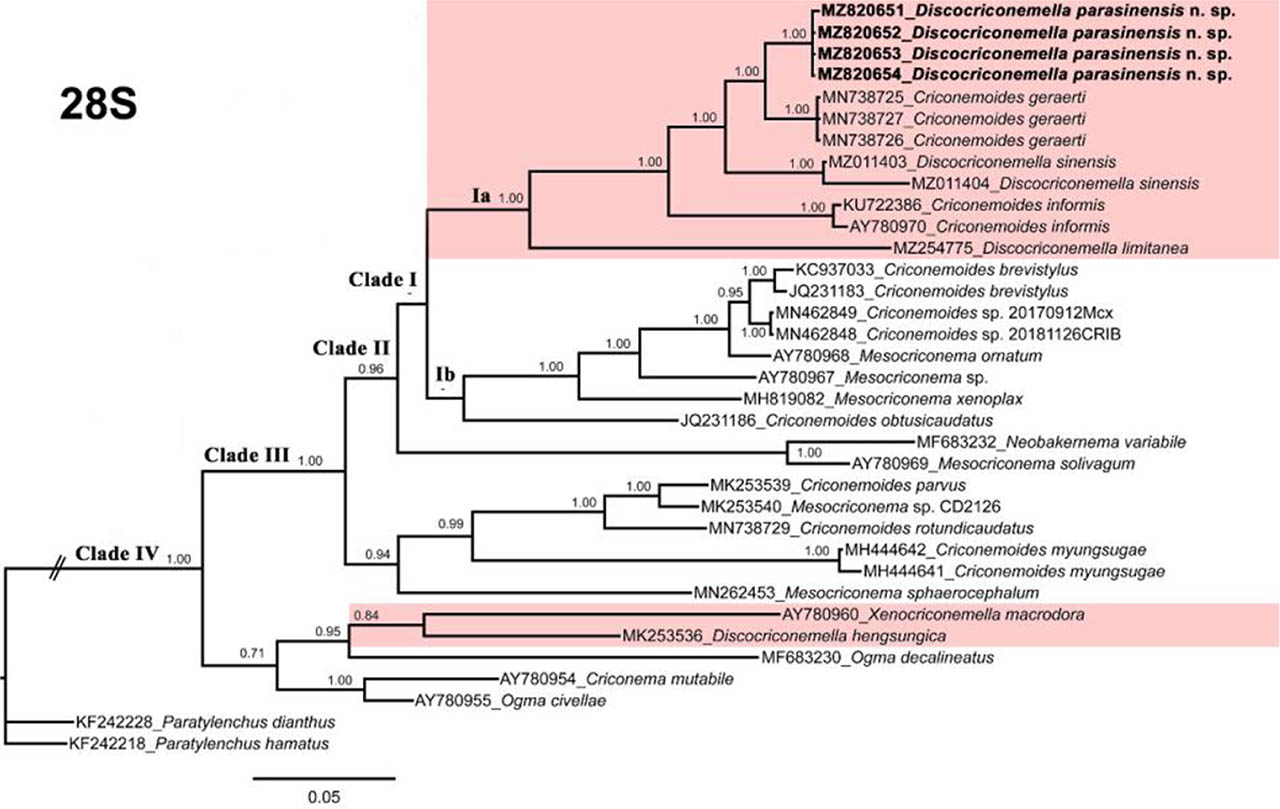
Figure 5
Phylogenetic relationships of D. parasinensis n. sp. with other criconematids species as inferred from Bayesian analysis using the D2–D3 of 28S rRNA gene sequence dataset with the TIM3+I +G model. Posterior probability >70% is given for appropriate clades. Newly obtained sequences are indicated in bold.
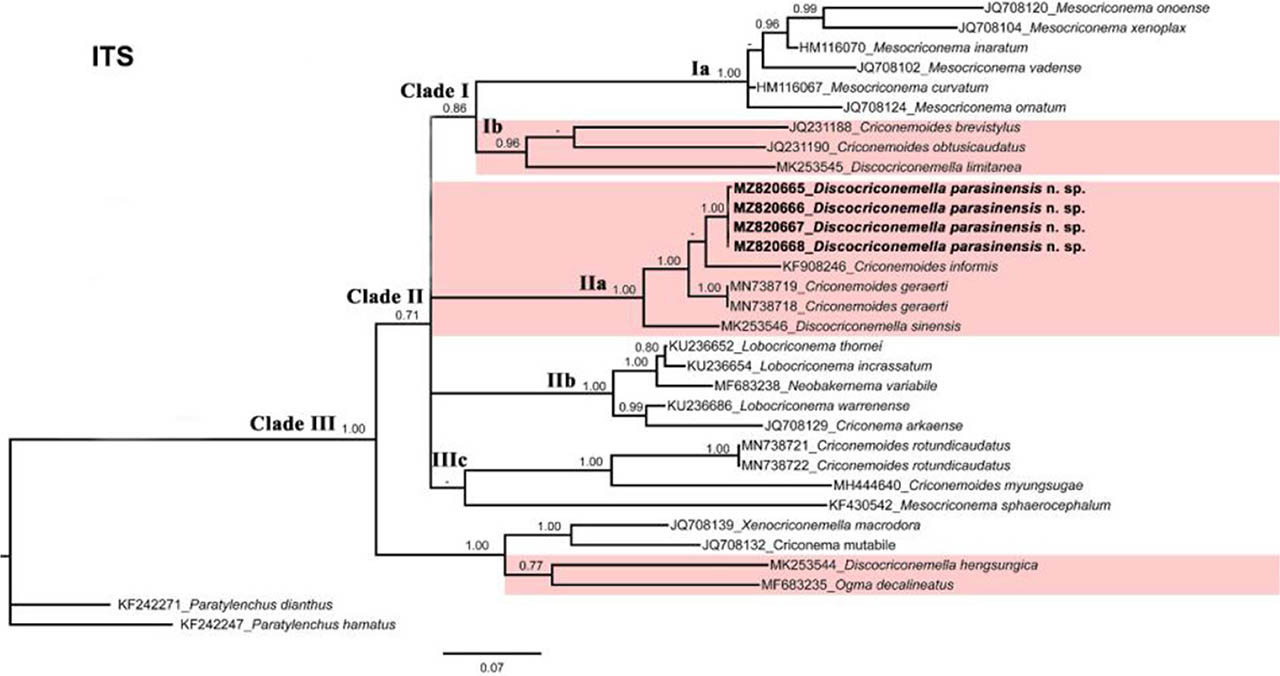
Figure 6
Phylogenetic relationships of D. parasinensis n. sp. with other criconematids species as inferred from Bayesian analysis using the ITS rRNA gene sequence dataset with the GTR+I+G model. Posterior probability >70% is given for appropriate clades. Newly obtained sequences are indicated in bold.