
Introduction
Cardiovascular diseases remain the foremost cause of mortality worldwide, accounting for 20 million of global deaths each year [1]. Despite major advances in prevention, diagnosis, and therapy, the absolute number of cardiovascular-related fatalities continues to increase, underscoring the urgent need for improved strategies in both acute and long-term patient management.
Among the parameters with high prognostic value, accurate assessment of left ventricular volume (LVV) has proven to be particularly informative. LVV is directly linked to stroke volume, cardiac output, and overall ventricular function, making it a critical parameter for evaluating the progression of heart failure, guiding device therapy, and optimizing pharmaceutical regimens [2, 3]. Reliable methods for LVV estimation could therefore play a pivotal role in improving cardiovascular care for the rising at-risk population.
Many monitoring technologies have emerged as a promising means to address these challenges. By enabling real-time acquisition of hemodynamic parameters, such systems facilitate earlier detection of clinical deterioration, allow for timely therapeutic adjustments, and ultimately improve patient outcomes [4, 5]. Moreover, continuous monitoring can reduce hospital readmissions and overall healthcare costs by supporting personalized and preventive care strategies.
Existing techniques for monitoring LVV present notable limitations that impede their routine, continuous use. Gold-standard modalities such as cardiac magnetic resonance imaging and three-dimensional echocardiography offer high accuracy, with CMR achieving an interstudy reproducibility of 2–10% [6]. These measurements are, however, expensive, time-consuming, and reliant on specialized personnel and infrastructure [6, 7]. Conversely, bedside methods, including two-dimensional echocardiography and impedance cardiography, either suffer from reduced precision or require frequent recalibration. These constraints hamper integration into real-time, automated monitoring workflows and highlight the need for novel LVV assessment approaches that combine accuracy with minimal operator dependency and calibration requirements [7].
For patients in whom invasive catheterization can be justified conductance and admittance catheters have been proposed for LVV assessment as an alternative to pulmonary artery thermodilution and form the basis of current pressure–volume analysis in both experimental and clinical settings [8, 9]. While firmly established in basic and clinical research, these methods have not seen widespread use in clinical practice [10]. One of the reasons, besides the invasiveness, is the elaborate calibration procedure, leading to mixed results (deviation between CMR and conductance catheter up to 40 mL in swine trial) even for expert practitioners [2, 11].
To address this need, we have developed a finite-element– method (FEM)-based approach to measure the volume of a LV phantom using catheter-based admittance measurements, which can be the basis for a new LVV estimation method. In our approach we account for the positional changes of the measurement catheter. Thus, this method has the potential for a higher accuracy and a reduced need for recalibration.
This paper describes the design of a FEM-based constrained Gauss–Newton estimation algorithm, including the underlying ventricle–catheter FEM model and a sensitivity-guided selection of informative 4-electrode configurations, and reports the estimation results from simulations and real measurements with a dynamic ventricle phantom.
Materials and Methods
Admittance Measurements
Admittance is measured using a 4-electrode configuration to minimize the influence of lead resistance Rl and electrode polarization effects [12]. Fig. 1 illustrates the measurement concept, where two electrodes are used to inject an electrical current and two other electrodes are used to measure a potential difference. The (transfer) admittance Y is then defined as the ratio of injected current I to the measured voltage V between the voltage-sensing electrodes: Y = I/V . We use a 10-electrode intracardiac catheter, so that in principle 5040 distinct 4-electrode current–voltage configurations are possible if all permutations of injection and measurement electrode pairs are considered.
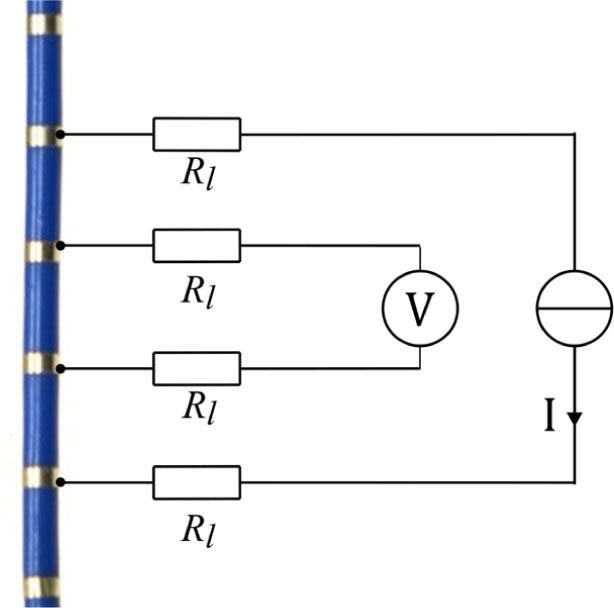
Figure 1:
Close-up of a section of the catheter, with a conceptual drawing of a single 4 electrode measurement. All electrode combinations with both measurement electrodes inside of the injection electrodes are considered.
For real-time monitoring, only a limited number of measurements can be measured. To obtain a feasible and informative measurement set, we systematically reduce the number of configurations based on physical considerations and expected signal quality. First, the reciprocity principle implies that exchanging current injection and voltage measurement pairs does not provide additional information, allowing us to discard reciprocal duplicates. Second, we exclude configurations in which the current-injecting electrodes lie between the voltage-sensing electrodes along the catheter, as these tend to exhibit a low signal-to-noise ratio (SNR). Applying these criteria yields a reduced set of 210 4-electrode configurations.
For algorithm development and evaluation, we use this set of 210 measurements as a reference and investigate further reductions motivated by sensitivity analysis. Let Y ∈ ℂm denote the vector of simulated admittances for all m selected 4-electrode configurations at a given operating point, and let pi be a scalar model parameter of interest (e.g., LVV, catheter offset, or blood conductivity σbl). The relative sensitivity of the measurements with respect to parameter pi is defined as
where division is performed element-wise and ⊙ denotes the Hadamard (element-wise) product.We compute sensitivities for three parameters: LVV, horizontal catheter offset o, and blood conductivity σbl, using the cylindrical left ventricle model with a LVV of 70 mL and the catheter in the center. The model is fully described in the upcoming simulation section. To enable comparison across the parameters with different scales, each sensitivity vector is normalized to 1.
The resulting sensitivity values for all 210 configurations are shown in Fig. 2, where the measurements are sorted three times according to the magnitude of SLVV, So, and Sσbl, respectively. When sorted by LVV sensitivity, the sensitivities with respect to catheter offset and blood conductivity vary without strong correlation, indicating that some measurements are predominantly sensitive to LVV. In contrast, sorting by catheter offset or blood conductivity reveals a strong correlation between So and Sσbl, suggesting that these two parameters are more difficult to distinguish based solely on the admittance data.
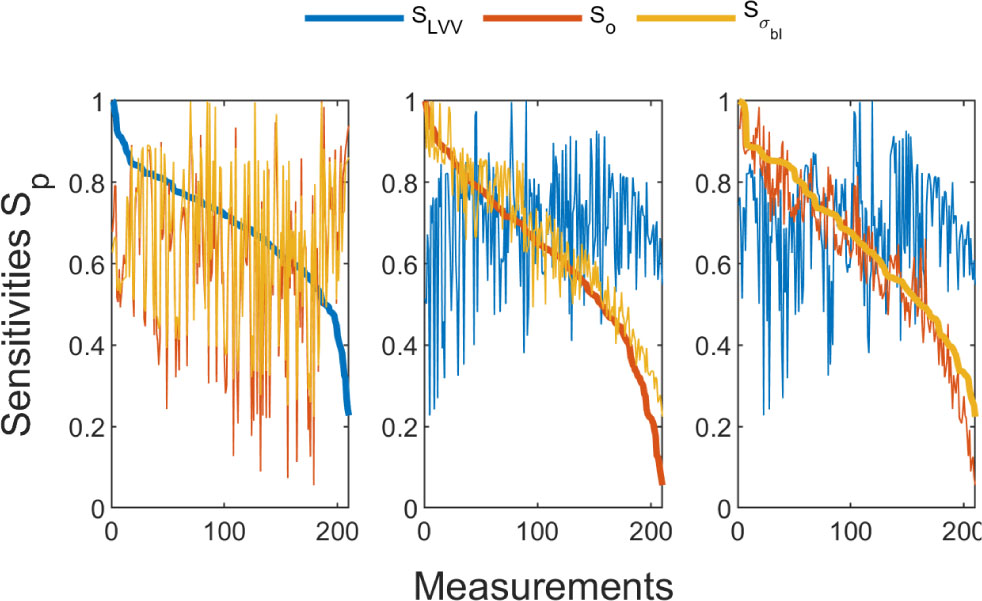
Figure 2:
Normalized sensitivity of the measurements. Sorted by three different parameters: LVV (left), blood conductivity (center), catheter offset (right).
This analysis shows that different 4-electrode configurations emphasize different parameters and that a partial separation of LVV from catheter offset and blood conductivity is feasible, while offset and σbl are more tightly coupled. We thus exclude the conductivity of blood as an estimation parameter and only estimate LVV alone, and LVV and catheter offset. Based on the sensitivity ranking, we construct a reduced measurement set by taking the union of the ten most sensitive configurations for each parameter, resulting in 19 distinct 4-electrode measurements due to overlap between the corresponding subsets. In the following, we therefore evaluate the estimation algorithm using both the full set of 210 measurements and this reduced set of 19 sensitivity-optimized configurations to explore the trade-off between measurement effort and estimation performance.
Estimation
The parameter estimation problem is formulated as the adjustment of a finite-element forward model such that the simulated 4-electrode admittance measurements match the measured data as closely as possible. Let the parameter vector p ∈ ℝn contain the quantities to be estimated (e.g., LVV and catheter offset), and let Ysim(p) ∈ ℂm denote the corresponding vector of simulated admittances for all selected measurement configurations. For a given measurement vector Ymeas ∈ ℂm, the residual is defined as
The inverse problem is then the non-linear least-squares minimization of the residual norm. We solve this problem by an iterative Gauss–Newton scheme. An overview of the algorithm is shown in Fig. 3.

Figure 3:
High-level overview of the FEM-based estimation algorithm using intracardiac admittance measurements.
Jacobian computation
To apply this gradient-based optimization scheme, we compute the Jacobian matrix
with i ∈ {1, . . . ,m} indexing the measurements and j ∈ {1, . . ., n} indexing the parameters. Since the measurements Ymeas are independent of the parameters, the Jacobian can be expressed directly in terms of the simulated admittances asThe derivatives are evaluated numerically using finite differences: central differences are employed in the interior of the admissible simulation region, and one-sided differences are used near the bounds of the simulation region. Step sizes for the finite differences are chosen small enough to approximate the derivatives accurately while avoiding excessive numerical noise.
Gauss–Newton update
At iteration k, the residual rk = r(pk) and Jacobian Jk = J(pk) are evaluated at the current parameter estimate pk. Linearizing r(p) around pk yields
and the Gauss–Newton step Δpk is obtained by solving the normal equations where (·)H denotes the conjugate transpose, I is the identity matrix, and λ > 0 is a small Tikhonov regularization parameter [13] introduced purely for numerical stability. The regularization does not aim to promote sparsity, as all parameters are expected to be non-zero, but to mitigate ill-conditioning in . Equation (6) is solved by an LU factorization of the system matrix.Step size and constraints
The tentative update is applied as
where α ∈ (0, 1] is a scalar step size. We performed backtracking line search to determine the optimal step size α [14]. During the majority of iterations α was close to 0.4. For that reason, we then used a constant α = 0.4 instead of determining the optimal step size during each iteration to increase the performance of the algorithm. Finally, the new parameters are constrained to a plausible range covering physiological and pathological values by clipping each parameter to its allowed range: LVV is constrained between 0 mL and 200 mL and the catheter offset between 0 and the maximum physically possible value depending on the current LVV.Stopping criteria
The iterative procedure is terminated either after a maximum of 20 iterations or earlier if the update becomes sufficiently small in all estimated parameters. Specifically, the iteration stops if the step size satisfies
for the parameters included in the current estimation scenario. For cases where only LVV is estimated, only the corresponding condition is enforced, whereas for joint LVV and offset estimation both criteria must be satisfied.Calibration
The simulation model does not completely replicate a real measurement. The deviations are due to a different model geometry, differences in the electrical properties, deviations due to numerical issues, as well as, measurement errors. To compensate for these deviations we performed a calibration of the measurements. We used an independent measurement of the LVV at minimal and maximal volume, similar to the established practice for conductance/admittance catheter approaches [8, 9]. For each 4-electrode configuration, we then assumed an affine mapping between measured and corrected admittance,
with a and b chosen accordingly to remove the deviation from the independent measurement.Simulation
The algorithm was evaluated in two settings: A simulation, covered in this section and an experiment described in the following section.
Although the left ventricle has a conical shape, analytical simulations have shown that for admittance measurements a simple cylindrical ventricle shape with fixed length closely resembles a full anatomical model. For this reason, most analytical models [15, 9, 16] have been developed using this simplification. Here, we used our cylindrical model, developed in our previous work [17] with a varying diameter, fixed ventricle length of 90 mm and myocardium thickness of 12 mm and surrounding tissue.
The electrical conductivity σ and relative permittivity ε for each material were chosen for a measurement at 50 kHz based on physiological data [18]. We selected for blood σbl = 0.7 S/m and εbl = 5197; for myocardium σmyo = 0.19 S/m and εmyo = 16982; and for the background tissue σbgrd = 0.1 S/m and εbgrd = 4272.
Finite-element simulations were performed using EIDORS, an open-source MATLAB toolkit for low frequency/quasi-static electrical simulations [19]. Geometries, electrode placements, and material properties were defined in EIDORS and discretized by Netgen using conforming tetrahedral meshes. The resulting sparse linear system from the FEM discretization was assembled and solved with EIDORS’ forward solver to obtain electrode voltages and resulting transfer admittances. Mesh density was selected via hyperparameter tuning to ensure numerical convergence and stability.
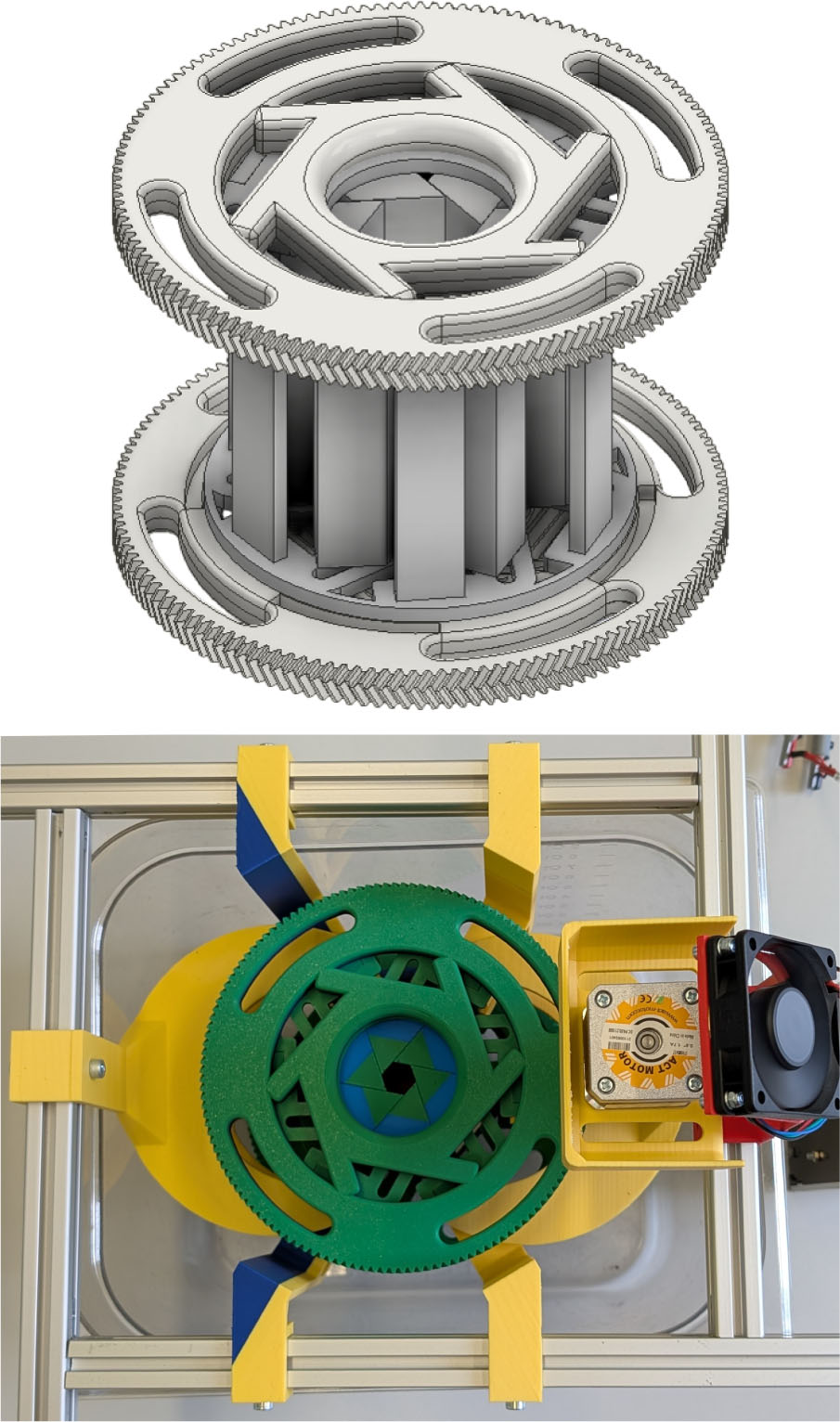
Figure 4:
Experimental setup; CAD drawing of phantom model phantom (top); Real phantom submerged in NaCl solution (bottom).
Experiment
To perform measurements in a controlled setup, we have developed a 3D printed left ventricle phantom that allows for changes in volume (Fig. 4). Ventricle contraction was emulated by approximating the cylindrical geometry by a 6-sided aperture-like design, with each segment sliding in a fixture to achieve the change in diameter. The phantom is driven by a microcontroller-controlled motor to allow for automatic changes in volume. This allows for a volume range from 5 mL to 210 mL, while also enabling dynamical measurements that emulate the cardiac motion during the heart cycle.
Since conducting filament with a conductivity similar to myocardium is not available, we have approximated the myocardium as non-conducting. The phantom was printed with PLA and was fully submerged in an NaCl solution with an electrical conductivity of 0.7 S/m, modeling the blood in the ventricle. The impedance measurements were performed at 50 kHz using a voltage injection of 10 mV resulting in currents below 6 μA, thus below the legal limit of 10 μA for a cardiac floating patient auxiliary current. The 10-electrode catheter (Inquiry, Abbott) used in the measurement was fixated in the center of the ventricle (not shown in the figure) and connected to an impedance analyzer (ISX-3, Sciospec).
Ethical approval
The conducted research is not related to either human or animal use.
Results
Physiological Simulation
In a first step, we evaluated the proposed estimation algorithm using the cylindrical FEM ventricle model with physiological electrical properties described in the simulation subsection of the Method section. All simulations were performed at 50 kHz using the 10-electrode catheter and either the full set of 210 4-electrode configurations or the reduced set of 19 sensitivity-optimized configurations.
Volume estimation
We first considered the case where only volume is estimated while the catheter is assumed to be centered and all other parameters are fixed at their nominal values. For a true volume of 70 mL, we computed the 2-norm of the residual, eq. (2), as a function of volume for three scenarios: (i) using all 210 measurements without noise, (ii) using the reduced set of 19 measurements without noise, and (iii) using the reduced set with added measurement noise. The resulting curves are shown in Fig. 5.
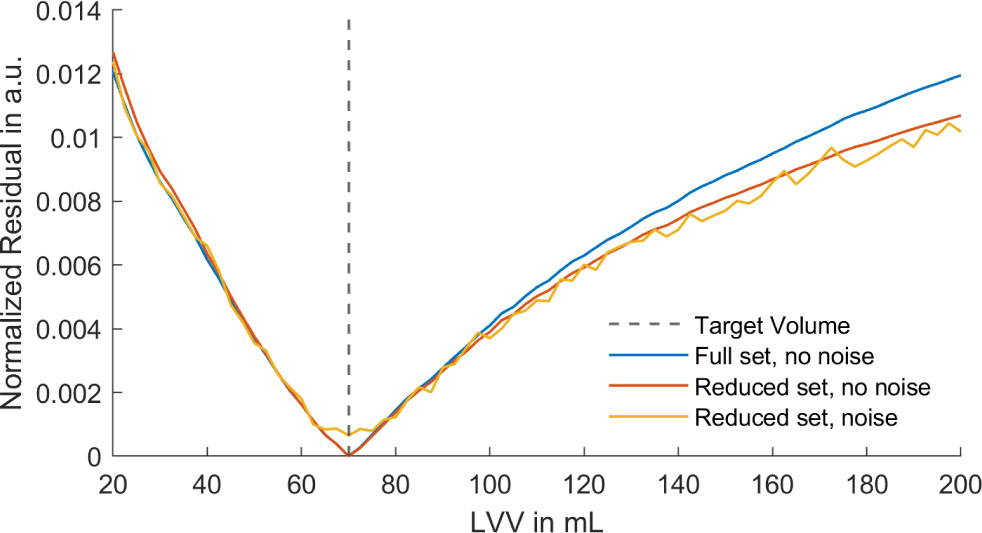
Figure 5:
Residual norm as a function of volume for the physiological simulation with a true volume of 70 mL: comparison of all 210 measurements, the reduced set of 19 measurements, and the reduced set with added noise.
For both noise-free cases, the residual exhibits a clear minimum at the true volume, indicating good identifiability of volume from the admittance data. The residual curve obtained from the reduced measurement set closely matches that of the full set, demonstrating that the sensitivity-based selection retains most of the volume information while substantially reducing the number of measurements. In the noisy scenario, the residual values are overall similar to the noise-free case, however, the minimum becomes slightly broader. Nevertheless, the location of the minimum remains near the true volume, suggesting that the volume estimate is robust with respect to the considered level of measurement noise.
Quantitatively, the estimation always yields an absolute error below 1 mL for all volumes, the small deviation is just below the stopping criterion. This error is expected due to the different meshes.
Joint estimation of volume and catheter offset
In a second simulation study, we jointly estimated volume and horizontal catheter offset to assess whether the algorithm can separate these two parameters despite their coupled influence on the admittance measurements. Using the physiological FEM model with a true volume of 70 mL and a 4 mm catheter offset, we computed the residual norm on a grid in the two-dimensional parameter space and visualized the resulting residual map for the reduced set of 19 measurements. Fig. 6 shows the residual map together with the Gauss–Newton iteration paths for four different initial guesses.
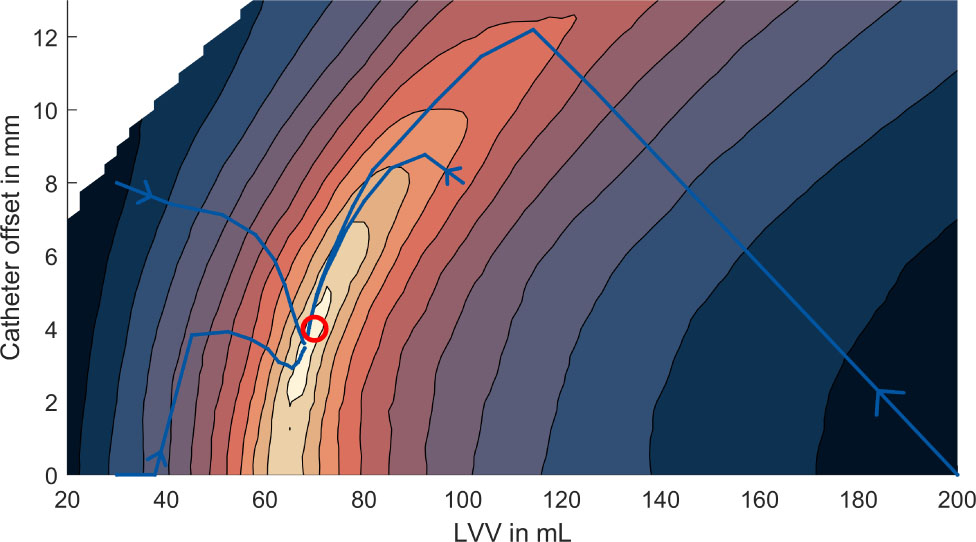
Figure 6:
Residual map for the simulation using the reduced set of 19 measurements; the true parameter combination is marked in red, and four Gauss–Newton iteration trajectories from different initial guesses are overlaid.
The residual map exhibits a well-defined basin of attraction with a single pronounced minimum located near the true volume–offset combination, indicating local convexity around the solution and good joint identifiability of both parameters for the chosen electrode configurations. For all four initialization points, the Gauss–Newton iterations converge toward the same region in parameter space within the prescribed maximum number of iterations, illustrating that the algorithm is robust with respect to the initial guess. These findings support the use of the reduced, sensitivity-optimized measurement set for simultaneous volume and offset estimation in the physiological simulation setting. We repeated this analysis for 50 different targets and achieved a mean estimation error for the volume of 2.4% regardless of the chosen initial conditions.
Experiment
In a second step, we validated the approach using the dynamic 3D-printed ventricle phantom submerged in a NaCl solution and equipped with the 10-electrode catheter as described in the method section. In contrast to the physiological simulation, the phantom walls are nonconductive, and no background tissue is present, which has been adjusted in the estimation algorithm accordingly.
Volume estimation
For the experiments, the phantom was operated in a volume range from 25 mL to 200 mL in increments of 5 mL. Intracardiac admittance measurements were acquired at each step. The volume was then estimated using both the full set of 210 measurements and the reduced set of 19 measurements. Fig. 7 shows the reconstructed volumes.
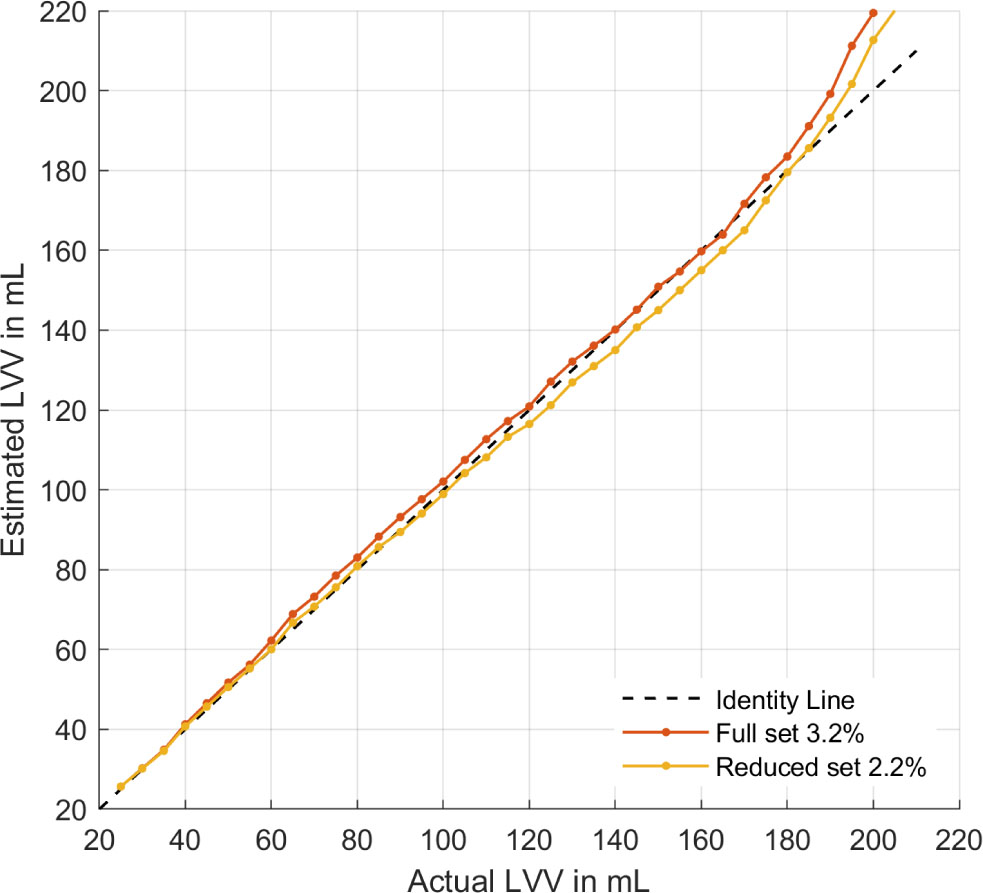
Figure 7:
Estimated volume over actual volume of the phantom experiment for the full set of 210 measurements and the reduced set of 19 measurements.
Both reconstructions closely follow the identity line, indicating that the algorithm can reliably estimate the volume in this controlled setting. The volume curves obtained from the full and reduced measurement sets are in good agreement, with a mean error of 3.2% and 2.2 %, which suggests that the sensitivity-based measurement reduction remains effective in the presence of model–phantom discrepancies and measurement noise.
Joint volume and offset estimation in the phantom
Finally, we investigated joint estimation of volume and catheter offset using data from the phantom experiment. Volume and offset were estimated using both the full set of 210 measurements and the reduced set of 19 measurements. Fig. 8 shows the reconstructed volumes.
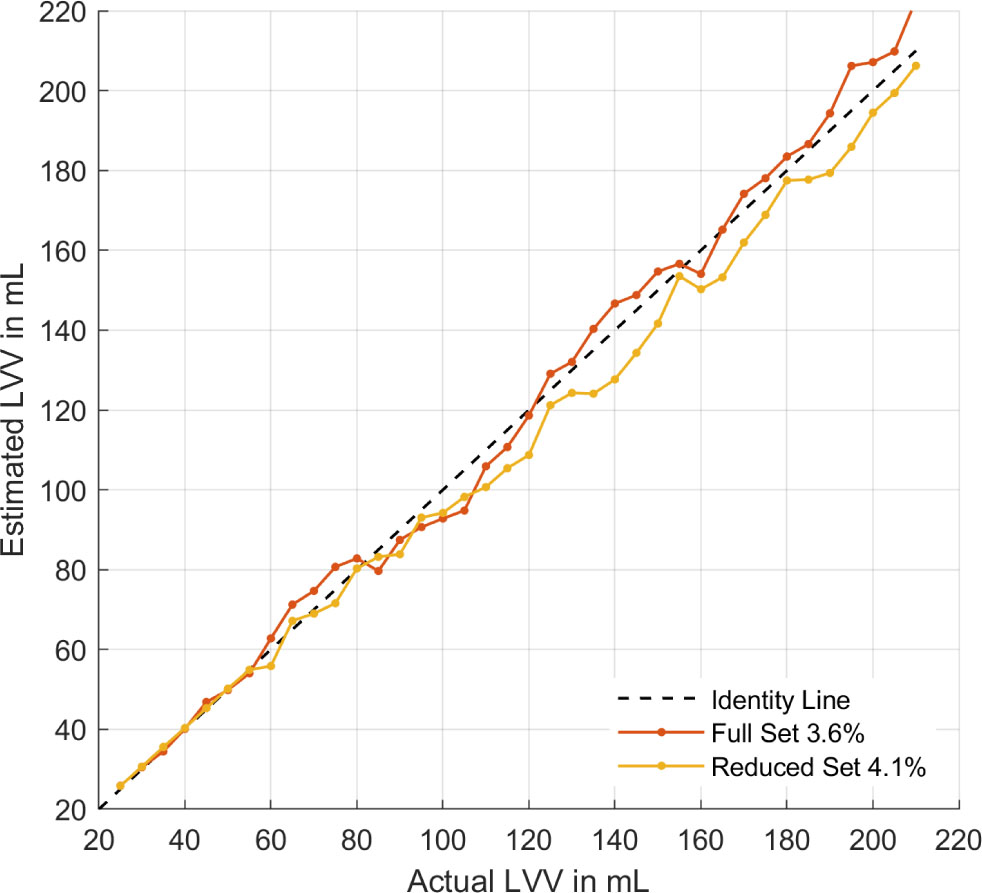
Figure 8:
Estimated volume for the joint volume and offset estimation in the phantom. Full measurement set of 210 measurements and the reduced set of 19 measurements.
The experimental residual map exhibits a distinct minimum region, although less symmetric and more elongated than in the purely simulated case, reflecting the combined effects of phantom geometry, non-conductive walls, and measurement noise. Nonetheless, the Gauss–Newton trajectories converge toward the same region in parameter space, indicating that the algorithm can still reconcile volume and catheter offset from the experimental admittance data after calibration. These results demonstrate that the proposed FEM-based estimation approach is transferable from numerical simulations to a physical test bench and can cope with moderate model mismatch and experimental imperfections.
Discussion
We investigated whether a finite-element–based algorithm can be used to robustly estimate the volume and catheter offset from catheter-based admittance measurements. By numerically simulating the ventricle, the approach aims to overcome limitations of analytical conductance/admittance models that rely on strong simplifications.
Starting from 5040 theoretical 4-electrode configurations for a 10-electrode catheter, we reduced the set to 210 physically meaningful measurements via the principle of reciprocity and SNR considerations and then to a smaller subset by exploiting a sensitivity-based ranking. The reduced set of 19 measurements can be measured within 85 ms and produced comparable accuracy to the full set of measurements both in simulation and measurements in the phantom, demonstrating that a smaller number of measurements that can be measured in real-time is sufficient for the estimation algorithm. An even further reduction of the number of measurements will be the topic of future work. The run time of the algorithm has not been optimized, since the focus was on the proof-of concept and is the topic of future work. However, even without optimization the algorithm runs between 100 ms and a few seconds, depending on the chosen initial conditions.
The dynamic phantom experiments provided a more realistic test of the approach under measurement noise and moderate model mismatch rather than to replicate full cardiac physiology. In the joint estimation experiments volume reconstruction closely followed the identity line for both the full set of 210 measurements and the reduced set of 19 measurements, with mean errors of 3.6% and 4.1 %, respectively. A direct comparison of these results with established clinical methods is not possible, due to the unique controlled setup.
Several limitations of the presented work should be acknowledged. Foremost, catheterization is an inherently risky procedure, thus this approach targets situations where invasive access can be justified. Further, the ventricle is modeled as a cylinder with fixed length and variable diameter, following common analytical models, but this simplification does not capture the true left ventricle shape (e.g., conical shape, papillary muscles/trabeculations), regional wall motion, or interaction with adjacent structures. However, if necessary this approach can be adapted to a fully physiological, generic or patient-specific, heart model. In addition, in the phantom the myocardium is represented as non-conductive (e.g., PLA walls), which differs from in-vivo conditions and limits the direct translatability of the quantitative results. Finally, although the dynamic phantom provides a controlled and repeatable environment, it does not reproduce all sources of variability and noise present in vivo, such as respiratory motion, arrhythmias, and changes in blood conductivity over time. Future work has to investigate and validate the method in biological models (e.g., ex-vivo or in-vivo animal studies).
Conclusions
We presented a FEM-based method for estimating the volume of a LV phantom from catheter-based admittance measurements. By formulating the inverse problem directly in measurement space and numerically simulating the phantom, the method incorporates geometric and conductive effects that are typically absorbed into empirical calibration in classical conductance-based approaches.
A sensitivity-driven selection of 4-electrode configurations reduces the large initial measurement space to a compact subset that remains informative for volume and offset, enabling a practical real-time acquisition strategy. Simulation and dynamic phantom results support the feasibility of this approach and provide a basis for extending the method to more realistic geometries and measurement protocols. These results represent a methodological proof-of-concept and form the basis for future studies using more realistic anatomical models and biological experiments.
Notes
Acknowledgement
This research was funded by the Deutsche Forschungsgemeinschaft (DFG, German Research Foundation), grant no. 452009371.