
Introduction
Electrodermal activity (EDA) refers to the variations in any electrical phenomena observed on the skin following sweat secretion [1, 2]. It serves as a proxy for the sympathetic nervous system reactivity during emotional and cognitive processes. Therefore, stimulus-evoked EDA responses have been widely used in cognitive neuroscience, psychophysiology, and many other applications [3, 4]. EDA is classified into three response parameters (SCRs, SPRs, and SSRs). SCRs are associated with skin resistance, which changes following skin sweating. In addition, the entire stratum corneum is considered a variable resistor, whose resistance changes as a result of sweating. SPRs are closely associated with sympathetic activation of eccrine sweat glands. When sweat ducts of the stratum corneum are filled with sweat, the negative voltage below the electrode is increased since the conductive sweat gives better contact to the negative potential at the duct and modifies SPRs [5]. The third EDA parameter (SSRs) is connected to the electrical capacitance of the skin, which is proportional to the moisture content of the corneum. The increment or decrement in SSRs is associated with an increase or decrease in the electrical capacitance of the skin [6].
EDA has two components: phasic and tonic. The phasic component reflects a sharp increase in EDA triggered by discrete stimuli, while the tonic component reflects slowly varying baseline levels in the absence of arousal stimuli [1, 2, 7]. Together, phasic and tonic EDA provide complementary insights into both rapid event-related responses and prolonged emotional or cognitive states [5]. However, the interpretation of EDA waveforms can sometimes be complicated by temporal dynamics that naturally occur with repeated stimuli.
Habituation is one of the most important of these dynamics. It is a fundamental neurophysiological process in which repeated stimulation causes a progressive decrement in a behavioral response, excluding sensory adaptation and motor fatigue. Importantly, habituation enables organisms to filter out irrelevant or non-threatening stimuli [8]. In the context of EDA, habituation is characterized by a gradual decrease in EDA responses over repeated presentations of the same stimulus. This is particularly important for research studies investigating emotional reactivity, learning, memory, fear processing, attention, and decision-making, because repeated stimuli are essential to experimental paradigms.
The effect of repeated stimuli presentation (habituation) on SCRs, one of the EDA parameters, has been examined in some studies. Early psychophysiological studies showed that repeated stimuli, such as visual or acoustic, cause a systematic reduction in amplitude of SCRs, indicating a decline in orienting or novelty responses [9, 10, 11]. Recently, some studies have shown that habituation in SCRs exhibits an exponential decay over time and that this decrease differs markedly between individuals [12, 13]. Additionally, a neurophysiological study using the sympathetic skin response confirmed that repeated electrical stimuli elicit progressively decreased autonomic activation, consistent with adaptation at the level of sweat glands and central mechanisms [14]. Notably, inter-individual differences in habituation of SCRs have been connected to repeated stimuli and resilience-related psychometric constructs, suggesting their potential diagnostic value for assessing personality traits such as resilience, depression, and anxiety [11]. Together, these findings suggest that habituation of EDA responses is not simply a peripheral phenomenon, but an informative indicator of emotional adaptability and central processing efficiency. Understanding these dynamics is important for optimizing experimental approaches that rely on repeated stimuli, such as in neurofeedback and affective neuroscience contexts, where consistent physiological engagement and clear interpretation of autonomic data are crucial.
Although previous studies have demonstrated progressive attenuation of SCRs following repeated exposure to stimuli, most investigations have primarily focused on a single EDA parameter, that is, SCRs. Consequently, the response patterns of multiple EDA parameters under structured multi-stimulus repetition protocols remain insufficiently understood. In addition, limited attention has been directed toward evaluating whether different EDA parameters exhibit distinct habituation characteristics during repeated stimulation. Therefore, the present study was designed to investigate the effects of repeated exposure to distinct stimuli on three EDA parameters: SCRs, SPRs, and SSRs. Simultaneous assessment of these complementary EDA components may provide a more comprehensive characterization of autonomic response dynamics and stimulus-specific habituation patterns during repeated sensory stimulation. Moreover, examining habituation across different EDA parameters is important because each parameter reflects various physiological properties of sweat gland activity and skin electrical behavior. While SCRs primarily reflect changes in sweat gland filling and skin resistance, SPRs provide information regarding negative potential at the skin duct, whereas SSRs give insight into changes in skin hydration associated with sympathetic activation. Therefore, combined evaluation of SCRs, SPRs, and SSRs may improve the understanding of autonomic adaptation mechanisms and reveal response features that may not be detectable when relying on a single EDA parameter alone.
Also, understanding how repeated stimuli impact EDA is important in neurophysiological applications. For example, in real-time fMRI neurofeedback approaches, especially in the amygdala [15], fear extinction [16] , anxiety [17], and post-traumatic stress disorder (PTSD) [18] .
In view of these considerations, there is a clear necessity to systematically examine how repeated stimuli influence the EDA responses, especially when SCRs, SPRs, and SSRs are simultaneously recorded. Such insight is crucial to improve the interpretability of psychophysiological data and to optimize stimuli used in experimental and neurotechnological applications. Therefore, this study aimed to address this gap by examining how repeated stimuli influence the three EDA response parameters (SCRs, SPRs, and SSRs) simultaneously using a new non-invasive bioimpedance method. By comparing patterns of EDA responses under different repetition stimuli, the study sought to investigate whether different repeated stimuli exposure sustains engagement or shifts autonomic dynamics over time.
Materials and methods
Subjects
A total of 60 healthy volunteers (30 males and 30 females, average age 23.46 ± 3.81 years old) participated in this study. All of them signed a written informed consent before starting the experiment. The study design aligned with the Declaration of Helsinki, and it was approved by the local ethics committee at the University of Zakho (approval number CoS.UoZ/14/9/2025). During the data collection, all participants remained seated comfortably in a chair in a quiet room. The room temperature was 22–23 °C.
Because this study aimed to investigate the effect of four repeated stimuli, each stimulus repeated five times (4 stimuli × 5 repetitions), on EDA responses, the sample size was estimated based on the mean effect sizes (Cohen’s fs) of the EDA responses to affective stimuli. An a priori power analysis was conducted using G*Power 3.1.9.7, assuming a Cohen’s f of 0.21 (i.e., minimum effect size), an alpha level of 0.05, a desired statistical power of 0.80, one group, 20 measurements, a correlation of 0.5 among measures, and a nonsphericity correction of 1. The result indicated that a total sample size of 13 participants was required. To account for unusable data, we recruited more participants accordingly, and the target sample size was increased to 60 participants. Therefore, the final sample size substantially exceeded the minimum requirement, ensuring adequate statistical power for detecting main effects and interactions.
Experimental session
To investigate the effects of repeated stimuli on EDA (SC, SP, and SS) responses, all participants were exposed to four different stimuli. Each stimulus was repeated five times. The stimuli were acoustic (exposure to the sound of plates breaking), image (looking at a scary photo), taste (drinking 3 mL of lemon (sour flavor) water), and smell (inhaling a pleasant odor), each with a duration of 2 seconds. A relaxation interval of 60 seconds was administered before and after presentations (repetition) of each stimulus to achieve the baseline EDA levels, resulting in a total recording period of 1300 seconds.
Electrodermal activity (EDA) recordings
The three EDA parameters (SCRs, SPRs, and SSRs) were recorded simultaneously from the same skin sites through a non-invasive bioimpedance and computerized system [19,20]. The computerized setup comprised a compact front-end electronic circuit connected to a laptop via a National Instruments DAQ card and controlled through LabVIEW 14 software. A three-electrode configuration was employed, consisting of a measuring electrode, a current-sink electrode, and a reference electrode. SCRs and SSRs were derived from the current-sink electrode (placed on the underarm) and the reference electrode (placed on the elbow apex, an electrodermally inactive site). On the other hand, SPRs were recorded between the hypothenar area of the palm (an electrodermally active area) and the reference electrode. All electrodes were Kendall Kittycat 1050NPSM Ag/AgCl solid gel ECG neonatal electrodes. Before recording EDA signals, a five-minute stabilization period was allowed after electrode placement on the three skin sites of the hand [19].
A Howland current source supplied about 20 μA AC signals to the skin through the measuring electrode for SCRs and SSRs measurements, driven by a 200 mV input from the data acquisition system. Analog signals from the skin via the front-end electronic box were digitized with the DAQ card and differentiated in LabVIEW. Then, signals were separated into the DC (SPRs) and AC (SCRs, SSRs) components through phase-sensitive rectification [19,20].
Data Analysis
To investigate the impacts of stimulus repetition on EDA responses the amplitude of the skin conductance responses (SCRs_Amp), amplitude of the skin potential responses (SPRs_Amp), and amplitude of the skin susceptance responses (SSRs_Amp) were computed from their waveforms. SCRs_Amp, SPRs_Amp, and SSRs_Amp were calculated from the difference between onsets and peaks of responses. Since SPRs are multidirectional, obtaining SPRs_Amp depends on the SPRs forms. For monophasic forms (both positive and negative), SPRs_Amp was computed from the onsets to the peaks difference, whereas for biphasic forms, SPRs_Amp was estimated from the peaks (negative or positive) to peaks (positive or negative) difference, similar to the approach used in [21]. The final score (SCRs_Tris) was derived from the time interval between the onset and the peak of the SCRs.
Statistical Analysis
To examine the effects of stimulus presentation (new modalities and repeated) on the EDA responses, a two-way repeated measures ANOVA was conducted. This approach allowed us to statistically determine whether EDA responses decreased across repeated presentations of the same stimulus, consistent with expected habituation processes, and to evaluate whether responses changed (i.e., habituation terminated) when a new stimulus block was presented at the end of the preceding block. In addition, a two-way repeated measures ANOVA was chosen because both independent variables, stimulus repetition (five levels) and types (four levels), were investigated for within-subject factors, yielding multiple dependent observations per individual. Statistical analysis was performed using IBM SPSS Statistics 27.
Informed consent
Informed consent has been obtained from all individuals included in this study.
Ethical approval
The protocol has been complied with all relevant national regulations, institutional policies and in accordance with the tenets of the Helsinki Declaration and has been approved by the authors’ institutional review board or equivalent committee.
Results
Amplitude of skin conductance response (SCRs_Amp)
Figure 1 illustrates the average SCRs_Amp across all participants (n=60) for four stimulus categories (sound, image, taste, and smell), each presented in five consecutive repetitions. Stimulus repetition 1–5 corresponds to sound, 6–10 to image, 11–15 to taste, and 16–20 to smell. It can be seen that a consistent habituation occurs within each stimulus block. For each new stimulus, the largest SCRs_Amp is observed, followed by a progressive decline across subsequent repetitions. In addition, SCRs_Amp increased despite the strong decrease observed at the end of the preceding block, demonstrating a stimulus-specific reset of habituation. Moreover, a two-way repeated measures ANOVA was conducted to examine the within-subject factors of stimulus repetition and stimulus category. The analysis revealed that SCRs_Amp values were significantly (F(4, 236) = 58.41, p = 0.001, ηp2= 0.497) decreased as the same stimulus was repeated, and showed a significant (F(3, 177) = 3.92, p = 0.01, ηp2= 0.062) main effect of stimulus categories on SCRs_Amp, demonstrating stronger SCRs at the onset of each new stimulus category, followed by smaller responses (habituation) with repetition.
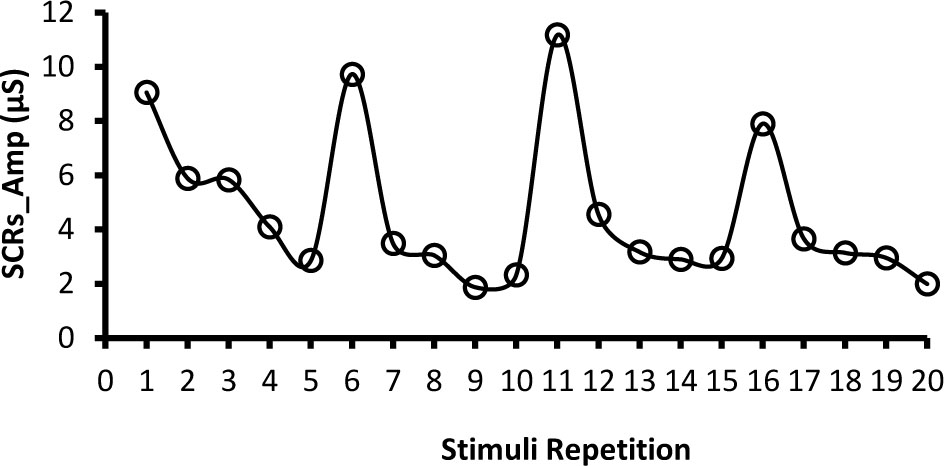
Fig. 1:
Shows potential habituation patterns in SCRs_Amp following sound (1–5), image (6–10), taste (11–15), and smell (15–20) stimuli across five repetitions. Each dot (data point) represents the average of SCRs_Amp computed from 60 subjects for a single repetition.
Rise time of skin conductance response (SCRs_Tris)
Shown in Figure 2 are data for SCRs_Tris computed from all subjects (n=60) with respect to repeated stimuli, and four different stimuli. The effects of repeated stimuli, which lead to attenuation, are clearly evident in this score. However, once new stimuli were presented, SCRs_Tris values increased, followed by a gradual reduction across subsequent repetitions. These findings were supported by the two-way repeated measures ANOVA analysis, which showed that repetition of the stimulus significantly (F(4, 236) = 43.09, p < 0.001, ηp2= 0.422) decreased SCRs_Tris, while introducing a novel stimulus significantly (F(3, 177) = 7.08, p < 0.001, ηp2 = 0.107) increased SCRs_Tris.
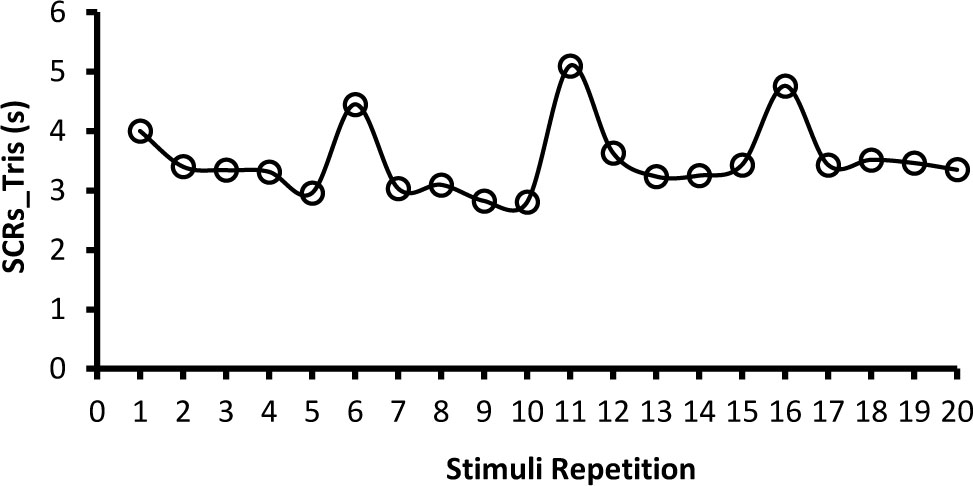
Fig. 2:
Shows potential habituation patterns in SCRs_Tris following sound (1–5), image (6–10), taste (11–15), and smell (15–20) stimuli across five repetitions. Each dot represents the average of SCRs_Tris computed from 60 subjects for a single repetition.
Amplitude of skin potential response (SPRs_Amp)
Average values of SPRs_Amp obtained from 60 participants as a function of repeated stimuli, and four stimulus categories (sound (1–5), image (6–10), taste (11–15), and smell (15–20)) are shown in Figure 3. The figure depicts a continuous reduction in SPRs_Amp with each repeated stimulus and a sharp increment with presentation of a new stimulus category. Additionally, ANOVA analysis revealed a significant (F(4, 236) = 53.87, p = 0.001, ηp2 = 0.477) effect of stimulus repetition on SPRs_Amp. ANOVA also indicated a significant (F(3, 177) = 6.26, p = 0.001, ηp2 = 0.096) main effect of the new stimulus presentation on SPRs_Amp.
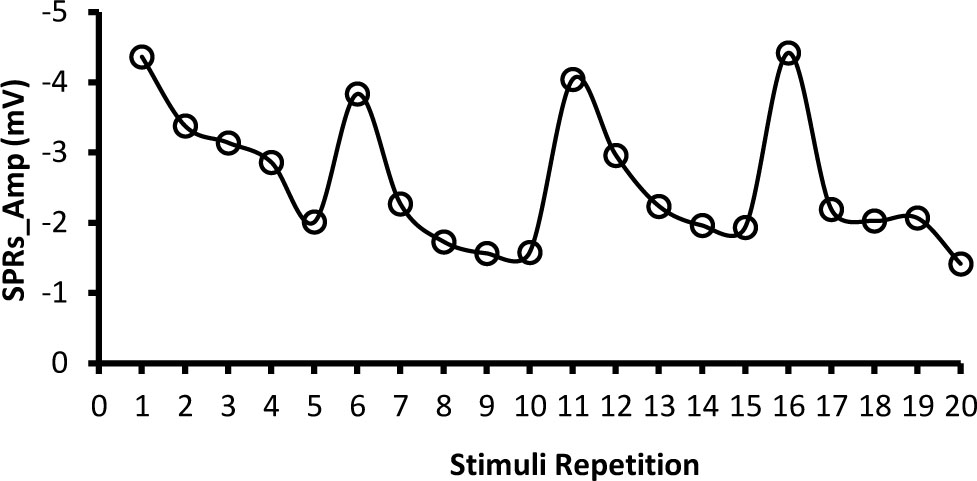
Fig. 3:
Shows potential habituation patterns in SPRs_Amp following sound (1–5), image (6–10), taste (11–15), and smell (15–20) stimuli across five repetitions. Each dot represents the average of SPRs_Amp computed from 60 subjects for a single repetition.
Amplitude of skin susceptance response (SSRs_Amp)
The effects of repeated stimulus and presentation of a new stimulus block were also observed in SSRs_Amp. Figure 4 indicates a clear reduction (habituation) pattern in the SSRs_Amp following repetition of the same stimulus, and the highest SSRs_Amp is produced with the start of a new stimulus. Two-way repeated measures ANOVA revealed significant (F(4, 236) = 35.03, p = 0.001, ηp2 = 0.374) influences of stimulus repetition on SSRs_Amp, reflecting that SSRs_Amp decreased across repeated presentations. On the other hand, ANOVA analysis demonstrated that SSRs_Amp increased significantly (F(3, 177) = 5.25, p = 0.002, ηp2 = 0.082) with the introduction of new stimulus types.
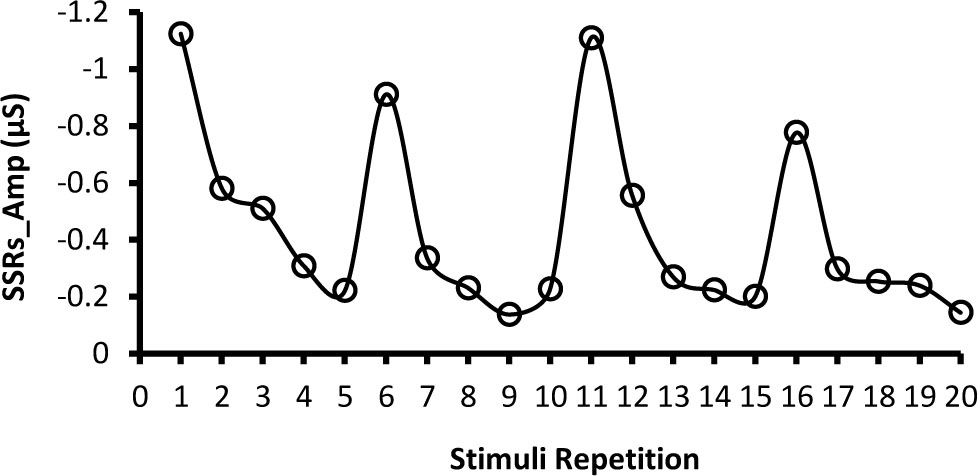
Fig. 4:
Shows potential habituation patterns in SSRs_Amp following sound (1–5), image (6–10), taste (11–15), and smell (15–20) stimuli across five repetitions. Each dot represents the average of SSRs_Amp computed from 60 subjects for a single repetition.
Discussion
This study examined the influence of repeated stimuli presentations on EDA responses as assessed by SCRs, SPRs, and SSRs. Generally, the study results demonstrated progressive modulation of EDA responses across repeated stimulations, supporting the presence of habituation-related autonomic adaptation during repeated sensory exposure. While habituation of EDA responses has been extensively described in psychophysiological research, most previous studies have primarily focused on SCRs alone or on simpler stimulation paradigms. In contrast, the simultaneous evaluation of SCRs, SPRs, and SSRs in the present study provides a broader characterization of sympathetic nervous system activity and skin electrical dynamics during habituation. Specifically, the findings of the current study showed SCRs, SPRs, and SSRs gradually decayed with each repetition and were increased during new stimulus presentations. These findings are in line with the theory of habituation proposed by Sokolov (1963) [21], which describes a brain-comparator process. Sokolov argued that a neuronal model is formed in the brain. If a repetitive stimulus matches the neuronal model, habituation occurs. Based on this theory, since the low-intensity stimulus used is of constant intensity during habituation trials, it should match the neuronal model, and a reduction should occur in (EDA) responses.
As shown in Figure 1, while at the beginning the (sound) stimulus elicited a sharper initial peak in the first trial, the SCRs decayed rapidly once the same stimulus was repeated. However, SCRs increased with each new stimulus and then decreased with repetition. These findings indicate that stimulus repetition may reduce autonomic arousal and orienting responses by enhancing habituation. The progressive attenuation of sympathetic activation with repeated stimulus presentation suggests reduced novelty, attentional demand, and emotional arousal over time [12]. It can be speculated that the cognitive system might have a somewhat inhibitory effect on the emotional system by reducing the amplitude of SCRs following stimulus repetition [22]. In addition, this highlights the between-trial patterns of habituation as the participants adapt to or anticipate upcoming stimuli. Furthermore, this is consistent with sweat gland adaptation [14] because once sweat glands are inactivated, or sweat production is reduced, the SCRs_Amp decreases [5, 23]. However, once a new stimulus was presented, the central mechanisms and sweat glands were activated by attentional engagement, leading to sweat production and, hence, higher SCRs [19, 24]. Our findings for SCRs are in line with those reported in the previous works [12, 22, 25, 26]. In accordance with the pattern of SCRs_Amp to repeated stimulus presentation, the rise time (SCR_Tris) of SCRs significantly decayed (Figure 2) with the stimulus repetition and rose when each new stimulus appeared. Therefore, the habitation impacts both the time duration and amplitude of SCRs.
The gradual reduction in SPRs (physiological response) with repeated stimulus exposure was also observed (Figure 3) in the study. The SPRs_Amp gradually diminished once participants were exposed to the same stimulus, indicating a reduction in physiological responsiveness as the stimulus became more familiar and less behaviorally significant [27]. This attenuation of SPRs can be interpreted as reflecting reduced novelty detection, decreased attentional demand, and adaptive autonomic regulation during repeated sensory exposure. Since this EDA parameter is physiological and indirectly associated with the amygdala and associated cortical networks, any inactivation that occurs following adaptation or habituation in these central mechanisms is reflected in SPRs. On the other hand, when a new stimulus was presented after each series of repetitions, SPRs_Amp was increased (i.e., dishabituated) due to increased attentional allocation and activation of the central process and the sweat glands [5, 19]. Moreover, once the sweat glands were activated, more sweat was generated, resulting in stronger SPRs [5]. Taken together, these findings suggest that SPRs are both stimulus-specific and sensitive to repetition, in accordance with autonomic habituation and stimulus-specific resetting mechanisms. We did not find a single study to directly compare with our SPRs findings.
The third EDA (SSRs) parameter, which is less investigated, and no prior studies have examined habituation effects in SSRs, was significantly affected by stimulus repetition. The habituation of SSRs_Amp to repeated stimuli was described by an exponential decay (Figure 4), consistent with a proportional reduction across trials. Moreover, a clear habituation effect in SSRs across repeated stimulus presentations is consistent with well-established psychophysiological principles of autonomic adaptation. SSRs, like other electrodermal response parameters, typically reflect sympathetic arousal and are known to decline with stimulus repetition as the organism becomes less responsive to a previously encountered event, reflecting reduced orienting rather than complete cessation of processing. This pattern is compatible with classic habituation models, which predict a progressive reduction in electrodermal responding as stimulus novelty and salience diminish over trials [14]. Accordingly, SSRs_Amp results suggest that repeated exposure led to attenuation of autonomic reactivity, supporting the interpretation that SSRs habituation is a robust feature of the response system under repeated stimulation [12]. However, like two other EDA parameters, SSRs recovered and produced a renewed orienting response once new stimuli were presented at the end of each preceding block. This parameter confirms the findings obtained with SCRs_Amp and SPRs_Amp, in which repeated stimuli (habituation) lead to decreased activation in central autonomic regulatory structures such as the amygdala and associated cortical networks, and cause adaptation in sweat gland mechanisms [14]. This, in turn, reduces the eccrine sweat glands' output and loss of the SSRs_Amp. Consequently, the variations in electrical phenomena recorded at the skin surface become smaller across repetitions.
The current study's findings contribute to the understanding of habituation in all EDA (SCRs, SPRs, and SSRs) parameters recorded simultaneously, which has not been previously explored, particularly in SPRs and SSRs. This suggests that habituation is an active and continuous process following the repeated presentation of identical stimuli. This has important implications for research studies that involve external stimuli to evoke consistent autonomic responses, especially in neurophysiological applications, where reduced physiological arousal may be misinterpreted as successful regulation rather than stimulus habituation. In all EDA responses (SCRs, SPRs, and SSRs), the habituation process has been interrupted by a change in stimulus, leading to the reinstatement of an orienting response. Resuming the presentation of the first stimulus increased the amplitude of EDA responses compared with those seen before the interruption, which is called dishabituation [5]. Thompson and Spencer [28] proposed that an increase in stimulus intensity is a prerequisite to elicit dishabituation. However, our findings clearly demonstrate that this phenomenon was induced by changing stimulus modality.
Conclusion
The findings of this study demonstrated that the SCRs, SPRs, and SSRs were reduced following the stimulus repetitions and habituation. The habituation process was described by an exponential decay, indicating that SCRs, SPRs, and SSRs decrease proportionally to the previous trials. However, habituation recovered (dishabituation occurred) with the change of stimulus modality at the end of each preceding block, and then habituation was induced again with repetition of the new stimulus. This suggests that utilizing different stimulus modalities rather than repeating the same stimulus may better preserve physiological reactivity by limiting within-trial habituation. In light of previous findings linking EDA responses to amygdala activation measured in neurotechnological applications, these results underscore the need to carefully consider stimulus presentation in applications such as investigations of amygdala function, where repetition of the same stimulus may unintentionally reduce amygdala activation, potentially mimicking volitional downregulation.