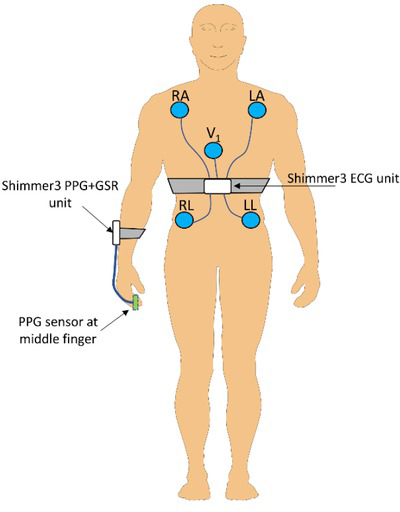
Figure 1
Placement of Shimmer3 measurement units (white boxes), ECG electrodes (blue circles) and the PPG sensor (green box).
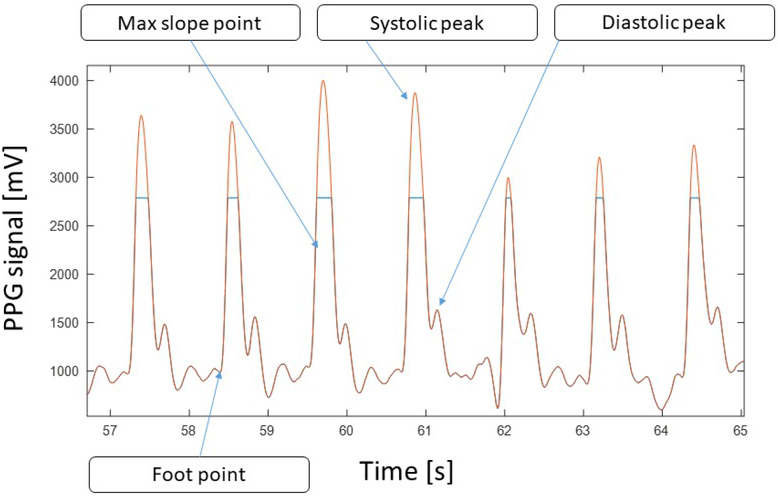
Figure 2
A seven beat PPG sequence showing clipping of the systolic peaks (blue curve) and the spline-based interpolation used (orange curve). The two fiducial points assessed is also marked in the figure.
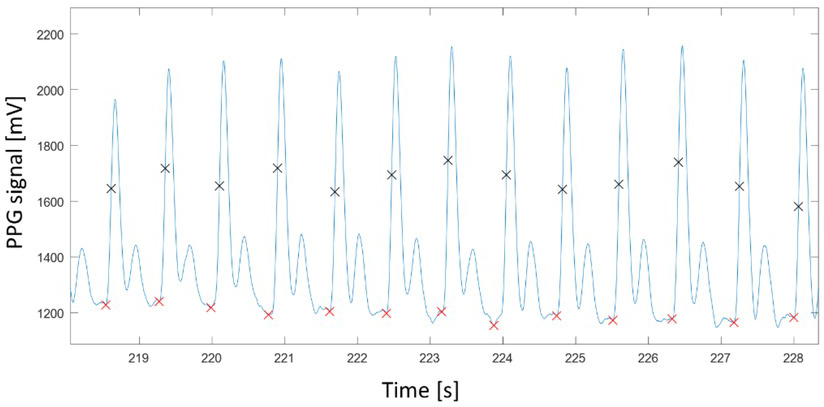
Figure 3
Example showing 13 beats of PPG recording together with the detected foot (red crosses) and max slope (black crosses) fiducial points. The foot points were located based on identifying negative-to-positive zero-crossing points of the first derivative of the signal, and the subsequent peak of the derivative was used to locate the max slope fiducial point.
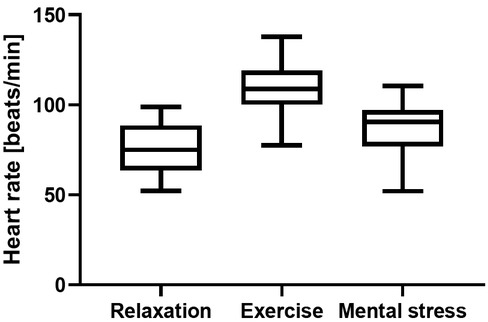
Figure 4
Average heart rate for all participants during the different periods.
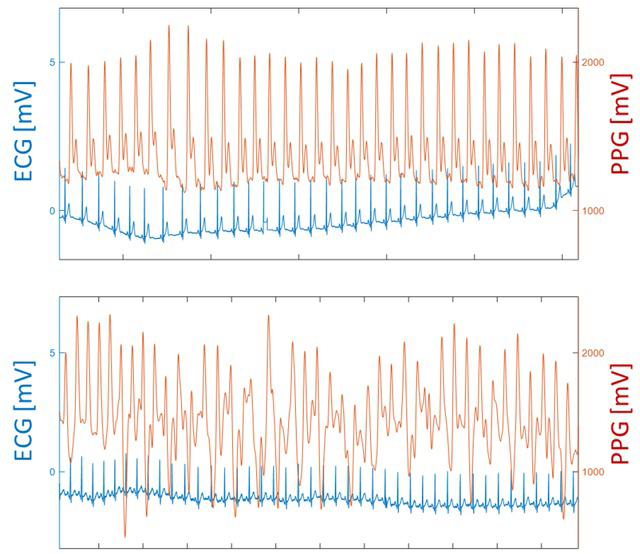
Figure 5
Example segments from recordings with good PPG signal quality (a), during the resting phase, and with poor PPG signal quality (b) during the exercise phase.
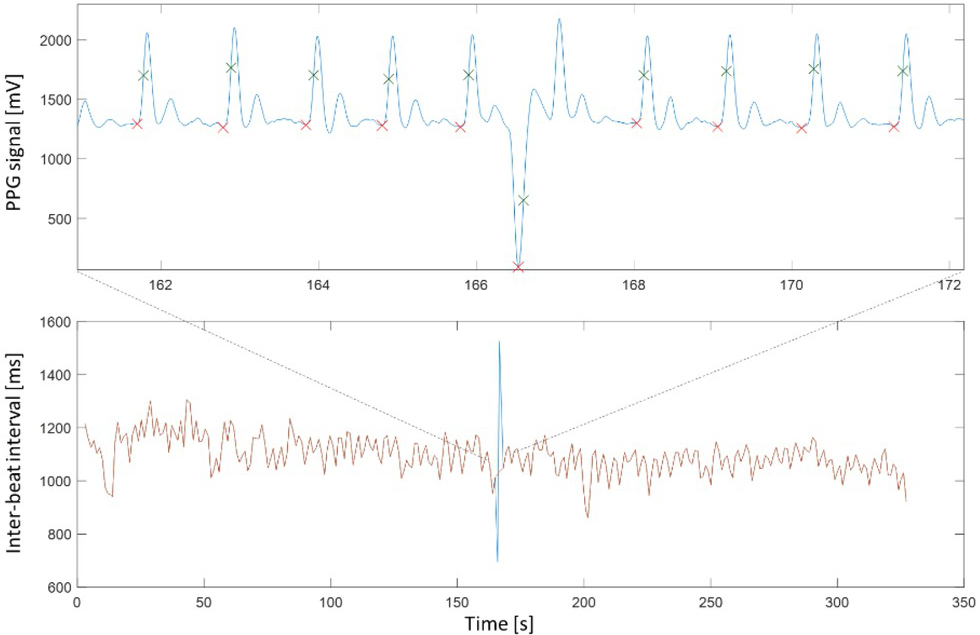
Figure 6
A transient disturbance in the PPG signal (upper plot) causing a large deviation in the estimated inter-beat interval over two points (blue line in lower plot). The red line shows the IBI time-series after outlier correction. The red and green crosses in the upper plot mark the foot and maximum slope fiducial points, respectively.
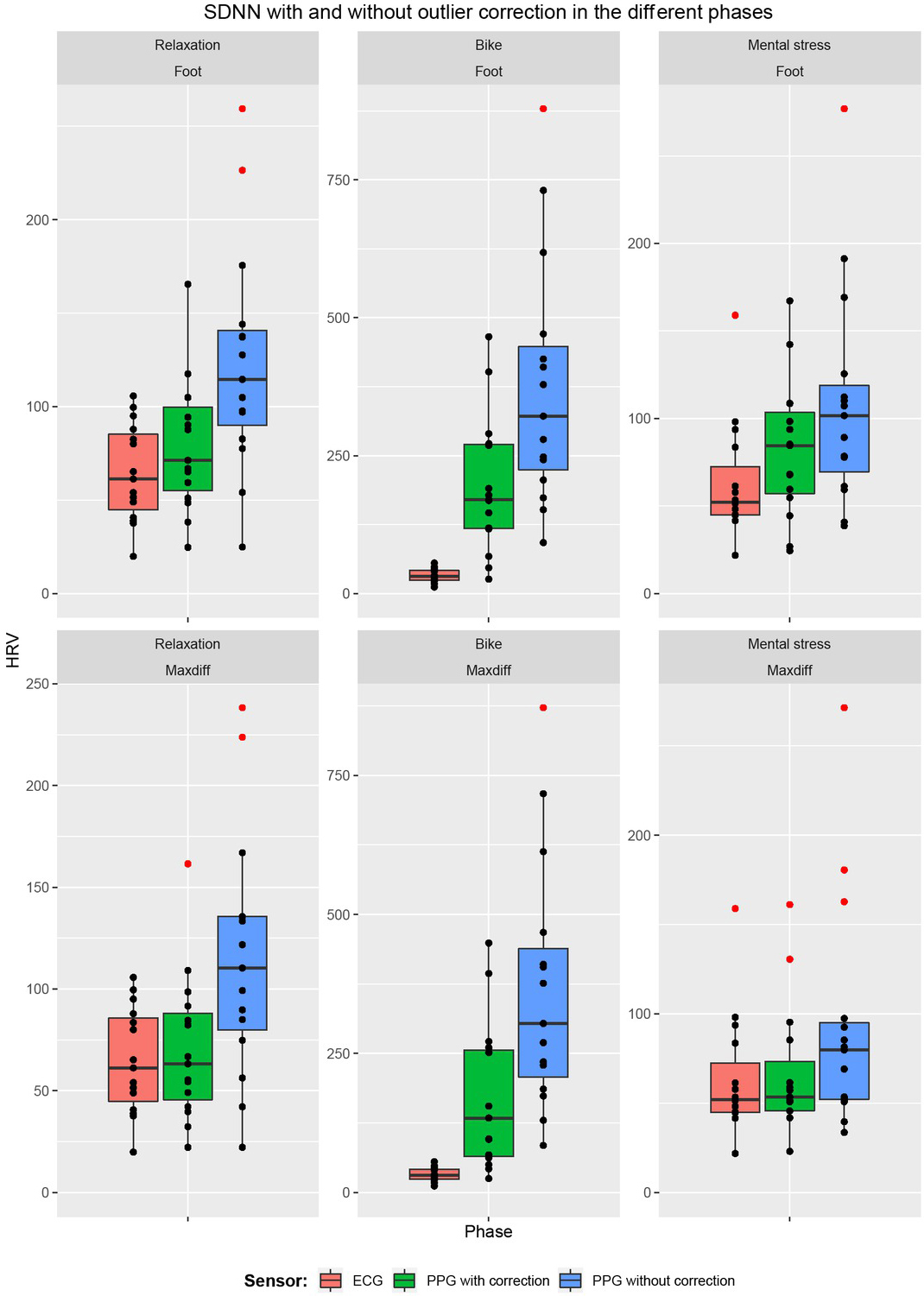
Figure 7
The spread of SDNN for the 15 participants measured with ECG and PPG with and without outlier correction, broken down by the different phases and fiducial points (foot and maxdiff). Outliers are shown in red.
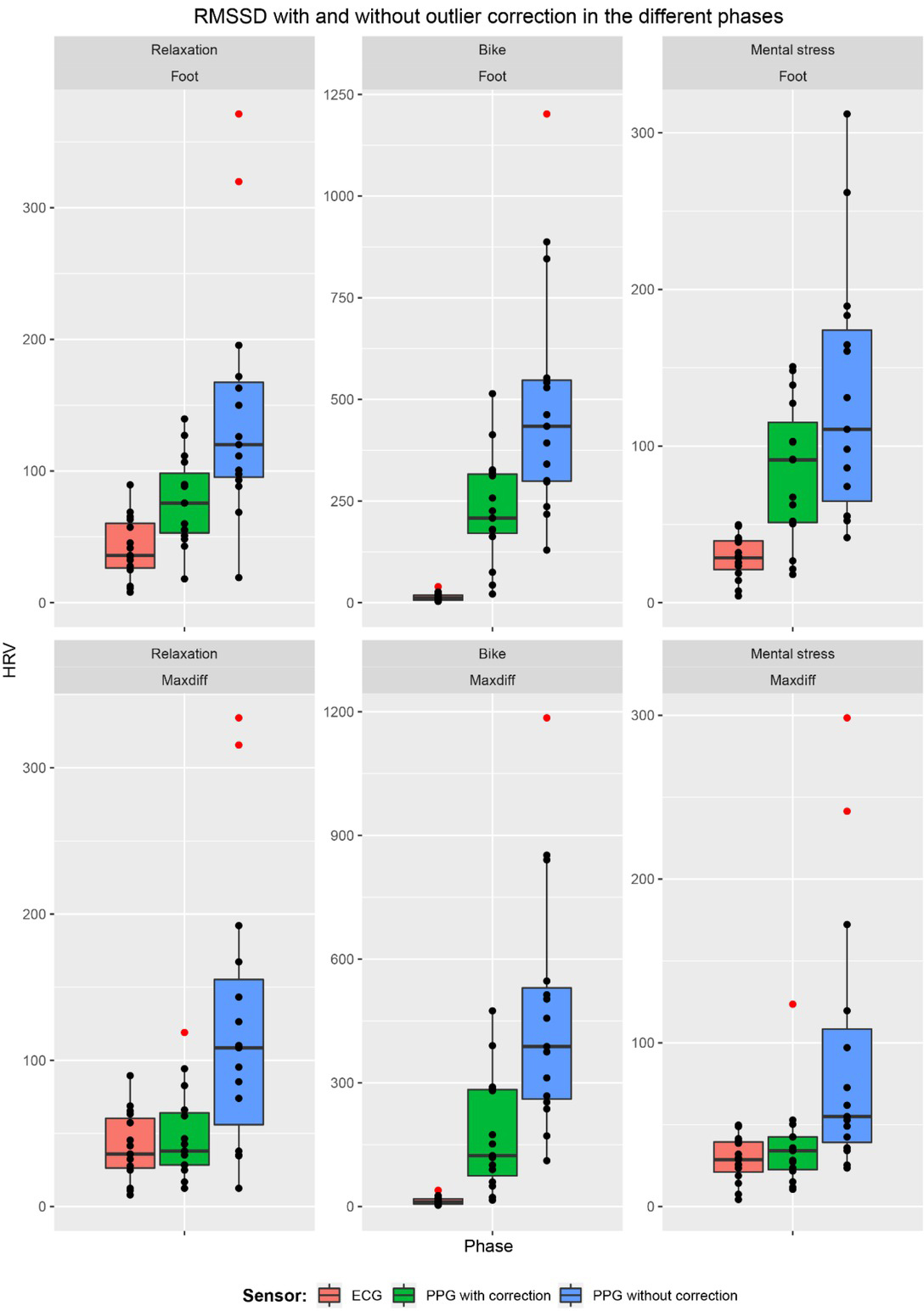
Figure 8
The spread of RMSSD for the 15 participants measured with ECG and PPG with and without outlier correction, broken down by the different phases and fiducial points (foot and maxdiff). Outliers are shown in red.
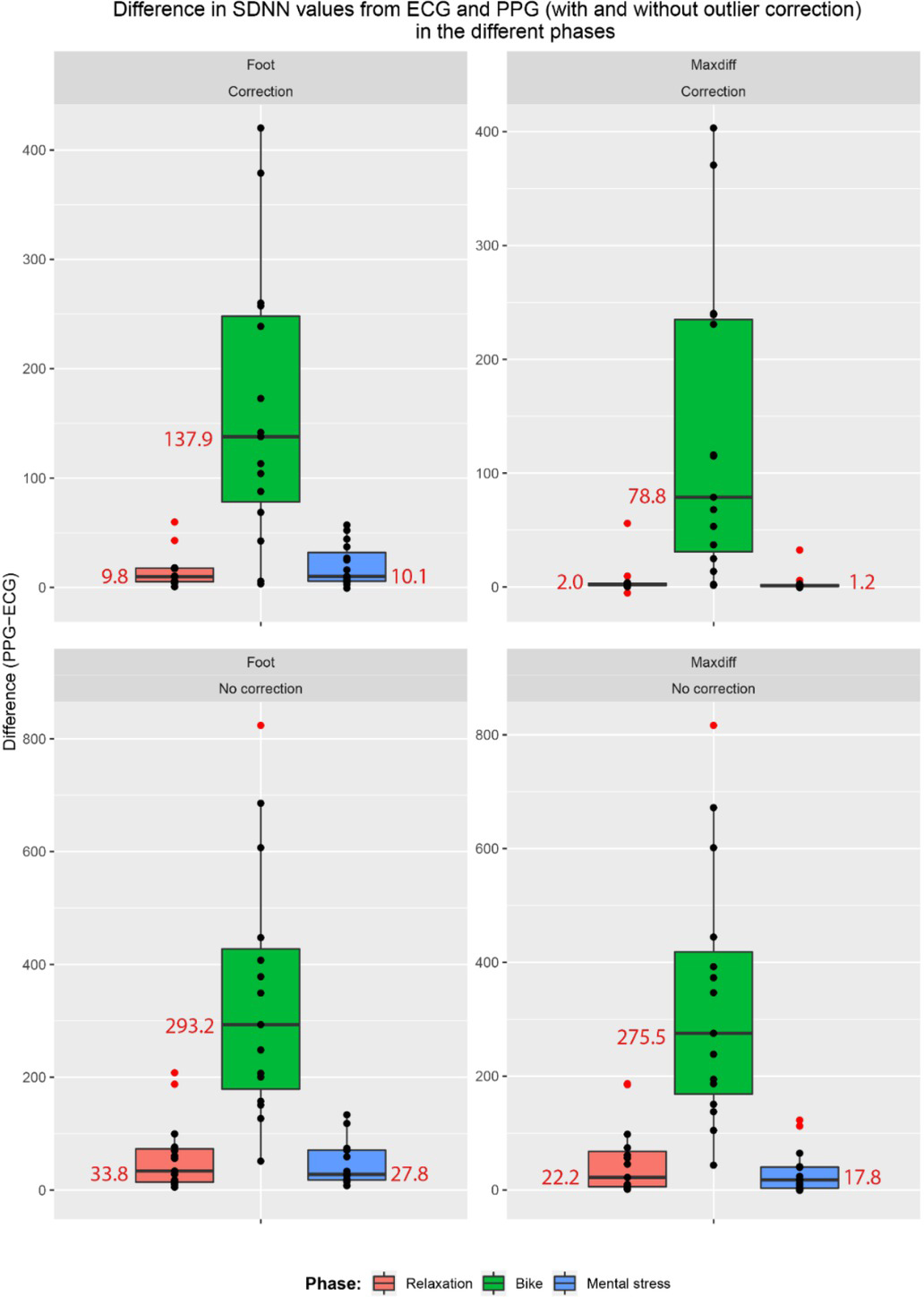
Figure 9
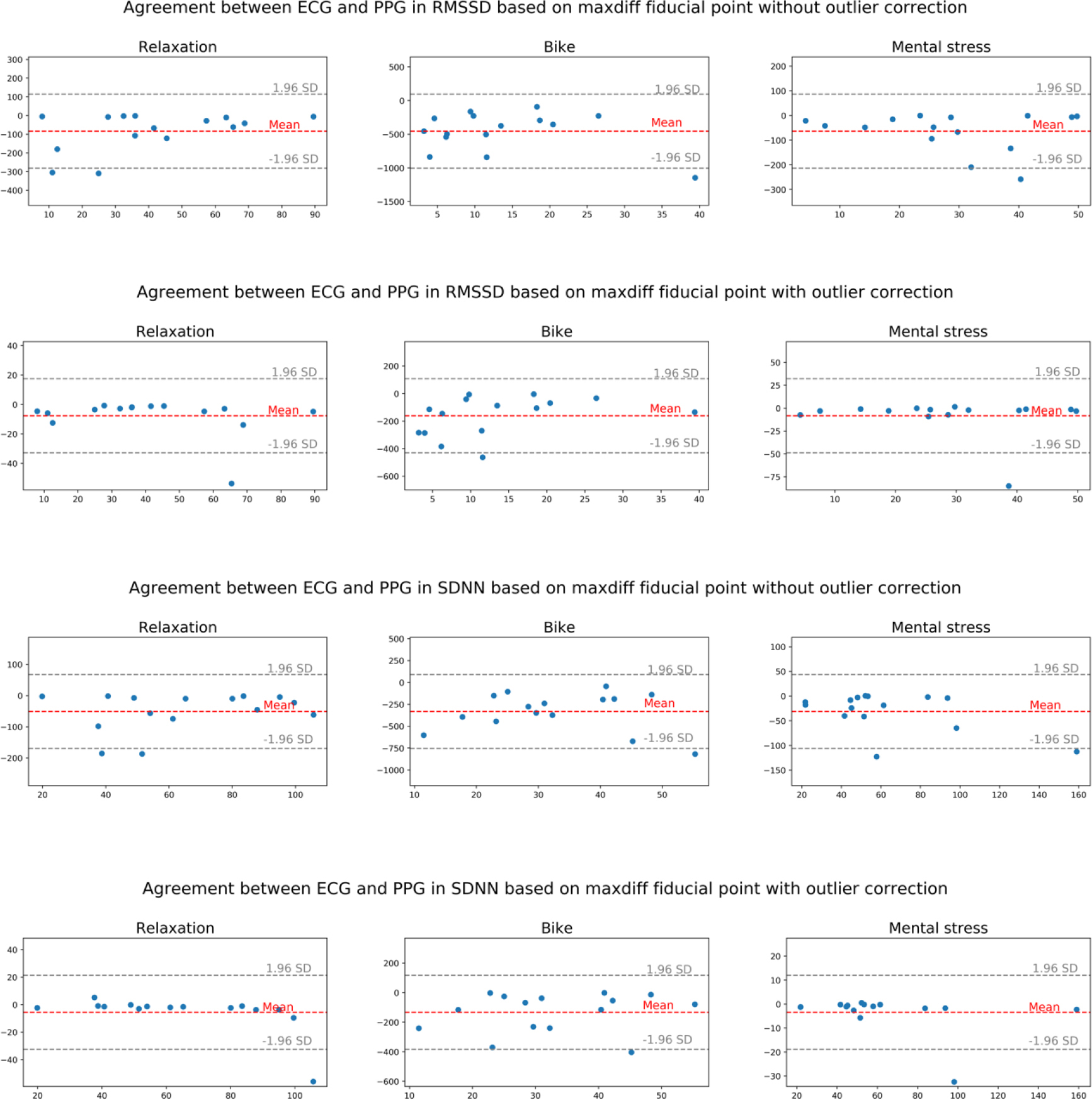
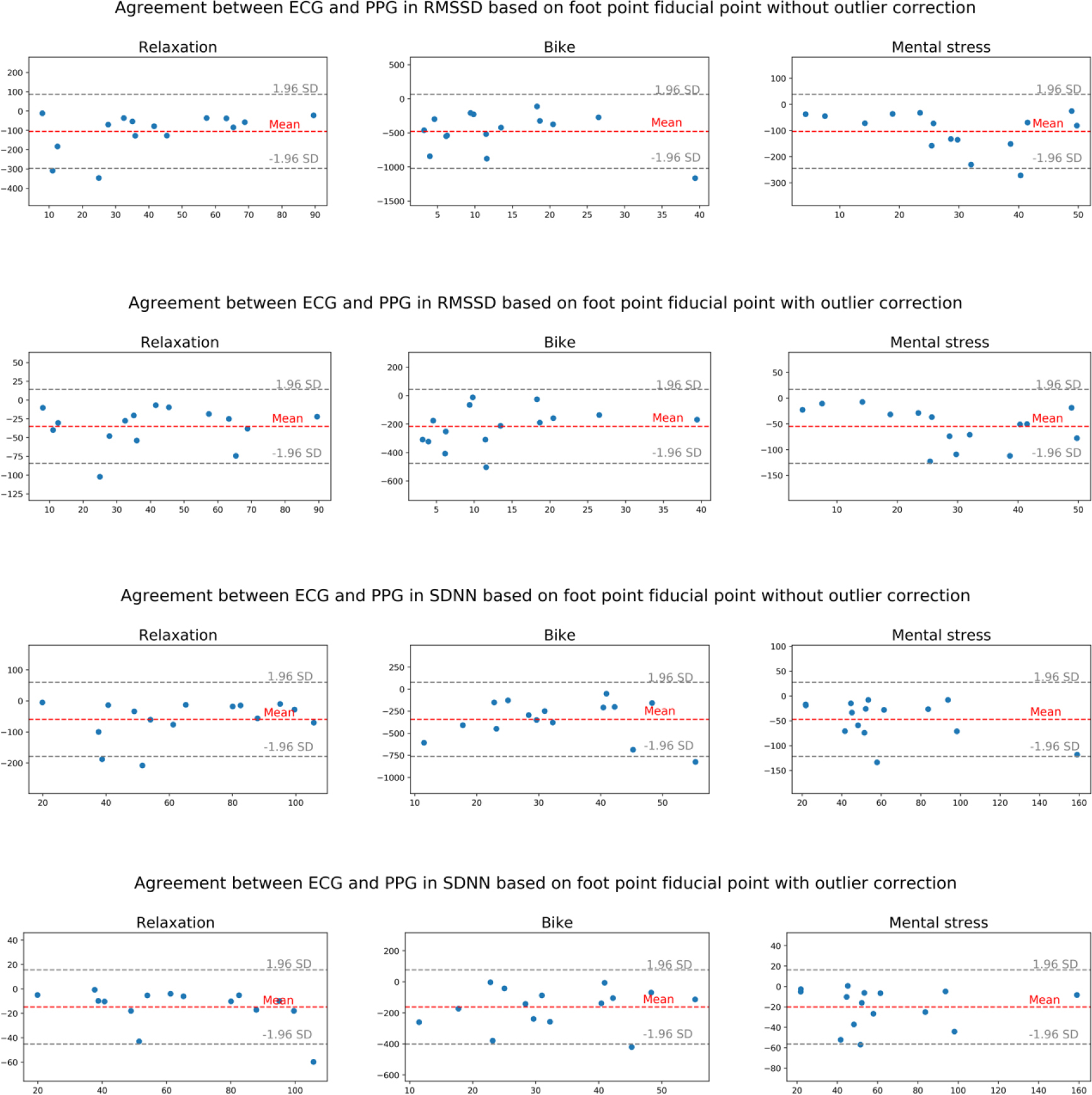
The difference between SDNN values as calculated from PPG and ECG for the 15 participants in the different phases. Grouped by fiducial point and outlier correction. Outliers and median values are shown in red.
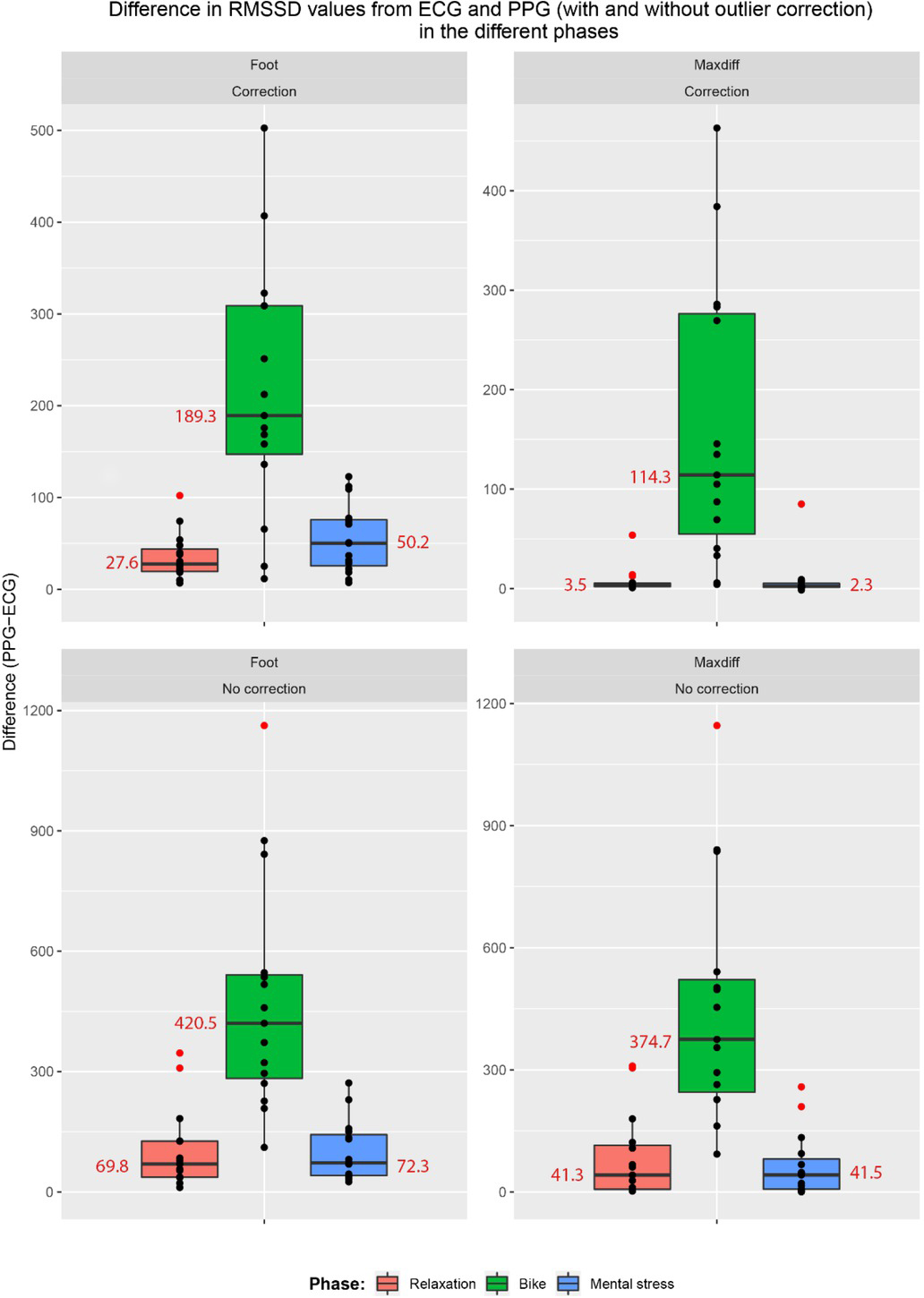
Figure 10
The difference between RMSSD values as calculated from PPG and ECG for the 15 participants in the different phases. Grouped by fiducial point and outlier correction. Outliers and median values are shown in red.
Table 1
Summary of agreement between HRV derived from ECG and PPG for each type of activity, depending on PPG fiducial point selection with and without correction of outliers. The agreement is represented as median absolute deviation (MAD), median absolute relative deviation (MARD) and the root mean square error (RMSE).
| Fiducial point | Outlier correction | HRV | Agreement | Relaxation | Exercise | Mental stress |
|---|---|---|---|---|---|---|
| Foot | Yes | SDNN | MAD | 9,83 | 137,86 | 10,14 |
| Max slope | Yes | SDNN | MAD | 2,25 | 78,82 | 1,19 |
| Foot | No | SDNN | MAD | 28,12 | 290,49 | 26,95 |
| Max slope | No | SDNN | MAD | 21,98 | 272,73 | 17,6 |
| Foot | Yes | RMSSD | MAD | 27,56 | 189,3 | 50,17 |
| Max slope | Yes | RMSSD | MAD | 3,46 | 114,26 | 2,27 |
| Foot | No | RMSSD | MAD | 64,21 | 415,58 | 72,18 |
| Max slope | No | RMSSD | MAD | 41,31 | 369,77 | 27,77 |
| Foot | Yes | SDNN | MARD | 18,00 % | 341 % | 23,20 % |
| Max slope | Yes | SDNN | MARD | 3,60 % | 239 % | 1,80 % |
| Foot | No | SDNN | MARD | 51,50 % | 933 % | 53,90 % |
| Max slope | No | SDNN | MARD | 22,00 % | 877 % | 28,30 % |
| Foot | Yes | RMSSD | MARD | 85,00 % | 1576 % | 156 % |
| Max slope | Yes | RMSSD | MARD | 8,20 % | 647 % | 6,40 % |
| Foot | No | RMSSD | MARD | 152 % | 1727 % | 216 % |
| Max slope | No | RMSSD | MARD | 60,00 % | 1572 % | 79,30 % |
| Foot | Yes | SDNN | RMSE | 21,41 | 202,95 | 27,33 |
| Max slope | Yes | SDNN | RMSE | 14,83 | 184,50 | 8,59 |
| Foot | No | SDNN | RMSE | 85,16 | 403,71 | 60,56 |
| Max slope | No | SDNN | RMSE | 79,17 | 395,91 | 49,43 |
| Foot | Yes | RMSSD | RMSE | 43,17 | 253,67 | 66,01 |
| Max slope | Yes | RMSSD | RMSE | 14,98 | 212,15 | 22,28 |
| Foot | No | RMSSD | RMSE | 143,70 | 552,46 | 126,00 |
| Max slope | No | RMSSD | RMSE | 131,14 | 533,94 | 99,57 |
Table 2
Summary of agreement between RR derived from ECG and IBI derived from PPG for each type of activity. The agreement is presented as median absolute deviation (MAD), median absolute relative deviation (MARD) and the root mean square error (RMSE).
| Fiducial point | Outlier correction | Agreement | Relaxation | Exercise | Mental stress |
|---|---|---|---|---|---|
| Foot | Yes | MAD | 3.97 | 18.93 | 4.71 |
| Max slope | Yes | MAD | 2.82 | 4.34 | 2.29 |
| Foot | No | MAD | 4.03 | 42.40 | 4.46 |
| Max slope | No | MAD | 2.93 | 48.86 | 2.29 |
| Foot | Yes | MARD | 0.51% | 3.24% | 0.69% |
| Max slope | Yes | MARD | 0.36% | 0.67% | 0.35% |
| Foot | No | MARD | 0.58% | 8.02% | 0.62% |
| Max slope | No | MARD | 0.38% | 9.45% | 0.35% |
| Foot | Yes | RMSE | 13.02 | 106.27 | 12.73 |
| Max slope | Yes | RMSE | 8.41 | 99.51 | 6.98 |
| Foot | No | RMSE | 34.03 | 255.14 | 21.85 |
| Max slope | No | RMSE | 35.15 | 262.89 | 14.22 |