Have a personal or library account? Click to login
Electrical impedance characterization of in vivo porcine tissue using machine learning Cover

Electrical impedance characterization of in vivo porcine tissue using machine learning

Open Access
|Jul 2021

Figures & Tables

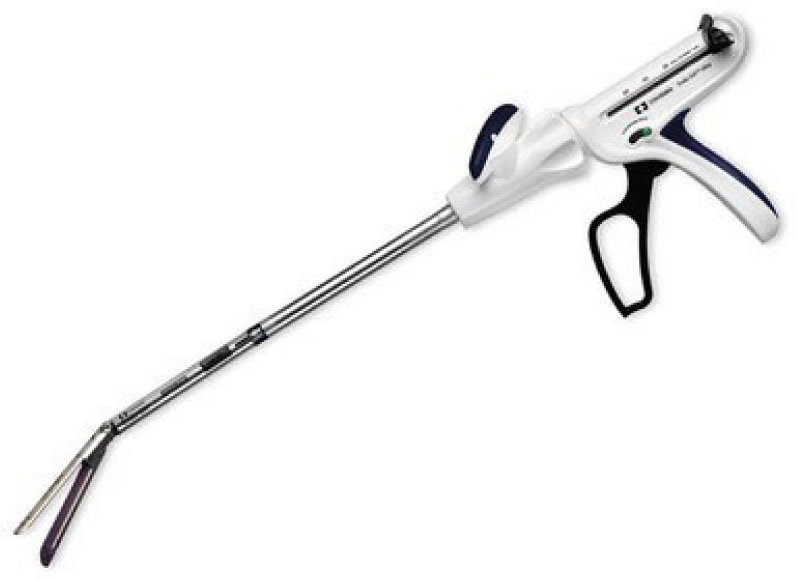
Fig. 1

Medtronic's Endo GIA laparoscopic stapler
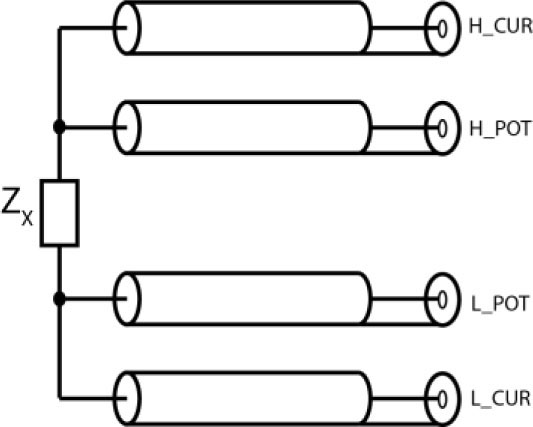

Fig. 2

Electrode configuration. Zx represents board impedance measurement. H_CUR and L_CUR are connected to ground electrodes, while H_POT and L_POT are the sense electrodes.
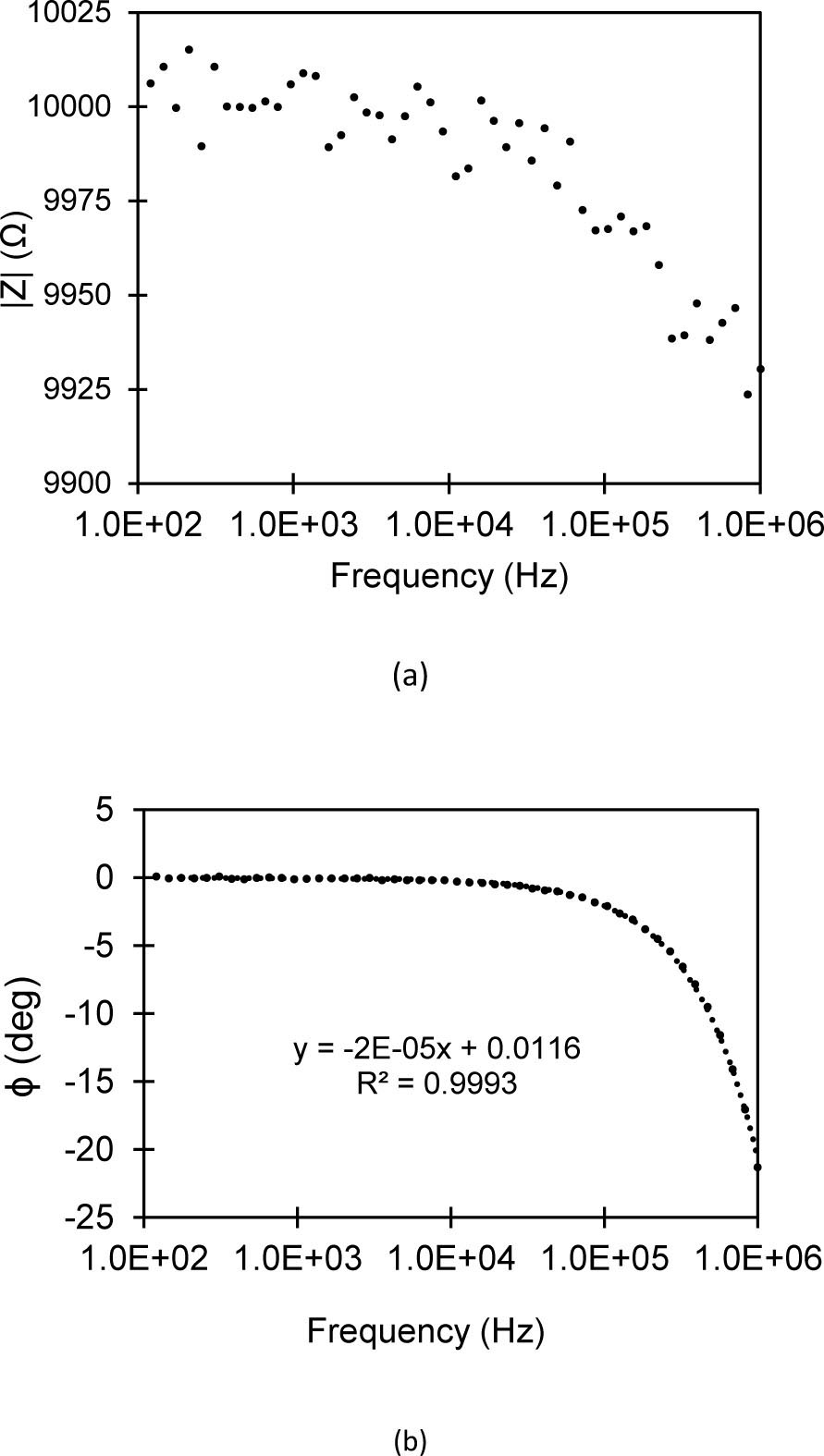

Fig. 3

Validation of measurement system with known resistor values. (a) Modulus values of a control 10 kΩ resistor. (b) Phase angle values of a control 10 kΩ resistor. Phase angle measurements exhibit linear dependency on frequency with slope -2E-5.
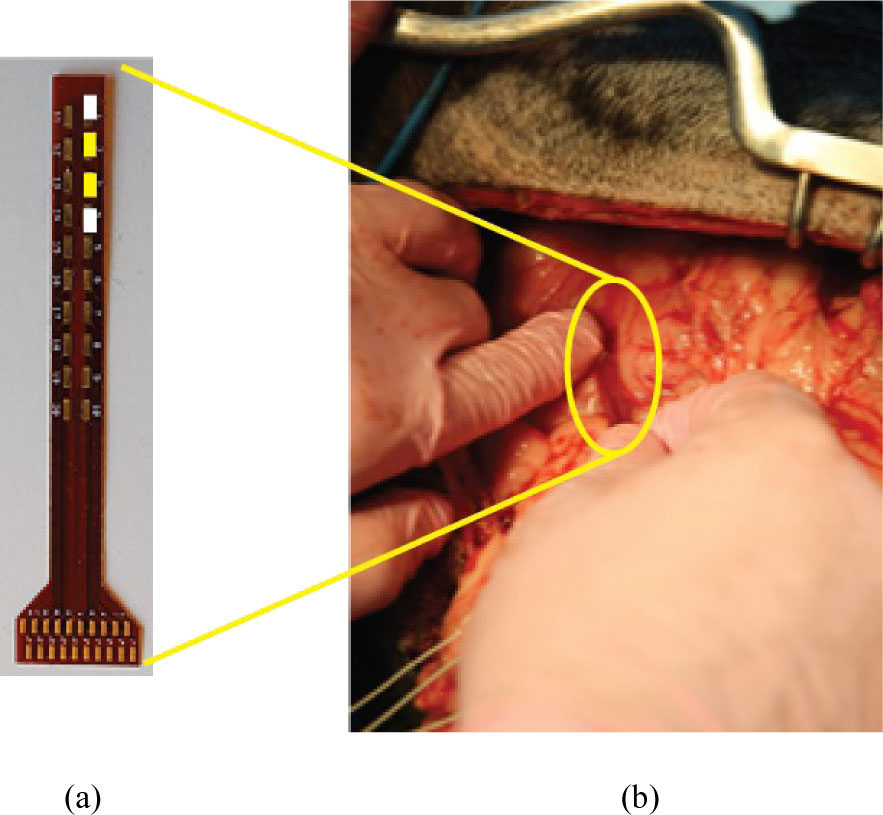

Fig. 4

Electrode placement. (a) is the electrode array that is described in section IIA, and shown in Fig. 2. Four total electrodes are used. The top and bottom white electrodes are H_CUR and L_CUR and are connected to ground electrodes, while the center yellow electrodes are H_POT and L_POT, the sense electrodes. (b) The electrode array is manually applied to the tissue for measurements.
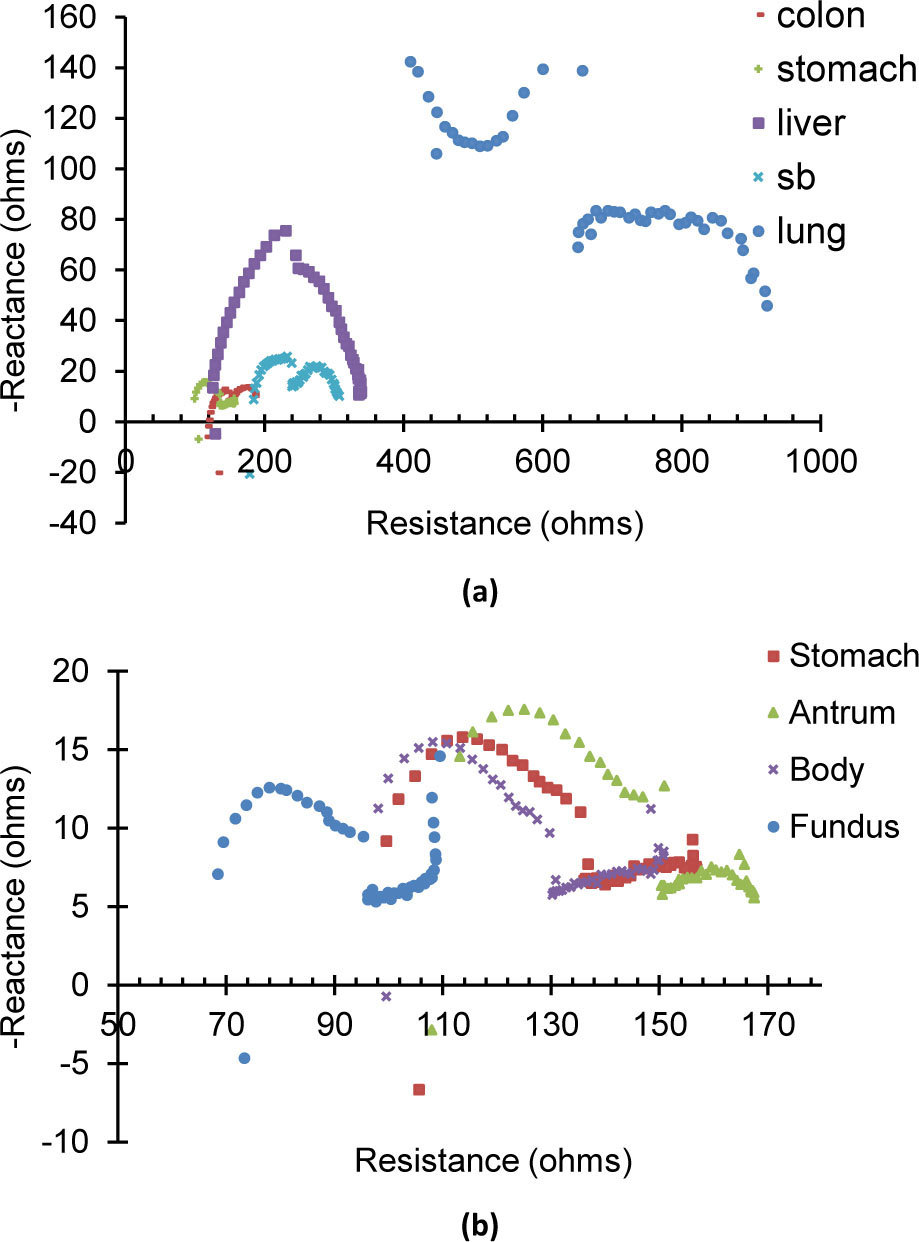

Fig. 5

Nyquist plots for EIS measurements. (a) Comparison between all measured tissue types: colon, liver, small bowel, lung, and aggregate stomach. (b) Comparison between just stomach segments (fundus, body, antrum) and all stomach data taken as an aggregate.
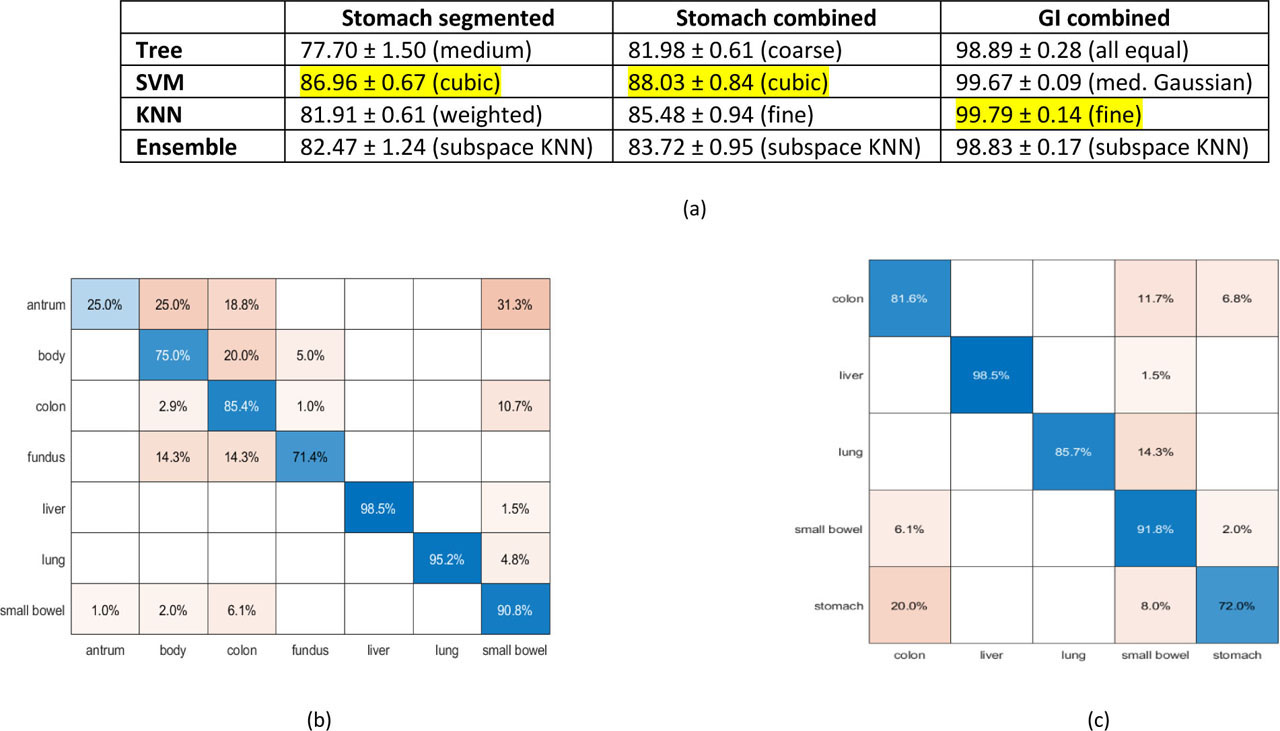

Fig. 6

(a) Comparison of mean accuracy with standard deviations for the different machine learning classification methods, along with best performing subclass. Confusion matrix plots generated from a single 10 fold cross-validation run using the cubic support vector machine subclass with (b) stomach separated out into fundus, body, and antrum and (c) fundus, body, and antrum aggregated together as stomach prior to comparison to other tissues.
Language: English
Page range: 26 - 33
Submitted on: Mar 21, 2021
Published on: Jul 2, 2021
Published by: University of Oslo
In partnership with: Paradigm Publishing Services
Publication frequency: 1 issue per year

© 2021 Stephen Chiang, Matthew Eschbach, Robert Knapp, Brian Holden, Andrew Miesse, Steven Schwaitzberg, Albert Titus, published by University of Oslo
This work is licensed under the Creative Commons Attribution 4.0 License.