
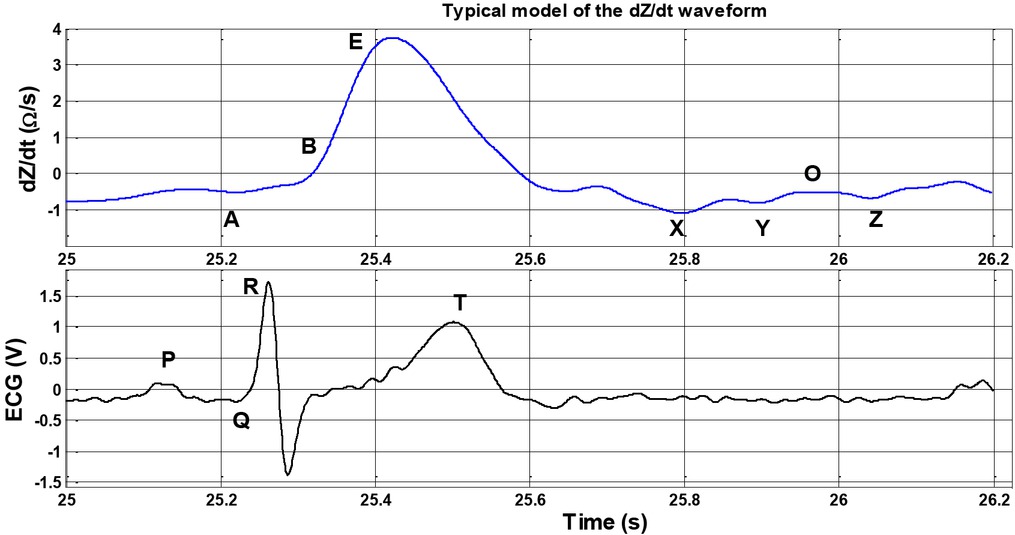
Fig. 1
Typical model of dZ/dt waveform recorded simultaneously with an ECG signal. Each signal is marked by characteristic points.
Table 1
Characteristic points of the dZ/dt signal.
| The points | Description |
|---|---|
| A | Atrial contraction |
| B | Aortic valve opening, which is often calculated as a 15% response from the baseline [14]. The B point may also be calculated from an equation that relates the R peak of the electrocardiography (ECG) signal and the E peak of the dZ/dt signal; RB = 1.233RE -0.0032RE2 - 31.59 [11]. |
| E (or C) | Maximum amplitude of dZ/dt from the baseline (dZ/dtmax). It represents the maximum aortic flow. |
| X | Aortic valve closing, which is calculated as the first turning point valley after the E point (d1) or the lowest minimum after the E point (d2) [22]. In the time domain, aortic valve closing occurs at the end of the T wave of the ECG signal. |
| Y | Pulmonic valve closing. It is the minimum notched between the X and O points [6]. |
| O | Mitral valve opening, the maximum positive point after the E wave [6]. |
| Z | Mitral regurgitation, which is the minimum notch after the O point [6]. |
Table 2
Hemodynamic parameters calculated using ICG characteristic points.
| Parameters | Description | Calculation |
|---|---|---|
| PEP | Pre-ejection period | The Q-B segment is required. |
| ET (or LVET) | Ventricular ejection time | The X-B segment is required. |
| IVRT | Isovolumic relaxation time | The X-O segment is required. |
| FT | Ventricular filling time | The Y-Z segment is required. |
| SV | Stroke volume; the volume of blood ejected from the left | Both the E point and X-B are required [8]. |
| ventricular in one cycle | ||
| CO | Amount of blood pumped during 1 min [8] | CO = SV × HR (2) |
| Heather index | Cardiac contractility index is the ratio between the | Noted E point and the Q-E time interval. |
| maximum amplitude of the dZ/dt signal. |
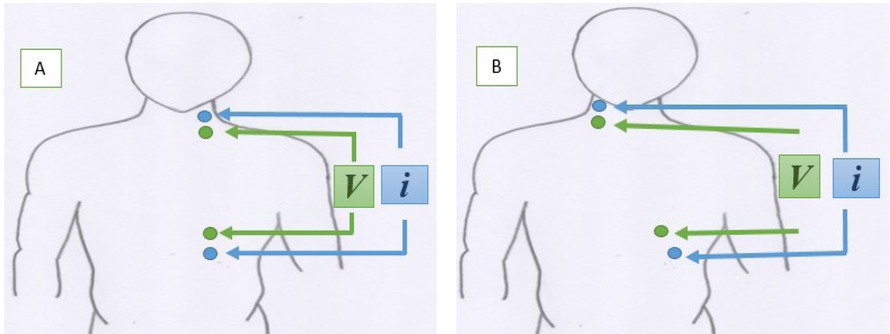
Fig. 2
Electrode positions. a) Electrode positions for measurements obtained with Respimon. b) Electrode positions for measurements obtained with the Z-RPI device.
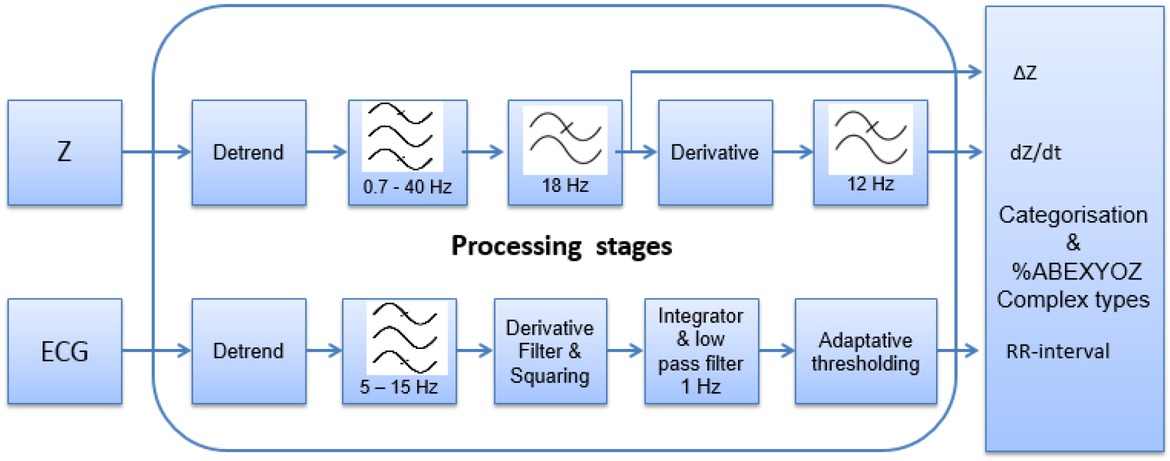
Fig. 3
Flowchart of the data processing stages.
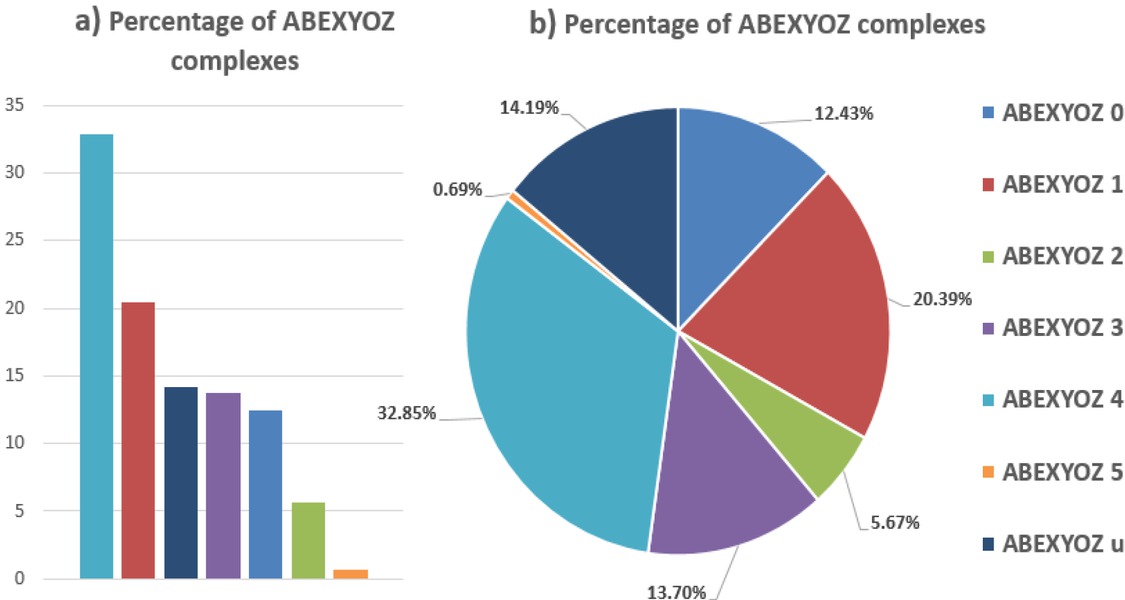
Fig. 4
Observed waveform morphology changes (ABEXYOZ types) of the dZ/dt signal.
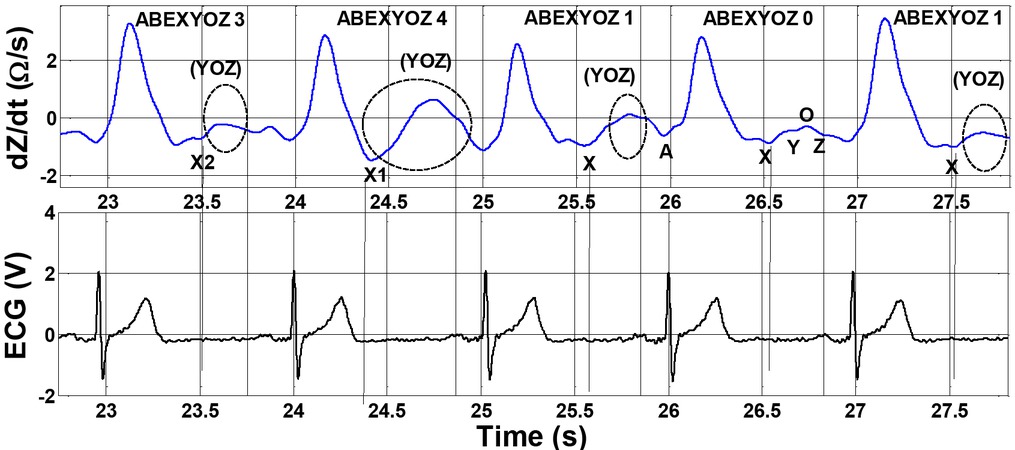
Fig. 5
Distribution of ABEXYOZ complexes with different morphologies. a) Order of percentages of ABEXYOZ complexes, from the most to the least abundant. b) Percentage of ABEXYOZ complexes.
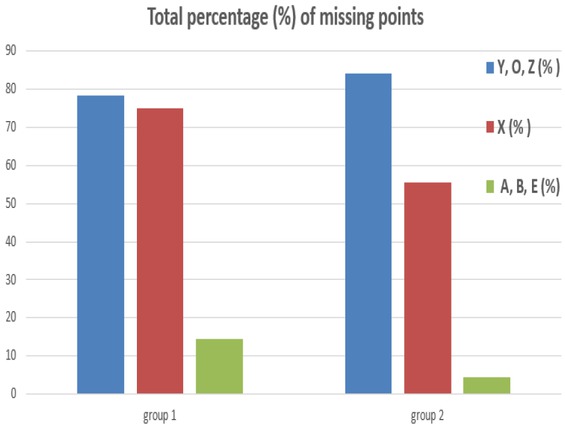
Fig. 6
Five consecutive ABEXYOZ complexes with different morphologies.
Table 3
Percentage of ABEXYOZ complexes in each recording per volunteer with the average heart-rate (mean ± SD) for group 1
| Waveform for group type 1 | 0 | 1 | 2 | 3 | 4 | 5 | u | HR |
|---|---|---|---|---|---|---|---|---|
| V 1 | 72.3 | 04.2 | 02.1 | - | - | - | 21.2 | 55 ± 5 |
| V 2 | 11.3 | 09.4 | 15.0 | 41.5 | 09.4 | 05.6 | 07.5 | 60 ± 3 |
| V 3 | - | 02.7 | - | 08.2 | 53.4 | - | 35.6 | 76 ± 5 |
| V 4 | 01.5 | 01.5 | - | - | 90.6 | - | 06.2 | 66 ± 2 |
| V 5 | - | 03.4 | - | - | 47.1 | - | 49.4 | 90 ± 6 |
Table 4
Percentage of ABEXYOZ complexes contained in each recording per volunteer with the average heart-rate (mean ± SD) for group 2
| Waveform Group type 2 | 0 | 1 | 2 | 3 | 4 | 5 | u | HR |
|---|---|---|---|---|---|---|---|---|
| V 1 | - | 86.4 | 02.7 | 02.7 | 08.1 | - | - | 52 ± 4 |
| V 2 | 29.4 | 06.4 | 23.0 | 10.2 | 15.3 | 01.2 | 14.1 | 75 ± 5 |
| V 3 | 07.6 | 10.7 | 12.3 | 35.3 | 26.1 | - | 07.6 | 66 ± 7 |
| V 4 | - | 53.4 | 01.3 | 28.7 | 16.4 | - | - | 69 ± 4 |
| V 5 | 02.2 | 25.8 | - | 10.1 | 61.8 | - | - | 87 ± 4 |
Table 5
Percentage of missing points of each characteristic point in each volunteer for both groups
| Group 1 | Group 2 | |||||||||
|---|---|---|---|---|---|---|---|---|---|---|
| V 1 | V 2 | V 3 | V 4 | V 5 | V 1 | V 2 | V 3 | V 4 | V 5 | |
| A, B, E (%) | 21.3 | 07.6 | 35.7 | 06.3 | 49.5 | 00.0 | 14.1 | 07.7 | 00.0 | 00.0 |
| X (%) | 23.5 | 79.3 | 97.3 | 97 | 96.6 | 13.6 | 64.2 | 81.7 | 46.6 | 72.0 |
| Y, O, Z (%) | 25.6 | 68.0 | 100.0 | 98.5 | 100.0 | 97.3 | 46.2 | 80.0 | 98.7 | 97 |
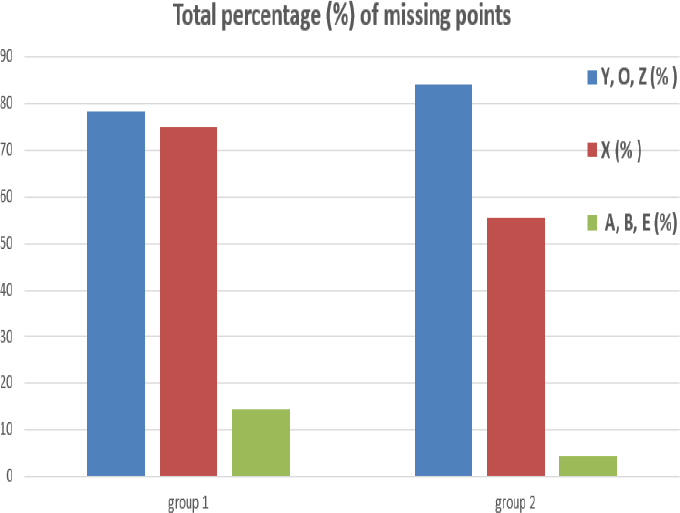
Fig. 7
Total percentage of missing points in both groups.
Table 6
Characteristic pattern of ABEXYOZ waveforms
| ABEXYOZ s | Description of ABEXYOZ complex |
| ABEXYOZ 0 | Typical ABEXYOZ complex of the dZ/dt waveform containing all characteristic ICG points |
| ABEXYOZ 1 | ABEXYOZ complex of the dZ/dt waveform with X but without YOZ are unidentified in one slope |
| ABEXYOZ 2 | ABEXYOZ complex of the dZ/dt waveform with typical characteristic points, except the X point, which is a not a clear X (noted X2) |
| ABEXYOZ 3 | ABEXYOZ complex of the dZ/dt waveform with an unpronounced X point (X2) and no well-defined YOZ points |
| ABEXYOZ 4 | ABEXYOZ complex of the dZ/dt waveform without well-defined XYOZ points that are almost time contained in one slope after the E wave |
| ABEXYOZ 5 | The ABEXYOZ complex of the dZ/dt waveform that have all of the typical characteristic points, except the X point, which may be a true X or X2, and the dZ/dt waveform has a skirt shape. |
| ABEXYOZ u | The ABEXYOZ complex of the dZ/dt waveform that is characterized by a high percentage of noise or missing points |