

I. Introduction
Between 2013 and 2017, the EU and its member states were negotiating simultaneously the Transatlantic Trade and Investment Partnership (TTIP) with the US and the Comprehensive Agreement on Investment (CAI) with China. The US and China were both regarded as partners for cooperation by the EU. In June 2015, the EU-PRC Summit in Brussels even agreed to “develop cooperation on defense and security” (European Council 2018). The European External Action Service (EEAS) emphasized that the CAI with the People’s Republic of China (PRC) was its “immediate priority” (European Commission and High Representative of the Union for Foreign Affairs and Security Policy [EC & HR/VP] 2016). According to all surveys conducted then, the Europeans’ favorable and unfavorable views of China had stagnated for a decade until 2017. However, European unfavorable views of China have risen sharply since then. In February 2018, the German Foreign Minister, Sigmar Gabriel, issued the first warning about the Belt & Road Initiative and pointed out the EU’s unpreparedness for this challenge.
“China’s rise will result in a massive shift in the balance of power. The initiative for a new Silk Road is not what people in Germany believe it to be — it is not a sentimental nod to Marco Polo, but rather stands for an attempt to establish a comprehensive system to shape the world according to China’s interests. China is developing a comprehensive systemic alternative to the Western model that, in contrast to our own, is not founded on freedom, democracy and individual human rights. But what we can blame ourselves for is the fact that we, as the ‘West,’ do not have our own strategy” (Gabriel 2018).
This unfavorable trend toward China was accelerated by the pandemic and the Russian invasion of Ukraine. In the end, the EU adopted its Indo-Pacific Strategy and de-risking policy as a response to the US Indo-Pacific Strategy and de-coupling doctrine, as reflected in the EU’s Indo-Pacific documents and recent European Council conclusions (European Commission & European External Action Service 2021; Council of the European Union 2021; European Council 2023). Many analysts suppose that Trump’s anti-China discourse and policy caused this massive shift of the Europeans’ perception of the PRC since 2018 (Leino 2023, 197–9). According to this thesis, Europeans closely followed the US to the extent that the EU modified their views of the PRC and adopted a new strategy conforming to the American new global and China strategies.
This paper draws on the author’s ongoing tracing of the TTIP negotiations and transatlantic relationship afterwards. It employs a triangulation among official documents, journalistic coverage and selective interviews with stakeholders and officials. It aims to illustrate and explain the fast evolution of the EU’s interpretation of the rise of the PRC between 2016 and 2020 and exploit the key factors structuring this new perception to see if Europeans’ cognitive shift was really shaped by Trumpism. The second section focuses on the American and European divergent perceptions of the rising PRC and different global strategies until 2018 and the converging trend since then. The third section explores probable reasons that might have caused this convergence, analyzing them one by one with the help of two matrices in the analysis of the European perception of China. In conclusion, this paper summarizes the findings and points out its potential contribution to the debate over the triangular relationship between the US, the EU, and the PRC in a new era.
II. American and European perceptions of the rise of the PRC and their strategies
American perceptions and strategies vis-à-vis the rising PRC
Soon after his reelection, Obama initiated a tripartite strategy aimed at establishing the TTIP between the US and the EU, the Trans-Pacific Partnership (TPP) with its allies in the Asia-Pacific, and the Trade in Service Agreement (TiSA) among pro-American economies in the WTO. Alerted by the weakening positions of the US and the EU in the aftermath of the financial crisis in 2008 and European sovereign debt crisis in the 2010s, the Obama administration drafted a new strategy to maintain the West’s dominance in a still fast globalizing world (Brands 2016). According to Obama’s strategy, the US and the EU should jointly promote the G20 as a new mechanism in compensation to the existing G7 in the global governance to maintain the momentum of the globalization. In parallel, the US initiated this tripartite grand strategy to construct a three-circle bloc with the US and, to a lesser degree, the EU at the core to dominate and reorient the globalization in their favor. In substance, this tripartite strategy aimed to contain and mitigate the rising impact of the PRC in global governance. The TTIP therefore was an integral part, even serving as the core element of this American new global strategy. Nonetheless, soon after Trump was inaugurated as the American president, the US withdrew from the TPP and negotiations on the TTIP were suspended. The TiSA in WTO was de facto abandoned in 2017. Obama’s grand strategy ended in a tragic and disastrous failure.
European perceptions and strategies vis-à-vis the rising PRC
The EU and its member states did not share this American viewpoint and interpretation of the rise of the PRC throughout the process of the TTIP (Su 2018, 22–3). Soon after starting negotiations on the TTIP with the US, the EU Council agreed to the opening of negotiations on the CAI with the PRC in 2013. This move came as the Chinese capital and enterprises began to invest in the European markets, a phenomenon totally neglected by the PRC-EEC (European Economic Community) Agreement on Economic Cooperation of 1985, which only regulated the European investment in the PRC. This new trend was accelerated after the outbreak of sovereign debt crisis in 2010 and the creation of the 16+1 format between the PRC and some Central and Eastern European countries in 2012. According to the European Commission and the EEAS, the initiative of CAI was welcomed because it aligned with the EU’s endeavor to conclude the Agreement on Climate Change under the UNFCC (United National Framework on Climate Change) particularly after its abortive efforts in Denmark in 2014 (European Commission & High Representative of the Union for Foreign Affairs and Security Policy 2016, Section V.3). The opening of negotiations with the PRC on economic cooperation facilitated the Sino-European collaboration on climate change, which indeed led to the successful adoption of the Paris Agreement on Climate Change in 2015.
Furthermore, in 2017, the Trump administration started its de-globalizing process by boycotting the nomination of the candidates for the Appellate Body of WTO, imposing high tariffs on imported items such as steel and aluminum, forcing American allies, including Canada, Mexico, Korea, and Japan, to renegotiate the existing trade agreements in favor of the US, and withdrawing from the Paris Agreement on Climate Change. In response, the EU and its member states were resolved to defend the globalization and global governance for which China was a vital partner. Vis-à-vis Trump’s anti-globalization discourses and violations of global rules, the EU accelerated its negotiations on economic cooperation with Japan, leading to the signature of the EU-Japan Agreement on Economic Partnership in 2019 and its entry into effect less than one year later (Pereira 2019, 16–7; Hilpert 2018, 446). When Trump boycotted the candidates of the Appellate Body of WTO and refused to negotiate on this subject, the EU and its member states presented the project establishing the Multi-Party Interim Appeal Arbitration Arrangement (MPIA) as an alternative system to the dysfunctional Appellate Body (Rauwylyn 2023, 693–4; Lu 2020, 16–7). When Trump ceaselessly attacked the Paris Agreement on Climate Change and finally withdrew from this deal, the newly inaugurated European Commission under the presidency of Von der Leyen highlighted the fight against climate change as its immediate priority and presented its ambitious Green Deal in 2019 to maintain the EU’s status as a “global standard setter” (Eckert 2021, 82). As a result, the EU established the CBAM (Carbon Border Adjustment Mechanism) in 2022 which entered into effect in October 2023. Facing Trump’s unilateralism and de-globalization campaign, the EU needed support of the PRC to defend the globalization and multilateralism that they had promoted for decades.
From the EU’s viewpoint then, a Transatlantic economic partnership with the US was as beneficial and contributive as a transcontinental economic cooperation with the PRC. The EU did not oppose the Belt & Road Initiative or the creation of Asia Infrastructure Investment Bank (AIIB) by the PRC. It did not prevent its members from participating in either of them. On 29 June 2015, the EU-PRC Summit was held in Brussels, where both parties agreed to enhance “cooperation to address key environmental challenges,” “cooperation in the field of energy,” and even to “develop cooperation on defense and security” (European Council 2015). In its joint communication to the European Parliament and the EU Council, the EEAS emphasized that the CAI with the PRC was its “immediate priority towards the objective of deepening and rebalancing” the EU’s relationship with the PRC, which was viewed as a partner of the EU (EC & HR/VP 2016). According to different polls, a majority of citizens in the EU and its member states maintained a positive view of the rise of the PRC and its role in global politics until 2017 (Table 1).
Table 1:
% in the country who have an unfavorable view of the PRC.
| 2015 | 2016 | 2017 | 2018 | 2019 | 2020 | |
|---|---|---|---|---|---|---|
| USA | 55% | 47% | 47% | 60% | 66% | 76% |
| France | -- | 49% | 61% | 52% | 54% | 70% |
| Germany | 50% | 60% | 53% | 54% | 56% | 71% |
| Italy | 57% | 61% | 59% | 60% | 57% | 62% |
| Spain | 50% | 56% | 43% | 48% | 53% | 63% |
| Poland | -- | 42% | 29% | 37% | 34% | --- |
| Hungary | -- | 44% | 45% | 47% | 37% | --- |
| Greece | -- | 37% | 40% | 48% | 32% | --- |
| Sweden | -- | 59% | 49% | 53% | 70% | 85% |
| Netherlands | -- | 43% | 42% | 45% | 58% | 73% |
The evolution of the EU perception of the rise of the PRC
However, this favorable view of the PRC rapidly dropped in 2018, when unfavorable views surpassed favorable ones in the US and many member states of the EU. Advocating the “reciprocal engagement” with the PRC in 2009, the European Council on Foreign Relations reiterated its abandonment of the “myth of convergence” and a European “return to realism” vis-à-vis the rise of PRC in 2017 (Fox & Godement 2009, 52–4; Godement & Vasselier 2017, 9–14). The gap between the unfavorable and favorable views has never ceased to enlarge since then. In 2023, on average, those adopting a negative view of the rise of the PRC and its role in world politics were twice as many as those adopting a positive view. Many Europeans seem to have shifted from a Sinophilic stance to a more Sinophobic one since 2018.
This new trend emerged with the EU’s adoption of a new strategy on the PRC. Since 2018, the EU and its member states have adopted a series of strategies and policies barring the Chinese capital from merging with European high-tech enterprises (Brennan & Vecchi 2021, 1076–9; Kuo 2023). In March 2019, the European Commission’s Strategy Outlook started to reinterpret the PRC as “a partner for cooperation,” “an economic challenger,” and “a systemic rival” to the EU (Small 2022, 23–4). In the same year, 25% of Europeans regarded the PRC as a partner and 45% as a competitor (Bertelsmann Stiftung 2020, 9, Figure 4). In April and September 2021, the EU Council and the European Commission adopted consecutively the EU’s Indo-Pacific Strategy, highlighting the importance of peace, freedom, and openness in the region, closely echoing the Indo-Pacific Strategy of the US. In May 2021, the European Parliament suspended the ratification process of the CAI. To consolidate the economic security of the EU, the European Commission adopted the de-risking strategy to regulate the EU-PRC economic relationship in a new global context in 2023. European enterprises began transplanting select supply chains out of the PRC.
III. Analysis
In order to analyze the EU member states’ attitudes toward the PRC, as early as 2008, Fox and Godement presented a matrix to clarify their divergences and reasons behind them (Fox & Godement 2009, 4, 23; Table 2 and Figure 1). According to their analysis, the EU member states’ divergent attitudes toward China were shaped by two key factors. Is this EU member state more critical or supportive on politically sensitive issues such as human rights or individual freedom in the PRC? Is this EU member state more liberal or protectionist on economic issues such as the restriction on imported products from the PRC? Based on this classification, the EU member states were divided into four groups.
Table 2:
Fox and Godeman’s classification of the EU member states’ attitudes toward the PRC in 2008.
| Economics\Politics | Politically critical | Politically supportive |
|---|---|---|
| Economically liberal | Group 1 Ideological free traders | Group 3 Accommodating Mercantilists |
| Economically protectionist | Group 2 Assertive industrialists | Group 4 European Followers |
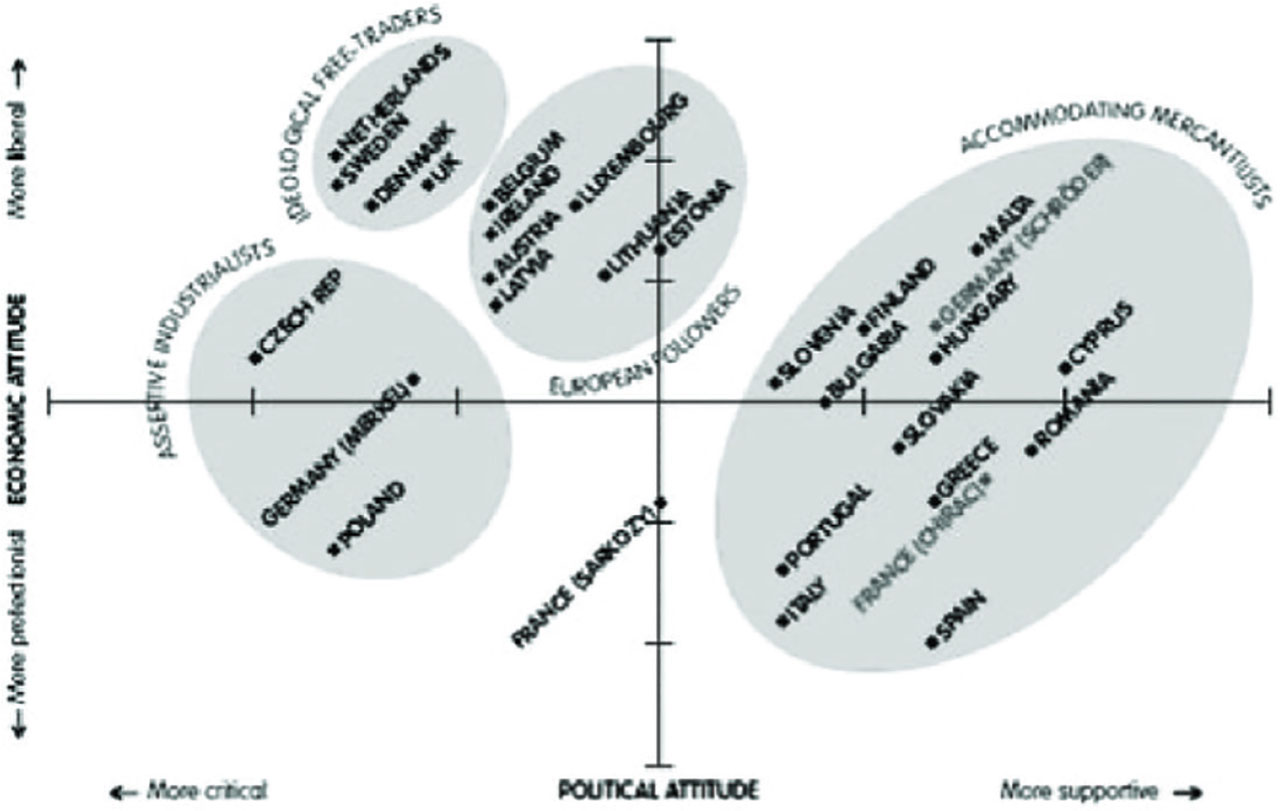
Figure 1:
Matrix by Fox and Godement 2008.
Source: Screenshot from Fox and Godement, op. cit., p. 4.
With reference to Fox and Godement’s matrix and taking into consideration the new context between 2008 and 2017, the EU member states can be divided into four groups in their engagements with the PRC. Group one was composed of the Northern European countries and the UK, whose economies were less dependent on the trade with and capital from the PRC. These countries placed strong emphasis on democratic values in their relationships with the PRC. Group two consisted of the Central European countries and the Baltics. They welcomed the investment from the PRC and endeavored to promote their trade with the PRC; however, owing to their bitter experience of the Moscow-imposed communist dictatorship between 1945 and 1990, the anti-communist legacy made these countries and their people easily resentful against any pro-communist appeasing discourses. Group three was the Benelux countries, which were less dependent on trade with and capital from the PRC but did not put a strong emphasis on freedom and human rights in their engagements with the PRC either. The Mediterranean European countries belonged to group four, which were eager to increase their trade with and attract capital from the PRC to the extent that those democratic values were often neglected in their engagements with the PRC. The other member states in the EU, particularly France and Germany, were often swinging between these extremes in their engagements with the PRC.
However, Fox and Godement also pointed out that the EU member states’ attitude might dramatically “change overnight” if a new ruling party came to power after elections. In their engagements with the PRC, European parties are influenced by their own political identities and their attitudes toward the Transatlantic relationship and European integration. In domestic politics, the Right is often interpreted as the promoter of national security and economic development, while the Left puts a heavier accent on social equality and labor rights. In external actions, those ruling parties and individuals who favor a more pro-Atlanticist policy are often more easily influenced by the US policies and discourse on China. On the other hand, pro-European integration leaders and people may care more about those values and norms esteemed as essential to the European Union, such as peace, reconciliation, liberty, and international rules (Table 3).
Table 3:
EU member states’ positions in domestic politics and external relations.
| External \ domestic | The Right | The Left |
|---|---|---|
| Transatlantic relationship as priority | Atlanticism | Progress movement |
| European integration as priority | European Sovereigntism | European socialism |
Taking into consideration these two matrices, this paper presents four propositions formulated as follows.
Proposition one: If the PRC tightens its communist rule domestically, unfavorable views of the PRC will rise, particularly in the ideological free traders and assertive industrialist European countries.
Proposition two: If a country enjoys rising trade surplus with and FDI from the PRC, its favorable view of the PRC will rise, particularly in those countries with a strong economical tradition of protectionism.
Proposition three: If the US adopts a hawkish discourse and policy on the PRC, unfavorable views of the PRC will rise, particularly in those countries that have pro-Atlanticist traditions or are now governed by pro-Atlanticist parties.
Proposition four: If the PRC takes external actions violating values such as peace, reconciliation, liberty, and international rules cherished in the European integration movement, unfavorable views of the PRC will rise, particularly in those countries that have strong traditions of pro-European integration or are now governed by pro-Europe parties.
i. The tightening communist control inside the PRC
Since he took office in 2012, Xi has been ceaselessly tightening his control inside the PRC. His concept of “comprehensive national security,” introduced in 2014, comprises nearly all dimensions of national development. It is deemed indispensable to the “rejuvenation of the nation,” leading to total securitization of communist control in the PRC (寇健文 2012). As a result, the apparatchiks of the CCP (Chinese Communist Party) prevailed over the governmental officials as the leading force and decision-makers at all levels in the implementation of central and local government policies, totally contrary to the trend started by Deng Xiaoping’s openness and reform in the 1980s (蔡文軒 2022). In the name of anti-corruption campaign, Xi’s government has arrested hundreds of high-ranking officials, generals, ministers, and CEOs of state enterprises. Some of them were even murdered or “died accidentally.” The arrest and conviction between 2014 and 2015 of the former permanent member of the CCP Politburo, Zhou Yongkang (周永康), was unprecedented, which reconfirmed Xi’s determination to establish absolute authority in the PRC.
However, Xi’s tightening control did not reverse the rising favorable views of the PRC between 2012 and 2017. The above-mentioned actions were perceived as power struggles inside the CCP, which had repeatedly emerged in the aftermath of power succession in the PRC. This perception has rapidly changed since 2017.
First, Xi started a campaign to put an end to the two-term restriction in 2017, a golden rule established by Deng Xiaoping in the 1980s and followed by all of Xi’s predecessors. Xi should have stepped down as the president of the Republic, the chairman of the CCP, and the commander-in-chief of the PLA (People’s Liberation Army) in 2022 according to the PRC Constitution and CCP Charter before their amendments in 2018. Compared to Xi’s predecessor’s appointment in 2007, the front-page headline of Xi’s renewed appointment in the People’s Daily in 2017 deliberately enlarged Xi’s headshot to the extent that the group photo of the seven permanent members of the Politburo on the bottom was presented as a negligible affiliation (人民日報 2007, front page; 人民日報, 2017, front page).
In the eyes of Europe, the authoritarian regime of the PRC, which was previously based upon collective leadership, has now transformed into an individual dictatorship, fully burying any “myth of convergence” in the West — the belief that continuous economic development might lead to a more open society and greater political tolerance in the PRC.
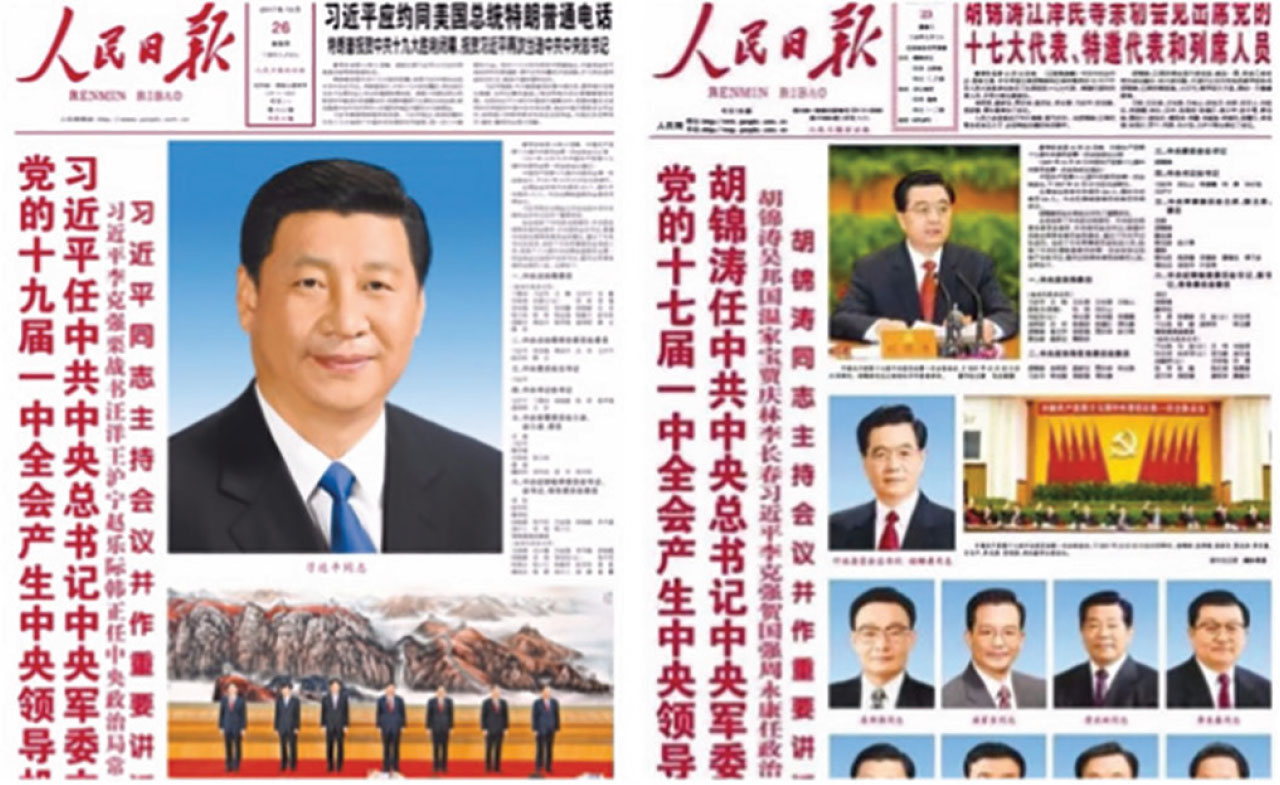
Figure 2:
Front page headlines in the People’s Daily of 2007 and 2017.
Source: Screenshot of ET Today of 23 October 2007 and 26 October 2017.
Second, Xi started to suppress any private sectors regarded as a threat to the CCP regime since 2016. In the name of “co-prosperity,” private enterprises were obliged to donate a fortune to the government in exchange for personal safety (王韻 2022). Furthermore, some leading entrepreneurs were suppressed. Jack Ma (馬雲), the founding father of Alibaba, was under investigation for his financial fraud in 2020. After being fined 20 billion RMB, Ma was forced to sell a majority of his shares to the government and hand over Alibaba to the state. One of the most popular actresses, Fan Bingbing (范冰冰), was penalized for her fake contract and tax evasion. Fan was forced to pay 200 million RMB in exchange for immunity from imprisonment. This trend disillusioned the Europeans who were ceaselessly promoting “reduction of government involvement in private contracts.”
In the same period, Xi’s tightening control gave rise to European concerns about the violation of human rights, particularly in Xinjiang and Hong Kong. The tensions between Han and Uighurs were fast rising in Xinjiang since their bloody conflicts in 2009, on which the European Parliament adopted its first resolution expressing its concerns over the Uighurs and condemnations of any actions violating human rights in Xinjiang in 2010. Europeans also refused to name the violence committed by Uighurs as terrorism as required by the PRC (Stern 2021, 8–9). In 2016, the PRC adopted the decision establishing several “re-educational bases” for Uighurs, which was first reported in Europe in 2017. Such actions immediately reminded Europeans of horrible concentration camps and genocidal crimes committed by Nazis. Criticism and sanctions imposed against these actions have since then rocketed throughout Europe. For example, in 2017, Ilham Tohti, one of the leading figures for Uighurs’ autonomy and freedom who is imprisoned in the PRC, was awarded the Weimar Human Rights Prize in July and Liberal International’s Prize for Freedom in November. In 2019, he was consecutively honored in absentia with Freedom House’s Freedom Award in New York, the Vaclav Havel Human Rights Prize by the Parliament of the Council of Europe, and the Sakharov Prize by the European Parliament. On 23 September 2024, the EEAS issued a call for the immediate and unconditional release of Tohti on the 10th anniversary of his life sentence in prison (European External Action Service [EEAS] 2024).
Another focal point was Hong Kong, which had been returned to the PRC in 1997 and established the so-called one country, two systems. However, since 2003, demonstrations never ceased to exist in Hong Kong, calling for universal elections of its governor and city council no later than 2017, following Article 45 of Hong Kong Basic Law and the resolution adopted by the PRC People’s Congress in 2007. Demonstrators also called for suspension of Article 23 of Hong Kong Basic Law that requires the Hong Kong government to legislate national security law. These demonstrations reached their peaks respectively in 2003, 2012, and 2014. In 2019, an incident concerning a murder committed by a Hong Kong citizen in Taiwan obliged the City Council to lift the ban that prevented the Hong Kong government from extraditing its citizens to Taiwan and Mainland China. Frightened by the possibility that any Hong Kong citizen could be extradited to Mainland China at the request of the PRC, tens of thousands of people demonstrated continuously in the streets between February and November 2019, even after the government withdrew the proposal in June. This anti-extradition to the PRC movement led to the landslide victory of pro-democracy parties in the Council elections in November 2019 and even cast an enormous impact on Taiwan’s general elections in January 2020. The European Parliament adopted a resolution supporting the Hong Kong people’s demonstrations and “strongly condemn[ed] the constant and increasing interference by China in Hong Kong’s internal affairs” (European Parliament 2019).
Worse still, the PRC Charity Law and the PRC Administrative Law on Overseas NGO’s Activities within China were both adopted in 2016 and took effect on 1 January 2017, which fall under national security legislation. All overseas NGOs are now managed and supervised under the jurisdiction of the Ministry of Public Security instead of the Ministry of Civil Affairs or Ministry of Foreign Affairs. All the overseas NGOs are required to “refrain from providing financial support to for-profit activities, political activities, and illegally supporting and sponsoring religious activities.” Such ambiguities obliged many international NGOs, 500–600 in total, and their workers in the PRC to leave, which severely damaged the country’s reputation overseas (Schaub 2021). A majority of these NGO workers had gone to and stayed in the PRC because they had believed that the PRC can make progress in all fields and they had passion to participate in it. “So many things in this law are so unclear,” commented an NGO leader in the PRC, “that the government will use it to suppress whomever it wants” (Spires 2020, 571). Disillusioned by the trend contrary to their expectations and having worked in the PRC for years or even decades, these NGO workers have become the truth tellers and opinion leaders on Chinese affairs on their return to Europe.
Since 2015, Xi’s government has been putting increasing pressure on enterprises in the PRC to establish a Communist Party Committee (CPC) if they hire more than three CCP members as employees. Though having existed for a long time, this regulation was implemented mainly in those state enterprises. “We could easily establish a branch as an empty shell and establish a CPC there,” replied a Taiwanese entrepreneur with around 600 employees, “but now it doesn’t work. You have to create a CPC inside the enterprise, which convenes weekly” (Su’s interview, 2024). Now all private, overseas, and international enterprises are required to establish a CPC, provoking tremendous criticism and complaints among international investors and CEOs. “China has fundamentally changed,” complained a former leading entrepreneur of the ECCC (European Chamber of Commerce China), “for it does not welcome international investors as before. Many of us have left” (Su’s interview, 2022).
ii. The increasing trade surplus with and FDI from the PRC
Suffering from the financial crisis in 2008 and sovereign debt crisis in 2010, Europeans welcomed back Chinese capital. The 16+1 scheme, jointly created by the PRC and sixteen Central and Eastern European Countries in 2012, reaffirmed this attitude. In 2011, the Greek government decided to cede the management of its ports and airports in exchange for liquid capital. In 2016, the Chinese enterprise COSCO (China Ocean Shipping Company) purchased two-thirds majority stake of Piraeus and became the administrator of the biggest port of Greece. Chinese FDI in Europe per year grew from $840 million in 2008 to $35–42 billion in 2017 (Liu & Davarinou 2019). In total, ten years after the financial tsunami in 2008, Chinese enterprises invested $318 billion in Europe, 45% more than Chinese FDI in the US in the same period. Chinese capital took over approximately 360 European enterprises (Le Corre 2018). While the COSCO was finalizing its agreement with the Greek government on the procurement of Piraeus, the PRC investment per year in Germany rose from 186 million euros in 2010 to 1.4 billion in 2011 and then to 11 billion in 2016: “China is buying up Germany” (Bian & Emons 2017, 157–61).
Despite the fact that some of these merging actions appeared on the cover story of the news media, few ever provoked a general debate over their impact or compatibility with European interests. They were in general interpreted as business deals where Europeans were impressed by those Chinese enterprises seemingly with unlimited cash flow.
This atmosphere changed after the publication of Made in China 2025 (MIC 2025) by the PRC in 2015. MIC 2025 enumerated ten key industries that the PRC would invest in heavily and develop into world-class production. These were information technology, robotics, green energy and vehicles, aerospace, ocean engineering, railway equipment, power equipment, new materials, medicine and pharmaceutics, and agricultural machinery (Wübbeke et al. 2016). MIC 2025 immediately made Americans believe that it constituted a challenge to American technological, scientific, and industrial predominance and provoked a similar debate in Europe. Some echoed American skepticism to MIC 2025 while others took it as another state-driven five-year plan only. The debate over the nature and ambition of MIC 2025 ended with the triumph of the skeptical views after the Chinese state enterprise Midea’s acquisition of the German advanced robotics company Kuka AG in 2016 for $5.2 billion. In the process of acquisition, some German and European politicians, scholars, journalists, and businesspeople tried their best to prevent it, but all failed. No legal leverage or political solidarity ever existed to make this prevention effective. Alerted by this unpreparedness, the EU started to draft a regulation aimed at screening the FDI into the internal market and particularly the capital targeting high-tech sectors. In March 2019, the European Commission submitted a regulation project on the establishment of a framework for the screening of FDI into the Union to the Council and European Parliament. In November 2020, Regulation 2019/452 took effect. “The Kuka case has become the most well-known example and a watershed moment in the German discourse on China’s investment activities” (Wrage & Kullik 2022). The acquisition of Kuka by Midea was immediately interpreted as a PRC plot to achieve the declared goals of MIC 2025. “The alarm bells are ringing,” reported the Deutsche Welle (Böhme 2016). According to the Bertelsmann Foundation, 64% of German companies merged by Chinese capital between 2014 and 2017 belonged to those ten sectors highlighted in MIC 2025 (Wrage & Kullik 2022). As the EU started to regulate the Chinese FDI in the union, its member states took steps to adopt or revise their own laws regulating FDI from the PRC. Though member states of the EU have not yet established a uniform mechanism to regulate the Chinese capital into the union, this process has given rise to skepticism of the PRC and its capital, both of which are now perceived as threats to European economic security.
iii. The rising hawkish discourse and policy toward the PRC in the US
When Obama launched his tripartite strategy to restructure globalization and consolidate American leadership, he and his government did not base their arguments on any anti-China discourse. In 2012, Hillary Clinton even welcomed the PRC to join the TPP if it entered into effect.
The so-called TPP will lower barriers, raise standards, and drive long-term growth across the region. . . . It will cover 40 percent of the world’s total trade and establish strong protections for workers and the environment. . . . We welcome the interest of any nation willing to meet 21st century standards as embodied in the TPP, including China.
Near the end of Obama’s presidency and during the presidential campaign in 2016, polls showed that a majority of Americans were skeptical about the TPP while neglecting the TTIP. It was at that time that Obama issued a formal statement implicitly condemning the PRC. “TPP allows America — and not countries like China — to write the rules of the road in the 21st century,” declared Obama. “Put simply, TPP will bolster our leadership abroad and support good jobs here at home” (Obama 2016). This can be regarded as Obama’s most hawkish discourse on the PRC.
Obama’s new tone cast no impact on his European counterparts’ attitude toward the PRC. Americans still opposed the TPP while Europeans condemned the TTIP. Obama’s grand strategy ended in a tragic and disastrous failure. European countries were then concentrating on the conclusion of the Paris Agreement on Climate Change and evaluating the Belt and Road Initiative in order to benefit the most from the rise of the PRC. Germany and the UK even agreed to work with Huawei to construct their 5G systems owing to financial and technological reasons. American and European perceptions of the rise of the PRC were so divergent that they had adopted totally different and even incompatible global strategies.
After the Trump administration took office in January 2017, he immediately ordered his government to investigate those economic practices of the PRC with and in the US. In March 2018, the Office of US Trade Representative published its investigation report, enumerating those incorrect, unfair, and even illegal practices conducted by the PRC government and enterprises in their trade with and investment in America. Following this report, Trump’s administration imposed tariffs on some Chinese products and restricted Chinese investment in the US.
However, these actions did not resonate in Europe as Trump’s anti-China arguments were regarded as part of his anti-globalization and pro-isolationist discourses. On the contrary, the EU was busy searching for solutions to difficulties in the global governance produced by Trump’s policies, in which the PRC acted as a contributive partner. In June 2017, in the immediate aftermath of Trump’s announcement of the American withdrawal from the Paris Agreement on Climate Change, both the EU and the PRC reiterated their commitments to this Agreement as responsible stakeholders. “China will stay committed to upholding and promoting the global governance on climate change,” declared the spokesperson of the PRC government, “and take an active part in the multilateral procession on climate change” (Haas 2017). Similarly, soon after American government boycotted the appellate body of WTO in October 2018, the EU initiated a proposal establishing the MPIA as a rescue package, which obtained full support from the PRC.
It was in the process of the American restriction of the PRC investment in the high-tech sector that allowed Trump’s anti-China discourses and policies to penetrate into the EU, changing the mindset of its leaders, elite, and the public. This shift was particularly evident in the US-led campaign against Huawei’s 5G construction since 2017. American government had been alerted by Huawei’s advanced technology and aggressive expansion as well as the European counterparts’ openness to Huawei’s bid for the 5G construction. To make matters worse, this openness was promoted by the UK and Germany, America’s closest allies in NATO (Pawlicki 2017, 21–40). As a result, by early 2019 the US government made a decision to persuade and, if necessary, force its NATO allies to follow the American approach to exclude Huawei from their constructions of the 5G Telecom. To achieve this goal, “the United States was preparing to run a campaign of unprecedented scope, most significant mobilization of political resources on a China-related issue in Europe that it had ever undertaken” (Small 2022, 43–4). In January 2020, the European Commission published its first report on 5G that established the so-called 5G Cyber-security Toolbox and warned of the dependence on risky 5G technology providers. By August 2024, eleven out of twenty-seven member states had fully banned Huawei and its partner ZTE from investing in telecom in their countries, while others implemented restrictions on these providers (Kroet 2024). Though the EU member states did not impose the same restrictions as the US government had expected, and despite Huawei and ZTE surviving these hostile actions, the American campaign against Huawei succeeded in provoking and deepening European suspicion of Chinese investment and concerns over industrial espionage by Chinese enterprises in Europe.
iv. The rising China threat thesis in Europe
In April 2015, the Chinese movie Wolf Warrior was released which ranked as the most successful PRC film of the year at the box office. Wolf Warrior II in 2017 proved to be another big success with box office earnings of 5.7 billion RMB in the PRC and 870 million USD overseas. The wolf-warrior style suddenly reshaped the PRC diplomacy and Chinese people’s behavior in the international community between 2016 and 2021, which caused non-recoverable damages to the image of the PRC in Europe (Dai & Luqiu 2022, 258–62). This wolf-warrior style of diplomacy was characterized by an arrogant attitude, confrontational rhetoric, coercive behavior, and a firm refusal of any criticism or even suggestions by the PRC officials and diplomats in Beijing and European capitals. On international occasions, the PRC diplomats employed more and more frequently Maoist vocabulary and discourse from past class conflicts. Interviewed on the subject of cross-strait relations, the then-PRC ambassador to France, Lu Shaye, replied that “all Taiwanese must be re-educated after the reunification to learn how to behave as patriotic citizens” (Newsweek 2022). That immediately reminded people of the re-educational camps for Uighurs in Xinjiang. “I was invited at a high-class French restaurant by high-ranking Chinese officials,” said a French diplomat who worked in the PRC, “and offered a bottle of red wine of Chateau Lafite Rothschild 2002. The Chinese host then presented this expensive Bordeaux red wine in a very arrogant manner by saying, ‘I believe you’ve had no chance tasting such grand wine in France’” (Su’s interview, 2019). Alongside this verbal bullying, the PRC implemented coercive actions as punishment or warnings on any states that had failed to comply with the PRC policy. For example, after Lithuania had established an office in Taipei and neglected warnings from Beijing, the PRC downgraded the bilateral relationship and made any import from Lithuania to China slower and more complicated. Europe was surely not the only victim of such wolf warrior diplomacy. Immediately after Meng Wanzhou was detained in Canada in December 2018, the PRC police arrested two former Canadian diplomats as retaliation until the day Meng was released in 2021. In response to the American deployment of the THAAD missile system in South Korea, the PRC “dissuaded” its citizens from traveling to South Korea, excluded Korean dramas from TV channels, and even bullied the Korean Rakuten Group in the PRC, who supplied the THAAD with its land in Korea. Rakuten Group was later obliged to sell out all of its shops in the PRC in 2019 and withdrew from the Chinese market in 2022.
This wolf warrior diplomacy has given rise to the China threat thesis among Europeans. “Compared to Putin’s Russia that had invaded Georgia in 2008 and Crimea in 2014,” analyzed a European diplomat, “the PRC was never perceived as a military expansionist. Unfortunately, its wolf warrior diplomacy has increased our worries that China under Xi’s assertive leadership may evolve in that direction” (Su’s interview, 2024). In other words, Europeans were increasingly worried that Xi’s wolf warrior diplomacy might develop into more aggressive military actions in the near future.
The first area of concern was the Taiwan Strait. Since the victory of Taiwan’s pro-independence party (Democratic Progress Party, DPP) in the presidential and parliament elections in 2016, the détente in the Strait was terminated as the PRC cut off the dialogue with Taiwan and launched larger and larger military drills surrounding this island. “Taiwan [is] the most dangerous place on earth,” declared The Economist in its cover story of 1–7 May 2021 (The Economist 2021). Since then, French, Dutch, and German warships have deliberately sailed through the Taiwan Strait to “signify Europe’s commitment to freedom of navigation in this absolutely crucial area” (POLITICO 2023).
The second area of concern was the South China Sea, where the PRC was in permanent conflict with Vietnam, the Philippines, and Indonesia. The judgment of the Permanent Court of Arbitration in 2016 did not scale down the tensions between the claiming parties. On the contrary, it accelerated the militarization of those islets and rocks by all claiming parties. The quarrels over the fishing rights were now upgraded to the tensions of claiming sovereign rights between coast guards. “Our Chinese counterparts always tried to assure us of our freedom of navigation in the South China Sea,” remarked an EEAS official, “but we don’t need their assurance. That is OUR right” (Su’s interview, 2024).
The third area of concern was the Sino-Indian border. In 2020, the PLA and the Indian Army went into conflict in the disputed territories between the PRC and India. It was reported that soldiers were fighting against each other with sticks and wands, avoiding firearms. Although the PRC and Indian foreign ministers called each other to find an immediate solution, tensions along the Sino-Indian borders fluctuated for years. Refraining from taking any positions in this conflict, the West generally expressed more sympathy for India (Wulf 2024).
In reporting and analyzing tensions in these three sub-regions in Asia, Europeans perceived the PRC as a troublemaker that expressed its strong intention to reunify Taiwan by force, expel other claimants in the South China Sea by coercive actions, and control those territories bordering India in dispute with an advanced military deployment. All of these analyses and perceptions paved way for the rising China threat thesis in Europe.
v. “China anxieties”: European lens in the context of crises
According to the above-mentioned analyses, the first and fourth propositions have been confirmed. As the PRC under Xi’s presidency has been tightening its domestic control, implementing wolf warrior diplomacy, and exercising aggressive military actions in its neighborhood, Europeans’ unfavorable view of the PRC has steadily increased since 2017. The third proposition was only partially confirmed as Europeans did not fully echo Trump’s anti- China discourse and policy until the US started a massive campaign against Huawei’s 5G construction in 2019. The second proposition was denied. The increasing trade surplus with and capital from the PRC did not boost the favorable view of the PRC, as expected in the second proposition. The FDI from the PRC and particularly the merging of key sector industries by those PRC state enterprises were interpreted as a threat to European economic security — one of the priorities highlighted in the EU’s Indo-Pacific Strategy.
The falsification of the second proposition and the modification of the third proposition have led to a tentative conclusion: Europeans perceived the rising PRC in the context of crises, particularly after Brexit started in 2016, giving rise to the so-called China Anxieties (Brennan & Vecchi 2021, 1079). From 2010 onward, Europeans were experiencing crises one after another. The sovereign debt crisis in 2010 heavily hit Greece, Ireland, Spain, Portugal, and Cyprus. The Arab Spring in 2011 disturbed the neighboring areas in the Mediterranean, paving the way for massive influxes of refugees and terrorist attacks. When the EU was busy dealing with millions of refugees coming from Africa and the Middle East, tensions in Ukraine and between Ukraine and Russia were escalating, which resulted in the domestic turmoil in Ukraine and Russia’s annexation of Crimea in 2014. In 2015, the refugee crisis reached its peak, with Merkel’s open-door policy polarizing Germany and the rest of Europe and stimulating the fast rise of populism and the extreme right. In 2016, the British vote for Brexit further disappointed those pro-Europe camps in the EU. Consequently, Euro-skepticism and extremism have been rising in nearly all the EU member states over the past decade. Trump’s victory immediately put into doubt those core values promoted by the EU for decades, including the fight against climate change, the defense of free trade order, and global governance based upon multilateralism. As a result, the three Ds — de-globalization, de-coupling, and de-risking — have influenced the European perception of the EU-PRC relationship (Babić & Linsi 2024, 2).
Emerging “China anxieties” in the mid-2010s differed from the earlier notion of the “China threat,” which was mostly associated with China’s military build-up and military actions in its neighboring territorial disputes. In the context of the debate over the “China threat,” China is usually regarded as a military disturber of the status quo and a threat to peace in the region.
In the lens of “China anxieties,” Europe’s normative power is put into doubt and its economic strength is being surpassed by that of China. Rising pessimism about the future of the global order and European integration made Europeans skeptical about its own power to defend itself as well as its influence upon others. Facing Xi’s tightening control inside the PRC and assertive actions in its external relations, the EU was perceived as impotent and took no effective actions. Increasing trade with the PRC and fast accumulation of Chinese capital in Europe were interpreted as risks of economic over-dependency and technological theft. Between 2016 and 2020, extreme political parties in Europe were emerging in parallel with the rising unfavorable view of the PRC. Rising pessimism about the future may have deepened Europeans’ unfavorable views of the Chinese actions inside and outside of the PRC. Europeans were also influenced by the increasingly hawkish American attitude toward the PRC, which overshadowed the positive impact of the increasing trade with and investment from the PRC.
IV. Conclusion
Until 2017, the favorable views of the rising PRC were steady and even increasing in a majority of the EU member states despite the fact that the US had adopted a totally different attitude toward the rise of PRC. However, this trend was fundamentally reversed in 2017, and the favorable views of the PRC have continuously declined since then. With reference to Fox and Godement’s matrix and the Atlanticism-Europeanism matrix, this paper presents four propositions to explain this development. Two have been confirmed, one was modified, and one was falsified. This modification and falsification have led to another observation: Since 2010, Europeans have perceived the outside world with a pessimist and skeptical lens. This lens has made them interpret the outside world from a more negative viewpoint. Xi’s tightening control and establishment of a dictatorship have disillusioned the thesis that the EU is a normative power and can exercise its influence by persuasion rather than coercion. The wolf warrior diplomacy and assertive external actions taken by the PRC have put into doubt the claim that the EU is a world-class and leading power in the construction and maintenance of a global liberal order. The rising American anti-China discourse and policies resonated with European pessimism and skepticism. Even the trade surplus with and increasing capital from the PRC were no longer favorably perceived in Europe.
The PRC’s tightening domestic control and wolf warrior diplomacy have resulted in reversing the favorable view of the PRC in the mid-2010s. This shift was further deepened by the American anti-China discourse and policies of the same period. However, Europeans’ pessimistic outlook also contributed to the rise of unfavorable attitudes toward the PRC. These forces have been intertwined with each other, making hostility toward the PRC irreversible on the eve of the outbreak of Covid-19 in March 2020. While Trump’s anti-China discourse and policies since 2018, the pandemic between 2020 and 2022, and the Russian invasion of Ukraine in February 2022 have accelerated this trend, they did not cause it.