![On Stryd-perke [Limited Spatio-Temporal Struggles] vis-à-vis Racialized Nationalism and South African Language Political Memory: An Archaeological Genealogy of Kaapse Afrikaans Cover](https://paradigm-files.s3.eu-central-1.amazonaws.com/JNMLP/cover-image.jpg)

1. Introduction
During South Africa’s transition from apartheid racial segregation to a multicultural and non-racial democracy, the sociolinguist Vic Webb (1992a, 3) summarized an issue facing all those interested in, and supportive of, Afrikaans specifically and linguistic diversity more generally: “Afrikaans is a problem.” At the heart of this “problem” is the stranglehold that Afrikaner nationalism has had, and in some ways still has, over the language. More than three decades later, this statement has neither lost its relevance, nor has the central question of a “solution” to Afrikaans-as-problem it presupposes been resolved. But if Afrikaans as a whole is a “problem,” perhaps one of its varieties could break free from its stranglehold and stand on its own legs? This is the discourse that has since 2021 been circulating around Kaapse Afrikaans, or Kaaps for short, widely defined as one of Afrikaans’s three main dialects tied to the origin communities of the language.
The ‘origin communities’ of the language refer to the socio-cultural communities that emerged at the Cape from the mid-17th century onwards. These include the Europeans (Dutch, Germans, Flemish, French, Portuguese, English, and Scandinavians), the Khoesan (a contentious term that groups pastoralists and hunter-gatherers ‘indigenous’ to the Cape who speak a click-language; see Du Plessis 2019; Jones 2019), and the slave population (largely composed of Southeast Asians). As intercultural contact at the Cape intensified, a form of proto-Afrikaans developed amongst and between these communities (see Roberge 1993; Groenewald 2024; Roberge 2024). This resulted in the three main dialect continuums of the language: Eastern Border Afrikaans, Orange River Afrikaans, and Cape (Kaapse) Afrikaans (Van Rensburg 2018). Whilst Eastern Border and Orange River Afrikaans are largely descended from proto-Afrikaans as spoken by white Afrikaners and Khoesan peoples who moved from the Cape to other parts of southern Africa, Kaaps is a prominent regiolect, specifically within Cape Town’s working-class community. For this reason, it has also been described as a working-class code of the Cape Peninsula which draws on English in various ways (Hendricks 2024).
It is around Kaaps that an impetus for renewal and change in and of Afrikaans has been building for years (see, for example, Van Rensburg 1991; Odendaal 2012; Van Heerden and Kotzé 2018). Recent developments have altered the focus from Kaaps-qua-Afrikaans to Kaaps-qua-Kaaps. Although a nuanced analysis is necessary to discern the various dynamics of contemporary developments around Kaaps, three central points tied to raciolinguistic developments that have emerged in recent debates will be critiqued in this article through an archaeological genealogy of Kaaps language politics. These points include the supposition that Kaaps can be the solution for a “[p]eople classified as Coloured by the Apartheid regime of South Africa … [who] have for a long time been without roots, identity, and a language or languages they can claim as their own” (Coetzee 2021), that Kaaps is “a language in its own right” (Haupt 2021; further see Williams 2024), and that that “[n]ot one iota of progressive and transformative reparation has been gestured” towards Kaaps within the broad Afrikaans community (Williams 2021). In contrast to these views, my analysis points to the long, contested, and at the same time prescient debates and critiques that a historicized view of Kaaps language politics brings to the fore. These three points, I hold, can be explicated as resulting from a latent racialized nationalism – in this case a fixation on ‘Coloredness’ in relation to Kaaps, that it constitutes a discrete language for ‘Colored people’, and, it is implied, that the powers that be of the (white) Afrikaans community have not engaged in any progressive transformation relative to the language’s ‘Colored’ speakers. Before continuing, it should be noted that, in contrast to many international contexts, in South Africa, “the term ‘Coloured’ does not refer to black people in general” (Adhikari 2005). Rather, it refers to people regarded as ‘mixed-race’ and/or from Khoesan and Malaysian descent. It is used interchangeably with ‘Brown’.
2. Movements, Conceptualising Stryd-perk, and Archaeological Genealogy as Frame
The hegemonic narrative of Afrikaans is tied to two movements. The rather unimaginatively titled First and Second Language Movements encapsulate the attempts by white Afrikaans speakers before and after the South African War (1899–1902) to standardize and develop a national language. These culminated in Afrikaans’s current standard form and the various institutions, such as the Taalkommissie [Language Commission], that sustain and promote it. The veneration of these movements within Afrikaans’s white community is perhaps best illustrated by an inculcation into Afrikaner consciousness through school textbooks and the mass production of popular histories (see Meiring 1939; Nienaber and Nienaber 1941, for example). Further, the Afrikaans Language Monument’s unveiling in 1975 commemorated the centenary of the founding of the Genootskap van Regte Afrikaners [GRA; Fellowship of True Afrikaners], the society that drove the First Language Movement (FLM).
It was only during the 1980s – against the backdrop of socio-political uncertainty and the real prospect of apartheid’s demise – that a change in the conception of ‘movement’ relative to Afrikaans was introduced by Theo du Plessis (1986). Through both demythologizing the notion of the unitary nature of the FLM and deracializing this history through reference to the Arabic-Afrikaans writing tradition within the Malay-Afrikaans community, Du Plessis shifted the conversation away from Afrikaner nationalist mythology towards grappling with the complexity of Afrikaans’s history. Since then, the question of ‘movement’ relative to the language has often been revisited, most notably in the dynamics around Afrikaans during the transition from apartheid to democracy and in the post-apartheid period (see Giliomee 1997; Nash 2000; Beukes 2007; Webb 2010; Kriel 2013).
Despite this proliferation of research and analyses, our understanding of historical language politics relative to the non-hegemonic dimensions of Afrikaans’s speech community has largely remained unchanged since the 1980s. ‘Alternatiewe Afrikaans’ of the late 1980s (see Pieterse 1994b; Rittles 1994; Kriel 1998) and ‘Afrikaaps’ post-2010 have both been studied and commented upon on numerous occasions (see Van der Waal 2012; Van Heerden 2016; Becker 2017; Stroud and Williams 2015; Holtzman 2019; Alim et al. 2021; Staphorst 2022; since ‘Afrikaaps’ is bound up with the contemporary movement, and it promotes so-called Afrikaaps, and not Kaaps, it is not addressed in this article). However, no systematic attempt at documenting the historical language political dynamics of Kaaps, for example, has been undertaken. What has received attention is the way in which dialects such as Kaaps was historically marginalized in relation to the hegemonic First and Second Language Movements (see Kriel 2018; Hamans 2024).
It should further be noted that I do not discuss the Arabic-Afrikaans movement of the 19th century. Not only has it been researched extensively (see, for example, Van Selms 1951, 1953, 1956, 1979; Muller 1960, 1962; Kähler 1971; Ponelis 1981; Du Plessis 1986; Hoedemaekers 2006; Kotzé 2007; Stell 2007; Stell, Luffin and Rakiep 2007; Dangor 2008; Babb 2010; Davids 2011; Dick 2012; Haron 2014; Versteegh 2011, 2014, 2015; Hoogervorst 2021; Staphorst 2024a; Willemse 2025a), but considering Arabic-Afrikaans, as a written form of Malay-Afrikaans, can be described as a particular sociolect of Kaaps, and hence did not offer a definition of, nor argue specifically for, Kaaps as a whole, I do not regard it as representing a ‘Kaaps movement’ per se. This does not suggest it is unimportant in any way, nor that the proverbial final word has been spoken on it (see Staphorst 2024a). The demarcation of movements should not be regarded as pigeonholing the production of texts in Kaaps. The written tradition of Kaaps is a rich and long one (see Adhikari 1996; Keuris 2022), and as such, my discussion does not take account of the ‘origin’ or development of Kaaps as a textual lect. The emphasis is rather on those periods and voices where sociocultural calls in the name of Kaaps have been prominent – where Kaaps itself is the object of discussion and mobilisation.
Within Afrikaans linguistics, two different, although not wholly distinct, conceptualisations of a ‘language movement’ as such have been formulated. Both of these definitions arose during – not uncoincidentally – the already mentioned period of the 1980s when the debate on and in Afrikaans was intensified against a more critical awareness of the link between Afrikaans and Afrikaner nationalism on the one hand (see Webb and Kriel 2000 for more on this link), and the continued relevance of Afrikaans within a post-apartheid future on the other (this debate is reflected in Prinsloo and Van Rensburg 1984; Du Plessis and Du Plessis 1987; Van den Heever 1987, 1988; Webb 1992b; Du Plessis and Van Gensen 1999). These two definitions are embodied by the arguments put forth by Jaap Steyn (1980) and Theo du Plessis (1986). Steyn proposed a narrow understanding of ‘language movement’ as a phenomenon tied to a nationalist movement, but with an explicit emphasis on the development of a particular language. This contrasts with Du Plessis’s argument that any ‘language movement’ is inherently a front for a nationalist and/or religious movement, with the particular language serving merely as a tool in service of a broader identitarian struggle. As will become clearer in my discussion, whilst questions of identity are inextricably entangled with the debates surrounding various discursive developments regarding Kaaps, they are not inherently the main thrust of the discussion. Following Du Plessis’s definition is therefore untenable. Further, Steyn regards a language movement as developing in stages, with each stage logically and necessarily following on what came before. In the case of Kaaps, there are links between the discursive formations I identify, but they are neither a clear nor direct ‘development’ of what came before. Further, the break between what I describe as the contemporary and historic discourses also precludes any neat and deterministic reading of the relationship between these discourses. Steyn’s definition is consequently equally untenable.
I position the Afrikaans term stryd-perk as driving my framing of the development of discourses surrounding Kaaps. Stryd-perk, which in Standard-Afrikaans is written as strydperk, refers to a space or site [perk] of struggle [stryd]. The word “stryd,” like its English equivalent “struggle,” has a particular resonance in South Africa, considering the fight against apartheid was known as “The Struggle,” and Kaaps, as it will become clearer, formed part of this resistance. Stryd-perk also rhymes with tydperk, or temporal period, and in his use of the term the anti-apartheid Afrikaans author André Brink (1985) referred to strydperk as a period, and not only a site, of struggle. When drawing on this expanded definition, stryd-perk can be understood as the spatio-temporalisation of struggle. Finally, my use of a hyphen between stryd and perk is to highlight another meaning of perk, which is limit. This highlights the limits of struggle, the ways in which these limitations are related to contemporary debates. Approaching the history of Kaaps as a succession of stryd-perke, is to move away from a deterministic understanding of a language movement as formulated by Steyn whereby certain stages within the debate necessarily follow on one another. Rather, it allows for a dynamic analysis that focuses on the particularities of every stryd-perk, as its own spatio-temporalisation of struggle with a unique set of limitations that might be related to other stryd-perke, but which nevertheless have their own internal dynamics.
When pursuing linguistic historiography, such as in this article wherein I discuss different successive stryd-perke, scholars broadly follow one of four broad traditions developed outside of linguistics. These include the history of ideas, the philosophy of history, the philosophy of science, and the sociology of science (Koerner 1999). This article marries the spirit of Michel Foucault’s scholarly orientations to historiography, known as archaeology and genealogy. I use ‘orientation’, rather than ‘methodology’, for Foucault’s notion of these approaches to historiography, which do not represent clear methodologies, but rather broad principles that guide analysis (see Garland 2014). Firstly, Foucauldian archaeology refers to identifying discursive strata within history, and this approach in many ways closely resembles a traditional approach to writing the history of ideas. Each strata represents a particular discursive phenomenon within which certain questions, assumptions, and debates were more prominent than in other strata. My identification of stryd-perke can be described as a form of reading for strata. Secondly, Foucauldian genealogical research is broadly concerned with writing a ‘history of the present’ as informed by the problematisation of a contemporary phenomenon. The writing of history, then, becomes an act of critique through which the contemporary moment can be analysed (for other examples relevant to the writing of linguistic historiographies, see Staphorst 2024b, 2024c, 2024d, 2024e, Forthcoming). The central problematisation I engage with is of the current, or in my analysis third, Kaaps movement, and the assumptions and logics that underpin it. This problematisation guides the overall structure of the article – with the latent racialized nationalism, and its three identified assumptions, of contemporary Kaaps discourse (namely that Kaaps is a language independent from Afrikaans, that no progress has been made relative to, and that it is an answer to the question of a language for the ‘Colored’ people) that is used as demarcationary markers for analysing historical dynamics. By marrying Foucauldian archaeology and genealogy, I focus on identifying both discrete stryd-perke and pointing to how certain ideas, debates, and concerns transcend particular stryd-perke, with guiding problematisation being the assumptions that undergird the latent racialized nationalism of contemporary Kaaps language politics.
3. The First Kaaps Stryd-perk: Conscientisation and Nonracialism
3.1. Kaaps as Afrikaans
The poet-philosopher Adam Small published his first collection of poems written in Kaaps in 1961. As mentioned in the previous section, Kaaps has a long tradition within South African print and literary culture, but Small’s poetry, and later dramatic texts, represent the first sustained attempt at using it in an assertive way. The only comparable use of Kaaps by a single author prior to Small is Abdullah Abdurahman’s Straatpraatjes columns of the early 20th century. In contrast to Small, Abdurahman treated Kaaps, and Afrikaans as a whole, with disdain – speaking about the “barbarous Cape Dutch [… as a] vulgar patois, fit only for the kitchen” (quoted in Willemse 2007a, 158). Small’s (1973, 9; emphasis in original) use and promotion of Kaaps, and specifically his widely cited ‘definition’ thereof, offers a strikingly different view:
Kaaps [is] nie [...] wat sekere Engelse mense in Suid-Afrika Capey (sou ʼn mens dit so spel?) noem nie, en ook nie wat sekere Afrikaanse-mense Gamat-taal noem nie. Kaaps is ʼn taal, ʼn taal in die sin dat dit die volle lot en noodlot van die mense wat dit praat, dra [...] Kaaps is nie ʼn grappigheid of snaaksigheid nie, maar ʼn taal. 1
In many ways, the ideas that would come to permeate all later discursive developments relative to Kaaps are summarized within this quotation: Kaaps as language, and Kaaps as dignified. Small’s use of the term ‘language’ deserves closer scrutiny. At first glance, it might seem that Small is advocating for Kaaps to be regarded as a language separate from Afrikaans. And this idea appears to echo a recent statement that Kaaps is “a language in its own right” (Haupt 2021).
This is incorrect when Small’s view of the concept of ‘language’ – a view formulated elsewhere – is considered. His view on language is perhaps best summarized in the following statement: “[s]onder taal, geen menslikheid” 2 (Small 1971, 171). Treating language as instrumentalist, as material, and as something logical was insufficient according to him, and he subsequently opted for a phenomenological conception: “Die verweefdheid van ons taal met ons lewe dui op die feit dat, terwyl ons as mense die taal formeer, die taal, deur ons gebruik daarvan, weer ons lewe formeer. Vir ons as sosiale wesens is die taal nie geheel en al in ons hande nie; ons is ook in die hande van die taal!” 3 (Small 1971, 177).
It is, therefore, misleading to equate Small’s poetic-philosophical reflections on Kaaps with a strictly linguistic definition. As he noted in 1995: “En, natuurlik, Kaaps is Afrikaans. Of, soos die akademiese mense sê, een van Afrikaans se variante” 4 (Small 1995, 11; also (see Small 1996; Small and Van Vuuren 2012). He advocated, rather, for acknowledging the humanity and dignity of Kaaps-speakers through acknowledging Kaaps, their particular idiom of expression, as ‘language’. This is also implied in his reflection when he describes it as “a language in the sense that it carries the full fate and destiny of those people who speak it” (my emphasis).
A further dimension of language that Small emphasizes in his philosophical writings is dialogue, or the importance of the phenomenal nature of interaction through language in creating and sustaining dialectical and shared change, a prerequisite of which is the shared recognition of the humanity, dignity, and worth of those entering the dialogue. It is for this reason that Small’s general philosophical orientation has been described as a communitarian ‘will to dialogue’, in contrast with Nietzsche’s individualistic ‘will to power’ (Cloete 2012). Small’s use and description of Kaaps can be read as a fulfilment of the conditions for dialogue – a dialogue, importantly, as much amongst Kaaps-speakers as between speakers of Kaaps, Standard-Afrikaans, and other South African languages.
The link between Kaaps and Afrikaans more broadly was not only argued for by Small. Fellow Kaaps-poet Peter Snyders, for example, argued in 1987 for viewing it in relation to a freer, emancipated understanding of Afrikaans; a form of the language he called ‘neo-Afrikaans’. He argued for a view of Kaaps that acknowledges its influence on colloquial Afrikaans across various socio-economic and ethnic divides, although still noting it is primarily identified with the working class. This idea of a ‘neo-Afrikaans’ was echoed during a landmark gathering on Afrikaans, education, and transformation, namely the Alternatiewe Afrikaans Seminaar (AAS, Alternative Afrikaans Seminar; see Van den Heever 1987, 1988). Although the gathering did not have Kaaps as its focus, nor were specific sessions or papers presented that spoke to it, it is difficult to imagine that it was not referred to, specifically when the notion of ‘Alternative Afrikaans’ was heavily discussed:
Terwyl die tema van die seminaar onder die titel “Alternatiewe Afrikaans” geval het, was daar nie ooreenstemmigheid oor hierdie benaming nie. Dié benaming was wel gebruik deur die organiseerder en sprekers as ‘n afstammeling van die Alternatiewe Onderwysbegrip, maar daar was ook sterk opinies ten gunste van die volgende terme: Oop Afrikaans, Relevante Afrikaans, Nuwe Afrikaans, Vrye Afrikaans, Betrokke Afrikaans. Dan was daar talle kongresgangers wat volstaan het met die oortuiging, Afrikaans bly Afrikaans, en ons durf hom nie iets anders noem nie … Die mening is ook gelug dat verskillende name slegs verdeeldheid skep en dat ons dus by die een benaming, Afrikaans, moet bly (Van den Heever 1988, 53). 5
Whilst the adjectives change, Afrikaans remained – with Kaaps, it can be inferred, forming part of the ‘new’, ‘open’, ‘relevant’, engaged’, ‘alternative’ incarnation of the language.
3.2. Kaaps and ‘Coloredness’
Besides Snyders and a handful of writers, Small was largely alone in propagating Kaaps – at least in terms of voices from Kaaps-speakers to support him in print. In fact, he was vociferously critiqued. Jakes Gerwel (1985) points to a long tradition of nonracialism amongst the black Afrikaans intelligentsia in Cape Town – a tradition dominant during Small’s debut and initial promotion of Kaaps. This tradition regarded the use of Kaaps as a form of conformity to apartheid epistemologies and raciolinguistic categorization. Small was, in their view, ‘giving in’ to apartheid discourses around ‘Coloredness’ and its associations with Kaaps.
Gerwel (1985) and Vernon February (1981), however, argued at the time that Small’s use of Kaaps does not reflect an internalization of hegemonic discourses, but an inversion thereof through his use of satire and irony in order to challenge dominant paradigms. His use of Kaaps can be seen as a form of critique of and within the broader Afrikaans language community. His use is decolonization of Afrikaans (Abrahams 1996), transformative Afrikaans (Koopman 2016), or, in Small’s philosophy, a ‘will to dialogue’, rather than an attempt to sustain and perpetuate an essentialist, bounded ‘Colored’ identity and language.
When Kaaps is viewed as an important dialect, rather than a raciolect, Gerwel’s (2012, 17) comment that “Small se kommer en bemoeidheid in sy poësie en dramas is met die armes; nêrens kan ek onthou dat hy etniese bruinheid tot kategorie maak nie” 6 adds greater nuance to the conversation: Kaaps as part of class struggle, rather than identity politics. And when Small (in Terreblanche 2021) spoke about the possibility of such a struggle being won, he noted that his vision would only be fulfilled if the struggle was a dialogic one, something that worked towards a shared future:
Ondanks die feit dat ek kan opgaan in Kaaps en dat dit vir my baie opwindend is dat daar selfs sprake is daarvan as skooltaal, wil ek tog keer dat dit weer aangegryp word vir verdeling, om mense wat Kaaps praat as anders te sien. Dit sou rubbish wees. Daarvoor sien ek nie kans nie, want dan is ek hoegenaamd nie verstaan nie. 7
Small was not alone in his critical view of the notion of ‘Coloredness’ in relation to Kaaps. As mentioned earlier, the 1980s were an important period in Afrikaans-language politics. Three dominant orientations towards Afrikaans and Afrikaans’s future took shape in this period: the progressive, the reformative, and the conservative (Du Plessis 1987), with the progressive orientation linked to black liberation politics and black consciousness (BC) broadly, and Kaaps in particular. Two influential conferences deserve mentioning: the first Swart Afrikaanse Skrywersimposium (SAS; Black Afrikaans Writer Symposium; see Smith et al. 1985) and the already mentioned AAS.
The first SAS, held at the University of the Western Cape (UWC) in 1985, was a gathering heavily influenced by Small’s intellectual affiliation with and contributions to BC philosophy in the 1970s (see Small 1997; Van Wyk 1997, 2017). BC had, with Small as key figure, permeated the intellectual climate of UWC, the ‘ethnic university’ created under apartheid for ‘Colored’ students. Against the backdrop of BC thinking, the symposium coalesced around the idea of the black Afrikaans writer as an inclusive and affirmative identity in contrast to colonial and apartheid categorisations based on notions of race (see Willemse 2007b, 2019, 2020, 2025b). ‘Black’, therefore, became a marker of shared oppression, whilst simultaneously pointing towards a shared future (it should be noted that the term was not uncontested, and fears of ‘black exceptionality’ were expressed during the first SAS (see Smith et al. 1985)).
It was during the first SAS that Ikey van der Rheede (1985, 34) noted the unfounded idea that Kaaps is a ‘Colored’ language: “Die taalvorm behoort nie in terme van etniese indekse beskryf te word nie. Dit behoort wel eerder in terme van sosio-ekonomiese indekse beskryf te word” 8. Van der Rheede’s argument was informed by the literary linguistics research by Frank Hendricks (1978) and sociolinguistic fieldwork by Rembrandt Klopper (1983), which together affirms the class codedness of Kaaps and its nonracial speech community. Although Van der Rheede does not discuss it, I would also reference research by Ernst Kotzé (1983a, 1983b, 1984) on Malay-Afrikaans, a sublect of Kaaps, which as his work evidences is shaped by religious forces, rather than ethnic ones. Further, during the AAS, Gerwel’s (1988, 11, 14) plenary address directly spoke to the dangers of creating a dichotomy between “bruiner en witter Afrikaanssprekendes[, sodat] die soeke na alternatiewe Afrikaans nie net gaan beteken dat ons nou bruin Afrikaans binne dieselfde vorme aanbied nie […] Ons sal in Afrikaans moet soek na iets wat juis die nierassigheid eerder as die bruinheid van Afrikaans beklemtoon” 9. Gerwel’s critique is important in relation to the perceived notion of Kaaps being a “brown” [i.e. ‘Colored’] language, the development thereof as a “brown” language, and changing normative Afrikaans towards its “brownness” – all of which would establish a new hegemony.
This view, as espoused by Small, Van der Rheede, and Gerwel, was by no means a unique perspective. As Hein Willemse (1990, 380) noted, there was a general mistrust of “apartheid-spawned and enforced notions of ‘ethnic groups’” that underpins the idea of ‘Brownness/Coloredness’ in relation to Kaaps amongst black Afrikaans writers at the time. Richard Rive (1985, 67), another prominent intellectual who was sceptical on the use of Kaaps, discussed the dangers of using its which, “on the surface[, seems] to attack the system, [but] by its emphasis on group recognition through dialect, it is in fact bolstering that system. Its continued existence is tied up with a vested interest in the maintenance of the status quo”. Further, amongst the informal resolutions reached during the AAS amongst the attendees, the following can be highlighted:
Daar moet gewaak word teen die uitbouing van ‘n alternatiewe bruin nasionalisme met ‘n bruin taal. In die soeke na ‘n alternatiewe staanplek vir Afrikaans, gaan dit dus nie noodwendig om die vestiging van ’n bruin Afrikaans wat in konflik staan met wit Afrikaans nie. ’n Progressiewe taalbeweging behoort te konsentreer op die uiteindelike vestiging van ’n taalgebied wat so demokraties in sy wese is dat alle Afrikaanssprekendes in Suid-Afrika daarmee kan identifiseer (Van den Heever 1988, 53–54). 10
A final point that can be raized in relation to Kaaps and ‘Coloredness’ can be gleaned through a glance to the life history of some of the key figures in the first stryd-perk: Small, who coined the term ‘Kaaps’, did not grow up speaking it. He was born and largely raized in the Boland, and only came into contact with Kaaps after his family relocated to Cape Town after his father was appointed as a headmaster in the suburb of Retreat (Van Wyk 2006). Kaaps was not, therefore, his ‘home variant’ of Afrikaans. Gerwel, who hailed from the Eastern Cape, had a similar relationship to Kaaps – and, as discussed earlier, it was Gerwel who specifically spoke to the dangers of a discourse of a ‘brown language’. Van der Rheede (1983, 1985) also noted the diversity of Afrikaans varieties that are spoken amongst ‘Coloreds’, and that any notion of a singular ‘Colored-language’, such as encapsulated in the word ‘Kleurling-Afrikaans’, which has been used as a synonym for Kaaps, is consequently unfounded. Lastly, Snyders, whose home variety of Afrikaans is Kaaps, shared the same sentiment during an interview in 1992. When asked by fellow poet Daniel Hugo, a white Afrikaner, whether or not Kaaps could be used by white writers, Snyders (in RSG 2022) replied that skin color does not matter – the question is whether the texts are convincing or not. The question of ‘ownership’ of Kaaps by any particular group, race or otherwise, of Afrikaans speakers was therefore clearly rejected. In this sense we see the consensus view of this stryd-perk emerging as being vehemently opposed to a latent racialized nationalistic perspective on Kaaps – a perspective, as my discussion illustrates, which is tied to a racial segregationist worldview espoused by apartheid intellectuals (for more on this raciolinguistic worldview’s influence on Afrikaans linguistics, see Valkhoff 1971; Roberge 1990; Kotzé and Kirsten 2016; Kriel 2018; Hamans 2021; Staphorst 2024c; Staphorst Forthcoming).
3.3. Kaaps and Transformation
What, then, can be called the legacy of this stryd-perk, and was there any form of change in the Afrikaans language community because of it? Here, it should firstly be noted, as mentioned earlier, that Kaaps was a contentious issue amongst the progressive Afrikaans intelligentsia at the time. During the SAS, for example, “[is u]iteenlopende opvattinge [...] uitgespreek oor die gebruik van Kaaps in skryfwerk. Akademici veral het skepties gestaan oor die motiewe, effektiwiteit en selfs wenslikheid daarvan, terwyl skrywers daarenteen meerendeel positief ingestel was” 11 (Smith et al. 1985, iv–v). An informal resolution of the symposium reflected a need for an “indringende wetenskaplike ondersoek … ’n Gesamentlike projek van taal- en letterkundiges, om indringend oor die aard, status, gebruik, betekenisvolheid daarvan navorsing te doen” 12 (Smith et al. 1985, iv).
The first SAS, therefore, points to two things relative to Kaaps at this time and broader questions of change in relation to Standard-Afrikaans more generally. Firstly, there was a lack of consensus on whether Kaaps ought to be used as a written medium; secondly, the resolution in the face of this lack of consensus was to articulate the need to study Kaaps scientifically before any broader linguistic change could be considered. This is an important point relative to the current critique levelled against the hegemonic Afrikaans linguistic community. Whilst much can be said about the overall slow speed of transformation of the Afrikaans linguistic consciousness broadly and the standard variety specifically, the contestations within the black Afrikaans community as articulated in the first stryd-perk, point to the fact that there was no united, affirmative voice to promote Kaaps – rather, it was viewed with suspicion.
The closest to an affirmative voice is reflected in the AAS’s proceedings, which included a list of recommendations and positions on Afrikaans that flowed from the seminar’s debates and discussions. Notable positions included rejecting notions of Afrikaans being a brown language; emphasising Afrikaans’s status as an African language; envisioning Afrikaans as central to democracy; acknowledging that Afrikaans as an apartheid-language harmed its black speakers; arguing for all Afrikaans’s varieties to be treated as equals; and calling for grammar rules to be revisited. The seminar was, therefore, one aimed primarily at changing the conversation around Afrikaans. Although the proceedings do not reflect Kaaps being a contentious question unto itself, nor that it was a discussion point, a number of the resolutions, including that all Afrikaans variants are equal and that the grammar rules ought to be revisited, point to its relevance in the broader conversation.
To my knowledge, no follow-up conference, meeting, or publication appeared aimed at furthering the stated positions and goals of AAS (different from SAS, which has had four follow-up conferences). The publication and seminar did lead to a protracted debate on the future of the language, specifically in the context of a (then hypothetical) democratic South Africa (see Letoit 1988; Louw 1988). The moniker ‘Alternative Afrikaans’ would further be analysed vociferously in the decade to follow (Pieterse 1994a, 1994b, Rittles 1994; Pieterse 1995a, 1995b, 1998), and be used as a lens through which to study Afrikaans language politics (Van Aardt 1989; Kriel 1998), pedagogy (Van Heerden 1992), and in relation to Afrikaans linguistic phenomena – both contemporary (Bosch and De Klerk 1995) and historical (Pheiffer 1996). What is clear is that there were aspirations for a ‘future’ for Kaaps where it could be a language of schooling (Small in Terreblanche 2021), have its own dictionary (Kleinhans 1988a), and potentially ‘survive’ Standard-Afrikaans (Kleinhans 1988b) – all arguments that have been furthered in the contemporary era.
Various proposals in relation to Kaaps and restandardization of Afrikaans have been formulated since the early 1990s – notably by Christo van Rensburg (1991), J.P. de Wet (1997), Gerda Odendaal (2012), Earl Basson (2022, 2024, 2025), and my work elsewhere (Staphorst 2024a). And although the Taalkommissie has adopted no in-depth changes as it relates to restandardization, the 2009 and 2017 editions of the Afrikaanse Woordelys en Spelreëls [AWS; Afrikaans Wordlist and Spelling Rules], the Taalkommissie’s standardisation instrument, have both included extensive new word lists from Kaaps on the one hand, as well as a spelling section on ‘colloquial Afrikaans’, which is influenced by Kaaps, on the other (Van Rensburg 2021). It is difficult to imagine these being adopted had the first Kaaps stryd-perk not occurred when it did, nor been as impactful as it was.
3.4. Kaaps, Conscientisation, and Nonracialism – The First Stryd-perk’s Broader Intellectual Genealogy
Although the first Kaaps stryd-perk did not lead to any tangible changes in the standard language, its effect on the broader conversation about what constitutes Afrikaans, who belongs to the language community, and what its future could look like can be described as linguistic conscientisation. As Willemse (2018) has noted, the BC intellectual climate on UWC drew heavily on Paulo Freire’s theory of critical pedagogy (CP). A central concept of CP is conscientisation: “Humankind emerge from their submersion and acquire the ability to intervene in reality as it is unveiled. Intervention in reality—historical awareness itself—thus represents a step forward from emergence, and results from the conscientizacao of the situation. Conscientizacao is the deepening of the attitude of awareness characteristic of all emergence” (Freire 2005, 109; emphasis in the original).
To conscientize is both to broaden understanding through critique and to address injustice through material change. In effecting this change, conscientisation is set against “destructive fanaticism” and a “sensation of total collapse of [the] world” (Freire 2005, 35). The sense of freedom that conscientisation generates cannot, therefore, be weaponized in the service of disorder and chaos. “On the contrary, by making it possible for people to enter the historical process as responsible Subjects, conscientizacao enrolls them in the search for self-affirmation and thus avoids fanaticism” (Freire 2005, 36). The first stryd-perk’s emphasis on the will to dialogue with hegemonic, establishment, Afrikaner nationalist Afrikaans embodies what I would consequently term linguistic conscientisation.
Further, the stryd-perk critique of ‘Coloredness’ as a racial construct, and Kaaps as ‘Colored language’ as a raciolinguistic concept, points to its solidarity with broader discourses of nonracialism and a critique of apartheid’s underlying racialized nationalism. It is important at this point to note that “nonracialism [as formulated and understood in the South African context] is not merely a politics of racial equality, of equal treatment for people deemed of different “races.” … Nonracialism is thus not a putative condition of racelessness. It is a politics of knowledge, not merely of challenging racism but of questioning race itself. It is a long-term epistemological project of making a new society and new persons” (Rassool 2019, 344–345). Both Small, who read Kaaps in classed rather than raced terms, and those who critiqued him and favored a radical deconstruction of a racialized understanding of Afrikaans can be characterized as nonracialist in their views, albeit with different approaches to realizing nonracialism. From the vantage point of all arguments put forth during this stryd-perk there was nevertheless a sense of caution in the approach to Kaaps – and this cannot be overestimated in relation to the limits placed on the “progress” of Kaaps specifically and Afrikaans more generally.
4. The Second Kaaps Stryd-perk: Scientificity and Creolisation
The second stryd-perk’s origin can be traced primarily to the Kaaps in Fokus [Kaaps in Focus] conference held at UWC in 2012, and secondarily, the Roots conference of 2009 and the Mainstreaming Afrikaans regional varieties conference of 2011. The Kaaps in Fokus conference, the first exclusively dedicated to the study of Kaaps, brought together various voices on the history, importance, and, centrally, future of Kaaps in relation to Afrikaans’s broad language community. The conference had speakers addressing highly divergent aspects of Kaaps, including the history of the dialect continuum, socio-cultural dimensions of the Kaaps community, and the importance thereof in socio-economic development. From the outset, we can glean from this academic backdrop a more critical, sober, and perhaps detached approach to all things Kaaps – which is not to say that this stryd-perk is characterized as any less committed to it. I would rather like to emphasize the basis in an academic, scientific discourse that from the outset forms part of this particular intellectual strata, which almost by definition approaches Kaaps not through any misguided lens of latent racialized nationalism, but rather does so cautiously and in the spirit of scientific inquiry.
4.1. Kaaps and Afrikaans
Following the thinking of Small, all the papers presented at these conferences that dealt with Kaaps specifically and/or Afrikaans more broadly positioned Kaaps as part of the broader Afrikaans language community: Hendricks (2016, 9), for example, noted that “[r]egarding its linguistic status, Kaaps should be regarded as a variety of Afrikaans – not as a language or language form alongside Afrikaans. The alternative name ‘Cape Afrikaans’ implicitly alludes to the fact that Kaaps is essentially a form of Afrikaans, and Charlyn Dyers (2016, 64) summarized “Kaaps (also known as Cape Vernacular Afrikaans) [as] a regional and often highly stigmatized variety of Afrikaans”. Hendricks and Dyers represent two different yet equally important approaches to sociolinguistics on Afrikaans in the post-apartheid sphere – Hendricks being primarily concerned with the study of literary, journalistic, and other writing in and on Kaaps, whilst Dyers conducts fieldwork amongst Kaaps-speakers. Both written and oral sources consequently influence their conclusions.
Further, the discourse of this stryd-perk has centred on Kaaps in relation to other, non-standardized varieties of the language. This is an important development in the broader discourse on Kaaps, since the identification of Afrikaans dialects, sociolects, and regiolects were not as clearly described both before and during the time of the first Kaaps stryd-perk. Afrikaans sociolinguistics experienced a dramatic sea-change in the 1980s (see Du Plessis 2001; Staphorst 2024d; corresponding with the change in internal language politics), and the 1990s saw a number of studies published which approached the question of Afrikaans’s overall sociolinguistic landscape with greater precision by drawing on the primary dialectological studies of the 1980s (see, for example, Van Rensburg (1997) and Ponelis (1998)). Against this backdrop, the position forwarded in this stryd-perk by Hendricks, Dyers, and Willemse (2016), amongst others, is that Kaaps is an Afrikaans working-class code spoken primarily in the Cape Peninsula. Hendricks (2024) has more recently offered a speculative reflection on how Kaaps could possibly be approached as a language independent from Afrikaans, through invoking the concept “isolect” in relation to the ongoing dictionary project on Kaaps. Through “isolect,” which refers to a neutral term denoting both a language and a variety, Hendricks (2024, 455) suggests we could move forward with the empirical study of Kaaps without assuming its status as an independent language – although he believes that the dictionary would “confirm the intertwinement of Kaaps with Afrikaans” rather than point to separation (see Staphorst (Forthcoming) for a critique of the Drietalige Woordeboek van Kaaps [Trilingual Dictionary of Kaaps] project).
This view of what Kaaps precisely is in relation to Afrikaans more generally is only one dimension of the broader conversation of this stryd-perk. The other concerns the role and value of Kaaps, and what they could and ought to be. Two specific discourses can be highlighted. The first is relative to conceptual thinking, and the second to restandardization. As it pertains to conceptual thinking, Dyers (2016), argues that thinking-Kaaps cannot be done accurately through received and dominant linguistic concepts. Thinking-Kaaps, therefore, is, at least in relation to existing theory, synonymous with theorising-Kaaps, and, by extension, theorising-language. Dyers therefore argues that new concepts and approaches are needed – not only for Kaaps’s sake, but in relation to the disciplines of linguistics and applied linguistics.
Although she does not explicitly link it to this, her work with Bassey Antia (2019) on creating multivariety study material for linguistics courses at UWC – for Afrikaans, for example, in both the standard variety and Kaaps – can be seen as a critique in action. Rather than opt for either the standard or Kaaps, they are treated equally, with students able to choose which variety they find more useful, with the option to draw on both as well.
Willemse (2016), in turn, does not present a truly novel argument, but rather builds on much of the work he and others before him have argued for in relation to Kaaps, namely that it ought to be destigmatized and receive due recognition for its role and value within the broader Afrikaans community. Importantly, Willemse argues for this through the concept of soppangheid, with soppang meaning ‘value’ or ‘worth’, an Afrikaansified form of the Buginese suppang or supan. Willemse is, therefore, arguing for the value and dignity of Kaaps and Kaaps-speakers through an Afrikaans term mostly used within Kaaps. Although the argument itself is, again, not truly novel, the manner in which it is presented is. It points to the validity of the argument by illustrating how Kaaps is not only a valuable part of Afrikaans but a site from which to conceptualise and theorise.
On restandardization. As mentioned in the discussion of the first stryd-perk, the question of restandardization has been raized numerous times – both in the AAS seminar, and since. Only in the second stryd-perk have more concrete proposals been offered. Michael le Cordeur (2015a, 2016, 2020) has become the dominant voice post-Small in presenting the argument within Afrikaans for the inclusion of Kaaps as a schooling language. His suggestions for developing it as a schooling language have led to varied responses – some positive (Van Huyssteen 2020), and some more critical (Van Coller and Steyn 2020; McLachlan 2020). What’s important to note is that even his supporters have offered critiques of his suggestions, and the central critique here – coincidentally offered by almost everyone – is his sole focus on Kaaps.
Here, I would posit that Le Cordeur is both guilty and innocent of this charge. He is guilty in the general sense of not proactively referring to other varieties of Afrikaans in his outlined strategy. However, he is innocent to the extent that his ideas germinated and were offered in a context that focused on Kaaps. Further, his strategy does not necessarily in any way exclude other Afrikaans varieties nor promote Kaaps at their peril. As mentioned, the more recent piece is simply a development of the argument he made at the conference held exclusively on Kaaps. It would, therefore, flow from such a paper that Kaaps would be the subject. Hence, whilst Le Cordeur is guilty of centring Kaaps, it is but a reflection of a broader moment wherein Kaaps is at the centre of the discourse. Le Cordeur (2011a) himself has written about the importance of various Afrikaans variants in relation to identity, and he is, therefore, by no means ignorant of the broader sociology of the language.
In contrast, Hendricks’s (2012, 2017, 2018) research and theorising on restandardization is more inclusive. Where Le Cordeur favours a bi-dialectical approach – where both Kaaps and Standard-Afrikaans are to be used concurrently – Hendricks argues for an equality perspective. This perspective treats all forms of Afrikaans, including Orange River Afrikaans, the often-neglected dialect continuum (see Staphorst 2024b, 2024c, 2024d, 2024e), as equals—and argues for their promotion in all forms of communication. The texts that then flow from this communication could be analysed and used scientifically to standardize Afrikaans as time passes. Rather than promote one variety over the other, or argue for ‘separate development’, his suggestion is predicated on a liberal approach to language use that could organically feed the standard.
Attempts to standardize Kaaps – specifically in the form of poetry by Kaaps-poets – have, however, also led to critique by black Afrikaans speakers. Two key figures stand out in this regard: first, the already-mentioned Willemse, and second, Candice Jantjies (2017). Willemse (2016) notably critiques the growing trend in Afrikaans literary writing in which Kaaps writers use exaggerated spelling and grammar to convey ‘difference’ from Standard-Afrikaans. This, he argues, harms the image of Kaaps, and he consequently emphasises the need for research on the variety to underpin attempts at creating a written form. Building on this argument, Jantjies, herself a speaker of Kaaps, critiques the lack of rigour with which the conversation, and realisation, of Kaaps in written form has been approached. As a result of this, Jantjies argues it would be more prudent to incorporate Kaaps within Standard-Afrikaans in a deep and meaningful way (an argument with echoes in the suggestions by Van Rensburg, De Wet, Odendaal, and Hendricks). What these debates and contestations illustrate is a healthy academic scepticism towards the object of scholarly scrutiny – hence a scientific attitude, rather than purely emotive.
4.2. Kaaps and ‘Coloredness’
The increased rigour and specificity with which Afrikaans sociolinguistics in general has been approached since the 1980s has led to a more nuanced understanding of race, identity, and Afrikaans varieties. The racialized nationalism that intellectuals in the previous stryd-perk warned against has been challenged more robustly in this one. Most notably, the idea that all ‘Colored’ Afrikaans-speakers in fact speak Kaaps as their variety of Afrikaans has been refuted, whilst the exclusivity of Kaaps as ‘Colored’ language has equally been critiqued (Hendricks 2016). As it relates to the broad church of Afrikaans dialects, it is particularly research on Orange River Afrikaans – the dialect continuum mostly spoken in the Northern Cape and in Namibia – that has come to be instrumental in this regard. For Orange River Afrikaans, like Kaaps, is a marginal variety cluster of the language and further has the majority of its speakers as ‘Colored’ (Hendricks 2018). There is, therefore, no such thing as a singular ‘Colored’ form of Afrikaans. Similarly, the research on Kaaps that has led it to be defined as ‘working class code’ has been equally important in relation to understanding it as a social, rather than ethnic, phenomenon: “In terms of its speakers, Kaaps is essentially sociolectal, rather than ethnolectal in nature. Accordingly, primarily the working class of Cape Town, including Cape Muslims and/or colored people, but also white people, has always spoken Kaaps. To regard Kaaps as a marker of Colored identity has therefore no solid base” (Hendricks 2016, 10). Sociolinguistic research has served as a critique of a raciolinguistic dichotomy between ‘White’ and ‘Colored’ Afrikaans.
This does not mean that racialized views of Afrikaans do not persist – only that the dominant voices in the second Kaaps stryd-perk draw on sustained research to critique those views. An example of this racialized view can, for example, be gleaned in a relatively recent debate on Kaaps and who has the authority to speak and write it. The Kaaps-poet Nathan Trantraal (in Trantraal and Marais 2013) caused a stir in the literary establishment when he argued that Small and Snyders had made Kaaps a ‘joke’-language through their poetry. Small specifically, Trantraal argued, was a conservative writer who is to blame for its negative image. He claims further that “Adam Small hettie Kaaps geskryf ie [...] Hy hettie Kaaps gepraat ie” 13 (Trantraal in Esterhuizen 2013). As mentioned earlier, Small did not speak Kaaps as his home variety of Afrikaans, and the criticism levelled against him by Trantraal implies an individual who does not speak it as their home variety cannot write it – a criticism also levelled at Marlene van Niekerk, one of the most lauded Afrikaans writers who included a number of poems written in Kaaps in her 2013 anthology, Kaar.
A notable response to Trantraal’s criticism is that of Anastasia de Vries (2015), who analysed the linguistic characteristics of Van Niekerk’s Kaaps-poetry. Through this analysis, De Vries argued that the poetry adheres to established linguistic norms of Kaaps, and as such ought not to be critiqued as ‘inauthentic’, but rather celebrated as broadening the corpus of Kaaps texts. She further noted how the criticism of Small, Snyders, and Van Niekerk – specifically by Trantraal and Annemarie van Niekerk (a white Afrikaans literary scholar) – falls into an essentialist discourse on Kaaps, reiterating notions thereof as homogenous and linked to ‘Colored’ South Africans. “’n Aandrang op die uitsluitlike (en uitsluitende) gebruikreg van Kaaps vir “diegene wat Kaaps praat” herinner veels te veel aan die etikettering wat tóé [d.w.s. onder apartheid] die Afrikaanse taalgemeenskap op grond van kleur verdeel het [...] En dié keer, lyk dit my, moet dié verdeling vanuit Kaaps in stand gehou word” 14 (De Vries 2015, 2). However, it is important to note that no precise language attitudinal study has been undertaken to determine the Kaaps: Afrikaans divide on the one hand and the perceived link between Kaaps and ‘Coloredness’ in the folk linguistic sense on the other. Considering such attitudes cannot be ignored, a study would be welcome in helping to establish the extent of the belief in Kaaps as ‘non-Afrikaans’ and ‘Colored’ – both inside and outside the Kaaps variational community.
4.3. Kaaps and Change
Similarly to the first stryd-perk, no radical systemic change has been brought about as it relates to Kaaps vis-à-vis Standard-Afrikaans as a result of this stryd-perk. Also similar to the first stryd-perk is the relative lack of consensus as to how to bring about such change. Although two concrete suggestions have been proposed over the past decade, as discussed earlier, there seems to be no clear way forward as to which one to follow – the bidialectical approach favoured by Le Cordeur, or the equality-perspective proposed by Hendricks. At the same time, Hendricks’s idea seems to be gaining tacit ground. He was a member of the Taalkommissie from 2010 to 2017, in which time his contribution specifically focused on bringing all varieties of Afrikaans, including both Kaaps and Orange River Afrikaans, into the standardisation process through drawing on the study of marginal texts (see Hendricks 2017, 2018). Although this has not led to a radical change in Standard-Afrikaans’ grammar, but rather the inclusion of lexical items from various varieties in the AWS, it should nevertheless not be disregarded. The value of this reform is, for example, even indirectly acknowledged by the Drietalige Woordeboek van Kaaps [Trilingual Dictionary of Kaaps, the project that embodies the current, hegemonic Kaaps movement] team through the inclusion of a newspaper piece on the changes to the AWS on their website (which contradicts the claim by the leader of the project that “not one iota” of change has occurred).
Despite the lack of grammatical change, there has been a concerted effort in mainstream Afrikaans institutions, most notably in education, the media, and the heritage sector, to inculcate a deeper consciousness around Kaaps as a central dimension of Afrikaans. In relation to education, it is noteworthy how textbooks have changed from the apartheid to post-apartheid models in relation to the inclusion of both visual and linguistic examples of Afrikaans varieties (see Engelbrecht 2017). Although much more could be done, specifically in relation to actively promoting the use of Kaaps (see Basson 2022 and 2024) rather than only representing it, the changes that have occurred is radical in relation to what was previously described as taalapartheid [linguistic apartheid or separatism] in Afrikaans textbooks (see Esterhuyse 1986).
The online platform, LitNet, the Afrikaans Language Monument, and the mainstream Afrikaans language press, Netwerk24, can also be referenced. Firstly, the writer Olivia Coetzee published her first translation of Bible verses in Kaaps on LitNet on the 1st of December 2016 – notably, the same year Kaaps in Fokus was published. By July 2017, Coetzee had published 14 extracts in translation. In August 2017, LitNet launched a Kaaps Bible translation competition with monetary prizes, and Coetzee, Peter Snyders, and Shirmoney Rhode served as adjudicators. Since the competition, Coetzee has published 59 further extracts alone. Secondly, the Afrikaans language monument (Afrikaanse Taalmuseum en -monument 2020) launched a competition to promote Arabic-Afrikaans in written form. What is particularly noteworthy is the winning entrant: the figure “Die Afrikaans Taalmonument Huldeblyk” that includes the language monument draped in Arabic script. The importance hereof cannot be overstated – particularly when read against the monument’s origin as celebrating the centenary of the creation of the GRA, rather than the first systematic attempt to create a written form of Afrikaans, namely Arabic-Afrikaans.
Lastly, Netwerk24. Anastasia de Vries (2016) notes in her Kaaps in Fokus-paper how a shift in the presence of Kaaps in the mainstream Afrikaans press, specifically in Rapport, Die Burger, Volksblad, and Beeld, has taken place – all of which were historically staunch supporters of Afrikaner nationalism (see Tomaselli and Louw 1999). De Vries notes that the inclusion of Kaaps is not necessarily the result of inherent goodwill towards different varieties of Afrikaans, but rather is driven by financial considerations. However, even if one is sceptical, the inclusion of articles and opinion pieces written in Kaaps is undoubtedly a good thing. What is central to these three examples, of which much more can be said, and of which there are also other examples, specifically as it relates to the main Afrikaans television channel, KykNET (see Steyn 2016), and the national Afrikaans radio station, RSG (see Willemse 2013), is that there is a move towards the inclusion of Kaaps at the very least, and the active promotion of Kaaps at best. Against the backdrop of these developments, the notion that no transformation has occurred in and through Afrikaans relative to Kaaps simply cannot hold. That much more ought to be done is true, but that the changes that have taken place also ought to be acknowledged and, if deemed insufficient, reckoned with in a sustained way is true as well.
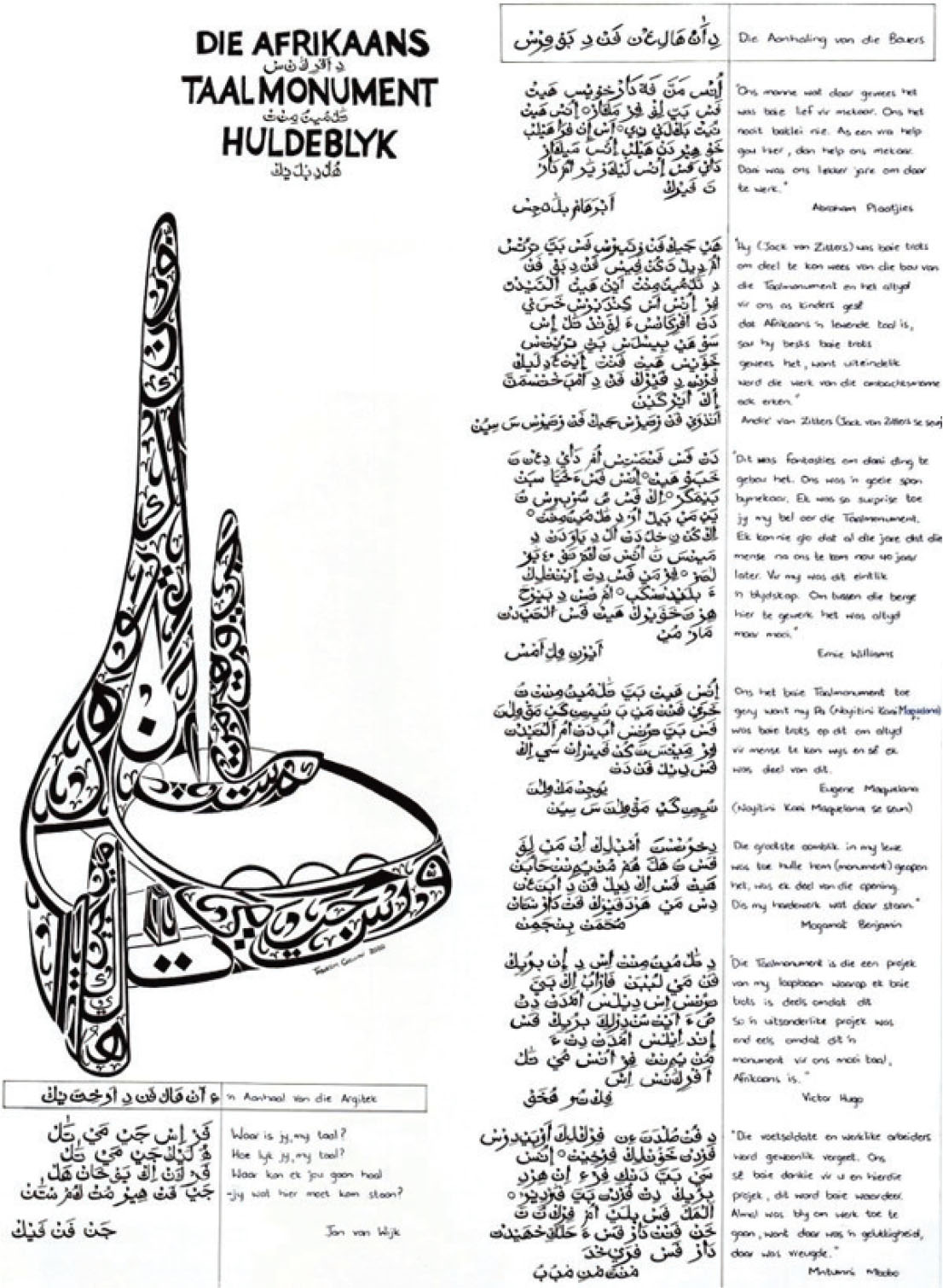
Figure 1:
Die Afrikaans Taalmonument Huldeblyk [The Afrikaans Language Monument Tribute].
4.4. Kaaps, Scientificity and Creolisation – the Second Stryd-perk’s Broader Intellectual Genealogy
As mentioned earlier, the central ideas that would propel the first and second Kaaps stryd-perke were encapsulated in Small’s first formulation of the dialect. However, whereas Small, Gerwel, and Snyders’s positions and arguments were mostly aimed at bringing Kaaps to the fore in broader discourses on Afrikaans that would serve progressive, nonracial values, scholars such Dyers, Willemse, De Vries, Le Cordeur, and Hendricks have over the past decade offered more incisive analysis, discussions, and applied work that has seen Kaaps’s stature gain greater prominence in the realms of both academic study and reallinguistik. Theirs is a search for scientificity – for the refinement of knowledge on Kaaps coupled with informed application, whether it be in the creation of study materials or the restandardization of Afrikaans. As was the case with the cautious, and in some cases openly sceptical, views of many in the first stryd-perk, this second one has, in many ways, been limited by this scientificity, if only in relation to tangible progress in the domain of radical linguistic change. Rather than argue for the promotion of Kaaps from an ideological vantage point, the second stryd-perk is again characterized by an aura of caution; this time due to an emphasis on scientifically sound postulations and theorisations on Kaaps.
Alongside the focus on scientificity is an emphasis on creolisation. By creolisation, I do not refer to an approach to language that views it in relation to race and “race-mixing” (see Neville Alexander’s (2009) critique of the creolisation debate in Afrikaans as a continuation of the colonial and apartheid fixation on race), nor to the use of the word in the purely linguistic sense (see discussions relative to Afrikaans: Ponelis 1993; Conradie 2024; Groenewald 2024; Roberge 2024). In this context, it refers to a continued process of andersmaking [making-different] that, as Willemse (2009) argues, has always-already been present in the South African context, and yet which administrative powers and processes, such as colonial rule and apartheid legislation, tried to inhibit. In this sense, creolisation refers not to ‘race-mixing’ as such, but rather acknowledging the always-already forms of change and transformation that have continued to shape South Africa and its languages, such as Afrikaans, and finding ways to respond to this acknowledgement that led to an “oper, breë kultuur en talige manifestasie” 15. Creolisation can be read as counter to the racialized discourse surrounding Kaaps specifically and Afrikaans more generally under apartheid, but also the latent racialized nationalism of the contemporary moment. Both this focus on scientificity and creolisation can be read as developments of the first stryd-perk’s call for research on Kaaps on the one hand, and its links to nonracialism and BC on the other. Although exhibiting slightly different emphases, the second stryd-perk is clearly a continuation of the first’s general ethos and spirit. And read against this backdrop, the assumptions made within the contemporary moment constitute a radical break from over six decades of scholarship and activism without a clear rationale for why such a break has been proposed and why it ought to be accepted above the arguments proposed within the precursor stryd-perke.
5. Concluding Thoughts
In this article, I set out to draw on Afrikaans and Kaapse Afrikaans language politics to explore the ways in which historical language political memory has been disengaged with in contemporary latent racialized nationalistic discourses. Drawing on Foucault’s archaeological and genealogical frames in relation to historiography and conceptualising stryd-perke as a unit of analysis, my discussion challenges three notions that are prominent in contemporary activist-linguistic work surrounding Kaaps: that Kaaps is a ‘Colored’ language tied to ‘Colored’ identity, that it is an independent language, and that no change has occurred in Afrikaans relative to Kaaps. What an historical analysis of Kaaps language politics – the first stryd-perk of conscientisation and the second of scientificity and creolisation – illustrates is that not only has there been (limited) forms of success in furthering and integrating Kaaps and other non-standardized varieties of Afrikaans (although much more could, and should, be done), but that the discourse on race and Kaaps’s status as a language unto itself, separate from Afrikaans, represents ideas that have been challenged from within the Kaaps variational linguistic community for more than six decades.
These ideas are particularly alarming when the history of Standard-Afrikaans and Afrikaner nationalism, which was a marriage between ideological raciolinguistics, nationalist desire, and mythological impulses, is considered. Against this backdrop, the recent emphasis on ‘Coloredness’ and Kaaps can be see as a direct result of this link between Standard-Afrikaans and Afrikaner nationalism – since, as Jonathan Rosa (2016) argues in one of the earliest pieces on raciolinguistics, standardisation of languages are often entangled with notions of languagelesness for those racialized groups left outside of the standardisation process. Read alongside this insight from Rosa, one could argue the latent racialized nationalism of the contemporary moment could be regarded as merely reflective of a general impulse from racialized groups in the face of raciolinguistic stigmatisation. However, when the longue durée of Kaaps language politics are taken into account, the uncritical adoption of such a nationalistic perspective can be labelled as deeply conservative. Without goin so far as to equate uncritically the contemporary Kaaps discourse and Afrikaner nationalism – an equation that would be both unfair and premature – it is imperative that the pitfalls of Afrikaner nationalism’s discourses on Afrikaans be grappled with as Kaaps develops. Whilst the idea that “Afrikaans is a problem” is one that continues to consume many a linguist and non-linguist alike, if those struggling for Kaaps (a struggle which, as the first and second stryd-perke illustrates, is necessary and which can be just and progressive) does not do so, the consensus a century from now could read: “Kaaps is a problem”.
Acknowledgements
This article is an adaptation of a sub-chapter from my MA (Linguistics) dissertation, titled “Ongehoord: Voices Unaccented; Voices Unharmonized. Afrikaans and South Africa’s First Peoples in Discourses of Higher Education Transformation” (Staphorst 2022). It was completed at Nelson Mandela University under the supervision of Mariana Kriel and co-supervision of Marisa Botha (Rhodes University); and examined by Paul Roberge (University of North Carolina – Chapel Hill) and Andries Coetzee (University of Michigan). Conversations with Hein Willemse (University of Pretoria) and Frank Hendricks (University of the Western Cape) over the past couple of years has had an equally formative influence on the final version of this article. The financial support of the Mandela Rhodes Foundation and South Africa’s National Department of Arts and Culture was further instrumental in completing the degree that formed the basis of this research. The views expressed within this piece nevertheless remain my own.