

Introduction
National identities are deeply impacted by memories of the past. The relationship between collective national identities and historical memories is a powerful force that emotionally, culturally, and politically moves societies. Memory is created and recreated in social institutions, the media, social media, and commemorative events organized by various groups. Among these institutions, the media, particularly the press, play a crucial role in conveying narratives of historical memory in light of current events. In regions marked by a violent and authoritarian past, such as Spain, debates about this past can stir deep wounds that are difficult to heal socially.
Spain’s historical memory is profoundly influenced by its violent civil war in the first half of the 20th century and the subsequent nearly 40-year Francoist dictatorship (1939–1975). This period has significantly shaped the national Spanish identity and the identities of various regions within Spain. Catalonia, in particular, has a strong national identity, but different memories of the same past have led to divergent national identities within the region. This study examines how Spanish and Catalan media discuss historical memory in relation to two contemporary events associated with the Francoist dictatorship: the removal of the monument commemorating the Battle of the Ebro in Tortosa and the transformation of the Via Laietana police station in Barcelona into a memorial site.
Historical Memory, the Press, and Social Media
The concept of historical memory emerged in the mid-20th century (Assmann and Czaplicka 1995; Funkenstein 1989; Halbwachs 2001; Ricoeur 2006) and encompasses the narratives built and shared by social groups about their past. These narratives are constructed through individual and collective processes, linking historical memory to collective identities. Members of the same social group share views of their common past to reinforce present bonds (Assmann and Czaplicka 1995; Giménez 2007). Unlike other types of collective memories, historical memory is often marked by collective trauma (wars, natural catastrophes, political crises) and serves as a tool for society to process and overcome that trauma (Eyerman 2001; Alexander et al. 2004).
Historical memory is continually updated to allow society to use the past to respond to present demands (Wagoner et al. 2019). It is a form of focused consciousness, highlighting past elements relevant to generating political awareness that influences the present and future (Toshchenko 2010). These memories are created and recreated in social institutions, including the media and social media, civic organizations, and government institutions. The press and social media play a central role in the production and reproduction of certain mnemonic discourses.
Reliable and diverse information supports free and informed citizen participation, essential for democratic systems. However, the current fragmented, hybrid, hyper-connected, and fast global media system often leads to unchecked information flows, resulting in disinformation (Chadwick 2017). This poses a problem for democracy, as citizens struggle to discern true from false information, especially on issues connected with collective identities like historical memories (Zelizer 1995 and 2011; Maswood and Rajaram 2019). Disinformation includes fake news and other phenomena, defined by Lazer et al. (2018) as fabricated information mimicking news but using false content without verification. Informational biases can also misinform citizens by presenting only one aspect of an issue, creating a disinformation effect even if the information is not false. Examples include polarization, emotional provocation, identity impersonation, disqualification of opponents, use of false expert opinions, and false balance between opposing opinions (Cook et al. 2017; Roozenbeek and van der Linden 2019; Wang 2020).
Historical memory, like other identity-related elements, develops through interactions between social actors, with citizen participation playing a fundamental role (Zubrzycki and Woźny 2020). In our networked society, many interactions occur on social media like X (formerly Twitter) and Facebook. Networked historical memory is especially vulnerable to disinformation, which negatively affects the plurality of exchanges between citizens. On X, tweets often use tones appealing to both positive and negative emotions rather than reasoned reactions (Duncombe 2019). The lack of filters on X allows users to express themselves freely, often using aggression, contempt, and disqualification as communicative strategies (Borgesius et al. 2016; Interian et al. 2023). This makes memories susceptible to alteration and falsification during their construction, with erroneous elements transmitted within groups. Disinformation in networked interactions can significantly impact memory storytelling networks, risking the democratic quality and diversity of conversations both online and offline.
Several authors have analyzed how historical memory acts in social media. Hilderbrand (2007) examined the democratizing potential of mediated memories on YouTube, concluding that it serves as a “portal of cultural memory.” Makhortykh (2020) compared World War II memories in Russian and Ukrainian YouTube discourses, highlighting YouTube’s role in contrasting past views among different identity groups. Birkner and Donk (2020) analyzed historical memory discourses about Paul von Hindenburg in German Facebook groups, noting the rise of right-wing groups using social media to spread their ideas. Vezjak (2018) studied the growth of fascist tendencies in Slovenia through mentions of Hitler on Facebook. In Spain, Congosto (2018) analyzed the recovery of historical memories on Twitter using the T-hoarder tool, considering the algorithmic functioning of the social media. Nevertheless, studies of such kind are very scarce in Spain, especially those who contrast how conflictive memories in which Spanish national identity is faced to other regional national identities, such as the Catalan or Basque cases.
Objectives of the Study
In Catalonia, a strong national identity rejects much of the Spanish Francoist past, building its democratic discourse in opposition to that dictatorial past. However, parts of the current Catalan political spectrum, especially right-wing parties like the former Convergència i Unió, have links to the Francoist past that emerge in historical memory debates. This study aims to understand how historical memories are constructed conflictingly within the current Catalan political context by analyzing two significant events between 2016 and 2022: the removal of the Battle of the Ebro monument in Tortosa and the transformation of the Via Laietana police station into a memorial site. These events were chosen due to their symbolic importance and the intense public and political debates they generated.
The Battle of the Ebro monument in Tortosa, erected in 1966 to commemorate the Nationalist victory in one of the Spanish Civil War’s bloodiest battles, has been a focal point of controversy. Efforts to remove the monument have faced legal challenges and opposition from groups advocating for its reinterpretation rather than removal. The monument’s presence is seen by many as a glorification of Francoist ideology, making its removal a significant act of historical reckoning (Pongiluppi 2020; Tomàs 2023). On the other hand, the Via Laietana police station in Barcelona, notorious for its use as a site of torture during the Franco regime, is another contentious site. Proposals to transform the police station into a memorial museum have been met with both support and resistance. The building’s conversion is seen as a crucial step in acknowledging and educating the public about the atrocities committed during Franco’s dictatorship. However, the process has been complicated by political disagreements and the building’s current use by Spanish police forces (Ricart 2011; Nofre et al. 2015).
To study these dynamics, we compare the constructions of historical memories in the press and on social media (X). The specific objectives are: (1) to map and analyze the narratives of historical memory generated by the press around these events and understand the disinformation phenomena in them. This involves a detailed content analysis of news articles from various Spanish and Catalan newspapers, focusing on how these narratives are framed and the presence of disinformation. And (2) to analyze the conversations generated on Twitter (now X) around these narratives of Catalan memory. This includes examining the nature of discussions, identifying key actors, and understanding the role of social media in shaping public perception and memory. By addressing these objectives, this study aims to provide new insights into the role of media and social media in constructing and contesting historical memories, contributing to broader debates on historical memory, identity politics, and the impact of disinformation in contemporary society.
Methods
Content Analysis
To fulfill the first specific objective, a content analysis was carried out on press publications from 2016 to 2022. The authors conducted two searches in the MyNews digital archive using the terms in Catalan and Spanish, comisaria Laietana or comissaria Laietana for the first case, and monumento Tortosa or monument Tortosa for the second case, between January 1, 2016, and December 31, 2022. The total number of news pieces retrieved was 434. All three authors read the headlines and first paragraphs and removed 235 pieces that were not related to either of the case studies, and 76 duplicates. As a result, a total of 123 news items related to removing the monument in Tortosa were analysed from the newspapers La Vanguardia, El Punt, Ara, Nació Digital, and ABC. In relation to the Via Laietana police station, 115 news items published in the newspapers Ara, Nació Digital, La Vanguardia, Vilaweb, and El Periódico were analysed. Table 1 shows the distribution of news items among these newspapers and the number of news items. The selection of newspapers followed two criteria: (a) each newspaper held a significant number of news pieces; (b) for each case, there were at least two newspapers edited in Spanish with a Spanish national stance and two edited in Catalan with a Catalan national stance.
Table 1:
Distribution of analyzed news items
| Tortosa | Via Laietana | ||
|---|---|---|---|
| Newspaper | Nº news items | Newspaper | Nº news items |
| El Punt | 34 | Ara | 29 |
| La Vanguardia | 30 | Nació Digital | 26 |
| Nació Digital | 35 | La Vanguardia | 17 |
| ABC | 14 | Vilaweb | 23 |
| Ara | 21 | El Periódico | 20 |
| Total | 134 | Total | 115 |
These 249 news items were analyzed using the same coding book, which includes cartographic variables (type of publication, date, author, etc.), as well as narrative construction (present actors, past actors, events, and thematic axes), framing (frames by Semetko and Valkenburg (2000) and Desrosiers (2012)), and disinformation phenomena. It should be noted that the Semetko and Valkenburg (2000) frames were originally built for understanding the framing of political news but have been widely used in other fields, such as health communication (Ogbodo et al. 2020; Guenther et al. 2021) or environment-related news (Partelow et al. 2020). Table 2 summarizes the coding scheme used. Disinformation strategies are adapted from McKay & Tenove (2021). Data from the content analysis were collected using MS Excel and analyzed both in MS Excel for descriptive analysis and with SPSS for hypothesis tests, mainly ANOVA tests.
Table 2:
Content analysis coding book
| Variable | Category | Code |
|---|---|---|
| Mapping | Newspaper | |
| Year of publication | 2016; 2017; 2018; 2019; 2020; 2021; 2021 | |
| Author | ||
| Visual resources | Images; photographs; illustrations; graphics; tables; infographics; social networks insights | |
| Narrative | Actors | Past; present |
| Events | Past; present | |
| Thematic axes | Political; social; historical; cultural; economic | |
| Framing | Semetko and Valkenburg (2000) | Responsibility; human interest; conflict; economic consequences; morality |
| Desrosiers (2012) | Counter-framing; severity; injustice; adversarial | |
| Mentions of “memory” | N mentions | |
| Disinformation | Strategies | False balance; false expert; discredit |
| Fallacies | Conspiracy; emotional provocation; polarization; impersonation |
Social Network Analysis
To analyze Twitter conversations related to the second specific objective, all tweets from 2015 to 2022 containing combinations of the terms in Catalan and Spanish—comisaria Laietana or comissaria Laietana, and monumento Tortosa or monument Tortosa—were downloaded using Twitter’s Academic API. These tweets were then analyzed with the T-Hoarder tool (Congosto et al. 2017), which facilitates graphing conversations on the social network by generating nodes for tweets that receive significant attention. Each retweet is represented by a line connecting the author of the original tweet to the retweeting user. When a tweet garners a large number of retweets, it forms a node. The tool visualizes the network by attracting or repelling nodes based on the proximity of retweet sources. This functionality allows T-Hoarder to process and analyze a large volume of tweets, enabling the study of polarization dynamics and filter bubbles around specific topics. In addition to mapping connections between profiles, the tool identifies conversation communities, which consist of profiles that frequently retweet one another. Each community is assigned a distinct color and a leader profile, whose username is indicated. The resulting graph depicts the major conversational communities, highlighting the nodes that interact most frequently.
Results
Content Analysis
The frequency of publications for each event analyzed was irregular over the years studied, as can be seen in Figure 1. The analysis of the press reporting on the two historical events revealed different publication dynamics. In the case of removing the Francoist monument in Tortosa (Figure 1A), it can be seen that the publication peaks partially correspond to the political changes in Catalan society during those years. They are especially related to a change in hegemony in the political space of parties in favor of Catalan independence from Spain, from the political party Junts towards Esquerra Republicana de Catalunya (regional elections of 2017 vs. elections in 2021). The publication dynamic of news items on the transformation of the Via Laietana police station does not have such a clear parallel relationship with the dynamics of Catalan regional politics as it was an initiative promoted by the Barcelona City Council. However, there is a peak in 2019, which was the year of the local elections.
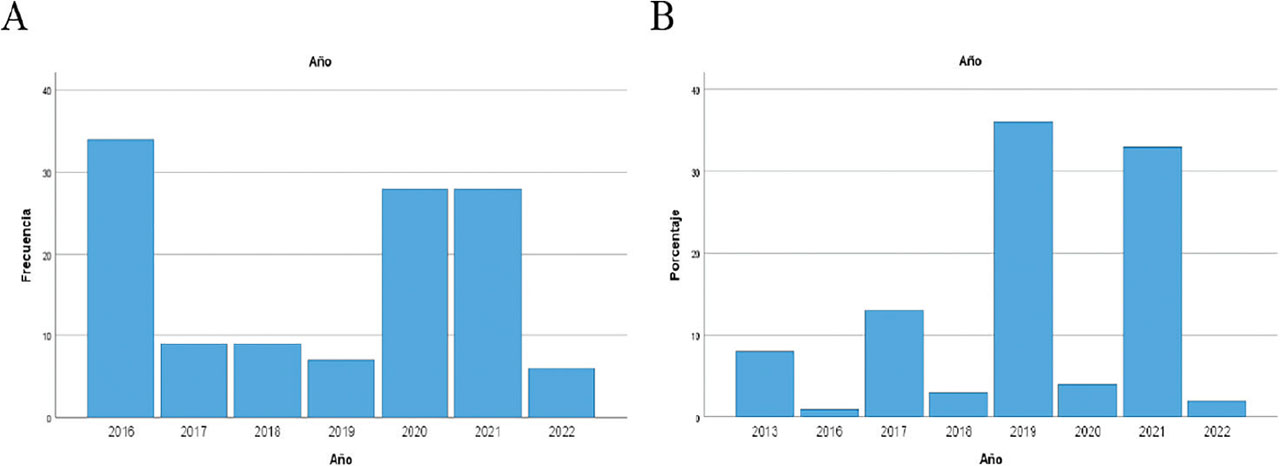
Figure 1:
Distribution over time of the news items about the two events: (a) the withdrawal of the Francoist monument in Tortosa, and (b) the project to transform the Via Laietana police station into a memorial site.
The analysis of the actors in the narratives (see Figure 2) shows that in both events, political actors play the central role over social actors. This indicates that the main driving force behind the construction of historical memory narratives is politics and political party interests, relegating memorial and civil organizations to secondary roles. In the debate on the Tortosa monument, the actors mentioned most frequently are the Tortosa City Council and political parties. In the case of the transformation of the Via Laietana police station, the actors mentioned most frequently are, once again, the political parties, followed by the Barcelona City Council.
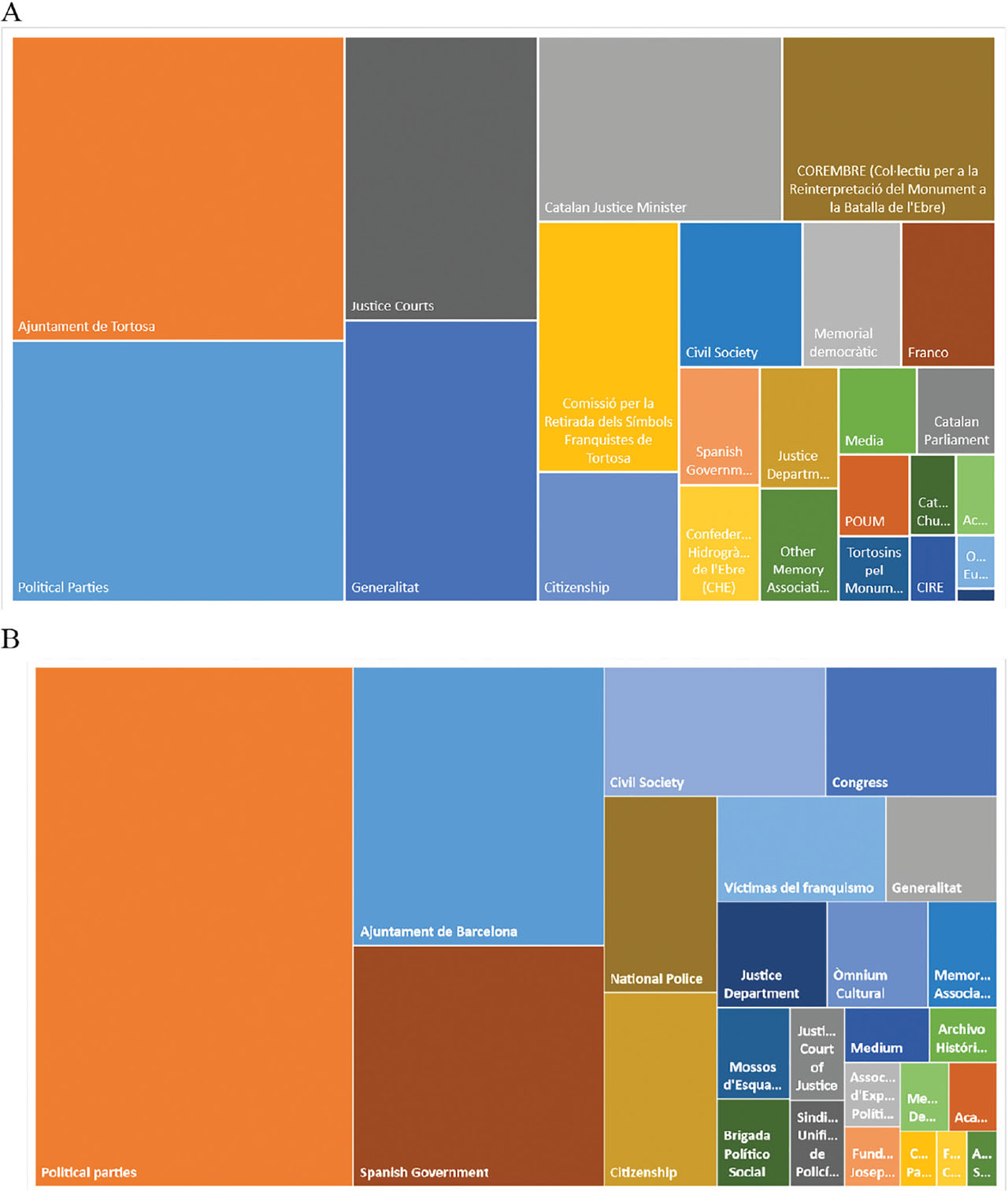
Figure 2:
Actors mentioned in the news items: (a) the withdrawal of the Francoist monument in Tortosa, and (b) the project to transform the Via Laietana police station into a memorial site.
The framing analysis revealed interesting information in the frames of Semetko and Valkenburg (Table 3 and 4). Nevertheless, frames of Desrosiers were very infrequent and did not provide meaningful results (data not shown). In both events, it can be seen how the framing of the economic consequences is not present between 2016 and 2020 but then suddenly appears in 2020 concerning the Tortosa monument and in 2021 concerning the Via Laietana police station, in both cases in a statistically significant way in ANOVA tests. This suggests that the debate on historical memory for the two events had not considered the economic consequences of the transformations required until 2020 and 2021, when this aspect became abruptly important. This may correspond, in the case of Tortosa, to the change in the hegemony of the political parties that support Catalan independence, from Junts to ERC in the Generalitat (Autonomous Government of Catalonia) and the City of Tortosa. In the case of Via Laietana, it could correspond to criticisms of the actions of the Barcelona City Council in national policy after the revalidation of the decisions made by Ada Colau (the then mayor of Barcelona).
Table 3:
Frames of Smetko and Valkenburg in relation to the debate on the Francoist monument in Tortosa
| Year | Responsibility | Human interest | Conflict | Morality | Economic consequences |
|---|---|---|---|---|---|
| 2016 | 0.35 | 0.00 | 0.30 | 0.00 | 0.00 |
| 2017 | 0.44 | 0.07 | 0.33 | 0.00 | 0.00 |
| 2018 | 0.44 | 0.02 | 0.18 | 0.00 | 0.00 |
| 2019 | 0.57 | 0.00 | 0.38 | 0.00 | 0.00 |
| 2020 | 0.39 | 0.01 | 0.39 | 0.00 | 0.12 |
| 2021 | 0.38 | 0.00 | 0.40 | 0.00 | 0.03 |
| 2022 | 0.50 | 0.00 | 0.27 | 0.00 | 0.00 |
| p-value | 0.04* | 0.207 | 0.859 | - | 0.001* |
Table 4:
Frames of Smetko and Valkenburg in relation to the transformation of the Via Laietana police station into a memorial site
| Year | Responsibility | Human interest | Conflict | Morality | Economic consequences |
|---|---|---|---|---|---|
| 2016 | 0.5 | 0.00 | 0.00 | 0.00 | 0.00 |
| 2017 | 0.54 | 0.00 | 0.05 | 0.00 | 0.00 |
| 2018 | 0.17 | 0.33 | 0.33 | 0.02 | 0.00 |
| 2019 | 0.52 | 0.21 | 0.39 | 0.00 | 0.00 |
| 2020 | 0.75 | 0.05 | 0.25 | 0.00 | 0.00 |
| 2021 | 0.38 | 0.10 | 0.31 | 0.00 | 0.05 |
| 2022 | 0.25 | 0.20 | 0.00 | 0.00 | 0.33 |
| p-value | 0.092 | 0.04* | 0.105 | 0.974 | 0.05* |
However, we find significant differences between the construction of the frames in the two events in the ANOVA tests. In the case of the Francoist monument of Tortosa, it can be seen how the frame of attributing responsibility increases significantly in 2019 and 2022, which were election years. In the case of the Via Laietana police station, the most significant frame is of human interest, especially in 2019, the year of local elections. The two results confirm that these two transformations have a high political profile that follows the electoral calendars rather than the groups and associations of historical memory that worked on these events.
Conversational Analysis on Twitter
To fulfill the second specific objective, we analyzed the tweets involved in the two conversations (about turning the Via Laietana police station into a memorial site, and the removal of the monument commemorating the Battle of the Ebro in Tortosa) with the T-hoarder tool. Figures 3 and 4 show the analysis of these two conversations.
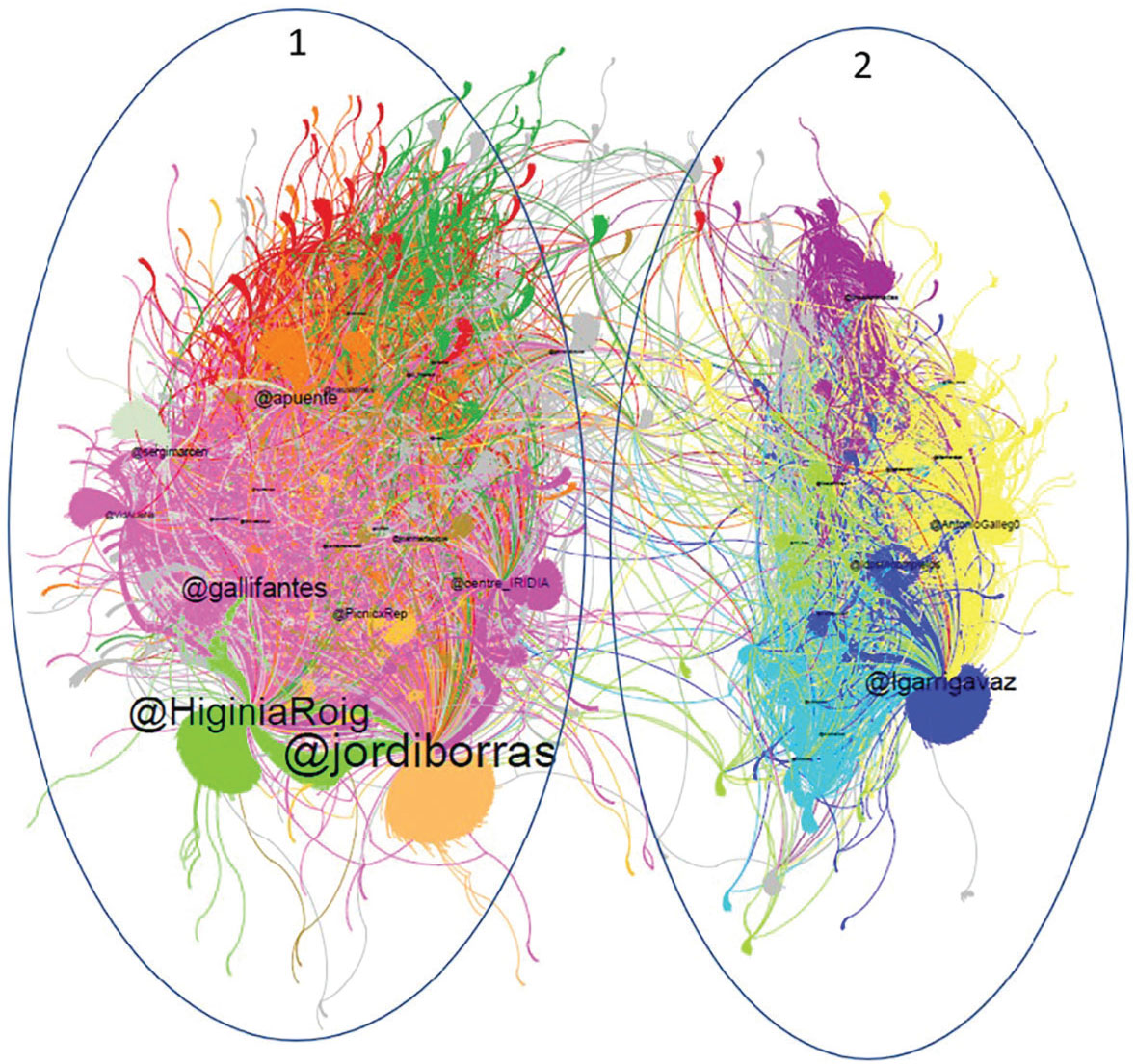
Figure 3:
Conversation on Twitter from 2015 to 2022 about turning the Via Laietana police station into a memorial site. Two main communities are detected: (1) in favor of Catalan independence; (2) against Catalan independence, active politicians from right-wing parties.
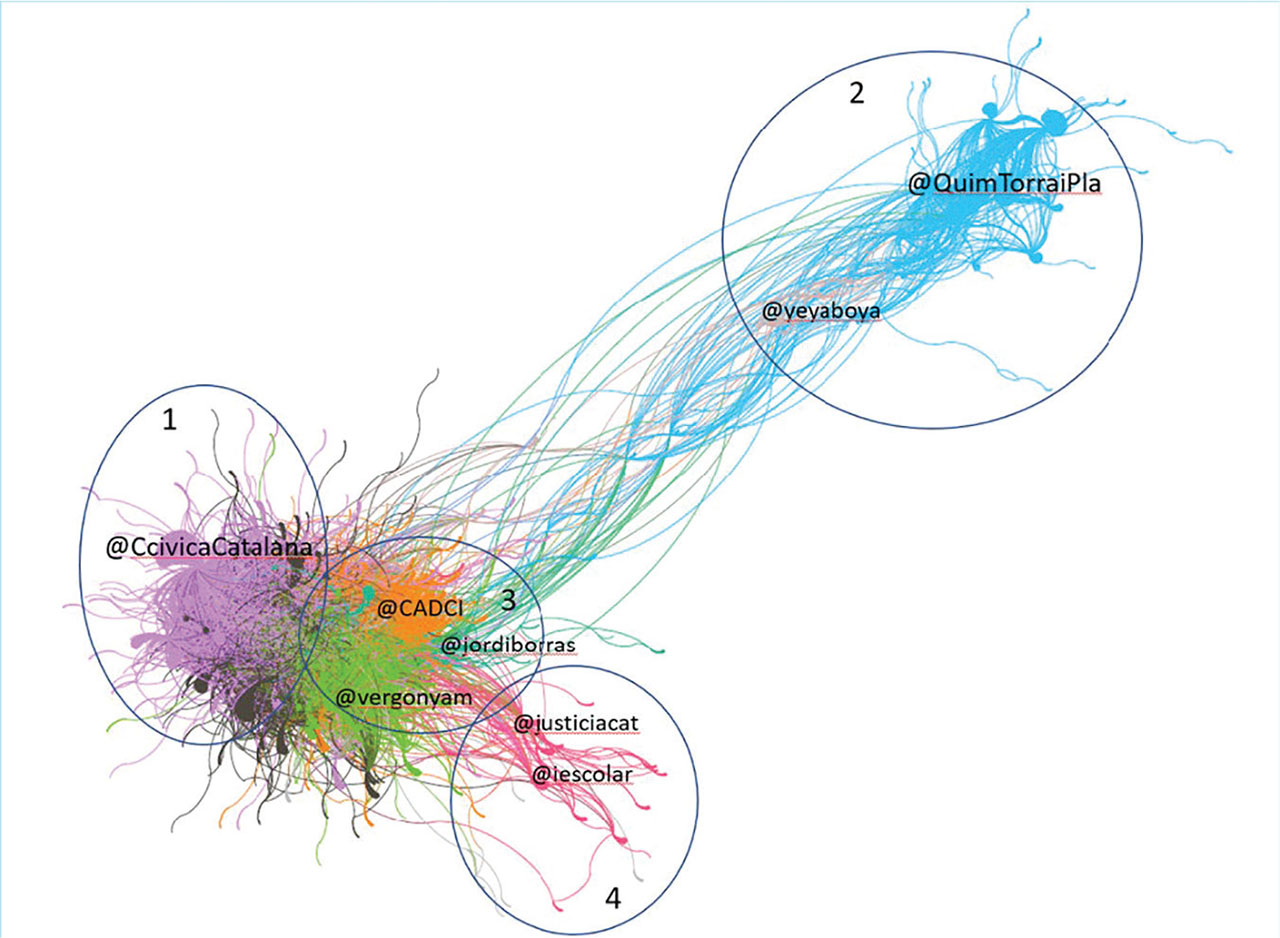
Figure 4:
Conversation on Twitter from 2015 to 2022 about the removal of the monument commemorating the Battle of the Ebro in Tortosa. Four communities are detected: (1) opposed to Catalan Independence; (2) in favor of Catalan independence, active politicians; (3) in favor of Catalan independence, civil society; (4) others without a fixed position.
Figure 3 represents the conversation around the conversion of the Via Laietana police station into a memorial site. The resulting graph shows 11 communities grouped into two large conversation communities that interact very little with each other. Based on the analysis of the leading nodes, it can be seen that these communities are grouped around two positions: those in favor of Catalan independence, with very little presence of active politicians, and those opposed to Catalan independence, with several active politicians involved, such as Ignacio Garriga of the political party VOX and Inés Arrimadas of Ciudadanos. These two communities have great internal coherence (the profiles contained within each conversation community retweet a lot with each other), but almost no interrelation. This shows that there are two clearly differentiated filter bubbles that do not relate to each other. Therefore, it is a clear example of a strongly polarized conversation.
Figure 4 shows the conversation on Twitter around the removal of the monument commemorating the Battle of the Ebro in Tortosa. The graph shows nine communities grouped into four conversation communities: (1) those opposed to Catalan independence; (2) those in favor of Catalan independence and who are active politicians, such as Quim Torra i Pla and Mireia Boye; (3) those in favor of Catalan independence and who are civil society organizations; and (4) others who do not have a fixed position, such as the official profile of the Department of Justice or the director of eldiario.es, Ignacio Escolar. Unlike the previous case, communities 1 and 3 interact a lot with each other, and given the proximity of the two communities in the graph, it seems that there is an intense debate between them. However, community 2, composed almost exclusively of the former President of the Generalitat, Quim Torra, does not attract either of the two conversations towards him, showing that he had little influence on the conversation. Finally, the group of other profiles shows a community that is separated a little from 1 and 3, but which has some interaction with them.
Conclusions and Discussion
The analysis performed by this study has shown how memory-related events are framed in the press and on X (formerly Twitter) in a context highly influenced by contested national identities, such as the Catalan context. Regarding the two specific events analyzed in the study (i.e., the removal of the Francoist monument in Tortosa and the transformation of the Via Laietana police station), the content analysis revealed that the main actors portrayed by the media were political actors (such as political parties) and judicial actors. In contrast, social actors such as associations and entities were much less represented. Both events were mainly framed under the economic frame related to electoral interest rather than historical interest. On X (formerly Twitter), both conversations were much more driven by political actors than by history-related actors. The echo chambers generated on X (formerly Twitter) for both case studies responded to political and electoral battles more than to history or memory discussions.
These results indicate that memory construction in the Catalan context is mediated by political discourse rather than historical evidence. Memory associations and entities should pay more attention to how the press and social media are modeling and framing historical discussions that inform collective identities. Recent history and contemporary political phenomena are linked (Jelin 2013). Although processes of constructing historical memory may refer to events that are distant in time, they bring about problems and social divisions, showing that they have a present dimension (Guixé and Coromines 2016). Above all, they follow the dynamics of political life. This has been demonstrated with the content analysis of more than 250 news items published between 2016 and 2022 in relation to the two studied events. This analysis has shown that narratives of historical memory, in a context such as Catalonia, which is strongly marked by a struggle in historical memory against the hegemonic narrative of Spain, are also dominated by the predominance of a struggle between political parties. Thus, the most cited actors in the news items are political actors, and the frequency of publication corresponds to the electoral calendars. Additionally, the news items are framed with the frames that dominate the political debate and not the historical debate, and therefore, they serve political objectives rather than those of memorial collectives and associations.
The conversational analyses of X (formerly Twitter), especially in relation to the Via Laietana police station, clearly illustrate how processes of recovering historical memory fragment, polarize and limit dialogue between opposing positions. The Barcelona City Council’s initiative to generate new memorial sites shows that, at least in the X (formerly Twitter) community, there is debate among members of related communities, but little dialogue between opposing communities. These results could be explained, in part, by the fact that schools do very little work on historical memory, neither in Spain (Barreiro Mariño 2017; Díez Gutiérrez 2020) nor in Catalonia (Sáez-Rosenkranz et al. 2021). Moreover, the findings highlight the necessity of working on memory from pedagogies in both school and non-school environments (Sacavino 2015). Research into the debate from extreme positions is another aspect of the limited pedagogical work done on historical memory (Jelin 2013; Sacavino 2015).
A similar situation, but with a certain nuance, occurs with the removal of the monument in Tortosa. In this case, there is also a polarization of positions; however, we observe a dialogue between the opposing positions as well. It is interesting that, being a policy of “forgetting,” it promotes more conversations, at least on X (formerly Twitter), between people with similar and contrary positions, and even neutral positions (institutional ones) appear. Ideas then emerge about the role of forgetting and how historical memory policies based on this dimension promote more intense dialogues than those of generating memorial sites.
The level of dialogue and communication before the two phenomena studied is symptomatic of an issue that had already been detected at the level of historical memory pedagogies in Catalonia (Sáez-Rosenkranz et al. 2021). Future teachers (and, by extension, adult society) strongly link historical memory with the Civil War and, to a lesser extent, with Francoism. The memory processes associated with the Civil War, such as the Tortosa monument (in this case, related to policies of forgetting), generate more dialogue between opposing positions than the creation of memorial sites from the Franco regime, which isolates debates. In this sense, although more in-depth research is necessary, it can be said that memory processes that are not consensual, such as memory processes at the social level, are more problematic and generate less dialogue than those linked to processes commonly connected with historical memory.
Additionally, another problem that memory studies have detected is evident from these results. In the case of Catalonia, historical memory is closely related to the position with respect to Catalan independence, as if it were the same voice. The pro-independence positions lean towards generating memorial sites and destroying Francoist memorial spaces, while the positions opposed to independence are aligned in the opposite direction. The contemporaneity of political debates with tints of historical memory is one of the significant problems associated with the processes of generating and working with historical memory (Guixé and Coromines 2016), which is challenging in the Spanish case (Barreiro Mariño 2017). Our results reinforce and highlight that it is very necessary to work on historical memory both in the classroom and at the social level based on pedagogies, so that processes of construction and reconstruction can emerge in democratic societies.