A Conceptual Model for Xieshang minzhu in the Chinese Context
The contemporary political study mainly involves formal ontological engagement, and it sometimes lacks semantic clarity. Ontologies, to some extent, are static, but with a limited role in reasoning about domains in which change matters,2 especially facing a divided society with different political status quo, including language, culture, history, and so on, which usually presents multilingual polities. In particular, linguistic barriers are thought to pose obstacles to politics (Doerr Nicole, 2012), and they can also cause problems in democratic inclusion in linguistically pluralist polities.3 Thus, for a political term, it first comes to the semantic and linguistic lens and then travels to the conceptual (Mulieri, 2016), thus, for the “conceptual analysis,” it should function as the speech-acts that belong to ordinary life as a way of “exercise in language philosophy.”4 Its interpretations depend on the specific historical, social, and political contexts rooted in different linguistic experiences (Koselleck, 1979), which are simultaneously subject to continuous change. This means that the first effort that we should pursue in analyzing the concepts is to look at how a given word has been associated with different meanings based on a certain language. Thus, to the case of deliberation, it is not a concept fixed by its identical object nor is it the name of a thing, but it is rather a semantic and collocation expression5 that we can handle in different ways, according to the sense that it can take within a determined context.
The variety of the semantic differences for the notion of deliberation is perhaps easier to articulate in those languages in which the different meanings correspond to different words. The semantic richness can be somehow regarded as a conceptual stretching of deliberation (Jürg Steiner, 2008; David Austen-smith and Timothy J. Feddersen, 2008). Thus, the deliberation per se should go beyond the standard understanding in political science and look for new theoretical models to deal with the emerging rise of transnational and polysemic of politics. This gap, which is especially highlighted among nations, is still fraught with linguistic and conceptual misunderstandings. For example, the mainstream Chinese discourse tends to describe China as an undemocratic state, thus leaving no room for deliberation, even though this view does not exist in China itself. China’s authoritative definition of Xieshang minzhu is as follows:
Xieshang minzhu in China is an important form of democracy under the leadership of Chinese Commubist Party (CCP) in which various sectors of the people conduct extensive consultation before and during the implementation of policy decisions on major issues concerning reform, development and stability, as well as practical issues concerning the vital interests of the people with the effort of forming the consensus.6
In China, the concept of Xieshang minzhu is derived from the speech of “three norms of democracy” that was made by Habermas in China in 2001. In line with the political consultation system in China, this overlapped and coupled at the time and immediately caused great interest from domestic scholars (Sun Dehai and Fang Shinan, 2015), with abundant academia achievements on the discourse. Thus, the mainstream in China holds the view that “China now, gradually formed China’s ‘indigenous consultative democracy discourse system,’ and therefore, finally entered the ideological discourse system of the CCP and state.”7 Nevertheless, our main contribution in this article is not to review the mass academia literature because they are sometimes discrepant with current policies, but instead, we aim to make an official discourse analysis. The second section of this article introduces the overall methodology and it will establish the corpus. The last section analyzes the official discourse of Xieshang minzhu in the Chinese context, and it is probably the best-fit form during the democratic transition (if any) and political reform in China.
Key Differences Between Anglo-Saxon Literature and Chinese Indigenized Scholarship of Deliberative Democracy
To date, the Anglo-Saxon literature of deliberation largely excludes the experiences of (quasi)-Xieshang in China, that is, another different setting that attempts to reconcile deliberation within an authoritarian regime. In this article, although the authors try to adopt a fresh non-Western perspective for further analysis, we still try to highlight the authentic context of China’s Xieshang minzhu by indicating the intrinsic differences between China and the West on deliberation and fill this void calling for a renewed attention to the indigenization of the local political studies and also for the better understanding the Chinese governance in non-Western societies.
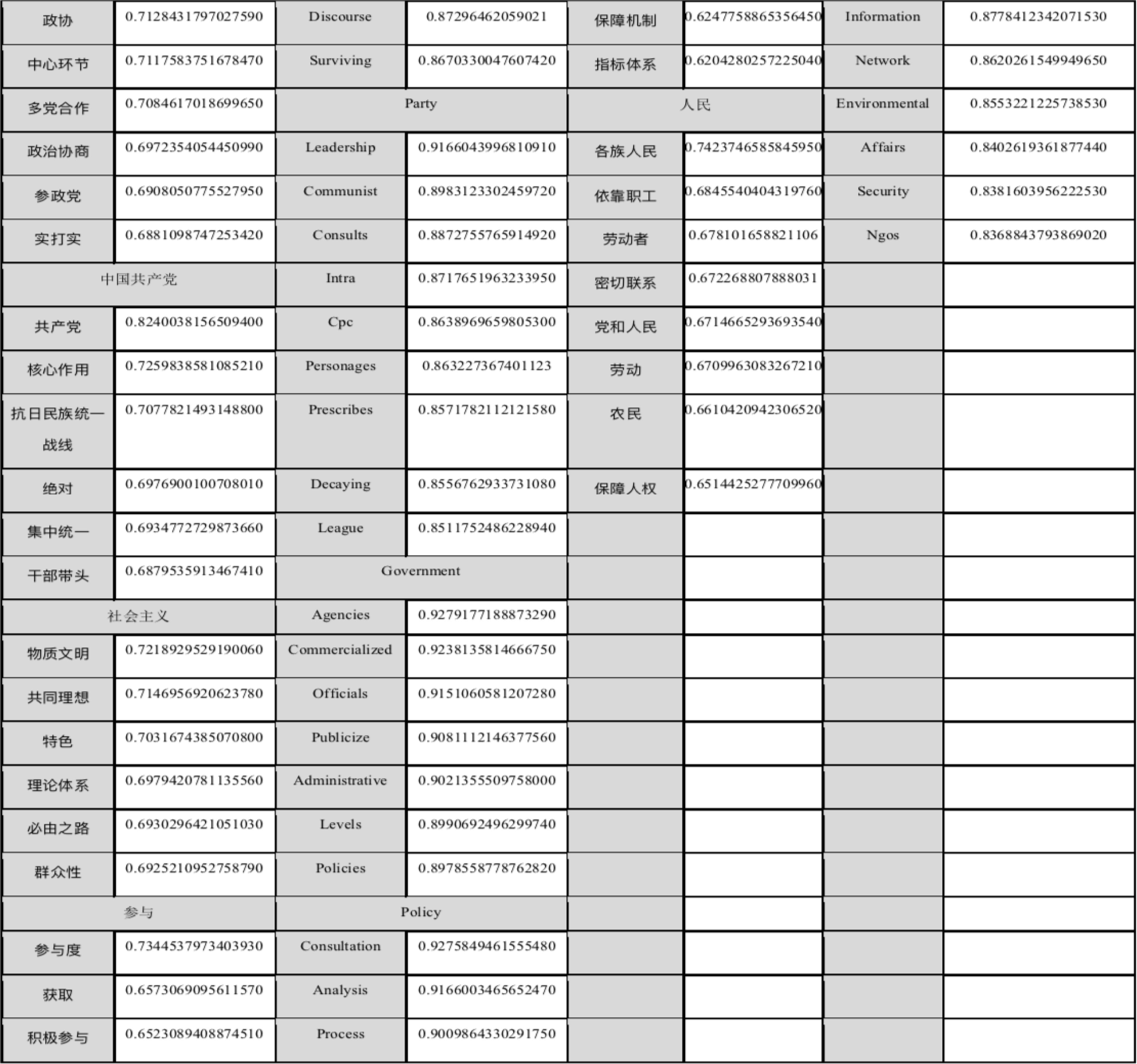
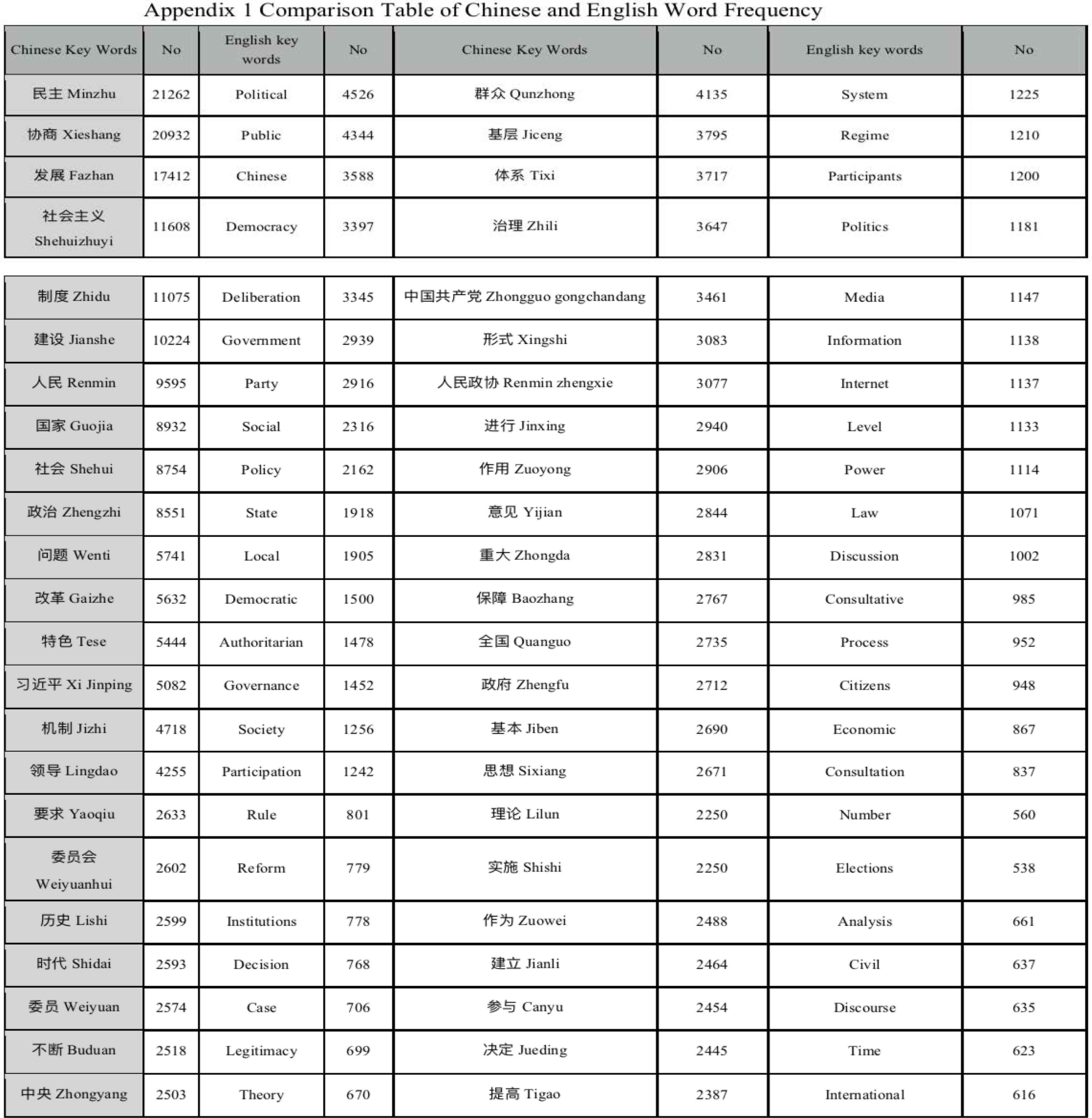
Traditional politics assumes a strong affiliation between deliberation and democracy, but the “authoritarian deliberation” coined by He Baogang (2012) strongly indicates the coexistence of authoritarianism and deliberation in a nondemocratic state (with 20,932/13.1% of “deliberation” and 1,478/5.7% of “authoritarian”: in English, it is 0.89% as the high-frequency words, see Appendix 1). Nevertheless, the criticisms were also crucial; for example, Leib (2005) stated that “we were ready to call almost any participatory institution seemed too generous, given that this participation was occurring within a country without the most basic of democratic indicia: competitive elections on the national level and basic liberal rights.”8Chart 1 and Appendix 1 indicate a quite large promotion with “party (with the correlated words like ‘monopoly’ (0.79), ‘dominate’ (0.76), ‘control’ (0.74), ‘leadership’ (0.71))” and ‘state’ (0.92), ‘regime’ (0.98) share 24.2% totally while democracy only share 13.10%. In addition, the debate between Jürg Steiner (2008)9 and David Austen-Smith et al. (2008) about the concept stretching for deliberation, which also showed the concern about the misunderstanding and misinterpretation for deliberative democracy, both theoretically and practically, in China.
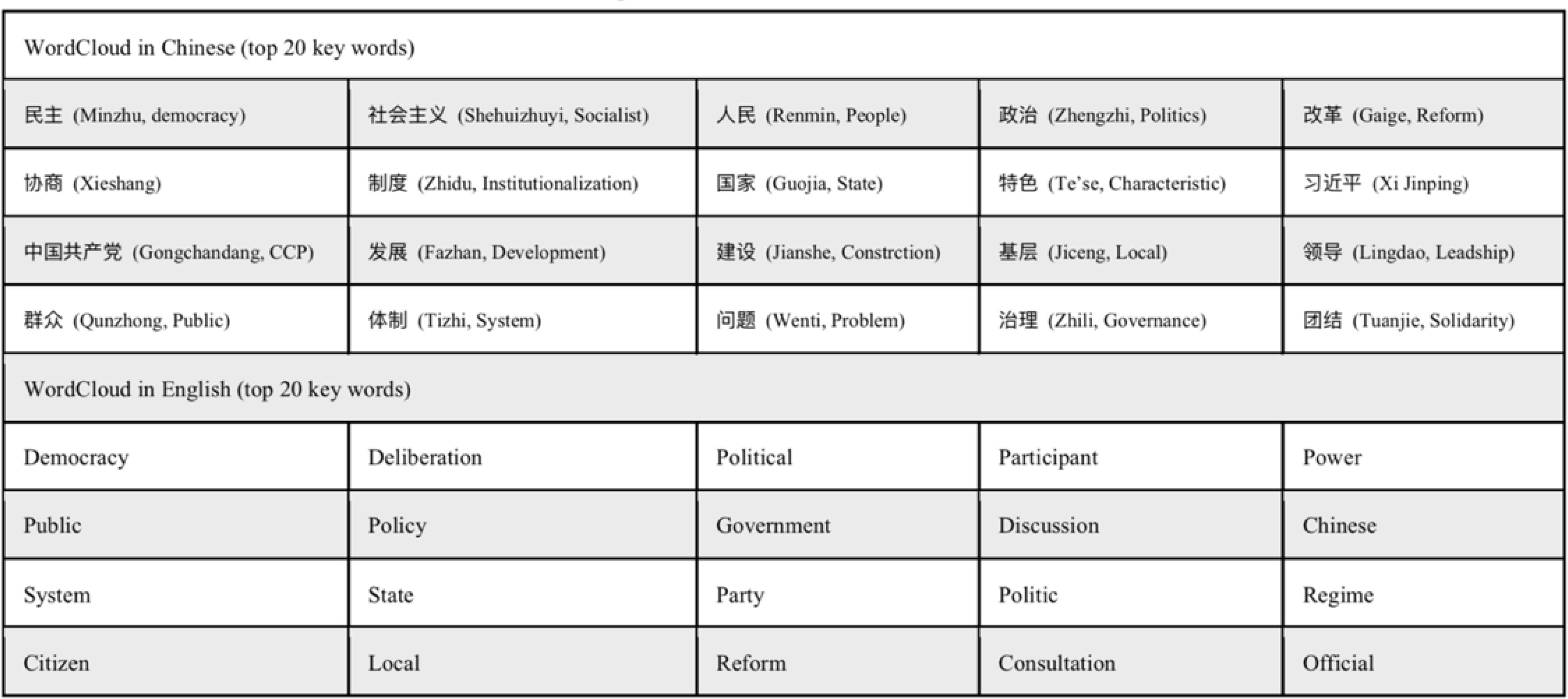
Chart 1
WordCloud in Chinese and English
Note: Based the WordCloud, the differences that in the main keywords of the built Chinese and English corpus can be intuitively reflected, but the primary and secondary relationship of specific keywords cannot be examined for the moment. So, we set up a diagram in the top 20 words to reflect the primary and secondary relationship of keywords.
An authoritarian deliberation is both logically possible and empirically real.10 In the new formulation proposed by He, he continues to defend the ideas with various arguments in the last few years. The objectively raison d’etre of Xieshang or Xieshang minzhu in China that distinguishes with the Western discourse is largely due to its functional orientation, namely Xieshang minzhu in China, which is the instrumental existence, that is “problem-oriented” (Wenti 5741 in Chinese). This is in line with the typical pragmatism in Chinese politics, that “for reducing social conflicts and the level of opposition, and facilitating compliance with and implementation of state policy, also, it can be an effective decision-making process, being an effective conflict-resolution device, and a means to overcome polarization” (He Baogang, 2016). First, authoritarian deliberation may merely exist in Chinese local governance, which is traceable especially in the coastal areas in China in recent years. The so-called deliberative experiments (e.g. Zhejiang Wenling, Shanghai, etc.) are far from generalizing the panorama of Xieshang minzhu in China. Including the inter-party consultations advocated by CCP, the Chinese People’s Political Consultative Conference (CPPCC) consultations centrally are merely formalistic. In addition, He thinks that the theoretical and practical tensions between deliberation and authoritarianism can hopefully be transformed into a driving force toward democracy (He, 2012, 2016).
The debate on deliberative democracy in Western academia views that liberal (representative) democracy is the foundation of deliberative democracy with electoral and competitive politics. However, it is acknowledged that competitive elections might inhibit genuine deliberation. Nevertheless, genuine democratic deliberation must be structured accordingly to elections, which are lacking in China. However, the local experiments that have even adopted high-technique methods still fail to be sufficiently deliberative and to be sufficiently representative (He, 2016). Against this background, Western theorists firmly stress the important role of a public sphere and civil society in developing deliberative democracy. Habermas (1994) and Dryzek (1990) stated that “[I]t can flourish only by creating, operating within, and confronting the state from an autonomous public sphere,” but these key factors may be problematic in the Chinese political context under a powerful state and monopoly party (as we mentioned before, the state-sponsored/official-background deliberative activities are quite narrow and limited within the authoritarian control), even with the hint that lack of active involvement of civil society and may, therefore, pensively lead to the authoritarian deliberation in China, but the hope is slim and unclear.
To date, based on the keywords distribution and proportion in Chinese and English in Chart 2 indicate, the key differences between the two lie essentially in the different polity that it relies on, namely liberal (representative) democracy and socialist democracy, that further shaped the different civil society (that with the key democratic elements within, such as freedom of speech, association, NGOs, etc.), as well as the manifold comprehension of the function toward deliberation. That is, Xieshang or Xieshang minzhu in China is largely affiliated to the conflict-resolution (see Appendix 1 with the high-frequency keywords like the noun “problem”>5,000, verb like “governance,” “solve,” “deal with”>4,000) mechanisms with the nature of instrumentality or somehow transition for further democracy. But in liberal (representative) democracy, being a form of democracy, it is the authentic “talk” among the public, at least ideally. These differences appeared in the charts with high-frequency vocabulary, which summed up as socialist deliberative democracy with Chinese characteristics (>29,200) and can also be found with vast differences through a comparison between Western and China based on a rustic view of democracy. Thus, this part is not for the sake of distinguishing the relative merits in either party but, also in the third part, to demonstrate how Xieshang minzhu is embedded in Chinese politics in its way.
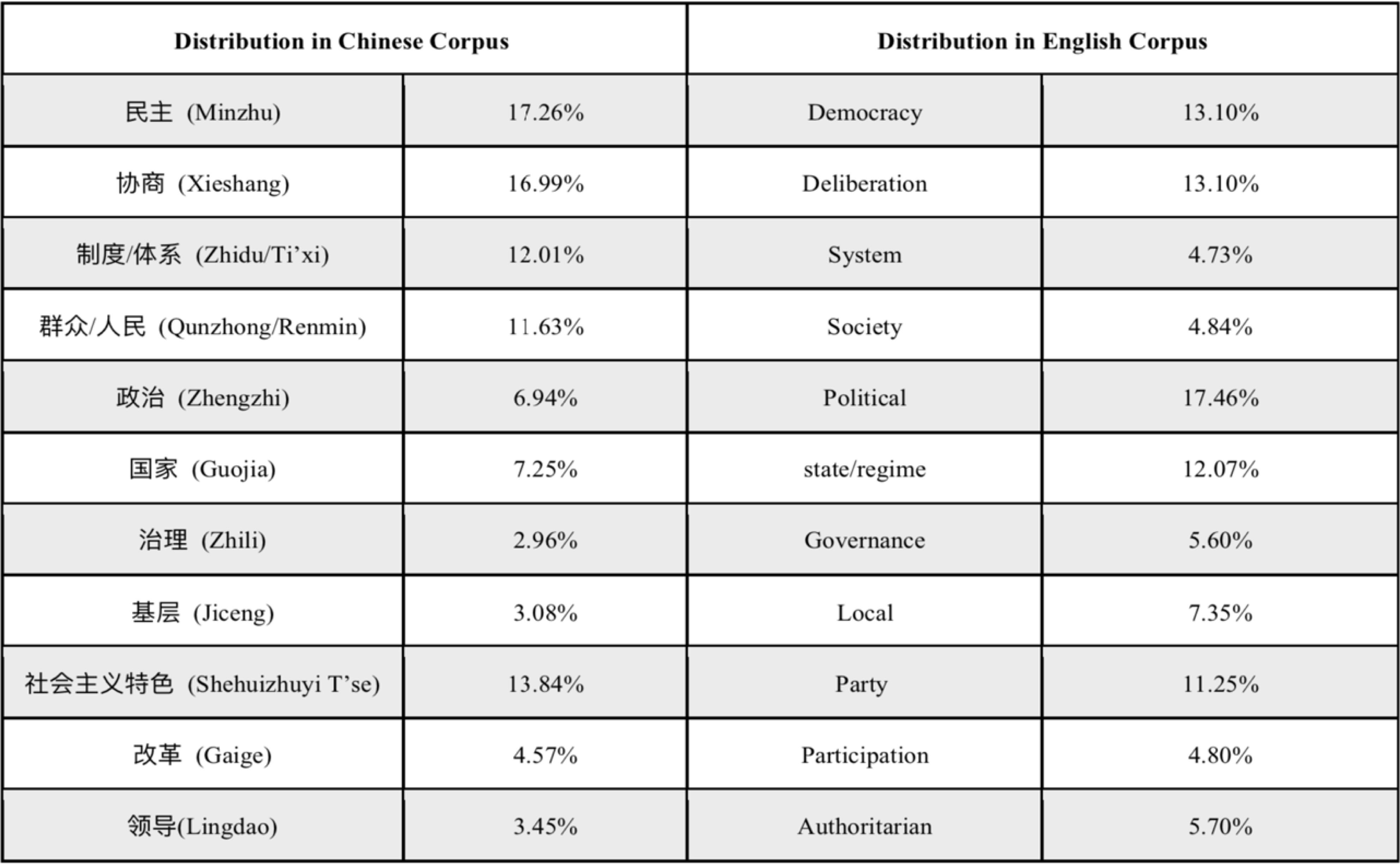
Chart 2
Keywords Distribution in Corpus
Methodologies and Corpus Establishment
Foundation of the Acquire Documents
The textual analysis is based on a database that was established on the official propaganda after the 18th NPC (2013), which, for the first time, officially adopted Xieshang minzhu. Our data sources are originally derived from the official databases with the title=“Xieshang minzhu (协商 民主)” or keywords=“Xieshang minzhu” with a total of 2,018 items11 through advanced (fuzzy) search.12 Although the authors did not sort the data before 2013, clearly, before the 18th National Congress, the official interpretation of Xieshang minzhu was not systematically engaged; notably, it was mainly conducted by scholars within the academia discussion. In contrast, after the 18th National Congress, academic discussion and official propaganda increased positively. Three main axes will be involved from an official perspective, as follows: I. official propaganda (newspapers); II. leaders’ speeches, especially Xi Jinping’s discourses on Xieshang minzhu; and III. official documents related.
The five most authoritative official media (newspapers) in China13 are the People’s Daily (Renmin ribao 人民日报) for 458 reports, Guangming Daily (Guangming ribao 光明日报) for 560 reports, Xinhua Daily(Xinhua ribao 新华日报 447 reports), China Comment (Bnayutan 半月谈 320 reports), Qiushi (Qiushi 求是 37 reports, formerly known as Red Flag (Hongqi 红旗 86 reports)).
The top leaders’ series of important speech databases with 95 items.14
Official documents on the subject of Xieshang or Xieshang minzhu in the Party-Building Database with 15 items.15
Although the antitheses between China and the West are not the focus of this article, we still carried out a rhetorical and semantic analysis of the Chinese indigenous studies with the English literature by establishing a database on deliberative democracy (the elucidation in the first part is a mirror case). Given that the Western literature of Xieshang minzhu does not appear in Pinyin, the keywords are “deliberative democracy,” or “deliberation,” or “consultation.” The main source of the database comes from the Bibcnrs16 and Google Scholar, with 124 articles (including overlap) related to the topic and processed in the same way.
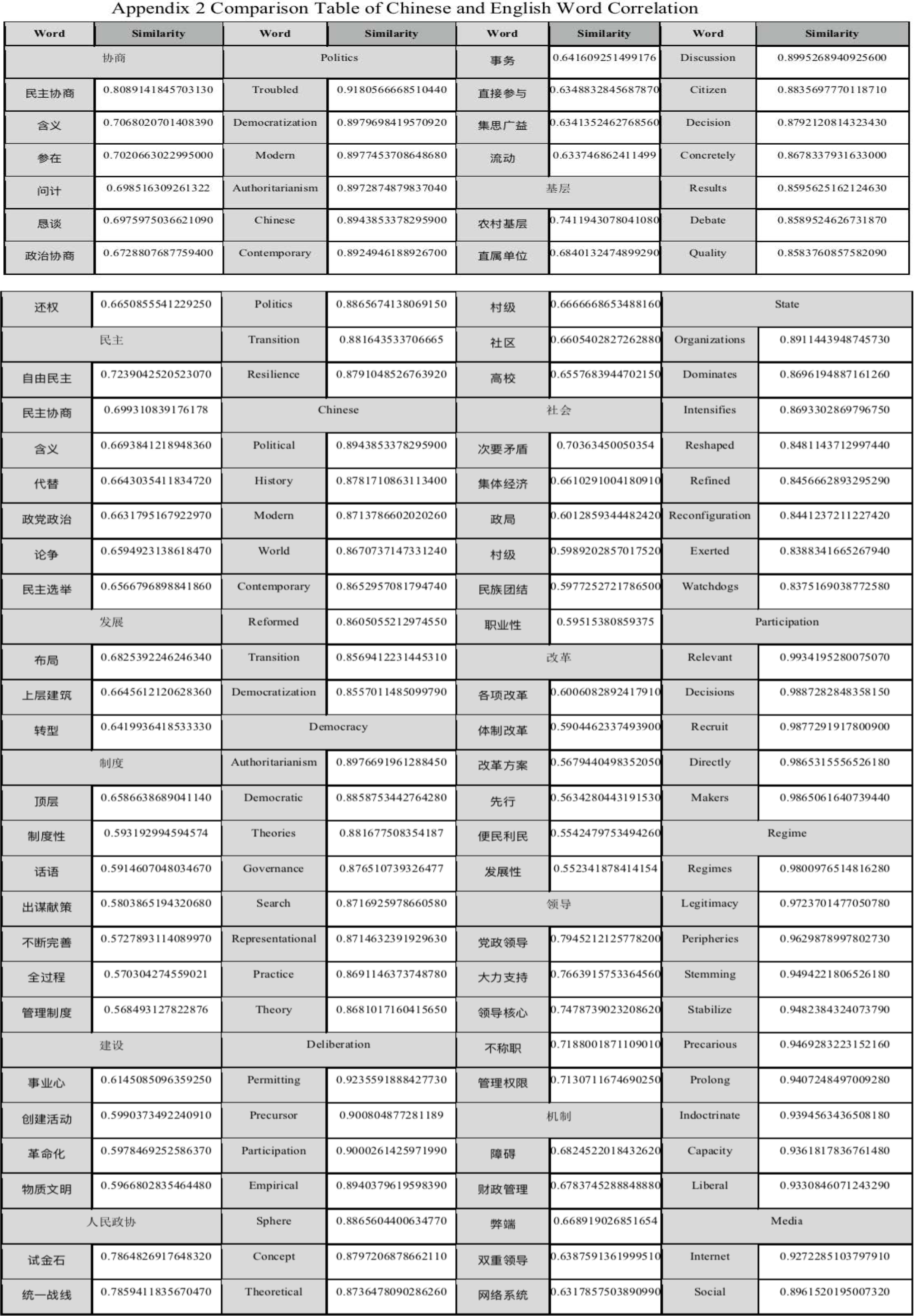
The first two steps set the foundation for the semantic analysis, but there are far more underlying concepts and metaphors behind the propaganda. Thus, Appendix 1 gives a further keyword correlation analysis to avoid overfitting by focusing on out of sample prediction and selects the best model for the underlying data from a set of candidate models (Van der Vaart, Dudoit and van der Laan, 2006). Correlation analysis based on the feature of the Chinese language can categorize the synonymy or the expressions with a similar meaning, such as the high-frequency words of “Chinese characteristics (Zhongguo te’se 6537),” “characteristics (Te’se 5444),” “socialism (Shehui zhuyi 11608),” “socialism with Chinese characteristics (Zhongguo te’se shehui zhuyi 12380)” can be classified as the Chinese characteristic with the correlated sub-keywords “CCP (Gongchandang 2503),” “party leadership (Dang de lingdao 4255),” “political reform (Zhengzhi gaige 5632),” “problem-oriented (Wenti/Wenti daoxiang 5741)” as the high-frequency words in Appendix 1; keywords like “system/mechanism (Tizhi, Jizhi, total with 15793),” “initialization (Zhiduhua 3717)” and related adjectives can be classified as the institutionalization of the Chinese Xieshang minzhu; The third category is “democracy (Minzhu 21262),” “forms of democracy (Minzhu xingshi 20932),” and “socialism democracy with Chinese characteristics (Shehui zhuyi te’se minzhu 8551).”
Facing simply too many political texts, scholars are rarely able to manually read all the texts in even moderately sized corpora. Hence, in this article, we try to conduct a systematic analysis of the large-scale text collections based on the automated content analysis outlined, within the following three stages:
Establishment of the corpus (see the aforementioned description of the foundation of the acquired documents both in Chinese and English for the official discourse).
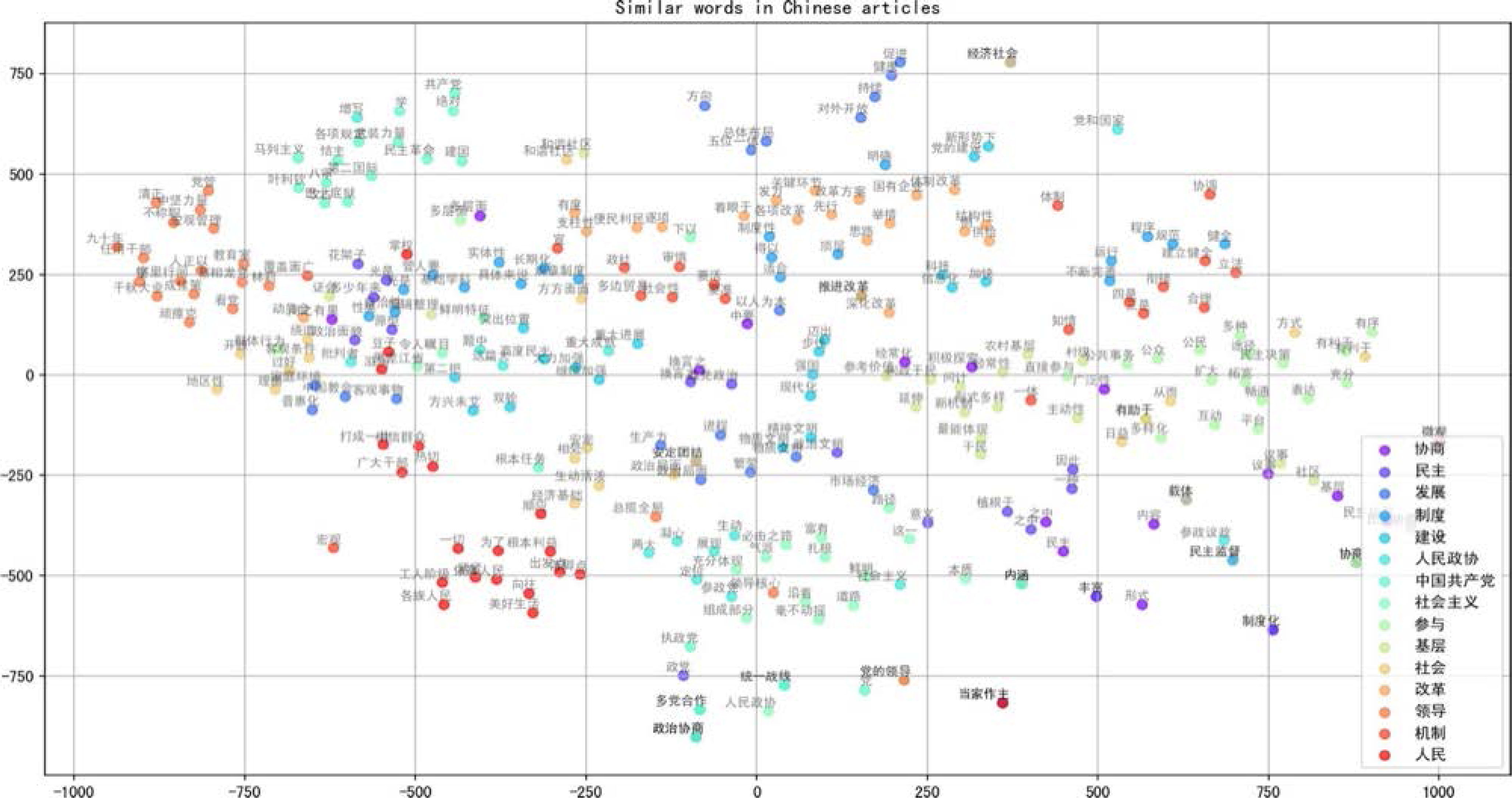
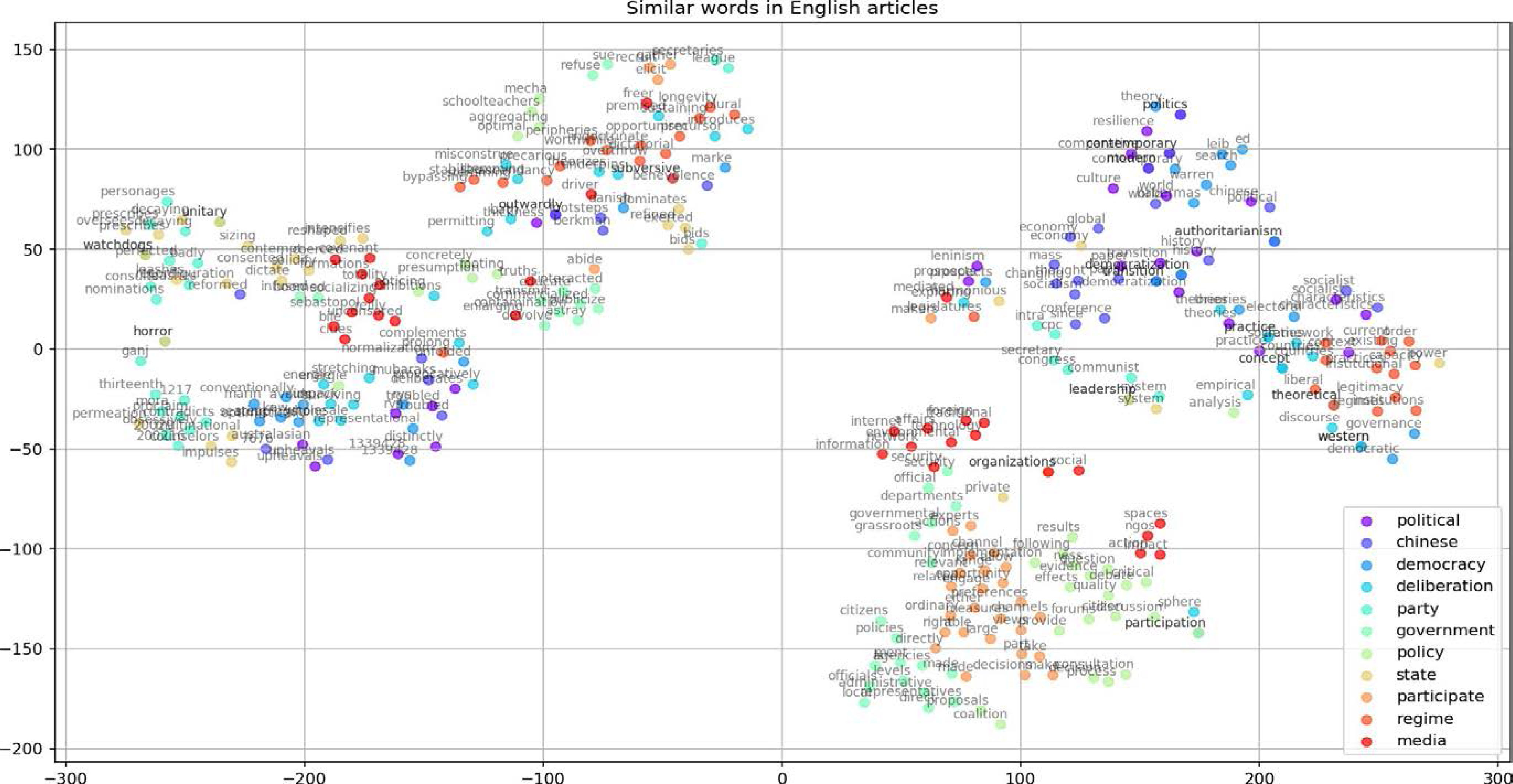
Statistical analysis (1): WordCloud-Pre-treat the Chinese data: decoding, tokenizing, cleaning stop or functional words in the data, analyzing the texts, and visualizing the keywords according to the frequency in the text by Logiciel R and Python. The cloud that filled with massive words in different sizes represents the frequency or the importance of the keywords17; 2). histogram to filter the 20 most used words and their frequency in the data with the third-party support for the histogram in Python—Matplotlib, with the occurrence frequency above 3,000 and also removes the miscellaneous words within the text; 3). Word2vec of correlation network to produce the word embeddings where words or phrases from the vocabulary are mapped to vectors of real numbers, quantify and characterize semantic similarities between linguistic items based on their distributional properties in large samples of language data within continuous skip-gram architecture. Then, adopt the t-SNE to visualize groups of the most similar words in high-dimensional Word2Vec Word Embeddings, which are located in multidimensional space.18
Semantic results (from the aforementioned analysis, draw the conclusion interspersed with specific numerical analysis).
In the third part, the authors will conduct the semantic analysis based on the following three main categories: I. Xieshang minzhu with Chinese Characteristics (general description; debate of electoral and deliberative democracy in China; and party leadership); II. institutionalization of Xieshang minzhu (participatory devices; Xieshang in the center and local) with various participatory devices; and III. Xieshang minzhu under Chinese democracy discourse. Note that a comparative study with the mirror case and induction of sub-related words within the main categories will also be conducted.
Semantic Results of the Chinese Political Discourse of Xieshang minzhu Xieshang minzhu with Chinese Characteristics
The authors adopt Chinese Pinyin with Xieshang minzhu for further demonstration instead of English or other linguistical translations, mainly because the Xieshang minzhu per se is quite ambiguous in translation, especially the correspondence and affiliation between Chinese and other languages.19 Indigenization of Chinese political scholarship is also increasingly inclined to abandon the rhetoric and linguistic disputes and turn to the analysis of xieshang minzhu with Chinese characteristics. It can be seen from the WordCloud and Histogram above that “Specialism (Te’se 特色)” and “socialism (Shehui zhuyi 社会主义)” account for the largest proportion, with a frequency of up to 17,500. In addition, according to the correlation map, we divide this part into three sub-subjects with a correlation rate up to 0.6,20 namely: 1) overview of the Xieshang minzhu; 2) controversy of the electoral democracy and Xieshang minzhu in China; and 3) party-dominant.
Both the Western doctrine of deliberative democracy in the Chinese-style deliberative context democracy21 and Xieshang minzhu rooted in the Chinese traditional political culture and thought, nevertheless, meet the requirements of netizens’ freedom of speech and association, interaction between society and government. Also, deliberative experiments in local China that flourished these years has aroused extensive discussion domestically and even internationally (Li Fan, 2014; e.g., the deliberative institutions in the test case of Wenling city) that indicated the consistency and reconcilable paradox the Xieshang minzhu within China’s authoritarianism. But to note, the giant repercussions always with the oppositions, on the one hand, although inspired by the Western deliberative democracy theory, Chinese propaganda and academia lopsided engaged to draw restrictive demarcation with the Western academia in the hope of soliciting the socialist Xieshang minzhu with Chinese characteristics. This trend has been further confirmed by a recent book that discusses 协商民主 Xieshang minzhu (officially translated in foreign languages as consultative democracy) and concludes that it better suits China than multi-party representative democracy.22 At the same time, officials and even academia have not yet reached a consensus on the definition of Xieshang minzhu with Chinese characteristics, or the widespread practice of Xieshang or quasi- Xieshang experiments at the local level, which largely lack the necessary theoretical support.
“Election” is a sensitive word that did not appear in the map (see Appendix 1, the authors extended the word frequency to 50 times, still, no (quasi)-“election” was found in the list). In the 1990s, local elections in China came to a halt and slid in a seemingly nonreciprocal manner, while the governments at all levels showed a clear refusal to move to electoral democracy. The direct election of cadres at the very local level in Chengdu, which was regarded as a prototype, was thus eliminated. The uncertain future toward democracy in China pressurizes the CCP, as well as the Chinese people, to find another form of democracy, rather than electoral (representative) democracy; namely, Xieshang minzhu. This is the congenital flaw of xieshang Minzhu in China, with the legitimized ignorance in official propaganda, also for some Chinese intellectuals, that deliberative and consultative style of democracy is much better than the electoral and conflictual model of liberal democracy (Lin Shangli, 2003).
Nevertheless, the CCP shows no signs of taking a democratic turn, which leaves little room for the discussion of “representative system” and “election” in the Chinese context, especially within the one-party rule. Thus, to the governmental-led sense, Xieshang minzhu is presented with the hope to skip the electoral (representative) democracy in China, and this trend is further confirmed by the top leaders in several speeches23 that were more broadly endorsed as a way of reforming the political system in the official document of the Central Party Committee.24 In the official framing, the two main forms of socialist democracy in China where elections and voting on the one hand, and full consultations of the people before major decisions are conducted to reach consensus on public issues.25 In September 2014, Xi Jinping tackled the sensitive topic of democracy26 and stated that: “Democracy is defined not only by people’s right to vote in an election but also the right to participate in political affairs on a daily basis.”27 To say the least, China does not prepare to pursue any kind of democracy, thus mass participation and deliberation are a priority for the short term.
From this lens, the official intention is very obvious, but not absolute. For example, at the local level in China, with village elections, consultative democracy is also required. Rural areas where competitive elections have developed in recent years may contain a genuine consultation of which voting was used in the final stages of public consultation. Thus, elections are the basis of public consultation that applies only, and more concretely, in the very local context, if any.
Against this background, among all the discourses on Chinese Xieshang minzhu, keywords, such as “party leadership (Dang de lingdao),” “core (Hexin)” and “central place (Zhongxin),”28 are high-frequency words and show the paradoxical affiliations between the party and democracy in contemporary China. Xieshang, per se, positively prompts the party leaders to be more responsive and accountable but indicates that how to keep this option or the basic elements in a one-party authoritarian state is still unclear. At one time, the CCP maintained control in an indirect or invisible way. For example, according to the interview with the secretary of the Party Affairs Office in Shuixiu Community, Wuxi indicated that the local community is generally autonomous, local party cadres will not intervene with the internal affairs including various voting meetings. However, if the local issues need mass of funds or under tension, then the director of the neighborhood committee still needs to report to the higher-ups for admissions; namely, the decision-makers are not the participants who voted but the cadres in the office.
Institutionalized and Systematic of Xieshang minzhu
Official discourses of Xieshang or Xieshng minzhu before the 18th National Congress usually accompanied with the misinterpretation (even in official documents) of “consultative democracy with Chinese characteristic,” “socialism consultative democracy,” “Chinese-style consultative democracy,” and so on. Thus, since Xi’s era, that institutionalization has become the focus of official efforts for further promoting Xieshang minzhu, responsibly, institutionalization is also one of the high-frequency words with a total frequency of 2,601. Traditionally, Chinese political culture pays little attention to procedure and institutionalization. Decision-making, therefore, is made by the leaders themselves due to authoritarian reasons with the convictions that procedures are inferior to efficiency. Thus, authorities with strong monopoly expect to achieve the ultimate goal without real deliberation. They even show no interest in deliberating openly (if any, the pressure from the higher-ups).
Further institutionalization of Xieshang or Xieshang minzhu in China is the priority, at best-forcing cadres to follow the deliberative rules in the governance. Such thoughts can be traced back to Mao’s mass line, which emphasis on deliberating, listening to, and valuing the voice of the masses politically. Socialist system and culture encourage deliberation, the new type of deliberative governance in Xi’s era, that more of the revival of political mobilization adapted for further dealing with the rapid change of economic and civil society, in which cadres and masses jointly solve practical problems, those can also be found in Table 1 as the high-frequency word “problem-(oriented).” Thus, Xieshang in China can both solve social conflicts without compromising central authority in a moderate democratization manner, and it can also be regarded as a new form of governance through the integration of executive orders and democratic consultation mechanisms.
Against this background, the CCP intends to design deliberative democratic institutions in a state that was seemingly more open to institutional innovation than many Western democracies, which are set in their ways. He Baogang (2013) summarized various forms of Xieshang system with “democratic talkfest,” “citizens’ councils,” and “urban or village representative assembly.” Obviously, the fact that those so-called democratic experiments exist at the local level shows that large-scale institutional design does not seem to be on the agenda. Thus, the deliberation (if any) is carried out under the centralized political structure, and this may cause the inherent tensions; namely, the elites control the deliberative process. As we have seen, the correlative words to institutionalization are mostly present with “top,” “discourse power,” “whole-process” and “dual leadership,” for example, that all with the correlation over 0.6. These might be partial summaries centrally but are far from the whole picture of local deliberation. In addition to the decision-making functions of the village committees, the municipal consultative bodies do not have their decision-making mechanisms, which merely functioned for further soliciting public opinions.
Xieshang minzhu Under Chinese-Style Democracy
Further interpretations of socialism with Chinese characteristics and Xieshang minzhu in Xi’s era are all based on the seemingly paradoxical concept of Chinese-style democracy. To date, it is not exactly a political term for just a matter of fact, literature29 on the Chinese democratic discourse or conceptions30 is quite large, notwithstanding, some fundamental conclusions that can be drawn from the diverse definitions, that is, Chinese democracy is by no means of the Western-style democracy, namely, multi-party system, open elections, judicial independence, etc., say it, the key factors of modern democracy are not taken into account. The author is more inclined to compare China’s democracy as a hybrid type than a merely autocratic one, as criticized by many authors, given that China still maintains a Communist party-state regime and the capability of national mobilization31 and limited political participation locally. Ultimately, there can be no political reform that can erode the party dictatorship. Following this logic, it is easy to understand the intention of the CCP for further pioneering Xieshang minzhu, as a form of democracy with Chinese characteristics that can also result in the “fallacy of electoralism.”32
We took the 18th National Congress as a watershed of Xieshang minzhu in contemporary China, within which Xieshang officially embedded in the theoretical system of socialism with Chinese characteristics and became a core component of the democratic thinking in Xi’s era. According to Tong’s33 semantic study of the 19th Report of National Congress, “Xieshang” and “Xieshang minzhu” appeared with a total of 12 times accounted for 9.01% of the report, “The essence of China’s democracy is public affairs should be deliberated by themselves.” Xieshang minzhu had been becoming the fifth major democratic form of socialist democracy “as an important way to realize the party leadership” along with the democratic election, democratic management, democratic decision-making, and democratic supervision.
Although democracy has always been a sensitive topic in China, it is still the most frequent keyword in Appendix I (21262), while deliberation following with 20,932 is the second place. For understanding China’s Xieshang minzhu, it must be placed into the considerations of Chinese-style democracy sphere anyway. At the same time, in the correlative words in Annex II, the democracy-related works like “liberal democracy (0.72),” “replacement (0.66),” “argument (0.65),” “democratic election (0.65)” strongly shows that Chinese-style democracy is distinct from Western-style democracy-liberal democracy. Neither the authorities nor academia conceals the formulation with the “socialism with Chinese characteristics” as a hot topic in domestic academic research.
The interpretation of China’s Xieshang minzhu in this dimension cannot be isolated against this backdrop. That is, CCP reinforce the path of Chinese democracy by reaffirming Xieshang or Xieshang minzhu in Chinese politics.34 This can also be found in appendix 1 with the high-frequency keyword like “people (Renmin 人民 9595),” which as the core concept in Chinese democracy with the doctrine of the “people are the masters of the state,” despite criticized by its utopian idea and not yet wildly recognized as a kind of democratic theory. Nevertheless, Chinese democracy does provide the theoretical support for the political consultation and deliberation, and also clearly state the relationship between the deliberative democracy and electoral democracy in China from this lens. Interpretations like “China model (Zhongguo moshi 中 国模式),” “China Road (Zhongguo daolu 中国道路)”35 that are presented in a seemingly more firmly permeable manner in the political discourse, strongly engaging the deliberation within. Simultaneously, “political consultation (Zhengzhi xieshang政治协商),” “intra-party deliberation (Zhengdang xieshang 政党协商),” “political consultative conference (Zhengxie 政协)” as the high-frequency (sub) keywords also indicate China’s basic political system, namely the political consultation system with the CPPCC as the main body. As Yan Jirong (2017) put it, “China’s political consultation system will not regard the free elections, open party bans, military nationalization and separation of powers as the prerequisite and merely approach to advance China’s democratization. Democracy is a thing that should be able to quickly reflect the will of people, namely, management performance is therefore, priority than democratic elections.”36
Sometimes, it may unpersuasive and ironic about the official discourse “democracy with Chinese characteristics” or the other synonyms, within which the CCP disguised itself with an authoritarian rule through pseudo-democratic political reform. But interestingly, from a duplex perspective, Chinese authorities successfully doctrine its people with such preset democratic model to distinguish it with the Western democracy thus further highlight its priorities in a nonelectoral and less-noxious manner; also to note, the democratic conceptions among the Chinese people do provide the regime support, although this article does not engage the discussion on how Chinese people shape their ideas of democracy, or concretely, deliberative democracy, it turned to be, according to the arguments of He Baogang (2014) on Chinese conception of deliberation, deliberation is more like the moral codes that solving conflicts in a peaceable way from a historical and cultural perspective. This is also well explained by the interaction between the state and society in a nonofficial perspective through the deliberative approach.
Conclusion
The CCP faces great pressure when confronting the wave of democratization worldwide. At the same time, the fission and degradation of the late-developing state (socialist regime) after adopting the liberal democracy also strongly alert China to the need to find its path. Scholarship on China studies focuses on the democratic transformation and authoritarian resilience, which rarely size up China’s political reforms in a non-Western perspective. The criticisms—namely, China’s so-called democratic reforms are far from satisfying democratic demand, or, the extremely inconsistency between China’s political reform and economic development—to some extent, may make sense. It does not necessarily lead to the legitimacy of China’s “authoritarianism” through some short-term economic achievements and superficial political reforms. Thus, from this lens, using the term democracy to describe such ventures seems to let the Chinese government off too easily.
Anyway, rather than immerse in the conceptual disputes of deliberative democracy in Chinese context, we thus adopted the official description of consultative democracy for further avoiding the semantic and rhetorical ambiguities. At the same time, contributions of this article are more likely to reinterpret the official discourse following the CCP’s original intention rather than academic misreading by adopting semantic analysis within the Chinese language. Technical means like Word2 VEC, python further contribute to a more precise text analysis base on the preset corpus. In short, Xieshang minzhu is different from the Western deliberative democracy, nevertheless, in line with the current China’s governmental innovation by calling for limited participation and consultation within the one-party rule. Second, amazing yet true, it was the authoritarian rules who feel the need to establish more thoroughgoing institutional design in the political reforms, which included the establishment of central and local consultative/deliberative institutions and the wildly preexisted democratic experimentations in the local. Finally, against the background of the Chinese style democracy, Xieshang minzhu itself, as well as other political discourses, therefore, would ultimately be an integral part within the Chinese socialism design and further serve for the CCP’s legitimacy. Whether Xieshang minzhu can eventually become a driving force for China’s truly democracy or an expedient choice for evading elections as a transformational option, it always provides a fresh non-Western-centered perspective for with both scholars and practitioners to further discuss the political envision of China.
Appendices
Appendix 1
Word Cloud Map and Numerical Quotieties
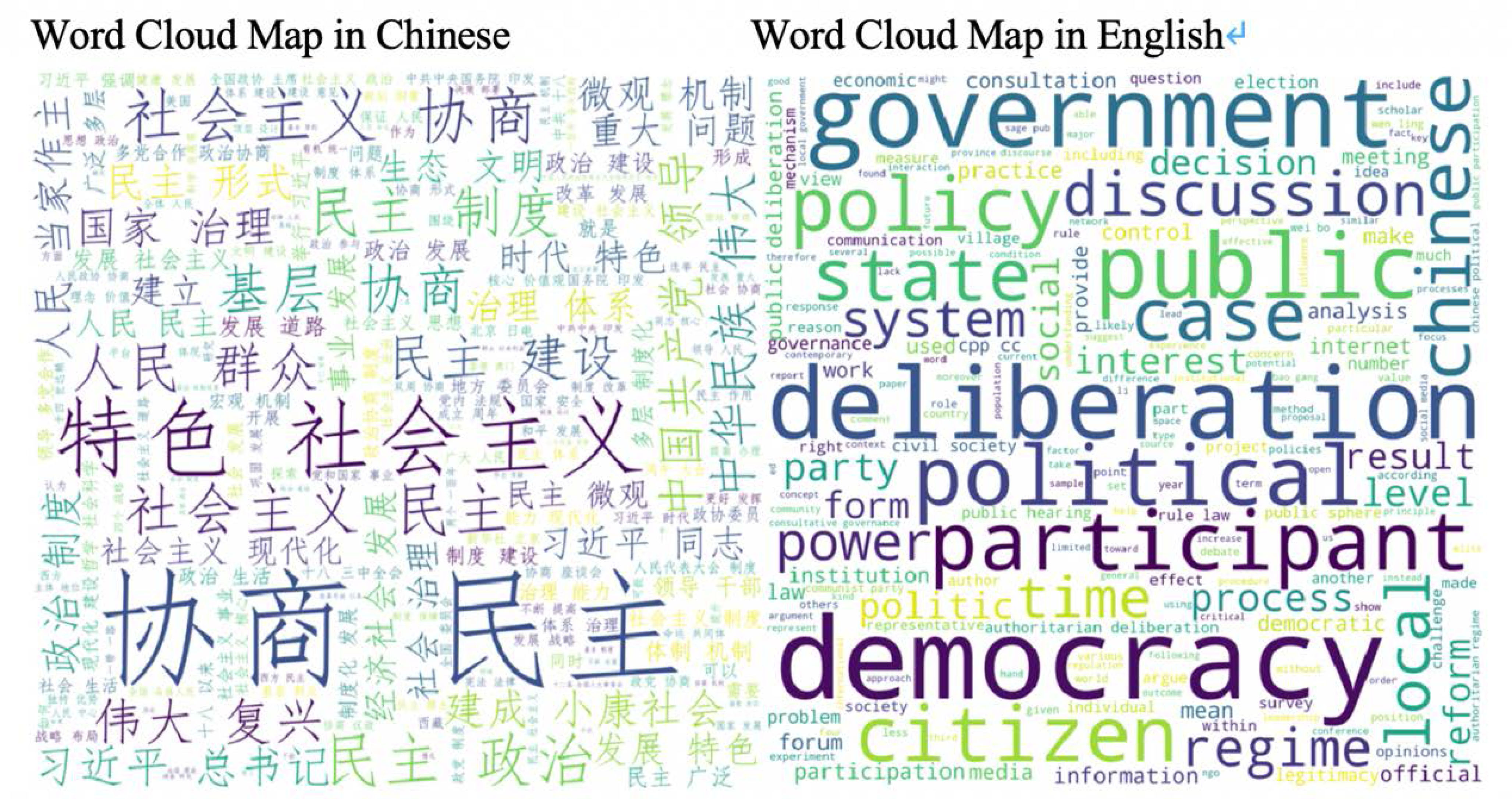
Graph of Chinese Word Frequency with Numerical Quotieties
Note: The translation of each index of the abscissa is: democracy, Xieshang, development, socialist, institution, construction, people, state, society, politics, problem, reform, characteristic, Xi Jinping, system, leadership, mass, local, systematic, governance.
Appendix 2
Comparison Table of Chinese and English Word Frequency
Appendix 2
Comparison Table of Chinese and English Word Correlation