
Tab. 1:
Deterrence strategies
| Deterrence strategy | Explanation |
|---|---|
| Deterrence by punishment | Deterrence by punishment refers to the state’s effort to convince the threat actor that aggression will be met with a countermeasure of at least the same effect. (Freedman 2013; Mazarr 2018) |
| Deterrence by denial | Deterrence by denial refers to the state’s effort to convince the threat actor that aggression will not achieve the desired effects, because, for example, the effect of the aggression will be less than intended or its costs will be higher than planned. (Freedman 2013; Mazarr 2018) |
| Direct deterrence | Direct deterrence refers to the state’s effort to convince the threat actor that aggression will be repelled. (Mazarr 2018; NATO 2022) |
| Extended deterrence | Extended deterrence refers to the state’s effort to convince the threat actor that aggression against allies or partners will result in countermeasures by that state. (Morgan 2003; Mazarr 2018; Black and Obradovic 2022; NATO 2022) |
| General deterrence | General deterrence refers to continuous and systematic measures implemented by the state to respond to aggression under normal conditions. Preparation is not aimed at any specific threat. The state tries to convince the threat actors that they are ready to respond to aggression. (Tor 2017; Mazarr 2018; Monaghan 2022; NATO 2022) |
| Immediate deterrence | Immediate deterrence refers to actions planned and implemented immediately against a threat that appears during a state crisis. During a crisis, the state tries to convince the threat actor that aggression will be responded to with immediate action. (Tor 2017; Mazarr 2018; Monaghan 2022; NATO 2022) |
| Narrow deterrence | Narrow deterrence refers to the state’s effort to convince the threat actor that they will be met with military force. (Arreguín-Toft et al. 2009; Mazarr 2018; Mueller 2021) |
| Broad deterrence | Broad deterrence refers to the state’s effort to convince the threat actor that aggression will be met with versatile measures. These include, e.g., military, political and economic measures and measures enabled by law and the information environment. (Wee 2014; Mazarr 2018; Lindsay and Gartzke 2019; Sweijs and Zilincik 2021) |
| Positive deterrence | Positive deterrence refers to the state’s effort to offer the threat actor opportunities for cooperation and rewards when it refrains from aggression. (Mazarr 2018; Kerttunen 2019; De Spiegeleire et al. 2020; Mueller 2021) |
| Negative deterrence | Negative deterrence refers to the state’s effort to convince the threat actor that aggression will result in a negative reaction and that the threat actor will lose, among other things, the benefits of cooperation. (De Spiegeleire et al. 2020; Monaghan 2022) |
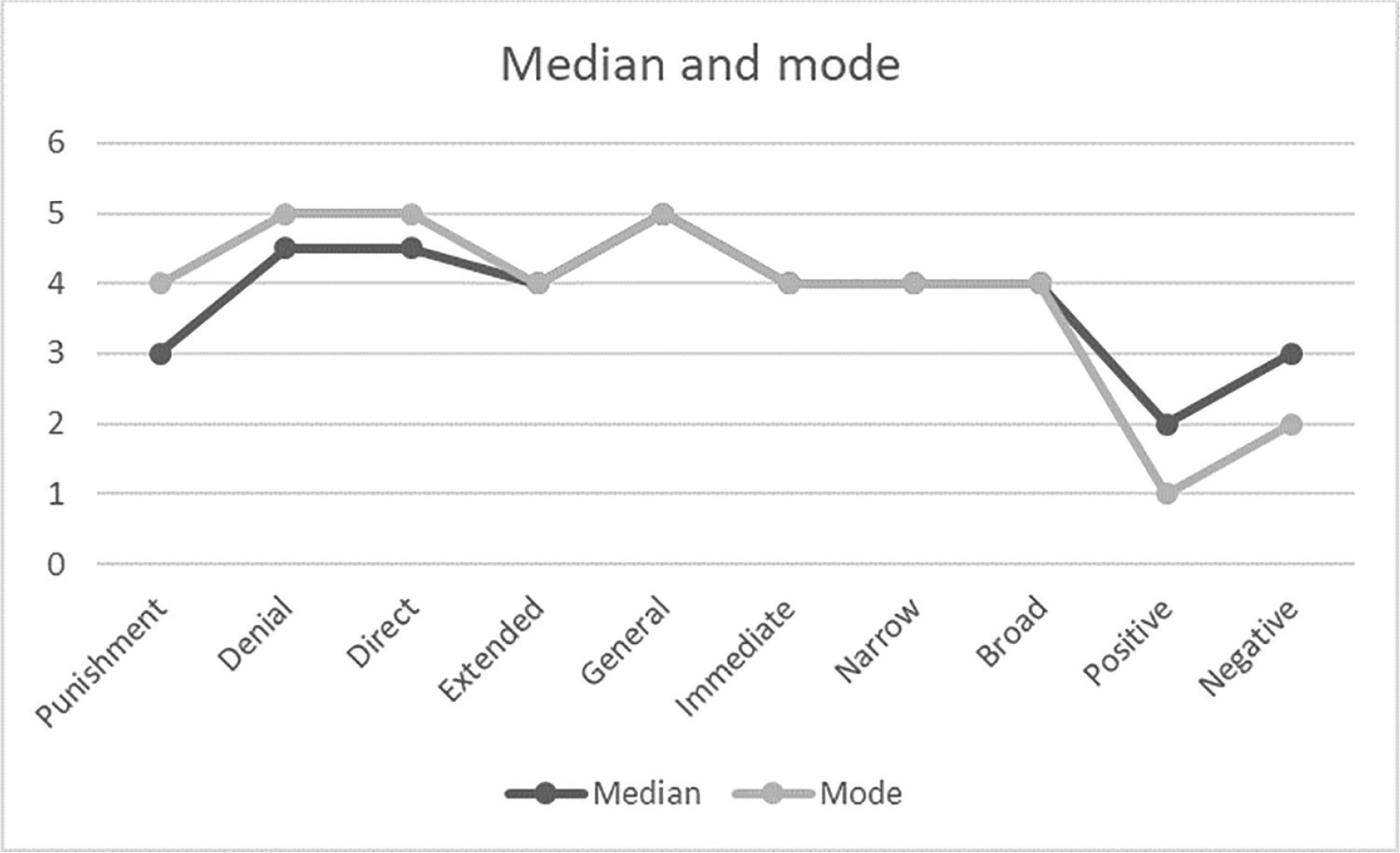
Fig. 1:
The median and mode of the quantitative data.
Tab. 2:
Statistics of the survey
| Deterrence type | Punishment | Denial | Direct | Extended | General | Immediate | Narrow | Broad | Positive | Negative |
|---|---|---|---|---|---|---|---|---|---|---|
| N Valid | 62 | 62 | 62 | 62 | 62 | 62 | 62 | 62 | 62 | 62 |
| Missing | 0 | 0 | 0 | 0 | 0 | 0 | 0 | 0 | 0 | 0 |
| Median | 3.00 | 4.50 | 4.50 | 4.00 | 5.00 | 4.00 | 4.00 | 4.00 | 2.00 | 3.00 |
| Mode | 4 | 5 | 5 | 4 | 5 | 4 | 4 | 4 | 1 | 2 |
| Variance | 1.380 | 0.411 | 0.675 | 0.934 | 1.077 | 0.970 | 1.155 | 1.175 | 1.194 | 1.564 |
| Percentiles | ||||||||||
| 25 | 2.00 | 4.00 | 4.00 | 3.75 | 4.00 | 3.00 | 3.00 | 3.00 | 1.00 | 2.00 |
| 50 | 3.00 | 4.50 | 4.50 | 4.00 | 5.00 | 4.00 | 4.00 | 4.00 | 2.00 | 3.00 |
| 75 | 4.00 | 5.00 | 5.00 | 5.00 | 5.00 | 4.00 | 4.25 | 5.00 | 3.00 | 4.00 |
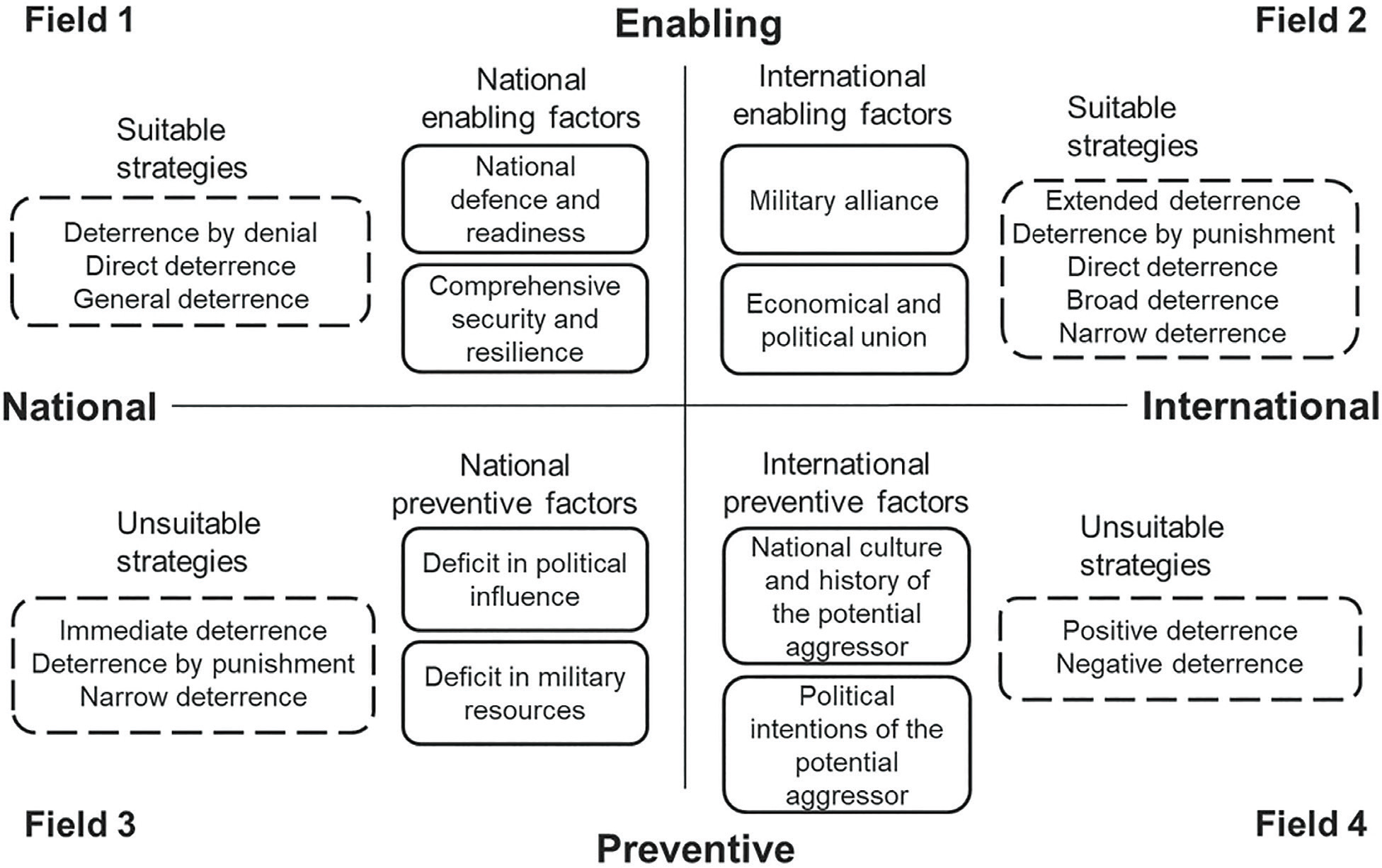
Fig. 2:
Suitable and unsuitable deterrence strategies for a small state with enabling and preventive factors based on the analysis.
Tab. 3:
Prevalence of factors in open-ended answers
| Factors Deterrence options | International enabling factors | National enabling factors | National preventive factors | International preventive factors | ||||||
| NATO | EU | Existing model | Comprehensive security | National defence and readiness | Limited armed forces | Low status as an international actor | Intentions of the potential aggressor | Uncategorised factors | Total | |
| General (%) | 6 | 2 | 17 | 29 | 15 | 4 | 6 | 2 | 19 | 100 |
| Denial (%) | 12 | 0 | 33 | 14 | 18.5 | 0 | 0 | 6 | 16.5 | 100 |
| Direct (%) | 35.0 | 0 | 0 | 12.5 | 32.5 | 10 | 0 | 5 | 5 | 100 |
| Extended (%) | 63 | 9 | 0 | 0 | 0 | 9 | 6.5 | 2 | 10.5 | 100 |
| Broad (%) | 26 | 20.5 | 1.5 | 14 | 5 | 1.5 | 9 | 7 | 15.5 | 100 |
| Narrow (%) | 21 | 5 | 20 | 5 | 9 | 16 | 5 | 0 | 19 | 100 |
| Immediate (%) | 6 | 0 | 24 | 6 | 18.5 | 24 | 9 | 0 | 12.5 | 100 |
| Punishment (%) | 49 | 0 | 4 | 0 | 0 | 23 | 0 | 14 | 10 | 100 |
| Negative (%) | 11 | 9 | 0 | 0 | 0 | 0 | 22 | 28 | 30 | 100 |
| Positive (%) | 0 | 0 | 9 | 0 | 0 | 0 | 12 | 22 | 57 | 100 |