

Figure 1.
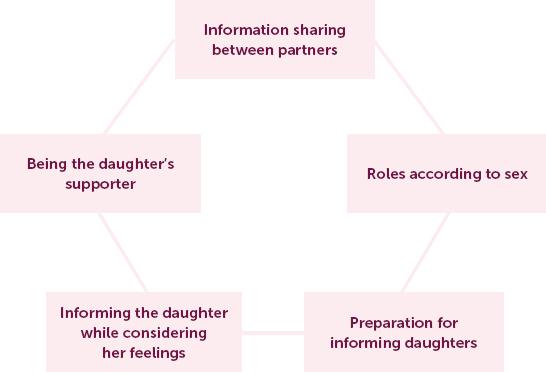
Five strategies used by parents to inform their daughters about haemophilia, including being a haemophilia carrier
| CATEGORY | SUBCATEGORY | CONCEPT |
|---|---|---|
| Information sharing between partners | Creating opportunities to talk about the daughter | Parents reconciled different viewpoints on their daughters before and after sharing information on haemophilia and carrying the haemophilia gene with them. |
| Considering an information-sharing approach | ||
| Differences of opinion between couples | ||
| Roles according to sex | Relationship between mothers and daughters because they are of the same sex | Mothers played a direct role in sharing information with their daughters as they were of the same sex. In contrast, fathers felt anxious and guilty when providing their daughters with information due to be being of a different sex and because daughters of fathers with haemophilia will carry the haemophilia gene. |
| Mothers of haemophilia carriers are concerned about their daughters | ||
| Relationship between fathers and daughters as they are of the opposite sex | ||
| Fathers with haemophilia feel guilty for their daughters | ||
| Preparation for informing daughters | Collecting information about haemophilia | Parents determined the timing of telling their daughters about haemophilia according to their stage of physical and psychosocial development. |
| Intentionally taking the daughter to patient association meetings | ||
| Consulting with a specialist | ||
| Observing the daughter’s mental development | ||
| Informing the daughter while considering her feelings | Gradual information sharing according to the daughter’s developmental stage | While considering the daughter’s stage of development mentally, parents used a positive approach to tell them about haemophilia so that they could feel comfortable in dealing with the fact that they carry the haemophilia gene. |
| Natural information sharing | ||
| Telling the daughter about haemophilia using a positive approach | ||
| Intentionally talking with an open mind | ||
| Being the daughter’s supporter | Answering questions from the daughter | After informing their daughters about haemophilia, parents acted as their supporters. They also considered how they would support their daughters if they were to have children with haemophilia. |
| Encouraging daughters to visit the hospital | ||
| Encouraging daughters and their partners to obtain information | ||
| Thinking about their daughters as parents |