Have a personal or library account? Click to login
Community detection on elite mathematicians’ collaboration network Cover

Community detection on elite mathematicians’ collaboration network

Open Access
|Nov 2024

Figures & Tables

Figure 1.

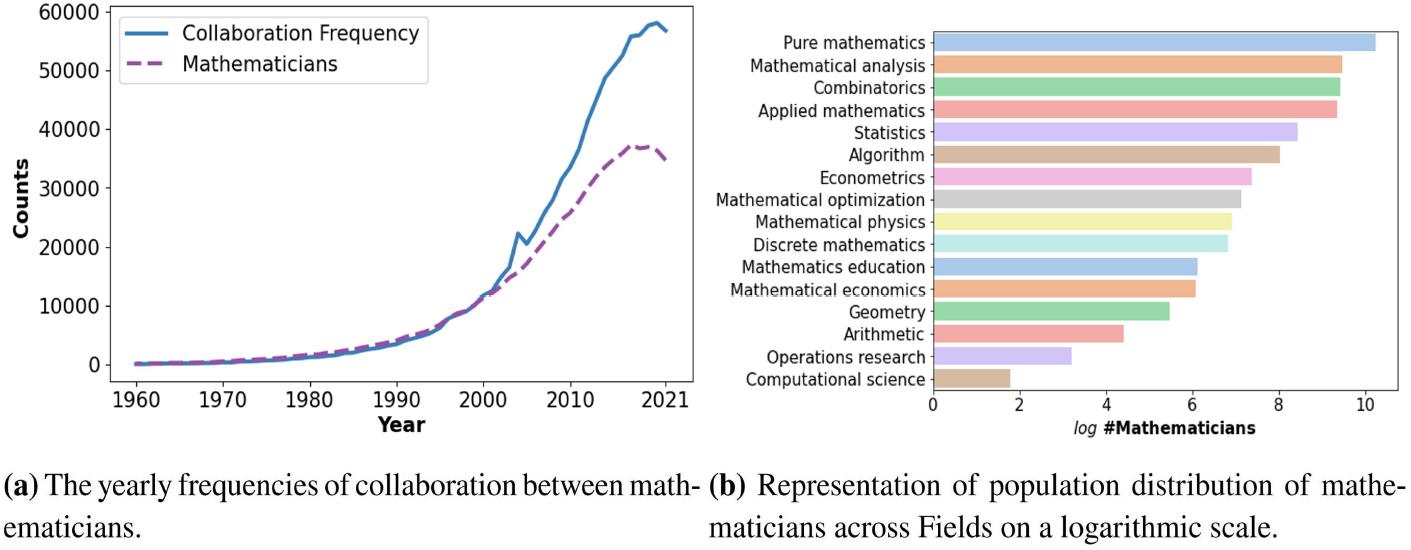
Data characteristics of mathematicians.

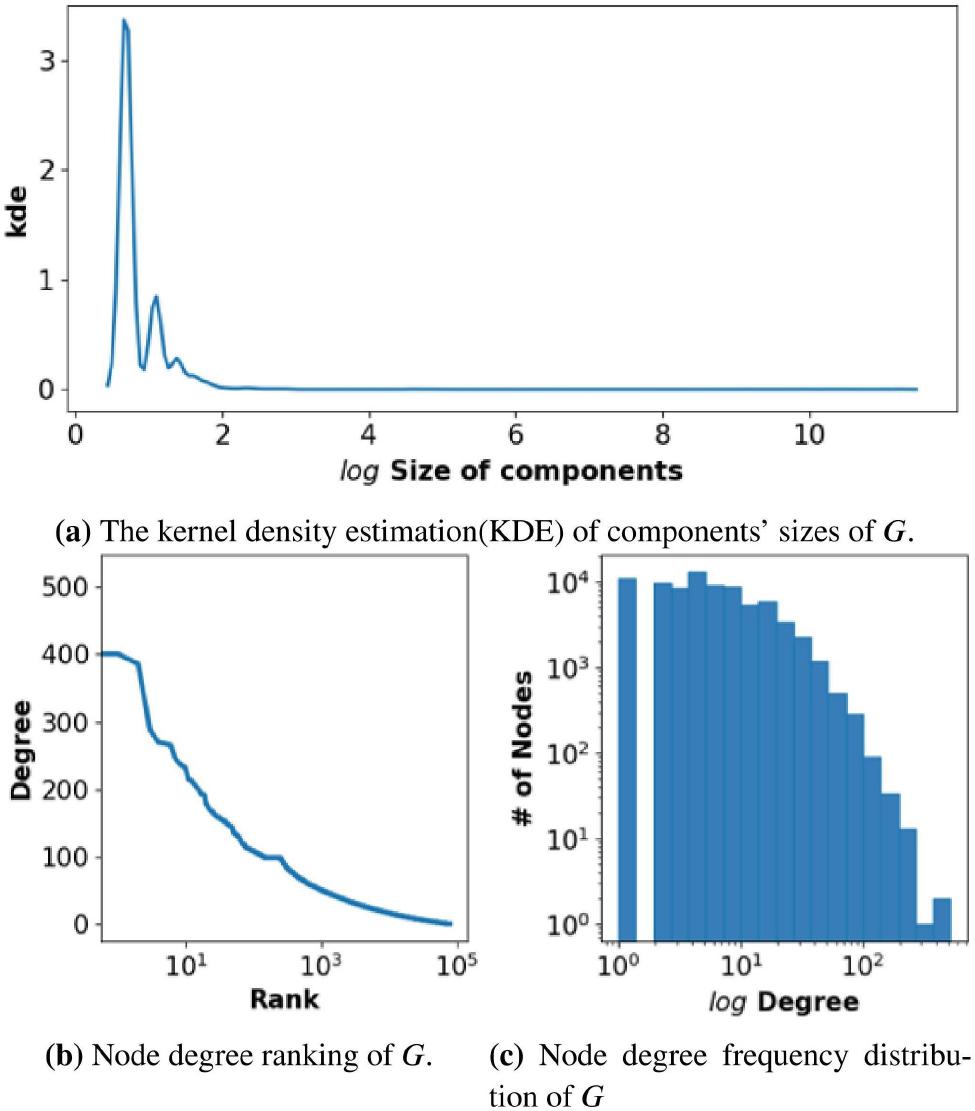
Figure 2.

Network characteristics.

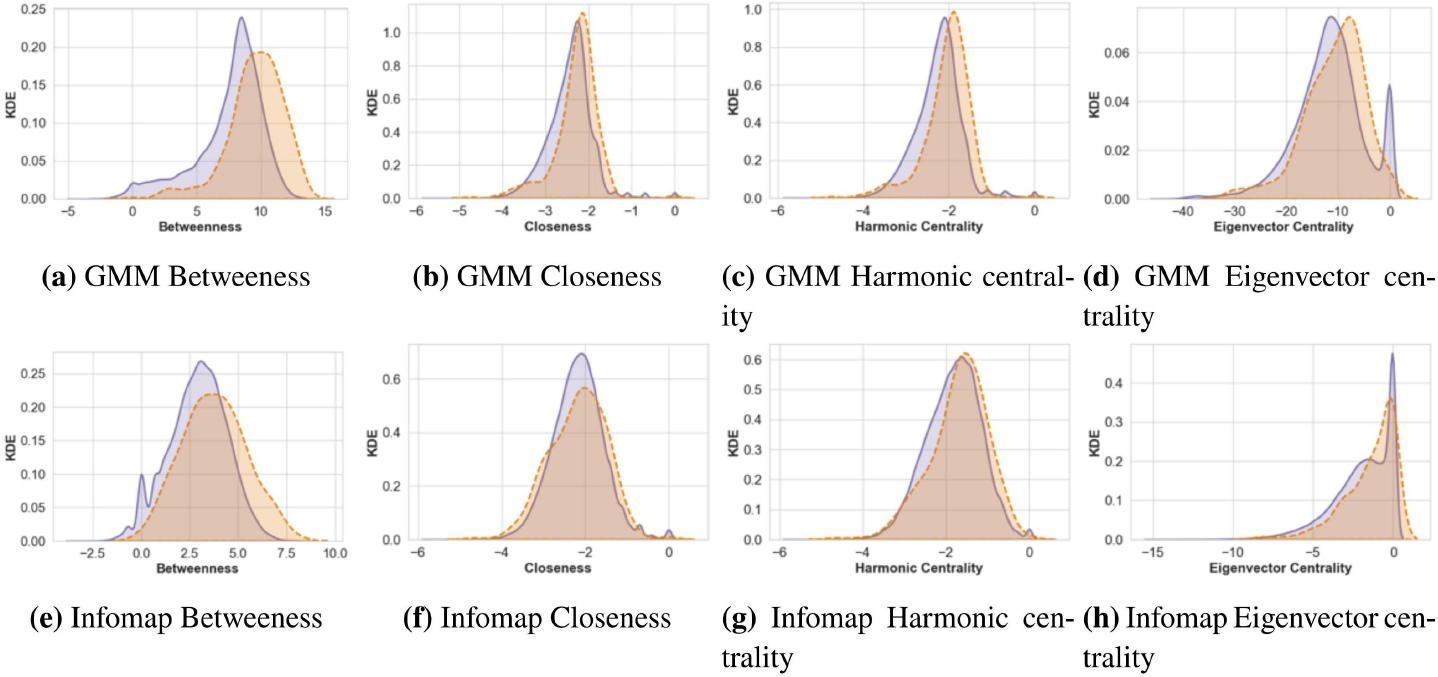
Figure 3.

Four centrality metrics were computed within communities identified by both GMM and Infomap, and subsequently compared between awardees and other mathematicians. The metrics assessed were: (a), (e) Betweenness; (b), (f) Closeness; (c), (g) Harmonic Centrality; and (d), (h) Eigenvector Centrality.

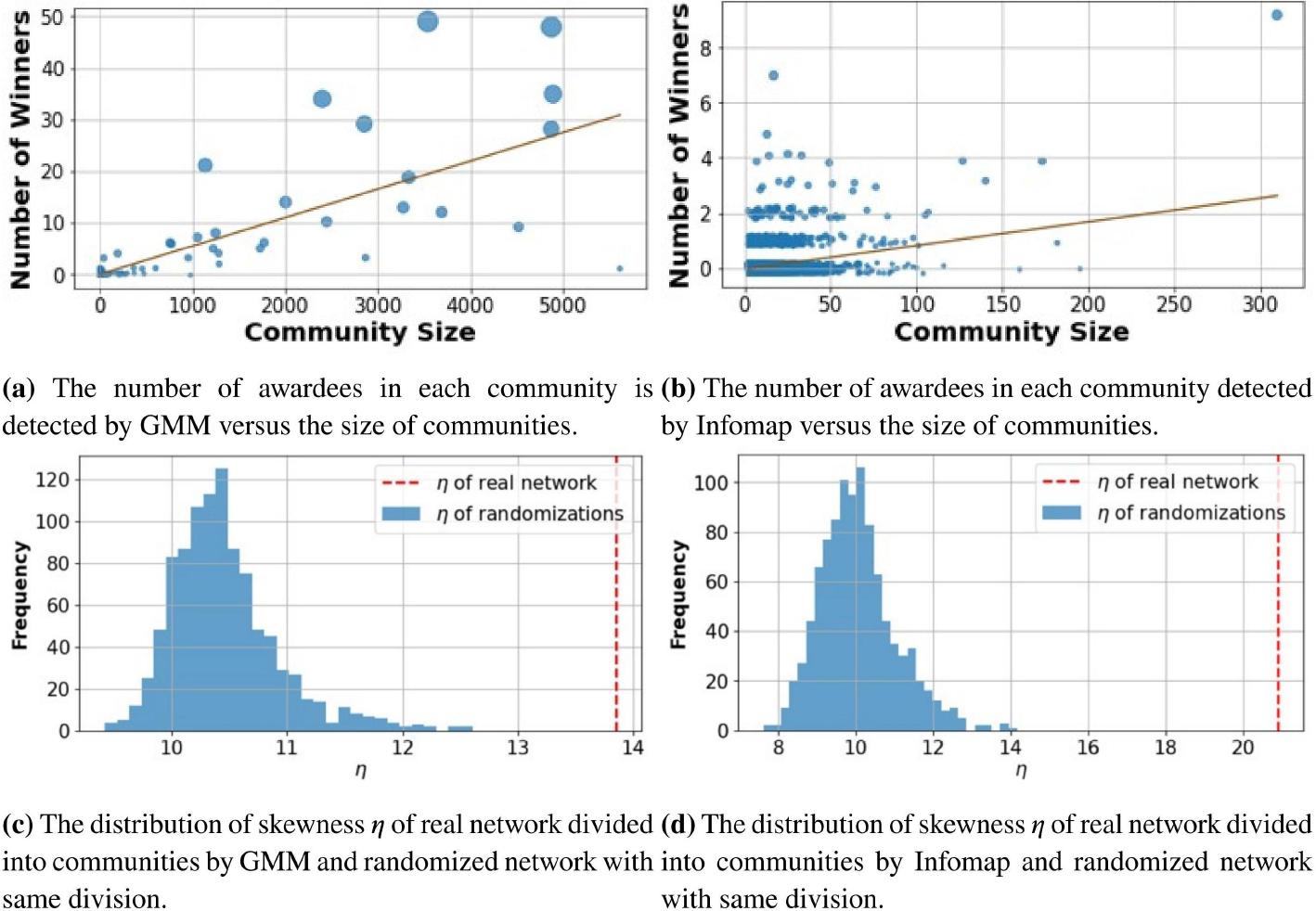
Figure 4.

Distributed characteristics of mathematicians and mathematical awardees within communities.

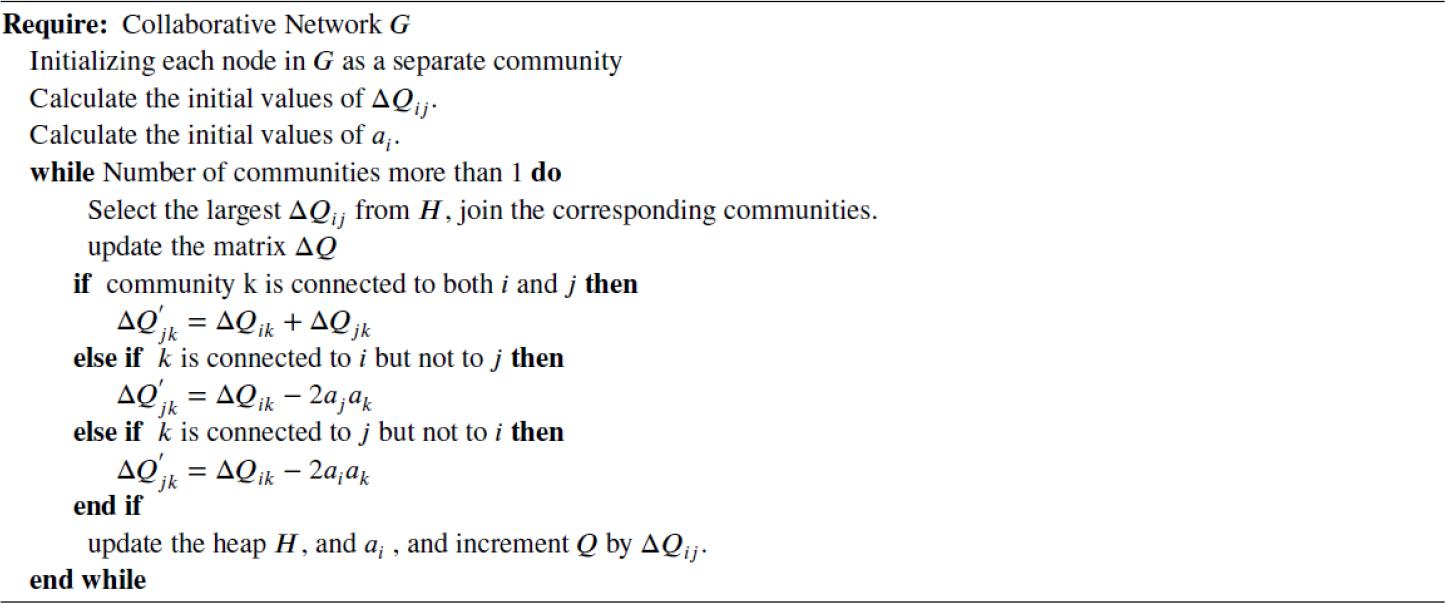
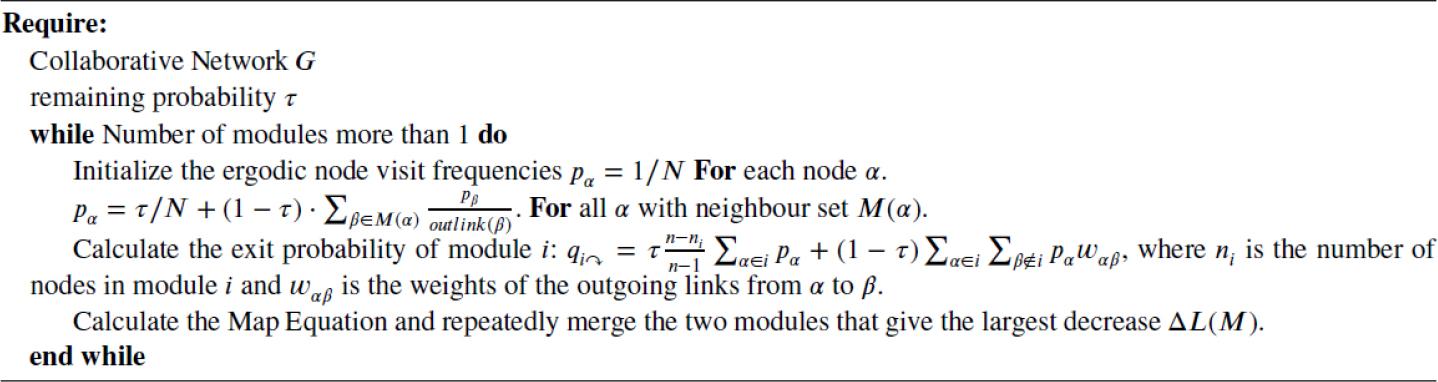
Algorithm 1

Figure A1.

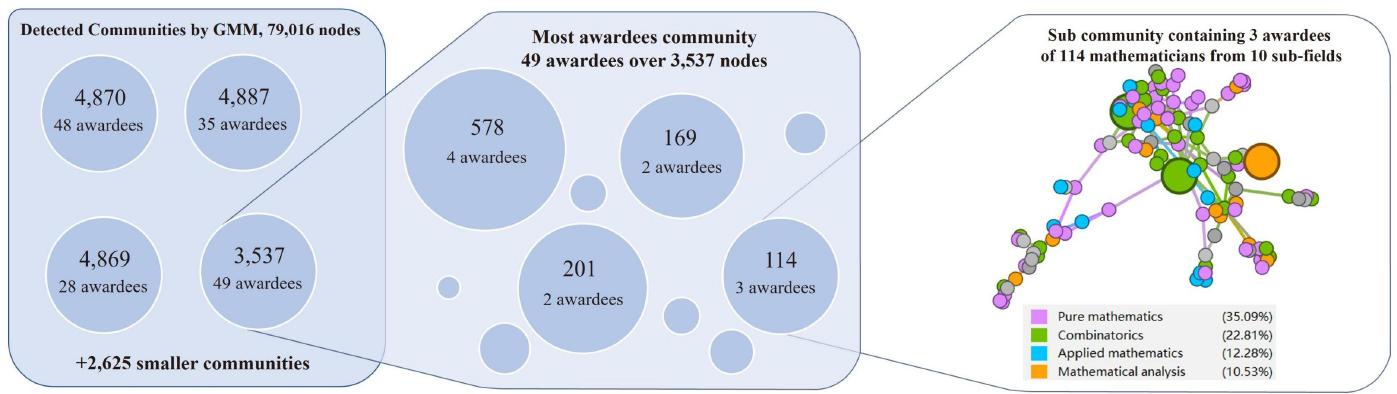
Communities and Sub-communities detected sequentially by GMM. The left sub-figure represents the result of the first detection on the collaboration network. The middle one is the community detected with most awardees in the first detection. The right one is network structure of one community in the second detection. The huge circle represents awardees, and the color indicates the sub-field of mathematicians.

Algorithm 2

Linear regression analysis on the number of awardees_

Algorithm#awardees
GMMInfomap
Community size0.0056***0.0092***
Simpson index-0.1075*-0.0339***

The basic characteristics of mathematicians’ collaborative networks_

NLklnNCdensity
79,016342,0228.65711.27740.19720.0001

NMI analysis between true field labels and detected community labels_

MethodGMMInfomap
Real NMI0.22220.2404
Random NMI(0.03361, 0.03365)(0.08247, 0.08250)

The t-test of the difference of centrality metrics between awardees and other mathematicians_

BetweennessClosenessHarmonic centralityEigenvector centrality
GMM47,777.2381***0.0141***0.0245***-0.0455***
Infomap96.5236***0.00530.0323***0.1148***
DOI: https://doi.org/10.2478/jdis-2024-0026 | Journal eISSN: 2543-683X | Journal ISSN: 2096-157X
Language: English
Page range: 1 - 23
Submitted on: Jul 25, 2023
Accepted on: Nov 22, 2023
Published on: Nov 19, 2024
Published by: Chinese Academy of Sciences, National Science Library
In partnership with: Paradigm Publishing Services
Publication frequency: 4 issues per year

© 2024 Yurui Huang, Zimo Wang, Chaolin Tian, Yifang Ma, published by Chinese Academy of Sciences, National Science Library
This work is licensed under the Creative Commons Attribution 4.0 License.