
TABLE 1.
Demographic and clinical variables of the analyzed patient population, considering the applied aortic reconstruction strategy and aneurysm rupture
| Parameter | EVAR (n = 57) | OSR (n = 60) | p value | Ruptured AAA (n = 46) | Non-ruptured AAA (n = 71) | p value |
|---|---|---|---|---|---|---|
| Included from Târgu Mureș (n, %) | 37 (64.9) | 36 (60.0) | 0.70 | 29 (63.0) | 44 (62.0) | 1.00 |
| Age (years)* | 67 (51–82) | 72 (52–87) | 0.07 | 73.0 (52–87) | 68 (51–82) | 0.01 |
| Male sex (n, %) | 53 (93.0) | 52 (86.7) | 0.36 | 41 (89.1) | 64 (90.1) | 1.00 |
| Emergent presentation (n, %) | 13 (22.8) | 48 (80.0) | <0.001 | 46 (100) | 15 (21.1) | <0.001 |
| Maximum aortic diameter (mm)* | 63 (37–120) | 80 (30–160) | <0.01 | 88 (33–160) | 63 (30–120) | <0.001 |
| Hemoglobin concentration (g/dl)* | 13.3 (7.4–17.9) | 10.42 (5.2–16.0) | <0.001 | 9.65 (5.2–14.6) | 13.6 (7.4–17.9) | <0.001 |
| Serum creatinine (mg/dl)* | 0.95 (0.73–2.40) | 1.28 (0.61–6.69) | <0.001 | 1.42 (0.72–6.69) | 0.98 (0.61–2.40) | <0.001 |
| Arterial hypertension (n, %) | 47 (82.5) | 45 (75.0) | 0.37 | 31 (67.4) | 61 (85.9) | 0.02 |
| Diabetes mellitus (n, %) | 11 (19.3) | 15 (25.0) | 0.50 | 9 (19.6) | 17 (23.9) | 0.65 |
| Cardiovascular disease history (n, %) | 19 (33.3) | 26 (43.3) | 0.32 | 17 (37.0) | 28 (39.4) | 0.84 |
| Pulmonary disease history (n, %) | 8 (14.0) | 8 (13.3) | 1.00 | 6 (13.0) | 10 (14.1) | 1.00 |
| Cerebrovascular disease history (n, %) | 0 (0.0) | 6 (10.0) | 0.02 | 5 (10.9) | 1 (1.4) | 0.03 |
| In-hospital mortality (n, %) | 2 (3.5) | 28 (46.7) | <0.001 | 29 (63.0) | 1 (1.4) | <0.001 |
| 1-year mortality (n, %) | 4 (9.8) | 30 (53.6) | <0.001 | 31 (72.6) | 3 (5.6) | <0.001 |
TABLE 2.
Postoperative complications in the analyzed patient population
| Parameter | EVAR (n = 57) | OSR (n = 60) | p value | Ruptured AAA (n = 46) | Non-ruptured AAA (n = 71) | p value |
|---|---|---|---|---|---|---|
| Hemorrhage (n, %) | 1 (1.8) | 17 (28.3) | <0.001 | 18 (39.1) | 0 (0.0) | <0.001 |
| Infection (n, %) | 4 (7.0) | 7 (11.7) | 0.52 | 7 (15.2) | 4 (5.6) | 0.10 |
| Stroke (n, %) | 1 (1.8) | 1 (1.7) | 1.00 | 2 (4.3) | 0 (0.0) | 0.15 |
| Acute coronary syndrome (n, %) | 0 (0.0) | 10 (16.7) | 0.001 | 10 (21.7) | 0 (0.0) | <0.001 |
| Mesenteric ischemia (n, %) | 0 (0.0) | 6 (10.0) | 0.02 | 6 (13.0) | 0 (0.0) | <0.01 |
| Dialysis (n, %) | 1 (1.8) | 14 (23.3) | <0.001 | 15 (32.6) | 0 (0.0) | <0.001 |
| Respiratory failure (n, %) | 2 (3.5) | 4 (6.7) | 0.67 | 5 (10.9) | 1 (1.4) | 0.03 |
| Endoleak (n, %) | 1 (1.8) | 0.0 | 0.48 | 0 (0.0) | 1 (1.4) | 1.00 |
| Other significant complications (n, %) | 0 (0.0) | 28 (46.7) | <0.001 | 27 (58.7) | 1 (1.4) | <0.001 |
TABLE 3.
Association between clinical parameters and postoperative complications
| Proposed predictors | With complications (n = 44) | Without complications (n = 73) | p value |
|---|---|---|---|
| Included from Târgu Mureș (n, %) | 29 (65.9) | 44 (60.3) | 0.56 |
| Age (years)* | 73.5 (54–87) | 68 (51–84) | <0.01 |
| Male sex (n, %) | 39 (88.6) | 66 (90.4) | 0.76 |
| Maximum aortic diameter (mm)* | 82 (30–160) | 63 (37–120) | <0.001 |
| Presence of aortic rupture (n, %) | 38 (86.4) | 8 (11.0) | <0.001 |
| Hemoglobin concentration (g/dl)* | 9.55 (5.2–14.8) | 13.4 (8.3–17.9) | <0.001 |
| Serum creatinine (mg/dl)* | 1.38 (0.72–6.69) | 1.01 (0.61–2.40) | <0.001 |
| Arterial hypertension (n, %) | 29 (65.9) | 63 (86.3) | 0.01 |
| Diabetes mellitus (n, %) | 10 (22.7) | 16 (21.9) | 1.00 |
| Cardiovascular disease history (n, %) | 17 (38.6) | 28 (38.4) | 1.00 |
| Pulmonary disease history (n, %) | 4 (9.1) | 12 (16.4) | 0.40 |
| Cerebrovascular disease history (n, %) | 5 (11.4) | 1 (1.4) | 0.02 |
| EVAR as treatment (n, %) | 5 (11.4) | 52 (71.2) | <0.001 |
TABLE 4.
Correlational analysis of potential predictors of in-hospital and 1-year mortality following AAA treatment
| Proposed predictors | Deceased in hospital (n = 30) | Discharged alive (n =87) | p value | Deceased at 1 year (n = 34) | Alive at 1 year (n = 63) | p value |
|---|---|---|---|---|---|---|
| Included from Târgu Mureș (n, %) | 21 (70.0) | 52 (59.8) | 0.38 | 26 (76.5) | 38 (60.3) | 0.12 |
| Age (years)* | 73.5 (54–84) | 68 (51–87) | <0.01 | 74 (54–87) | 68 (51–82) | <0.001 |
| Male sex (n, %) | 25 (83.3) | 80 (92.0) | 0.18 | 29 (85.3) | 58 (92.1) | 0.31 |
| Maximum aortic diameter (mm)* | 89.5 (40–160) | 64 (30–150) | <0.001 | 88 (40–160) | 64 (30–120) | 0.001 |
| Presence of aortic rupture (n, %) | 29 (96.7) | 17 (19.5) | <0.001 | 31 (91.2) | 12 (19.0) | <0.001 |
| Hemoglobin concentration (g/dl)* | 9.85 (5.2–14.6) | 13.2 (6.5–17.9) | <0.001 | 9.85 (5.2–15.3) | 13.3 (6.8–17.9) | <0.001 |
| Serum creatinine (mg/dl)* | 1.45 (0.72–6.69) | 1.01 (0.61–5.8) | <0.001 | 1.42 (0.81–6.69) | 0.96 (0.61–2.91) | <0.001 |
| Arterial hypertension (n, %) | 18 (60.0) | 74 (85.1) | <0.01 | 20 (58.8) | 55 (87.3) | <0.01 |
| Diabetes mellitus (n, %) | 5 (16.7) | 21 (24.1) | 0.45 | 7 (20.6) | 13 (20.6) | 1.00 |
| Cardiovascular disease history (n, %) | 15 (50.0) | 30 (34.5) | 0.19 | 15 (44.1) | 22 (34.9) | 0.38 |
| Pulmonary disease history (n, %) | 4 (13.3) | 12 (13.8) | 1.00 | 4 (11.8) | 9 (14.3) | 1.00 |
| Cerebrovascular disease history (n, %) | 5 (16.7) | 1 (1.1) | <0.001 | 5 (14.7) | 1 (1.6) | 0.01 |
| EVAR as treatment (n, %) | 2 (6.7) | 55 (63.2) | <0.001 | 4 (11.8) | 37 (58.7) | <0.001 |
| Any postoperative complication (n, %) | 28 (93.3) | 16 (18.4) | <0.001 | 30 (88.2) | 10 (15.9) | <0.001 |
TABLE 5.
Multivariate stepwise regression models predicting mortality
| Model | Deceased in hospital | Deceased at 1 year | Cox regression |
|---|---|---|---|
| Included from Cluj-Napoca (Târgu Mureș as reference) | – | – | 0.454 (p = 0.046) |
| Age (years) | – | 0.205 (p = 0.002) | 1.002 (p = 0.934) |
| Male sex | – | – | 1.516 (p = 0.402) |
| Maximum aortic diameter (mm) | 0.029 (p = 0.044) | 0.049 (p = 0.020) | – |
| Hemoglobin concentration (g/dl) | – | – | – |
| Serum creatinine (mg/dl) | – | 1.504 (p = 0.025) | – |
| Arterial hypertension | –1.413 (p = 0.090) | –1.877 (p = 0.083) | – |
| Cardiovascular and cerebrovascular disease history | 2.727 (p = 0.003) | – | 2.101 (p = 0.035) |
| Pulmonary disease history | – | – | – |
| OSR (EVAR as reference) | 2.192 (p = 0.034) | – | 2.778 (p = 0.044) |
| Any postoperative complications | 3.799 (p < 0.001) | 2.618 (p = 0.001) | 8.457 (p < 0.001) |
TABLE 6.
Length of hospitalization and total costs per patient
| Parameter | EVAR (n = 57) | OSR (n = 60) | p value | Ruptured AAA (n = 46) | Non-ruptured AAA (n = 71) | p value |
|---|---|---|---|---|---|---|
| Length of hospital stay (days) | 8.0 (3–83) | 8.5 (0–50) | 0.44 | 6.0 (0.0–50.0) | 9.0 (3.0–83.0) | <0.01 |
| Length of ICU stay (days) | 1.0 (0.2–10.3) | 2.45 (0.0–42.7) | <0.01 | 2.7 (0.0–42.7) | 1.0 (0.2–8.0) | <0.01 |
| Preoperative period (days) | 3.0 (0.0–70.0) | 0.0 (0.0–9.0) | <0.001 | 0.0 (0.0–8.0) | 2.0 (0.0–70.0) | <0.001 |
| Total costs without specific medical devices (Euro) | 4,097 (1,195–22,606) | 5,430 (131–67,646) | 0.84 | 5,619 (131–67,646) | 4,306 (1,195–22,606) | 0.84 |
| Total costs including specific medical devices (Euro) | 13,734 (10,016–40,363) | 5,989 (690–68,205) | <0.001 | 6,178 (690–68,205) | 13,131 (3,107–40,363) | <0.001 |
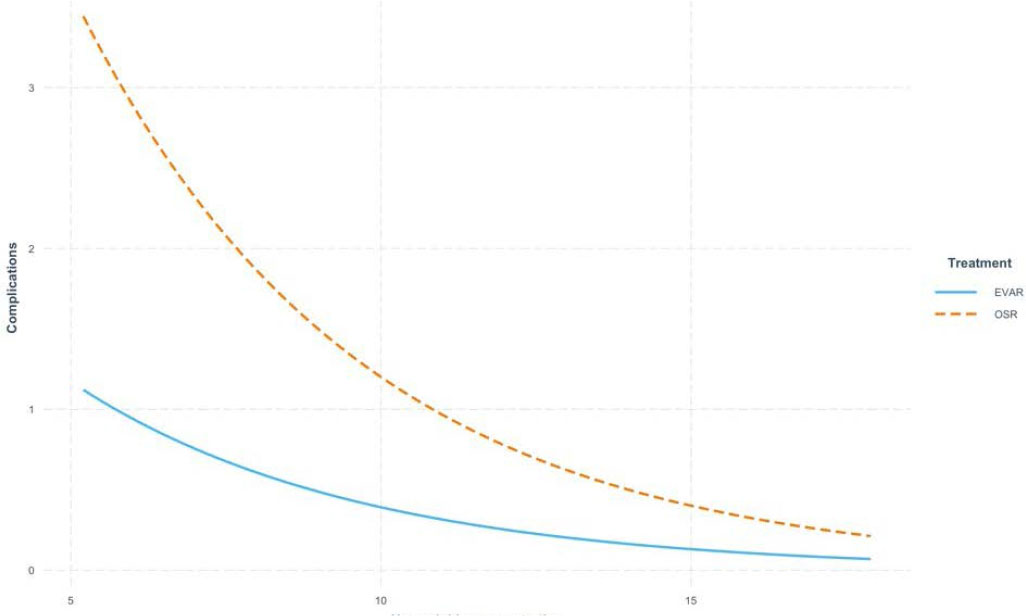
FIGURE 1.
The effect of hemoglobin concentration (g/dl) on the number of complications according to the chosen treatment strategy. As hemoglobin levels increase, the difference in complication rates between EVAR and OSR decreases.
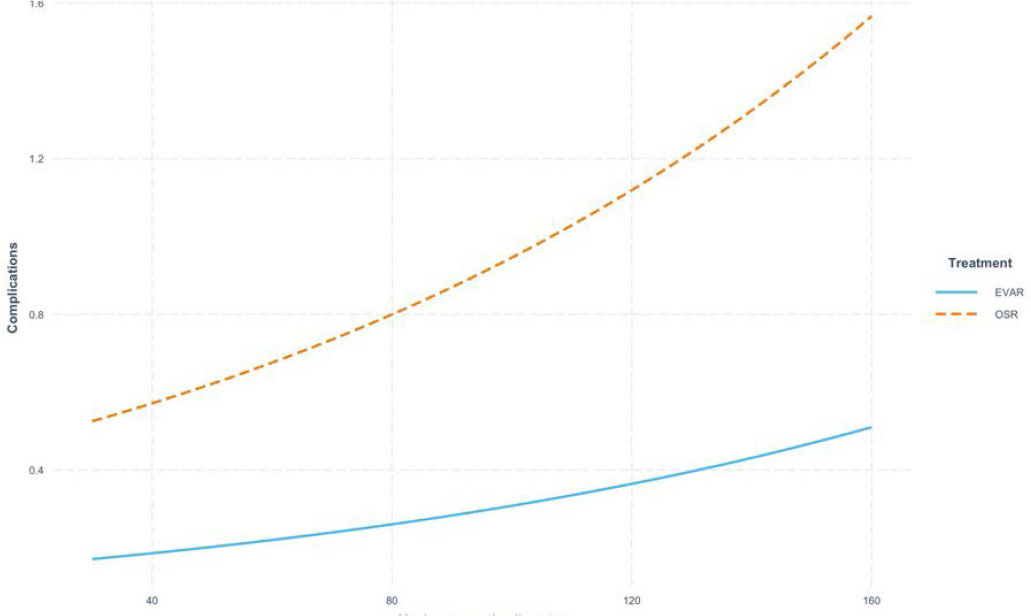
FIGURE 2.
The effect of the maximum aortic diameter (mm) on the number of complications, according to the chosen treatment strategy. As the aortic diameter increases, the number of complications resulting from OSR increasingly diverge from those resulting from EVAR.
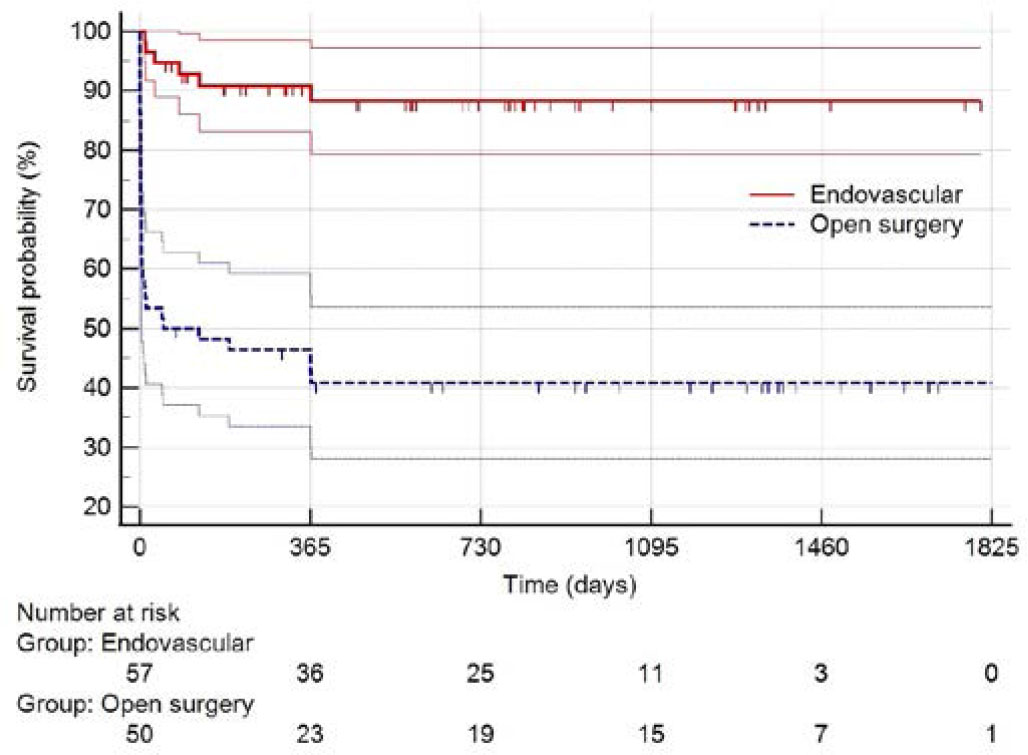
FIGURE 3.
Survival time (days) after endovascular vs. open surgical aortic repair. Although survival time decreases immediately after the intervention for both EVAR and OSR, the decline is less pronounced with EVAR, and survival time remains consistently higher compared to OSR. These findings are supported by the log-rank test (Χ2 = 30.6; p < 0.001).
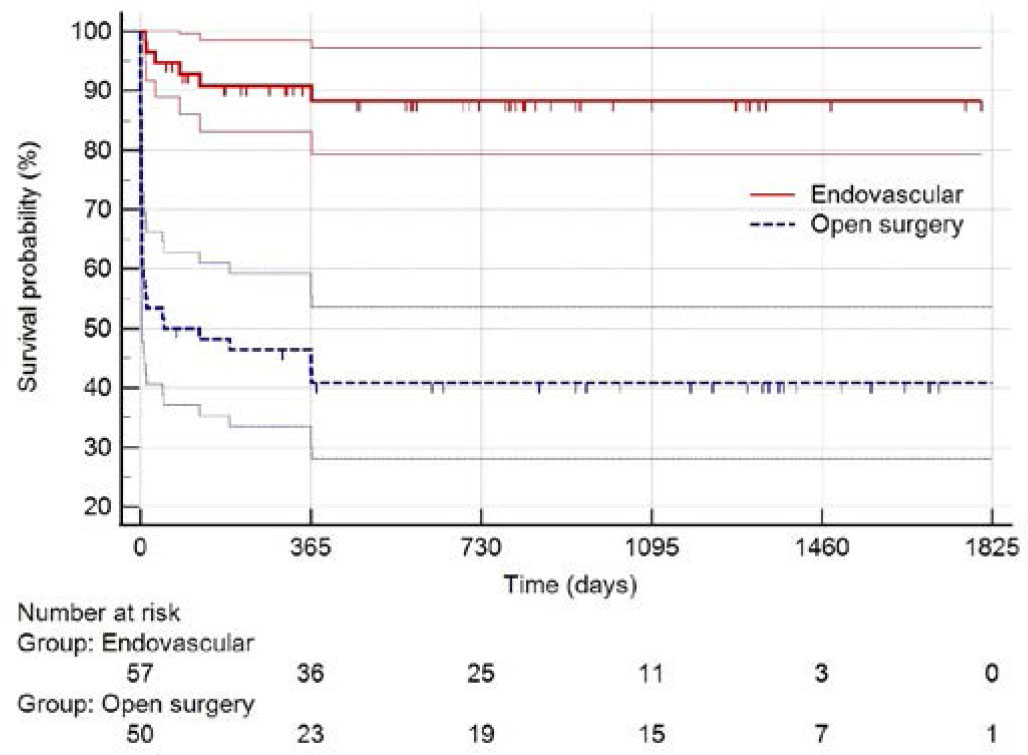
FIGURE 4.
Survival time (days) in relation to the occurrence of postoperative adverse events. Patients without complications (strata = 0) had a longer survival time compared to those who experienced adverse events (strata = 1). These findings are supported by the log-rank test (X2 = 61.3, p < 0.001).