
INTRODUCTION
Atherosclerosis is a pathology specific to the elderly, characterized by dysfunction of the arterial wall layers and progressive inflammatory changes.1 Initial intimal lesions occur in the presence of elevated blood lipid levels, particularly low-density lipoprotein (LDL), which accumulates in the subendothelial space and triggers the recruitment of inflammatory cells. Infiltrating monocytes differentiate into macrophages, which internalize lipids and transform into foam cells. The necrosis and apoptosis of these foam cells triggers an immune response, leading to the release of pro-inflammatory mediators that further recruit inflammatory cells to the area.2,3,4 The development of atherosclerotic plaques in the carotid arteries can lead to complex cerebrovascular diseases such as stroke and transient ischemic attack (TIA), either through significant arterial lumen narrowing or unstable plaques. To prevent the occurrence of stroke, which is a significant cause of disability in these patients, the treatment of symptomatic and asymptomatic severe carotid artery stenosis should be performed according to clinical guidelines.5,6,7
Carotid endarterectomy (CEA) is the preferred treatment for patients with severe carotid stenosis, as recommended by the 2023 clinical guidelines of the European Society of Vascular Surgery for the management of atherosclerotic carotid disease. When combined with appropriate medical management, CEA can significantly reduce the incidence of stroke or TIA in these patients. Immediate postoperative complications include neck hematoma, facial or hypoglossal nerve palsy, and severe hypotension, whereas TIA or stroke occur in a small proportion of cases.8,9,10,11
High-sensitivity C-reactive protein (hs-CRP) is a well-established marker of systemic low-grade inflammation, with elevated levels associated with an increased risk of atherosclerotic cardiovascular events.12,13 Numerous studies have found a connection between increased plasma hs-CRP levels, unstable carotid plaques, and higher degrees of stenosis.14,15,16 Longitudinal studies indicate that higher preoperative hs-CRP levels correlate with a greater likelihood of early restenosis following CEA; however, evidence regarding its association with immediate postoperative complications is limited.17,18,19 Monocyte chemoattractant protein 1 (MCP-1) is a chemokine that recruits and attracts monocytes to sites of inflammation, including the atherosclerotic arterial wall.20,21,22 Recent genetic and observational studies in humans provide additional evidence linking circulating MCP-1 levels to an increased risk of both stroke and coronary artery disease.23,24,25 Furthermore, elevated plasma MCP-1 levels have been associated with an increased risk of major adverse cardiovascular events (MACE) following CEA, regardless of age, sex, and vascular risk factors. This suggests that MCP-1 may serve as a potential biomarker for MACE in these patients and could represent a therapeutic target for managing the progression of systemic atherosclerosis.26,27
Another group of biomarkers is represented by matrix metalloproteinases (MMPs), a well-recognized group of proteases that have a major role in the progression and regression of atherosclerotic plaques.28 Previous studies have demonstrated a correlation between elevated levels of MMPs, such as MMP-3, MMP-7, and MMP-9, and reduced levels of their endogenous inhibitor (tissue inhibitor of matrix metalloproteinases-1 (TIMP-1)) in carotid plaque specimens and blood samples from patients with unstable carotid plaques.29,30 A recent study reported significantly higher MMP-9 levels in patients with established carotid atherosclerosis compared to individuals without carotid atherosclerotic plaques. Moreover, during post-intervention follow-up, elevated MMP-9 levels were identified as an independent predictor of MACE.31 Among the various MMPs studied, MMP-9 is the most strongly associated with cardiovascular diseases.32
Recent studies suggest that oxidized low-density lipoprotein (ox-LDL) has a crucial role in the development of atherosclerotic lesions.33 Ox-LDL indirectly influences the expression and activity of MMPs within atherosclerotic plaques.34 Additionally, ox-LDL stimulates the production of MCP-1, which leads to endothelial injury and the formation of new blood vessels.35 In a 2024 study, Woźniak et al. demonstrated that patients with unstable carotid plaques exhibit higher levels of ox-LDL and MMP-9 compared to those with stable plaques. Among these markers, ox-LDL appears to be the most reliable independent predictor of plaque instability in patients undergoing evaluation for CEA.36
The aim of this study was to identify serum biomarkers that can predict immediate postoperative complications following CEA.
MATERIAL AND METHOD
This prospective clinical study was conducted between February 2023 and January 2024 at the Vascular Surgery Clinic of the County Emergency Clinical Hospital of Targu Mures, Romania. The study involved all patients admitted with carotid artery stenosis greater than 70% who underwent carotid revascularization. Individuals with a second stenotic lesion in the intracranial segment of the internal carotid artery, those who experienced restenosis after CEA on the same artery, patients presenting carotid near occlusion (defined as severe stenosis with the collapse of the distal vessel), and individuals with hematological disorders were excluded from the study. Patients who chose not to take part in the study were also excluded.
COLLECTION OF PATIENT DATA AND BLOOD SAMPLES
Patient data were collected from the clinical charts and medical records, and included age, sex, symptoms, and comorbidities such as hypertension (including its stage), ischemic heart disease, advanced coronary artery disease, diabetes (with type specification), chronic kidney disease, peripheral arterial disease, dyslipidemia, and smoking status. Patients with ischemic heart disease who underwent a revascularization procedure for their coronary artery lesions were classified as having advanced coronary artery disease. Additionally, stroke history, preoperative medications (including anticoagulants, antiplatelet agents, and lipid-lowering therapy), and blood test results were documented. Patients were monitored for the first 2 days postoperatively to identify any immediate complications, including stroke, TIA, cranial nerve palsy, neck hematoma, and severe hypotension.
Blood samples were collected in plain and EDTA vacutainers and promptly sent to the laboratory. Depending on the type of blood collection tube, serum and plasma were separated by centrifugation. The resulting serum or plasma samples were aliquoted and stored at −80 °C until all samples had been collected from the recruited patients.
SURGICAL TECHNIQUE OF CEA
The CEA procedure began with a longitudinal incision on the anterolateral region of the neck, aligned with the anterior border of the sternocleidomastoid muscle. Dissection proceeded through the anatomical layers to expose the carotid arteries, which were then isolated using vascular loops, followed by systemic administration of heparin (70 IU/kg). The internal carotid artery was clamped, and if cerebral oxygen levels declined significantly from the baseline within the first 2–3 min, a shunt was placed to prevent cerebral hypoxia. Following carotid artery clamping, a longitudinal arteriotomy was performed at the common and internal carotid artery sites, followed by endarterectomy with or without shunting (Flexcel Carotid Shunt, LeMaitre). The artery was sutured with a mono-filament wire, and in certain cases, a juxta-arterial drain tube was placed near the carotid artery. Finally, the skin was closed using the intradermal technique.
STUDY OF CIRCULATING BIOMARKERS
Serum inflammatory and lipid markers were assessed using immunoassay techniques, specifically nephelometry for hs-CRP measurement and ELISA for the quantification of MMP-9, MCP-1, and ox-LDL (Wuhan Fine Biotech Co.). Serum hs-CRP levels were measured using the latex particle enhanced immuno-nephelometry technique on a BN ProSpec automated analyzer (Siemens Healthineers). MMP-9, MCP-1, and ox-LDL were determined by ELISA on a Dynex DSX automated analyzer (Dynex Technologies), which enables the simultaneous processing of four different ELISA kits and has intuitive software with high throughput capabilities. MMP-9 quantification was performed in 96-well plates precoated with anti-MMP-9 antibodies, which enabled the uptake of the target analyte from the sample, with the subsequent formation of immune complexes. Detection was achieved through the addition of a conjugate containing biotin-labeled secondary antibodies and a streptavidin-peroxidase complex. Absorbance values at 450/620 nm were used to determine MMP-9 concentrations via extrapolation from a calibration curve. A similar principle was used to determine MCP-1 and ox-LDL levels, with antibodies specific to each target analyte coating the wells.
STUDY OUTCOMES
The primary objective of the study was to identify patients who experienced immediate complications, such as stroke, TIA, cranial nerve palsy, neck hematoma, and severe hypotension, in the first 48 h following surgery.
The secondary objective was to evaluate the relationship between these complications and the patients’ comorbidities, risk factors, preoperative medications, and serum biomarkers.
STATISTICAL ANALYSIS
An α significance level of 0.05 and a 95% confidence interval (CI) were considered. All reported 95% CI were bootstrapped with 1,000 samples.37 Continuous variables were evaluated for normal distribution using the Shapiro–Wilk test. Continuous variables with normal distribution were reported as mean ± s.d. and compared using the unpaired Student’s t-test, whereas continuous variables without normal distributions and discrete variables were reported as median (interquartile range) and compared using the Mann–Whitney U-test. Categorical variables were reported as absolute and relative frequencies and compared using Fisher’s exact test. Correlations were evaluated using Spearman’s test. All multivariable models were constructed in a stepwise forward selection based on the Bayesian information criterion.38 The predictive performance of the binary logistic model was analyzed using the area under the receiver operating characteristic curve and a calibration curve. Statistical analyses were performed using R v.4.1.1 and R Studio v.1.4.17.
RESULTS
CHARACTERISTICS OF THE STUDY POPULATION
The study group consisted of 46 individuals aged between 42 and 80 years, with a more significant proportion of men (n = 31; 67.39%) compared to women (n = 15; 32.61%). The most frequent comorbidities were hypertension (95.65%) with stage II hypertension identified in 27 cases (58.7%), dyslipidemia in 43 cases (93.48%), and ischemic heart disease in 36 cases (78.26%). Of the 46 patients included in the study, only three had atrial fibrillation at the time of surgery, but none of them presented postoperative complications. Despite the significant number of patients with dyslipidemia, only four patients were classified as having grade 2 or 3 obesity, and the average body mass index (BMI) for the whole group was 28.78. The levels of carotid artery stenosis varied from 70% to 95%, with a mean of 83.47 ± 6.57%. Within the study population, 18 patients (39.13%) were smokers, but a substantial proportion, 30 patients (65.22%), had a recent history of stroke before undergoing surgery (Table 1).
TABLE 1.
Baseline characteristics of the study population
| Variables | Study population (n = 46) |
|---|---|
| Male sex | 31 (67.39%) |
| Female sex | 15 (32.61%) |
| Age (years) | 66.07 ± 8 |
| BMI (kg/m2) | 28.36 (25.15–31.32) |
| Hypertension | 44 (95.65%) |
| Hypertension stage II | 27 (58.7%) |
| Ischemic heart disease | 36 (78.26%) |
| Advanced coronary artery disease | 12 (26.09%) |
| Atrial fibrillation 3 (6.52%) | |
| Diabetes mellitus | 15 (32.61%) |
| Treatment with oral antidiabetics | 9 (19.57%) |
| Treatment with insulin | 6 (13.04%) |
| Peripheral arterial disease | 12 (26.09%) |
| Chronic kidney disease | 8 (17.39%) |
| Stroke history | 30 (65.22%) |
| Dyslipidemia | 43 (93.48%) |
| Smoking | 18 (39.13%) |
| Mean carotid artery stenosis (%) | 83.47 ± 6.57 |
PREOPERATIVE MEDICATION AND LABORATORY PARAMETERS
In our study group, 11 patients were receiving either nonvitamin K antagonist oral anticoagulants (NOACs) or vitamin K antagonists (VKAs) prior to CEA. Antiplatelet therapy included aspirin or P2Y12 inhibitors, with 42 patients receiving at least one of these agents, and 19 undergoing dual antiplatelet therapy. All 43 participants with dyslipidemia were on statin therapy, with 11 receiving combination treatment with ezetimibe. Regarding statin intensity, 39 patients (90.7%) were on moderate-intensity statin therapy and 4 patients (9.3%) received high-intensity statin therapy (Table 2).
TABLE 2.
Preoperative medication
| Medication | Study population (n = 46) |
|---|---|
| Anticoagulant | 11 (23.91%) |
| NOAC | 8 (17.39%) |
| VKA | 3 (6.52%) |
| Antiplatelet | 42 (91.3%) |
| Aspirin | 36 (78.26%) |
| P2Y12 inhibitor | 26 (56.52%) |
| Hypolipemic | 43 (93.48%) |
| Statin | 43 (93.48%) |
| Statin + ezetimibe | 11 (23.91%) |
Complete blood count included absolute counts of neutrophils, lymphocytes, and monocytes. We also calculated the neutrophil-to-lymphocyte ratio (NLR) and the lymphocyte-to-monocyte ratio (LMR). Three patients had neutrophilia (NEU > 7.0 × 10³/µl), five patients had lymphocytosis (LYMPH > 3.5 × 10³/µl), and six patients had monocytosis (MONO > 900 × 103/µl). Additionally, plasma hs-CRP levels ranged from 0.16 to 29.2 mg/l, serum MCP-1 levels varied between 75.97 pg/ml and 847.06 pg/ml, MMP-9 levels ranged from 1.94 pg/ml to 560.4 ng/ml, and ox-LDL levels ranged between 17.59 pg/ml and 234.21 ng/ml. These biomarkers were considered to have predictive potential (Table 3).
TABLE 3.
Laboratory parameters
| Laboratory parameter | Value |
|---|---|
| Neutrophils (× 103/µl) | 5.35 ± 1.48 |
| Lymphocytes (× 103/µl) | 1.96 (1.61–2.74) |
| Neutrophil-to-lymphocyte ratio | 2.43 (1.76–3.16) |
| Monocytes (× 103/µl) | 0.66 ± 0.2 |
| Lymphocyte-to-monocyte ratio | 3.33 (2.7–4.12) |
| hs-CRP (mg/l) | 1 (0.55–5.57) |
| MCP-1 (pg/ml) | 196.51 (156.52–245.6) |
| MMP-9 (ng/ml) | 71.03 (43.43–104.39) |
| ox-LDL (ng/ml) | 52.16 (34.79–67.73) |
EARLY POSTOPERATIVE COMPLICATIONS AND CORRELATIONS WITH SERUM BIOMARKERS
Within the first 48 h following CEA, both clinical and biological parameters were assessed for all patients. Our team monitored the study participants to determine whether acute postoperative complications arose. We were specifically looking for neurological issues (such as stroke and TIA), cranial nerve palsies, neck hematomas, and instances of severe hypotension. Among the study participants, three experienced neurological issues postoperatively (one stroke and two TIAs), one developed facial nerve palsy, and another developed hypoglossal nerve palsy. Additionally, four patients developed neck hematomas, and two experienced severe hypotension, necessitating a brief transfer to the intensive care unit (maximum of 6 h) for inotropic support. Despite the limited sample size, no in-hospital deaths were recorded following CEA.
To minimize the occurrence of immediate postoperative complications and prevent their onset, we sought to identify the factors that might affect this outcome. We categorized the study participants into two groups: one comprising 36 patients who did not experience any postoperative complications and another consisting of 10 patients who did encounter such complications, as previously mentioned, with one patient who developed two complications. We employed statistical analyses to determine whether patient characteristics, comorbidities, pre-operative medications, laboratory results, and biomarkers could have an impact on the emergence of complications following CEA (Tables 4 and 5).
TABLE 4.
Associated comorbidities and preoperative medication in patients with and without postoperative complications
| Variables | Patients without complications (n = 36) | Patients with complications (n = 10) | p value |
|---|---|---|---|
| Male sex | 23 (63.89%) | 8 (80%) | 0.48 |
| Age (years) | 65.61 ± 8.5 | 67.7 ± 5.95 | 0.47 |
| BMI (kg/m2) | 28.05 (24.29–30.59) | 29.51 ± 3.64 | 0.35 |
| Hypertension | 35 (97.22%) | 9 (90%) | 0.38 |
| Hypertension stage | 2 (2–2) | 2 (2–3) | 0.52 |
| Ischemic heart disease | 28 (77.78%) | 8 (80%) | 0.99 |
| Advanced coronary artery disease | 9 (25%) | 3 (30%) | 0.70 |
| Diabetes mellitus | 13 (36.11%) | 2 (20%) | 0.45 |
| Treatment with oral antidiabetics | 8 (22.22%) | 1 (10%) | 0.66 |
| Treatment with insulin | 5 (13.89%) | 1 (10%) | 0.99 |
| Peripheral artery disease | 10 (27.78%) | 2 (20%) | 0.70 |
| Chronic kidney disease | 7 (19.44%) | 1 (10%) | 0.66 |
| Stroke history | 25 (69.44%) | 5 (50%) | 0.28 |
| Dyslipidemia | 34 (94.44%) | 9 (90%) | 0.52 |
| Smoking | 17 (47.22%) | 1 (10%) | 0.06 |
| Carotid artery degree stenosis | 84.53 ± 6.47 | 79.5 ± 5.5 | 0.02 |
| Preoperative anticoagulant | 10 (27.78%) | 1 (10%) | 0.41 |
| NOAC | 8 (22.22%) | 0 (0%) | 0.15 |
| VKA | 2 (5.56%) | 1 (10%) | 0.52 |
| Preoperative antiplatelet | 33 (91.67%) | 9 (90%) | 0.99 |
| Aspirin | 27 (75%) | 9 (90%) | 0.41 |
| P2Y12 inhibitor | 22 (61.11%) | 4 (40%) | 0.29 |
| Preoperative hypolipemic | 34 (94.44%) | 9 (90%) | 0.61 |
| Statin | 34 (94.44%) | 9 (90%) | 0.61 |
| Statin + ezetimibe | 8 (22.22%) | 3 (30%) | 0.66 |
TABLE 5.
Laboratory parameters and serum biomarkers in patients with and without postoperative complications
| Laboratory parameters | Patients without complications (n = 36) | Patients with complications (n = 10) | p value |
|---|---|---|---|
| Neutrophils (× 103/µl) | 5.47 ± 1.56 | 4.91 ± 1.14 | 0.30 |
| Lymphocytes (× 103/µl) | 2.07 (1.65–3) | 1.86 ± 0.42 | 0.12 |
| Neutrophil-to-lymphocyte ratio | 2.34 (1.73–3.14) | 2.73 ± 0.75 | 0.39 |
| Monocytes (× 103/µl) | 0.67 ± 0.21 | 0.62 ± 0.16 | 0.47 |
| Lymphocyte-to-monocyte ratio | 3.47 (2.69–4.14) | 3.42 ± 0.97 | 0.57 |
| hs-CRP (mg/l) | 0.98 (0.54–4.94) | 2.04 (0.6–18.73) | 0.29 |
| MCP-1 (pg/ml) | 206.87 (157.96–250.72) | 181.94 (160.27–202.13) | 0.46 |
| MMP-9 (ng/ml) | 67.17 ± 34.28 | 191.92 ± 182.72 | 0.03 |
| ox-LDL (ng/ml) | 51.81 (35.01–70.83) | 50.99 ± 14.32 | 0.96 |
The findings from our statistical analyses indicated that demographic factors such as age, sex, and weight of the patients did not affect the occurrence of postoperative complications. Furthermore, the patients’ comorbidities and the medications they took did not have a direct impact on postoperative recovery following CEA. Interestingly, smoking, known as a cardiovascular risk factor, did not elevate the risk of postoperative complications (p = 0.06); approximately half of the patients who did not experience postoperative complications were smokers, compared to just 1 in 10 among those with unfavorable outcomes after CEA. The degree of carotid artery stenosis significantly influenced postoperative recovery (p = 0.02), indicating that lower grades of stenosis, particularly between 70% and 80%, heightened the likelihood of postoperative complications (Table 4).
We also investigated the effect of laboratory parameters and blood biomarkers on the occurrence of postoperative complications. Based on the statistical tests conducted, the sole biomarker that indicated a likelihood of postoperative complications was MMP-9, notably when its value exceeded the cut-off value of our group, 124.55 (p = 0.03). None of the other laboratory tests demonstrated a predictive capability for preventing complications after CEA (Table 5).
The final stepwise multivariable linear regression model for predicting perioperative complications included MMP-9 and hs-CRP. Both markers correlated positively with the number of complications, similarly to univariate regression. However, in the final stepwise multivariable binary logistic regression model for predicting postoperative complications, only MMP-9 was a significant predictor (Table 6). In the univariate regression analysis, a noteworthy positive correlation was found between the serum levels of hs-CRP and MMP-9 and the number of complications occurring during hospitalization following CEA, whereas MCP-1 and ox-LDL showed no correlation with the overall number of complications (Figure 1). MMP-9 had an area under the curve of the receiver operator characteristic of 0.717 (0.513–0.889), with an associated cut-off value of >124.55 ng/ml.
TABLE 6.
Final stepwise multivariable linear and binary logistic regression models for the prediction of complications after CEA
| Multivariable linear regression* | |||
| Parameter | Coefficient (95% CI) | Std. error | p value |
| MMP-9 (ng/ml) | 0.0029 (0.001–0.005) | 0.001 | 0.004 |
| hs-CRP (mg/l) | 0.0288 (0.005–0.053) | 0.012 | 0.021 |
| Multivariable binary logistic regression** | |||
| Parameter | OR (95% CI) | p value | |
| MMP-9 (ng/ml) | 0.0183 (0.002–0.035) | 0.02 | |
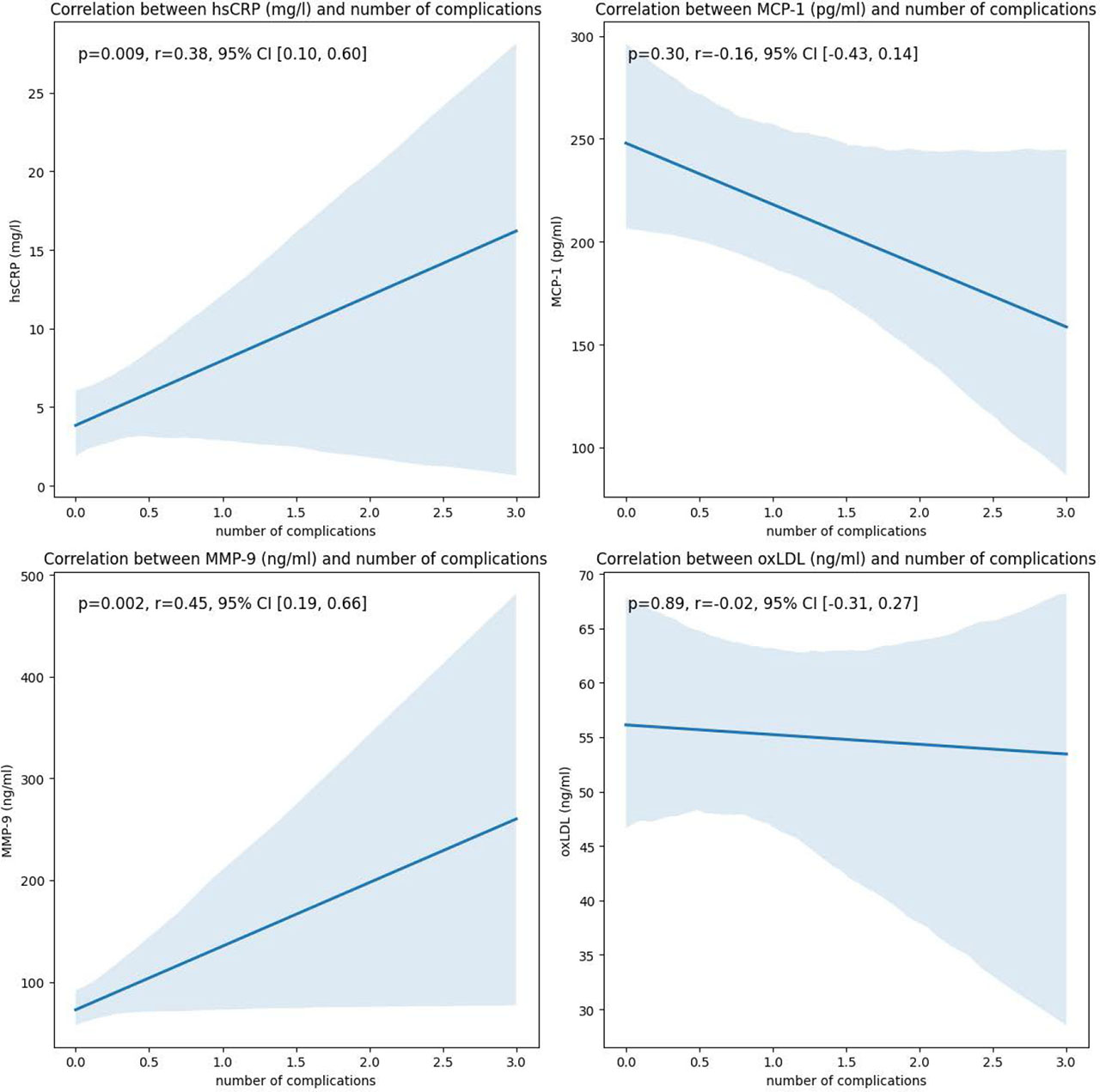
FIGURE 1.
Linear correlation between serum parameters and the number of complications. The p value was obtained by using Spearman's test.
DISCUSSION
CEA is a surgical procedure aimed at removing atherosclerotic plaque from the carotid artery, which is crucial for maintaining adequate blood flow to the brain, as approximately 15% of strokes are still caused by carotid artery stenosis. Guidelines published by the European Stroke Organisation (2021) and the European Society of Vascular Surgery (2023) strongly recommend CEA for patients with carotid artery stenosis greater than 70% because of the low rate of postoperative complications, improvements in quality of living, and the absence of age-related increase in perioperative stroke or mortality risk.8,9 Endarterectomy has also demonstrated benefits for patients with moderate stenosis (50–69%) and is highly beneficial for those with high-grade stenosis (70–99%).1,39
The clinical outcomes observed in our study are consistent with those reported in our previous research40 and a larger study conducted by Cruz Silva et al.41 in terms of mean age, sex, types of comorbidities, stroke history, and postoperative complications. The findings of these studies also indicate that preoperative anticoagulant and antiplatelet therapy does not prevent the occurrence of neurological complications following CEA. These results are consistent with our observations, as presented in Table 4.
In comprehensive research examining the causes of procedural strokes after CEA, Huibers et al. identified eight possible mechanisms that might lead to postoperative stroke. The analysis of over 3,000 patients revealed that no single stroke mechanism was dominant, the most common being carotid embolic, hemodynamic, and hyperperfusion syndrome.42 Following CEA, less than 3% of patients experienced a stroke, mostly occurring on the day of surgery, which aligns with the findings of our study.
One of the biomarkers examined in our research was MMP-9. The perioperative blood concentration of this biomarker was also analyzed by Molloy et al., who discovered that patients with elevated preoperative levels of MMP-9 had an increased risk of developing cerebral embolization at the time of the procedure. Embolization occurs during the dissection and preparation of the carotid artery, as shown by transcranial ultrasound performed during CEA, and this was also associated with higher MMP-9 levels on the first postoperative day.43 Our findings align with these results, indicating that elevated preoperative levels of this biomarker are associated with an increased risk of postoperative complications, including stroke and TIA.
A 2018 systematic review by Zielinska-Turek et al. demonstrated that elevated MMP-9 levels alongside reduced tissue inhibitor of metalloproteinase (TIMP) levels are indicative of a higher risk of ischemic stroke. These findings indicate that the previously mentioned fluctuations in MMP-9 and TIMP levels may serve as predictors of cerebrovascular incidents in patients with symptomatic and asymptomatic carotid stenosis who have undergone stenting or endarterectomy.44 These outcomes for patients undergoing CEA were also encountered in our study.
We also found an association between elevated preoperative levels of hs-CRP and the development of immediate complications following CEA, echoing the findings of Heider et al., who also observed higher hs-CRP and fibrinogen levels in patients who experienced brain infarctions after CEA. Their findings indicate that preoperative fibrinogen and hs-CRP levels are independent factors associated with the emergence of new periprocedural cerebral ischemic lesions due to microemboli incidents.45 The authors concluded that although their study included 183 patients, further research is needed to endorse hs-CRP as a prognostic indicator for perioperative cerebral lesions. Our study found that patients who presented complications after CEA had higher hs-CRP levels, which may contribute to identifying a predictor for brain ischemia after CEA.
Another biomarker we analyzed was MCP-1. Some of our patients had high preoperative MCP-1 serum levels. However, additional statistical tests were not able to demonstrate a correlation between high MCP-1 levels and immediate postoperative complications after CEA. Only one study, published by Mack et al., found a correlation between elevated preoperative MCP-1 levels and acute neurocognitive decline 1 day after CEA. Postoperative MCP-1 levels were also high in these patients on the first day after surgery, suggesting that inflammatory mechanisms may be involved in this pathology.46
LIMITATIONS OF THE STUDY
This clinical study has certain limitations. The first one is the relatively small sample size, which may limit our ability to observe more types of immediate postoperative complications. Consequently, our analysis focused on the most commonly occurring complications following CEA. Additionally, certain clinical and paraclinical variables were not subjected to statistical analysis, potentially leading to the omission of findings that might have statistical significance. Moreover, these results cannot be generalized to populations with lower degrees of carotid artery stenosis but are indicated for CEA due to symptomatic conditions. Future research should aim to identify the most effective biomarkers for predicting complications following CEA in patients with severe carotid stenosis.
CONCLUSIONS
Carotid endarterectomy is a surgical procedure performed on individuals with significant stenosis of the carotid artery, typically older adults, with the objective of reducing the risk of neurological complications. Our study demonstrated that in patients with severe carotid stenosis the incidence of immediate postoperative complications, including stroke, TIA, facial or hypoglossal nerve palsy, neck hematoma, or severe hypotension, are influenced by the degree of stenosis and the elevated blood levels of MMP-9 and hs-CRP. Such complications can, on occasion, pose a critical and life-threatening risk, necessitating a multi-disciplinary and coordinated treatment approach. Identifying and addressing the risk factors that could lead to these adverse events is paramount to preventing them.
Notes
[4] ETHICS APPROVAL
This research was carried out in accordance with the principles stated in the Declaration of Helsinki and was approved by the ethical committees of the County Emergency Clinical Hospital of Targu Mures, Romania (approval no. 1324/26.01.2023) and George Emil Palade University of Medicine, Pharmacy, Science, and Technology of Targu Mures, Romania (approval no. 2095/15.02.2023).
[5] CONSENT TO PARTICIPATE
All study participants provided written informed consent before being included in the study.
[6] DATA AVAILABILITY
Further data is available from the corresponding author upon reasonable request.
[7] FUNDING
This work was supported by the George Emil Palade University of Medicine, Pharmacy, Science, and Technology of Targu Mures, Romania (research grant no. 164/4/10.01.2023).
[8] Contributed by AUTHOR CONTRIBUTIONS
I.A.B., A.H., and E.H. contributed to conceptualization. I.A.B., A.V.M., G.B.M., and P.A.C contributed to data curation. I.A.B., A.H., and E.H. contributed to methodology. I.A.B., A.V.M., A.H., E.H., and G.B.M. contributed to investigation. A.P.C. performed the statistical analysis. I.A.B., A.H., and E.H. prepared the original draft. A.V.M. provided supervision. A.H., P.A.C., and G.B.M. reviewed and edited the manuscript. All authors have read and agreed to the published version of the manuscript.