
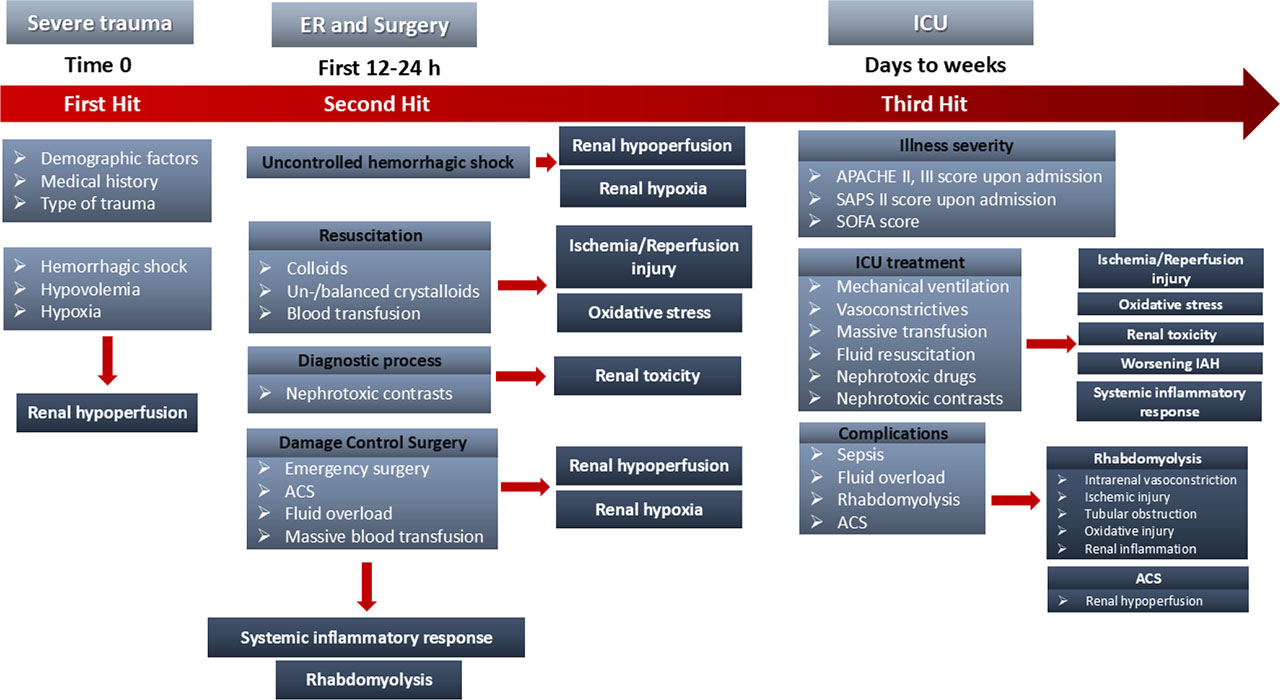
Fig. 1.
Potential risk factors of TrAKI in different timepoints of trauma treatment: Severe trauma triggers initial AKI due to hemorrhage, hypovolemia and hypoxia, resulting in renal hypoperfusion. After these, the second hit due to fluid resuscitation, massive transfusion, emergency abdominal surgery, abdominal compartment syndrome and diagnostic processes with nephrotoxic contrast agents could further deteriorate renal hypoperfusion, cause ischemia/reperfusion injury, oxidative stress and renal toxicity. The third hit, due to critical care treatment or late complications, may cause additional disorders resulting in renal function impairment. ACS: Abdominal Compartment Syndrome, APACHE score: Acute Physiology and Chronic Health Evaluation score, ER: Emergency Room, IAH: Intrabdominal Hypertension, ICU: Intensive Care Unit, SAPS score: Simplified Acute Physiology Score, SOFA score: Sequential Organ Failure Assessment score, TrAKI: Trauma related Acute Kidney Injury
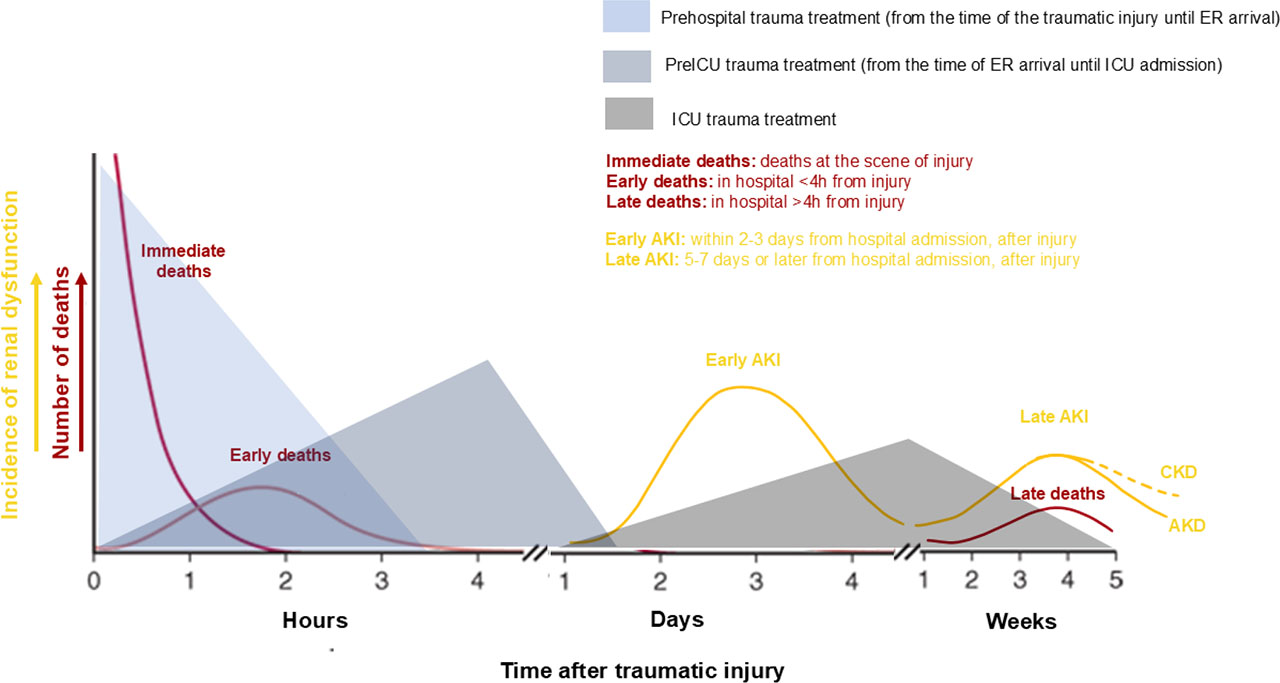
Fig. 2.
Bimodal distribution of Trauma – related Acute Kidney Injury (TrAKI): In line with trimodal distribution of deaths in trauma (red lines) [3], a bimodal distribution of TrAKI is observed (yellow lines). A first peak occurs approximately at 48–72 hours after trauma (time 0), is referred as “Early AKI” and is a direct consequence of trauma itself as well as prehospital and upon admission in the hospital trauma management. A second peak occurs >7 days or week, is referred as “Late AKI” and it is related to critical care and the delayed complications of critical illness. The latter AKI may exist as long as 90 days, hence called AKD (Acute Kidney Disease) (continuous yellow line) or rarely even longer, hence called CKD (chronic kidney disease) (dashed yellow line).
Table 1.
Trauma-related AKI studies
| Type of study | Material | AKI incidence | Diagnostic criteria | Time to AKI diagnosis | RRT requirement | Total mortality | Demographic/Comorbidities | Prehospital risk factors | Pre-ICU risk factors | ICU risk factors | Renal outcome | |
|---|---|---|---|---|---|---|---|---|---|---|---|---|
| Bagshaw SM et al, Ren Fail.2008;30:581–9 (ANZICS and APD). [12] | Multi-center retrospective study (57 ICUs) (1/1/2000 – 31/12/2005) | ICU only trauma patients (42.2% TBI) | 1711/9449 (18.1%) | RIFLE | Within 24 hours after ICU admission in 36.1% | Not mentioned | 16.7% AKI vs 7.8% non-AKI | Older age, Female sex, Pre-existed comorbidities | Direct renal injury, Abdominal and pelvic injury | Need for nephrectomy | APACHE II and III score, Sepsis | Not mentioned |
| Moore AM et al, Ren Fail. 2010;32(9):1060–1065.[18] | 2-center retrospective study (Trauma DataBase) (1/1/2008 – 31/12/2008) | ICU only head trauma patients (GCS<13) | 19/207 (9.2%) | RIFLE | First 10 days of admission | Not mentioned | 42.1% AKI vs 18.1% non-AKI | Older age | Lower GCS, APACHE III score | Not mentioned | Not mentioned | Not mentioned |
| Bihorac A et al, Ann Surg. 2010;252(1):158–165.[10] | Multicenter prospective cohort (Trauma-DataBase) (11/2003-3/2008) | Trauma patients that live >24 h after injury | 253/982 (26%) | RIFLE | First 28 days of hospitalization, 68% within 48 hours | 11% RRT | 3 times higher in AKI patients | Not the age | Low body temperature, Not ISS | Lactate level, blood transfusion | MOD score >3 | 50% didn’t have complete recovery in the first 28 days |
| Li N et al, Neurocrit Care. 2011;14(3):377–381.[14] | Retrospective single center study (1/2007 – 5/2010) | Only traumatic brain injury patients (GCS<8) with hospital stay>48 h | 31/136 (23%), 21/31 (68%) stage 1, 7/31 (22%) stage 2, 3/31 (10%) stage 3 | AKIN | Within 7 days after brain injury | 0% RRT | 17/31 AKI (55%) vs 11/105 non-AKI (11%) | Age | Lower GCS, Higher TBI score | Transtentorial herniation | Not mentioned | 100% renal recovery among survivors |
| Shashaty MGS et al, J Crit Care 2012;27(5):496–504. [11] | Single center prospective cohort study (10/2005 – 6/2009) Excluded only head trauma | ICU trauma patients | 147/400 (36.8%) | AKIN | First 5 days from ER presentation, 53.1% on day 0–1 | 9/147 | 1: 9.8% 2: 13.7% 3: 30.4% vs 3.8% in non-AKI | African American race, BMI>30, Diabetes | AIS>4 | Blood transfusion | ISS | Not mentioned |
| Podoll AS et al, PLoS One. 2013; 8(10):e7737. [1] | Retrospective observational single center study (trauma database) (1/2009 – 3/2010) Excluded head trauma and burns | ICU trauma patients in Texas Trauma Institute | 54/901 (6%), Stage 1: 85% 2: 11% 3: 4% | AKIN | Within 72 hours of admission | 10/54 (19%) RRT | 83/901 (9.2%) total mortality vs 16/54 (29.6%) AKI patients’ mortality | Age | AIS, Not ISS | Not mentioned | Not mentioned | Not mentioned |
| Baitello AL et al, J Bras Nefrol. 2013; 35(2):127–131. [24] | Retrospective observational study (7-8/2004) | Severe trauma patients (ISS>16) admitted in hospital | 13/75 (17.3%) | AKIN | Within the first 3 days of admission | 1/13 (7.6%) RRT | 29.3% total mortality, 8/13 AKI mortality | Not age, Not gender | Head injury (GCS<10), ISS | Higher volume replacement, Not MAP | Not nephrotoxic drugs | Not mentioned |
| Skinner DL et al, Injury 2014;45(1):259–64. [25] | Retrospective observational single center (3/2008 – 3/2011) | ICU trauma patients | 102/666 (15%): 25% (25/102) I, 57% (58/102) F | RIFLE criteria | 57% at the time of ICU admission | 39/102 (38%) RRT | 57% AKI group, 78.9% among renal injury | Age>50, | ISS>45 | BE >-12, iv contrast administration, blunt trauma | SOFA, RM | Not mentioned |
| Ahmed M et al, Br J Neurosurg. 2015;29(4):544–548.[15] | Retrospective observational study (1/4/2012 - 31/3/2013) | Only TBI patients, that underwent surgery, survived and hospital discharged | 11/95 (11.6%): Stage 1: 7/11 (63.6%), 2: 3/11 (27.3%), 3: 1/11 (9.1%) | AKIN | 81.8% within 5 days of admission | 0/11 RRT | No mortality (0%) | Not significantly different | Lower GCS | Higher glucose, Larger volume of blood loss | Aminoglycoside therapy | 100% renal recovery |
| Elterman J et al, J Trauma Acute Surg 2015;79(4 Suppl 2):S171–4. [26] | Retrospective cohort study (01/2010 – 11/2010) | Only trauma US army, with CPK>5000 U/L | 79/318 (24.8%) with CPK>5000 U/L, AKI Stage I: 56/318 (17.6%) Stage 2: 3/318 (0.9%), Stage 3: 7/318 (2.2%) | KDIGO 2012 | Not mentioned | 6/7 Stage 3 required RRT | Not mentioned | Not mentioned | ISS, Mechanism of injury, Transport time | Massive transfusion >10 PRBC | Not mentioned | Not mentioned |
| Eriksson M et al, J Trauma Acute Care Surg. 2015;79(3):407–12. [16] | Single-center retrospective observational study (2/2007 – 9/2012) | Only ICU trauma patients | 101/413 (24.9%) KDIGO stage 1: 59% 2: 13% 3: 28% | KDIGO 2012 | 2–7 days of ICU admission | 27/101 (26%) CRRT, 6/101 IRRT | 26.2% vs 7.1% | Male sex, Age, Diabetes | ISS score >40 | Massive transfusion, HES overload | Shock, Sepsis, | None of ICU survivors were dialysis dependent 1 year after trauma |
| Heegard KD et al, J Trauma Acute Care Surg 2015;78(5):988–93. [23] | Data from 2 observational single-center studies | Only trauma ICU patients (mainly males) (Afghanistan – US army) | 46/134 (34.3%) KDIGO stage 1: 25.4% 2: 3.7% 3: 5.2% (total: 34.3%) | KDIGO 2012 | 80.5% the first 2 hospital days | Not mentioned | AKI 21.7% vs non-AKI 2.3% | Not the age | ISS score | Lactate, Blood transfusion | Blood transfusion | Not mentioned |
| Stewart IJ et al. Am J Kidney Dis. 2016;68(4):564–570. [27] | Retrospective observational study (2/2002 – 2/2011) | Only ICU trauma US service members, wounded in Iraq or Afghanistan, transferred in Landstuhl, Germany | 474/3807 (12.5%), Stage 1: 9.8%, 2: 1.6%, 3: 1.1% | KDIGO 2012 | Within 7 days | 14/474 RRT | 112/3807 (2.9%) in total died, 13.1% with AKI vs 1.5% without AKI | Age, African American race | ISS score | Shock | Shock, Sepsis | Not mentioned |
| Lai WH et al. Scand J Trauma Resusc Emerg Med. 2016;24(1):136.[16] | Retrospective study (1/1/2009 – 31/12/2014) | All trauma patients admitted in hospital (Taiwan trauma registry) | 78/14504 (0,54%) general in trauma 45/2789 (2.1%) ICU trauma patients | KDIGO 2012 | Within 24 hours | 3/78 (3.8%) RRT | Not mentioned | Age, Diabetes, Hypertension, Coronary artery disease | ISS score, Shock, GCS<8, Longer transport time | Shock, Intracerebral hemorrhage, | Shock | Not mentioned |
| Haines RW et al, Sci Rep. 2018;8(1):3665. [28] | Single-center retrospective observational study (2/2012 – 31/10/2014) | Only trauma ICU patients | 163/830 (19.6%) | KDIGO 2012 | Within 7 days (median time 2.7 days) | 42/830 (5.1%) | 53/163 (32.5%) vs 103/667 (15.4%) | Age, Charlson score | NISS score, ISS score, Abdominal or pelvic trauma, ER SBP, ER lactate, PRBC’s transfused in the first 24 h, first ALT, CK, SCr, and phosphate | First Cr, Phosphate, Blood transfusion | SAPS II score, Blood transfusion | Not mentioned |
| Harrois A et al, Crit Care 2018;22(1):344. [13] | Prospective observational multicenter study (5/2011-6/2014) | 3 French level-1 trauma centers | 13% total AKI R: 7% I:3.7% F:2.3% | RIFLE | 96% within 5 days | 1.6% RRT | Twofold increase ICU mortality | Not the age, SAPS II score | ABP, Maximum heart rate, ISS score | Renal trauma, Lactate, Hemorrhagic shock, RBC transfusion | SAPS II score, SOFA score, CPK peak | Not mentioned |
| Perkins ZB et al, PLoS One 2019;25: 14(1):e0211001. [8] | Single-center prospective observational study (1/2007-31/2016) | From ER admission-ICU-Hospital discharge | 178/1410 12.6% KDIGO stage 1: 66.3% 2: 10.1% 3: 23.6% | KDIGO 2012 | 2 (1–5) days | 38/178 (21.4%) | 47/178 (26.4% in AKI patients) 128/1232 (10.4% in non-AKI) | Age, Diabetes | ISS score, Blunt injury, Shock | Volume overload, Blood transfusion, Admission SBP, Lactate | Volume overload, Blood transfusion, Vasopressors, Nephrotoxic drugs | Not mentioned |
| Leditzke K et al, In Vivo. 2021;35(5):2755–62.[19] | Single-center retrospective observational study (10/2016-01/2018) | ICU trauma patients with ISS>16, admitted within 6 hours after injury | 18/39 | NGAL, Serum creatine, Serum urea | 1.2±1.4 days (range:0–5 days) | Not mentioned | 18% mortality | CKD | Severe injury (ISS>16) | Catecholamines | MV, Catecholamines, Sepsis, NGAL>177 ng/ml | Not mentioned |
| Yasuda R et al, Front Med (Lausanne). 2024 Feb 23;11:1346183.[20] | Single-center prospective observational study (10/2019-02/2020) | ICU trauma patients | 15/100 | LFAB | 6–12 hours after trauma | Not included | Not mentioned | Not mentioned | ISS | Contrast media, shock | Shock | Not mentioned |
| Martinez et al, Crit Care 2024;28(1):382.[29] | Multicenter retrospective cohort study (French Traumabase registry) (1/1/2012 – 1/6/2023) | ICU trauma patients, CK>5000 U/L | 1544/8592 severe RM | Not mentioned | Not mentioned | 4% increase 30-day mortality | Not mentioned | ISS score | Not mentioned | Not mentioned | Not mentioned |
[i] Abbreviations: ABP: Arterial Blood Pressure, AIS: Abbreviated Injury Scale, AKI: Acute Kidney Injury, APACHE II score: Acute Physiologic Assessment and Chronic Health Evaluation II score, BE: Base excess, BMI: Body Mass Index, CKD: Chronic Kidney Disease, ER: emergency room, GCS: Glasgow Coma Scale, ISS: Injury Severity Score, MV: Mechanical Ventilation, NISS: New Injury Severity Score, OR: operating theatre, PRBC: packs of red blood cell, RM: Rhabdomyolysis, SAPS II score: Simplified Acute Physiology II score, SBP: Systolic Blood Pressure, SOFA score: Sequential Organ Failure Assessment score
Table 2.
Risk factors of TrAKI in different time points
| Risk factors | Intervention | Pathophysiologic mechanism of TrAKI | Clinical and/or biochemical markers | |
|---|---|---|---|---|
| Physical characteristics | Older age, Male gender, African American, Obesity | BMI | ||
| Comorbidities | Chronic Kidney Disease, Diabetes mellitus, Chronic hypertension, Chronic heart failure, Cirrhosis, Chronic obstructive pulmonary disease, Hematologic malignancy | Antiplatelet drugs, | APACHE II, III score SAPS II score, Charlson score | |
| At hospital admission | Abdominal trauma, Pelvic trauma, Blunt and penetrating trauma, Renal trauma, Brain Injury | Hemorrhagic shock, Hypovolemia, Hypoxia, Renal hypoperfusion | Transportation time, ISS, NISS AIS, Admission lactate value, Minimum prehospital MAP, Maximal prehospital HR, Duration until trauma center admission, GCS | |
| First 12-24 h (ER and OR treatment) | Uncontrolled hemorrhage | Renal hypoperfusion, Renal hypoxia | Coagulopathy, Hypoxemia, Hypothermia, Lactemia, Viscoelastic assays, Acidosis | |
| Resuscitation process | Number of transfused units of PRBC, Fluid overload, Need for vasoconstrictives | I/R, Oxidative stress, Systematic inflammatory response | ||
| Diagnostic process | Intravenous contrast agents | Renal toxicity | ||
| Damage control surgery | Emergency surgery, ACS, Fluid overload, Massive transfusion | Renal hypoperfusion, Renal hypoxia, RM, Systematic inflammatory response | ||
| ICU admission (first 5 days – weeks) | Illness severity | SAPS II score, APACHE II or III score, SOFA score | ||
| ICU treatment | Mechanical ventilation | Systemic inflammatory response, Worsening IAH | Hypoxemia, Hypothermia, Lactemia, Acidosis, Coagulopathy, Viscoelastic assays | |
| Vasoactive therapy (noradrenaline, vasopressin) | Renal hypoperfusion | |||
| Fluid infusion | I/R, Oxidative stress | |||
| Blood transfusion | ||||
| Nephrotoxic drugs (diuretics, non-steroidal anti-inflammatory drugs, aminoglycosides, glycopeptides, contrast media) | Renal toxicity | |||
| ICU complications | Fluid overload | Systemic inflammatory response, Worsening IAH | CK, Myoglobin, Urea, Creatinine, Diuresis, Acidosis, Lactemia, Electrolytic abnormalities, IAP values, AKI biomarkers (NGAL, L-FABP, IGFBP-7 and TIMP-2 etc) | |
| RM | Intrarenal vasoconstriction, Ischemic injury, Tubular obstruction, Oxidative injury, Renal inflammation | |||
| ACS | Renal hypoperfusion | |||
| Sepsis | Renal hypoperfusion, Renal oxidative injury | |||
| Multiorgan dysfunction |
[i] Abbreviations: AIS: Abbreviated Injury Scale, ACS: Abdominal Compartment Syndrome, AKI: Acute Kidney Injury, APACHE II score: Acute Physiologic Assessment and Chronic Health Evaluation II score, BMI: Body Mass Index, CK: Creatine Phosphokinase, ER: emergency room, GCS: Glasgow Coma Scale, HR: Heart Rate, IAH: Intra-abdominal Hypertension, IAP: Intra-abdominal Pressure, IGFBP-7: Insulin like growth factor binding protein-7, ISS: Injury Severity Score, L-FABP: Liver fatty acid-binding protein MAP: Mean Arterial Pressure, NISS: New Injury Severity Score, NGAL: Neutrophil Gelatinase-Associated Lipocalin, OR: operating theatre, PRBC: packs of red blood cell, RM: Rhabdomyolysis, SAPS II score: Simplified Acute Physiology II score, SOFA score: Sequential Organ Failure Assessment score, TIMP-2: Tissue inhibitor of metalloproteinases 2.