
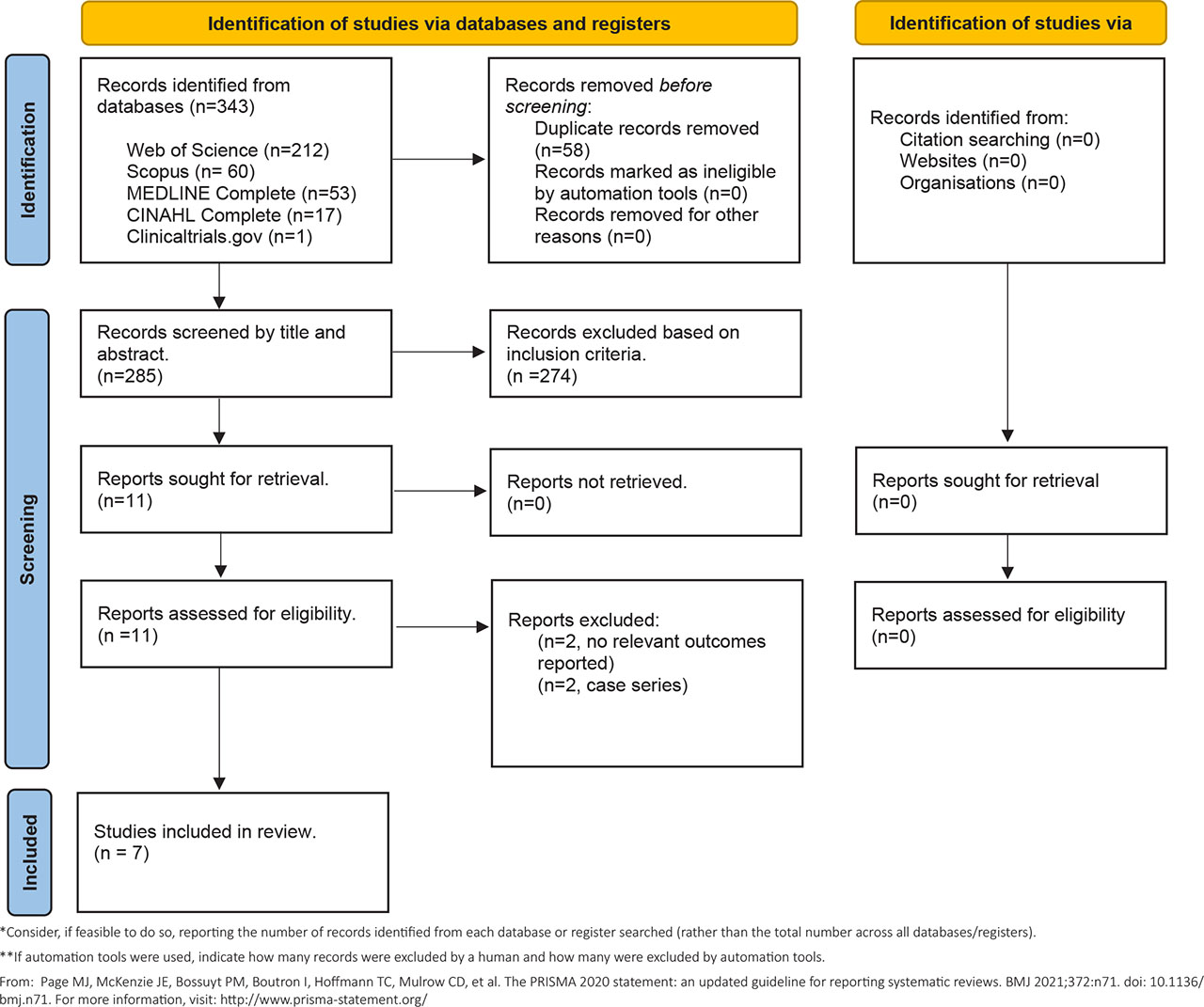
Fig. 1.
Preferred Items for Systematic Review and Meta-Analysis (PRISMA) screening process.
Table 1.
Definition of clinical, bacteriological and safety outcomes in the SEVEN included studies
| Study/year/country | Clinical outcome | Microbiological outcome | Adverse events |
|---|---|---|---|
| Levchenko 2023/Ukraine | Clinical parameters (body temperature and changes in respiratory parameters while on ventilator, including C dyn, PEEP and PIP), laboratory indices (blood oxygen saturation, leukocyte count), instrumental methods (CXR) Average duration of MV Average duration of ICU stays | Microbial load in sputum from endotracheal tubes on Day 3 and Day 5 | NA |
| Polat 2015/Turkey | Favourable clinical response: Clinical cure or clinical improvement (complete or partial resolution, respectively, of presenting symptoms and signs of pneumonia w/o requirement of any additional antibiotics at the end of the colistin treatment Clinical failure: persistence or progression of presenting symptoms and signs of pneumonia without requirement of any additional antibiotics at the end of colistin treatment Duration of PICU stay and Duration of MV after the initiation of colistin VAP-related mortality: patients who died due to persisting or worsening signs of pneumonia while receiving colistin tx Other-cause mortality: patients who died due to all other non-VAP related causes | Bacterial eradication – no growth of the causative microorganisms in the final culture Bacterial failure – persistence of the causative microorganism on follow-up cultures regardless of the clinical outcome Recurrence – re isolation of the same pathogen regardless of the clinical outcome Time to bacterial eradiation (TBE): duration of colistin tx until the day of bacterial eradication, defined as the day the cultures first became negative and remained negative in repeated samples | Nephrotoxicity – 50% or greater increased in serum creatinine level from the baseline and/or elevation of serum creatinine values beyond the estimated normal rage for the patient’s age group at any time during the tx Neurotoxicity Bronchoconstriction |
| Hussain 2020/Pakistan | Clinical success was defined as Clinical improvement: incomplete resolution OR Clinical cure: complete resolution Clinical failure: worsening or persistence Duration of NICU stay and Duration of MV after the initiation of colistin VAP-related mortality was defined as neonatal death during colistin therapy with persistent signs of pneumonia Overall Mortality | Eradication of the causative organism – no growth of the pathogen in the final culture of specimens during the entire hospitalization Persistence of the causative organism – persistent growth of the causative pathogen regardless of the clinical outcome Regrowth of the causative organism – re-isolation of the same pathogen regardless of the clinical outcome of the infection Colonization – persistence or regrowth of the pathogen without symptoms and signs of infection | Acute kidney injury (AKI) – increment in serum creatinine levels of ≥0.3mg/dl within 48 hours or 150–200% increase from baseline trough value Neurotoxicity – an episode of seizure or change in consciousness level at any time during colistin therapy Electrolyte imbalance causing additional electrolyte replacement required: Hypomagnesemia: <1.6mg/dl, Hypokalaemia: <3.5mM/L |
| Khanababee 2024/Iran | Days of hospital stay Days of MV Fever occurrence Laboratory markers: White blood cell (WBC) counts, Erythrocyte sedimentation rate (ESR), C-reactive protein (CRP) levels Mortality rate | No microbiological outcomes measured | Nephrotoxicity Neurotoxicity Tachycardia Bronchospasm |
| Bharathi 2022/India | Favorable outcome: Presenting symptoms and signs of infection were completely or partially resolved at the termination of colistin treatment OR Normalization of WBC counts, improvement of ABG, and reduction or disappearance of radiological findings on CXR Average duration of MV Average postoperative ICU stays Average hospital stays (days) VAP associated mortality Other cause mortality | Bacterial eradication – final culture of specimens demonstrating no growth of the pathogen during the entire hospitalization Persistence – Persistent growth of the responsible pathogen regardless of the clinical outcome of the infection Recurrence (regrowth) – reappearance of the same pathogen regardless of the clinical outcome Colonization – persistence or reappearance of the same pathogen with no symptoms and signs of infection | Nephrotoxicity – Change in serum creatinine levels |
| Sachev 2019/India | Clinical cure was defined as complete resolution of all signs and symptoms of pneumonia, with normalization of total leucocyte count and temperature at the end of CS therapy. Clinical failure was defined as persistent or worsening of presenting signs and symptoms. Duration on MV and PICU stay. Mortality rate | Bacterial eradication, if no growth of the same pathogen as in the last culture of a respiratory specimen; Persistent bacteria if same microbe was obtained along with signs and symptoms of VAP infection; | Renal impairment was defined if increase in the serum creatinine level of patients occurred with previously normal renal function or a doubling of the baseline serum creatinine level in patients with pre-existing renal insufficiency. Adverse events. |
| Kang 2014/Taiwan | NA | Cure was defined as at least three separate sputum culture that had no A.baumannii growth and each at least 1 day apart | Renal compromise – presence of decreased urine output ≤1ml/kg/hr, plasma creatinine level ≥1.5mg/dl and elevated BUN (ml/kg/hr) |
Table 2.
Ventilator-associated pneumonia - main characteristics, outcomes and results of the included studies
| Author/Year/Country | Study design | Patients | Type of Nebulizer | Intervention/Placebo | Duration & dosage | Results reported |
|---|---|---|---|---|---|---|
| Inhaled + IV Abx VS IV Abx only, n=4 | ||||||
| Levchenko 2023/Ukraine | Randomized controlled trial, single-blind (Pilot study) | 20 (10/10) infants with VAP in ICU | Not stated | TR1 (n=10): inhaled AMK + systemic IV Abx TR2 (n=10): systemic IV Abx only | TR1: Inhaled AMK 500mg BD for x1/52 + IV MER (5 pt), IV CPZ-SBT (3 pt), IV AZM (2 pt) TR2: CPZ-SBT (which was changed into IV MER 3 days later) and CLI (4 pt), AZM and CLI (3 pt), MER and VAN (3 pt) | A 2-fold increase in resistance and a significant increase in PIP values (22–23 cm H20) were found in the control group. Prolongation of the purulent-inflammatory process in the lungs compared to the patients administered inhaled amikacin in the early period of VAP. Decreased microbial load in sputum from the endotracheal tubes on the 3rd day of antimicrobial therapy in TR1 vs TR2: (log (3.59±0.32) CFU/ml) vs ((log (5.49±0.27) CFU/ml) (P<0.001). *Duration of MV days was median (range) [6(5–10) vs 7(6–12), P<0.05] Duration of ICU stay was 1 day lower in TR1 compared to TR2 [7(6–12) vs 8(7–14), P=0.20] |
| Polat 2015/Turkey | Retrospective Cohort study | 50 (18/32) aged 1 month to 18 years critically ill children with VAP due to COS GNB in PICU | Vibrating Mesh Nebulizer | TR1 (n=18): inhaled + IV CS. TR2 (n=32): IV CS only | TR1: Inhaled CS administered concurrently >1yo: 75mg BD ≤1yo: 4mg/kg/dose BD + IV CS median dose 3.4mg/kg for a median duration of 14 days TR2: IV CS median dose 3.2mg/kg for a median duration of 16 days Both treatment arms have other concomitant antibiotic treatment (carbapenems, glycopeptides, aminoglycosides, CPZ-SBT, PIP-TAZ, fluoroquinolones) | No significant differences in favorable clinical response (P=0.362) and bacterial eradication (P=0.362) Median time to bacterial eradication (TBE) shorter in TR1 group vs TR2: median of 3 days vs median of 6 days (P<0.001) Duration of PICU stay and duration of MV was not significant between TR1 and TR2 (29 vs 26 days, P=0.8; 19 vs 22.5 days, P=0.156). VAP asstd mortality: TR1 17% vs TR2 18.8% (P=0.99) Other cause mortality: TR1 27.7% vs 18.8% (P =0.48) Only one pt in TR2 developed nephrotoxicity on treatment Day 8, however the pt also received concomitant vancomycin and radiocontrast agent on Day 7. Three pts in TR1 experienced bronchoconstriction and desaturation at the time of administration of the first doses, which did not require discontinuation of colistin treatment and was alleviated with B2-agonist. |
| Hussain 2020/Pakistan | Retrospective case control study | 32 (16/16) neonate with MDR-assoc VAP in NICU | Not stated | TR1 (n=16): Inhaled + IV CS TR2 (n=16): IV CS only | TR1: Inhaled CS 4mg/kg/dose BD for median duration 7.5 days + IV CS 2.5–5.0mg/kg/day 2–4 daily doses for median duration 4.5 days TR2: IV CS 2.5–5.0mg/kg/day 2–4 daily doses for median duration 12.5 days Both groups have concurrent other IV Abx therapy (MER, AMK, CIP) | Clinical success: Clinical cure was significant in TR1 group compared to TR2 group (56.3% vs 31.3%, P<0.05) while clinical improvement was not significantly different (P>0.999). Eradication of infection was significant in TR1 group compared to TR2 group (68.8% vs 43.8%, P<0.05). Duration of NICU stay was not significant in TR1 group compared to TR2 group (19.5 vs 23.5 days, P=0.078). Duration of MV was significantly reduced in Inhaled + IV CS group compared to IV CS group (median range 7.5 vs 11.5 days, P<0.001) VAP asstd mortality: 12.5% in TR1 vs 31.3% in TR2 (P=0.08) Overall Mortality: 25% in TR1 vs 73.8% in TR2 (P=0.06) AKI occurrence in inhaled + IV CS group compared to IV CS group only was 1 and 5 neonates respectively (6.25% vs 31.3%, P<0.05) |
| Khanababee 2024/Iran | Randomized controlled trial study | 80 (40/40) children aged 2–18 yrs old with MDR-assoc VAP in PICU (excluded patients who died [n =2]) | Not stated | TR1 (n=40): Inhaled CS + IV Abx TR2 (n=40): IV Abx only | TR1: Inhaled CS 3 to 5mg/kg every 6 hours for a duration of 2 to 3 weeks (maintained at least 2 weeks) + IV Abx TR2: IV Abx only | Fever occurrence was significantly higher in the control group than in the colistin group (7.5% vs. 2.5%, P = 0.04). No significant in white blood cell (WBC) counts between TR1 and TR2 (13,120 ± 7,821.08 and 21,871.79 ± 35,818.61 mm3, P = 0.31). No significant differences between the two groups in erythrocyte sedimentation rate (ESR) and C-reactive protein (CRP) levels (P > 0.05). Duration of hospital stay was not significant between TRI and TR2 (29.83 ± 22.35 vs. 34.92 ± 20.03 days, P = 0.29). Days of mechanical ventilation were not significantly different (23.15 ± 21.17 vs. 24.06 ± 17.87 days, P = 0.83). No significant difference in mortality rate (26 children [65%] in TR2 and 23 children [57.5%] in TR1 died [P=0.49]). No neurotoxicity was observed in either group. Nephrotoxicity was reported at 2.5% in TR1 and 7.5% in TR2, though not statistically significant (P = 0.305). Tachycardia was not significant when TR1 compared to TR2 (80% vs 70%, P=0.302) |
| Inhaled + IV Abx vs Inhaled NS + IV Abx, n=2 | ||||||
| Bharathi 2022/India | Randomized double-blinded controlled study | 98 (51/47) children with VAP due to GNB in the postoperative period following cardiac surgery for congenital heart disease in SICU | Breath-actuated jet nebulizer | TR 1 (n=51): Inhaled CS + IV Abx TR2 (n=47): Inhaled NS + IV Abx | TR 1: Inhaled CS 4mg/kg BD reconstituted in 4ml of sterile NS + IV Abx TR 2: Inhaled sterile NS 4ml BD + IV Abx IV Abx used in both groups are CS, antipseudomonal Abx such as MER, AMK, CPZ-SBT, PIP-TAZ, LZD and TIG. Received both IV colistin + one antipseudomonal antibiotic: TR1 47.1% vs TR2 44.6% Received IV colistin only: TR1 17.65% vs TR2 38.2% Received IV antipseudomonal only: TR1 35.25% vs TR2 17.2% Duration of Inhaled CS and NS was administered until the end of systemic antibiotic therapy. | Favorable clinical response was not significant (mean 37 vs 31 days, P=0.696) **Significant reduction in duration of MV with (mean 11.2 vs 18.1 days, P=0.002), postoperative ICU stay (mean 14.04 vs 22.3 days, p=0.004) and hospital stay (mean 17.6 vs 26.2 days, P=0.005) in TR1 compared to TR2. Eradication of GNB causing VAP in 80.4% of the patients in TR1 and 68.1% patients in TR2 (P=0.16) VAP-related mortality: TR1 3.9% vs TR2 14.9% (P=0.07) Other cause mortality: TR1 23.5% vs TR2 19.1% (P=0.64) ** No statistically significant differences in adverse events between the two groups (but no details regarding this). |
| Sachdev 2019/India | Open-label, pilot randomized controlled trial | 35 (16/19) children with MDR-asstd VAP in PICU | Vibrating mesh nebulizer (Aerogen, Ireland) | TR1 (n-16): Inhaled CS + IV antibiotics TR2 (n=19): Inhaled NS + IV antibiotics | TR1: Inhaled CS 500,000 IU reconstituted in 4ml of NS (TDS) + IV antibiotics TR2: Inhaled NS 4ml TDS + IV antibiotics Duration of Inhaled CS and NS was administered until the end of systemic antibiotic therapy. IV antibiotics were given for at least 14 days. | Clinical cure was higher in TR1 compared to TR,2 however was not significant (93.7% vs 73.6%, p=0.12) No significant difference in bacterial eradication (100% vs 76.5%, p=0.06) Microbiological cure was assessed in 13 and 17 in TR1 and TR2 respectively due to early extubation/BBS culture negative/isolates resistant to colistin *Median (IQR) of MV days: TR1 15(11.5,17) vs TR2 11(6.5,20.5), p=0.128 Median (IQR) PICU days: TR1 16(14,22) vs TR2 13(11,36), p=0.185 Mortality rate was higher in TR2 as compared to TR1 (31.5% VS 18.7%, P=0.39) although not statistically significant. No statistically significant differences in adverse events (cough, bronchospasm, renal impairment) between the two groups. |
| Inhaled Abx only vs IV Abx only, n-1 | ||||||
| Kang 2014/Taiwan | Retrospective case control | 31 (8/23) preterm infants with VAP due to A.baumannii infection in NICU | Neb-easy nebulizer kit | TR1 (n=8°): Inhaled CS TR2 (n=23): IV Abx only °4 pts received concomitant IV Abx but did not improve until inhaled antibiotics was started | TR1: Inhaled CS 33.4mg BD with average 9.1 days (range 4-22 days) with 4 pts received IV antimicrobial concurrently TR2: Combination of antibiotics regimen: IV AMK (4 pt), AMP-SBT (14 pt), IV CAZ (6 pt), IV MER (7 pt), IV CEF (2 pt) | All pre-term infants in both treatment groups were reported to be cured with A.baumannii eradicated from airway secretions and discharged. No adverse effects reported |
TR1: Treatment regimen 1 (main); TR2: Treatment regimen 2 (control); VAP: Ventilator-associated pneumonia; COS GNB: Colistin-organism sensitive gram negative bacteria; MDR: Multi-drug resistant; SICU: Surgical Intensive Care Unit; NICU: Neonatal intensive care unit; OD: Once daily; BD: Twice daily; Abx: Antibiotic; IT Abx: Intrathecal Antibiotic; 1yo: 1 year old; ; MV: Mechanical ventilation; Pt: patient; Tx: treatment; Pa: pseudomonas aeruginosa; H.influenza: Haemophilus influenza; A.baumannii: Acinetobactor baumannii; BAL: Bronchoalveolar lavage; PO: Per oral; BBS: Blind bronchial sampling.
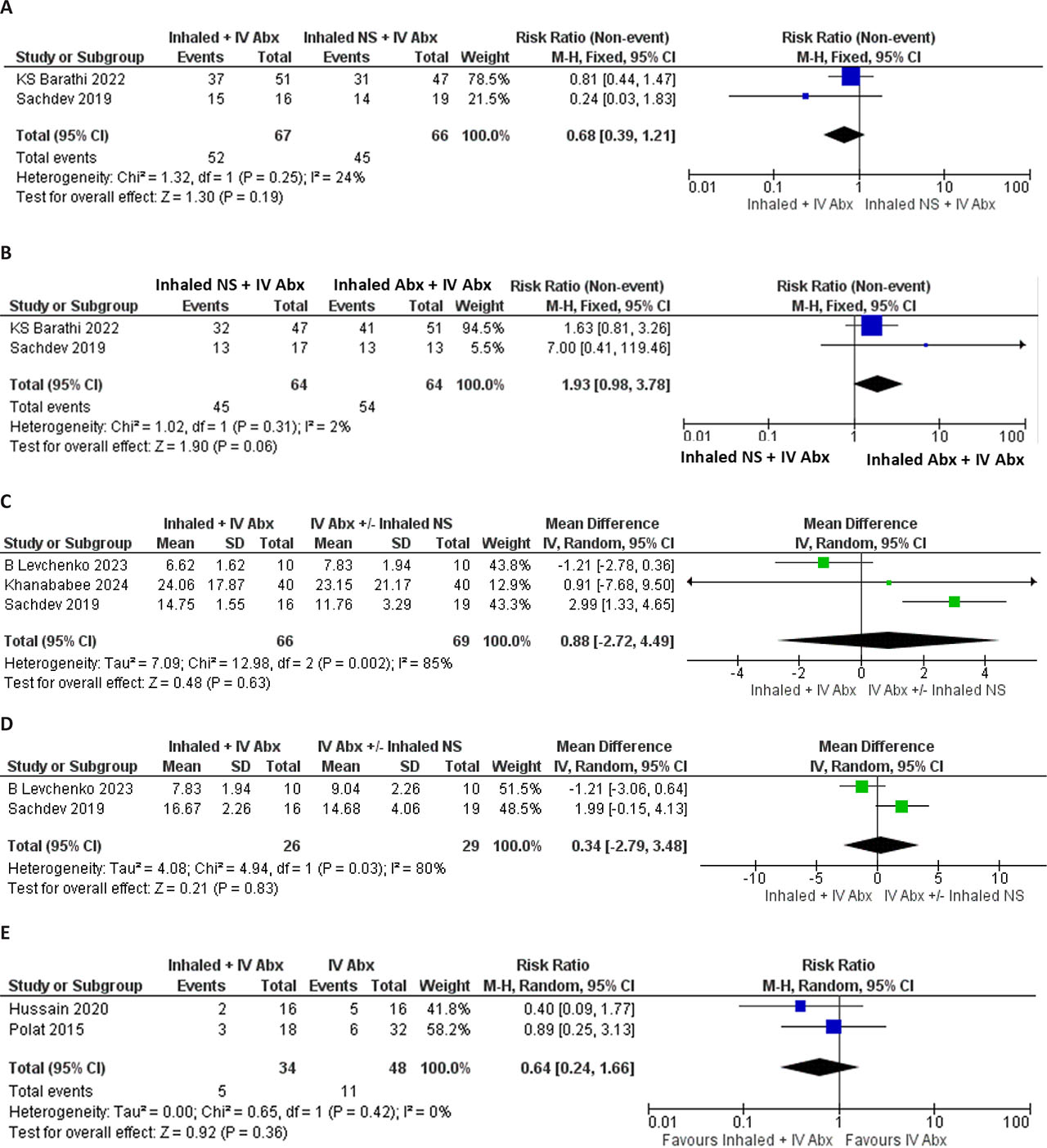
Fig. 2.
Forest plot for clinical outcomes. (A) Clinical success, (B) Bacterial Eradication (C) Duration of Mechanical Ventilation (D) Duration of intensive care unit (ICU) stay (E) Mortality

Fig. 3.
Forest plot for nephrotoxicity