Have a personal or library account? Click to login
Exploring pharmacological strategies in the management of ARDS: Efficacy, limitations, and future directions Cover

Exploring pharmacological strategies in the management of ARDS: Efficacy, limitations, and future directions

Open Access
|Jul 2025

Figures & Tables

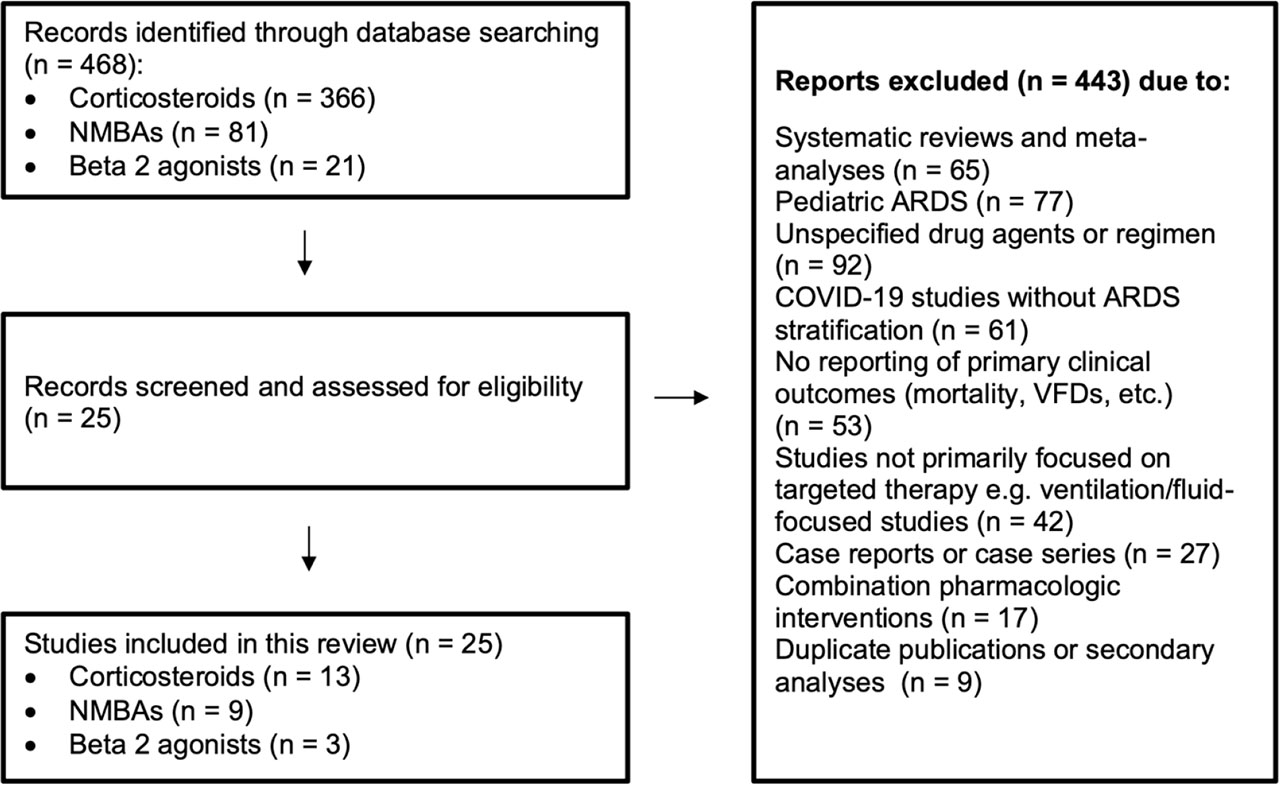
Fig. 1.

Search strategy and study selection

Beta-2 agonists in ARDS

ReferenceStudy designNumber of patientsBeta-agonists type and doseKey findings
[14]RCT
  • 40 patients with ARDS

  • Albuterol group (n=19)

  • Placebo group (n=21)

IV albuterol infusions run at 0.075 ml/kg/h (15 μg/kg/h) for 7 days
  • ↔ PaO2/FiO2 ratio at day 7

  • ↔ VFDs

  • ↔ 28-day mortality

  • ↔ Incidence of supraventricular arrhythmias

[15]RCT
  • 282 patients with ARDS

  • Albuterol group (n=152)

  • Placebo group (n=130)

Aerosolized albuterol (5 mg) q 4 hours for up to 10 days
  • ↔ VFDs

  • ↓ ICU free days in the albuterol group (13.5 vs 16.2; P=0.023)

  • ↔ Mortality outcome at day 60 and at day 90

  • ↔ Organ failure free days

  • ↔ Cardiac arrhythmias

[16]RCT
  • 326 patients with moderate to severe ARDS

  • Albuterol group (n=162)

  • Placebo group (n=164)

IV albuterol (15 μg/kg ideal bodyweight per hour) for up to 7 days
  • ↑ 28-day mortality (34 vs 23%; P=0.03)

  • ↓ VFDs (8.5 vs 11.1 days; P < 0.05)

  • ↓ Organ failure free days (16.2 vs 18.5 days; P < 0.05)

  • ↑ Incidence of cardiac arrhythmia (9 vs 2%; P < 0.05)

Appraisal of Key Clinical Studies of Pharmacologic Agents in ARDS

ReferenceDrug ClassStudy Design & SettingBias RiskEvidence Strength
Steinberg et al. [5]CorticosteroidsMulticenter RCT; persistent ARDSWell-designed-blinded but late interventionModerate
Meduri et al. [6]CorticosteroidsMulticenter RCT; early severe ARDSWell-designed-blinded and early intervention; limited sample sizeModerate
Meduri et al. [7]CorticosteroidsMulticenter RCT; prolonged ARDSBlinded, limited sample sizeModerate
Villar et al. [8]CorticosteroidsMulticenter, randomized, double-blind RCTStrong methodological design with blindingHigh
Tomazini et al. [9]CorticosteroidsMulticenter, randomized, open-label controlled trialLack of blindingModerate
Papazian et al. [10]NMBAsMulticenter, randomized, double-blind RCTStrong design with blinding and protocol standardizationHigh
Moss et al. [11]NMBAsMulticenter, randomized, open-label controlled trialLack of blinding; early termination for futilityModerate
Forel et al. [12]NMBAsMultiple-center, prospective, controlled trialWell-designed with blinding; limited by small sample sizeModerate
Gainnier et al. [13]NMBAsMultiple center, prospective, controlled trialStrong blinding and randomization; small sample sizeModerate
Perkins et al. [14]Beta-2 agonistsSingle-center, randomized, double-blind placebo-controlled trialWell-designed with blinding; small sample size limits generalizabilityModerate
Matthay et al. [15]Beta-2 agonistsMulticenter, randomized, double-blind placebo-controlled trialStrong design with adequate blinding; some heterogeneity in patient severityModerate
Gao Smith et al. [16]Beta-2 agonistsMulticenter, randomized, double-blind, placebo-controlled trialHigh-quality design with rigorous blinding; stopped early for safety concernsModerate

Corticosteroid in ARDS

ReferenceStudy designNumber of patientsCorticosteroid type and doseKey findings
[5]RCT
  • 180 patients with ARDS

  • Methylprednisolone (n=89)

  • Placebo (n=91)

  • Methylprednisolone

  • 2 mg/kg

  • Followed by

  • 0.5 mg/kg q 6 h for 14 days

  • Followed by

  • 0.5 mg/kg q 12 h for 7 days, and then tapering the dose over 2 or 4 days

  • ↑ VFDs (11.2 vs 6.8 days; P<0.001) at day 28

  • ↑ ICU free days (8.9 vs 6.2 days; P=0.02) at day 28

  • ↑ VFDs (159 vs 149 days; P=0.04) at day 180

  • ↔ ICU free days at day 180

  • ↔ 60- or180-day mortality

[6]RCT
  • 91 patients with severe early ARDS

  • Methylprednisolone (n = 63)

  • Placebo (n = 28)

Methylprednisolone infusion (1 mg/kg/d) for up to 28 days
  • ↑ VFDs (16.5 vs 8.7 days; P=0.001) at day 28

  • ↑ PaO2/FiO2 ratio (256 vs 179; P = 0.006) on day 7

  • ↓ Length of ICU stay (7 vs 14.5 days; P = 0.007) at day 28

  • ↓ ICU mortality (20.6 vs 42.9%; P = 0.03) at day 28

  • ↔ Length of hospital stay at day 28

[31]RCT
  • 216 patients with COVID-19 induced-ARDS

  • Dexamethasone group (n=111)

  • Methylprednisolone (n=105)

  • IV dexamethasone 6 mg daily for 7 to 10 days

  • Methylprednisolone 250 – 500 mg daily for 3 days followed by oral prednisone 50 mg daily for 14 days

  • ↓ Mortality (7.4 vs 36.9 %; P< 0.0001) at day 30 for methylprednisolone than dexamethasone

  • ↑ Recovery time (3 vs 6 days; P < 0.0001) for methylprednisolone than dexamethasone

[7]RCT
  • 24 patients with severe ARDS

  • Methylprednisolone (n=16)

  • Placebo (n=8)

  • Methylprednisolone 2 mg/kg per day

  • → taper over 32 days

  • Loading: 2 mg/kg IV once

  • Days 1–14: 2 mg/kg/day

  • Days 15–21: 1 mg/kg/day

  • Days 22–28: 0.5 mg/kg/day

  • Days 29–30: 0.25 mg/kg/day

  • Days 31–32: 0.125 mg/kg/day

  • ↓ Mechanical ventilation duration (11.5 vs 23 days; P = 0.001)

  • ↓ ICU mortality (0 vs 62%; P=0.002)

  • ↓ Hospital mortality (12 vs 62%; P=0.03)

  • ↓ Lung injury score (LIS) (1.7 vs 3.0; P<0.001)

  • ↑ PaO2/FiO2 ratio (262 vs 148; P<0.001)

  • ↑ Successful extubation (7 vs 0; P=0.05)

  • ↑ Organ failure free days (16 vs 6 days; P =0.005)

[32]RCT
  • 81 Mechanically ventilated patients at high risk for ARDS

  • Methylprednisolone (n=39)

  • Placebo (n= 42)

Methylprednisolone 30 mg/kg, q 6 hours for 48 hours
  • ↔ Oxygen requirements

  • ↔ Days of intensive care

  • ↑ Incidence of infection rate (P < 0.05)

[29]Cohort
  • 20 postoperative ARDS patients

  • Placebo (n=8)

  • Methylprednisolone (n=12)

  • Loading dose 2 mg/kg followed by 2 mg/kg/day

  • IV daily q 6 hours and then changed to a single oral dose or discontinued

  • ↓ Mortality (8.3 vs 87.5%; P= 0.001)

  • ↑ PaO2/FiO2 ratio on day 4 (P < 0.05)

[36]RCT
  • 99 ARDS patients

  • Methylprednisolone (n=50)

  • Placebo (n=49)

Methylprednisolone (30 mg/kg q 6 hours for 24 hours)↔ Mortality at 45 days
[30]Secondary analysis of RCT
  • 745 ARDS patients

  • No corticosteroids (n=506)

  • Corticosteroids (n=239)

  • IV or PO corticosteroids (e.g. methylprednisolone /dexamethasone/prednisone/hydrocortisone)

  • Doses: 20 mg methylprednisolone / 3.75 mg dexamethasone/ 25 mg prednisone/ 100 mg hydrocortisone daily

↔ Mortality
[8]RCT
  • 277 patients with moderate-to-severe ARDS

  • Dexamethasone group (n=139)

  • Control group (n=138)

Dexamethasone IV 20 mg once daily for 5 days and then reduced to 10 mg daily from day 6 to day 10
  • ↑ VFDs (12.3 vs 7.5 days; P<0.0001) at 28 days

  • ↑ PaO2/FiO2 (P < 0.05) on day 6

  • ↓ Mortality at 60 days (21% vs 36%, P = 0.0047)

  • ↓ SOFA score on day 3 (P < 0.05)

  • ↔ Adverse events

[9]RCT
  • 299 patients with COVID-19–associated with moderate to severe ARDS

  • Dexamethasone (n =151) or Control (n = 148)

Dexamethasone IV 20 mg once daily for 5 days and then reduced to 10 mg for additional 5 days or until ICU discharge
  • ↑ VFDs (6.6 vs 4 days; P = 0.04) at 28 days

  • ↓ SOFA (6.1 vs 7.5; P = 0.004) at 7 days

  • ↔ Mortality at 28 days

  • ↔ ICU-free days at 28 days

[25]RCT
  • 106 patients with mild to moderate COVID-19-related ARDS

  • Methylprednisolone (n=36), Dexamethasone (n=35), Hydrocortisone (n=35)

  • Dexamethasone IV 6 mg once daily for 10 days

  • Methylprednisolone IV 16 mg BID for 10 days

  • Hydrocortisone IV 50 mg TID for 10 days

  • ↔ VFDs

  • ↔ PaO2/FiO2 ratio

  • ↔ ICU stays

  • ↔ Hospital stays

  • ↔ 28-day mortality

  • ↔ Adverse events

[26]RCT
  • 98 patients with COVID-19-related ARDS

  • High dexamethasone groups (n=49)

  • Low dexamethasone groups (n=49)

  • 16 mg of dexamethasone IV daily for 5 days followed by 8 mg for 5 days or

  • 6 mg of dexamethasone IV daily for 10 days.

  • ↔ VFD between high- and low-dose dexamethasone groups at 28 days

  • Successful extubation on high dose group (P < 0.05)

  • ↔ Adverse events

[37]RCT
  • 197 patients with sepsis related ARDS

  • Hydrocortisone (n = 98)

  • Placebo (n = 99)

Hydrocortisone IV 50 mg q 6 h daily for 7 days
  • ↑ PaO2/FiO2 (319.1 vs 266.3; P = 0.001)

  • ↔ Mechanical ventilation duration at day 28

  • ↔ Mortality at 28 days

Neuromuscular blocking agents in ARDS

ReferenceStudy designNumber of patientsNMBAs type and doseKey findings
[10]RCT
  • 339 patients with moderate to severe

  • ARDS Cisatracurium (n=177)

  • Placebo (n=162)

15 mg of cisatracurium followed by a continuous infusion of 37.5 mg/hour for 48 hours
  • ↓ Hazard ratio of mortality. HR= 0.68 (95% CI, 0.48 to 0.98; P = 0.04)

  • ↓ Mortality (23.7 vs 33.3 %; P=0.05) at 28-day

  • ↓ Mortality (30.8% vs 44.6%, P=0.04) in patients with baseline PaO2/FiO2 <120 mm Hg

  • ↔ Mortality at 90-day

  • ↑ VFDs (10.6 vs 8.5 days; P=0.04) at 28 days

  • ↑ VFDs (53.1 vs 44.6 days; P=0.03) at 90 days

  • ↑ ICU free days (47.7 vs 39.5; P=0.03) at 90 days

  • ↔ ICU free days at 28 days

[11]RCT
  • 1006 patients with moderate-severe ARDS

  • Cisatracurium group (n=501)

  • Control group (n=505)

15 mg of cisatracurium followed by a continuous infusion of 37.5 mg/hour for 48 hours
  • ↔ 90 days mortality

  • ↔ Hospital death at 28 days

  • ↔ VFDs at 28 days

  • ↔ ICU free days at 28 days

  • ↔ Hospital free days at 28 days

  • ↑ Cardiovascular adverse events (14 vs 4 events; P=0.02)

[12]RCT
  • 36 patients with moderate-severe ARDS

  • Cisatracurium (n = 18)

  • Placebo (n = 18)

A bolus dose of cisatracurium 0.2 mg/kg was followed by a continuous infusion at an initial rate of 5 μg/kg/min for 48 hr
  • ↔ Mechanical ventilation duration

  • ↔ VFDs at 28 days

  • ↔ ICU mortality

  • ↑ PaO2/FiO2 ratio (P < 0.001)

[13]RCT
  • 56 patients with moderate-severe ARDS

  • Cisatracurium (n=28)

  • Placebo (n=28)

50 mg bolus of cisatracurium followed by a continuous infusion at an initial rate of 5 μg/kg/min for 48 hr
  • ↑ PaO2/FiO2 ratios (P < 0.05)

  • ↔ ICU mortality

  • ↔ VFDs at day 28

  • ↔ VFDs at day 60

[47]Retrospective cohort study
  • 172 patients with moderate-severe ARDS

  • Control (n = 86)

  • Cisatracurium (n = 86)

NA
  • ↓ Length of ICU stay (9.37 vs 14.67 days; P <0.01)

  • ↓ Duration of ventilation (6.40 vs 12.38 days; P <0.01)

  • ↔ Length of hospital stay

  • ↔ Mortality outcomes at 28-day, 90-day, or 1-year

[44]Retrospective cohort study
  • 58 patients with moderate-severe ARDS

  • Cisatracurium (n=29)

  • Vecuronium (n=29)

  • The treatment duration was around three days (74.2 vs 69.6 hr) in cisatracurium and vecuronium, respectively

  • The average daily dose 123.7 vs 63 mg/day in cisatracurium and vecuronium, respectively

  • The hourly infusion rate 7.9 vs 4.4 mg/hr in cisatracurium and vecuronium, respectively

  • ↔ Ventilator days

  • ↔ ICU mortality

  • ↔ Hospital mortality

  • ↔ Length of ICU stay

  • ↔ Hospital length of stay

  • ↔ PaO2/FiO2 ratio after 48 hours

[43]Retrospective cohort study
  • 3802 patients with ARDS or at risk for ARDS

  • Cisatracurium (n=1,901)

  • Vecuronium (n=1,901)

Continuous infusion of NMBA for at least 2 days. The exact dose is not available.
  • ↔ Mortality outcome

  • ↔ Hospital length of stay

  • ↓ Ventilator days (P = 0.005) in patients treated with cisatracurium

  • ↓ ICU length of stay (P = 0.028) in patients treated with cisatracurium

[45]Retrospective cohort study
  • 76 patients with severe ARDS

  • Atracurium (n=18)

  • Cisatracurium (n=58)

  • The treatment duration (2.5 vs 2.6 days) in atracurium and cisatracurium, respectively

  • The treatment dose (1.9 vs 2.5 μg/kg/min) in atracurium and cisatracurium, respectively

  • ↔ PaO2/FiO2 at 72 hr

  • ↔ VFDs at day 28

  • ↔ ICU length or stay

  • ↔ Hospital length of stay

  • ↔ Hospital mortality

[46]Retrospective cohort study
  • 225 patients with ARDS

  • Atracurium (n = 75)

  • Cisatracurium (n = 150)

  • Atracurium 4 µg/kg/min, titrated by 0.5 µg/kg/min q 15 minutes to a maximum dose of 20 µg/kg/min for at least 12 hr

  • Cisatracurium 1 µg/kg/min, titrated by 0.5 µg/kg/min q 15 minutes to a maximum dose of 10 µg/kg/min for at least 12 hr

  • ↑ PaO2/FiO2 ratio (68.6 vs 54.6; P= 0.011) for atracurium than cisatracurium at 24 hours,

  • ↑ PaO2/FiO2 ratio (52.3 vs 41.3; P=0.014) for atracurium than cisatracurium at 72 hours

  • ↔ PaO2/FiO2 ratio at 48 hours

  • ↔ ICU length of stay

  • ↔ Hospital length of stay

  • ↔ Duration of mechanical ventilation

  • ↑ Hospital mortality (58.7 vs 36 %; P=0.001) in atracurium than cisatracurium

DOI: https://doi.org/10.2478/jccm-2025-0030 | Journal eISSN: 2393-1817 | Journal ISSN: 2393-1809
Language: English
Page range: 208 - 220
Submitted on: Feb 5, 2025
Accepted on: Jul 3, 2025
Published on: Jul 31, 2025
Published by: University of Medicine, Pharmacy, Science and Technology of Targu Mures
In partnership with: Paradigm Publishing Services
Publication frequency: 4 issues per year

© 2025 Sultan Almuntashiri, published by University of Medicine, Pharmacy, Science and Technology of Targu Mures
This work is licensed under the Creative Commons Attribution 4.0 License.