
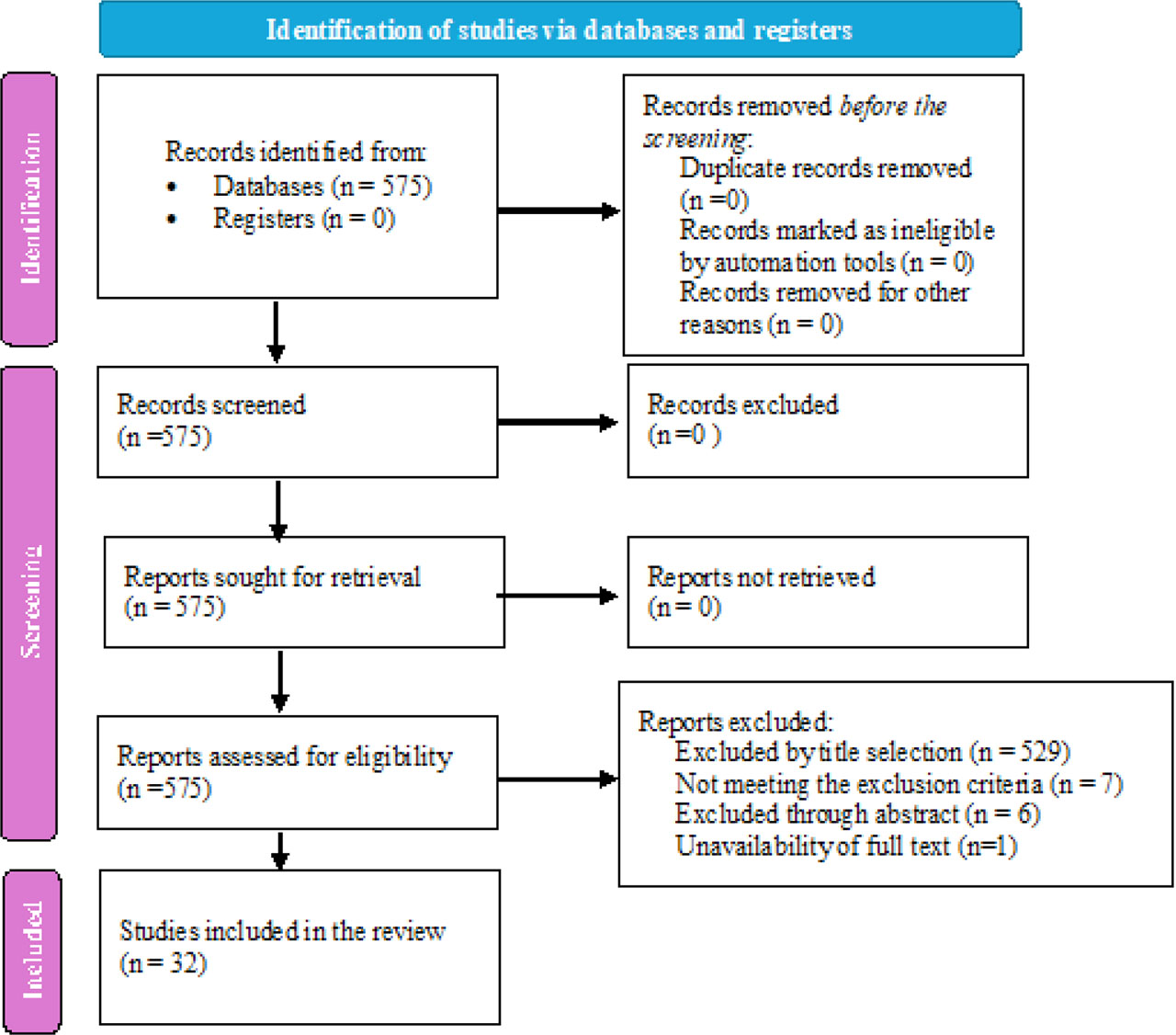
Fig. 1.
PRISMA flow diagram
Table 1.
Characteristics of the studies
| Title of the study | Authors | Sample size | Inclusion criteria | Year/Place | Methodology | Conclusion |
|---|---|---|---|---|---|---|
| Comparison of the SpO2/FIO2 ratio and the PaO2/FIO2 ratio in patients with acute lung injury or ARDS | Rice et al. | 672 | ARDS ventilated with low tidal volume strategy | 2007/USA | Corresponding measurements of Spo2 (values ≤ 97%) and Pao2 from patients enrolled in the ARDS Network trial of a lower tidal volume ventilator strategy (n = 672) were compared to determine the relationship between SFR and PFR. SFR threshold values correlating with PFR ratios of 200 (ARDS) and 300 (ALI) were determined. | SFR of 235 and 315 correlated with PFR of 200 and 300, respectively, for diagnosing and following up patients with ALI and ARDS. |
| Comparison of the Pulse Oximetric Saturation/Fraction of Inspired Oxygen Ratio and the Pao2/Fraction of Inspired Oxygen Ratio in Children | Khemani et al. | 1298 | Children with acute lung injury | 2009/Los Angeles | Electronically queried blood gas measurements from two tertiary care pediatric ICUs (PICUs). Included in the analysis were corresponding measurements of Spo2, Pao2, and Fio2 charted within 15 min of each other when Spo2 values were between 80% and 97%. | SFR is a reliable noninvasive marker for PFR to identify children with ALI or ARDS. |
| Pulse oximetry saturation to fraction inspired oxygen ratio as a measure of hypoxia under general anesthesia and the influence of positive end-expiratory pressure | Tripathi et al. | 2754 | Surgical patients apart from cardaic and thoracic surgery | 2010/USA | Adult general anesthetics performed with arterial blood gas analysis. Intraoperative data were collected from an anesthesia information system. The SFR corresponding to PFR of 300 were determined. | SFR correlated with the PFR in patients undergoing general anesthesia, especially those ventilated with PEEP more than 9 cm H2O and/or with P/F less than 300. |
| Oxygen saturation/fraction of inspired oxygen ratio is a simple predictor of noninvasive positive pressure ventilation failure in critically ill patients | Spada C et al. | 133 | Respiratory failure patients receiving NIV support | 2010/USA | A prospective observational study was conducted in patients requiring NPPV. Clinical data including respiratory mechanics at the time of NPPV initiation, and clinical outcomes were recorded. | A simple index of SFR at the time of NPPV initiation could be used to identify patients at high risk of NPPV failure |
| The use of the pulse oximetric saturation/fraction of inspired oxygen ratio for risk stratification of patients with severe sepsis and septic shock | Serpa Neto et al. | 260 | Patients with severe sepsis | 2013/Brazil | Retrospective cohort study in those admitted to 2 tertiary mixed intensive care units with severe sepsis or septic shock. | Low SFR upon ICU admission is associated with an increased risk of mortality in patients presenting with septic shock. |
| SpO2/FiO2 as a predictor of non-invasive ventilation failure in children with hypoxemic respiratory insufficiency | Pons-Odena et al. | 309 | Children with acute respiratory failure | 2013/Spain | Data of children requiring NIV support were included. Clinical data collected were RR, heart rate, SpO2 and FiO2 before NIV was started. | SFR is a reliable predictor of early NIV failure in children. |
| SpO2/FiO2 Ratio on Hospital Admission Is an Indicator of Early Acute Respiratory Distress Syndrome Development Among Patients at Risk | Festic et al. | 4646 | Pateints admitted in acute care setting with atleast one risk factor for ARDS. | 2013/USA | SFR was noted in the first 6 hours of admission. SFR was evaluated as a continuous as well as a categorical variable by creating the following arbitrarily chosen SFR cutoffs: <100, 100 < 200, and 200 < 300. These simplified cutoffs were chosen empirically to approximate the PFR cutoffs for ARDS severity | SFR measured within first 6 hours of admission to the hospital is an independent indicator of early ARDS development among patients at risk. Lesser SFR may indicate earlier progression to fully established ARDS. |
| Correlation of oxygen saturation as measured by pulse oximetry/fraction of inspired oxygen ratio with PaO2/fraction of inspired oxygen ratio in a heterogeneous sample of critically ill children | Lobete et al. | 298 | Children under mechanical ventilation, noninvasive ventilation support, and breathing spontaneously admitted to a tertiary care noncardiac surgery PICU. | 2013/spain | A retrospective database study was conducted in a pediatric intensive care unit of a university hospital. Simultaneous blood gas and pulse oximetry were collected in a database. | Oxygen saturation as measured by SFR is an adequate noninvasive surrogate marker for PFR. |
| The use of the pulse oximetric saturation to fraction of inspired oxygen ratio in an automated acute respiratory distress syndrome screening tool | Schmidt et al. | 3767 | All patients admitted in critical care unit | 2015/USA | This was a retrospective cohort study using the Multiparameter Intelligent Monitoring in Intensive Care II database. The relationship was derived and validated in all patients ventilated for at least 24 hours. | The SFR may be an adequate substitute for the PF ratio in an automated ARDS screening tool. |
| Correlation of SpO2/FiO2 Ratio and PaO2/FiO2 Ratio in Hypoxemic Patient While Breathing in Room Air. | Nittha Oerareemitr et al. | 179 | Hypoxemic patients on room air | 2018/Thailand | Spo2 and pao2 measurements were done on room air. | SFR from pulse oximetry significantly correlated with PFR from ABG analysis but the exact equation was not as good enough to estimate PFR calculated from the SFR of the pulse oximetry. |
| Spo2/fio2 on presentation as a predictor for early hemodynamic deterioration in intermediate risk acute pulmonary embolism | Domaradzki et al | 178 | Intermediate-risk pulmonary embolism (hemodynamically stable with right ventricle to left ventricle ratio > 0.9 or tricuspid annular plane systolic excursion < 18 mm). | 2019/USA | For patients admitted through the emergency department. the first available set of parameters was taken into account; For in-patients, the parameters were recorded at the closest time to diagnostic suspicion and before any intervention. SFR on presentation was computed by using a conversion table as follows | In intermediate-risk pulmonary embolism, SFR on presentation can help predict the risk of early hemodynamic deterioration |
| Continuously available ratio of SpO2/FiO2 serves as a noninvasive prognostic marker for intensive care patients with COVID-19 | Lu Xiaofan et al. | 280 | Severe and critically ill (intensive care) patients with COVID-19. | 2020/China | The ratio of SFR was measured at day 1, 3, 7, 14 and 28 since admission to intensive care wards. | SFR could serve as a non-invasive prognostic marker to facilitate early adjustment for treatment, thus improving overall survival. |
| Pulse oximetric saturation to fraction of inspired oxygen (SpO2/FIO2) ratio 24 hours after high-flow nasal cannula (HFNC) initiation is a good predictor of HFNC therapy in patients with acute exacerbation of interstitial lung disease | Koyauchi T et al. | 66 | Acute exacerbation of interstitial lung disease | 2020/Japan | Retrospective analysis of patients with AE-ILD who underwent HFNC. Overall survival, the success rate of HFNC treatment, adverse events, temporary interruption of treatment, discontinuation of treatment at the patient's request, and predictors of the outcome of HFNC treatment were evaluated. | The SFR 24 hours after initiating HFNC was a good predictor of successful HFNC treatment. |
| SpO2/FiO2 as a predictor of high flow nasal cannula outcomes in children with acute hypoxemic respiratory failure | Kim Ga Eun et al. | 139 | Children treated with HFNC due to AHRF | 2021/South korea | Trends of SFR and PFR during HFNC were analyzed. To predict HFNC outcomes, a nomogram was constructed based on predictive factors. | SFR may be an easy-to-use predictor of HFNC outcomes in children with AHRF |
| Mortality Prediction Using SaO2/FiO2 Ratio Based on eICU Database Analysis | Patel Sharad et al. | 33701 | 18 years and above patient requring all modalities of oxygen supplementation | 2021/USA | The features age, gender, SaO2, PaO2, FIO2, admission diagnosis, Apache IV, mechanical ventilation, and ICU mortality were extracted from the eICU Collaborative Research Databas | SFR appears to be a better predictor of ICU mortality than PFR. |
| Role of SpO2/FiO2 Ratio and ROX Index in Predicting Early Invasive Mechanical Ventilation in COVID-19. A Pragmatic, Retrospective, Multi-Center Study | AlberdiIglesias et al. | 2040 | Participants with suspected COVID-19 infection and those transferred with high priority by ambulance to the corresponding ED | 2021/Spain | Multicenter, retrospective cohort study was | SFR had better accuracy than the ROX index in predicting Invasive MV. SFR is a simple, non-invasive, and promising tool for predicting the risk of IMV in patients infected with COVID-19. |
| Assessment of the SpO2/FiO2 ratio as a tool for hypoxemia screening in the emergency department | Catoire P et al | 395 | COVID-19 pateints | 2021/France | Retrospectively studied patients admitted to an academic-level ED who were undergoing a joint measurement of SpO2 and arterial blood gas. Compared SpO2 with SaO2 and evaluated performance of the SFR for the prediction of 300 and 400 mmHg PFR cut-off values | SFR showed a good association with the PFR. SFR can be used for the estimation of the degree of hypoxemia on admission to the emergency room, allowing the patient's severity to be assessed prior to confirmation of viral status. |
| Correlation of Pao2/Fio2 Ratio with Spo2/Fio2 Ratio in Children on Mechanical Ventilation | Zahra ahmed et al. | 30 | Children requring atleast 48 hours of mechanical ventilation in PICU | 2021/Pakistan | Arterial blood gas sampling for calculation of PFR and measurement of SFR was done simultaneously (within 5 minutes). | Noninvasive SFR can reliably be used in place of PFR in children on mechanical ventilation as a strong correlation was observed |
| Correlation Between the Ratio of Oxygen Saturation to Fraction of Inspired Oxygen and the Ratio of Partial Pressure of Oxygen to Fraction of Inspired Oxygen in Detection and Risk Stratification of Pediatric Acute Respiratory Distress Syndrome | Lohano PD et al. | 120 | Age range of 2 months to 16 years, admitted to PICU with acute onset of respiratory distress | 2021/Pakistan | Measured SpO2, PaO2, FiO2 and calculated SFR and PFR | Strong correlation between the SFR and PFR, and a statistically substantial agreement. So, the SFR can be reliably used for early detection and risk assessment of ARDS in children. |
| S/F and ROX indices in predicting failure of high-flow nasal cannula in children | Kim Ji Hye et al | 152 | Children with respiratory distress | 2022/South korea | Ratio of percutaneous oxygen saturation to the fraction of inspired oxygen (S/F), the ratio of SFR to RR (ROX), the ratio of SFR to RR/median RR (ROX-M), and the ratio of SFR to z-score of RR (ROX-Z) were calculated and compared between groups | SFR and ROX-M can be used for early prediction of hypoxic HFNC failure. |
| Correlation of SpO(2)/FiO(2) and PaO(2)/FiO(2) in patients with symptomatic COVID-19: An observational, retrospective study | Bonaventura Aldo et al. | 1028 | >18 years, symptomtic COVID 19 patients; patients with >97% SpO2 were excluded. | 2022/Italy | To ensure accuracy of SpO2 assessments, the following considerations were followed: (1) no position changes 5 min prior to the measurement; (2) checking for the accurate position and cleanliness of the sensor; and (3) evaluation of satisfactory waveforms on the monitor. After 1 min of steady SpO2 measurement, the value was recorded along with the oxygen setting, | Routine use of SFR as a reliable surrogate of PFR in patients with COVID-19-related ARDS. |
| Utility of Pulse Oximetry Oxygen Saturation (SpO2) with Incorporation of Positive End-Expiratory Pressure (SpO2*10/FiO2*PEEP) for Classification and Prognostication of Patients with Acute Respiratory Distress Syndrome | Todur Pratibha et al. | 85 | Patients aged 18–80 years on invasive mechanical ventilation (MV) diagnosed with ARDS | 2022/India | The values of PaO2, FiO2, and SpO2 were collected at three different time points. They were at baseline, i.e., after intubation and initiation of MV (within one hour of intubation), day one (1–24 hours of MV), and day three (48–72 hours of MV). | S/FP *10 has a strong correlation to P/FP *10 in ARDS patients. |
| ROX index and SpO2/FiO2 ratio for predicting high-flow nasal cannula failure in hypoxemic COVID-19 patients: A multicenter retrospective study | Kim Jin Hyoung et al. | 133 | COVID-19 pateints receiving HFNC | 2022/South korea | The ROX index and the SpO2/FiO2 ratio at 1 h, 4 h, and 12 h after HFNC initiation were calculated | SFR following HFNC initiation was an acceptable predictor of HFNC failure. SFR may be a good prognostic marker for intubation in COVID-19 patients receiving HFNC. |
| Combining blood glucose and SpO2/FiO2 ratio facilitates prediction of imminent ventilatory needs in emergency room COVID-19 patients | Sakai K et al. | 106 | COVID 19 patients requring oxygen support | 2023/Japan | Blood glucose and SFR was recorded as they were easliy available. | Measuring blood glucose and SFR may be a simple and versatile new strategy to accurately identify ER patients with COVID-19 at high risk for the imminent need of MV. |
| Analysis of ROX Index, ROX-HR Index, and SpO2/FIO2 Ratio in Patients Who Received HighFlow Nasal Cannula Oxygen Therapy in Pediatric Intensive Care Unit | Choi Sun Hee et al | 107 | Children admitted to PICU | 2023/South korea | Data on clinical and personal information, ROX index, ROX-HR index, and SFR were collected | ROX index, ROX-HR index, and SFR appear to be promising tools for the early prediction of treatment success or failure in patients initiated on HFNC for acute hypoxemic respiratory failure. |
| Ratio of Oxygen Saturation to Inspired Oxygen, ROX Index, Modified ROX Index to Predict High Flow Cannula Success in COVID-19 Patients: Multicenter Validation Study | Ruangsomboon Onlak et al. | 173 | Adult patients with COVID-19 treated with HFNC in the ED | 2023/Thailand | All these parameters were measured while the patients were still in the ED awaiting disposition. At 0 and 2 hours after HFNC initiation, we calculated three parameters and assessed them for their utility in predicting HFNC outcomes: the SFR; the ROX index; and the modified ROX index. | The SFR measured two hours after high-flow nasal cannula initiation was better than the ROX index and the modified ROX index at predicting HFNC success in patients with acute hypoxemic respiratory failure secondary to COVID-19 in the ED setting. |
| Comparison of PaO2/FiO2 (PF ratio) to SpO2/FiO2 (SF ratio) and OI to OSI for Predicting Short Term Outcomes in Children with Acute Hypoxemic Respiratory Distress: A Prospective Observational Study | Shah Niyati et al. | 200 | Children with acute hypoxemic respiratory distress | 2024/India | Prospective observational study Serial PFR and SFR calculated at 0, 6, 24 and 48 hours were compared and their trends were utilized for prediction of 28 day mortality. Same was done in ventilated patients using OI and OSI. | SFR is a reliable surrogate for PFR and a useful predictor of progression to ventiation and survival at discharge |
| Emergency Department SpO2/FiO2 Ratios Correlate with Mechanical Ventilation and Intensive Care Unit Requirements in COVID-19 Patients | Zhang Gary et al. | 539 | Adult COVID-19 patients | 2024/USA | Retrospective chart review Highest and lowest SFR were calculated on admission | SFR of 300 or below correlated with the need for mechanical ventilation during hospitalization. |
| SpO2/FiO2 and PaO2/FiO2 for Predicting Intensive Care Admission in Wheezy Children: An Observational Study | Beniwal Rakhi et al. | 315 | Wheezy children aged 6 months to 12 years requiring admission in the pediatric emergency department | 2024/India | Oxygen saturation (SpO2) and fraction of oxygen in inspired air (FiO2) were recorded at admission while the partial pressure of oxygen (PaO2) was measured using arterial blood gas analysis performed within half an hour of admission | SFR cut-off of < 300 had a good sensitivity in determining need for PICU admission. SFR had only a moderate correlation with PFR. |
| A Prospective Observational Study Comparing Oxygen Saturation/Fraction of Inspired Oxygen Ratio with Partial Pressure of Oxygen in Arterial Blood/Fraction of Inspired oxygen ratio among critically Ill patients requiring different modes of Oxygen supplementation in ICU | Alur Rakesh et al | 125 | Adult AHRF (acute hypoxemic respiratory failure) patients receiving oxygen therapy | 2024/India | At admission and during deterioration or within 24 hours, measurements of FiO2, PaO2, and SpO2 were documented | Uutility of the SFR as a substitute for the PFR in the diagnosis of AHRF in adults who are critically ill. |
| Evaluation of Correlation and Agreement between SpO2/FiO2 ratio and PaO2/FiO2 ratio in Neonates | Muniraman H et al | 196 | Neonates with respiratory failure | 2022/USA | Retrospective cohort study including neonates with respiratory failure over a 6-year study period. Correlation and agreement between PFR with SFR was analyzed | SFR correlated strongly with PFR with good agreement between derived PFR from noninvasive SpO2 source and measure PFR. |
| Comparison of non-invasive to invasive oxygenation ratios for diagnosing acute respiratory distress syndrome following coronary artery bypass graft surgery: a prospective derivation-validation cohort study | Bashar Farshid R et al. | 671 | Pateints undergoing CABG surgery | 2018/Iran | SPO2, PaO2, and FiO2 were measured once per patient upon study enrollment, and SPO2 was recorded at the time of ABG sampling. SPO2 was observed for a minimum of 1 min before the value was recorded. | PaO2 and SaO2 correlated in the diagnosis of ARDS, with a PFR of 300 correlating to an S/F of 311 (Sensitivity 90%, Specificity 80%). The SFR may allow for early real-time rapid identification of ARDS. |