
Introduction
Post-operative pancreatic fistula (POPF) is one of the important causes of morbidity and mortality after pancreatoduodenectomy (PD), along with increasing the risk of sepsis and healthcare costs [1,2]. The International Study Group of Pancreatic Fistula (ISGPF) defined POPF in 2005 and revised it again in 2016 as “drain output of any measurable volume of fluid on or after postoperative day 3 with an amylase content greater than 3 times the serum amylase activity.” [1,3]. POPF is considered a potentially serious complication of PD, which can lead to pseudoaneurysm, bleeding, multiple organ failure, and death. POPF is caused by pancreatic enzyme extravasation from the pancreatico-enteric anastomosis to the peri-pancreatic or intra-abdominal area [5]. After the 2016 revision of the definition, Grade A is no longer considered a CR-POPF; it is now a biochemical leak with no clinical implications for the patient and no need for intervention. Grade B is now considered the clinically relevant post-operative pancreatic fistula (CR-POPF) as it requires prolonged abdominal drainage and therapeutic interventions such as prolong antibiotics, hospital stay, or interventional radiology guided drain placement. Grade C is the most serious type of CR-POPF needing surgical re-exploration and is more likely to lead to complicated clinical consequences, including multi-organ failure [4]. Factors for CR-POPF have been reported to include male gender (OR=3.06), older adults (OR=3.22), BMI >25.0 (OR=2.58), and first postoperative-day amylase concentration (OR=5.73) [6]. The incidence of CR-POPF after PD has been reported to range from 16.95% to 47.3% across different regions and patient demographics [7, 8, 9, 10, 11]. This variation is due to many factors, one of which is the lack of uniformity in the definition of POPF until it was defined by ISGFP. Mortality related to CR-POPF has been reported to be 6.3% in the positive cases, varying among countries across the globe, healthcare systems and patient demographics [12]. A study conducted in Pakistan reported mortality due to CR-POPF as 3.2% [13]. This variation in mortality is multi-factorial and may be related to health care resources, surgical techniques, unit volume, surgical expertise, as well as the availability of intensive care and allied health care resources, such as interventional radiology services. In this study from Pakistan, the cohort of patients presented mostly with periampullary tumours and at a younger age than in western cohorts, suggesting that the pattern of disease and surgical outcomes is likely to differ from those in western cohorts [13]. Various anastomotic techniques and somatostatin analogues may marginally reduce the risk of CR-POPF, while early drain amylase assessment and predictive scores are effective for early detection [14,15]. Several scoring systems are applicable in clinical practice and help detect CR-POPF early, preventing patients from advancing to more advanced stages of the fistula by initiating early clinical interventions [11]. Common predictive scoring systems for the detection of CR-POPF include the original Fistula Risk Score (o-FRS), the Birmingham score, and the Duct Parenchyma Ratio (DPR) [11,16]. The effectiveness of the scoring systems has been continuously assessed over time, and reports on the external validation of the o-FRS and Birmingham scores have been published [17,18]. The scoring systems have proven useful for predicting CR-POPF, enabling early diagnosis and prompt treatment [19]. These scoring systems have not been studied in a Pakistani population, and studies from this region report different disease prevalence and age distributions. It is worth evaluating the effectiveness of these systems in our patient cohort to assess feasibility and effectiveness. Therefore, the objectives of this study were to evaluate and compare the efficacy of the original Fistula Risk Score (o-FRS) and duct-to-parenchyma ratio (DPR) in predicting clinically relevant postoperative pancreatic fistula (CR-POPF) after pancreatoduodenectomy, and to assess their combined predictive performance in a Pakistani cohort.
Material and Methods
The current study was conducted at Shaukat Khanum Memorial Cancer Hospital & Research Centre (SKMCH & RC), Peshawar, from July 2021 to Aug 2024. Ethical approval was granted from the Institutional Review Board of SKMCH& RC with letter No. Ex-05-08-23-01. The study used a retrospective cohort design, and data were collected from the Hospital Information System (HIS), a prospectively maintained patient electronic database. A total of 114 patients underwent PD procedures at our hospital. Using the non-probability consecutive sampling technique, patients were enrolled in the study if they were at least 18 years old, provided verbal and written consent, and were assured of their voluntary participation. Patients’ medical records and other data were assessed for gland consistency (soft and hard as per a single surgeon’s subjective assessment, which is documented in the operative notes) and, location of the lesion (ampullary, pancreatic head, uncinate process, periampullary, duodenal and distal cholangiocarcinoma). Other data recorded included histopathological type (adenocarcinoma, neuroendocrine tumour, pseudopapillary neoplasm, or adenoma). Blood loss was recorded in millilitres, and the o-FRS score was calculated for each patient. Duct size and parenchyma size were reported in millimetres from a cross-section of Computed Tomographic (CT) images. This was calculated using a measurement tool in the Picture Archiving and Communication System (PACS) by a single observer to avoid inter-observer variability. The parenchyma was measured at the pancreatic neck overlying the portal vein as a standard, and the duct was measured at the same site to avoid variability in measurement techniques. The DPR was calculated for each patient by dividing the ductal diameter by the parenchymal diameter on a preoperative computed tomographic (CT) image. All PD surgeries were performed by a single consultant surgeon with formal training in Hepato-Pancreatico-Biliary (HPB) Surgery, using the modified Blumgart technique with a pancreatic stent [33]. All patients followed enhanced recovery after surgery protocols; however, we do not use octreotide routinely in our cohort [34]. Two Jackson-Pratt drains are routinely placed in the abdomen for drainage, and amylase contents are measured on days 2 and 4 before deciding on removal. If amylase content and volume are high, the drains are left in place, and POPF is categorised as per previous definitions [1,3].
Patients’ files who reported the development of CR-POPF were coded as “Y”, and those without CR-POPF were coded as “N”. Data were entered into SPSS version 26 and tested for normality. The description of continuous variables has been presented as the mean and standard deviation (SD) for normally distributed data, and as median and interquartile range (IQR) for non-normally distributed data. To assess the predictive performance of o-FRS and DPR, a receiver operating characteristic (ROC) curve was used to determine the diagnostic accuracy of the scales [20]. The level of significance was considered as P<0.05. The BMI of study participants was categorised according to the Centres for Disease Control and Prevention (CDC) classification [21]. The cut-off point for DPR was set at 0.25; scores <0.25 were considered to be at high risk of CR-POPF, and scores >0.25, low risk of CR-POPF. For o-FRS, scores of 1–2 are categorised as low risk, 3–6 as intermediate risk, and 7–10 as high risk for developing CR-POPF. Duct size was categorised as high risk (<3mm) and low risk (>3mm) in relevance with earlier published studies [20,21].
Results
The study included 114 patients, of whom 67 (58.8%) were male, and 47 (41.2%) were female. The mean age of the patients was reported as 50.49±13.03 years. Gland consistency was reported as soft in 79 (69.3%) and hard in 35 (30.7%). Location of the cancer was reported as ampullary 37 (32.45%), periampullary 32 (28.07%), pancreatic head 26 (22.8%), duodenum 10 (8.7%), uncinate process 8 (7.01%) and a single case of distal cholangiocarcinoma (0.87%). The post-operative histopathology reported moderately differentiated adenocarcinoma in 64 (56.14%), well-differentiated adenocarcinoma in 17 (15%), poorly differentiated adenocarcinoma in 15 (13.15%), chronic pancreatitis in 4 (3.5%), and neuroendocrine tumour grade 3 in 3 (2.64%) patients. Neuroendocrine tumour grade 1 and grade 2, pseudopapillary neoplasm, and intraductal papillary mucinous neoplasms were each reported in two patients, and a single case of well to moderately differentiated adenocarcinoma was documented. The median blood loss was 200 ml (IQR of 100–300 ml). The mean o-FRS was 4.38, ± SD 2.05, the median of the duct size was 2.70 mm (IQR of 2.40 mm), and the mean parenchyma size was reported as 12.95 mm +/− 3.12 SD. A total of 20 (17.54%) patients of the 114 had CR-POPF, out of which 16 (14.03%) patients developed type B CR-POPF and 4 (3.50%) developed type C CR-POPF.
In univariate analysis, age groups of participants, BMI, gland consistency, postoperative histopathology, and blood loss did not show a significant association with the presence or absence of CR-POPF. There was a significant correlation between gender and CR-POPF (P=0.034), as well as duct size and CR-POPF (P=0.04) (Table 1).
Table 1.
Univariate Analysis.
| Factors | Mean, Median/IQR | Number (percentages) | Fistula Presence | P-Value | |
|---|---|---|---|---|---|
| Yes | NO | ||||
| Age in years | Mean: 50.49±13.03 | 18–30 years 10 (8.8) | 1 | 9 | 0.785 |
| 31–50 years 41 (36) | 9 | 32 | |||
| 51–70 years 57 (50) | 9 | 48 | |||
| 71 years & above 6 (5.3) | 1 | 5 | |||
| Gender | Male: 67 (58.8) | 16 | 51 | 0.034* | |
| Female: 47 (41.2) | 4 | 43 | |||
| BMI in kg | Mean:24.74±4.53 | Underweight 12 (10.5) | 3 | 9 | 0.198 |
| Healthy weight 46 (40.4) | 5 | 41 | |||
| Overweight 43 (37.7) | 11 | 32 | |||
| Obesity 13 (11.4) | 1 | 12 | |||
| Duct Size mm | Median:2.70 | Duct size <3mm 66 (58) | 16 | 50 | 0.044* |
| IQR: 1.80–4.20 | Duct size >3mm 48 (42) | 4 | 44 | ||
| Duct to Parenchyma Ration | Mean: 0.261±1.52 | High risk (<0.25): 61 (53.5) | 16 | 46 | 0.013* |
| Low risk (>0.25): 53 (46.5) | 4 | 48 | |||
| Fistula risk score | Mean: 4.38±2.05 | Low risk: 25 | 2 | 23 | 0.004* |
| Medium risk: 71 | 10 | 61 | |||
| High risk: 18 | 8 | 10 | |||
| Gland consistency | Soft 71 (62.28) | 14 | 57 | 0.940 | |
| Hard 43 (37.72) | 6 | 37 | |||
| Post-operative histopathology | Moderately diff- Adenocarcinoma 64 (56) | 10 | 54 | 0.552 | |
| Poorly diff- Adenocarcinoma 15 (13) | 1 | 14 | |||
| Well diff-Adenocarcinoma 17 (15) | 6 | 11 | |||
| Well to mod-diff adenocarcinoma 1 (0.9) | 0 | 1 | |||
| Neuroendocrine tumour Grade-I 2 (1.8) | 0 | 2 | |||
| Neuroendocrine tumour Grade -II 2 (1.8) | 1 | 1 | |||
| Neuroendocrine tumour Grade -III 3 (2.6) | 1 | 2 | |||
| Pseudopapillary neoplasm 2 (1.8) | 0 | 2 | |||
| Intraductal papillary mucinous neoplasm 2 (1.8) | 0 | 2 | |||
| Chronic Pancreatitis 5 (4.4) | 1 | 4 | |||
| Tubulovillious Adenoma 1 (0.9) | 0 | 1 | |||
| Blood loss in ml | Median: 200 ml | Less than 500 ml: 103 (90) | 19 | 84 | 0.717 |
| IQR:100–300 ml | 500ml–1000 ml: 10 (8.8) | 1 | 9 | ||
| More than 1000ml: 1 (0.9) | 0 | 1 | |||
The ROC curve (Figure 1) for o-FRS was located in the top-left corner of the graph, indicating greater predictive accuracy than DPR. The Y-axis shows the o-FRS values, which are the true positive rate. The X-axis shows the DPR values, which correspond to the false-positive rate. The area under the curve (AUC) (Table 2) for o-FRS, which was 0.709 (95% CI: 0.579–0.844), indicated that o-FRS is effective in predicting the presence of CR-POPF. The smaller standard error, 0.067, further indicates the precision of o-FRS in predicting CR-POPF, while the significance level (P=0.003) indicates that o-FRS is statistically significant in distinguishing the presence or absence of CR-POPF. DPR, though statistically significant (P-value = 0.001), has an AUC of 0.232 (95% CI: 0.136–0.337), which is below 0.5 and indicates poor predictive ability. This could be interpreted as a higher DPR inversely correlating with CR-POPF. But if compared with the AUC of o-FRS (0.732), the ability of o-FRS to predict CR-POPF is much higher; thus, it can be concluded that o-FRS is more effective than DPR in predicting the occurrence of CR-POPF. The combined effect of o-FRS and DPR on predicting CR-POPF was evaluated using a binary logistic regression model. The model was statistically significant (P < 0.001) in predicting CR-POPF. In the combined model, DPR was a significant predictor of CR-POPF (OR = 0.000, P = 0.008), but o-FRS was not statistically significant (OR = 1.127, 0.486). In the presence of DPR, the o-FRS failed to predict CR-POPF with significant accuracy, whereas the combined model showed a very low sensitivity of 5%.
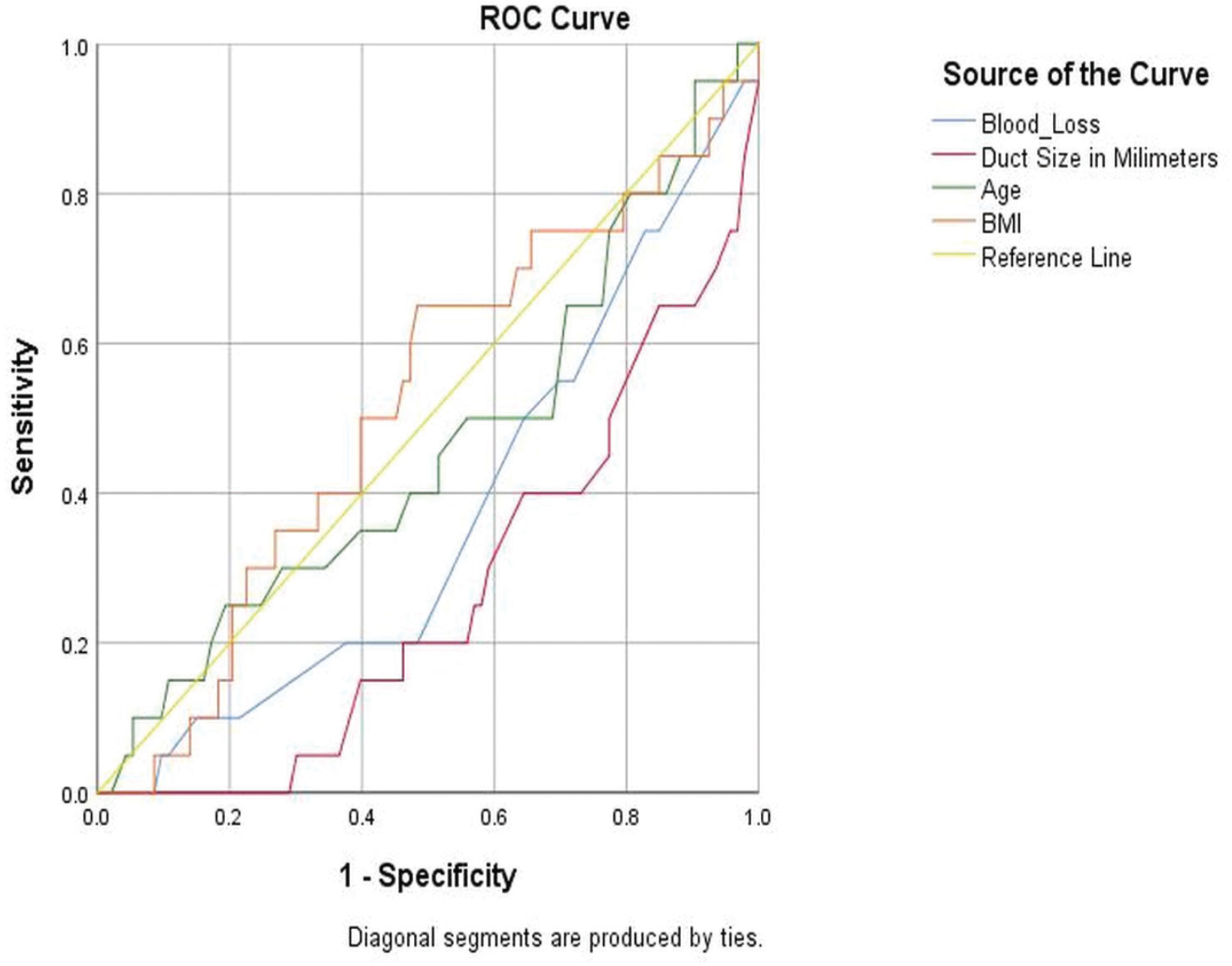
Figure 1.
ROC (Receiver Operating Characteristic) curve for original Fistula Risk Score (o-FRS) and duct-to-parenchyma ratio (DPR).
Table 2.
Area under curve (AUC) analysis of o-FRS and DPR with corresponding significance and confidence intervals.
| SN | Test variable | Area under curve | Confidence interval | Level of significance | Standard error |
|---|---|---|---|---|---|
| 1 | O-FRS | 0.709 | 0.577–0.841 | 0.003 | 0.067 |
| 2 | DPR | 0.232 | 0.132–0.332 | 0.000 | 0.051 |
Table 3 presents the multivariate analysis of the variables. Age, BMI, blood loss (ml), and gland consistency were not significant predictors of CR-POPF in the studied population. Duct size in mm was a significant predictor of CR-POPF (OR=0.43, P=0.006). Each 1 mm increase in duct size was reported with a 56.9% decrease in the occurrence of POPF. The female gender was reported to have higher odds of developing CR-POPF with OR=3.96 as compared to male participants, with P=0.036. This means that women have 4 times the odds of developing CR-POPF. Figure 2 shows the ROC curve for individual factors. AUC analysis (Table 4) for blood loss, age and BMI was not significant, and none of the three variables reported prediction ability. Duct size in mm was reported to be significant (P=0.001, P<0.05), but the AUC value was 0.267, which was insufficient for model prediction. 8 patients (7.01%) needed re-exploration for various reasons, with no cases of failure to rescue. 4 of these re-explorations were because of a type C leak, with one patient presenting with a bleeding pseudo-aneurysm of the Gastro-duodenal artery stump, which was not amenable to Interventional Radiology (IR) procedures. There was only one all-cause death within 30 days as well as 90 days (related to a gastro-jejunostomy leak and further complicated by a massive pulmonary embolism). All-cause readmission within 30 days of the primary operation occurred in 27.19% (n=31) of patients.
Table 3.
Multivariate Logistic regression.
| Variables | Odds Ratio | Confidence Interval | P-value |
|---|---|---|---|
| Age | 0.99 | 0.95–1.04 | 0.932 |
| BMI | 0.96 | 0.86–1.07 | 0.520 |
| Gland consistency | |||
| soft | 0.822 | 0.254–2.663 | 0.744 |
| hard | |||
| Duct size in mm | 0.43 | 0.23–0.78 | 0.006* |
| Gender | |||
| male | Reference | ||
| female | 3.96 | 1.09–4.38 | 0.036* |
| Blood loss in ml | 0.998 | 0.994–1.00 | 0.214 |
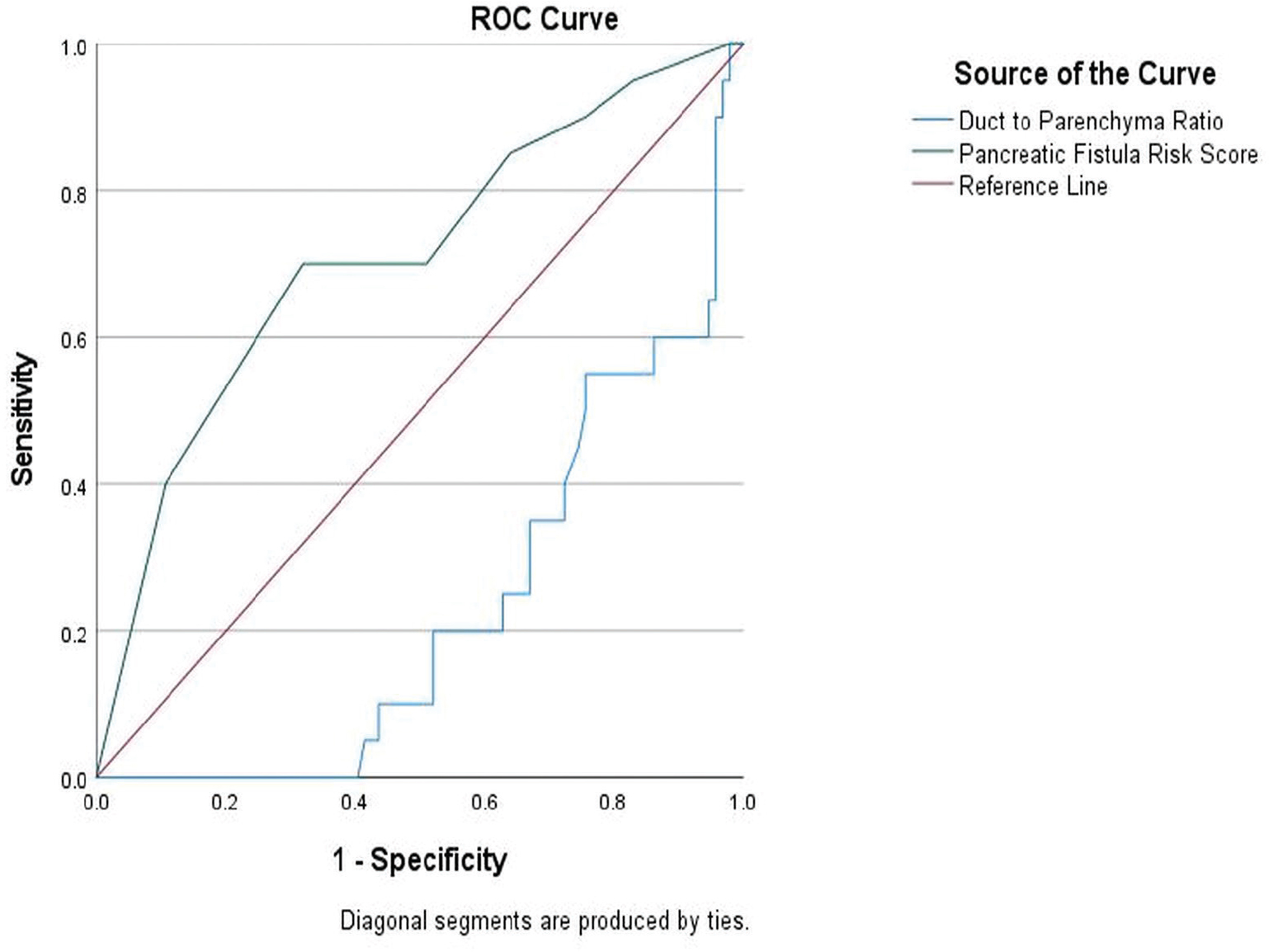
Figure 2.
ROC (Receiver Operating Characteristic) curve for individual factors.
Discussion
This study found that o-FRS was a better predictor of CR-POPF after PD than DPR, with higher sensitivity (22.1%), specificity (91.9%), and PPV (85%) (Table 5). The o-FRS demonstrated better accuracy (AUC = 0.709, P = 0.003) compared to DPR (AUC = 0.232, P = 0.006). While the combined o-FRS/DPR model was statistically significant (P = 0.001), its low sensitivity (5%) rendered it impractical for predictive purposes.
Table 5.
Diagnostic Accuracy of DPR and o-FRS in Predicting CR-POPF: Sensitivity, Specificity, and Predictive Values.
| Predictive scores | Sensitivity | Specificity | Positive predictive value | Negative predictive value |
|---|---|---|---|---|
| DPR | 0% | 76.2% | 0% | 68.1% |
| o-FRS | 22.1% | 91.9% | 85% | 36.2% |
Among clinical factors, male gender and duct size were significant predictors of CR-POPF on univariate analysis; however, on multivariate analysis, female gender had 4-fold higher odds (OR = 3.96, P = 0.036) of developing CR-POPF. The reason for this finding needs further investigation in future studies. An increase in duct size was protective, reducing CR-POPF risk by 56% per mm increase (OR = 0.43, P = 0.006), though its predictive value was limited (AUC = 0.267). Other factors, including age (P = 0.785), BMI (P = 0.198), gland consistency (P = 0.833), histopathology (P = 0.552), and blood loss (P = 0.717), were not significant predictors. This study, conducted in a Pakistani cohort, suggests that o-FRS is a better predictor of CR-POPF than DPR, whereas the combined model is clinically impractical due to its low sensitivity.
CR-POPF is considered one of the most significant complications after PD, and a series of studies have reported different risk factors for CR-POPF, including multi-visceral resection (P=0.039), BMI (P=0.001), and duct size [22, 23, 24, 25]. The mean age of the studied population was 50.81 years, while the participants who developed CR-POPF had a mean age of 49 years, ranging from 24 to 78 years. Another study from Pakistan reported the median age of CR-POPF patients as 54 years, with a range of 19 to 78 years [26]. While matching the same age groups, the mean age of CR-POPF patients was reported as 51.5 and 56.8 years from Pakistan [27,28]. Comparatively, studies from other regions have reported higher mean ages for CR-POPF patients, at 65.6 years [8,29] and 60 years [8,29]. Evidence has reported older age (OR=3.22) as a risk factor for CR-POPF, but this association was not significant in the current study. 50% (n=10) of the positive CR-POPF cases were reported in patients under 50 years of age, but this was not found to be significant [6,30]. Furthermore, the current study’s results show that the female gender has a higher odds of developing CR-POPF (OR=3.96, CI 1.09–4.38), which is the opposite of a previous study showing that the male gender (OR=3.06) is significant for CR-POPF [6, 25]. Studies have reported the alternative fistula risk score (a-FRS) as an effective scale for predicting CR-POPF [AUC: 0.823, P=0.006], thus showing higher efficacy than o-FRS [AUC: 0.709, P=0.003]; however, we do not use a-FRS in our setup, therefore, we did not investigate the comparison between these two scoring systems [24]. The current study found that duct size (P=0.031) was a predictive factor of POPF, consistent with earlier studies [31]. The current study reported o-FRS as an effective predictor of CR-POPF in our cohort of patients from Pakistan, and similar studies have affirmed this in other geographical regions as well [32]. The current study did not report any association between pancreatic texture and POPF, although some studies have reported that a soft pancreatic texture (P=0.001) and a small pancreatic duct (P=0.001) can be significant predictors of POPF [33]. This could be because our cohort of patients was younger and in better physiological condition than those in studies from other regions, but this needs further investigation in future studies. The combined effect of DPR and o-FRS has not been evaluated before. The current study investigated the combined effect of the two scoring systems; although statistically significant (P<0.001), the results were also associated with a very low sensitivity of 5%. Hence, the combined model failed to achieve external validity. The current study encountered the limitations and biases inherent to retrospective studies. The study did not report any other factors related to the co-morbidities of the patients, which may have a significant impact on the occurrence of POPF in the participants studied, nor did we assess co-founding factors such as the impact of surgical volume, intra-operative technique variability, such as the impact of vein/multi-visceral resections, or differences in post-operative care. Though we feel this impact would have been minimal, given that all patients are cared for by the same surgeon and intensive care team, the variation in practice is small. The current study is a valuable addition to the evidence base, helping policymakers and researchers in Pakistan and the region understand the metrics of CR-POPF and its associated factors.
In summary, postoperative pancreatic fistula is an important clinical complication experienced by patients after pancreaticoduodenectomy. The use of DPR and o-FRS scales has been determined in the literature to predict CR-POPF. The current study reported that o-FRS was an effective tool for predicting CR-POPF compared with DPR in our cohort of patients from Pakistan.
The combined effect of DPR and o-FRS in predicting CR-POPF was significant, although, due to low sensitivity, it did not achieve external validity.