
Introduction
Cancer diagnosis and treatment can often lead to significant financial burden for patients, impacting their quality of life (1). Despite national and global cancer support programs, many patients still pay out-of-pocket for necessities such as transport, investigations, medications, and hospitalization (2). A review by Azzani et al. found that 47% of cancer patients in middle- and high-income countries experienced catastrophic health expenditure, rising to 74.4% in low-income countries. This highlights the substantial financial challenges, especially in resource-limited settings like Pakistan, which sees approximately 0.18 million new cancer cases annually (3), with limited resources for comprehensive cancer care (4).
The term ‘Financial Toxicity’ (FT) is frequently used to describe the burden faced by patients and their families due to increasing expenses in cancer care (5). This financial strain not only negatively impacts their quality of life but also impacts treatment adherence, leading to a higher risk of mortality and personal bankruptcy (6). Additionally, caregivers often experience potential loss of employment and household income due to increased caregiving responsibilities (7). A systematic review evaluating the effects of FT reported a positive association of FT with depression, anxiety, reduced social engagement, increased worry about future expenses, and challenges in transitioning to cancer survivorship (8,9). In South Asia, access to standardized healthcare is a challenge. A study done in a tertiary care hospital of Peshawar, Pakistan reported that 84% of the patients could not meet their monthly expenses owing to the cost of cancer treatment and 85% were worried that they might lose their jobs (10).
Given the profound impact of FT on patients’ lives, accurately measuring FT is crucial. Robust measurement tools can help identify the extent of the burden, guide interventions, and inform policies aimed at alleviating financial stress for cancer patients. The Comprehensive Score for Financial Toxicity – Functional Assessment of Chronic Illness Therapy (COST-FACIT) is a patient-reported outcome tool widely used to assess the degree of FT amongst patients with cancer (11,12). It consists of 11 questions rated on a five-point Likert scale, where lower scores indicate higher levels of FT (10). The tool has been validated in various languages and has been used to identify FT in patients with chronic illness including diabetes and cancer (13,14,15). Its use in cancer patients has led to studies focusing on reducing the financial burden of care and developing cost-effective care programs.
Although several studies have been conducted to assess FT in cancer patients, data from Pakistan is limited, and no standardized tool has been developed. This study aimed to translate and validate the COST-FACIT tool in Urdu language to assess FT in our population. Having a validated tool in the local language is an essential first step toward exploring the outcomes and identifying strategies to decrease the financial burden on oncological patients.
Materials and Methods
This was a cross-sectional study conducted at four tertiary care institutions in Karachi, Pakistan, including Aga Khan University Hospital (AKUH), Cancer Foundation Hospital (CFH), Jinnah Postgraduate Medical Center (JPMC), and Patel Hospital (PH). These four hospitals represent public and private sector hospitals and together represent a diverse group of patients with various ethnic and socio-economic backgrounds. The study used the Comprehensive Score for Financial Toxicity (COST) FACIT tool, which was translated, from October to November 2023, into Urdu following the FACIT translation guidelines described in detail below. Formal permission was sought from the FACIT group and ethical approval was received from all participating institutions. Written informed consent was obtained from the patients before administering the study questionnaire. Data collection spanned from November to December 2023, ensuring all activities involving human participants were conducted after IRB approval was granted.
The sample size for this study was determined based on the FACIT translation guidelines, which recommend including 10 patients for tool translation. Therefore, no formal statistical methods or power analysis were performed, as we adhered to these established guidelines. We included adult (≥ 18 years) patients who received treatment for any gastrointestinal (GI) cancer at one of four participating institutes. Patients were excluded if they had a history of prior malignancy other than GI cancer, psychiatric illness or medications, physical disabilities such as stroke or amputations, and inability to read, write, or understand at least one of the two languages (English or Urdu). Nonprobability consecutive sampling was employed to enroll participants in this study. Authors (M.T.H.S., S.S.V., F.S., A.A.K.) approached eligible GI cancer patients during their scheduled appointments in surgical and oncology clinics and wards. After obtaining informed consent, participants completed the Urdu version of the COST tool through interviews conducted by the authors. To ensure a diverse sample, participants were recruited from all four hospitals: three from JPMC, three from AKUH, and two each from PH and CFH. The patients in whom the Urdu version was pre-tested were all native Urdu speakers, ensuring proficiency in the language.
The COST-FACIT tool comprises 12 items, labeled FT1 to FT12, and is assessed using a 5-point Likert scale ranging from 0 to 4. A score of 0 represents “Not at all,” 1 is “A little bit,” 2 is “Somewhat,” 3 is “Quite a bit,” and 4 is “Very much.” Items 2, 3, 4, 5, 8, 9, and 10 are reverse scored, while item 12 is a non-scoring summary question and does not factor into the overall financial toxicity score. The sum of item scores may range from 0 to 44. The financial toxicity score is computed by summing the scores of 11 items, multiplying by 11, and dividing by the number of items answered. Lower scores reflect greater financial toxicity. Scores are categorized into four grades: Grade 0 (COST score ≥26) indicating no effect on the quality of life, Grade 1 (score 14–25) indicating a mild effect, Grade 2 (score 1–13) indicating a moderate effect, and Grade 3 (score 0) indicating a significant effect on quality of life (16,17). The four-step process commenced with forward translation, where the English version of COST-FACIT tool was independently translated into Urdu by Y.A. and M.N., both possessing a medical background and good command of English and Urdu. Following this, M.T.H.S., who is fluent in both English and Urdu, and with a medical background, reconciled the two forward translations. Next, the reconciled version was back-translated into English by H.A.P. and S.S.V., who are proficient in Urdu and have a health-related background. The back-translated questionnaire was then compared with the original English version confirming their close alignment. Each of these steps was thoroughly documented and submitted to the FACIT team for their review. Any queries raised were addressed, and eventually, the team approved the final version for pilot testing. For the pilot testing phase, the finalized questionnaire was administered to 10 native Urdu-speaking cancer patients. The pilot testing was conducted across all four hospitals, following ERC approval. Patient feedback was actively recorded to assess the clarity and comprehension of the translated items. If any words were found to be difficult to understand, they were modified to simpler, more comprehensible terms; however, no significant changes were required.
Descriptive analysis was performed for patients’ demographic and disease-related characteristics including sex, age, education level, marital status, occupation, monthly household income, and site of tumor, and reported as frequencies, percentages, means, and standard deviations. The content validity of the COST-FACIT tool was evaluated. Internal consistency was measured using Cronbach’s alpha, where an alpha coefficient of 0.7 or higher was deemed acceptable (18). Inter-item correlations were calculated to evaluate internal consistency, with correlations greater than 0.7 indicating potential redundancy among items, warranting their removal (19). Data analysis was performed using Stata MP v.14 software.
Results
Table 1 presents the characteristics of the patients included in the study. A total of 10 patients participated, including 6 females (60%) and 6 patients (40%) aged between 40 and 60 years. Among these, 30% were from Aga Khan University Hospital (private, fee-for-service), 20% from Cancer Foundation Hospital (private, subsidized), 30% from Jinnah Postgraduate Medical Center (public, free of cost), and 20% from Patel Hospital (private, subsidized). In terms of monthly household income, 4 (40%) patients reported an income of less than 50,000, while an equal proportion reported an income between 50,000 and 100,000. The most common site of cancer among the patients was esophagus (4 patients, 40%), followed by colon (3 patients, 30%), pancreas (2 patients, 20%), and rectum (1 patient, 10%). The mean FACIT COST score was 16.3 (SD = 11.255, range 4–40) among all participants. The financial toxicity experienced by the patients was categorized into four grades based on the COST-FACIT scores. As depicted in Figure 1, 2 patients (20%) experienced no effect on quality of life (Grade 0), 2 (20%) had a mild effect (Grade 1), and the majority, 6 patients (60%), experienced a moderate effect on their quality of life (Grade 2). No patients reported a high effect on their quality of life (Grade 3).
Table 1.
Patient characteristics
| Characteristics | N (%) |
|---|---|
| Institution | |
| Aga Khan University Hospital | 3 (30%) |
| Cancer Foundation Hospital | 2 (20%) |
| Jinnah Postgraduate Medical Center | 3 (30%) |
| Patel Hospital | 2 (20%) |
| Sex | |
| Male | 4 (40%) |
| Female | 6 (60%) |
| Age | |
| Less than 40 years | 3 (30%) |
| 40–60 years | 4 (40%) |
| Above 60 years | 3 (30%) |
| Education | |
| Not educated | 3 (30%) |
| Primary | 1 (10%) |
| Secondary | 3 (30%) |
| Graduate and above | 3 (30%) |
| Marital status | |
| Married | 9 (90%) |
| Unmarried | 1 (10%) |
| Occupation | |
| Employed (excluding self employed) | 1 (10%) |
| Unemployed | 1 (10%) |
| Labour work | 1 (10%) |
| Home maker | 5 (50%) |
| Self employed | 1 (10%) |
| Retired | 1 (10%) |
| Monthly household income (in Pak Rupees) | |
| <50,000 | 4 (40%) |
| 50,000–100,000 | 4 (40%) |
| >100,000 | 3 (30%) |
| Site of cancer | |
| Colon | 3 (30%) |
| Esophagus | 4 (40%) |
| Pancreas | 2 (20%) |
| Rectum | 1 (10%) |
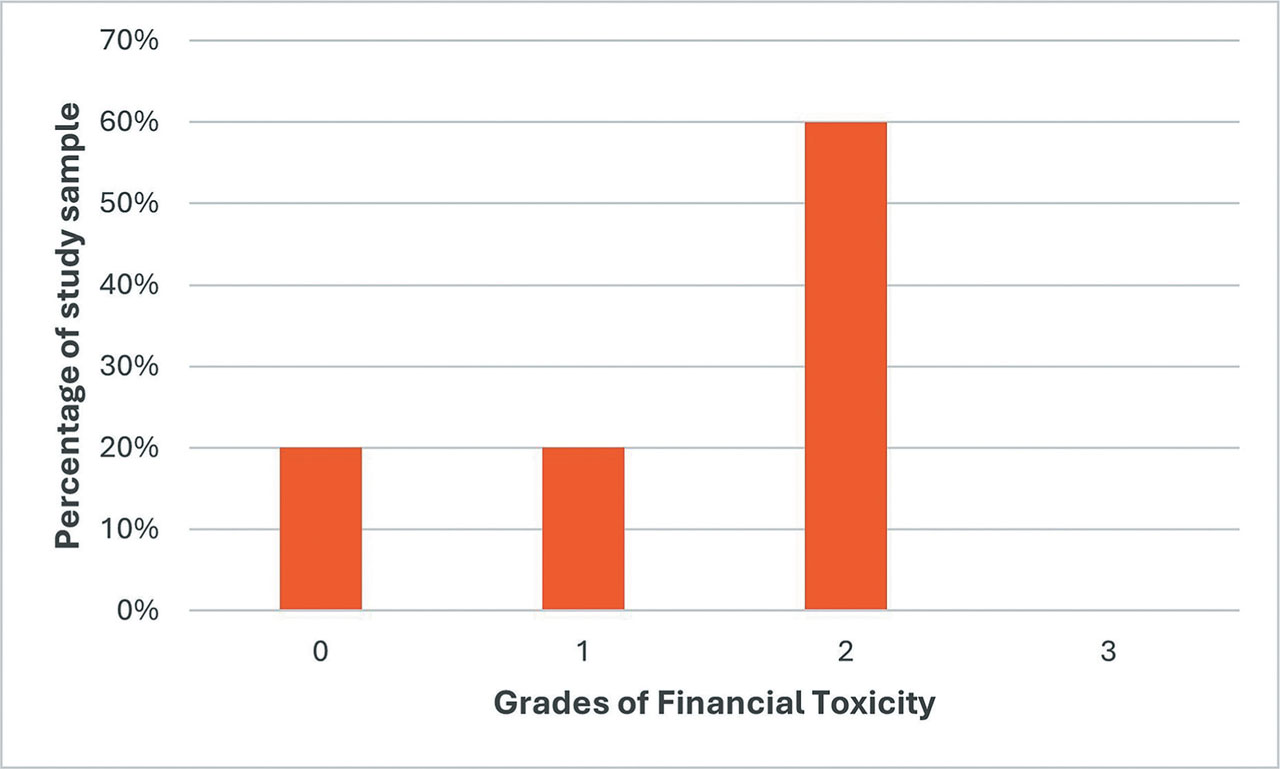
Figure 1.
Distribution of Participants Across Grades of Financial Toxicity.
Table 2 presents the descriptive statistics and internal consistency values for the FACT-COST tool items. The mean scores for the items ranged from 0.8 to 2.1. The internal consistency, as measured by Cronbach’s alpha if the item was deleted, ranged from 0.869 to 0.914, indicating good internal consistency. The Content Validity Indices (CVIs) for relevance and clarity based on expert and patient responses are presented in Table 3. The CVIs for expert relevance ranged from 0.64 to 0.91, while the CVIs for expert clarity ranged from 0.70 to 1.00. Mean patient relevance CVI was 1, and mean patient clarity CVI was 0.99. The average CVI for relevance based on expert responses was 0.82, and for clarity, it was 0.90. These values indicate that the items are considered relevant and clear by both experts and patients.
Table 2.
Descriptive and Internal Consistency for FACIT COST Tool Items
| COST item | Mean | STD | Cronbach’s alpha if item deleted |
|---|---|---|---|
| FT1 | 1 | 1.33 | 0.902 |
| FT2 | 1 | 1.49 | 0.892 |
| FT3 | 1.1 | 1.45 | 0.869 |
| FT4 | 1.8 | 1.32 | 0.914 |
| FT5 | 1.7 | 1.64 | 0.874 |
| FT6 | 1.8 | 1.14 | 0.879 |
| FT7 | 1.2 | 1.69 | 0.872 |
| FT8 | 2.1 | 1.52 | 0.883 |
| FT9 | 1.8 | 1.48 | 0.891 |
| FT10 | 2 | 1.63 | 0.883 |
| FT11 | 0.8 | 1.32 | 0.880 |
Table 3.
Content Validity Indices for FACIT COST Tool Items
| COST item | Content Validity Index (CVI) for relevance – expert responses | Content Validity Index (CVI) for clarity – expert responses | Content Validity Index (CVI) for relevance – patient responses | Content Validity Index (CVI) for clarity – patient responses |
|---|---|---|---|---|
| FT1 | 0.82 | 1.00 | 1.00 | 1.00 |
| FT2 | 0.91 | 0.90 | 1.00 | 1.00 |
| FT3 | 0.91 | 1.00 | 1.00 | 1.00 |
| FT4 | 0.73 | 0.70 | 1.00 | 1.00 |
| FT5 | 0.64 | 0.90 | 1.00 | 1.00 |
| FT6 | 0.82 | 1.0 | 1.00 | 0.90 |
| FT7 | 0.82 | 1.0 | 1.00 | 1.00 |
| FT8 | 0.91 | 0.9 | 1.00 | 1.00 |
| FT9 | 0.73 | 0.8 | 1.00 | 1.00 |
| FT10 | 0.82 | 0.8 | 1.00 | 1.00 |
| FT11 | 0.82 | 0.8 | 1.00 | 1.00 |
Table 4 presents the inter-item correlations matrix for the FACIT COST tool items. The correlations highlight some strong relationships between certain pairs of items, such as FT3 and FT5 (r = 0.904), FT3 and FT7 (r = 0.855), and FT5 and FT7 (r = 0.709). These high correlations indicate potential redundancy among these items. However, these items have been retained due to their unique content value, which adds depth to the tool’s measurement capability.
Table 4.
Inter-Item Correlations Matrix for FACIT COST Tool
| FT1 | FT2 | FT3 | FT4 | FT5 | FT6 | FT7 | FT8 | FT9 | FT10 | FT11 | total_~e | |
|---|---|---|---|---|---|---|---|---|---|---|---|---|
| FT1 | 1 | |||||||||||
| FT2 | 0.447 | 1 | ||||||||||
| FT3 | 0.403 | 0.772 | 1 | |||||||||
| FT4 | −0.696 | −0.283 | 0.128 | 1 | ||||||||
| FT5 | 0.255 | 0.547 | 0.904 | 0.381 | 1 | |||||||
| FT6 | 0.514 | 0.328 | 0.756 | 0.045 | 0.682 | 1 | ||||||
| FT7 | 0.297 | 0.530 | 0.855 | 0.220 | 0.709 | 0.836 | 1 | |||||
| FT8 | 0.164 | 0.196 | 0.548 | 0.343 | 0.593 | 0.527 | 0.467 | 1 | ||||
| FT9 | 0.169 | 0.202 | 0.374 | 0.092 | 0.202 | 0.570 | 0.643 | 0.603 | 1 | |||
| FT10 | 0.255 | 0.365 | 0.657 | 0.258 | 0.79 | 0.599 | 0.565 | 0.536 | 0.323 | 1 | ||
| FT11 | 0.570 | 0.623 | 0.711 | −0.218 | 0.485 | 0.639 | 0.621 | 0.731 | 0.663 | 0.310 | 1 | |
| Total score | 0.429 | 0.623 | 0.931 | 0.177 | 0.862 | 0.84 | 0.880 | 0.743 | 0.626 | 0.750 | 0.792 | 1 |
Discussion
Our study results provide strong evidence supporting the validity, reliability, and cultural relevance of the Urdu version of the COST-FACIT tool for assessing financial toxicity (FT) among cancer patients. This version is culturally and linguistically appropriate for Urdu-speaking populations in Pakistan and for those of Pakistani origin currently living in different countries, an estimated population of 231.7 million people worldwide, who speak Urdu as their native or second language (20).
Notably, 60% of the patients in our study experienced moderate FT, underscoring the substantial economic burden faced by cancer patients. This highlights FT as a critical issue across different cultural and linguistic backgrounds, reinforcing the necessity to understand FT in various populations. The Urdu version of the COST-FACIT tool fills a gap in the assessment of FT among non-English speaking populations, such as those in Pakistan. Accurate assessment tools are crucial for identifying patients at risk of financial distress and implementing appropriate interventions. The validated Urdu version of the COST-FACIT tool can be used in clinical settings to tackle the financial difficulties faced by cancer patients in Urdu-speaking regions.
The reliability of the Urdu COST-FACIT tool is confirmed with a Cronbach’s alpha value of 0.90, which aligns closely with the original version12 and significantly exceeds the accepted threshold of 0.7, demonstrating strong internal consistency and reliability. Content Validity Indices (CVIs) for expert relevance ranged from 0.64 to 0.91, and for expert clarity ranged from 0.70 to 1.00. These values indicate that the items are considered relevant and clear by experts.
Financial toxicity and the costs of cancer care are particularly challenging in low- and middle-income countries (LMICs). A systematic review by Gordon et al. reported that financial toxicity affected up to 73% of cancer survivors (21). In Rwanda, a low-middle income country, Rubagumya et al. reported that 44% of patients had to sell property to cover cancer treatment costs, 29% sought charity from public, family, or friends, and 16% took out loans with interest (22). In Pakistan, a patient’s ability to afford treatment is critical for accessing healthcare, and financial toxicity creates a host of challenges (23). There is limited literature on the financial toxicity experienced by Pakistani patients, underlining the importance of having a validated tool in local languages to measure this issue.
The availability of the translated and validated COST-FACIT questionnaire in Urdu enables healthcare providers to more effectively assess and manage financial toxicity in cancer patients. The tool’s strong reliability and validity indicate that it can produce findings comparable to those from other Urdu-speaking communities and regions with similar healthcare systems. By utilizing this tool, healthcare providers can identify patients at risk of financial distress, tailor interventions accordingly, and assist with financial planning. Additionally, it facilitates the exploration of financial assistance programs, thereby helping to alleviate the financial burdens faced by cancer patients. This comprehensive approach ensures that financial toxicity is addressed in a culturally relevant and accurate manner, ultimately improving patient care and outcomes. With the validated Urdu version, future studies can be designed to assess financial toxicity more accurately in the Pakistani population. These studies can explore the factors leading to financial toxicity, the adverse outcomes associated with it, its overall impact on patients, and potential strategies to alleviate it. This approach will provide a deeper understanding of financial toxicity and help develop targeted interventions to support cancer patients in managing their financial burdens.
This study should not be taken as representative data for FT amongst Pakistani patients. Its small sample size, while appropriate for tool validation, is not adequate to describe FT amongst patient with cancer in Pakistan. Future studies should include larger and more diverse cohorts to better understand the financial stress faced by cancer patients across different types and stages of cancer. Additionally, this study did not explore the factors associated with financial toxicity and its effects.
We have translated and validated the Urdu adaptation of the COST-FACIT tool. It is reliable measure that assists healthcare professionals in evaluating and identifying the financial burden experienced by cancer patients. It can be used by researchers and clinicians to study FT in Urdu speaking populations, both in Pakistan and among Pakistani-origin individuals living in several countries throughout the world.
Acknowledgments
We would like to express our sincere gratitude to Yumna Ahmed (Y.A.), Maryum Nouman (M.N.), and Hamdan Ahmed Pasha (H.A.P.) for their invaluable assistance with the translation of the COST-FACIT tool. We also extend our thanks to the FACIT team (www.facit.org) for guiding us through the translation guidelines, ensuring that the tool was accurately adapted for our population.
Notes
[2] Contributed by Authors Contributions
Conceived and designed the analysis: M.T.H.S., S.S.V., M.R.K., S.N.Z.
Collected the data: M.T.H.S., S.S.V., F.S., A.A.K.
Contributed data or analysis tools: M.T.H.S., S.S.V., F.S., A.A.K. Performed the analysis: S.S.V.
Wrote the paper: M.T.H.S., S.S.V., F.S., A.A.K.
Reviewed the paper: L.S., A.J., M.R.K., S.N.Z.