
Table 1.
Number of Varroa mites found on the bottom boards after late summer-autumn treatments in each experimental group in 2010 and 2011
| N | Min | Max | Mean** | SD | |||
|---|---|---|---|---|---|---|---|
| SCS | Both apiaries | Years together | 54 | 16 | 1806 | 352 a | 316.1 |
| MCS | 68 | 17 | 1975 | 456 b | 364.6 | ||
| Both groups | Apiary (W) | Years together | 70 | 16 | 1975 | 372 a | 346.4 |
| Apiary (S) | 52 | 121 | 1806 | 412 b | 343.3 | ||
| Both groups | Both apiaries | 2010 | 72 | 16 | 1806 | 455 b | 335.5 |
| 2011 | 50 | 27 | 1975 | 345 a | 355.2 | ||
| Total | 16 | 1975 | 410 | 346.4 |
* SCS colonies with queens instrumentally inseminated using semen from drones of a single colony, MCS colonies with queens instrumentally inseminated using mixed semen from drones of thirty colonies
** different letters in columns separated by blank row indicate significant differences at α=0.05 based on multifactor
Anova
The table shows only the main effects. Data were transformed with the Log10 formula.
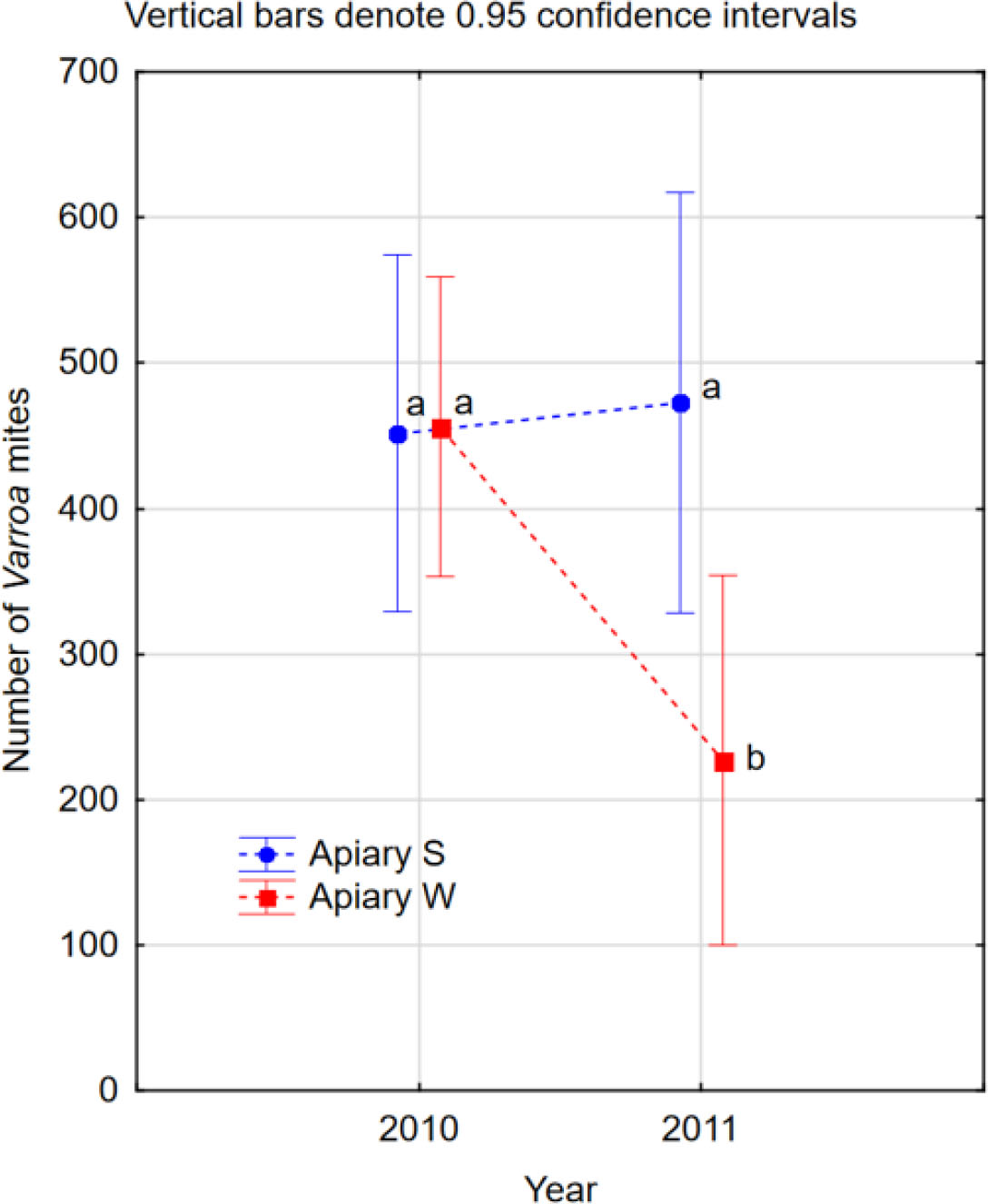
Fig. 1.
Number of Varroa mites found after treatment on the bottom boards in particular years and apiaries.
Means among seasons indicated with different letters differed significantly from each other (P<0.05).
Table 2.
The number of Varroa mites found on the bottom boards after late summer-autumn treatments in each experimental group in 2010 and 2011. The SCS group was divided according to the origin of the paternal colonies
| N | Min | Max | Mean** | SD | |
|---|---|---|---|---|---|
| SCS-M | 23 | 27 | 1806 | 337 a | 388.5 |
| SCS-N | 12 | 16 | 941 | 378 a | 289.4 |
| SCS-G | 19 | 43 | 922 | 354 a | 240.4 |
| MCS | 68 | 17 | 1975 | 456 a | 364.6 |
Table 3.
Number of dead bees with winter debris and nest adjustment in spring 2010 and 2011 in bee colonies according to Varroa infestation level expressed on a scale of 1–3
| Mean** | Median | Range | |||
|---|---|---|---|---|---|
| 1 | 23 | 1359 a | −14.2 a | −7.1 | −50 – 0 |
| 2 | 33 | 1188 a | −11.0 a | 0 | −40 – 0 |
| 3 | 38 | 1356 a | −11.4 a | −14.3 | −50 – 33 |
| Total | 95 | 1288 | −11.8 | −14.2 | −50 – 33 |
Table 4.
Distribution of healthy colonies and those infected with Vairimorpha spp. from each experimental group
| N | 0 | 1 | 2 | 3 | ||
|---|---|---|---|---|---|---|
| SCS | 2010 | 89 | 28 | 2 | 1 | 8 |
| MCS | 27 | 5 | 4 | 14 | ||
| SCS | 2011 | 68 | 18 | 1 | 3 | 10 |
| MCS | 23 | 6 | 1 | 6 | ||
| SCS | 2012 | 25 | 1 | 1 | 2 | 7 |
| MCS | 4 | 2 | 1 | 7 | ||
| Total | 182 | 101 | 17 | 12 | 52 |
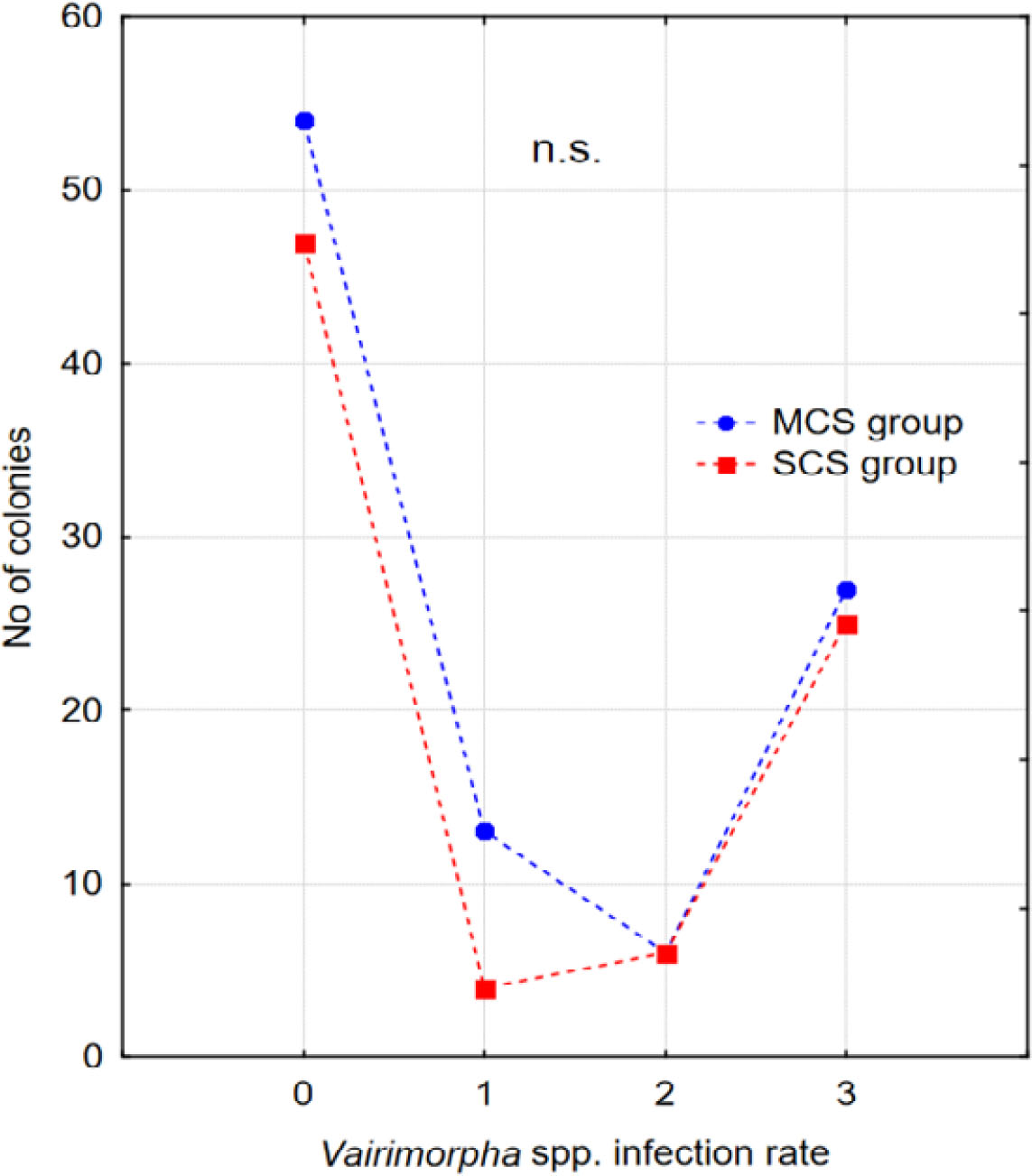
Fig. 2.
Number of healthy colonies (0) and infected with Vairimorpha spp. (scale 1–3) in the different experimental groups,
n.s. - not significant.
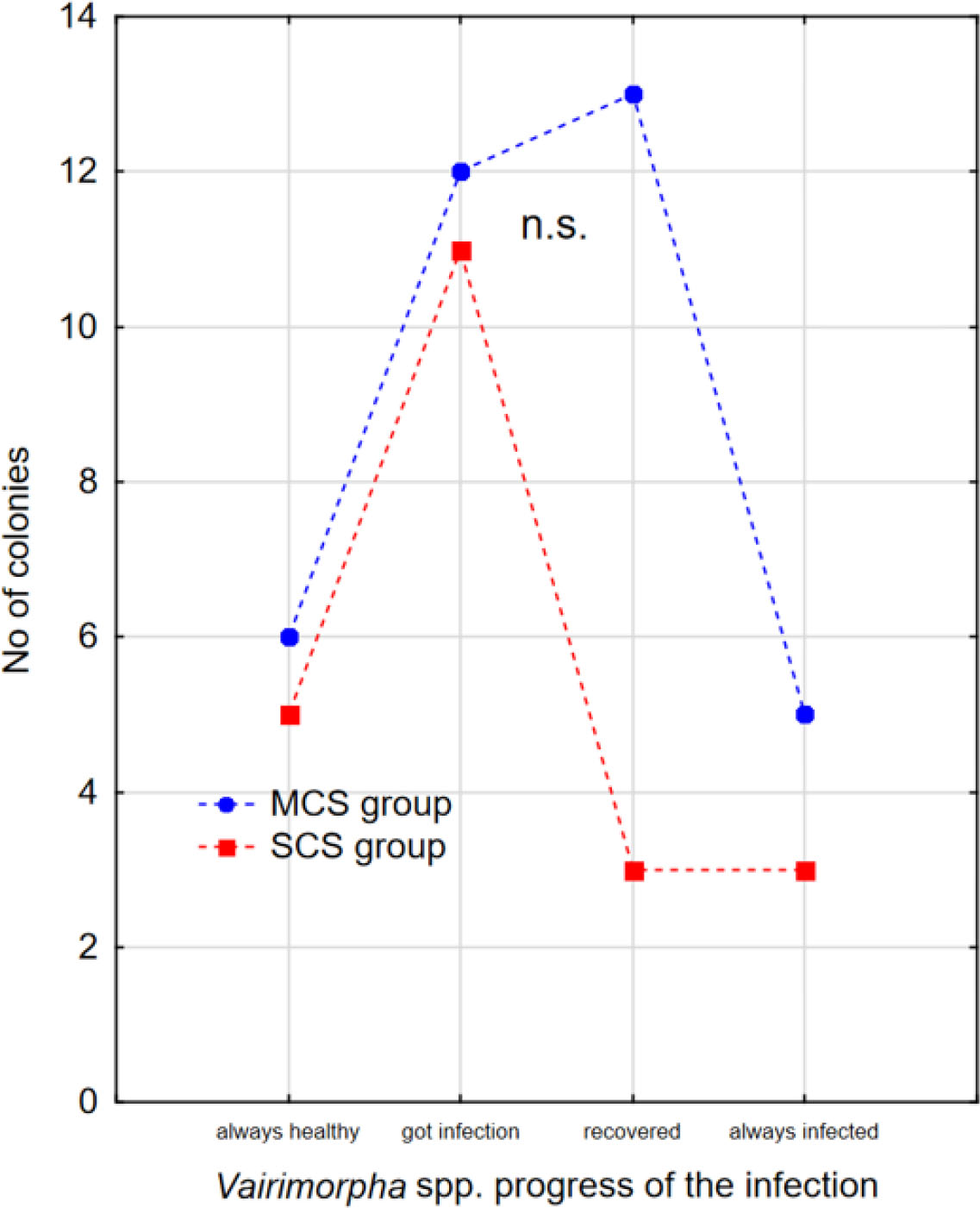
Fig. 3.
Number of healthy colonies and those infected with Vairimorpha spp. and then recovered changes during the experimental period in each experimental group colonies,
n.s. - not significant.
Table 5.
Distribution of healthy colonies from each experimental group and those infected with Vairimorpha spp.
Table 6.
Distribution of viruses in bee samples taken in autumn from colonies in each experimental group in 2010 and 2011
| N | 0 | ABPV | DWV | ABPV + DWV | ||
|---|---|---|---|---|---|---|
| SCS | 2010 | 71 | 21 | 9 | 2 | 0 |
| MCS | 24 | 14 | 1 | 0 | ||
| SCS | 2011 | 45 | 13 | 1 | 5 | 1 |
| MCS | 19 | 0 | 7 | 0 | ||
| Total | 116 | 77 | 24 | 15 | 1 | |
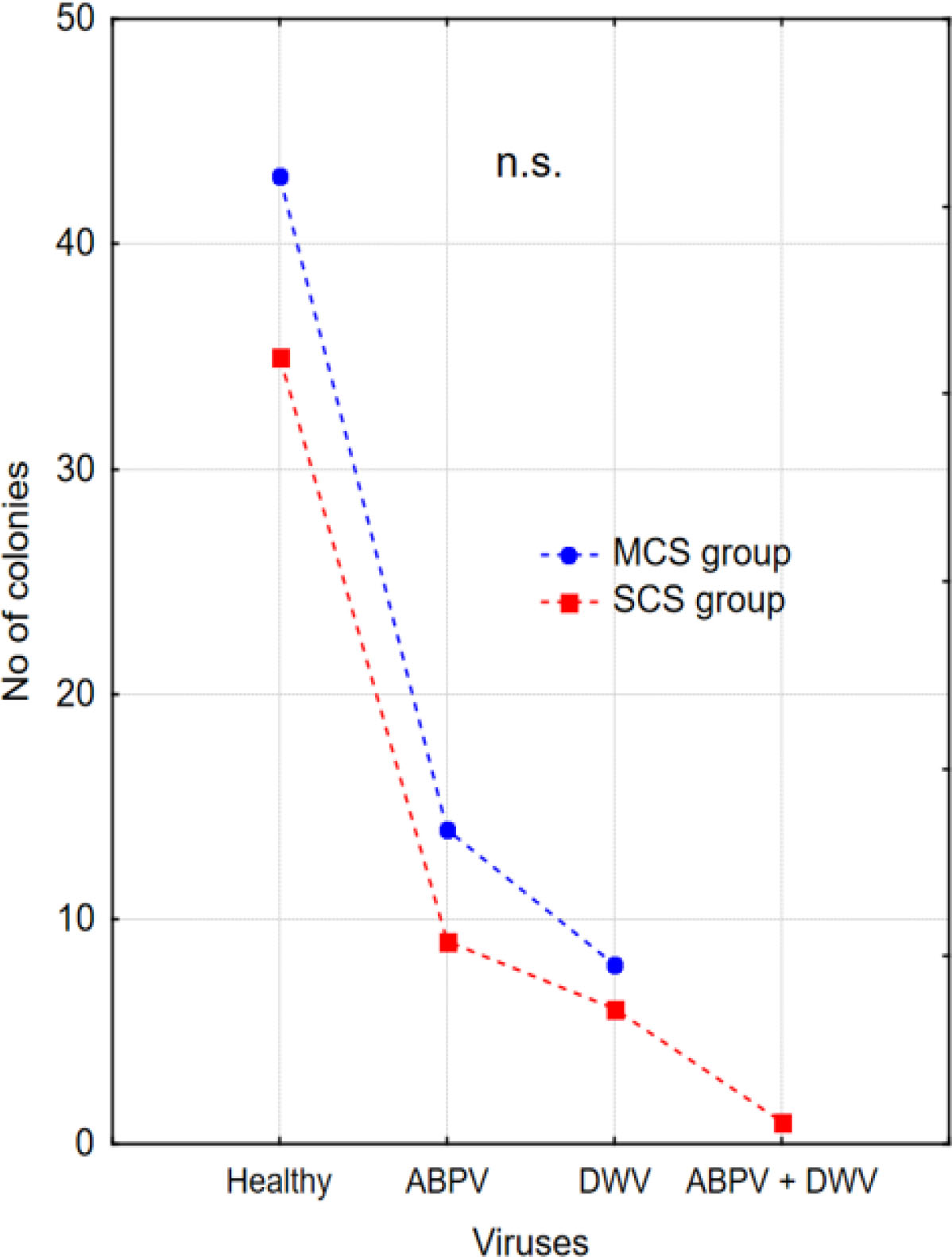
Fig. 4.
Number of healthy colonies and infected with ABPV and DWV in the different experimental groups,
n.s. - not significant
Table 7.
Number of Varroa mites before winter and some indicators of overwintering of healthy colonies and those infected by viruses
| Mean** | Median | ||||
|---|---|---|---|---|---|
| Healthy | 75 | 420 a | 1251 a | −11.2 a | −14.0 |
| ABPV | 23 | 485 a | 1035 a | −7.7 a | 0.0 |
| DWV | 13 | 417 a | 2047 b | −31.1 b | −33.3 |
| ABPV + DWV*** | 1 | 321 | 2621 | −16.6 | −16.6 |
| Total | 112 | 432 | 1288 | −12.7 | −14.2 |