
INTRODUCTION
The western honey bee, Apis mellifera L., has a wide distribution in Africa, the Middle East and Europe. Since Ruttner’s morphological classification of twenty-five taxonomic groups (subspecies) of the western honey bee (Apis mellifera L.) (Ruttner, 1988), twenty-nine recognized subspecies of Apis mellifera has been identified with the addition of newly described subspecies including A. m. ruttneri from Malta (Sheppard et al., 1997), A. m. pomonella from Central Asia (Sheppard & Meixner, 2003), A. m. simensis from Ethiopia (Meixner et al., 2011) and Apis mellifera sinisxinyuan Xinyuan bees from China (Chen et al., 2016). These subspecies are now typically divided into four major groups, supported by morphometric and molecular studies: A lineage in Africa, M lineage in western and northern Europe, C lineage in eastern Europe and O lineage in the Middle East and Western Asia (Garnery et al., 1992; Whitfield et al., 2006; Oleksa et al., 2011; Han et al., 2012; Péntek-Zakar et al., 2015). The existence of a fifth lineage (Y) in the north-east side of Africa from the country of Ethiopia has also been proposed (Franck et al., 2001).
Turkey is in the contact zone of the different lineages and was first proposed to be O lineage, but then studies revealed it to be mostly C-lineage (Smith et al., 1997; Palmer et al., 2000; Kandemir et al., 2006; Özdil et al., 2009). Within Turkey, wide ranges of climates and habitats are found, and several honey bee subspecies and ecotypes have been described. According to Ruttner (1988), A. m. anatoliaca, A. m. caucasica, and A. m. meda exist in Turkey. Nearly all of the Turkey is occupied by the Anatolian honey bee (A. m. anatoliaca). A. m. caucasica and A. m. meda are found in the northeast and the southeast, respectively. Recent molecular studies of Turkish honeybees have shown that A. m. syriaca is found in the southern part of the country near the Hatay province (Palmer et al., 2000; Kandemir et al., 2006; Bodur et al., 2007; Solorzano et al., 2009) and in contrast to Ruttner’s studies, morphometric (Güler & Kaftanoğlu, 1999; Güler, 2010; Güler et al., 2010) and molecular studies (mtDNA and microsatellites) have revealed a fifth honey bee subspecies in the Thrace region of Turkey (Smith et al., 1997; Palmer et al., 2000; Kandemir et al., 2006; Bodur et al., 2007; Kekecoglu et al., 2009; Ünal & Özdil, 2018). Thrace honey bee populations are considered as a different ecotype of A. m. carnica in Turkey’s honey bee gene resources and registered officially by the Republic of Turkey, Ministry of Agriculture and Forestry (Anonymous, 2020).
Within the Balkan Peninsula very near to the Thrace region, several honey bee subspecies and ecotypes including A. m. carnica, A.m. macedonica and A. m. cecropia have been described through morphometrics and molecular studies but A. m. carnica is the most widely found pioneer honey bee subspecies in this region and the Carniolan subspecies was reported to have the most strains in the world in its natural geography (Sušnik et al., 2004; Bouga et al., 2005, 2011; Nedić et al., 2009; Muñoz et al., 2009, 2012; Martimianakis et al., 2011; Coroian et al., 2014; Meixner et al., 2014; Tanasković et al., 2021).
In this study, a detailed morphological and genetic characterization of honey bees from the Thrace and western Anatolian region of Turkey was surveyed. We made a comprehensive sampling and used forty-one morphological characteristics and sequenced the tRNAleu-Cox2 intergenic region to identify the honey bee (A. mellifera) populations in the European part of Turkey-Thrace region (Tekirdağ, Kırklareli and Edirne provinces), Island Gökçeada and Çanakkale province (both Gallipoli Peninsula and western Anatolian side).
The aim of this study was threefold: (i) to provide a detailed morphological characterization of the Thrace and the western Anatolian region of Turkey, with a large sampling size through the analysis of morphological characteristics; (ii) to reveal the different haplotypes after the completion of the survey of mtDNA variation of the tRNAleu-cox2 region through the sequencing of a large collection of individuals sampled across the entire Thrace and western Anatolian region and to revise the C lineage haplotypes which have already been deposited to the GenBank database; (iii) to determine whether the dominant Thrace region ecotype belonged to A. m. caucasica, A. m. macedonica or A. m. carnica subspecies.
MATERIAL AND METHODS
Sampling of the honey bees
The worker bees were collected between May 2014 and September 2015 for morphological and mitochondrial surveys. Honey bees were sampled from five different localities; three provinces in the Thrace region: Tekirdağ, Kırklareli, Edirne provinces; the Çanakkale province: (Gallipoli Peninsula and western Anatolian side); the island of Gökçeada on the Marmara Sea near Gallipoli Peninsula (Fig. 1). A total of 1650 worker bee samples (110 colonies from twenty-three apiaries, fifteen repetitions per colony) were evaluated for forty-one morphological characteristics. On the other hand, 217 worker bees, including morphologically measured 110 samples, from 133 apiaries in seventy-nine different localities with the two of each reference samples (A. m. caucasica, A. m. carnica, A. m. macedonica) were analysed for genetic characterization. One sample was taken from each colony, which derived from established colonies maintained by local non-migratory beekeepers. These samples were used for DNA sequencing of the tRNAleu-cox2 region in the mitochondrial genome.
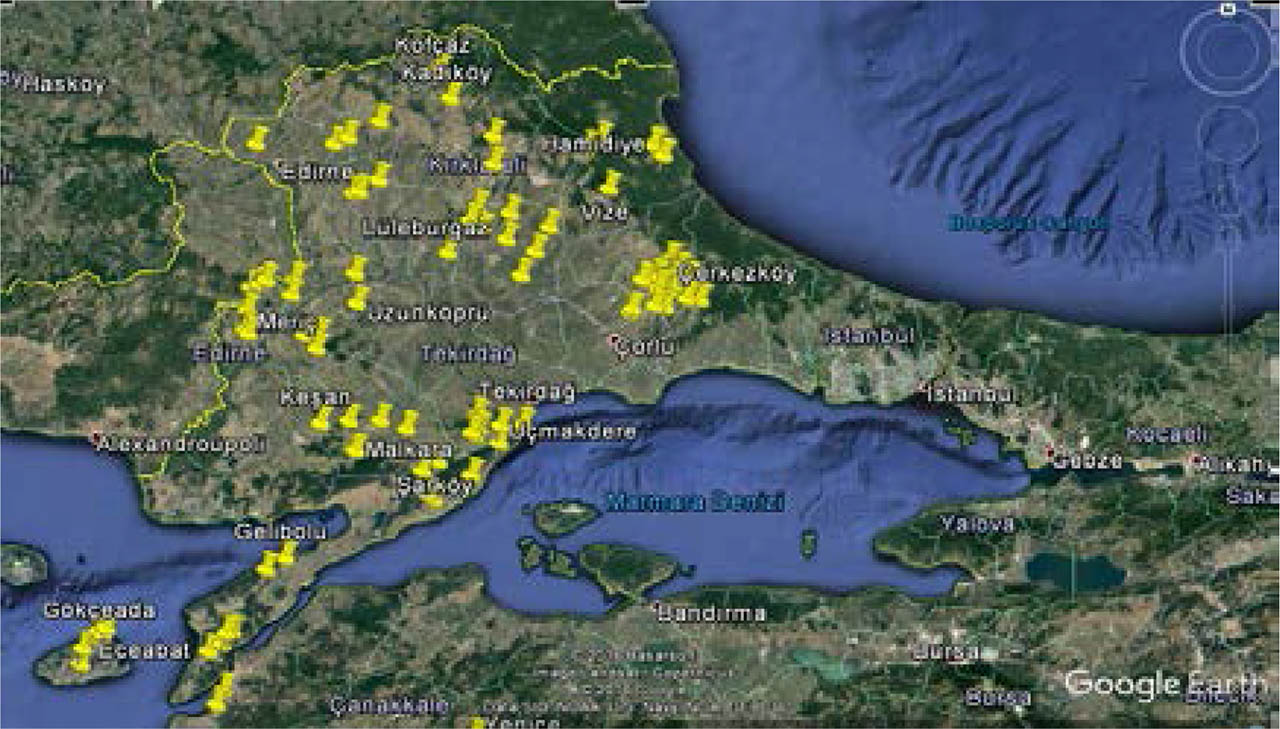
Fig. 1
Sampling locations of honey bees in European part of Turkey-Thrace region (Tekirdağ, Kırklareli and Edirne), Island of Gökçeada and Çanakkale province (both Gallipoli Peninsula and western Anatolian side).
Morphological evaluation
The worker bee samples were collected and stored in 72% ethyl alcohol until preparation. Each part of the samples was fixed on the slide with chloral hydrate-free Hoyer’s liquid. Each of the 110 colonies consisted of fifteen worker bees, so a total of 1650 (15x110) worker bees were used for morphological measuring. The right forewings of the fifteen worker bees from each colony were mounted on glass slides with Hoyer’s liquid. In each sample, the standard and most commonly used anterior wing vein angles A4, B4, D7, E9, G18, J10, J16, K19, L13, N23 and O26 were measured biometrically with the use of the software available in the Olympus trinocular stereo microscope (SZ61) (Ruttner et al., 1978; Moritz, 1991). Forty-one morphological characters given in Tab. 1 and Tab. 2 were measured as described by Moritz (1991), Güler (2010) and Güler et al. (2010). Measurements were made with the Olympus SZ61 trinocular stereo microscopewith the computer program (cellSens standart 1.8).
Table 1
The mean and standard errors of the directly measured morphological characters of the Thrace, Çanakkale and island Gökçeada worker bee samples
| Tekirdağ | Kırklareli | Edirne | Çanakkale | Gökçeada | ||
|---|---|---|---|---|---|---|
| LH*** | 0.238±0.004c | 0.228± 0.003c | 0.231±0.002c | 0.270±0.003b | 0.283±0.004a | 0.247±0.003 |
| WTa*** | 1.117±0.022b | 1.100±0.015bc | 1.051±0.010c | 1.127±0.227b | 1.186±0.015a | 1.109±0.009 |
| WTb* | 0.300±0.012ab | 0.316±0.011ab | 0.305±0.011ab | 0.336±0.012a | 0.296±0.013b | 0.311±0.006 |
| LPr** | 6.247±0.077b | 6.316±0.072ab | 6.319±0.023ab | 6.511±0.068a | 6.422±0.108ab | 6.351±0.030 |
| LFNS | 2.621±0.016 | 2.637±0.011 | 2.622±0.008 | 2.631±0.020 | 2.663±0.016 | 2.633±0.006 |
| LT* | 3.144±0.019ab | 3.145±0.016ab | 3.116±0.011b | 3.145±0.023ab | 3.178±0.016a | 3.143±0.008 |
| LM* | 2.044±0.013b | 2.092±0.013a | 2.078±0.009ab | 2.073±0.013ab | 2.092±0.013a | 2.074±0.006 |
| WM* | 1.168±0.008ab | 1.162±0.009b | 1.190±0.006a | 1.169±0.009ab | 1.155±0.008b | 1.170±0.004 |
| WT3*** | 1.896±0.007b | 1.869±0.008b | 1.877±0.007b | 1.961±0.013a | 1.984±0.015a | 1.910±0.006 |
| WT4*** | 1.846±0.007c | 1.806±0.008d | 1.822±0.007cd | 1.920±0.012b | 1.953±0.014a | 1.859±0.006 |
| WS3* | 2.811±0.012b | 2.804±0.014b | 2.792±0.009b | 2.912±0.076a | 2.823±0.013ab | 2.825±0.015 |
| LWM*** | 1.481±0.020b | 1.421±0.009bc | 1.404±0.006c | 1.664±0.043a | 1.639±0.009a | 1.505±0.014 |
| WWMNS | 2.346±0.012 | 2.361±0.013 | 2.342±0.011 | 2.396±0.057 | 2.342±0.013 | 2.357±0.012 |
| DWM*** | 0.315±0.005b | 0.325±0.005b | 0.317±0.005b | 0.349±0.011a | 0.352±0.006a | 0.329±0.003 |
| LS6U* | 2.606±0.012b | 2.633±0.014ab | 2.640±0.010ab | 2.642±0.031ab | 2.679±0.017a | 2.637±0.008 |
| WS6* | 3.119±0.018b | 3.137±0.018b | 3.128±0.015b | 3.161±0.041ab | 3.215±0.016a | 3.146±0.011 |
| LFW*** | 8.333±0.022b | 8.343±0.036b | 8.362±0.018b | 8.546±0.016a | 8.486±0.028a | 8.402±0.014 |
| WFW** | 2.856±0.009b | 2.866±0.015ab | 2.878±0.008ab | 2.902±0.008ab | 2.893±0.019a | 2.877±0.006 |
| LCa** | 0.491±0.004ab | 0.504±0.005a | 0.502±0.004a | 0.488±0.005ab | 0.484±0.005b | 0.495±0.002 |
| LCb*** | 0.218±0.003ab | 0.212±0.006bc | 0.201±0.002c | 0.230±0.003a | 0.226±0.003a | 0.216±0.002 |
| CT2*** | 6.981±0.105a | 6.788±0.105ab | 6.597±0.103b | 5.994±0.153c | 6.615±0.125b | 6.621±0.060 |
| CT3** | 6.763±0.111a | 6.403±0.092b | 6.389±0.078b | 6.099±0.207b | 6.787±0.108a | 6.479±0.059 |
| CT4*** | 4.200±0.069a | 4.365±0.056a | 4.372±0.064a | 3.580±0.103c | 3.831±0.108b | 4.113±0.045 |
| CSc** | 0.853±0.147a | 0.451±0.078bc | 0.325±0.059c | 0.863±0.109a | 0.666±0.135ab | 0.618±0.052 |
[i] Length of hairs (LH), Width tomentums a (WTa), Width tomentum b (WTb), Length of proboscis (LPr), Length of femur (LF), Length of tibia (LT), Length of metatarsus (LM), Width of metatarsus (WM), , Width of tergite 3 (WT3), Width of tergite 4 (WT4), Width of sternit 3 (WS3), Length of wax mirror, (LWM), Width of wax mirror (WWM), D. Between mirrors (DWM), Length of sternum 6 (LS6), Width of sternum 6 (WS6), Length of forewing (LFW), Width of forewing (WFW), Length of cubital a (LCa), Length of cubital b (LCb), Colour of tergit 2 (CT2), colour of tergit 3 (CT3), Colour of tergit 4 (CT4), Colour of scutelum (CSc)
[ii] NS, *, **, *** non significant and significant at 0.05, 0.01, and 0.001 respectively.
Table 2
The mean and standard errors of some calculated and direct measured morphological characters of the Thrace, Çanakkale and Gökçeada regions worker bee samples
| Tekirdağ | Kırklareli | Edirne | Çanakkale | Gökçeada | ||
|---|---|---|---|---|---|---|
| TI* | 4.284±0.232ab | 3.887±0.148b | 3.809±0.165b | 3.952±0.234b | 4.683±0.231a | 4.080±0.093 |
| LHLNS | 7.809±0.045 | 7.871±0.033 | 7.816±0.027 | 7.833±0.054 | 7.934±0.043 | 7.846±0.018 |
| CI*** | 2.302±0.043b | 2.471±0.044a | 2.552±0.051a | 2.153±0.044b | 2.188±0.048b | 2.365±0.025 |
| T3+T4*** | 3.737±0.015c | 3.675±0.017d | 3.695±0.014cd | 3.868±0.031b | 3.937±0.026a | 3.765±0.013 |
| MI*** | 57.206±0.387a | 55.716±0.331bc | 57.394±0.317a | 56.471±0.496ab | 55.236±0.194c | 56.508±0.180 |
| S6INS | 83.398±0.490 | 84.056±0.296 | 84.581±0.327 | 83.681±0.499 | 83.452±0.301 | 83.875±0.182 |
| A4*** | 32.109±0.206bc | 30.970±0.242d | 31.769±0.249c | 32.532±0.193ab | 32.866±0.320a | 31.953±0.122 |
| B4*** | 104.037±0.543ab | 105.727±0.598a | 103.399±0.660bc | 101.882±0.517cd | 101.027±0.802d | 103.474±0.312 |
| D7*** | 100.857±0.344a | 99.495±0.377b | 99.413±0.355b | 101,121±0.376a | 102.036±0.527a | 100.432±0.193 |
| E9*** | 20.392±0.153bc | 21.013±0.153a | 20.693±0.252ab | 19.855±0.134c | 19.158±0.294d | 20.336±0.105 |
| G12** | 88.837±0.430bc | 88.360±0.348bc | 87.933±0.348c | 90.190±0.331a | 89.480±0.436ab | 88.857±0.184 |
| J10** | 52.605±0.398b | 53.989±0.358a | 54.274±0.443a | 53.876±0.499a | 52.536±0.520b | 53.521±0.206 |
| J16*** | 90.103±0.385bc | 91.953±0.357a | 90.859±0.401ab | 91.927±0.405a | 89.436±0.434c | 90.936±0.196 |
| K19NS | 74.372±0.367 | 75.440±0.416 | 75.356±0.291 | 75.615±0.428 | 74.662±0.499 | 75.104±0.179 |
| L13*** | 16.145±0.119b | 15.556±0.143cd | 15.390±0.112d | 17.759±0.290a | 15.989±0.273bc | 16.112±0.112 |
| N23*** | 88.683±0.402cd | 91.161±0.263b | 89.854±0.405bc | 92.905±1.066a | 88.180±0.408d | 90.212±0.288 |
| O26* | 34.496±0.420b | 35.195±0.456ab | 34.147±0.444b | 34.537±0.602b | 36.538±0.807a | 34.862±0.239 |
[i] Tomentum Index (TI), Length of Hind Leg (LHL), Cubital Index (CI), Body size (T3+T4), Metatarsal Index (MI), Sternum 6 Index (S6I), Veinal angles A4, B4, D7, E9, G12; J10, J16, K19, L13, N23, O26
[ii] NS, *, **, *** non significant and significant at 0.05, 0.01, and 0.001 respectively.
Statistical analysis
The morphometrics data were analysed through ANOVA, and the differences between the means were compared with the Student Newman Keuls (SNK) post hoc tests (SPSS, 2004). In addition, the Multivariate Discriminant Stepwise Analysis Method (MDSAM), which determines the differences and the grouping levels in terms of the morphological characteristics between more than two biological sources, was used to determine the Standard Multivariate Canonical Discriminant Function and Constant Descriptive Coefficients (SMCDFCDC) of the five different regions from Thrace and western Anatolia (Cooley & Lohnes, 1971). The territorial regions of the groups in a Coordinate system were determined and standardized with the use of the SMCDFCDC (Fig. 2).
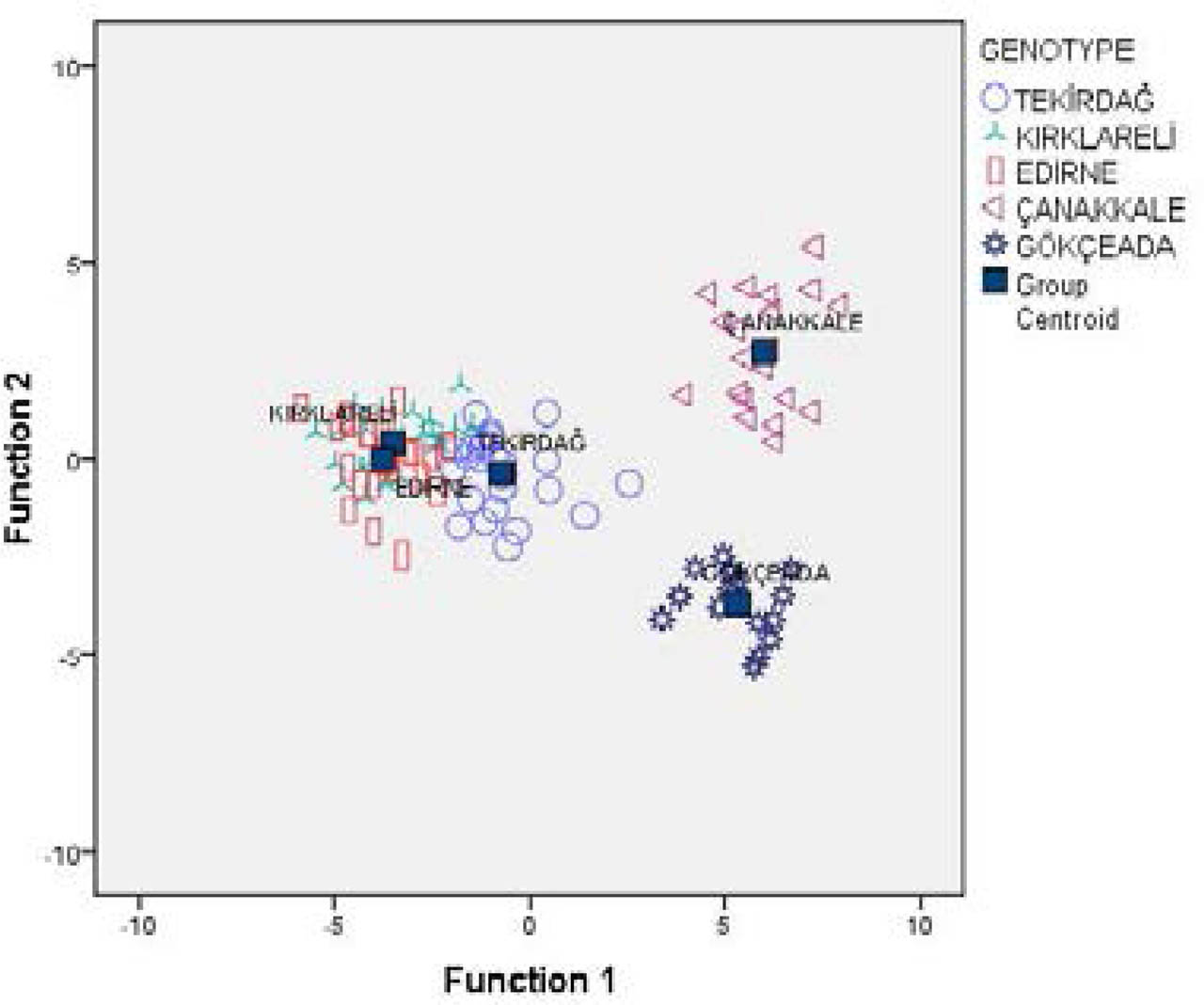
Fig. 2
Discriminant Analysis of honey bee (Apis mellifera) samples from different genotypes (Tekirdağ, Edirne, Kırklareli, Çanakkale and Gökçeada Island). Horizontal axis: canonical function 1; vertical axis: canonical function 2.
Genetic Characterization DNA isolation
The worker bees were individually placed in the Eppendorf tubes containing 95% ethanol and transported to the Molecular Genetics Laboratory, the Department of Agricultural Biotechnology, Tekirdağ Namık Kemal University. Total genomic DNA was extracted from thoraces according to the phenol-chloroform extraction method (Sambrook & Russel, 2001). The genomic DNA concentration was quantified with a Qubit™ 2.0 Fluorometer (ThermoFisher Scientific), and 20–30 ng of genomic DNA was used for the PCR.
DNA sequencing
The tRNAleu-cox2 gene region was amplified according to Garnery et al. (1992) with E2 and H2 primers. The amplified PCR products were sequenced on an Applied Biosystems 3500XL Genetic Analyzer (Applied Biosystems, USA) in order to verify the nucleotide variations. The sequences were assembled with ChromasPro version 1.7.6 and aligned with the BioEdit Sequence Alignment Editor with Clustal W multiple alignment modules (Hall, 1999). Phylogenetic trees were generated with the use of the neighbor-joining algorithm in MEGA 6 (Tamura et al., 2013). The SplitsTree was also used to construct a network from the distance matrices based on allele-sharing distances (Huson & Bryant, 2006).
RESULTS
The worker-bee samples belonging to the five locations were found to be similar in only five characters but different from one another (P<0.001) in thirty-six characters (Tab. 1 and Tab. 2).
The Discriminant Analysis Stepwise method showed that the hair length (HL), wing L13 veinal angle, fourth tergite width (T4), wing N23 veinal angle, metatarsal index (MI), wing E9 veinal angle, second tergite color (CT2), scutellum color (CSC), both wing O26 and D7 veinal angles and wing length (WL) characters determined that the worker-bee samples represented the different (P<0.001) bee populations respectively (Tab. 1 and Tab. 2).
The method determined 94.5% to be the proper grouping level of 110 worker bee samples representing these five different locations. Grouping in different areas indicated that these bees come from different genetic sources in terms of morphological structure Tab. 3.
Table 3
Grouping levels of 110 worker bee samples collected from bee genotypes in five different areas and the number and ratios of the genotype groups each sample represents
| Edirne | Çanakkale | Gökçeada | ||||||
|---|---|---|---|---|---|---|---|---|
| Tekirdağ | 23 | 2 | 25 | |||||
| Kırklareli | 23 | 2 | 25 | |||||
| Number | Edirne | 2 | 23 | 25 | ||||
| Çanakkale | 20 | 20 | ||||||
| Orijinal Groups | Gökçeada | 15 | 15 | |||||
| Tekirdağ | 92.0 | 8.0 | 100.0 | |||||
| Kırklareli | 92.0 | 8.0 | 100.0 | |||||
| % | Edirne | 8.0 | 92.0 | 100.0 | ||||
| Çanakkale | 100.0 | 100.0 | ||||||
| Gökçeada | 100.0 | 100.0 |
Morphological differences according to the discriminant functions (F1) were found among the worker bee samples of the Thrace Region (Kırklareli, Tekirdağ and Edirne), Çanakkale and Gökçeada Island (Fig. 2). The Çanakkale and Gökçeada samples formed a cluster in completely different areas from one another and from samples of the Thrace Region (100%). Therefore, three different populations were formed in terms of the morphological structure: one on the continent of the Europe-Thrace region, one in the Çanakkale province on Asian/Anatolian side of the Turkey and one Gökçeada Island. The Sea of Marmara and Gallipoli Peninsula, important barriers in separating Asian and European continents, have also played an important role in forming this genetic variation.
The populations of the Thrace region (Tekirdağ, Edirne and Kırklareli) were found similar to one another in relation to the morphological structure. The samples of the region were overlapped at certain levels. For example, two samples (8%) from Tekirdağ were placed within the samples from Kırklareli and two samples (8%) from Kırklareli in Edirne, and two samples (8%) from Edirne in Kırklareli. The overlapped clustering (Fig. 2) in this region was the result of a similar morphological structure. In fact, the worker bee samples in the Thrace region were found to be similar to one another in some of the morphological characteristics (HL, WT3, WTb, WS3, DWM, LS6, WS6, LFW, and CT4) (Tab. 1 and Tab. 2). On the other hand, the most important difference between the bee samples of the Thrace region was seen in the wing veinal angles.
The results of the tRNAleu-cox2 sequencing of the Thrace honeybees
The analysis of the sequence data at the tRNAleu-cox2 region produced twenty-two different haplotypes, of which sixteen were novel), and all of them were ascribable to the East European C-lineage and characterized by the presence of a single Q sequence corresponding to the predicted composition of this region. The mtDNA fragment corresponded to the positions 3363–3935 bp (Crozier & Crozier, 1993). The polymorphic sites of the intergenic tRNAleu-cox2 region of the previous C2 haplotypes and the haplotypes that are found in this study, GenBank accession numbers, and the variations with the nucleotide positions were summarized in Tab. 4. Sixteen polymorphic sites were detected within the sequenced 571–573 bp mtDNA fragment, and the sequences were deposited in the GenBank database with accession numbers MH939332-MH939353 (Tab. 4). In our study, 104 samples out of 217 (~48%) were found to be exactly the same as the published C2d haplotype in the NCBI Genbank database (accession numbers FJ824584, FJ824585, FJ037777, JQ977701, JF723977). C2d was found as a common haplotype all over the Thrace region, especially in Tekirdağ (0.78), Kırklareli (0.24), Edirne (0.67) and Gökçeada Island (0.50) (Tab. 4 and Tab. 5). In this study, the C2d sequence was deposited to the GenBank database with the accession number MH939332. Along with the C2d haplotype, previously published C2s, C2v, C2i, C2j, and C2h haplotypes were also observed in the Thrace region less frequently, forty-four samples out of 217 (20.27%). The DNA sequences of the A. m. carnica, A. m. macedonica, and A. m. caucasica reference samples were found exactly the same as the published C2v, C2d and C2h haplotypes, respectively. The remaining sixty-nine samples from different parts of Thrace, Çanakkale, and Gökçeada Island revealed sixteen novel haplotypes. Based on the results from this survey, existing haplotype names were revised and updated following a nomenclature system established earlier (C1-C2 system) and extended herein for the intergenic region. Novel haplotypes, C2d2, C2v1, and C2v2, were observed in Tekirdağ and Kırklareli provinces, while C2i1, C2i2, C2i3, C2s1 and C2c1 haplotypes were only observed in the Kırklareli province, especially along the Istranca Mountain ridges and higher regions (Tab. 5). Along with these five new haplotypes found in Kırklareli, twelve haplotypes out of 22 were observed in this region near the Istranca Mountains. On the other hand, C2h, C2h1, C2h2, C2h3, and C2d3 C2d4 haplotypes were also found only in the Edirne and Çanakkale (Asian/Anatolian side) provinces, and these haplotypes were found to be similar to the previously published A. m. caucasica haplotypes (Özdil et al., 2009; Solorzano et al., 2009). Finally, the novel C2s2 and C2s3 haplotypes were only found in the Gökçeada Island populations (Tab. 5).
Table 4
The polymorphic sites of the intergenic tRNAleu-cox2 region of the previous C2 haplotypes and the haplotypes that are found in this study, NCBI GenBank accession umbers and the citing references are given. The mtDNA fragment corresponds to the positions 3363–3935 bp published by Crozier & Crozier (1993).
| Haplotypes | bp | 3406 | 3410* | 3424* | 3425* | 34281 | 3442 | 3449 | 3474 | 3488* | 3512* | 3514 | 3535 | 3536* | 3567 | 3569 | 3573* | 3575 | 3576* | 3588 | 3589 | 3605 | 3634 | 3664* | 3670 | 3735 | 3769 | 3771 | References |
|---|---|---|---|---|---|---|---|---|---|---|---|---|---|---|---|---|---|---|---|---|---|---|---|---|---|---|---|---|---|
| JQ977700_C2c (A. m. carnica) | 572 | T | A | A | T | - | T | T | T | A | T | T | A | A | A | A | A | - | C | G | - | . | T | T | T | T | C | C | Suśnik et al., 2004; Muñoz et al., 2009, 2012 |
| JQ977701 / FJ824585_C2d (A.m.carnica / A.m.macedonica) | 572/526. | . | . | . | - | . | . | - | . | . | . | . | . | . | . | . | . | - | . | . | - | . | C | . | . | . | T | . | Suśnik et al., 2004; Muñoz et al., 2009, 2012 |
| JQ977702_C2e (A. m. carnica) | 571 | . | . | . | . | - | . | . | - | . | . | . | . | . | . | . | . | - | . | . | - | . | C | . | . | . | T | . | Kozmus et al., 2007; Muñoz et al., 2009 |
| FJ357806_C2f (A. m. meda) | 571 | . | . | . | . | - | - | . | . | . | . | . | . | . | . | . | . | - | . | . | - | . | C | . | . | . | T | . | Özdil et al., 2009 |
| FJ357807_C2g (A. m. meda) | 571 | . | . | . | . | - | - | . | . | . | . | . | . | . | T | . | . | - | . | . | - | . | C | . | . | . | T | . | Özdil et al., 2009 |
| FJ357808_C2h (A. m. caucasica) | 514 | . | . | . | . | - | . | . | . | . | . | . | . | . | T | . | . | - | . | . | - | . | C | . | . | . | T | T | Özdil et al., 2009 |
| FJ447491_C2i (A. m. carnica) | 517 | . | . | . | . | - | . | . | . | . | . | . | . | . | . | . | . | - | . | A | - | . | C | . | . | . | T | . | Nedić et al., 2009 |
| JF723978_C2j (A. m. carnica) | 572 | . | . | . | . | - | . | . | . | . | . | . | . | . | T | . | . | - | . | . | - | . | C | . | . | . | T | . | Nedić et al., 2009; Coroian et al., 2014 |
| GQ433624_C2k (A. m. carnica) | 401 | . | . | . | . | - | . | . | - | . | . | . | . | . | . | . | . | - | . | A | - | . | C | . | . | . | T | . | Razpet at al., 2009 unpublished |
| GQ433625_C2l (A. m. carnica) | 401 | . | . | . | . | - | . | . | . | . | . | . | . | . | . | - | . | - | . | . | - | . | . | . | . | . | . | . | Razpet at al., 2009 unpublished |
| GQ433626_C2m (A. m. carnica) | 402 | C | . | . | . | - | . | . | . | . | . | . | . | . | . | . | . | - | . | . | - | . | . | . | . | . | . | . | Razpet at al., 2009 unpublished |
| GQ433627_C2n (A. m. carnica) | 402 | . | . | . | . | - | . | . | . | . | . | . | . | . | . | . | . | - | . | . | - | . | . | . | C | . | . | . | Razpet at al., 2009 unpublished |
| JQ977704_C2o (A. m. carnica) | 571 | . | . | . | . | - | . | . | - | . | . | A | . | . | . | . | . | - | . | . | - | . | C | . | . | . | T | . | Muñoz et al., 2012 |
| JQ977705_C2p (A. m. carnica) | 571 | . | . | . | . | - | . | C | - | . | . | . | . | . | . | . | . | - | . | . | - | . | C | . | . | . | T | . | Muñoz et al. 2012; Coroian et al. 2014 |
| HM117905_C2q (A. m. carnica) | 549 | . | . | . | . | - | . | . | . | . | . | . | . | . | . | . | . | - | . | . | - | . | C | . | . | . | T | . | Muñoz 2013/Coroian et al. 2014 |
| HM117906_C2r (A. m. carnica) | 546 | . | . | . | . | - | . | . | . | . | . | . | T | . | . | . | . | - | . | . | - | . | C | . | . | . | T | . | Coroian et al. 2014 |
| JF723979_C2s | 572 | . | . | . | . | - | . | . | . | . | . | A | . | . | . | . | . | - | . | . | - | . | C | . | . | . | T | . | Muñoz 2013 |
| JQ973663_C2t | 572 | . | . | . | . | - | . | . | . | . | . | . | . | . | T | . | . | - | . | . | - | . | C | . | . | A | T | . | Muñoz 2013 |
| JQ973664_C2v | 572 | . | . | . | . | - | . | . | . | . | . | . | . | . | . | . | . | - | . | . | - | . | . | . | . | . | T | . | Muñoz 2013 |
| JQ754649 C2x | 573 | . | . | . | . | - | . | . | . | . | . | . | . | . | . | . | . | A | . | A | - | . | C | . | . | . | T | . | Muñoz 2013/Coroian et al. 2014 |
| JQ754650_C2y | 571 | . | . | . | . | - | . | . | . | . | . | . | . | . | . | . | . | - | . | . | - | - | . | . | . | . | . | . | Muñoz 2013; Coroian et al. 2014 |
| JQ754648_C2z | 572 | . | . | . | . | - | . | . | . | . | . | . | . | . | . | . | . | - | . | . | - | . | . | . | . | . | . | . | Muñoz 2013/; Coroian et al. 2014 |
| MH939332_C2d | 572 | . | . | . | . | - | . | . | . | . | . | . | . | . | . | . | . | - | . | . | - | . | C | . | . | . | T | . | |
| MH939333_C2d1 | 571 | . | . | . | . | - | . | . | . | . | . | . | . | - | . | . | . | - | . | . | - | . | C | . | . | . | T | . | |
| MH939334_C2s | 572 | . | . | . | . | - | . | . | . | . | . | A | . | . | . | . | . | - | . | . | - | . | C | . | . | . | T | . | |
| MH939335_C2v | 572 | . | . | . | . | - | . | . | . | . | . | . | . | . | . | . | . | - | . | . | - | . | . | . | . | . | T | . | |
| MH939336_C2v1 | 572 | . | . | . | . | - | . | . | . | . | . | . | . | . | . | . | . | - | . | A | - | . | . | . | . | . | T | . | |
| MH939337_C2v2 | 572 | . | . | . | . | - | . | . | . | . | . | . | . | . | . | . | . | - | T | . | - | . | . | . | . | . | T | . | |
| MH939338_C2d2 | 572 | . | . | . | . | - | . | . | . | . | C | . | . | . | . | . | . | - | . | . | - | . | C | . | . | . | T | . | |
| MH939339_C2i | 572 | . | . | . | . | - | . | . | . | . | . | . | . | . | . | . | . | - | . | A | - | . | C | . | . | . | T | . | |
| MH939340_C2i2 | 572 | . | T | . | . | - | . | . | . | . | . | . | . | . | . | . | . | - | . | . | - | . | C | . | . | . | T | . | |
| MH939341_C2i3 | 571 | . | T | - | . | - | . | . | . | . | . | . | . | . | . | . | . | - | . | . | - | . | C | . | . | . | T | . | |
| MH939342_C2s1 | 572 | . | T | . | . | - | . | . | . | . | . | A | . | . | . | . | . | - | . | . | - | . | C | . | . | . | T | . | |
| MH939343_C2c1 | 572 | . | T | . | . | - | . | . | . | . | . | . | . | . | . | . | . | - | . | . | - | . | . | . | . | . | . | . | |
| MH939344_C2i1 | 572 | . | T | . | . | - | . | . | . | . | . | . | . | . | . | . | . | - | . | A | - | . | C | . | . | . | T | . | |
| MH939345_C2j | 572 | . | . | . | . | - | . | . | . | . | . | . | . | . | T | . | . | - | . | . | - | . | C | . | . | . | T | . | |
| MH939346_C2h | 572 | . | . | . | . | - | . | . | . | . | . | . | . | . | T | . | . | - | . | . | - | . | C | . | . | . | T | T | |
| MH939347_C2d3 | 572 | . | . | . | C | - | . | . | . | . | . | . | . | . | . | . | . | - | . | . | - | . | C | . | . | . | T | . | |
| MH939348_C2d4 | 572 | . | . | . | . | - | . | . | . | . | . | . | . | . | . | . | T | - | . | . | - | . | C | . | . | . | T | . | |
| MH939349_C2h1 | 572 | . | . | . | . | - | . | . | . | . | . | . | . | . | . | . | . | - | . | . | - | . | C | . | . | . | T | T | |
| MH939350_C2h2 | 573 | . | . | . | . | - | . | . | . | . | . | . | . | . | . | . | . | - | . | . | G | . | C | . | . | . | T | T | |
| MH939351_C2h3 | 571 | . | . | . | . | - | . | . | . | - | . | . | . | . | . | . | . | - | . | . | - | . | C | . | . | . | T | T | |
| MH939352_C2s2 | 572 | . | . | . | . | - | . | . | . | . | . | A | . | . | . | . | . | - | . | . | - | . | C | C | . | . | T | . | |
| MH939353_C2s3 | 571 | . | . | . | . | - | . | . | . | . | . | . | . | - | . | . | . | - | . | . | - | . | C | C | . | . | T | . |
Table 5
Number of analyzed colonies (n), haplotype distributions in the honey bee colonies from Thrace and the reference populations
| Location | n | C2d | C2d1 | C2s | C2v | C2v1 | C2v2 | C2d2 | C2i | C2i1 | C2i2 | C2i3 | C2s1 | C2c1 | C2j | C2h | C2d3 | C2d4 | C2h1 | C2h2 | C2h3 | C2s2 | C2s3 |
|---|---|---|---|---|---|---|---|---|---|---|---|---|---|---|---|---|---|---|---|---|---|---|---|
| Tekirdağ | 50 | 39 | 2 | 5 | 1 | 2 | 1 | ||||||||||||||||
| Kırklareli | 67 | 16 | 1 | 8 | 2 | 1 | 2 | 3 | 22 | 6 | 2 | 3 | 1 | ||||||||||
| Edirne | 49 | 33 | 1 | 2 | 5 | 4 | 2 | 2 | |||||||||||||||
| Çanakkale | 31 | 6 | 8 | 3 | 5 | 2 | 2 | 2 | 3 | ||||||||||||||
| Gökçeada | 20 | 10 | 1 | 4 | 1 | 1 | 3 | ||||||||||||||||
| 217 | 104 | 10 | 12 | 18 | 3 | 2 | 2 | 6 | 3 | 22 | 6 | 2 | 3 | 6 | 2 | 2 | 3 | 2 | 2 | 3 | 1 | 3 | |
| A. m. carnica | 2 | 2 | |||||||||||||||||||||
| A. m. macedonica | 2 | 2 | |||||||||||||||||||||
| A. m. caucasica | 2 | 2 |
The phylogeny of the haplotypes based on the tRNAleu-cox2 intergenic region in this study with the published Genbank reference haplotypes revealed mainly two, indeed three different clusters (Fig 3); C2c, C2l, C2m, C2n C2v, C2y, C2z and novel haplotypes found in this study C2c1, C2v1, C2v2 were clustered together. These novel haplotypes were only observed in the European part of Turkey-Thrace region. The second cluster was comprised of C2t, C2j, C2g, and C2h and novel C2h1, C2h2, C2h3 haplotypes, which had been previously defined as caucasica-like haplotypes. The remaining published haplotypes (C2d, C2k, C2l, C2p, C2q, C2o, C2s, C2r. etc.) and newly found C2d1-C2d4, C2s1-C2s3, C2i1-C2i3 haplotypes were clustered together in the third cluster (Fig. 3).
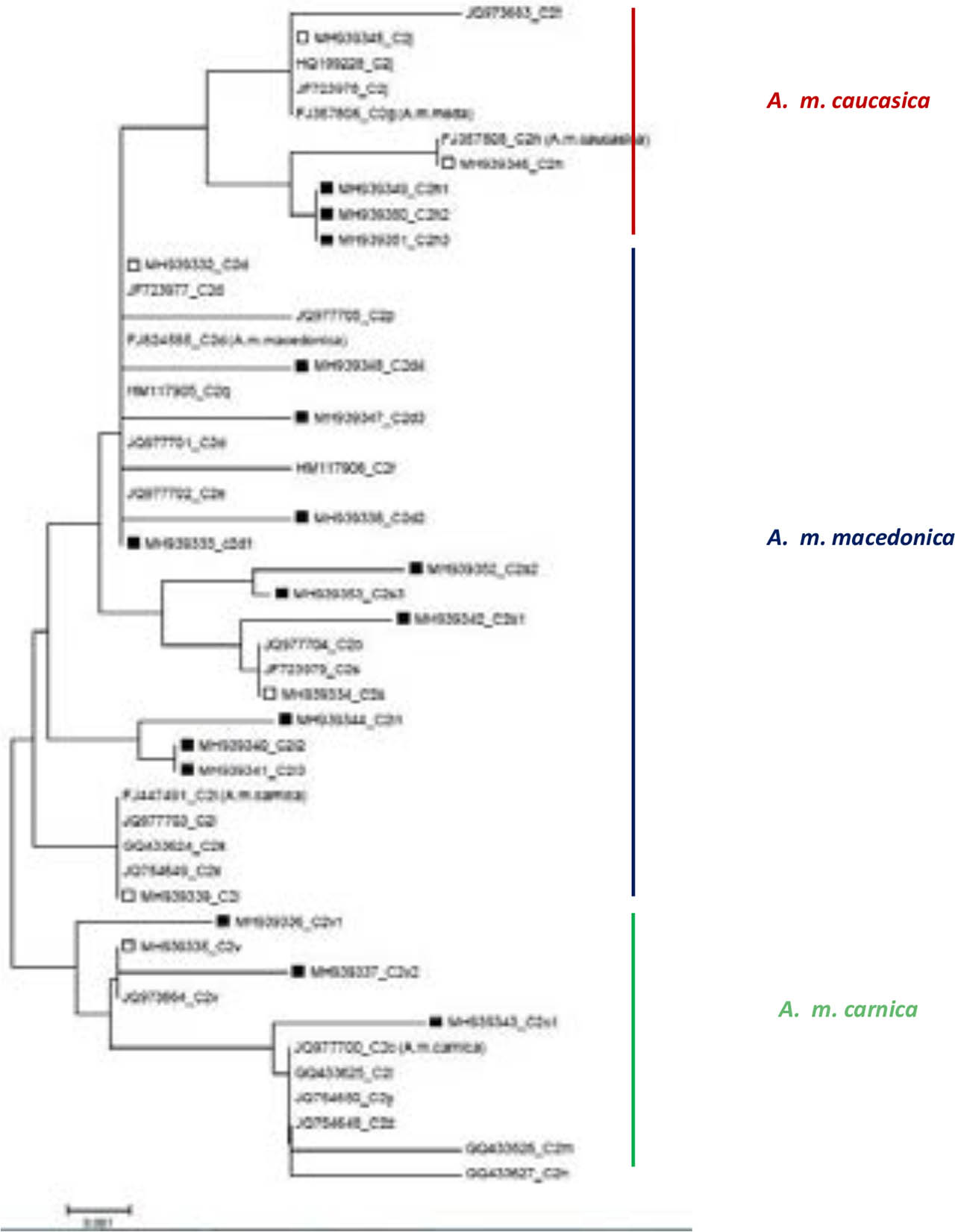
Fig. 3
Neighbor-joining tree based on intergenic tRNAleu-cox2 region sequences performed on nucleotide distances computed by Kimura’s (1980) formula through MEGA6 (Tamura et al., 2013).
▪Indicates novel haplotypes that were found in this study.
In this study, a NeighborNet network was constructed by the SplitsTree4 (version 4.1) program with the published and newly found haplotypes (Fig. 4). According to the NeighborNet network, all haplotypes were split into three main groups, which had been found in agreement with the morphometric and phylogenetic studies.
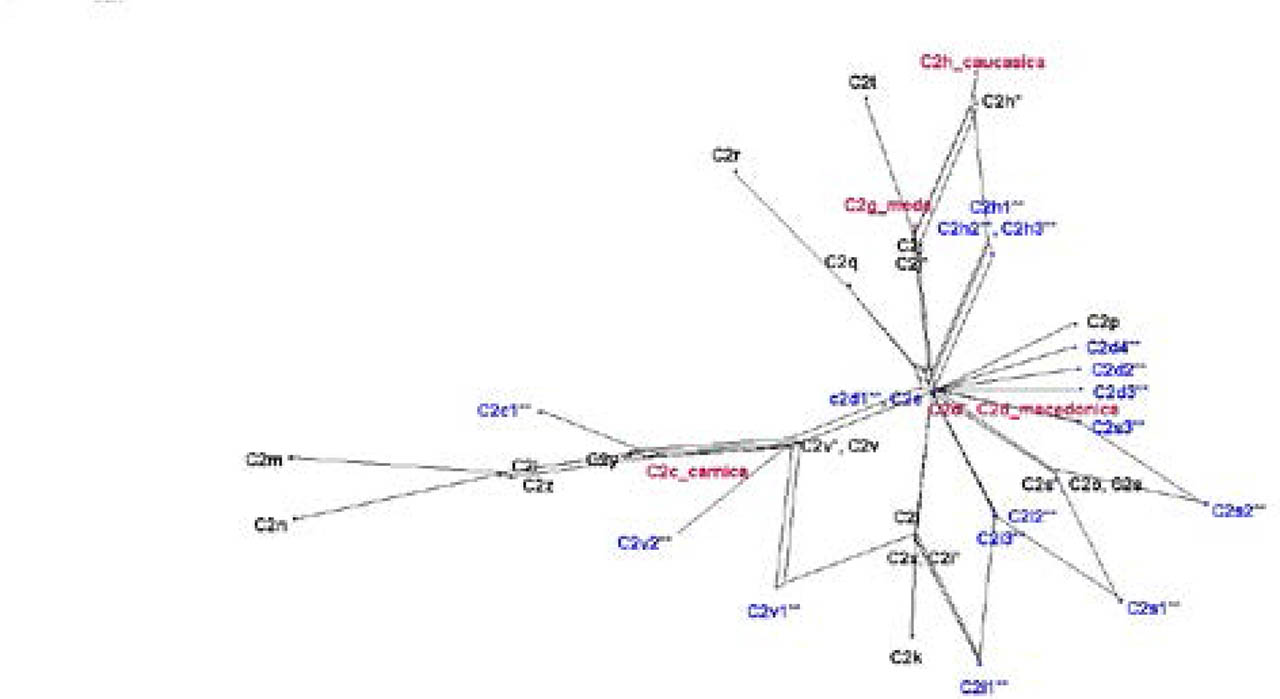
Fig. 4
A NeighborNet Network constructed from SplitsTree4 (version 4.1)
**Novel haplotypes found in this study are written in blue.
DISCUSSION
In the present study, we wanted to reveal the morphometric and genetic structure of the honey bees found in the European Part of Turkey, the Thrace region, located in the southeast of the Balkan Peninsula. Previous morphometric studies by Ruttner (1988), classified Thrace honey bees of Turkey as A. m. anatoliaca, but afterwards morphometric studies (Güler & Kaftanoğlu, 1999; Güler et al., 2010), mtDNA studies (Smith et al., 1997; Palmer et al., 2000; Kandemir et al., 2006; Ünal & Özdil, 2018) and microsatellites (Bodur et al., 2007) revealed that Thrace honey bees were different from A. m. anatoliaca. Not long ago, the Thrace honey bee populations were considered as a distinct ecotype of A. m. carnica by the Republic of Turkey, Ministry of Agriculture and Forestry (Anonymous, 2020) The populations of the Thrace region (Tekirdağ, Edirne, and Kırklareli) were found similar to one another in relation to the morphological structure. However, the level of morphological similarity (8%) was found very low in this study, because the region had received uncontrolled queen bee introduction from different subspecies including the Caucasian or Anatolian honey bees. Güler (2010) had reported that the genetic mixture of a native bee population of a region was significantly affected by the use of external queen bees.
According to previous morphological and molecular studies, the honey bee populations of the Thrace region can be considered as an ecotype of Apis mellifera carnica (Palmer et al., 2000; Bodur et al., 2007; Güler et al., 2010; Ünal & Özdil, 2018). The Carniolan honey bees have been reported to have important distinguishing morphological characters (Kauhausen-Keller et al., 1997; Ruttner, 1988; Güler et al., 2010). For example, according to Ruttner (1988), the most important distinctive morphological character of the Carniolan subspecies was the cubital index (CI; 2.589), while Dawino protocol and Güler et al. (2010) reported that the most important distinguishing character was the wing B4 veinal angle (110° and 106°). In this study, the worker bee samples of the Thrace region have shown similarity to Carniolan subspecies in terms of the cubital index, B4 veinal angle and some of the other characters (A4, D7, J10, J16 and N23) (Ruttner, 1988; Güler & Kaftanoğlu, 1999; Güler et al., 2010; Kuliçi & Kume, 2014)
Although Ruttner (1988) stated that the Thrace honey bee populations were morphologically similar to the Apis mellifera anatoliaca, we found that the Thrace honey bees had lower similarity with the Anatolian subspecies. For example, the average scutellum colour of the Anatolian subspecies been found to be 5.83 scales (Güler & Kaftanoğlu, 1999), whereas in this study, the average scutellum color was found 0.543 in the Thrace honey bee populations.
Due to the ecological differences (flora, climatic, etc.) in the Balkan Peninsula, different ecotypes of the Carniolan subspecies have been originated, and the Thrace honey bees can be one of them because of the high variation that was observed between the populations of A. m. carnica in their original territory (Moritz, 1991; Poklukar & Kezic, 1994; Lodesani & Costa, 2003; Kuliçi & Kume, 2014). Indeed, according to Ruttner (1988), the Carniolan subspecies was reported to have the most strains in the world in its natural geography.
On the other hand, the Gökçeada Island samples were clustered in a narrow space in the coordinate system (Fig. 2). The most important reason for that, the island is a completely isolated area and it maintains its natural position. The island worker bee samples were found to be completely different from the others in terms of seventeen characters. For example, the island bee has the longest hair (HL) and the largest body size (T3+T4) structures, which showed that its populations maintained their morphological structure compared to the previous studies (Güler & Kaftanoğlu, 1999). It is emphasized that the island’s cold and continuous winds were considered to be the main reason for these morphological differences.
In this study, we also provide the most comprehensive survey of DNA sequencing of the tRNAleu-cox2 region whichever reported for the European part of Turkey-Thrace region, Gökçeada Island and Çanakkale province (Gallipoli Peninsula and west Anatolian side). The C1/C2 haplotypes of the tRNAleu-cox2 region were first reported by Franck et al., (2000) and the only difference between the C1 and C2 was a single C nucleotide deletion (h) at the 3428th position of the mitochondrial genome. Franck et al. (2000) reported the C1, C2a and C2b haplotypes in their study, and the C2c and C2d haplotypes were observed by Sušnik et al. (2004) in Slovenia, Croatia (A. m. carnica) and Greece (A. m. macedonica), respectively. Also, the C2d haplotype was reported in all of the studied honey bees from Macedonia, and morphometrical analyses confirmed that those workers with the C2d haplotype were similar to A. m. macedonica, whereas the workers with the C2c haplotype were similar to A. m. carnica (Muñoz et al., 2009). Although most of the studies attributed the C2d haplotype to A. m. macedonica, subsequent studies have revealed that the C2d haplotype was also found in A. m. carnica (Kozmus et al., 2007; Muñoz et al., 2009, 2012; Coroian et al., 2014). After the C2c/C2d classification of the following haplotypes pertaining to the Balkan Peninsula, the novel haplotypes have been described but less frequently. The C2e haplotype was first reported in honey bees from Serbia (A. m. carnica) (Kozmus et al., 2007), and the C2h haplotype was first reported in A. m. caucasica samples from Turkey (Özdil et al., 2009). Another haplotype, the C2i, was first reported in Ikaria/Greece (Muñoz et al., 2009) and later from Serbia (Nedić et al., 2009; Muñoz et al., 2012). The C2j haplotype was first reported in honey bees from Serbia (Nedić et al., 2009) and later in Romania (Coroian et al., 2014). The DNA sequences of the C2k, C2l, C2m and C2n haplotypes of the tRNAleu-cox2 region were deposited to the NCBI GenBank database (GQ433624-GQ433627) but were unpublished. The haplotypes of the C2o (JQ977704) and C2p (JQ977705) were reported in Serbia (Muñoz et al., 2012). The additional haplotypes C2q, C2r, C2t, C2v, C2x, C2y and C2z were also reported in honey bees from Romania, and the C2s haplotype (JF723979) was first reported in honey bees from Hungary (Muñoz et al., 2012; Coroian et al., 2014). In our study, C2d was found to be the common haplotype (~48%) in the Thrace region. Previously published C2s, C2v, C2i, C2j and C2h haplotypes were also observed in the Thrace region but less frequently (20.27%). Additionally, sixteen novel haplotypes were also obtained. Coroian et al. (2014) reported that according to the morphometrical analyses, the workers with the C2c haplotype were more similar to A. m. carnica and confirmed the haplotypes C2c, C2v, C2y and C2z were carnica-like haplotypes, whereas the C2d, C2e, C2f, C2p, C2q, C2r, C2s, C25-C28 were macedonica-like haplotypes. In our study, a neighbor-joining tree based on the intergenic tRNAleu-cox2 region sequences was drawn and three different clusters were obtained. The first cluster mainly consisted of the A. m. carnica haplotypes (C2c, C2v) and newly found C2v1-Cv2, C2c2 that were found in the Thrace region, while the second cluster consisted of previously defined caucasica-like haplotypes. The remaining published haplotypes (C2d, C2k, C2l etc.) and newly found C2d1-C2d4, C2s1-C2s3 and C2i1-C2i3 haplotypes were clustered together in the third cluster which may be defined as macedonica-like haplotypes. According to the network, carnica-like haplotypes, macedonica-like haplotypes and caucasica-like haplotypes were again split from each other. When we consider the geographical distribution of the haplotypes, caucasica-like haplotypes were mainly found in the Asian/Anatolian side of Çanakkale and Edirne provinces, and this may be due to the commercial queen rearing, especially Caucasian queen import to this region. Macedonica-like haplotypes were mainly observed in honey bees from the European part of Turkey-Thrace region (Tekirdağ, Kırklareli and Edirne) and partly from Gökçeada Island. Carnica-like haplotypes were only found in honey bees from Kırklareli and especially the Istranca Mountain ridges and higher regions.
The genetic origin of honey bees found in the European part of the Turkey-Thrace region has been a mystery for a long time. First, Thrace honey bees were classified as A. m. anatoliaca, but new molecular and morphometric studies have revealed a different honey bee subspecies/ecotype in this region which showed similar morphometric and genetic characteristics to A. m. macedonica and A. m. carnica. According to the results of this study, the Thrace honey bees of Turkey had lower similarity with A. m. anatoliaca or A. m. caucasica, but caucasian queen import may have a negative effect on the conservation of the genetic resources of the Thrace region. It is obvious that the Marmara Sea and the Gallipoli Peninsula also served as a natural barrier for the propagation of the A. mellifera subspecies. On the other hand, this study found that Thrace honey bees were more similar to A. m. macedonica through mtDNA sequence analysis, and that especially carnica-like honey bees were only found near the Istranca mountain ridges in the Kırklareli province while macedonica-like honey bees were observed all around the Thrace region in the European part of Turkey. Recently, the Republic of Turkey, Ministry of Agriculture and Forestry, have registered Thrace honey bees as an ecotype of A. m. carnica, and according to our results some of the Thrace honey bee populations may be both A. m. carnica and A. m. macedonica but the assignment to the latter subspecies seems more likely due to its geographic range. In conclusion, it is very important for these genetic resources and ecotypes to be protected in their original habitats and conservation strategies should be performed for the future.
ACKNOWLEDGMENTS
The authors are deeply indebted to numerous people that have contributed to this study for providing honey bee reference samples; Ljubiša Ž. Stanisavljević for providing A. m. carnica samples from Serbia and Leonidas Charistos for providing A. m. macedonica samples from Greece. Financial support for this research was provided by The Scientific and Technological Research Council of Turkey-TUBITAK through the Project 3001-TOVAG 114O883, Project Coordinator Fulya Özdil.
Notes
[6] Contributed by AUTHORS CONTRIBUTION
FO conceived this research, submitted the project and designed the experiments; DO and FO determined the sampling locations and participated in the sampling of the honey bees; AG participated in the design and interpretation of the morphometric data; SY and AA performed the molecular and morphometric experiments and analysis; FO, RI and AG wrote the paper and participated in its revisions. All authors read and approved the final manuscript.
[7] Conflicts of interest CONFLICT OF INTEREST
The authors declare that they have no conflict of interest.