
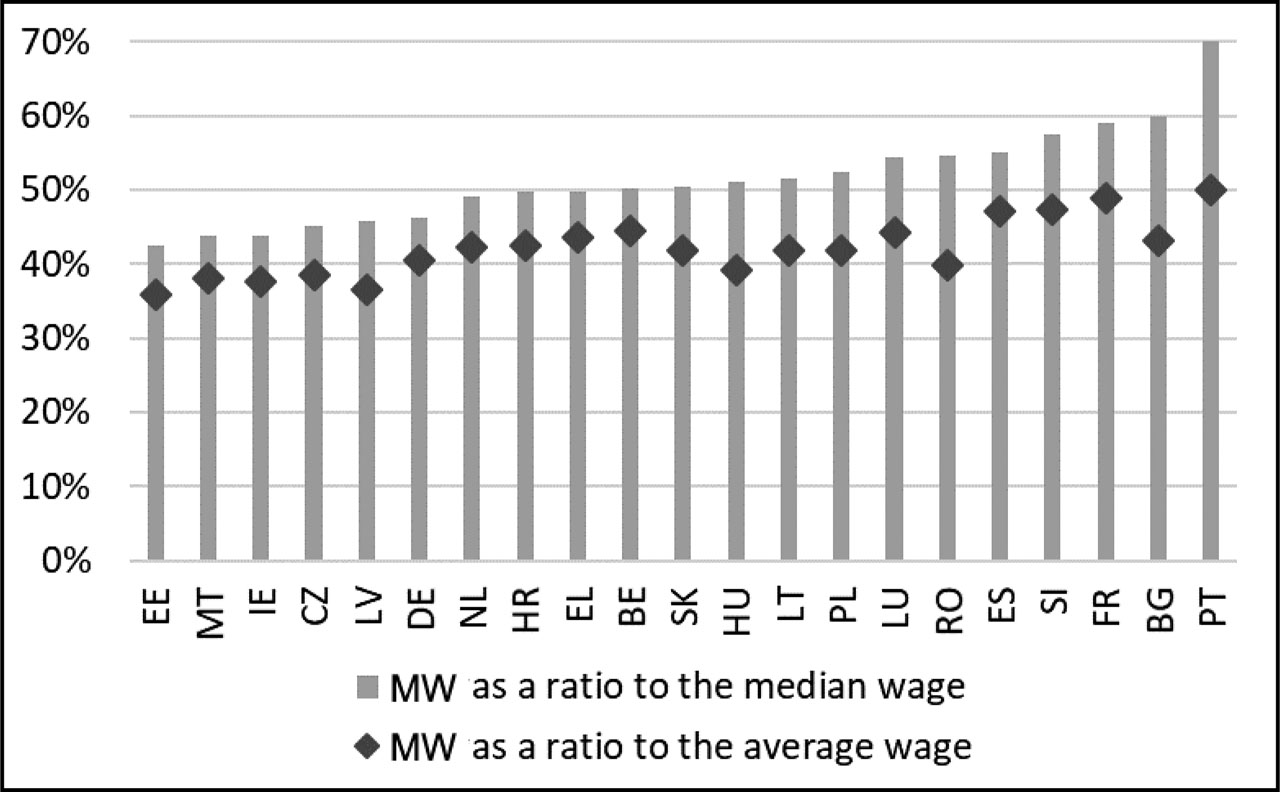
Figure 1
MWs, expressed as a percentage of the gross median and average wage of full-time workers, 2019.
Source: European Commission calculations based on Eurostat data. MWs, minimum wages.
Table 1
A summary of results at the EU level
| Median wage | Average wage | |||||
|---|---|---|---|---|---|---|
| 50% of median wage | 55% of median wage | 60% of median wage | 40% of average wage | 45% of average wage | 50% of average wage | |
| Countries affected (of the 21 with a statutory national MW) | 9 MS: CZ, DE, EE, EL, HR, IE, LV, MT, NL | 15 MS: all but BG, ES, FR, PT, RO, SI | 19 MS: all but PT and BG | 6 MS: CZ, EE, HU, IE, LV, MT | 17 MS: all but ES, FR, PT, SI | 20 MS: all but PT |
| Number of workers affected | 5 million | 11 million | 22 million | 0.7 million | 12 million | 24 million |
| Increase in the EU wage bill (%) | 0.2 | 0.4 | 1.0 | 0.01 | 0.4 | 1.0 |
| Impact on wage inequality (%) | −2 | −5 | −8 | −1 | −6 | −10 |
| Impact on in-work poverty (%) | −2 | −6 | −12 | −1 | −7 | −13 |
| Gender pay gap (%) | −0.7 | −2 | −5 | −0.2 | −2 | −5 |
| Impact on total employment (%) | −0.1 | −0.2 | −0.4 | −0.01 | −0.2 | −0.5 |
| Impact on labor supply (hours offered) (%) | 0.00 | 0.07 | 0.15 | 0.05 | 0.09 | 0.17 |
[i] Notes: EUROMOD simulations. The baseline scenario reflects MWs in 2019. Impacts on wage inequality, in-work poverty, and the gender pay gap reflect an unweighted arithmetic average across EU Member States. Impacts on employment and hours offered reflect EU averages weighted by employment.
[ii] BE, Belgium; BG, Bulgaria; CZ, Czech Republic; DE, Germany; EE, Estonia; EL, Greece; ES, Spain; EU, European Union; EU, European Union; FR, France; HR, Croatia; HU, Hungary; IE, Republic of Ireland; LT, Lithuania; LU, Luxembourg; LV, Latvia; MS, Member States; MT, Malta; MW, minimum wage; NL, The Netherlands; PL, Poland; PT, Portugal; RO, Romania; SI, Slovenia; SK, Slovakia.
Table A1
SMWs in the various scenarios
| Countries | Statutory MW | Hypothetical MW as a ratio of | |||||
|---|---|---|---|---|---|---|---|
| Median wage | Average wage | ||||||
| 50% | 55% | 60% | 40% | 45% | 50% | ||
| Belgium | 1,594 | 1,584 | 1,742 | 1,900 | 1,434 | 1,613 | 1,792 |
| Bulgaria | 286 | 239 | 262 | 286 | 266 | 299 | 332 |
| Czechia | 519 | 580 | 638 | 695 | 545 | 613 | 681 |
| Germany | 1,557 | 1,680 | 1,848 | 2,016 | 1,537 | 1,729 | 1,921 |
| Estonia | 540 | 636 | 699 | 763 | 601 | 676 | 751 |
| Greece | 758 | 761 | 837 | 914 | 695 | 782 | 869 |
| Spain | 1,050 | 952 | 1,047 | 1,142 | 893 | 1,005 | 1,116 |
| France | 1,521 | 1,288 | 1,417 | 1,546 | 1,243 | 1,399 | 1,554 |
| Croatia | 506 | 510 | 561 | 611 | 478 | 538 | 598 |
| Hungary | 464 | 451 | 496 | 541 | 469 | 528 | 586 |
| Ireland | 1,656 | 1,886 | 2,074 | 2,263 | 1,757 | 1,977 | 2,196 |
| Lithuania | 555 | 538 | 591 | 645 | 532 | 598 | 665 |
| Luxembourg | 2,071 | 1,919 | 2,110 | 2,302 | 1,888 | 2,124 | 2,360 |
| Latvia | 430 | 470 | 517 | 564 | 470 | 529 | 588 |
| Malta | 762 | 871 | 958 | 1,045 | 798 | 898 | 997 |
| Netherlands | 1,616 | 1,662 | 1,828 | 1,994 | 1,545 | 1,738 | 1,931 |
| Poland | 523 | 505 | 555 | 606 | 506 | 570 | 633 |
| Portugal | 700 | 499 | 549 | 599 | 561 | 631 | 701 |
| Romania | 446 | 402 | 443 | 483 | 440 | 495 | 551 |
| Slovenia | 887 | 771 | 848 | 925 | 748 | 842 | 935 |
| Slovakia | 520 | 515 | 566 | 618 | 498 | 560 | 622 |
[i] Source: SMWs from Eurofound (2019). HMWs are derived from Eurostat data on median and average wages.
[ii] Note: HMWs, which are smaller than actual SMWs, are marked in gray. Wages of countries outside the Euro area are expressed in EUR. All wage levels are reported in gross terms.
[iii] HMWs, hypothetical MWs; MW, minimum wage; SMWs, statutory MWs.
Table A2
Labor supply elasticities and average working hours
| Country | Labor supply elasticity | Average working hours of MW earners | Average working hours of non–MW earners |
|---|---|---|---|
| Belgium | 0.048 | 31.4 | 36.8 |
| Bulgaria | 0.041 | 38.2 | 40.4 |
| Czechia | 0.045 | 37.7 | 40.9 |
| Germany | 0.123 | 29.8 | 37.9 |
| Estonia | 0.031 | 37.5 | 40.1 |
| Greece | 0.025 | 35.5 | 39.9 |
| Spain | 0.052 | 30.2 | 38.3 |
| France | 0.083 | 32.9 | 37.3 |
| Croatia | 0.005 | 39.0 | 40.7 |
| Hungary | 0.023 | 39.9 | 39.7 |
| Ireland | 0.092 | 30.5 | 34.3 |
| Lithuania | 0.048 | 37.4 | 39.6 |
| Luxembourg | 0.041 | 36.8 | 39.7 |
| Latvia | 0.037 | 38.0 | 40.2 |
| Malta | 0.056 | 31.3 | 39.6 |
| Netherlands | 0.046 | 28.2 | 33.3 |
| Poland | 0.025 | 37.2 | 41.0 |
| Portugal | 0.069 | 37.2 | 40.3 |
| Romania | 0.011 | 40.8 | 41.0 |
| Slovenia | 0.036 | 37.5 | 40.1 |
| Slovakia | 0.023 | 39.0 | 39.7 |
[i] MW, minimum wage.
[ii] Source: Calculations based on EUROLAB.
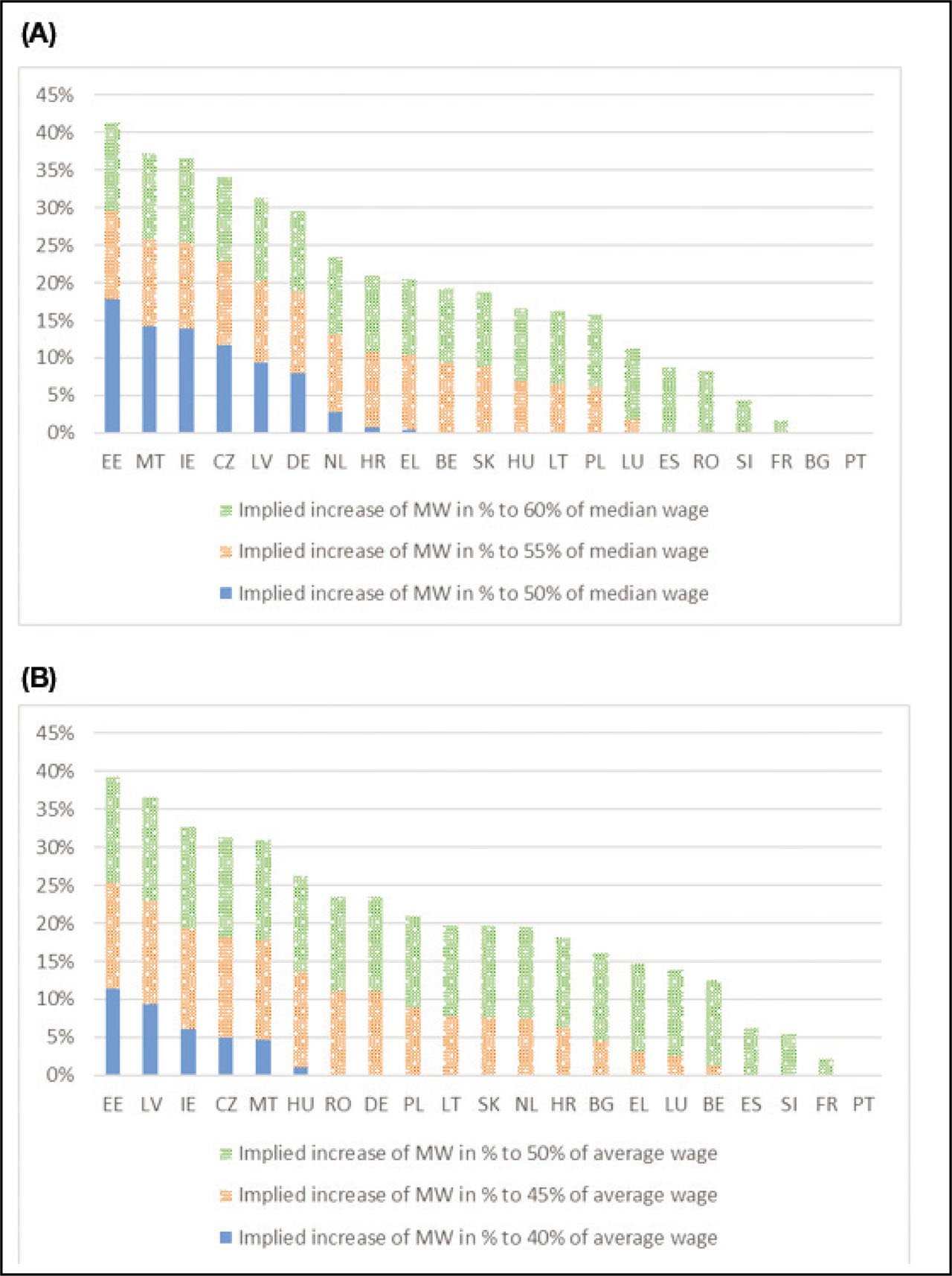
Figure A1
Implied MW increases for various indicative reference values (%).
(A) Scenarios of MWs as a proportion of the median wage. (B) Scenarios of MWs as a proportion of the average wage.
Source: Own calculations based on Eurofound data on monthly MW levels in 2019 (Eurofound, 2019) and Eurostat data on monthly earnings in 2019. BE, Belgium; BG, Bulgaria; CZ, Czech Republic; DE, Germany; EE, Estonia; EL, Greece; ES, Spain; FR, France; HR, Croatia; HU, Hungary; IE, Republic of Ireland; LT, Lithuania; LU, Luxembourg; LV, Latvia; MS, Member States; MT, Malta; MW, minimum wage; NL, The Netherlands; PL, Poland; PT, Portugal; RO, Romania; SI, Slovenia; SK, Slovakia.
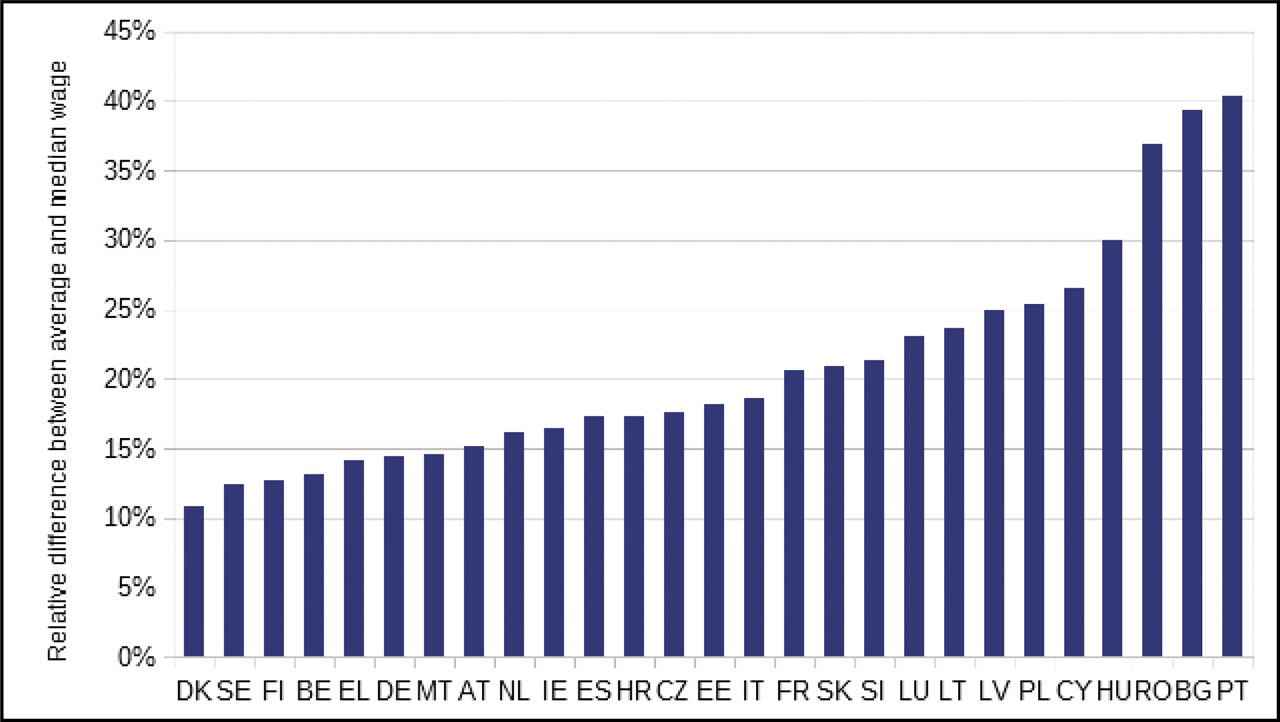
Figure A2
The relative difference between the average and the median wage, 2019.
Source: Eurostat. BE, Belgium; BG, Bulgaria; CZ, Czech Republic; DE, Germany; EE, Estonia; EL, Greece; ES, Spain; FR, France; HR, Croatia; HU, Hungary; IE, Republic of Ireland; LT, Lithuania; LU, Luxembourg; LV, Latvia; MS, Member States; MT, Malta; MW, minimum wage; NL, The Netherlands; PL, Poland; PT, Portugal; RO, Romania; SI, Slovenia; SK, Slovakia.
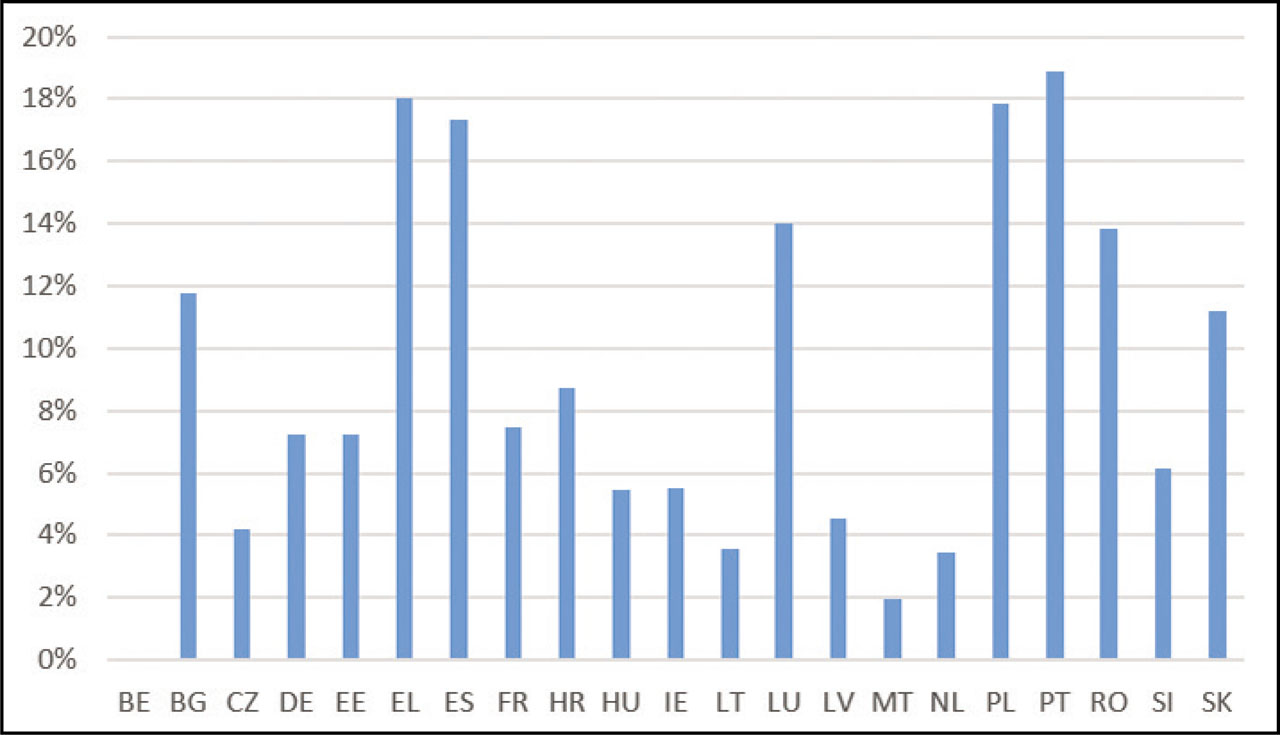
Figure A3
Share of workers earning (a wage close to) the SMW in the baseline scenario.
Notes: EUROMOD simulations for 2019. The graph shows the share of workers earning from 80% to 105% of the MW in the baseline. Countries are sorted alphabetically. BE, Belgium; BG, Bulgaria; CZ, Czech Republic; DE, Germany; EE, Estonia; EL, Greece; ES, Spain; FR, France; HR, Croatia; HU, Hungary; IE, Republic of Ireland; LT, Lithuania; LU, Luxembourg; LV, Latvia; MS, Member States; MT, Malta; MW, minimum wage; NL, The Netherlands; PL, Poland; PT, Portugal; RO, Romania; SI, Slovenia; SK, Slovakia; SMW, statutory MW.
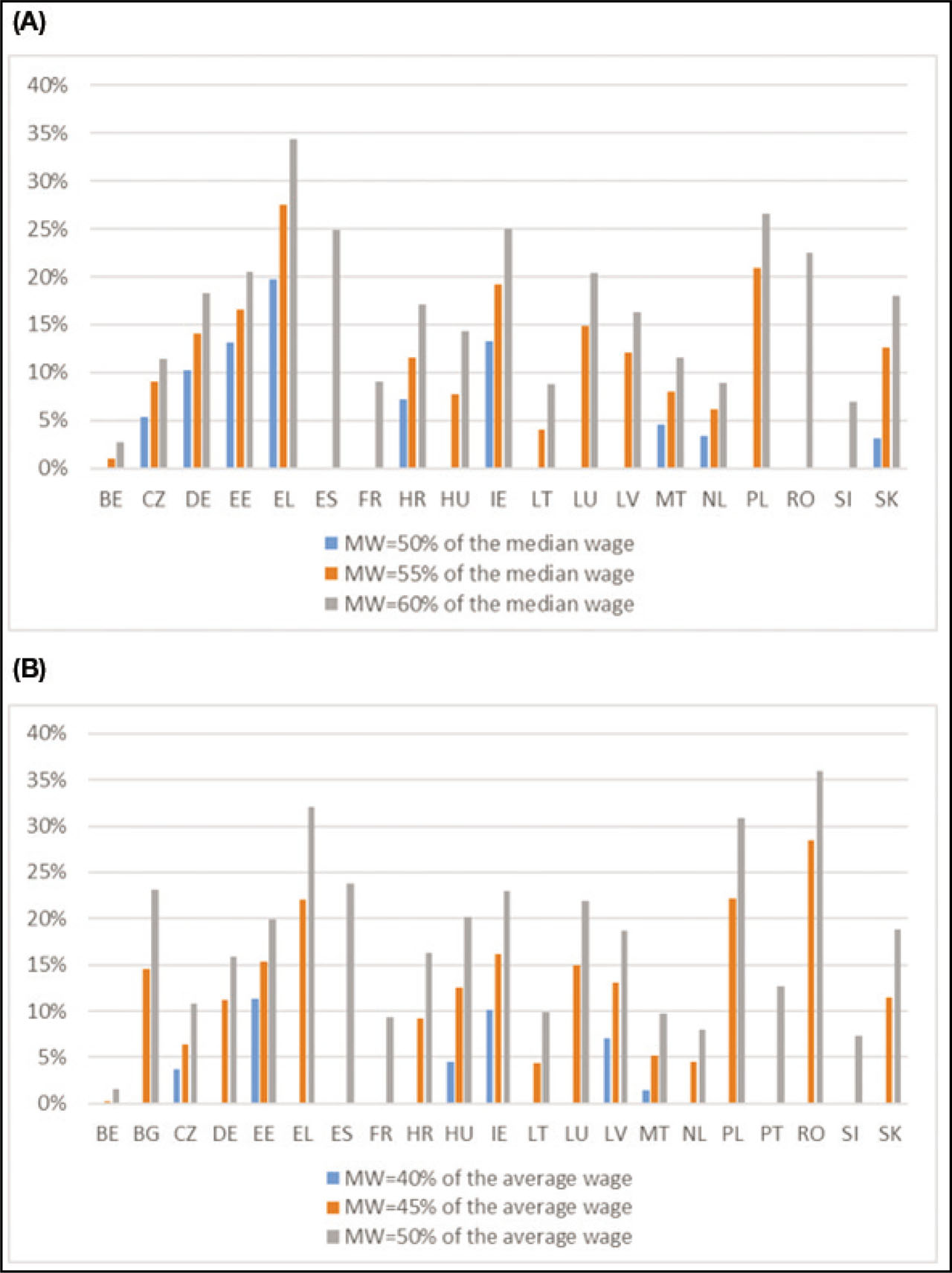
Figure A4
Share of workers affected by increases of the MW.
(A) Scenarios of MWs as proportion of median wages. (B) Scenarios of MWs as proportion of average wages.
Notes: EUROMOD simulations. The baseline scenario reflects MWs in 2019. Countries are sorted alphabetically. Countries with actual MWs above the hypothetical scenarios are excluded. BE, Belgium; BG, Bulgaria; CZ, Czech Republic; DE, Germany; EE, Estonia; EL, Greece; ES, Spain; FR, France; HR, Croatia; HU, Hungary; IE, Republic of Ireland; LT, Lithuania; LU, Luxembourg; LV, Latvia; MS, Member States; MT, Malta; MW, minimum wage; NL, The Netherlands; PL, Poland; PT, Portugal; RO, Romania; SI, Slovenia; SK, Slovakia.
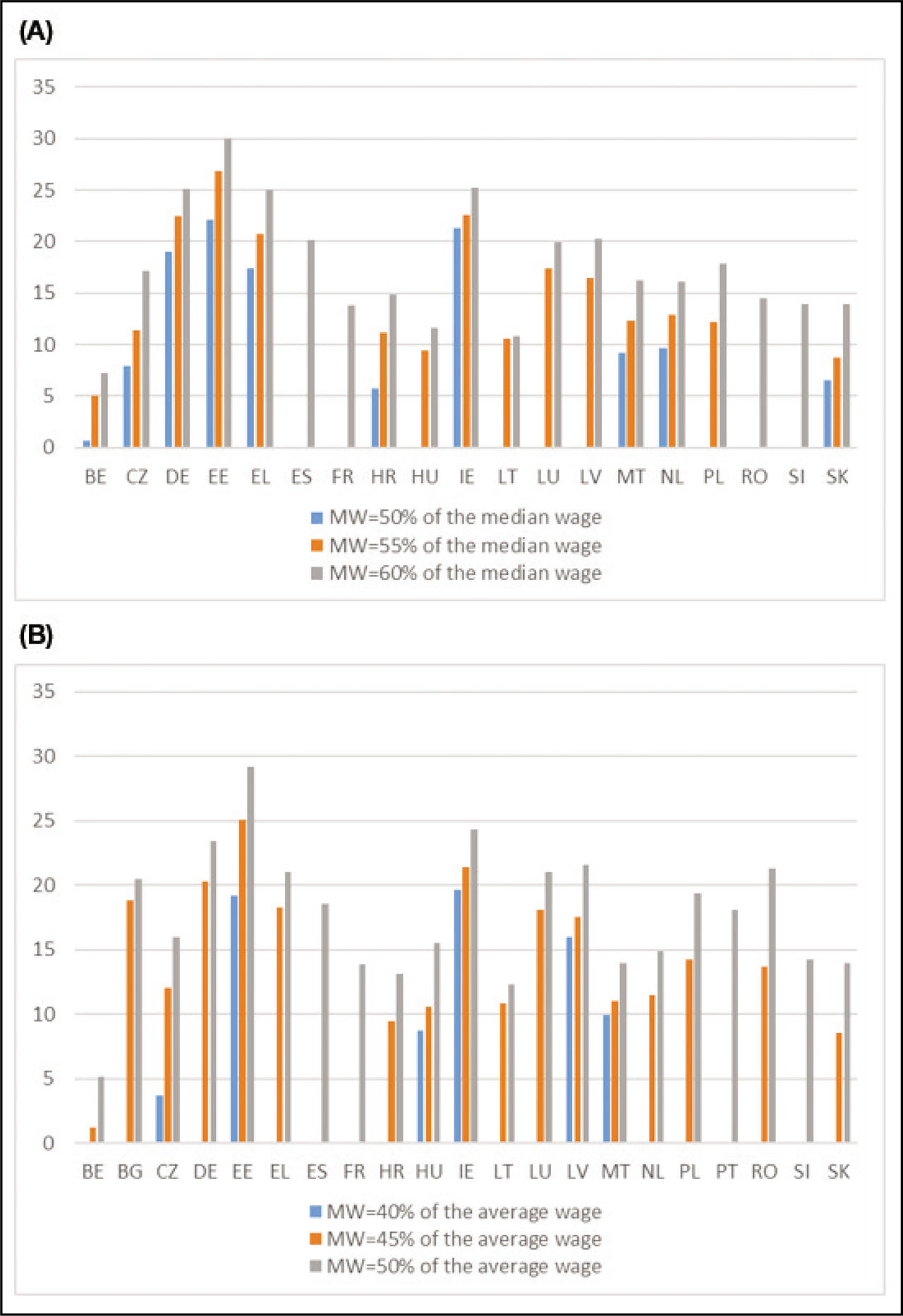
Figure A5
Average increase in the wages of those affected by increases in the MW (%).
(A) Scenarios of MWs as a proportion of the median wage. (B) Scenarios of MWs as a proportion of the average wage.
Notes: EUROMOD simulations. The baseline scenario reflects MWs in 2019. Countries are sorted alphabetically. Countries with actual MWs above the hypothetical scenarios are excluded. BE, Belgium; BG, Bulgaria; CZ, Czech Republic; DE, Germany; EE, Estonia; EL, Greece; ES, Spain; FR, France; HR, Croatia; HU, Hungary; IE, Republic of Ireland; LT, Lithuania; LU, Luxembourg; LV, Latvia; MS, Member States; MT, Malta; MW, minimum wage; NL, The Netherlands; PL, Poland; PT, Portugal; RO, Romania; SI, Slovenia; SK, Slovakia.
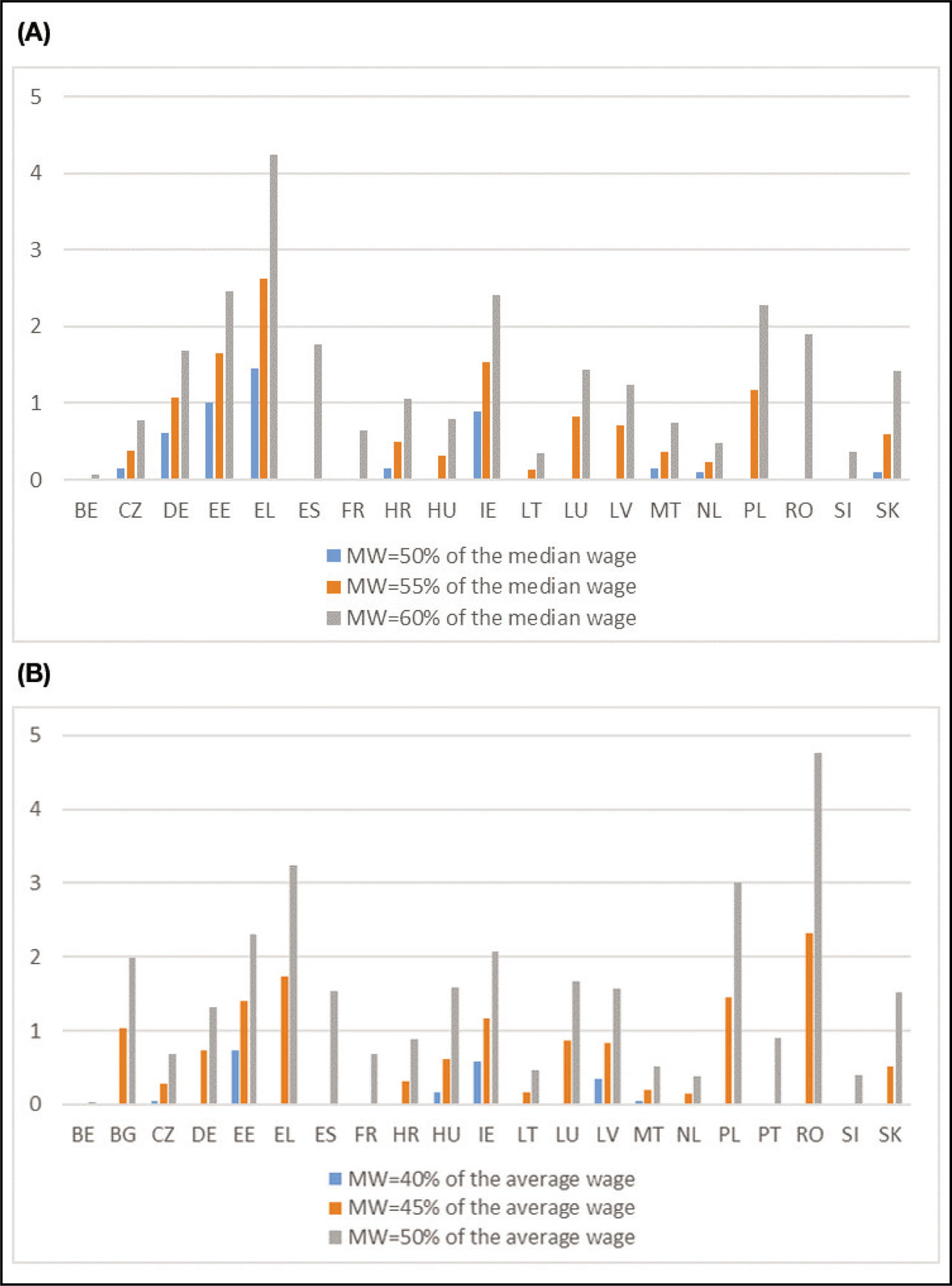
Figure A6
Change in the total wage bill as a result of changes in the MWs (%).
(A) Scenarios of MWs as a proportion of the median wage. (B) Scenarios of MWs as a proportion of the average wage.
Notes: EUROMOD simulations. The baseline scenario reflects MWs in 2019. Countries are sorted alphabetically. Countries with actual MWs above the hypothetical scenarios are excluded. BE, Belgium; BG, Bulgaria; CZ, Czech Republic; DE, Germany; EE, Estonia; EL, Greece; ES, Spain; FR, France; HR, Croatia; HU, Hungary; IE, Republic of Ireland; LT, Lithuania; LU, Luxembourg; LV, Latvia; MS, Member States; MT, Malta; MW, minimum wage; NL, The Netherlands; PL, Poland; PT, Portugal; RO, Romania; SI, Slovenia; SK, Slovakia.
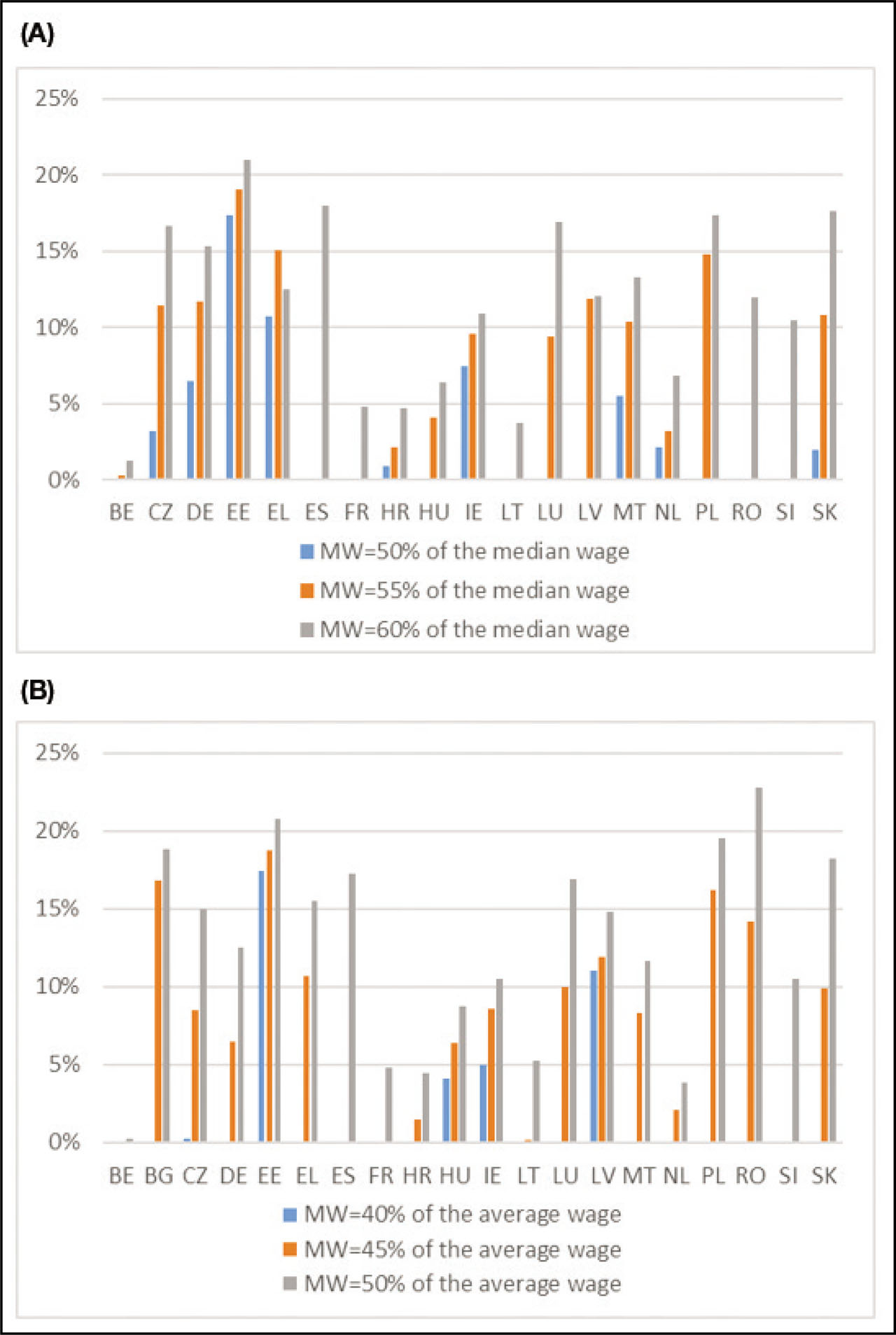
Figure A7
Reduction in wage inequality in simulated HMW scenarios, D5/D1 indicator.
(A) Scenarios of MWs as a proportion of the median wage. (B) Scenarios of MWs as a proportion of the average wage.
Notes: EUROMOD simulations. The baseline scenario reflects MWs in 2019. Countries are sorted alphabetically. Countries with actual MWs above the hypothetical scenarios are excluded. The D5/D1 indicator is obtained by comparing the median (D5) divided by the first decile (D1) of the earnings distribution. BE, Belgium; BG, Bulgaria; CZ, Czech Republic; DE, Germany; EE, Estonia; EL, Greece; ES, Spain; FR, France; HMW, hypothetical MW; HR, Croatia; HU, Hungary; IE, Republic of Ireland; LT, Lithuania; LU, Luxembourg; LV, Latvia; MS, Member States; MT, Malta; MW, minimum wage; NL, The Netherlands; PL, Poland; PT, Portugal; RO, Romania; SI, Slovenia; SK, Slovakia.
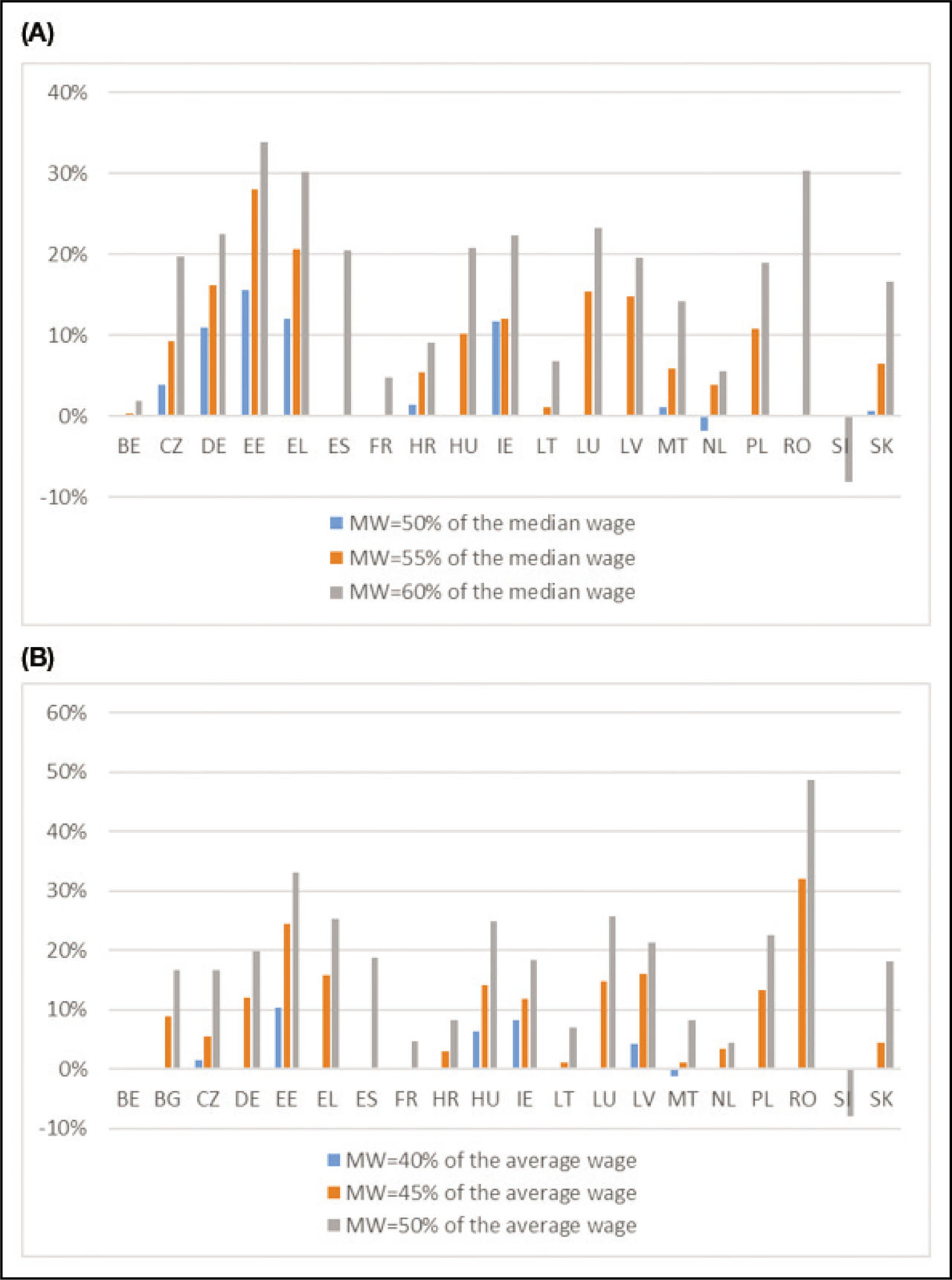
Figure A8
Reduction in in-work poverty in simulated HMW scenarios.
(A) Scenarios of MWs as a proportion of the median wage. (B) Scenarios of MWs as a proportion of the average wage.
Notes: EUROMOD simulations. The baseline scenario reflects MWs in 2019. Countries are sorted alphabetically. Countries with actual MWs above the hypothetical scenarios are excluded. BE, Belgium; BG, Bulgaria; CZ, Czech Republic; DE, Germany; EE, Estonia; EL, Greece; ES, Spain; FR, France; HMW, hypothetical MW; HR, Croatia; HU, Hungary; IE, Republic of Ireland; LT, Lithuania; LU, Luxembourg; LV, Latvia; MS, Member States; MT, Malta; MW, minimum wage; NL, The Netherlands; PL, Poland; PT, Portugal; RO, Romania; SI, Slovenia; SK, Slovakia.
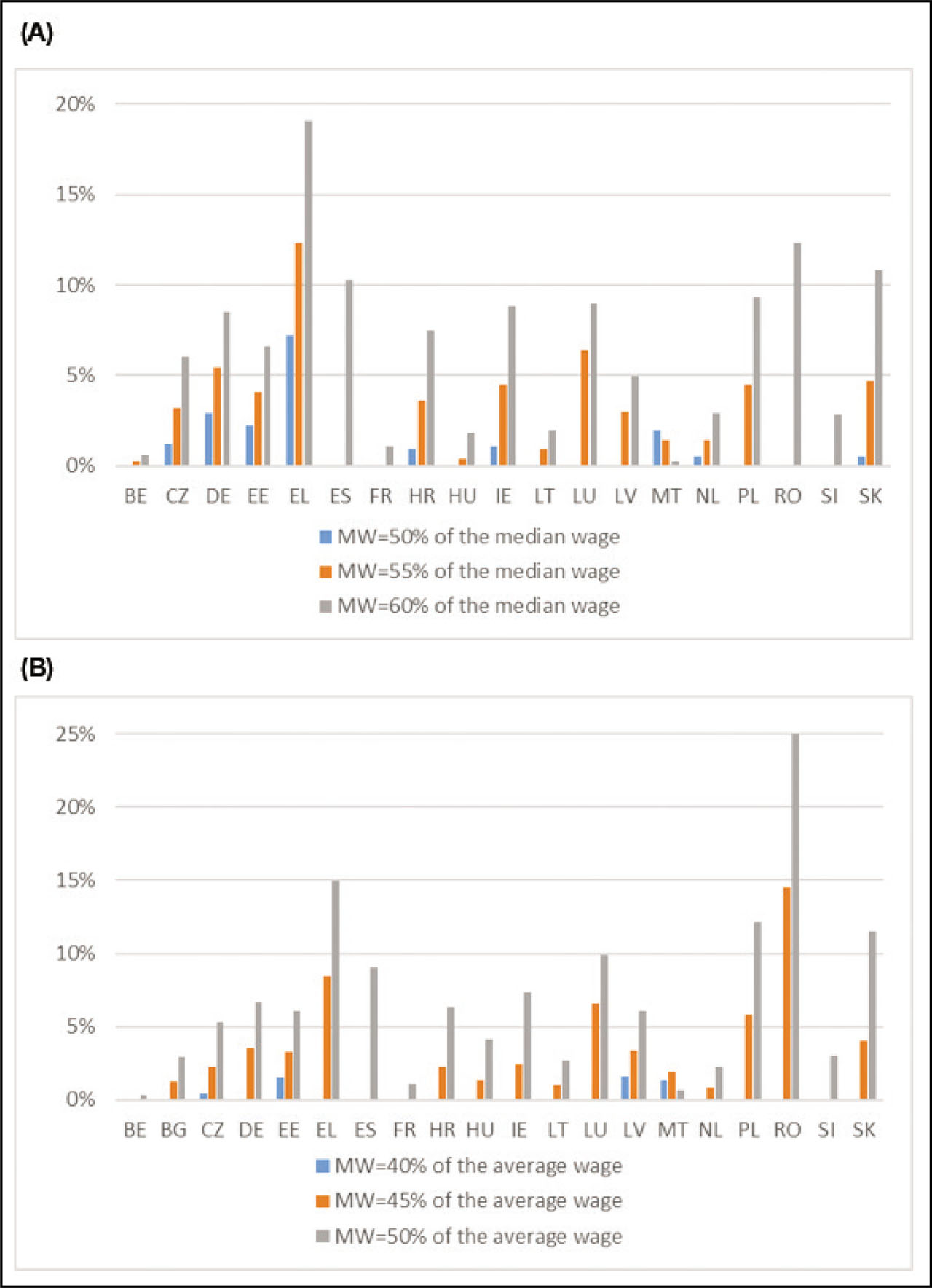
Figure A9
Reduction in the gender pay gap in simulated HMW scenarios.
(A) Scenarios of MW as a proportion of the median wage. (B) Scenarios of MW as a proportion of the average wage.
Notes: EUROMOD simulations. The baseline scenario reflects MW in 2019. Countries are sorted alphabetically. Countries with actual MW above the hypothetical scenarios are excluded. The gender pay gap is the difference between average gross hourly wages of male and female employees as a percentage of male wages, unadjusted for individual characteristics. BE, Belgium; BG, Bulgaria; CZ, Czech Republic; DE, Germany; EE, Estonia; EL, Greece; ES, Spain; FR, France; HMW, hypothetical MW; HR, Croatia; HU, Hungary; IE, Republic of Ireland; LT, Lithuania; LU, Luxembourg; LV, Latvia; MS, Member States; MT, Malta; MW, minimum wage; NL, The Netherlands; PL, Poland; PT, Portugal; RO, Romania; SI, Slovenia; SK, Slovakia.
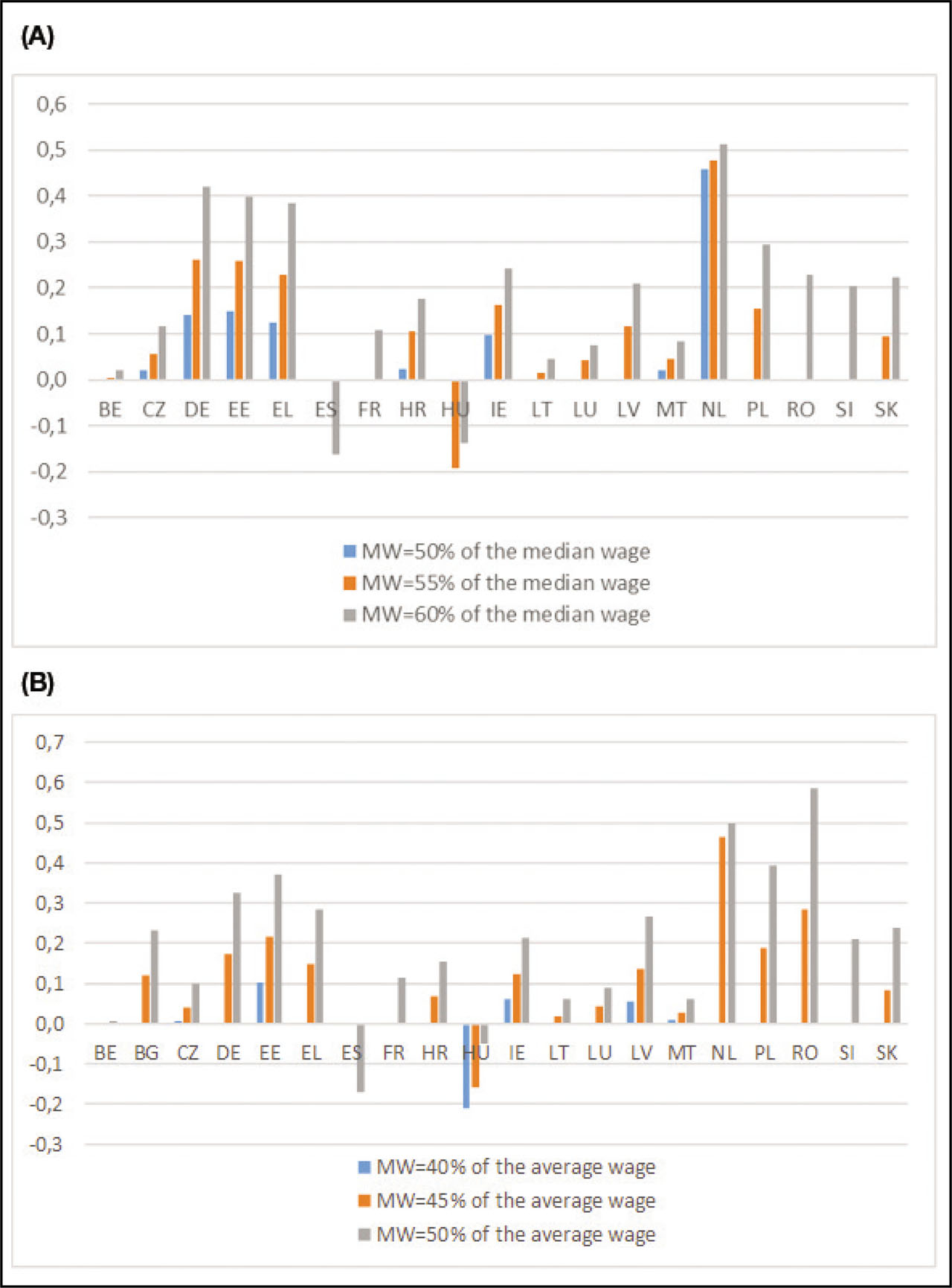
Figure A10
Impact on public budgets (change in fiscal balance as a percentage of GDP).
(A) Changes in fiscal balance when MWs are set as a proportion of the median wage. (B) Changes in fiscal balance when MWs are set as a proportion of the average wage.
Notes: EUROMOD simulations. Positive numbers reflect improvements in the public fiscal balance. Countries are sorted alphabetically. Countries with MWs above 60% of the median wage are excluded. BE, Belgium; BG, Bulgaria; CZ, Czech Republic; DE, Germany; EE, Estonia; EL, GDP, gross domestic product; Greece; ES, Spain; FR, France; HR, Croatia; HU, Hungary; IE, Republic of Ireland; LT, Lithuania; LU, Luxembourg; LV, Latvia; MS, Member States; MT, Malta; MW, minimum wage; NL, The Netherlands; PL, Poland; PT, Portugal; RO, Romania; SI, Slovenia; SK, Slovakia.
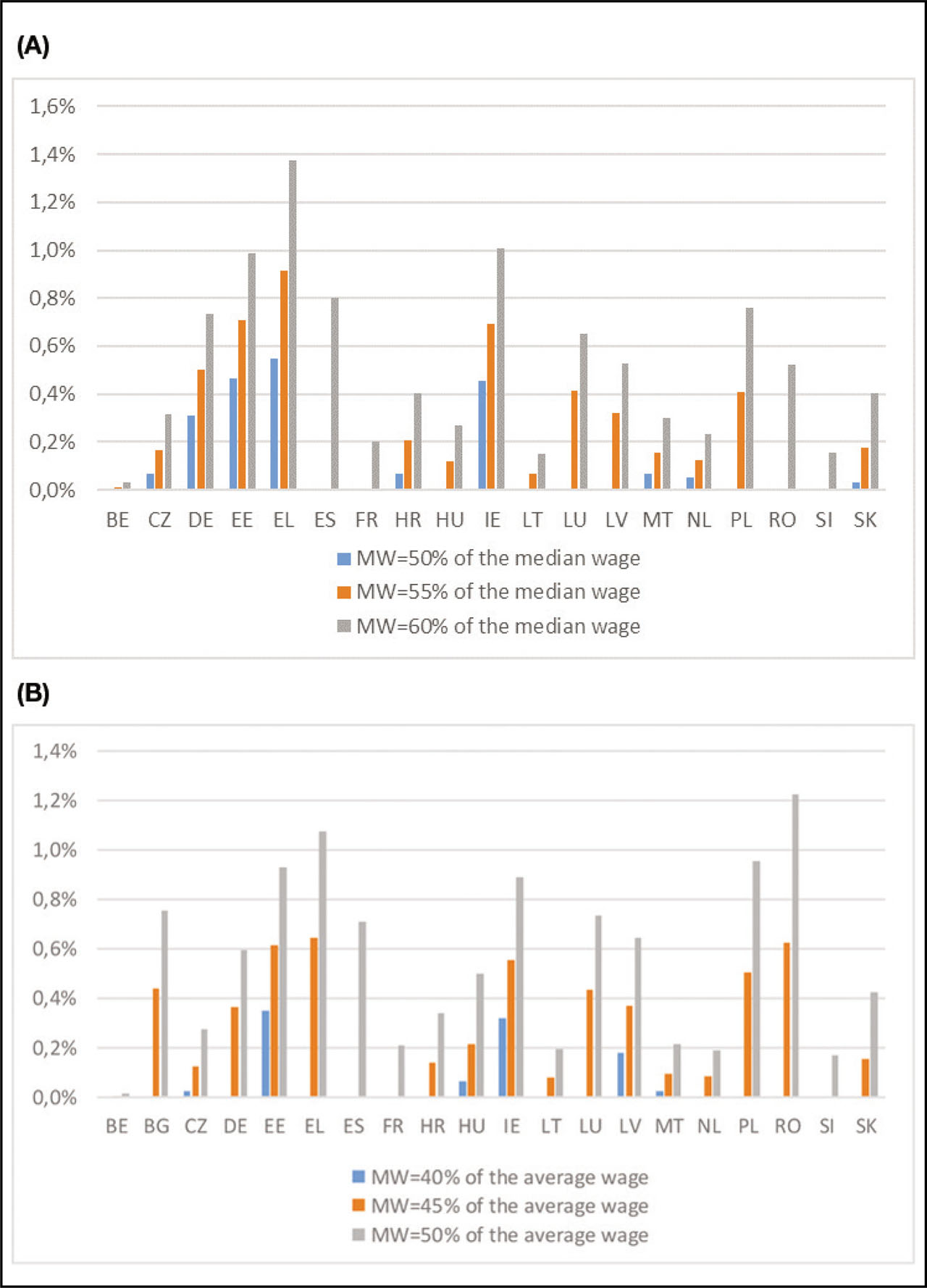
Figure A11
Estimation of possible negative employment effects in simulated HMW scenarios.
(A) Scenarios of MWs as a proportion of the median wage. (B) Scenarios of MWs as a proportion of the average wage.
Notes: EUROMOD simulations. The baseline scenario reflects MWs in 2019. Countries are sorted alphabetically. Countries with actual MWs above the hypothetical scenarios are excluded. BE, Belgium; BG, Bulgaria; CZ, Czech Republic; DE, Germany; EE, Estonia; EL, Greece; ES, Spain; FR, France; HMW, hypothetical MW; HR, Croatia; HU, Hungary; IE, Republic of Ireland; LT, Lithuania; LU, Luxembourg; LV, Latvia; MS, Member States; MT, Malta; MW, minimum wage; NL, The Netherlands; PL, Poland; PT, Portugal; RO, Romania; SI, Slovenia; SK, Slovakia.
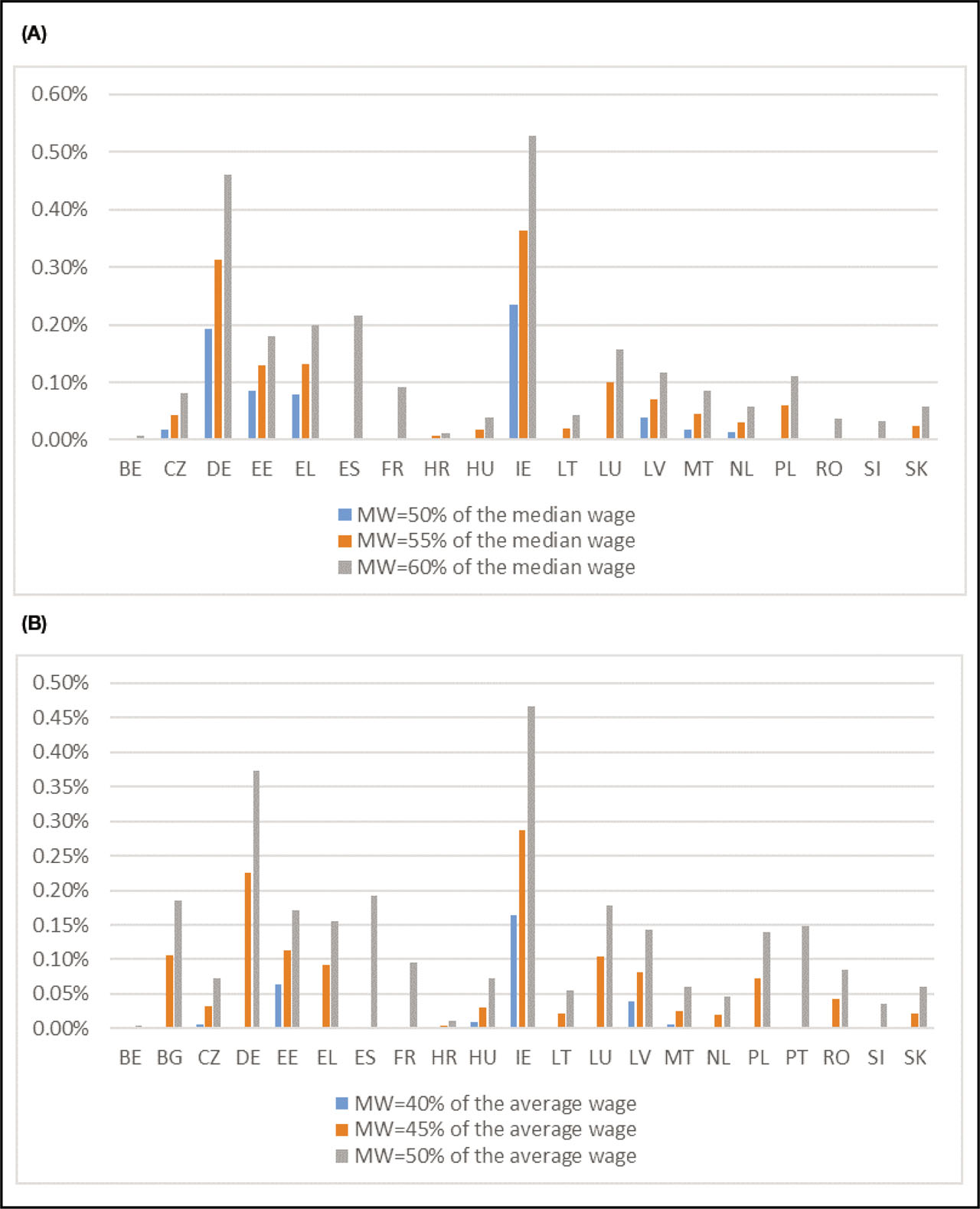
Figure A12
Estimation of possible positive labor supply effects in simulated HMW scenarios (%).
(A) Scenarios of MWs as a proportion of the median wage. (B) Scenarios of MWs as a proportion of the average wage.
Notes: EUROMOD simulations using EUROLAB. The baseline scenario reflects MWs in 2019. Countries are sorted alphabetically. Countries with actual MWs above the hypothetical scenarios are excluded. BE, Belgium; BG, Bulgaria; CZ, Czech Republic; DE, Germany; EE, Estonia; EL, Greece; ES, Spain; FR, France; HMW, hypothetical MW; HR, Croatia; HU, Hungary; IE, Republic of Ireland; LT, Lithuania; LU, Luxembourg; LV, Latvia; MS, Member States; MT, Malta; MW, minimum wage; NL, The Netherlands; PL, Poland; PT, Portugal; RO, Romania; SI, Slovenia; SK, Slovakia.
Table B1
Median number of hours worked by full-time employees
| Country | Median working hours |
|---|---|
| BE | 38 |
| FR | 38 |
| IE | 39 |
| All other 18 EU Member States with SMWs | 40 |
[i] Note: People working >30 h/week are defined as full-time employees.
[ii] Source: EUROMOD input data based on EU-SILC 2017.
[iii] BE, Belgium; EU, European Union; EU-SILC, European Statistics on Income and Living Conditions; FR, France; IE, Republic of Ireland; SMWs, statutory MWs.
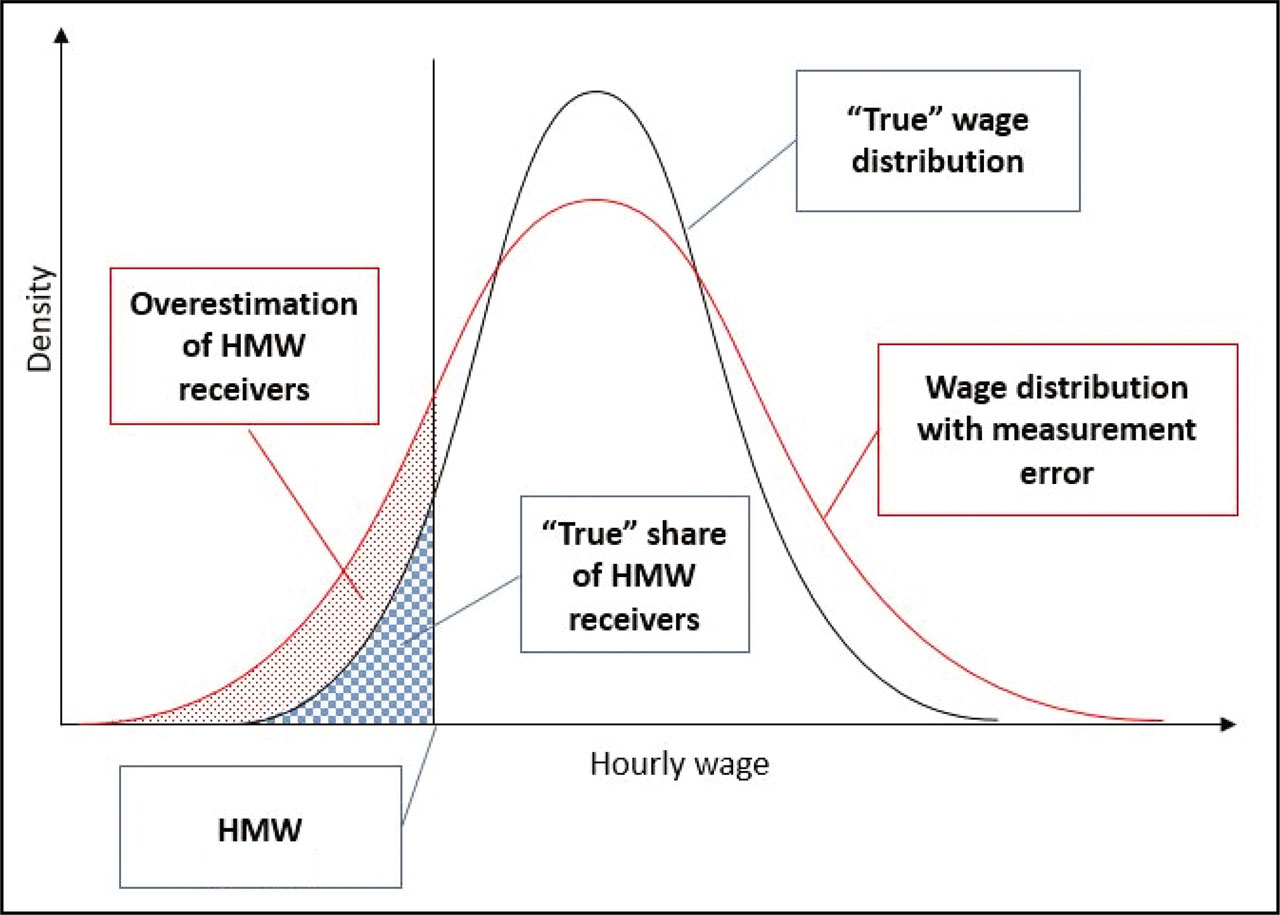
Figure B1
Distribution of gross hourly wages.
HMW, hypothetical MW.
Table B2
Difference in growth between SMWs and average wages from 2016 to 2019
| Country | (A) Nominal growth of SMW 2016–2019 (%) | (B) Average nominal wage growth 2016–2019 (%) | Difference between (A) and (B) (%) |
|---|---|---|---|
| Belgium | 4 | 7 | −3 |
| Bulgaria | 33 | 28 | 5 |
| Czechia | 44 | 24 | 20 |
| Germany | 8 | 9 | −1 |
| Estonia | 26 | 22 | 4 |
| Greece | 11 | 4 | 7 |
| Spain | 37 | 3 | 34 |
| France | 4 | 10 | −6 |
| Croatia | 22 | 14 | 8 |
| Hungary | 32 | 43 | −12 |
| Ireland | 7 | 10 | −3 |
| Lithuania | 46 | 66 | −20 |
| Luxembourg | 9 | 8 | 1 |
| Latvia | 16 | 26 | −10 |
| Malta | 5 | 12 | −7 |
| Netherlands | 6 | 5 | 2 |
| Poland | 27 | 19 | 8 |
| Portugal | 13 | 8 | 6 |
| Romania | 59 | 79 | −20 |
| Slovenia | 12 | 9 | 3 |
| Slovakia | 28 | 18 | 10 |
[i] SMWs, statutory MW.