
Table 1
Number of Residency-program Graduates by Cohort of Program Completion, and Number of First-year Elementary School Principals and Assistant Principals by Year and Residency-Program Participation Status
| First-year principals | First-year assistant principals | ||||
|---|---|---|---|---|---|
| Residency program graduates | Residency program participants | Non-participants | Residency program participants | Non-participants | |
| 2013 | 63 | ||||
| 2014 | 65 | 5 | 36 | 18 | 70 |
| 2015 | 63 | 18 | 25 | 19 | 68 |
| 2016 | 39 | 18 | 23 | 17 | 40 |
| 2017 | 35 | 15 | 27 | 12 | 25 |
| 2018 | 14 | 15 | 6 | 28 | |
| Total | 265 | 70 | 126 | 72 | 231 |
[i] Notes: First-year principal or assistant principals are counted once in the first year they appear in a CPS school. The sample of first-year principals represents those that are included in our estimation sample.
Table 2
Descriptive Statistics for the Principal Sample
| Residents | Non-residents | Difference (Residents minus non-Residents) | |
|---|---|---|---|
| Student Variables | |||
| Math z-score | −0.076 [0.062] | −0.010 [0.046] | −0.065 |
| Reading z-score | −0.075 [0.057] | −0.022 [0.038] | −0.053 |
| Black | 0.487 [0.050] | 0.370 [0.040] | 0.117* |
| Hispanic | 0.367 [0.048] | 0.452 [0.038] | −0.085 |
| Other race | 0.042 [0.010] | 0.069 [0.017] | −0.027 |
| Female | 0.489 [0.004] | 0.497 [0.003] | −0.007 |
| Special Education | 0.150 [0.005] | 0.145 [0.004] | 0.005 |
| Grade Average Enrollment | 61.599 [4.269] | 70.345 [3.695] | −8.746 |
| Principal variables | |||
| Asian | 0.000 [0.000] | 0.014 [0.014] | −0.014 |
| Black | 0.015 [0.015] | 0.010 [0.010] | 0.005 |
| Hispanic | 0.425 [0.062] | 0.350 [0.044] | 0.075 |
| Multiple race | 0.143 [0.044] | 0.167 [0.041] | −0.024 |
| Female | 0.754 [0.052] | 0.587 [0.050] | 0.167** |
| Birth Year | 1977.436 [0.717] | 1971.143 [0.579] | 6.293*** |
| Proportion with the job title: acting | 0.034 [0.020] | 0.049 [0.021] | −0.015 |
| Proportion with the job title: interim | 0.524 [0.064] | 0.671 [0.047] | −0.147* |
| Proportion with the job title: contract | 0.441 [0.064] | 0.280 [0.044] | 0.161** |
| Number of observations | 23,356 | 41,465 | |
Notes: Student characteristics are measured in the year prior to the entry of a the new principal or assistant principal.
Standard deviation in square brackets. Statistical significance of the resident/non-resident difference is based on regressions with standard errors clustered by school.
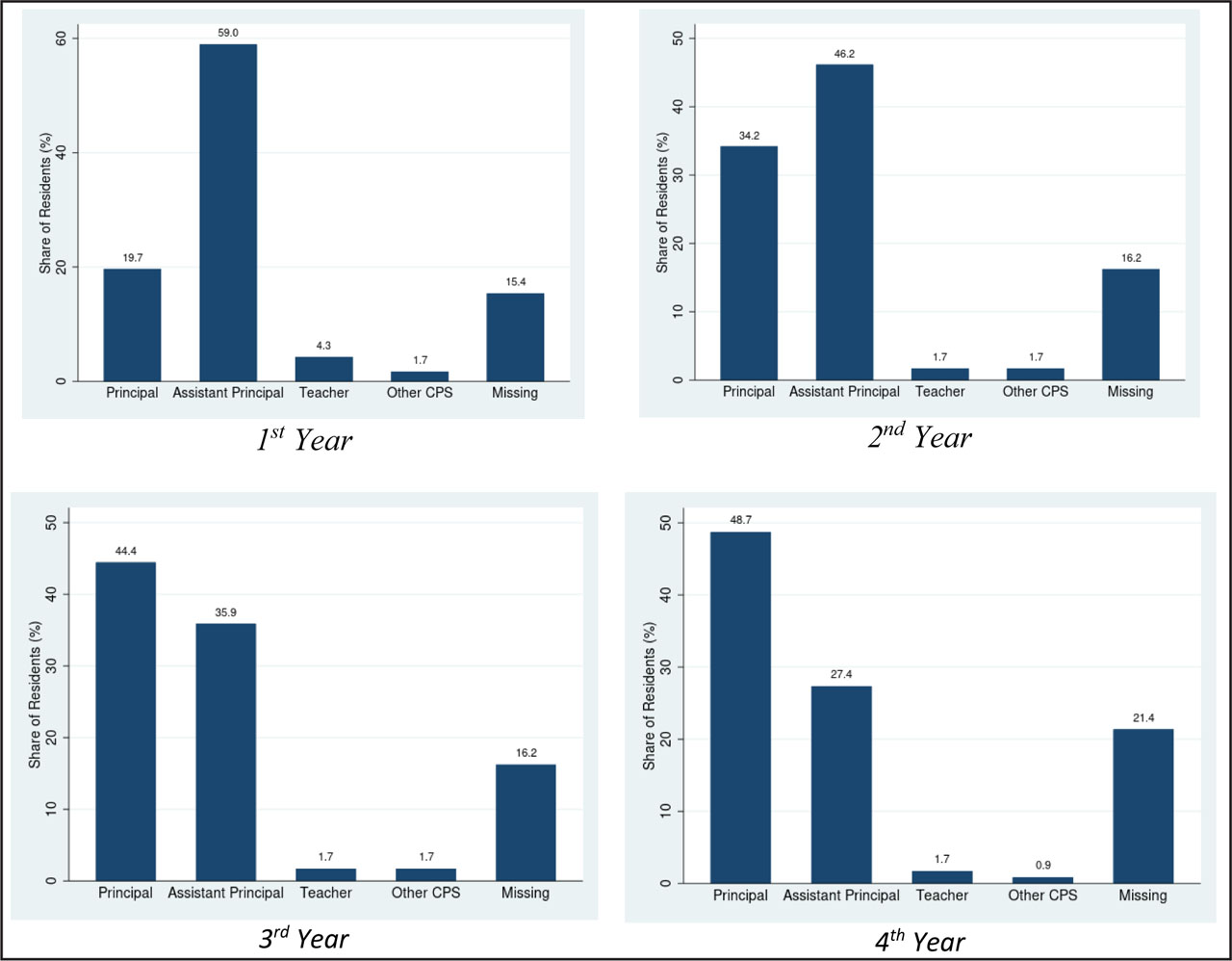
Figure 1
Position Distribution of the 2013 and 2014 Residency Program Graduates, by Number of Years Following Completion of the Residency Program.
Table 3
Resident-Versus Non-Resident-Principal Transition Rates, by Destination and Period Examined
| Transition in any year (2014–2017) | Transition following the 1st year | |||||
|---|---|---|---|---|---|---|
| Any destination | ||||||
| Resident Principal | 0.130* (0.068) | 0.110 (0.070) | 0.071 (0.083) | −0.00017 (0.050) | 0.0018 (0.052) | −0.028 (0.060) |
| Mean Turnover | 0.30 | 0.30 | 0.30 | 0.10 | 0.10 | 0.10 |
| Sample Size | 184 | 184 | 184 | 184 | 184 | 184 |
| Multinomial Logit Estimates (relative to no transition) | ||||||
| Transition within CPS | ||||||
| Resident Principal | 2.65*** (0.77) | 2.65*** (0.77) | 3.30** (1.38) | 2.15* (1.18) | 2.40** (1.18) | 2.20 (1.80) |
| Transition out of CPS | ||||||
| Resident Principal | −0.10 (0.42) | −0.16 (0.44) | −0.55 (0.60) | −1.33 (0.86) | −1.36 (0.96) | −2.39** (1.18) |
| Sample Size | 184 | 184 | 184 | 184 | 184 | 184 |
| Student Controls | N | Y | Y | N | Y | Y |
| Principal Controls | N | N | Y | N | N | Y |
Notes: We focus on newly entering principals between 2014 and 2017. The sample includes 184 newly entering principals. The left side of the table focuses on transitions in any year from 2014 to 2017. The right focuses on transitions occurring after the end of the new principal's first year. Student controls include school-year averages of racial composition, enrollment, share in special education, and share female. Principal controls include indicators for race, female, and job title (interim principal, acting principal, or principal) and birth year. All regressions control for year dummy variables. Robust standard errors are in parentheses.
Table 4
Gardner (2022) two-stage event-study estimates
| Levels | Gains | ||||
|---|---|---|---|---|---|
| Math | Reading | Math | Reading | ||
| Pre-period | Resident*(t=−5) | −0.0048 (0.0155) | −0.0116 (0.0106) | 0.0101 (0.0086) | 0.0001 (0.0057) |
| Resident*(t=−4) | 0.0108 (0.0142) | 0.0109 (0.0090) | 0.0210* (0.0108) | 0.0183** (0.0085) | |
| Resident*(t=−3) | −0.00004 (0.0102) | 0.0061 (0.0083) | −0.0021 (0.0104) | −0.0033 (0.0074) | |
| Resident*(t=−2) | 0.0070 (0.0131) | 0.0084 (0.0091) | −0.0013 (0.0099) | 0.0048 (0.0083) | |
| Post-period | Reference period (t=−1) | ||||
| Resident*(t=0) (dropped) | |||||
| Resident*(t=1) | 0.0451 (0.0305) | 0.0374 (0.0240) | 0.0516*** (0.0153) | 0.0321*** (0.0122) | |
| Resident*(t=2) | 0.0714* (0.0427) | 0.0481* (0.0277) | 0.0503** (0.0195) | 0.0165 (0.0111) | |
| Sample Size | 440968 | 440968 | 352705 | 351864 | |
Notes: The samples include students in schools that hire a new principal (resident trained or non-resident trained) in the years 2014 to 2018. Schools have at least 5 years of data prior to the entry and at least 2 years following the entry of the new principal. Note that schools where a new principal entered in 2018 will only have 2 “post-period” years.
Estimates are based on the two-stage approach in Gardner (2022), where the first stage uses untreated observations to estimate school and period effects, and these effects are then removed prior to comparing outcomes for treated and untreated observations. Regressions include school fixed effects and year fixed effects. Regressions also control for indicators for grade. Period t=0 which is the first year of the new principal's tenure is dropped from the sample.
Standard errors clustered by school are in parentheses.
Table 5
Gardner (2022) two-stage event-study estimates (school has 3 post-period years)
| Levels | Gains | ||||
|---|---|---|---|---|---|
| Math | Reading | Math | Reading | ||
| Pre-period | Resident*(t=−5) | −0.0035 (0.0153) | −0.0031 (0.0105) | 0.0046 (0.0091) | 0.0009 (0.0062) |
| Resident*(t=−4) | 0.0021 (0.0129) | 0.0057 (0.0089) | 0.0131 (0.0091) | 0.0114 (0.0073) | |
| Resident*(t=−3) | −0.00007 (0.0115) | 0.0028 (0.0093) | 0.0041 (0.0108) | −0.0006 (0.0076) | |
| Resident*(t=−2) | 0.0072 (0.0141) | 0.0053 (0.0101) | −0.0007 (0.0108) | 0.0047 (0.0098) | |
| Post-period | Reference period (t=−1) | ||||
| Resident*(t=0) (dropped) | |||||
| Resident*(t=1) | 0.0417 (0.0363) | 0.0502* (0.0286) | 0.0437** (0.0183) | 0.0416*** (0.0147) | |
| Resident*(t=2) | 0.0721* (0.0438) | 0.0494* (0.0291) | 0.0439** (0.0197) | 0.0124 (0.0116) | |
| Sample Size | 385322 | 385322 | 308109 | 307332 | |
Notes: The samples include students in schools that hire a new principal (resident trained or non-resident trained) in the years 2014 to 2017. Schools have at least 5 years of data prior to the entry and 3 years following the entry of the new principal. Note that schools where a new principal entered in 2018 will not contribute to these estimates.
Estimates are based on the two-stage approach in Gardner (2022), where the first stage uses untreated observations to estimate school and period effects, and these effects are then removed prior to comparing outcomes for treated and untreated observations. Regressions include school fixed effects and year fixed effects. Regressions also control for indicators for grade. Period t=0 which is the first year of the new principal's tenure is dropped from the sample.
Standard errors clustered by school are in parentheses.
Table 6
Gardner (2022) two-stage event-study estimates (principal remains there 3 years)
| Levels | Gains | ||||
|---|---|---|---|---|---|
| Math | Reading | Math | Reading | ||
| Pre-period | Resident*(t=−5) | 0.0076 (0.0198) | 0.0011 (0.0126) | 0.0117 (0.0119) | 0.0005 (0.0069) |
| Resident*(t=−4) | 0.0074 (0.0157) | 0.0019 (0.0098) | 0.0116 (0.0106) | 0.0049 (0.0067) | |
| Resident*(t=−3) | −0.0085 (0.0139) | 0.0038 (0.0119) | −0.0011 (0.0129) | 0.0053 (0.0096) | |
| Resident*(t=−2) | 0.0071 (0.0183) | 0.0031 (0.0129) | −0.0031 (0.0139) | 0.0025 (0.0127) | |
| Post-period | Reference period (t=−1) | ||||
| Resident*(t=0) (dropped) | |||||
| Resident*(t=1) | 0.0466 (0.0520) | 0.0616 (0.0413) | 0.0519* (0.0269) | 0.0541*** (0.0210) | |
| Resident*(t=2) | 0.1007 (0.0660) | 0.0787* (0.0467) | 0.0654** (0.0276) | 0.0247 (0.0165) | |
| Sample Size | 229918 | 229918 | 183850 | 183468 | |
Notes: The samples include students in schools that hire a new principal (resident trained or non-resident trained) in the years 2014 to 2016. To be included in the sample, principals must remain in their school at least 3 years. Thus, principals from entry cohorts in 2017 and 2018 will not contribute to these estimates.
Estimates are based on the two-stage approach in Gardner (2022), where the first stage uses untreated observations to estimate school and period effects, and these effects are then removed prior to comparing outcomes for treated and untreated observations. Regressions include school fixed effects and year fixed effects. Regressions also control for indicators for grade. Period t=0 which is the first year of the new principal's tenure is dropped from the sample,
Standard errors clustered by school are in parentheses.
Table 7
Gardner (2022) two-stage event-study estimates (school covariates)
| Enrollment | Black | Hispanic | Other | Female | Special Education | ||
|---|---|---|---|---|---|---|---|
| Pre-period | Resident*(t=−5) | −0.2652 (0.7526) | 0.0093*** (0.0031) | −0.0054* (0.0033) | 0.0015 (0.0010) | 0.0022 0.0022 | 0.0001 0.0019 |
| Resident*(t=−4) | −0.0998 (0.4900) | 0.0039** (0.0019) | −0.0034 (0.0023) | 0.0017 (0.0011) | −0.0004 0.0016 | 0.0004 0.0017 | |
| Resident*(t=−3) | −0.1110 (0.3483) | −0.0006 (0.0011) | −0.0015 (0.0011) | 0.0006 (0.0007) | 0.0015 0.0017 | −0.0005 0.0013 | |
| Resident*(t=−2) | 0.2523 (0.4461) | −0.0038* (0.0022) | 0.0029 (0.0023) | −0.0009 (0.0006) | 0.0012 0.0018 | −0.0007 0.0015 | |
| Pos | Reference period (t=−1) | ||||||
| Resident*(t=0) (dropped) | |||||||
| Resident*(t=1) | −1.1356 (1.2912) | −0.0155** (0.0058) | 0.0131** (0.0066) | −0.0039 (0.0029) | 0.0019 0.0045 | −0.0047 0.0041 | |
| Resident*(t=2) | −2.1136 (1.1582) | −0.0152* (0.0081) | 0.0185** (0.0091) | −0.0051 (0.0037) | 0.0027 0.0055 | −0.0052 0.0048 | |
| Sample Size | 440968 | 440968 | 440968 | 440968 | 440968 | 440968 | |
Notes: Similar to Table 4, the sample here include students in schools that hire a new principal (resident trained or non-resident trained) in the years 2014 to 2018. Schools have at least 5 years of data prior to the entry and at least 2 years following the entry of the new principal. Note that schools where a new principal entered in 2018 will only have 2 “post-period” years.
Estimates are based on the two-stage approach in Gardner (2022), where the first stage uses untreated observations to estimate school and period effects, and these effects are then removed prior to comparing outcomes for treated and untreated observations. Regressions include school fixed effects and year fixed effects. Regressions also control for indicators for grade. Period t=0 which is the first year of the new principal's tenure is dropped from the sample,
Standard errors clustered by school are in parentheses.
Appendix Table A1
TWFE event-study estimates
| Levels | Gains | ||||
|---|---|---|---|---|---|
| Math | Reading | Math | Reading | ||
| Pre-period | Resident*(t=−5) | 0.0087 (0.0431) | 0.0034 (0.0274) | 0.0477* (0.0270) | 0.0285 (0.0175) |
| Resident*(t=−4) | 0.0258 (0.0404) | 0.0286 (0.0246) | 0.0576** (0.0284) | 0.0459** (0.0206) | |
| Resident*(t=−3) | 0.0154 (0.0213) | 0.0244 (0.0217) | 0.0322 (0.0266) | 0.0230 (0.0171) | |
| Resident*(t=−2) | 0.0212 (0.0267) | 0.0236 (0.0169) | 0.0298 (0.0199) | 0.0270 (0.0183) | |
| Post-period | Reference period (t=−1) | ||||
| Resident*(t=0) (dropped) | |||||
| Resident*(t=1) | 0.0541** (0.0267) | 0.0501** (0.0201) | 0.0779*** (0.0215) | 0.0528*** (0.0172) | |
| Resident*(t=2) | 0.0782* (0.0411) | 0.0584** (0.0241) | 0.0759*** (0.0255) | 0.0357*** (0.0154) | |
| Sample Size | 440968 | 440968 | 352705 | 351864 | |
Notes: The samples include students in schools that hire a new principal (resident trained or non-resident trained) in the years 2014 to 2018. Schools have at least 5 years of data prior to the entry and at least 2 years following the entry of the new principal. Note that schools where a new principal entered in 2018 will only have 2 “post-period” years.
Estimates are based on a two-way fixed effect regression with school fixed effect, year fixed effects, and grade indicators. Period t=0 which is the first year of the new principal's tenure is dropped from the sample.
Standard errors clustered by school are in parentheses.
Appendix Table A2
TWFE event-study estimates (school has 3 post-period years)
| Levels | Gains | ||||
|---|---|---|---|---|---|
| Math | Reading | Math | Reading | ||
| Pre-period | Resident*(t=−5) | −0.0047 (0.0434) | 0.0043 (0.0303) | 0.0297 (0.0268) | 0.0190 (0.0202) |
| Resident*(t=−4) | 0.0028 (0.0399) | 0.0151 (0.0269) | 0.0386 (0.0262) | 0.0304 (0.0201) | |
| Resident*(t=−3) | 0.0019 (0.0318) | 0.0129 (0.0245) | 0.0282 (0.0249) | 0.0176 (0.0200) | |
| Resident*(t=−2) | 0.0090 (0.0241) | 0.0148 (0.0186) | 0.0207 (0.0242) | 0.0216 (0.0231) | |
| Post-period | Reference period (t=−1) | ||||
| Resident*(t=0) (dropped) | |||||
| Resident*(t=1) | 0.0347 (0.0304) | 0.0490** (0.0239) | 0.0606** (0.0236) | 0.0528** (0.0212) | |
| Resident*(t=2) | 0.0667* (0.0392) | 0.0540** (0.0243) | 0.0630** (0.0248) | 0.0284* (0.0168) | |
| Sample Size | 385322 | 385322 | 308109 | 307332 | |
Notes: The samples include students in schools that hire a new principal (resident trained or non-resident trained) in the years 2014 to 2017. Schools have at least 5 years of data prior to the entry and 3 years following the entry of the new principal. Note that schools where a new principal entered in 2018 will not contribute to these estimates.
Estimates are based on a two-way fixed effect regression with school fixed effect, year fixed effects, and grade indicators. Period t=0 which is the first year of the new principal's tenure is dropped from the sample.
Standard errors clustered by school are in parentheses.
Appendix Table A3
TWFE event-study estimates (principal remains there 3 years)
| Levels | Gains | ||||
|---|---|---|---|---|---|
| Math | Reading | Math | Reading | ||
| Pre-period | Resident*(t=−5) | 0.0178 (0.0602) | 0.0055 (0.0395) | 0.0436 (0.0396) | 0.0113 (0.0277) |
| Resident*(t=−4) | 0.0181 (0.0549) | 0.0085 (0.0344) | 0.0436 (0.0391) | 0.0176 (0.0264) | |
| Resident*(t=−3) | 0.0021 (0.0446) | 0.0114 (0.0341) | 0.0291 (0.0365) | 0.0185 (0.0303) | |
| Resident*(t=−2) | 0.0163 (0.0372) | 0.0099 (0.0283) | 0.0286 (0.0368) | 0.0140 (0.0319) | |
| Post-period | Reference period (t=−1) | ||||
| Resident*(t=0) (dropped) | |||||
| Resident*(t=1) | 0.0526 (0.0426) | 0.0622* (0.0341) | 0.0767** (0.0350) | 0.0614** (0.0292) | |
| Resident*(t=2) | 0.1004* (0.0561) | 0.0777* (0.0394) | 0.0861** (0.0331) | 0.0331 (0.0246) | |
| Sample Size | 229918 | 229918 | 183850 | 183468 | |
Notes: The samples include students in schools that hire a new principal (resident trained or non-resident trained) in the years 2014 to 2016. To be included in the sample, principals must remain in their school at least 3 years. Thus, principals from entry cohorts in 2017 and 2018 will not contribute to these estimates.
Estimates are based on a two-way fixed effect regression with school fixed effect, year fixed effects, and grade indicators. Period t=0 which is the first year of the new principal's tenure is dropped from the sample.
Standard errors clustered by school are in parentheses.
Appendix Table A4
Gardner (2022) two-stage event-study estimates (controlling for period before)
| Levels | Gains | ||||
|---|---|---|---|---|---|
| Math | Reading | Math | Reading | ||
| Pre-period | Resident*(t=−5) | −0.0052 (0.0154) | −0.0121 (0.0105) | 0.0090 (0.0086) | 0.0005 (0.0057) |
| Resident*(t=−4) | 0.0098 (0.0135) | 0.0094 (0.0087) | 0.0179* (0.0105) | 0.0159* (0.0073) | |
| Resident*(t=−3) | −0.0017 (0.0097) | 0.0034 (0.0097) | −0.0075 (0.0104) | −0.0074 (0.0073) | |
| Resident*(t=−2) | 0.0045 (0.0147) | 0.0043 (0.0097) | −0.0095 (0.0101) | −0.0014 (0.0078) | |
| Post-period | Reference period (t=−1) | ||||
| Resident*(t=0) (dropped) | |||||
| Resident*(t=1) | 0.0435 (0.0321) | 0.0333 (0.0252) | 0.0433*** (0.0157) | 0.0258** (0.0126) | |
| Resident*(t=2) | 0.0687 (0.0436) | 0.0438 (0.0287) | 0.0418** (0.0197) | 0.0097 (0.0114) | |
| Sample Size | 440968 | 440968 | 352705 | 351864 | |
Notes: Similar to Table 4, the sample here include students in schools that hire a new principal (resident trained or non-resident trained) in the years 2014 to 2018. Schools have at least 5 years of data prior to the entry and at least 2 years following the entry of the new principal. Note that schools where a new principal entered in 2018 will only have 2 “post-period” years.
Estimates are based on the two-stage approach in Gardner (2022), where the first stage uses untreated observations to estimate school and period effects, and these effects are then removed prior to comparing outcomes for treated and untreated observations. Regressions include school fixed effects and year fixed effects. Regressions also control for indicators for grade and an indicator for the period before the transition (t=−1). Period t=0 which is the first year of the new principal's tenure is dropped from the sample,
Standard errors clustered by school are in parentheses.
Appendix Table A5
TWFE control coefficients
| Mathematics | Reading | |||
|---|---|---|---|---|
| Levels | Gains | Levels | Gains | |
| Student Black | −0.5523*** | −0.1834*** | −0.3968*** | −0.1482*** |
| 0.0346 | 0.0112 | 0.0368 | 0.0111 | |
| Student Hispanic | 0.3420*** | −0.1112*** | −0.327*** | −0.1047*** |
| 0.0261 | 0.0083 | 0.0297 | 0.0094 | |
| Student Other Race | 0.0989* | 0.0532** | −0.0816*** | −0.0061 |
| 0.0569 | 0.0210 | 0.0279 | 0.0113 | |
| Student Female | −0.0434*** | −0.0061*** | 0.1095*** | 0.0312*** |
| 0.0051 | 0.0019 | 0.0046 | 0.0019 | |
| Student Special Education | −0.0975 | −0.2951*** | −1.2028*** | −0.3671*** |
| 0.0175 | 0.0088 | 0.0145 | 0.0076 | |
| Sample Size | 440968 | 352705 | 440968 | 351864 |
Notes: Similar to Table 4, the sample here include students in schools that hire a new principal (resident trained or non-resident trained) in the years 2014 to 2018. Schools have at least 5 years of data prior to the entry and at least 2 years following the entry of the new principal. Note that schools where a new principal entered in 2018 will only have 2 “post-period” years.
The control coefficient estimates come from regressions that include school fixed effects and year fixed effects. Regressions also control for indicators for grade. Period t=0 which is the first year of the new principal's tenure is dropped from the sample,
Standard errors clustered by school are in parentheses.