
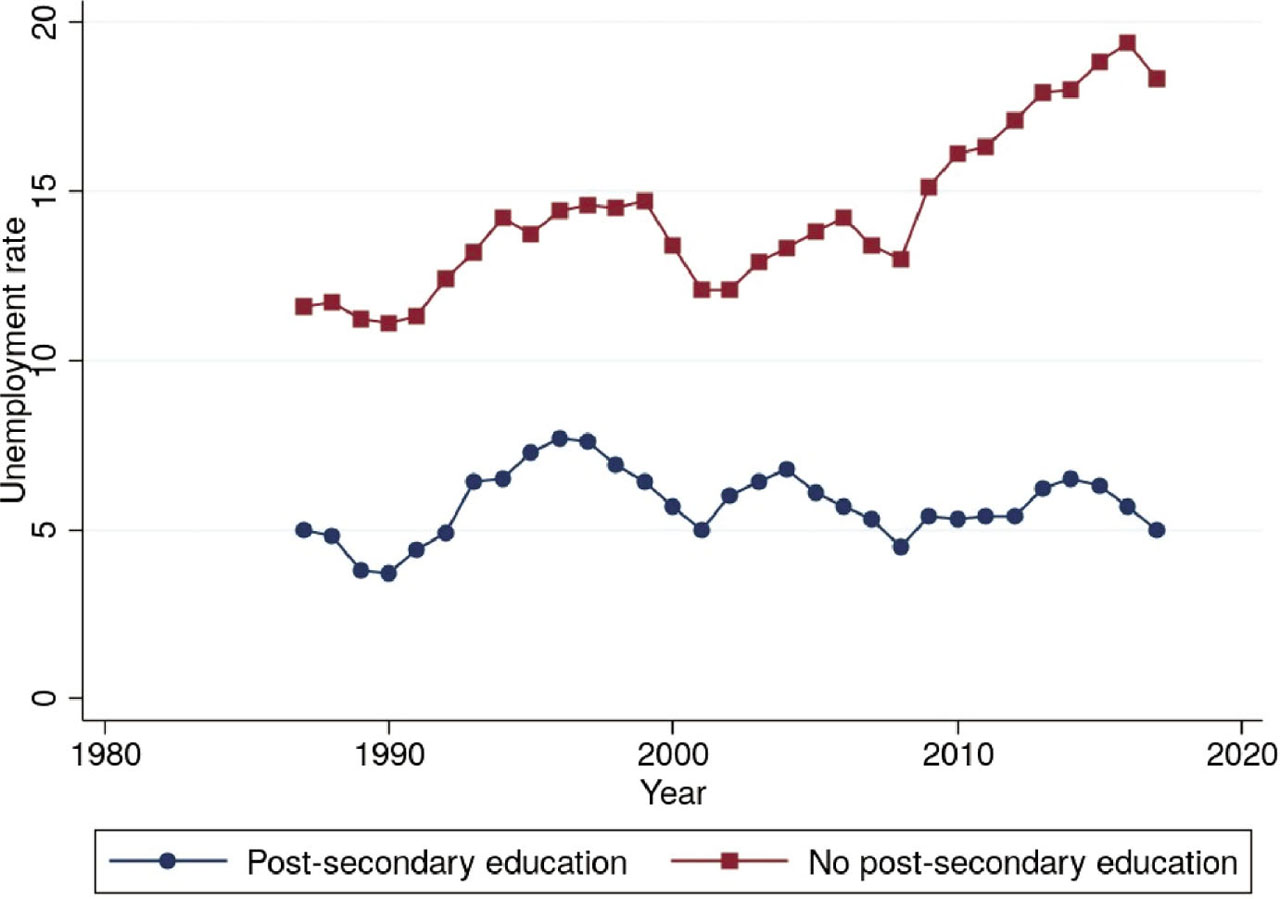
Figure 1
Unemployment gap by education in France, 1987–2017.
Notes: The figure represents the unemployment rate in France for individuals with and without postsecondary education. Source: Observatoire des inégalités https://www.inegalites.fr/Le-taux-de-chomageselon-le-diplome-et-l-age
Table 1
Descriptive statistics
| Panel A: Individual characteristics | |||||
| Mean | St. Dev. | Min. | Max. | Obs. | |
| Age | 18.04 | 1.03 | 16.69 | 23.18 | 19,181 |
| Male | 0.41 | 0.49 | 19,181 | ||
| French nationality | 0.92 | 0.25 | 19,181 | ||
| Mean grade in h-school | 11.81 | 2.06 | 3.25 | 19.33 | 19,181 |
| Held back in h-school | 0.07 | 0.26 | 19,181 | ||
| Low social background | 0.14 | 0.35 | 19,181 | ||
| High achievers | 0.32 | 0.46 | 19,181 | ||
| Major in h-school: economics | 0.44 | 0.49 | 19,181 | ||
| Major in h-school: sciences | 0.37 | 0.48 | 19,181 | ||
| Major in h-school: literature | 0.18 | 0.38 | 19,181 | ||
| Public h-school | 0.81 | 0.38 | 19,181 | ||
| C feedback at univ. application | 0.27 | 0.30 | 19,181 | ||
| Enrolled at university | 0.50 | 0.50 | 19,181 | ||
| Panel B: High School Class Mean Characteristics | |||||
| Quantile | |||||
| Min | P25 | P50 | P75 | Max | |
| Mean class age | 18.05 | 18.16 | 18.38 | 18.53 | 19.33 |
| Class share of males | 0.05 | 0.33 | 0.42 | 0.50 | 0.70 |
| Class share of French | 0.75 | 0.92 | 0.96 | 1.00 | 1.00 |
| Class size | 22 | 24 | 28 | 31 | 35 |
| Mean class grade | 10.10 | 11.25 | 11.79 | 12.29 | 14.17 |
| Class share held back | 0.00 | 0.00 | 0.05 | 0.09 | 0.38 |
| Class share of low soc. back. | 0.00 | 0.05 | 0.12 | 0.18 | 0.50 |
| Class share high achievers | 0.00 | 0.09 | 0.26 | 0.43 | 0.92 |
| Class share enrolled at university | 0.08 | 0.42 | 0.57 | 0.87 | 1.00 |
| Class share observed | 0.62 | 0.77 | 0.88 | 1.00 | 1.00 |
[i] Notes: Panel A indicates the mean characteristics for the full sample, the standard deviation the minimum, maximum and number of observations of the students applying at university. Panel B reports the distribution of the class mean over the different classes.
Table 2
OA policy and enrollment
| Panel A: individual feedback | ||||
| A or B Feedback | C Feedback | |||
| Enrollment | 0.51 | 0.47 | ||
| (0.01) | (0.01) | |||
| Panel B: peers’ feedback | ||||
| Share of peers with C feedback | 0.2 | 0.4 | 0.6 | 0.8 |
| Enrollment | 0.69 | 0.57 | 0.42 | 0.35 |
| (0.01) | (0.01) | (0.01) | (0.01) | |
[i] Notes: The table indicates the proportion of students enrolling at university relative to the feedback received. Panel A relates individual enrollment and individual positive or negative feedback. Panel B relates individual enrollment and the share of peers receiving C feedback. Standard errors are in parentheses.
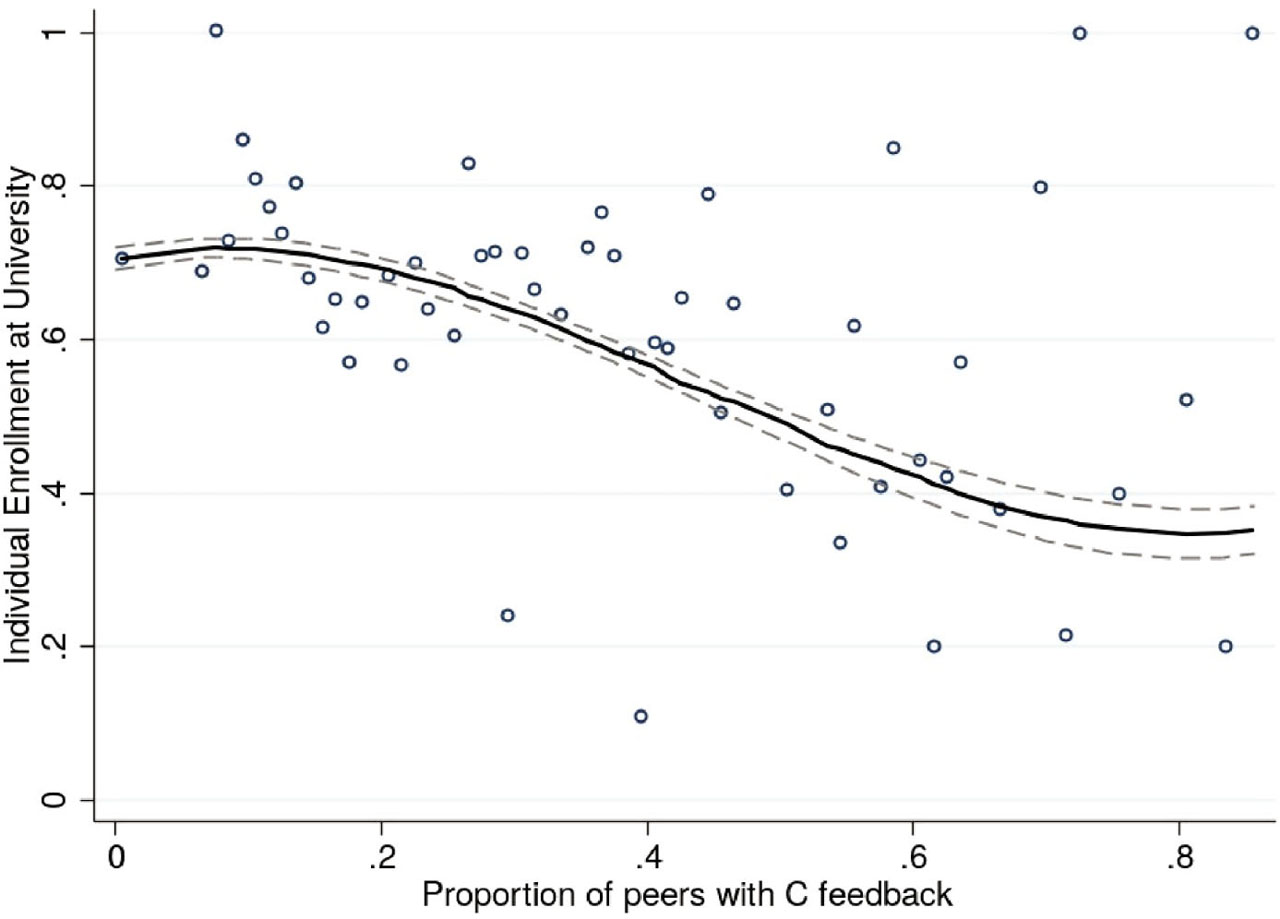
Figure 2
University Enrollment and Share of Peers with C Feedback.
Notes: The figure represents the relation between individual enrollment at university and the proportion of peers with C feedback. Dots are data averages over small intervals. The black continuous line represents the predicted value from a regression of the enrollment dummy variable on a polynomial function of order three of the share of peers with C feedback. The dashed grey lines represent 95% standard errors. The regression coefficients used to compute the predicted values are displayed in Table A3. The predicted value is computed from individual data and not data averages.
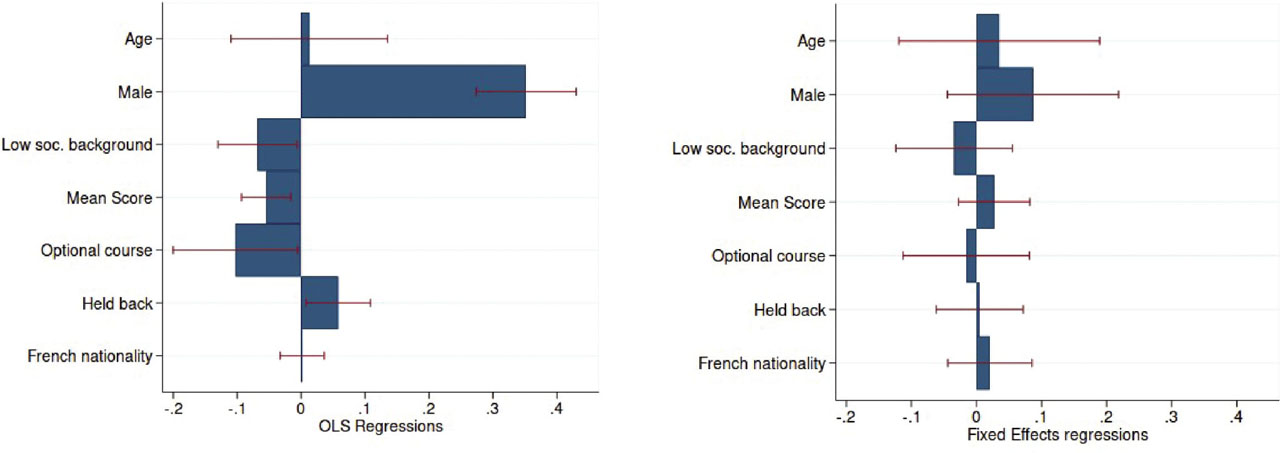
Figure 3
Balancing tests for the proportion of peers with C feedback.
Notes: The figure represents the estimated coefficient from the separated regressions of each individual's observable characteristics on the share of peers with C feedback. The left panel displays OLS regressions, while the right panel presents fixed-effect regressions using major-by-high-school-by-year fixed effects and controlling by the peers mean characteristics; horizontal red lines are the standard errors.
Table 3
Balancing tests for the proportion of peers with C feedback
| (1) | (2) | (3) | |
|---|---|---|---|
| Dependent variable | |||
| Age | 0.013 (0.062) | −0.060 (0.069) | 0.035 (0.079) |
| Male | 0.352*** (0.040) | 0.157*** (0.052) | 0.087 (0.067) |
| Low soc. background | −0.068*** (0.032) | −0.040 (0.033) | −0.034 (0.046) |
| Mean grade in h-school | −0.054*** (0.020) | 0.034 (0.025) | 0.027 (0.028) |
| Optional course in h-school | −0.103*** (0.050) | −0.060 (0.054) | −0.016 (0.050) |
| Held back in h-school | 0.058*** (0.026) | 0.004 (0.028) | 0.005 (0.034) |
| French nationality | 0.002 (0.018) | 0.041* (0.025) | 0.021 (0.033) |
| Major-by-high-school-by-year fixed effects | ✓ | ✓ | |
| Peers characteristics | ✓ | ||
| Observations | 19,181 | 19,181 | 19,181 |
Notes: The table indicates OLS and major-by-high school-by-year fixed effects estimates from separate regressions of the relevant dependent variable on the proportion of peers with C feedback. Column (3) uses the following mean peers’ characteristics as control variables: age, gender, a dummy for low social background, mean numerical grade, and dummies for optional classes, having been academically held back, French nationality, and public high school. Robust standard errors clustered at the high school major level are reported in parentheses.
Table 4
Regressions of individual enrollment on peers with C feedback from university application
| Dep. Var: Probability to enroll at university | ||||||
|---|---|---|---|---|---|---|
| (1) | (2) | (3) | (4) | (5) | (6) | |
| Prop. of peers with C feedback | −0.153*** (0.048) | −0.094** (0.037) | −0.095** (0.037) | −0.055 (0.040) | −0.065 (0.041) | −0.068* (0.041) |
| Individual characteristics | ✓ | ✓ | ✓ | ✓ | ||
| Peers characteristics | ✓ | ✓ | ||||
| Major-by-high-school-by-year fixed effects | ✓ | ✓ | ✓ | |||
| Observations | 19,181 | 19,181 | 19,181 | 19,181 | 19,181 | 19,181 |
| R2 | 0.001 | 0.067 | 0.073 | 0.001 | 0.019 | 0.023 |
| Mean dep. var. | 0.507 | 0.507 | 0.507 | 0.507 | 0.507 | 0.507 |
Notes: The table indicates the regression of individual enrollment on the proportion of peers with C feedback. The table reports regressions using the share of peers with C feedback as the main explanatory variable. Individual and peer mean characteristics used as control are: age, gender, a dummy for low social background, mean numerical grade, optional classes, having been academically held back, French nationality, public high school, and year dummy variables. Robust standard errors clustered at school-major-year level are reported in parentheses.
Table 5
Heterogeneous effects: Regressions by gender and by social background
| Panel A : Dep. Var: Prob. to Enroll | |||||
| Male | Female | All | |||
| (1) | (2) | (3) | (4) | (5) | |
| Prop. of peers with C feedback | −0.122* (0.070) | −0.034 (0.063) | |||
| Prop. of male peers with C feedback | −0.110** (0.054) | −0.013 (0.035) | |||
| Prop. of female peers with C feedback | −0.032 (0.035) | −0.035 (0.045) | |||
| Prop. of same gender peers with C feedback | −0.044* (0.024) | ||||
| Prop. of other gender peers with C feedback | −0.028 (0.024) | ||||
| Individual Characteristics | ✓ | ✓ | ✓ | ✓ | ✓ |
| Peers Characteristics | ✓ | ✓ | ✓ | ✓ | ✓ |
| Major-by-high-school-by-year fixed effects | ✓ | ✓ | ✓ | ✓ | ✓ |
| Observations | 7,891 | 7,891 | 11,290 | 11,290 | 19,181 |
| R2 | 0.026 | 0.026 | 0.022 | 0.022 | 0.022 |
| Mean dep. var. | 0.509 | 0.509 | 0.506 | 0.506 | 0.507 |
| Panel B: Dep. Var.: Prob. to Enroll | |||||
| Low social background | High social background | All | |||
| (1) | (2) | (3) | (4) | (5) | |
| Prop of peers with C feedback | −0.105* (0.062) | −0.027 (0.050) | |||
| Prop of low soc. back. peers with C feedback | −0.053* (0.029) | 0.021 (0.021) | |||
| Prop of high soc. back. peers with C feedback | −0.053 (0.044) | −0.019 (0.039) | |||
| Prop of same soc. back. peers with C feedback | −0.034 (0.022) | ||||
| Prop of other soc. back. peers with C feedback | 0.002 (0.018) | ||||
| Individual characteristics | ✓ | ✓ | ✓ | ✓ | ✓ |
| Peers characteristics | ✓ | ✓ | ✓ | ✓ | ✓ |
| Major-by-high-school-by-year fixed effects | ✓ | ✓ | ✓ | ✓ | ✓ |
| Observations | 5,068 | 5,068 | 14,113 | 14,113 | 19,181 |
| R2 | 0.027 | 0.027 | 0.018 | 0.018 | 0.022 |
| Mean dep. var. | 0.535 | 0.535 | 0.497 | 0.497 | 0.507 |
Notes: The table reports the regressions of individual enrollment on the share of peers with a C feedback by gender and social background. Panel (A) restricts the sample by gender, while panel B splits the sample by social background. Individual and peers’ mean characteristics used as control are: age, gender (panel B only), scholarship in h-school (panel A only), mean numerical grade, optional classes, having been academically held back, and public high school. Major-by-high-school-by-year fixed effects are included as controls. Robust standard errors clustered at school-major-year level are reported in parentheses.
Table 6
Heterogeneous effects: Regressions by ability level
| Dep Var: Prob. to Enroll at University | |||||
|---|---|---|---|---|---|
| (1) | (2) | (3) | (4) | (5) | |
| Prop. of peers with C feedback | −0.068* (0.041) | −0.071* (0.041) | −0.071* (0.043) | −0.071* (0.041) | −0.092** (0.043) |
| Top 50% in ability distribution | 0.010 (0.009) | 0.010 (0.009) | |||
| Top 50% × Prop. of peers with C feedback | 0.001 (0.121) | ||||
| Bottom 25% in ability distribution | −0.081*** (0.009) | −0.090*** (0.011) | |||
| Top 25% in ability distribution | −0.079*** (0.009) | −0.082*** (0.009) | |||
| Bottom 25% × Prop. of peers with C feedback | 0.023 (0.014) | ||||
| Top 25% × Prop. of peers with C feedback | 0.048* (0.026) | ||||
| Individual characteristics | ✓ | ✓ | ✓ | ✓ | ✓ |
| Peers characteristics | ✓ | ✓ | ✓ | ✓ | ✓ |
| Major-by-high-school-by-year fixed effects | ✓ | ✓ | ✓ | ✓ | ✓ |
| N | 19,181 | 19,181 | 19,181 | 19,181 | 19,181 |
| R2 | 0.023 | 0.023 | 0.023 | 0.030 | 0.030 |
| Mean dep. var. | 0.507 | 0.507 | 0.507 | 0.507 | 0.507 |
| P-value F-test | 0.033 | ||||
Notes: The table indicates the results of regressions of individual enrollment on the proportion of peers with C feedback. Top 50%: dummy variable taking the value 1 if the students’ score belongs to the top 50% of the score distribution in her class and 0 otherwise. P-value F-test: test of the null hypothesis that the two interaction terms are equal to zero. Individual and peers mean characteristics used as control are: age, gender, scholarship, optional classes, having been academically held back, French nationality, and public high school. Major-by-high-school-by-year fixed effects are included as controls. Robust standard errors clustered at school-major-year level are reported in parentheses.
Table 7
Heterogeneous effects: Regressions by number of observed peers
| Dep Var: Prob. to Enroll at University | ||||
|---|---|---|---|---|
| (1) | (2) | (3) | (4) | |
| Prop. of peers with C feedback | −0.068* (0.041) | −0.080 (0.051) | −0.061 (0.042) | −0.075* (0.043) |
| Nb of obs. peers above the median | −0.002 (0.013) | |||
| Prop. of obs. peers with C feedback × Above median | 0.044 (0.081) | |||
| Total class observed | −0.021 (0.022) | |||
| Prop. of obs. peers with C feedback × Total Class | −0.057 (0.188) | |||
| Prop. obs. peers >80% | −0.014 (0.016) | |||
| Prop. of obs. peers with C feedback × Observed peers >80% | 0.087 (0.051) | |||
| Individual characteristics | ✓ | ✓ | ✓ | ✓ |
| Peers characteristics | ✓ | ✓ | ✓ | ✓ |
| Major-by-high-school fixed effects | ✓ | ✓ | ✓ | ✓ |
| N | 19,181 | 19,181 | 19,181 | 19,181 |
| R2 | 0.023 | 0.023 | 0.023 | 0.023 |
| Mean dep. var. | 0.507 | 0.507 | 0.507 | 0.507 |
Notes: The table indicates the results of regressions of individual enrollment on the share of peers receiving C feedback. Nb of observed peers above median: dummy variable taking the value 1 if the number of observed peers in the class is above the median number of observed peers in the data and 0 otherwise. Total Class observed: Dummy variable taking the value 1 if the number of observed peers is equal to the total number of peers in the class. Prop. obs. peers >80%: More than 80% of the class peers are observed. Individual and peers mean characteristics used as control are: age, gender, scholarship, optional classes, having been academically held back, French nationality, and public high school. Major-by-high-school-by-year fixed effects are included as controls. Robust standard errors clustered at school-major-year level are reported in parentheses.
Table 8
Placebo regressions
| Dep. Var: Probability to Enroll at University | ||||
|---|---|---|---|---|
| Peer mean computed in | ||||
| year t+1 (1) | year t+1 (2) | year t+2 (3) | year t+2 (4) | |
| Prop. of peers with C feedback | −0.029 (0.048) | −0.048 (0.051) | −0.054 (0.049) | −0.056 (0.053) |
| Individual characteristics | ✓ | ✓ | ||
| Peers characteristics | ✓ | ✓ | ||
| Major-by-high-school-by-year fixed effects | ✓ | ✓ | ✓ | ✓ |
| 14,402 | 14,402 | 13,544 | 13,544 | |
| Mean dep. var. | 0.508 | 0.508 | 0.505 | 0.505 |
Notes: The table presents the results of regressions of individual enrollment on the proportion of peers with C feedback for different samples of peers. Columns (1) and (2) use the share of peers of students in the same high school and the same high school major as individual i one year after individual i. Columns (3) and (4) repeat the same exercise, using the peers from year t+2. Individual and peers mean characteristics used as control are: age, gender, scholarship, mean numerical grade, optional classes, having been academically held back, French nationality, and public high school. Major-by-high-school-by-year fixed effects are included as controls. Robust standard errors clustered at school-major-year level are reported in parentheses.
Table A1
Decomposition of the variance in peer group-level means
| Total peer mean Variance | Within h-school Majors (%) | Between h-school Majors (%) | |
|---|---|---|---|
| Enrollment | 0.09 | 46.48 | 53.52 |
| C feedback | 0.02 | 62.66 | 37.34 |
| Age | 0.76 | 8.82 | 91.18 |
| Male | 0.06 | 65.89 | 34.11 |
| Low soc. background | 0.03 | 60.21 | 39.79 |
| Mean score in h-school | 1.26 | 55.60 | 44.40 |
| Elective class in h-school | 0.09 | 47.06 | 52.94 |
| Held-back in h-school | 0.02 | 61.31 | 38.69 |
| French nationality | 0.04 | 17.86 | 82.14 |
[i] Notes: The table indicates the decomposition of the variance of the class mean within and between high school majors. Column (1) provides the total variance, column (2) shows the within high school major share of the variance, and column (3) displays the between high school major share of the variance.
Table A2
Randomization check of high school class assignment
| (1) | (2) | (3) | (4) | |
|---|---|---|---|---|
| Percent Significant at the | Mean P-value | |||
| 10% level | 5% level | 1% level | ||
| Age | 0.1 | 0.06 | 0.02 | 0.42 |
| Male | 0.12 | 0.06 | 0.02 | 0.47 |
| Low social background | 0.08 | 0.04 | 0.01 | 0.48 |
| Optional courses in h-school | 0.11 | 0.05 | 0.02 | 0.45 |
| Held back in h-school | 0.06 | 0.04 | 0.01 | 0.47 |
| French Nationality | 0.07 | 0.03 | 0.01 | 0.44 |
[i] Notes: The table is based on separate OLS regressions with age, gender, low social background, optional courses, having been academically held back, and French nationality as dependent variables. The explanatory variables are a set of class dummies. We run one regression for each high school major. Columns (1)–(3) show the proportion of F-tests rejected the null hypothesis at the 10%, 5%, and 1%, respectively. Column (4) displays the mean P-value over the different regressions.
Table A3
Regression of individual enrollment on the share of peers with a C feedback
| Dep. Var: Probability to Enroll at University | |
|---|---|
| (1) | |
| Prop. of peers with C feedback | 0.350 (0.104) |
| Prop.2 | −2.513 (0.325) |
| Prop.3 | 1.892 (0.235) |
| Observations | 19,181 |
| R-squared | 0.024 |
[i] Notes: The table indicates the regression of individual enrollment on the share of classmates receiving C feedback from their university application. The regression is used to compute the predicted value depicted in Figure 2.