
Table 1
Administrative records data on U.S. wage and salary and BI
| Legal designation | Tax Form/Info. Return | Files Schedule SE? | Survey-based data | Universe data |
|---|---|---|---|---|
| Employee | W-2 Wage and Salary Statement | N/A | Social Security Administration MEF, DER extract, 1991–2015 | W-2 Records 2005–2015 |
| Sole proprietorship | 1040 Schedule C Profit or Loss from Business | If total self-employment income >$400 | Social Security Administration MEF, DER extract, 1991–2015 | Census nonemployer and employer Business Registers 2007–2015 |
| Partnership | Schedule K1: Partner's Share of Income, Deductions, Credits, etc. | If total self-employment income >$400 | Social Security Administration MEF, DER extract, 1991–2015 | Schedule K1 filings 2007–2015 |
| S corporation | Schedule K1: Partner's Share of Income, Deductions, Credits, etc. | No | N/A | Schedule K1 filings 2007–2015 |
| C corporation | Outside the scope of our analysis | No | N/A | N/A |
[i] DER, Detailed Earnings Record; MEF, Master Earnings File; SE, Self-Employment Tax.
Table 2
Share of business owners who receive wage and salary payments
| Schedule C | Form K1 | Form K1 | |
|---|---|---|---|
| Sole Proprietors | Partnerships | S Corps. | |
| Owners of EIN firms in W-2 (%) | 7.4 | 1.1 | 40.4 |
[i] Notes: Authors’ calculations of universe-level W-2, Schedule C, and Schedule K1 records. Percentages indicate the share of businesses owners who receive a W-2 record of the wage and salary income from a business of a particular legal form that they own. EIN, Employer Identification Number.
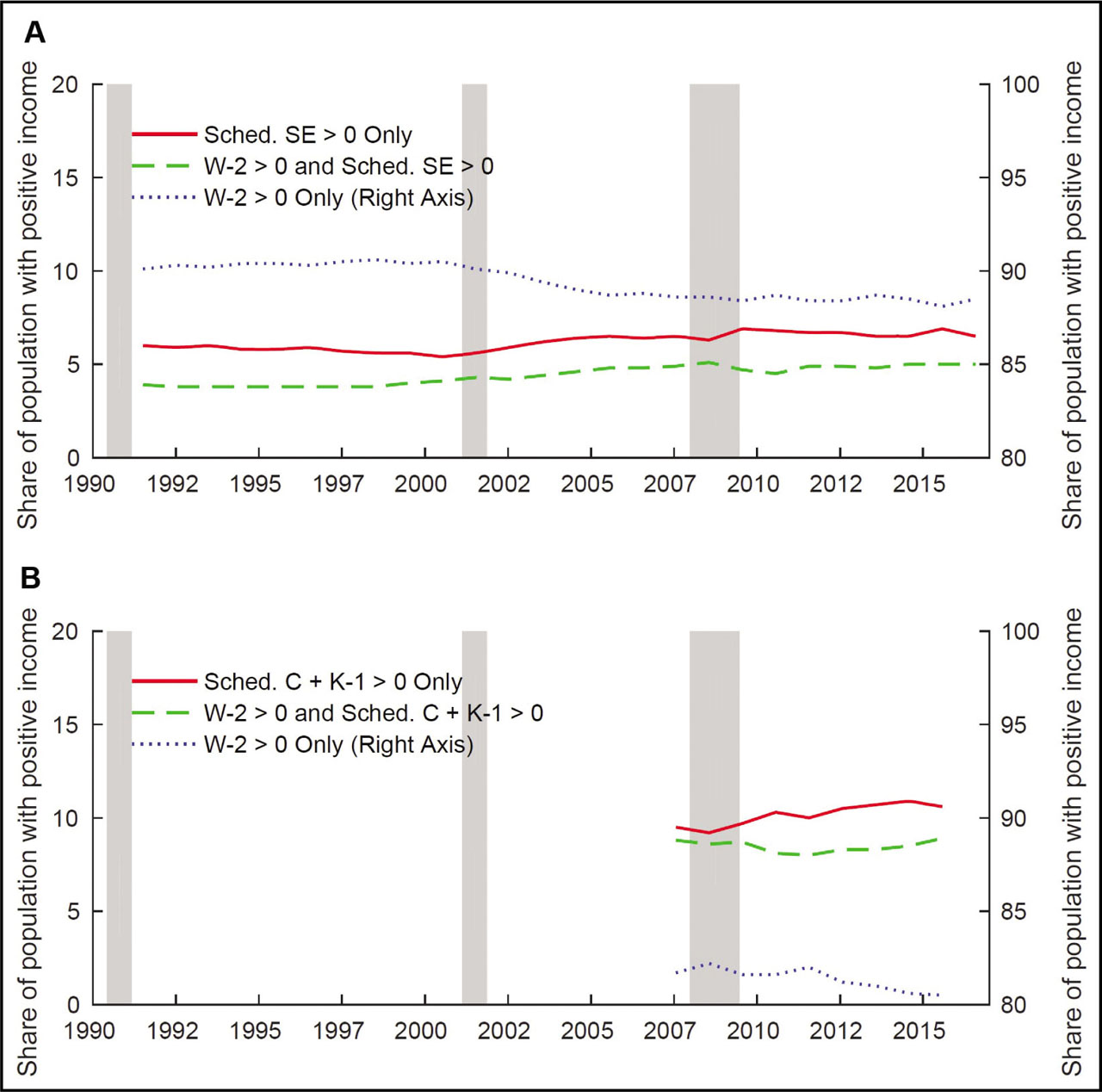
Figure 1
Shares of the population with income in a calendar year, by income source.
Notes: A: CPS-DER W-2 and Schedule SE. B: Universe W-2 and Schedules C and K-1. Authors’ calculations of the CPS-DER W-2 and Schedule SE records, as well as universe-level W-2, Schedule C, and Schedule K1 records. Schedule C covers sole proprietors, and K1 covers partnership and S corporation income. Wage and salary income comes from W-2 records. CPS-DER, Current Population Survey-Detailed Earnings Record; SE, Self-Employment Tax.
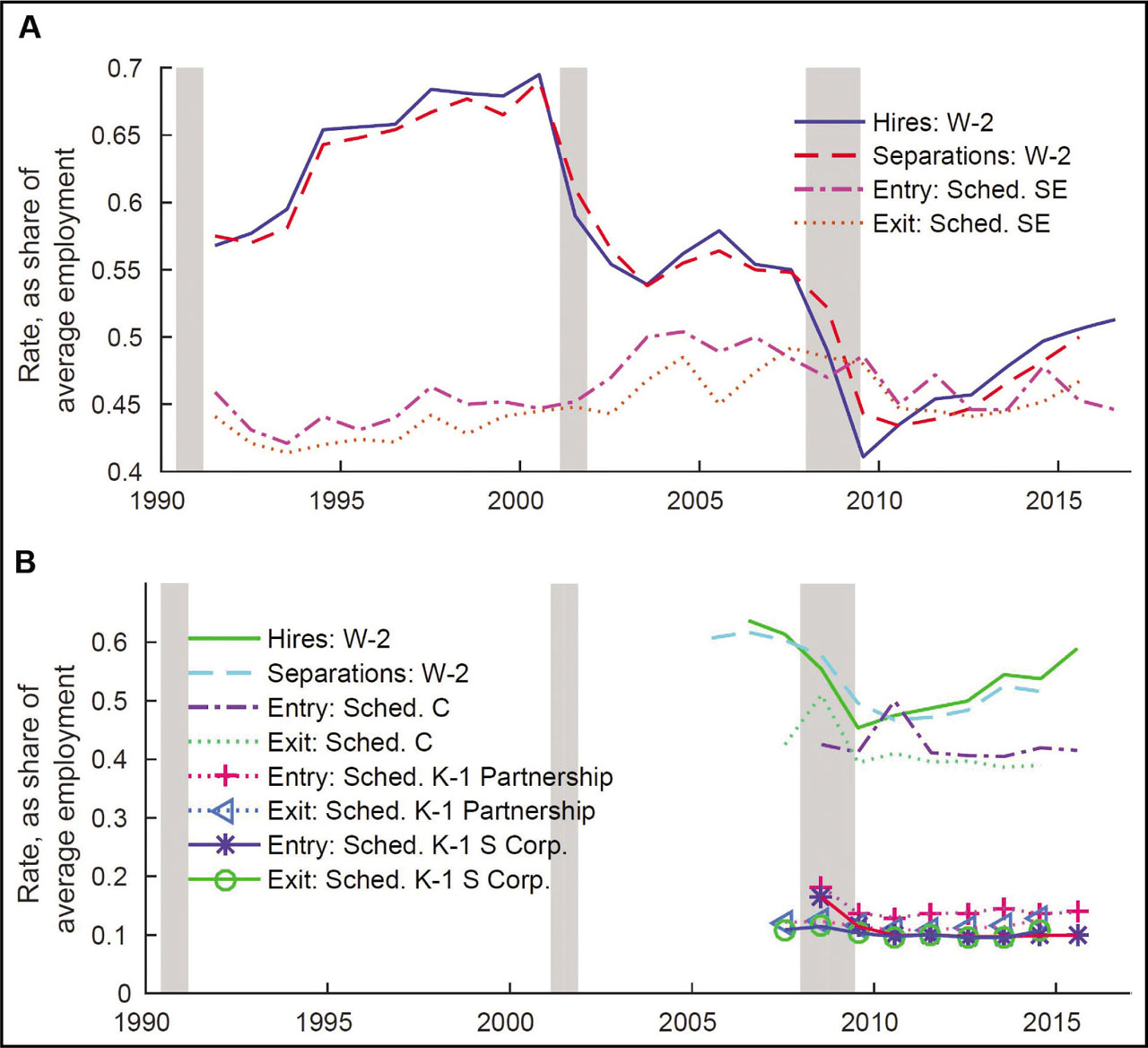
Figure 2
Hire and separation rates vs. BI entry and exit rates.
Notes: A: CPS-DER W-2 and Schedule C. B: Universe W-2 and Schedules C and K-1. Authors’ calculations of CPS-DER W-2 and Schedule SE records, as well as universe-level W-2, Schedule C, and Schedule K1 records. Entry indicates zero BI in the previous year and positive BI in the current year. Exit indicates positive BI in the current year but zero BI in the subsequent year. Denominators for each rate are the average of total number of owners of the given entity type at the beginning and end of the year. BI, business income; CPS-DER, Current Population Survey-Detailed Earnings Record; SE, Self-Employment Tax.
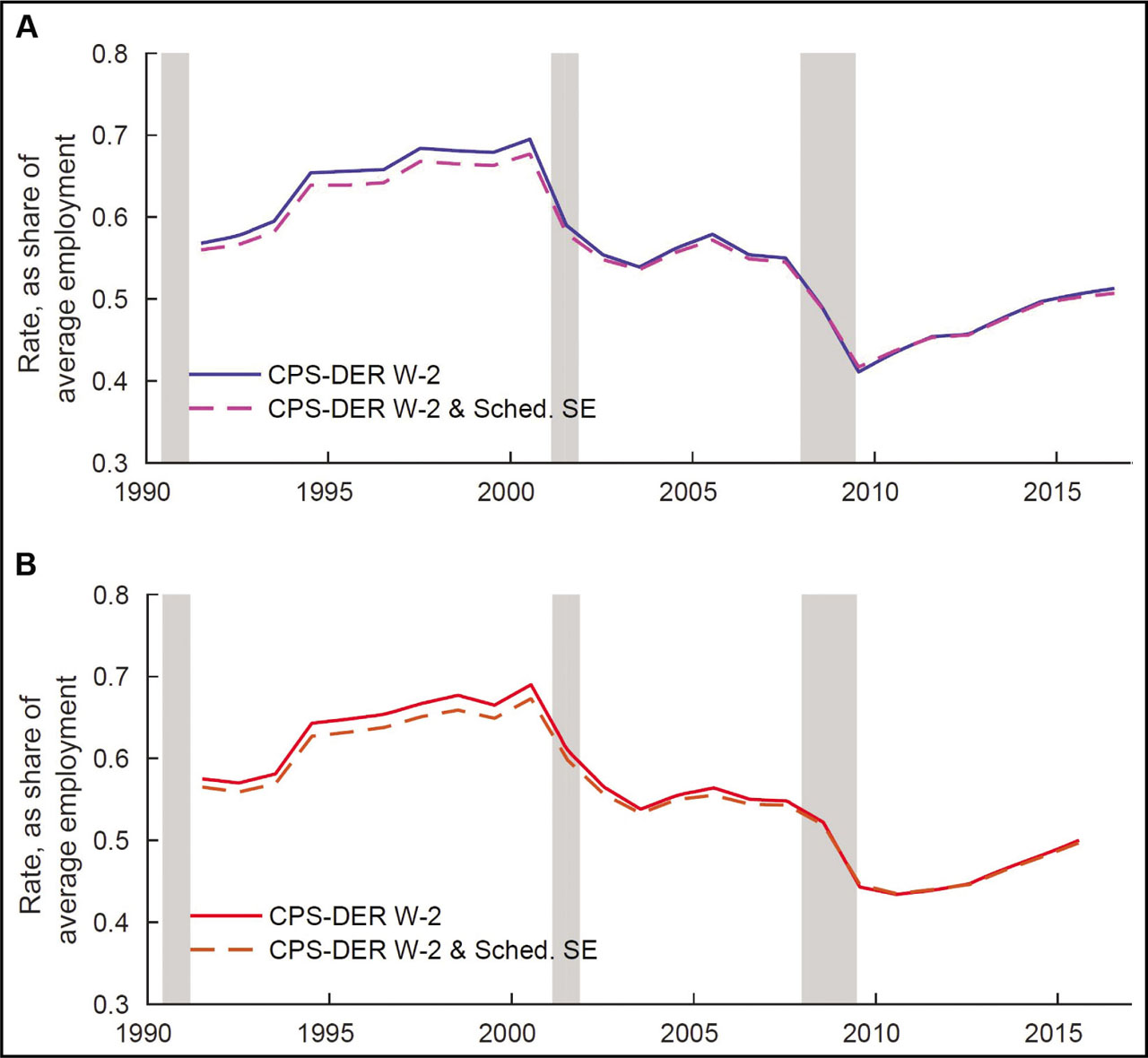
Figure 3
Hires and separations.
Notes: A: Hires. B: Separations. Authors’ calculations of CPS-DER W-2 and Schedule SE records, as well as universe-level W-2, Schedule C, and Schedule K1 records. CPS-DER, Current Population Survey-Detailed Earnings Record; SE, Self-Employment Tax.
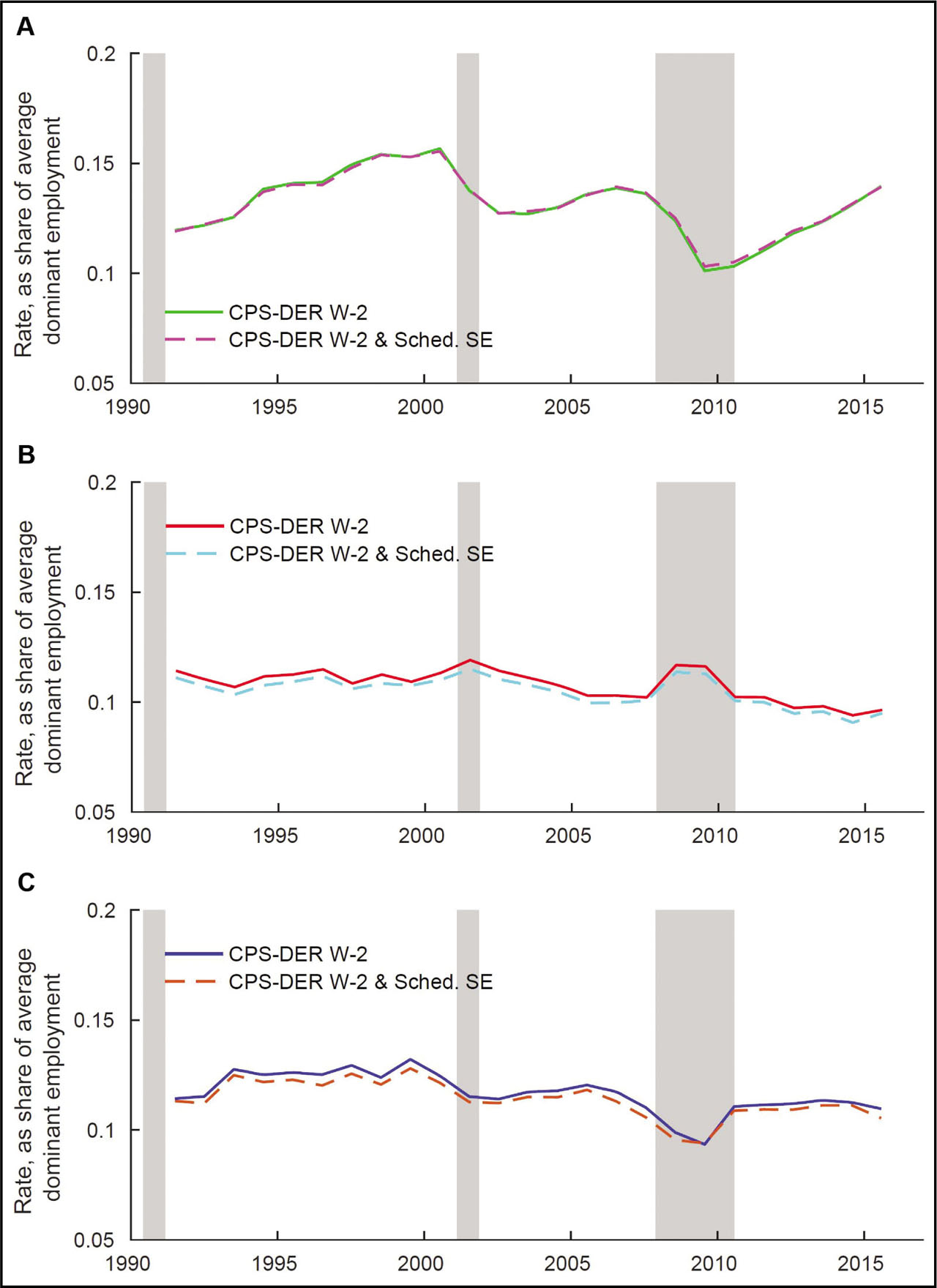
Figure 4
Employer-to-employer and nonemployment transitions.
Notes: A: Employer-to-employer. B: Employment-to-nonemployment. C: Nonemployment-to-employment. Authors’ calculations of CPS-DER W-2 and Schedule SE records, as well as universe-level W-2, Schedule C, and Schedule K1 records. CPS-DER, Current Population Survey-Detailed Earnings Record; SE, Self-Employment Tax.
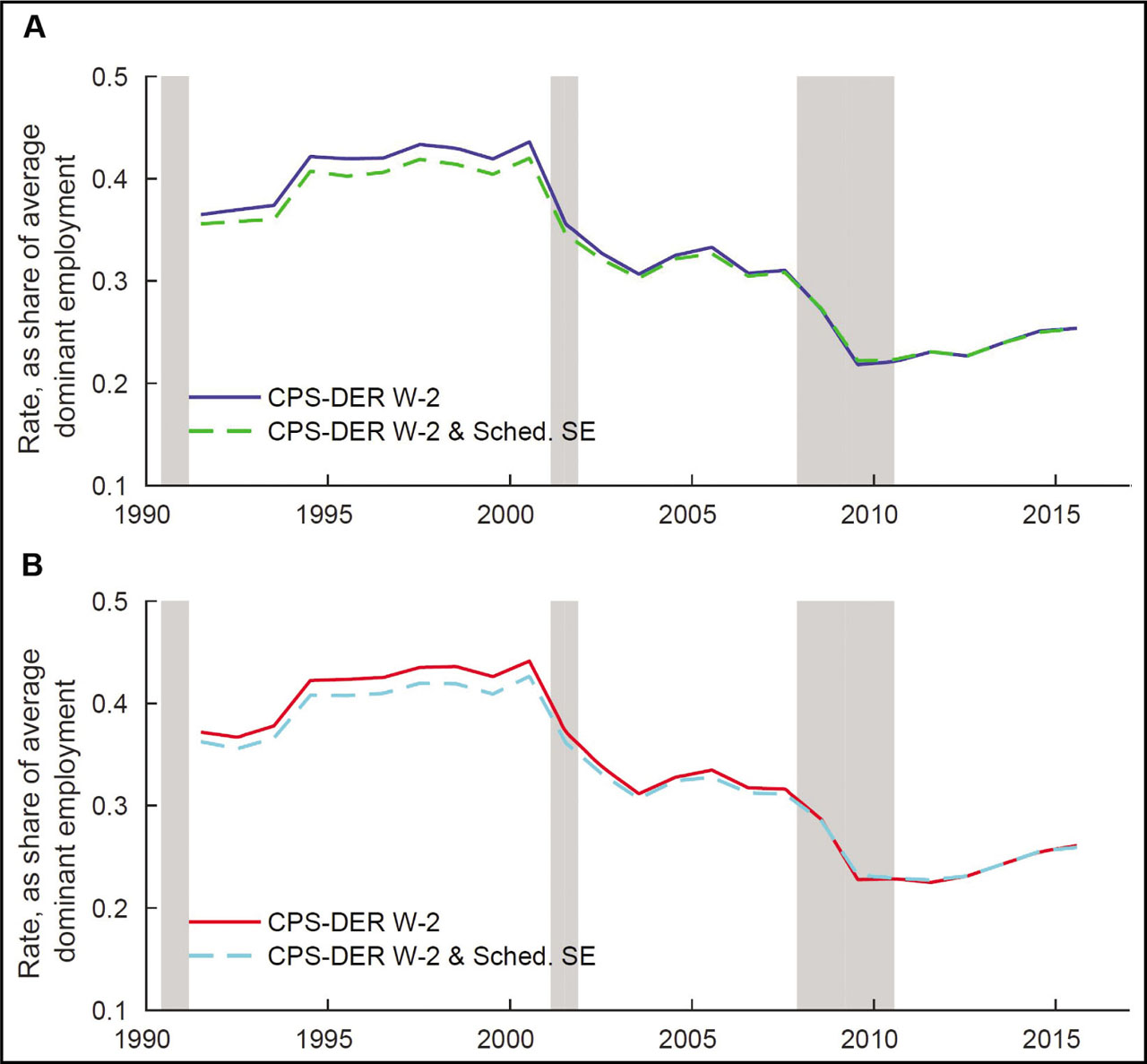
Figure 5
Secondary and short-duration job hires and separations.
Notes: A: Hires. B: Separations. Authors’ calculations of CPS-DER W-2 and Schedule SE records. CPS-DER, Current Population Survey-Detailed Earnings Record; SE, Self-Employment Tax.
Table 3
Measured decline in reallocation (percentage points) including vs. including self-employed: 1994 vs. 2014
| Reallocation Measure | Decline in W-2 | Decline in W-2 & Schedule SE | Difference | Percent offset (%) |
|---|---|---|---|---|
| Hires | 15.7 | 14.4 | 1.3 | 8.3 |
| Separations | 16.1 | 14.7 | 1.4 | 8.7 |
| Employer-to-employer | 0.7 | 0.6 | 0.2 | 23.8 |
| Employment-to-nonemployment | 1.8 | 1.7 | 0.1 | 4.1 |
| Nonemployment-to-employment | 1.3 | 1.1 | 0.2 | 15.6 |
| Secondary/short-duration hires | 13.9 | 12.8 | 1.1 | 7.4 |
| Secondary/short-duration separations. | 13.8 | 12.6 | 1.2 | 8.9 |
[i] Notes: Authors’ calculations of CPS-DER W-2 and Schedule SE records. The “Difference” and “Percent offset” columns may not exactly correspond with the difference between the “Decline in W-2” and “Decline in Schedule SE” columns due to rounding. CPS-DER, Current Population Survey-Detailed Earnings Record; SE, Self-Employment Tax.
Table 4
Number of wage and salary jobs worked regressed on BI
| CPS-DER | Universe | |||
|---|---|---|---|---|
| Intercept | 1.420*** (0.000) | 1.409*** (0.000) | ||
| Ever BI | 0.074*** (0.000) | 0.081*** (0.001) | ||
| Ever BI* BI | −0.143*** (0.001) | −0.101*** (0.001) | −0.088*** (0.001) | 0.013*** (0.001) |
| Ever BI* BI*BI dom | −1.002*** (0.001) | −0.818*** (0.001) | −1.010*** (0.002) | −0.817*** (0.001) |
| Worker fixed effects | N | Y | N | Y |
| R2 | 0.096 | 0.446 | 0.151 | 0.652 |
[i] Notes: Authors’ calculations of CPS-DER W-2 and Schedule SE records, as well as universe-level W-2, Schedule C, and Schedule K1 data. Regressions estimate how the number of jobs worked differ based on an individual's BI. BI, business income; CPS-DER, Current Population Survey-Detailed Earnings Record; SE, Self-Employment Tax.
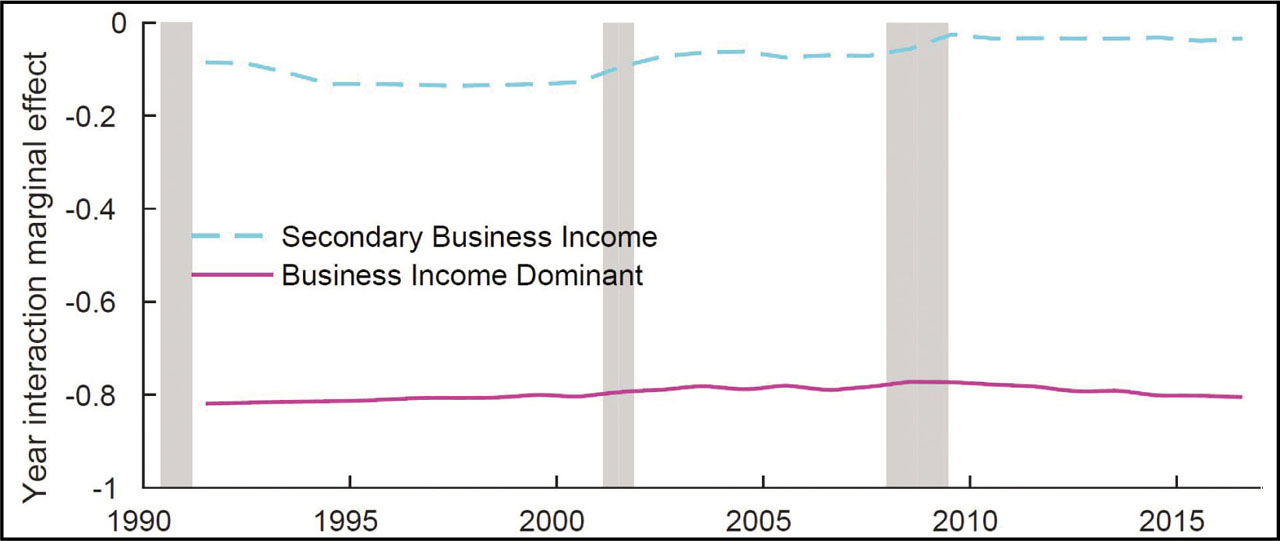
Figure 6
Regression point estimates over time.
Notes: Authors’ calculations of CPS-DER W-2 and Schedule SE records. Plots show point estimates from a regression with the number of wage and salary jobs worked in a given year. Specifically, the year interactions for primary and secondary income from self-employment in a given calendar year. CPS-DER, Current Population Survey-Detailed Earnings Record; SE, Self-Employment Tax.
Table 5
Number of industries worked regressed on BI
| Total industries | ||||
|---|---|---|---|---|
| Intercept | 1.258*** (0.000) | 1.258*** (0.000) | ||
| BI | 0.444*** (0.001) | 0.431*** (0.001) | 0.384*** (0.001) | 0.392*** (0.002) |
| BI*BI dom | 0.163*** (0.002) | 0.116*** (0.002) | ||
| Worker fixed effects | N | Y | N | Y |
| R2 | 0.053 | 0.406 | 0.055 | 0.407 |
[i] Notes: Authors’ calculations of CPS-DER W-2 and Schedule SE records. Regressions estimate how the number of industries worked differ based on an individual's BI. BI, business income; CPS-DER, Current Population Survey-Detailed Earnings Record; SE, Self-Employment Tax.
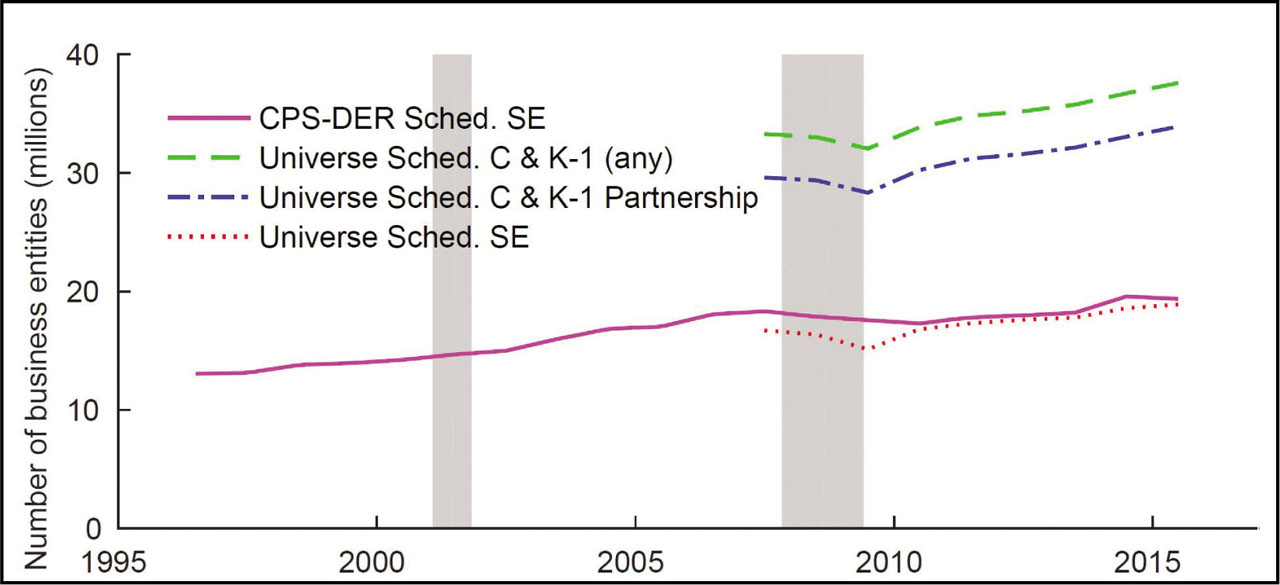
Figure B1
Total number of administrative records self-employed (millions).
Notes: CPS-DER numbers from 1996–2010 are from Figure 1 of Abraham et al. (2018). Other totals are authors’ calculations on CPS-DER Schedule SE records, as well as universe-level Schedule C and Schedule K1 records. CPS-DER, Current Population Survey-Detailed Earnings Record; SE, Self-Employment Tax.
Table C1
Share of business owners who receive wage and salary payments
| Schedule C Sole Proprietors | Form K1 Partnerships | Form K1 S Corps. | |
|---|---|---|---|
| W-2 Data | |||
| Share of owners: (%) | |||
| Owners of EIN firms in W-2 | 7.4 | 1.1 | 40.4 |
| Owners of employer firms in W-2 | 12.5 | 11.2 | 70.3 |
| Owners of employer firms, top 3 | 10.3 | 7.9 | 59.7 |
| Share of firms: (%) | |||
| Any owner of EIN firms in W-2 | 7.5 | 3.8 | 48.8 |
| Any owners of employer firms in W-2 | 13.2 | 24.3 | 84.8 |
| Any owners of employer firms, top 3 | 11.0 | 20.2 | 78.5 |
| LEHD Data | |||
| Share of owners: (%) | |||
| Owners of EIN firms in UI | 7.3 | 1.1 | 39.4 |
| Owners of employer firms in UI | 12.3 | 9.3 | 69.0 |
| Owners of employer firms, top 3 | 9.8 | 6.9 | 59.4 |
| Share of firms: (%) | |||
| Any owner of EIN firms in UI | 7.8 | 4.5 | 48.6 |
| Any owners of employer firms in UI | 13.6 | 26.5 | 83.0 |
| Any owners of employer firms, top 3 | 10.8 | 22.4 | 77.0 |
[i] Notes: Authors’ calculations of universe-level W-2, Schedule C, and Schedule K1 records. Percentages indicate the share of businesses owners who receive a W-2 record of the wage and salary income from a business of a particular legal form that they own, as well as the share of businesses that have at least one owner with a W-2 record. Authors’ calculation of LEHD administrative records and universe-level Schedule C and Schedule K1 records. This table shows the share of businesses owners who receive a UI record of the wage and salary income from the businesses that they own, as well as the share of businesses that have at least one owner with a UI record. “Top 3” indicates that the owner is among the top 3 highest earners at that employer. EIN, Employer Identification Number; LEHD, Longitudinal Employer-Household Dynamics; UI, unemployment insurance.
Table C2
Share of owners who receive wage & salary payments: first year, single establishment
| Schedule C Sole Proprietors | Form K1 Partnerships | Form K1 S Corps. | |
|---|---|---|---|
| W-2 Data | |||
| Share of owners: (%) | |||
| Owners of employer firms in W-2 | 16.1 | 14.3 | 61.5 |
| Owners of employer firms, top 3 | 13.9 | 11.4 | 57.1 |
| Share of firms: (%) | |||
| Any owners of employer firms in W-2 | 17.0 | 26.9 | 74.6 |
| Any owners of employer firms, top 3 | 14.6 | 23.5 | 71.1 |
| LEHD Data | |||
| Share of owners: (%) | |||
| Owners of employer firms in UI | 15.5 | 13.8 | 59.6 |
| Owners of employer firms, top 3 | 13.5 | 11.3 | 55.4 |
| Share of firms: (%) | |||
| Any owners of employer firms in UI | 16.4 | 27.2 | 72.7 |
| Any owners of employer firms, top 3 | 14.2 | 23.8 | 69.3 |
[i] Notes: Authors’ calculations of LEHD administrative records, as well as universe-level W-2, Schedule C, and Schedule K1 records. Entries in the table indicate the share of businesses owners who receive a W-2 or have a LEHD UI payroll record of the wage and salary income from the businesses that they own. Numbers are averages over time of annual averages from 2007–2014 for firms in their first year as employers that consist of a single establishment. “Top 3” indicates that the owner is among the top 3 highest earners at that employer. LEHD, Longitudinal Employer-Household Dynamics; UI, unemployment insurance.
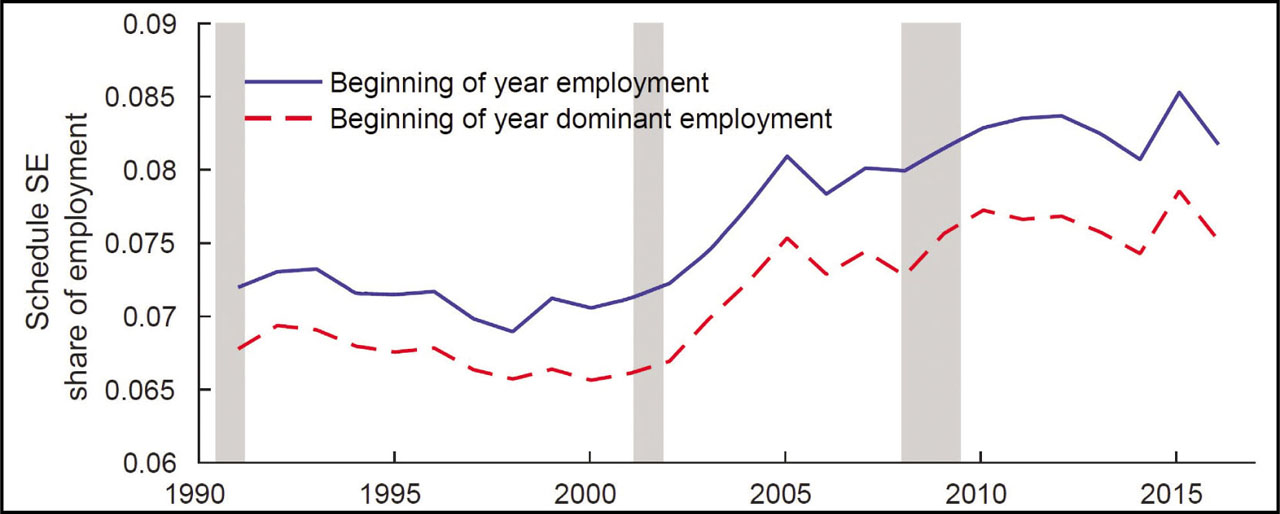
Figure D1
Schedule SE share of total consecutive-year employment.
Notes: Authors’ calculations of CPS-DER W-2 and Schedule SE records. CPS-DER, Current Population Survey-Detailed Earnings Record; SE, Self-Employment Tax.
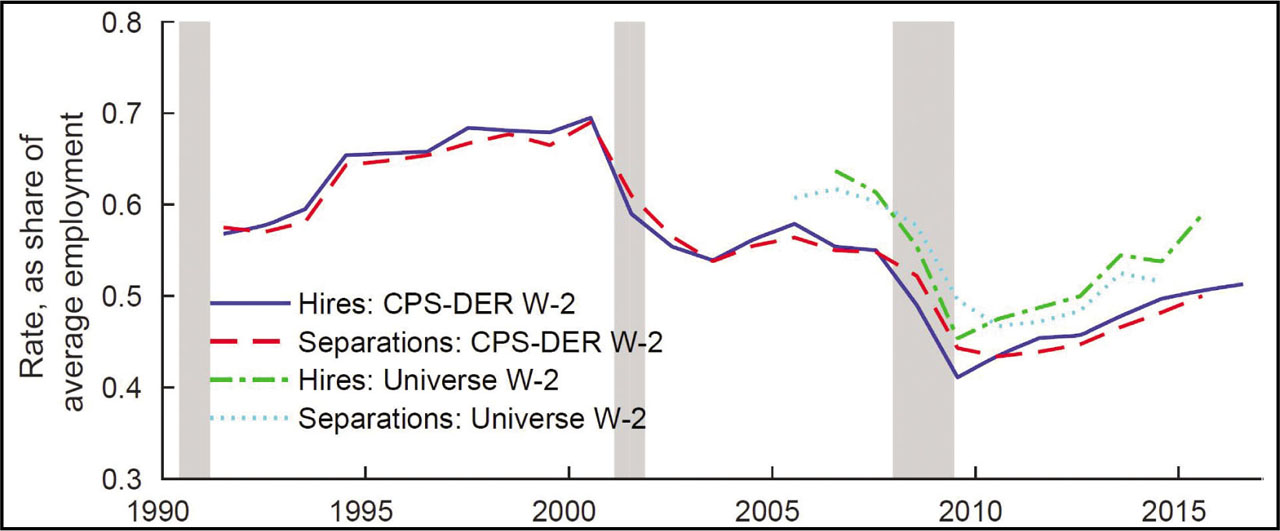
Figure E1
Hire and separation rates: wage and salary (W-2) employment.
Notes: Authors’ calculations of CPS-DER W-2 records, as well as universe-level W-2 records. The denominator for all rates is the average of employment at the beginning and end of the year. CPS-DER, Current Population Survey-Detailed Earnings Record.
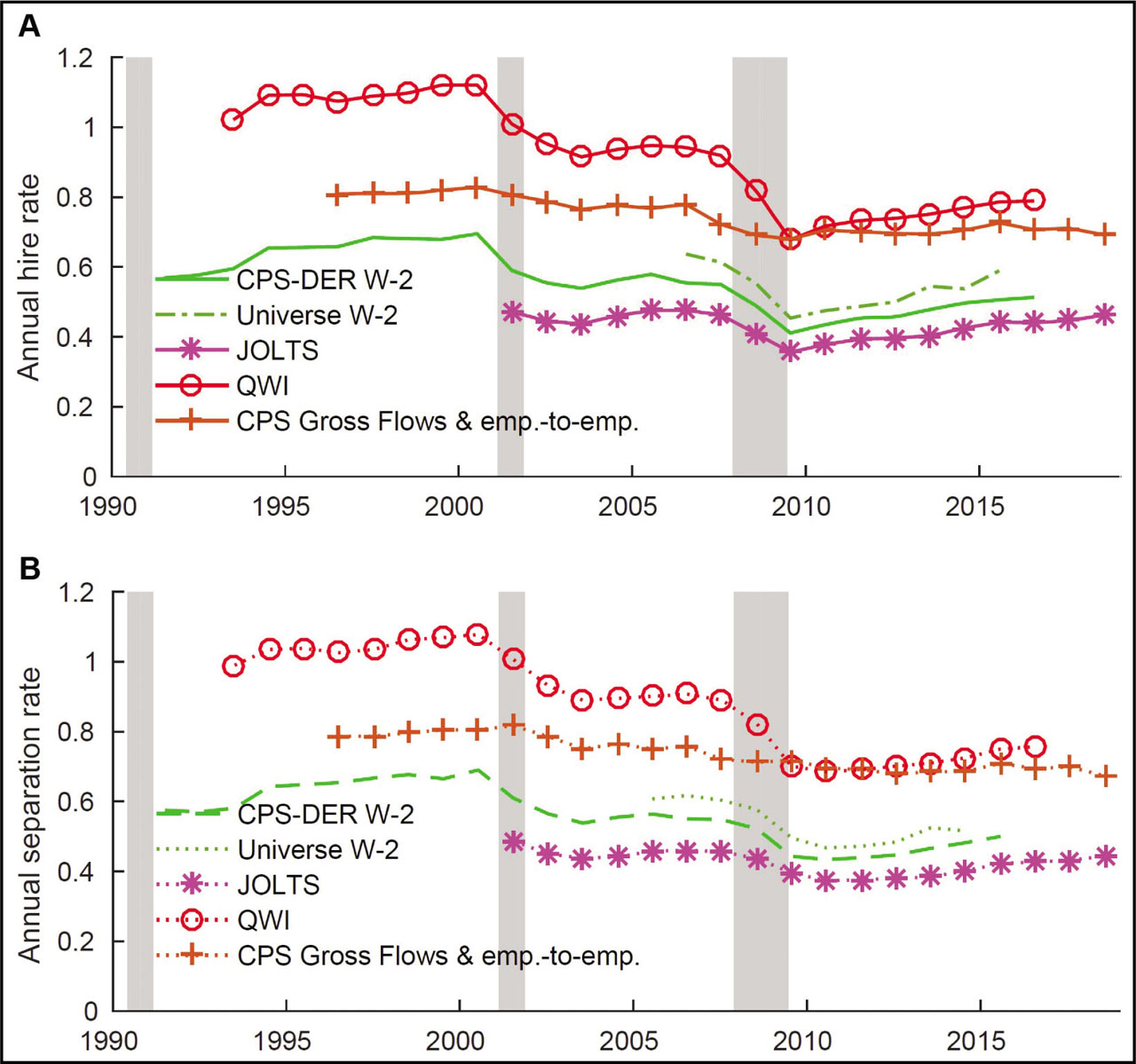
Figure E2
Annual hire and separation rates.
Notes: A: Hires. B: Separations. Authors’ calculations of CPS-DER W-2 records, universe-level W-2 data, and published aggregates. The denominator for the W-2 rates is the average of employment at the beginning and end of the year. JOLTS, QWI, and CPS Gross Flows and Employer-to-Employer Transitions series sum rates within a calendar year. CPS-DER, Current Population Survey-Detailed Earnings Record; JOLTS, Job Openings and Labor Turnover Survey; QWI, Quarterly Workforce Indicators.
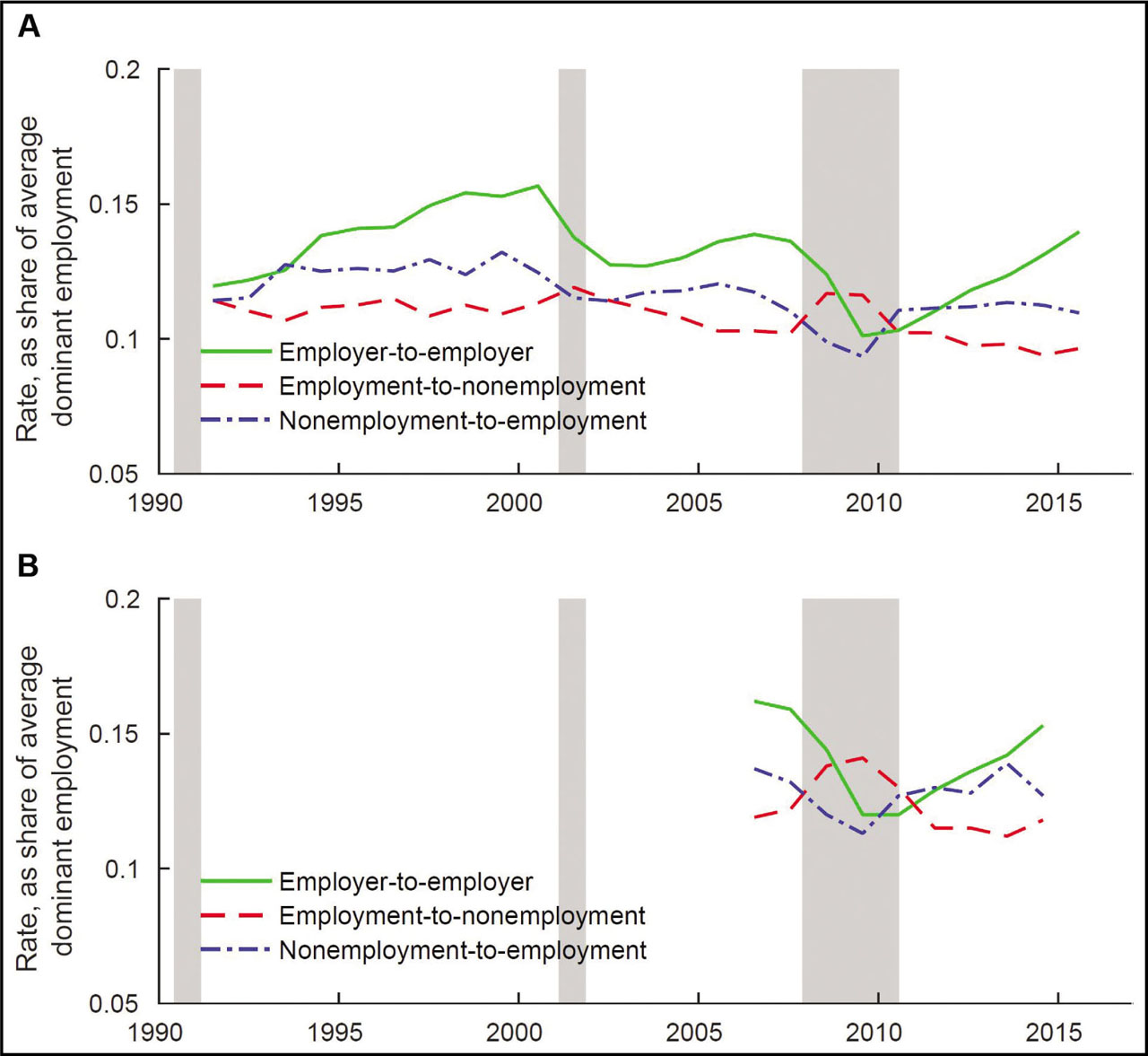
Figure E3
Employer-to-employer and nonemployment transitions.
Notes: A: CPS-DER W-2. B: CPS-DER W-2. Authors’ calculations of CPS-DER W-2 records, as well as universe-level W-2 records. The denominator for all rates is the average of dominant employment at the beginning and end of the year. CPS-DER, Current Population Survey-Detailed Earnings Record.
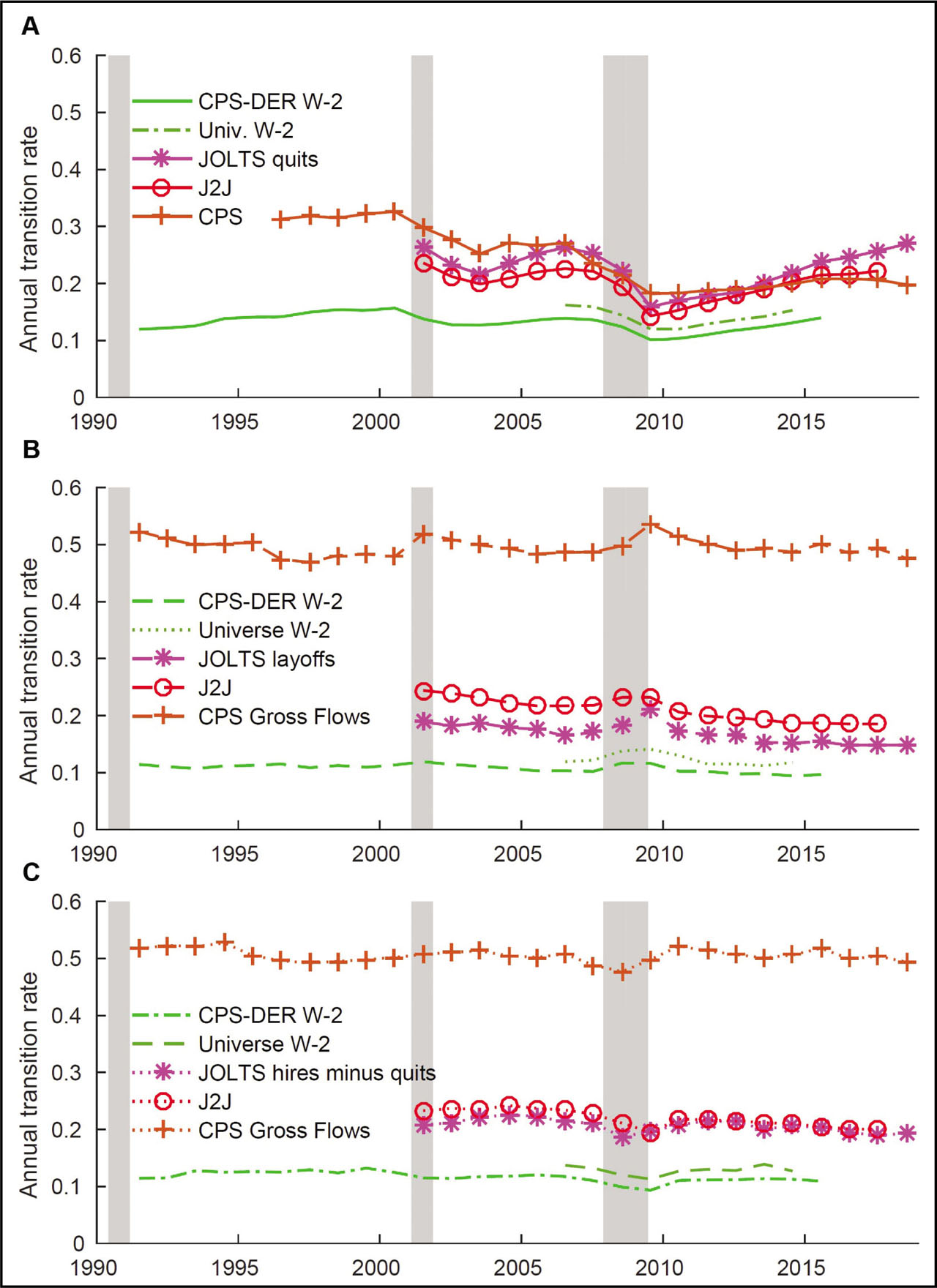
Figure E4
Annual transition rates.
Notes: A: Employer-to-employer. B: Employment-to-nonemployment. C: Nonemployment-to-employment. Authors’ calculations of CPS-DER W-2 records, as universe-level W-2 records, and published aggregates. The denominator for the W-2 based rates is the average of employment at the beginning and end of the year. JOLTS, QWI, and CPS Gross Flows and Employer-to-Employer Transitions series sum rates within a calendar year. CPS-DER, Current Population Survey-Detailed Earnings Record; JOLTS, Job Openings and Labor Turnover Survey; QWI, Quarterly Workforce Indicators.
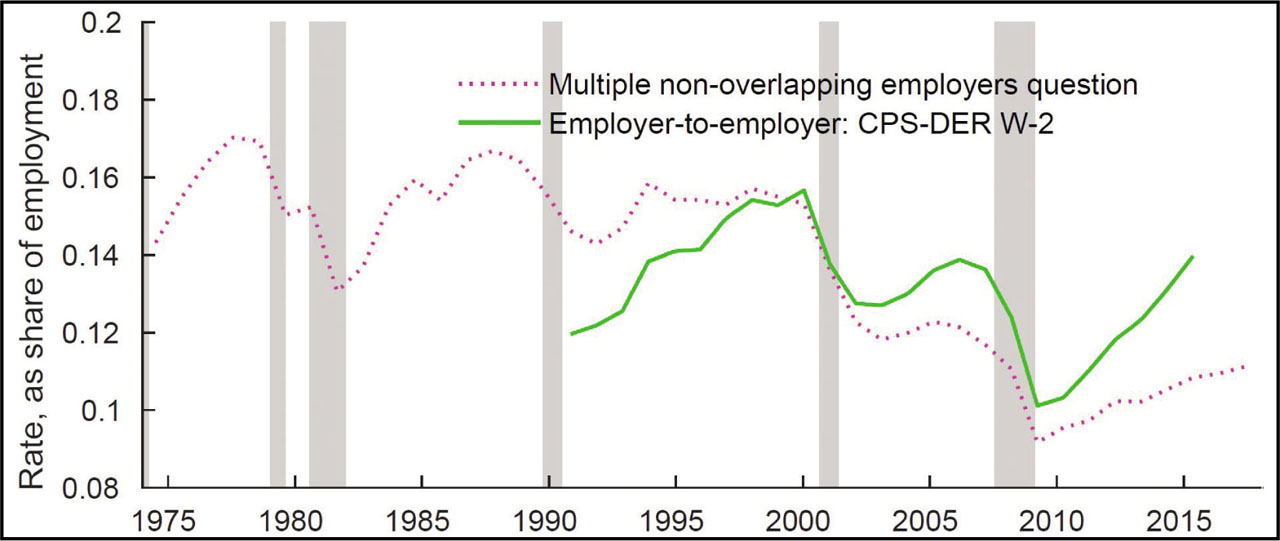
Figure E5
CPS-ASEC Multiple non-overlapping employers question vs. administrative records.
Notes: Authors’ calculations of hires and separations using CPS-ASEC respondents who report multiple non-overlapping jobs in the prior year, as well as CPS-DER W-2 records. For the CPS-ASEC responses, the denominator is those who were in scope of the multiple non-overlapping employers question. For the employer-to-employer transition rate derived from administrative records, the denominator is the average of employment at the beginning and end of the year. CPS-DER, Current Population Survey-Detailed Earnings Record; CPS-ASEC, Annual Social and Economic Supplement.
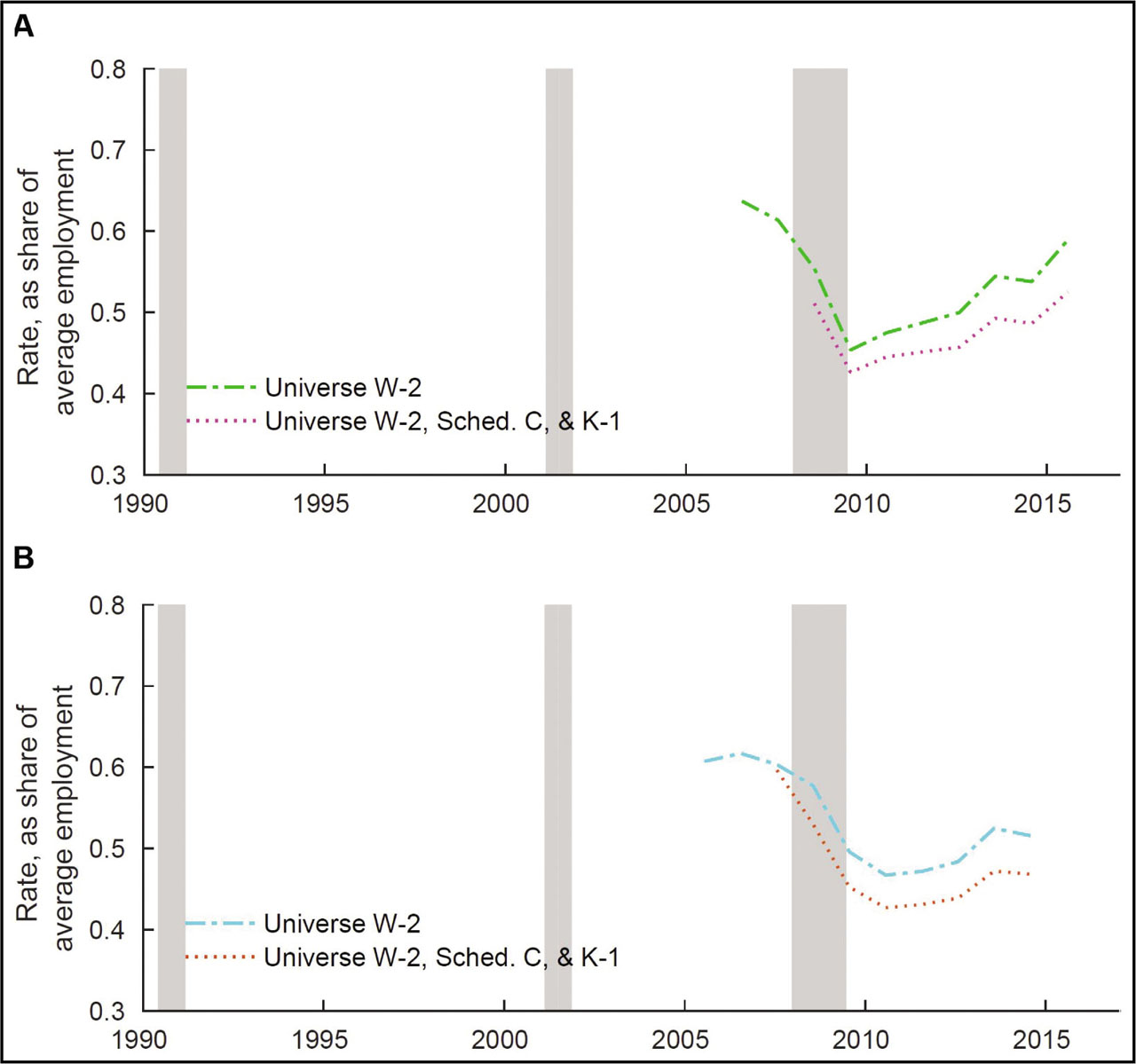
Figure F1
Hires and separations.
Notes: A: Hires. B: Separations. Authors’ calculations of CPS-DER W-2 and Schedule SE records, as well as universe-level W-2, Schedule C, and Schedule K1 records. CPS-DER, Current Population Survey-Detailed Earnings Record; SE, Self-Employment Tax.
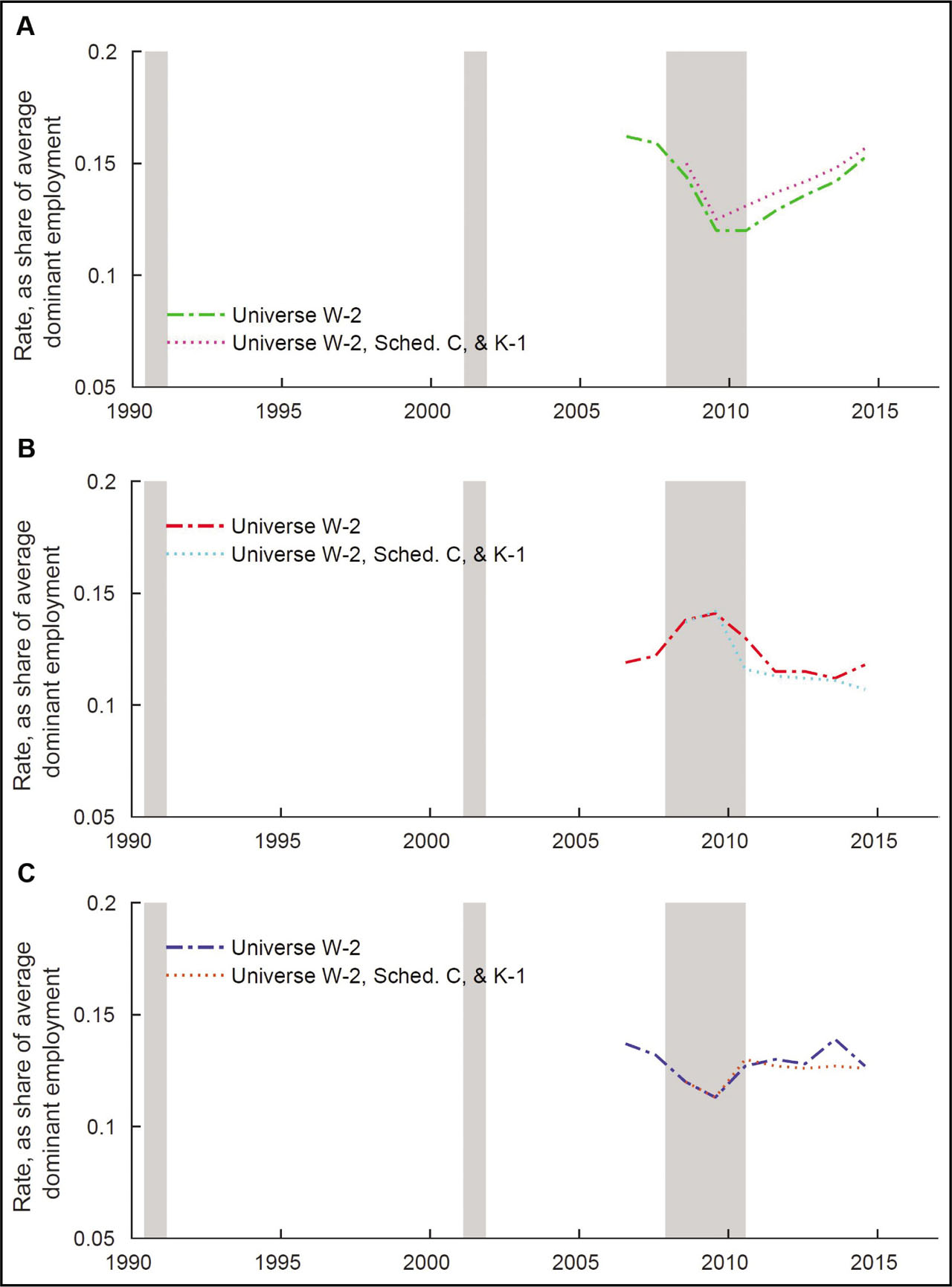
Figure F2
Employer-to-employer and nonemployment transitions.
Notes: A: Employer-to-employer. B: Employment-to-nonemployment. C: Nonemployment-to-employment. Authors’ calculations of CPS-DER W-2 and Schedule SE records, as well as universe-level W-2, Schedule C, and Schedule K1 records. CPS-DER, Current Population Survey-Detailed Earnings Record; SE, Self-Employment Tax.
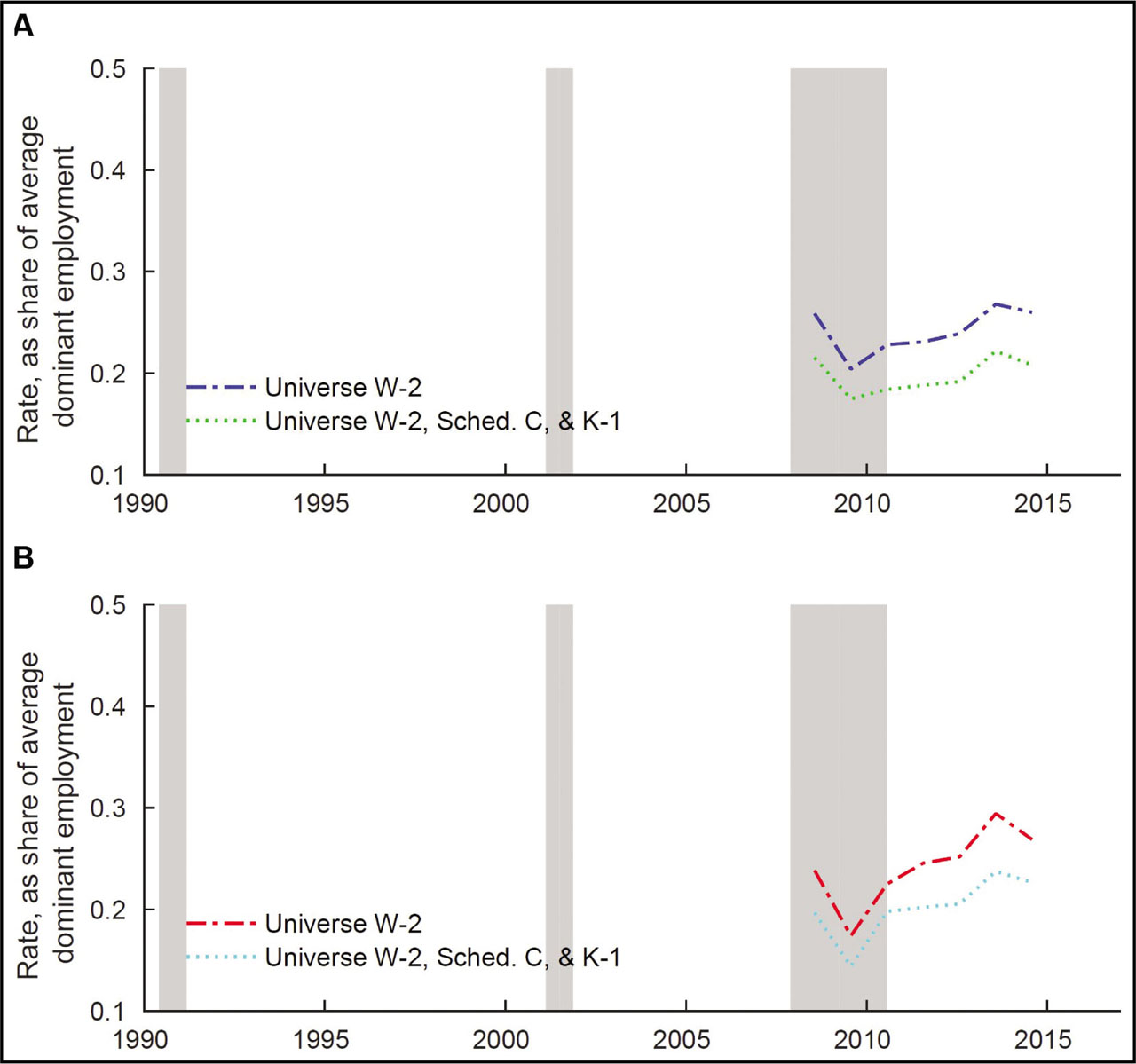
Figure F3
Secondary and short-duration job hires and separations.
Notes: A: Hires. B: Separations. Authors’ calculations of universe-level W-2, Schedule C, and Schedule K1 records.
Table G1
Regression of number of wage and salary jobs worked on BI Intercept from any wage and salary employer in the year.
| CPS-DER | Universe | CPS-DER | Universe | |
|---|---|---|---|---|
| Intercept | 1.495*** (0.000) | 1.490*** (0.001) | ||
| BI | −0.883*** (0.001) | −0.757*** (0.002) | −0.596*** (0.001) | −0.313*** (0.001) |
| Worker fixed effects | N | N | Y | Y |
| R2 | 0.148 | 0.146 | 0.421 | 0.618 |
[i] Notes: Authors’ calculations of CPS-DER W-2 and Schedule SE records, as well as universe-level W-2, Schedule C, and Schedule K1 records. BI, business income; CPS-DER, Current Population Survey-Detailed Earnings Record; SE, Self-Employment Tax.
Table G2
Regression of total number of jobs (including BI) on BI
| CPS-DER | Universe | CPS-DER | Universe | |
|---|---|---|---|---|
| Intercept | 1.495*** (0.000) | 1.490*** (0.001) | ||
| BI | 0.117*** (0.001) | 0.567*** (0.001) | 0.404*** (0.001) | 0.748*** (0.001) |
| Worker fixed effects | N | N | Y | Y |
| R2 | 0.003 | 0.026 | 0.323 | 0.757 |
[i] Notes: Authors’ calculations of CPS-DER W-2 and Schedule SE records, as well as universe-level W-2, Schedule C, and Schedule K1 records. Regressions estimate how the number of jobs worked differ based on an individual's BI. BI, business income; CPS-DER, Current Population Survey-Detailed Earnings Record; SE, Self-Employment Tax.
Table G3
Regression of total number of jobs worked on BI, by dominant earnings
| CPS-DER | Universe | CPS-DER | Universe | |
|---|---|---|---|---|
| Intercept | 1.456*** (0.000) | 1.409*** (0.000) | ||
| Ever BI | 0.077*** (0.001) | 0.081*** (0.001) | ||
| Ever BI * BI | 0.829*** (0.001) | 1.251*** (0.001) | 0.899*** (0.002) | 1.805*** (0.002) |
| Ever BI * BI * BI dom | −1.002*** (0.001) | −1.080*** (0.001) | −0.818*** (0.002) | −0.841*** (0.002) |
| Worker fixed effects | N | N | Y | Y |
| R2 | 0.028 | 0.074 | 0.351 | 0.768 |
[i] Notes: Authors’ calculations of CPS-DER W-2 and Schedule SE records, as well as universe-level W-2, Schedule C, and Schedule K1 data. Regressions estimate how the number of jobs worked differ based on an individual's BI. BI, business income; CPS-DER, Current Population Survey-Detailed Earnings Record; SE, Self-Employment Tax.