
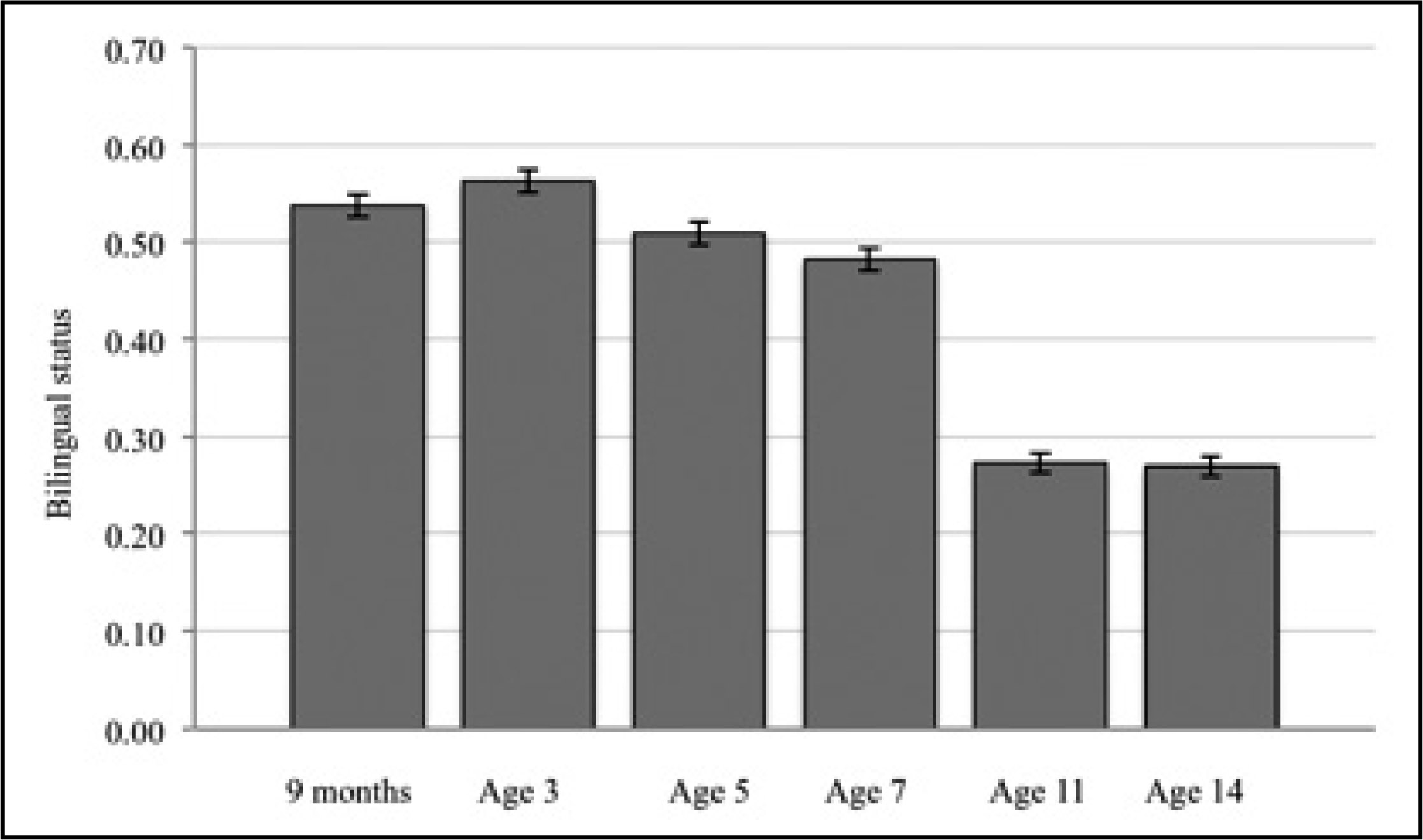
Figure 1
Children's bilingual status over time.
Source: The UK MCS. Authors’ calculations are based on a bilingual sample.
Table 1
Summary statistics of selected variables
| Monolingual | Bilingual | Difference | |||
|---|---|---|---|---|---|
| Outcomes | |||||
| Language development (verbal reasoning skills) | |||||
| Age 3 | 50.42 | [10.68] | 38.87 | [11.30] | −11.55*** |
| Age 5 | 55.1 | [10.69] | 43.95 | [11.65] | −11.15*** |
| Age 7 | 115.47 | [18.07] | 114.88 | [17.35] | −0.59 |
| Age 11 | 60.15 | [9.70] | 56.98 | [10.60] | −3.17*** |
| Age 14 | 6.98 | [3.38] | 6.1 | [2.80] | −0.88*** |
| Emotional development (SDQ score) | |||||
| Age 3 | 9.11 | [5.00] | 11.18 | [5.88] | 2.07*** |
| Age 5 | 6.89 | [4.60] | 8.49 | [5.29] | 1.61*** |
| Age 7 | 6.87 | [5.02] | 8.26 | [5.20] | 1.39*** |
| Age 11 | 7.07 | [5.37] | 7.71 | [5.25] | 0.64** |
| Age 14 | 13.3 | [3.89] | 14.35 | [4.33] | 1.05*** |
| Pro–social development | |||||
| Age 3 | 7.40 | [1.87] | 7.46 | [1.99] | 0.06 |
| Age 5 | 8.42 | [1.66] | 8.27 | [1.80] | −0.15** |
| Age 7 | 8.63 | [1.60] | 8.46 | [1.74] | −0.17** |
| Age 11 | 8.77 | [5.37] | 8.69 | [1.63] | −0.08 |
| Age 14 | 8.32 | [3.89] | 8.25 | [1.95] | −0.08 |
| Time–varying controls | |||||
| Child's age in months | |||||
| Age 3 | 37.62 | [2.34] | 38.24 | [3.21] | 0.62*** |
| Age 5 | 62.67 | [2.84] | 62.63 | [2.83] | −0.04 |
| Age 7 | 86.96 | [2.84] | 87.12 | [2.85] | 0.16 |
| Age 11 | 128.06 | [5.68] | 127.97 | [5.74] | −0.09 |
| Age 14 | 165.06 | [5.42] | 165.11 | [5.45] | 0.05 |
| Below 60% of the median UK income | |||||
| Age 3 | 0.29 | [0.45] | 0.54 | [0.50] | 0.25*** |
| Age 5 | 0.27 | [0.45] | 0.57 | [0.50] | 0.30*** |
| Age 7 | 0.26 | [0.44] | 0.55 | [0.50] | 0.29*** |
| Age 11 | 0.28 | [0.45] | 0.56 | [0.50] | 0.28*** |
| 9 months: Gross motor delay | 0.11 | [0.32] | 0.14 | [0.35] | 0.03* |
| 9 months: Fine motor delay | 0.12 | [0.33] | 0.14 | [0.35] | 0.02 |
| 9 months: Communication gesture delay | 0.41 | [0.49] | 0.43 | [0.50] | 0.03 |
| Parental inputs | |||||
| 9 months: Importance of stimulating the baby | 0.36 | [0.57] | 0.58 | [0.67] | 0.22*** |
| 9 months: Importance of talking to the baby | 0.15 | [0.38] | 0.31 | [0.53] | 0.16*** |
| 9 months: Importance of cuddling the baby | 0.12 | [0.34] | 0.24 | [0.51] | 0.13*** |
| 9 months: Importance of regular sleep/feeding time | 0.59 | [0.75] | 0.75 | [0.82] | 0.16*** |
| Age 3: Frequency of the child being taken to the library | 0.56 | [0.78] | 0.41 | [0.73] | −0.15*** |
| Age 3: Frequency reading to the child | 3.31 | [0.98] | 2.67 | [1.34] | −0.63*** |
| Age 5: Frequency of the child being taken to the library | 0.73 | [0.67] | 0.68 | [0.72] | −0.05* |
| Age 5: Frequency reading to the child | 2.45 | [0.63] | 2.31 | [0.75] | −0.14*** |
| Age 7: Frequency of the child being taken to the library | 0.75 | [0.66] | 0.8 | [0.72] | 0.05 |
| Age 7: Frequency reading to the child | 2.11 | [1.59] | 2.36 | [1.45] | 0.26*** |
| Time invariant controls | |||||
| Male | 0.52 | [0.50] | 0.5 | [0.50] | −0.02 |
| Birth weight | 1.23 | [0.75] | 1.71 | [1.05] | 0.48*** |
| Young migrant | 0.77 | [0.42] | 0.52 | [0.50] | −0.24*** |
| Mother born non–English country | 0.26 | [0.44] | 0.88 | [0.33] | 0.62*** |
| Father born non–English country | 0.27 | [0.44] | 0.88 | [0.33] | 0.61*** |
| Child is white | 0.72 | [0.45] | 0.12 | [0.33] | −0.60*** |
| Mother with higher qualification | 0.43 | [0.50] | 0.32 | [0.47] | −0.11*** |
| Father with higher qualification | 0.59 | [0.49] | 0.57 | [0.50] | −0.01 |
Table 2
The effects of bilingualism on language development; the selected coefficient is child's age
| z-Verbal reasoning skills | |||||
|---|---|---|---|---|---|
| (I) 2–6 | Age 3 | Age 5 | Age 7 | Age 11 | Age 14 |
| Panel (A): OLS with basic controls | |||||
| Bilingualw−1 | −0.629*** (0.053) | −0.587*** (0.057) | 0.069 (0.059) | −0.246*** (0.064) | −0.153** (0.059) |
| R2 | 0.276 | 0.187 | 0.022 | 0.050 | 0.033 |
| Panel (B): OLS basic + full controls | |||||
| Bilingualw−1 | −0.352*** (0.062) | −0.379*** (0.067) | 0.096 (0.071) | −0.037 (0.071) | −0.077 (0.062) |
| R2 | 0.379 | 0.308 | 0.111 | 0.176 | 0.092 |
| Panel (C): OLS basic + full controls + past endowments | |||||
| Bilingualw−1 | −0.345*** (0.061) | −0.199*** (0.062) | 0.219*** (0.067) | −0.022 (0.068) | −0.085 (0.062) |
| z-Verbal reasoning skillsw−1 | 0.403*** (0.024) | 0.294*** (0.025) | 0.255*** (0.030) | 0.202*** (0.026) | |
| z-SDQ scorew−1 | −0.039* (0.021) | −0.182*** (0.026) | −0.030 (0.028) | −0.043 (0.028) | |
| R2 | 0.394 | 0.418 | 0.217 | 0.233 | 0.135 |
| N | 1993 | 1682 | 1693 | 1504 | 1361 |
Notes: Standard errors, clustered at the family level, are in parentheses. All regressions are weighted to account for the non-response rate. Each panel corresponds to a separate specification, where the bilingual effect with basic controls (child's age in months, gender and ethnicity, and mother's age) is reported in Panel (A); Panel (B) additionally includes child's birth weight, mother's age and marital status, mother's and father's highest qualification obtained when the child is nine months old, a young migrant indicator, mother and father coming from non-English speaking background, biological mother present in the household, child's number of siblings, frequency of reading to the child or library visits, poverty indicator, regional controls along with time-varying characteristics measured at period w − 1, such as a poverty indicator, child's number of siblings, mother's marital status, and presence of biological mother; however, it omits lagged endowment effects; Panel (C) in addition to the full set of controls includes lagged input measures for language and emotional development.
Table 3
The effects of bilingualism on emotional development; the selected coefficient is child's age
| z-SDQ score | |||||
|---|---|---|---|---|---|
| (I) 2–6 | Age 3 | Age 5 | Age 7 | Age 11 | Age 14 |
| Panel (A): OLS with basic controls | |||||
| Bilingualw−1 | 0.219*** (0.058) | 0.055 (0.057) | 0.091 (0.056) | 0.049 (0.065) | 0.081 (0.072) |
| R2 | 0.086 | 0.067 | 0.055 | 0.023 | 0.022 |
| Panel (B): OLS basic + full controls | |||||
| Bilingualw−1 | 0.109 (0.069) | −0.049 (0.073) | −0.031 (0.066) | −0.056 (0.072) | −0.038 (0.078) |
| R2 | 0.165 | 0.126 | 0.118 | 0.083 | 0.084 |
| Panel (C): OLS basic + full controls + past endowments | |||||
| Bilingualw−1 | 0.105 (0.068) | −0.106* (0.061) | −0.043 (0.054) | −0.095 (0.060) | 0.006 (0.071) |
| z-Verbal reasoning skillsw −1 | −0.033 (0.023) | −0.047** (0.022) | −0.110*** (0.024) | −0.016 (0.032) | |
| z-SDQ scorew−1 | 0.493*** (0.025) | 0.561*** (0.023) | 0.520*** (0.025) | 0.494*** (0.031) | |
| R2 | 0.175 | 0.354 | 0.420 | 0.386 | 0.276 |
| N | 1993 | 1682 | 1693 | 1504 | 1361 |
Notes: Standard errors, clustered at the family level, are in parentheses. All regressions are weighted to account for the non-response rate. Each panel corresponds to a separate specification where the bilingual effect with basic controls (child's age in months, gender and ethnicity, and mother's age) is reported in Panel (A); Panel (B) additionally includes child's birth weight, mother's age and marital status, mother's and father's highest qualification obtained when the child is nine months old, a young migrant indicator, mother and father coming from non-English speaking background, biological mother present in the household, child's number of siblings, frequency of reading to the child or library visits, poverty indicator, regional controls along with time-varying characteristics measured at period w −1, such as a poverty indicator, child's number of siblings, mother's marital status, and presence of biological mother; however, it omits lagged endowment effects; Panel (C) in addition to the full set of controls includes lagged input measures for language and emotional development.
Table 4
The effects of bilingualism on pro-social development; the selected coefficient is child's age
| z-Pro-social score | |||||
|---|---|---|---|---|---|
| (l) 2–6 | Age 3 | Age 5 | Age 7 | Age 11 | Age 14 |
| Panel (A): OLS with basic controls | |||||
| Bilingualw−1 | −0.114** (0.058) | 0.051 (0.062) | −0.014 (0.060) | −0.070 (0.070) | −0.048 (0.070) |
| R2 | 0.020 | 0.034 | 0.021 | 0.023 | 0.028 |
| Panel (B): OLS basic + full controls | |||||
| Bilingualw−1 | −0.089 (0.072) | 0.065 (0.086) | 0.035 (0.070) | 0.014 (0.081) | −0.030 (0.073) |
| R2 | 0.053 | 0.055 | 0.049 | 0.046 | 0.048 |
| Panel (C): OLS basic + full controls + past endowments | |||||
| Bilingualw−1 | −0.088 (0.071) | −0.002 (0.078) | 0.039 (0.063) | 0.071 (0.075) | 0.004 (0.066) |
| z-Pro-social scorew−1 | 0.306*** (0.026) | 0.399*** (0.026) | 0.395*** (0.032) | 0.414*** (0.030) | |
| R2 | 0.062 | 0.148 | 0.225 | 0.183 | 0.231 |
| N | 1993 | 1682 | 1693 | 1504 | 1361 |
Notes: Standard errors, clustered at the family level, are in parentheses. All regressions are weighted to account for the non-response rate. Each panel corresponds to a separate specification where the bilingual effect with basic controls (child's age in months, gender and ethnicity, and mother's age) is reported in Panel (A); Panel (B) additionally includes child's birth weight, mother's age and marital status, mother's and father's highest qualification obtained when the child is nine months old, a young migrant indicator, mother and father coming from non-English speaking background, biological mother present in the household, child's number of siblings, frequency of reading to the child or library visits, poverty indicator, regional controls along with time-varying characteristics measured at period w −1, such as a poverty indicator, child's number of siblings, mother's marital status, and presence of biological mother; however, it omits lagged endowment effects; Panel (C) in addition to the full set of controls includes lagged input measures for pro-social development.
Table 5
The effects of bilingualism on language, emotional, and pro-social development – OLS and GMM dynamic estimates
| (1) | (2) | (3) | |
|---|---|---|---|
| OLS no past endowments | OLS with past endowments | System GMM effects | |
| Panel (A): Outcome: z-Verbal Reasoning skills | |||
| Bilingualw−1 | −0.102*** (0.036) | −0.032 (0.031) | 0.040 (0.106) |
| z-Verbal reasoning skillsw−1 | 0.278*** (0.014) | 0.602*** (0.218) | |
| z-SDQ scorew−1 | −0.092*** (0.013) | −0.743** (0.352) | |
| Year dummies | Yes | Yes | Yes |
| Hansen p-value | 0.243 | ||
| Arellano–Bond test AR(2) p-value | 0.152 | ||
| Panel (B): Outcome: z-SDQ score | |||
| Bilingualw−1 | −0.006 (0.037) | −0.049* (0.027) | −0.018 (0.048) |
| z-Verbal reasoning skillsw−1 | −0.066*** (0.011) | −0.069 (0.093) | |
| z-SDQ scorew−1 | 0.490*** (0.014) | 0.266* (0.155) | |
| Year dummies | Yes | Yes | Yes |
| Hansen p-value | 0.551 | ||
| Arellano–Bond test AR(2) p-value | 0.753 | ||
| Panel (C): Outcome: z-Pro-social score | |||
| Bilingualw−1 | −0.001 (0.025) | 0.014 (0.021) | −0.028 (0.033) |
| z-Pro-social scorew−1 | 0.343*** (0.019) | 0.287* (0.157) | |
| Year dummies | Yes | Yes | Yes |
| Hansen p-value | 0.344 | ||
| Arellano–Bond test AR(2) p-value | 0.238 | ||
| N (Observations) | 6310 | 6310 | 6310 |
| N (Individuals) | 2269 | ||
Notes: Robust standard errors, which are clustered at the family-level, are placed in parentheses. Columns (1) and (2) report OLS estimates of Eq. (1) without and with past language and emotional endowments, respectively. Column (3) reports the system GMM estimator which assumes that effects have constant correlation with the inputs. All estimates include the full set of controls and time dummies. Verbal reasoning skills refer to language development and the SDQ score refers to emotional development.
Table 6
Heterogeneous effects of bilingualism, by children's gender
| Age 3 | Age 5 | Age 7 | Age 11 | Age 14 | |
|---|---|---|---|---|---|
| Panel (A): Outcome: z-Verbal Reasoning skills | |||||
| Boys | |||||
| Bilingualw−1 | −0.320*** (0.085) | −0.207** (0.090) | 0.242** (0.110) | 0.090 (0.101) | −0.200** (0.094) |
| N | 1012 | 840 | 832 | 731 | 662 |
| R2 | 0.381 | 0.425 | 0.227 | 0.223 | 0.157 |
| Girls | |||||
| Bilingualw−1 | −0.352*** (0.087) | −0.179** (0.084) | 0.148* (0.085) | −0.155* (0.089) | 0.007 (0.083) |
| N | 981 | 842 | 861.000 | 773 | 699 |
| R2 | 0.424 | 0.440 | 0.224 | 0.268 | 0.132 |
| Panel (B): Outcome: z-SDQ score | |||||
| Boys | |||||
| Bilingualw−1 | 0.145 (0.096) | −0.165* (0.092) | −0.060 (0.080) | −0.187** (0.088) | −0.076 (0.105) |
| N | 1012 | 840 | 832 | 731 | 662 |
| R2 | 0.175 | 0.357 | 0.442 | 0.427 | 0.323 |
| Girls | |||||
| Bilingualw−1 | 0.093 (0.100) | −0.041 (0.080) | −0.005 (0.074) | −0.009 (0.082) | 0.124 (0.097) |
| N | 981 | 842 | 861 | 773 | 699 |
| R2 | 0.201 | 0.356 | 0.409 | 0.358 | 0.261 |
| Panel (C): Outcome: z-Pro-social score | |||||
| Boys | |||||
| Bilingualw−1 | −0.126 (0.102) | 0.092 (0.122) | 0.006 (0.099) | −0.001 (0.108) | 0.069 (0.098) |
| N | 1012 | 840 | 832 | 731 | 662 |
| R2 | 0.076 | 0.136 | 0.184 | 0.187 | 0.256 |
| Girls | |||||
| Bilingualw−1 | −0.021 (0.102) | −0.093 (0.101) | 0.076 (0.078) | 0.184* (0.103) | 0.099 (0.083) |
| N | 981 | 842 | 861 | 773 | 699 |
| R2 | 0.067 | 0.153 | 0.256 | 0.192 | 0.217 |
Notes: Standard errors, which are clustered at the family level, are in parentheses. The specifications include the same controls as in Panel (C) in Tables 2–4. Verbal reasoning skills refer to language development and the SDQ score refers to emotional development.
Table 7
Heterogeneous effects of bilingualism, by mother's level of education
| Age 3 | Age 5 | Age 7 | Age 11 | Age 14 | |
|---|---|---|---|---|---|
| Panel (A): Outcome: z-Verbal reasoning skills | |||||
| Mother's education – “High” | |||||
| Bilingualw−1 | −0.430*** (0.152) | −0.205 (0.132) | −0.132 (0.126) | −0.061 (0.147) | −0.270 (0.223) |
| N | 339 | 310 | 286 | 267 | 241 |
| R2 | 0.365 | 0.318 | 0.248 | 0.194 | 0.248 |
| Mother's education – A-level and below | |||||
| Bilingualw−1 | −0.328*** (0.067) | −0.200*** (0.071) | 0.279*** (0.078) | −0.018 (0.079) | 0.019 (0.063) |
| N | 1654 | 1372 | 1407 | 1237 | 1120 |
| R2 | 0.376 | 0.414 | 0.217 | 0.22 | 0.118 |
| Panel (B): Outcome: z-SDQ score | |||||
| Mother's education – “High” | |||||
| Bilingualw−1 | −0.025 (0.144) | −0.080 (0.116) | 0.083 (0.101) | 0.100 (0.126) | 0.023 (0.188) |
| N | 339 | 310 | 286 | 267 | 241 |
| R2 | 0.199 | 0.455 | 0.45 | 0.459 | 0.248 |
| Mother's education – A-level and below | |||||
| Bilingualw−1 | 0.128* (0.076) | −0.105 (0.071) | −0.056 (0.063) | −0.135** (0.068) | 0.065 (0.075) |
| N | 1654 | 1372 | 1407 | 1237 | 1120 |
| R2 | 0.161 | 0.343 | 0.404 | 0.377 | 0.276 |
| Panel (C): Outcome: z-Pro-social score | |||||
| Mother's education – “High” | |||||
| Bilingualw−1 | 0.404** (0.187) | 0.016 (0.146) | −0.022 (0.127) | −0.059 (0.148) | −0.216 (0.191) |
| N | 339 | 310 | 286 | 267 | 241 |
| R2 | 0.121 | 0.27 | 0.424 | 0.382 | 0.389 |
| Mother's education – A-level and below | |||||
| Bilingualw−1 | −0.177** (0.078) | −0.006 (0.092) | 0.044 (0.074) | 0.084 (0.086) | 0.110 (0.067) |
| N | 1654 | 1372 | 1407 | 1237 | 1120 |
| R2 | 0.069 | 0.143 | 0.227 | 0.171 | 0.221 |
Notes: Standard errors, which are clustered at the family-level, are placed in parentheses. The specifications include the same controls as in Panel (C) in Tables 2–4. Verbal Reasoning skills refer to language development and the SDQ score refers to emotional development.
Table 8
Bilingual mother's behavior, well-being, and home inputs, by child's age
| (1) | (2) | (3) | (4) | (5) | (6) | |
|---|---|---|---|---|---|---|
| Time spent with child | Frequency of reading | Good relationship with partner | Depressive symptoms | Life | Mother | |
| Age 9 months | ||||||
| Bilingual motherw−1 | 0.082** (0.032) | −0.069*** (0.025) | 0.231* (0.133) | −0.041 (0.032) | ||
| N | 3035 | 3035 | 3035 | 3035 | ||
| Age 3 | ||||||
| Bilingual motherw−1 | 0.074*** (0.028) | 0.174*** (0.067) | 0.093** (0.041) | −0.112*** (0.030) | 0.329** (0.151) | −0.051 (0.034) |
| N | 1993 | 1993 | 1993 | 1993 | 1993 | 1993 |
| Age 5 | ||||||
| Bilingual motherw−1 | 0.097*** (0.035) | 0.039 (0.069) | 0.085** (0.039) | −0.053*** (0.019) | 0.501*** (0.163) | −0.061* (0.034) |
| N | 1682 | 1682 | 1682 | 1682 | 1682 | 1682 |
| Age 7 | ||||||
| Bilingual motherw−1 | 0.074** (0.032) | 0.318*** (0.115) | −0.001 (0.015) | 0.265* (0.138) | −0.053 (0.034) | |
| N | 1693 | 1693 | 1693 | 1693 | 1693 | |
| Age 11 | ||||||
| Bilingual motherw−1 | 0.024 (0.044) | 0.029 (0.021) | 0.267* (0.152) | −0.168*** (0.029) | ||
| N | 1504 | 1504 | 1504 | 1504 | ||
| Age 14 | ||||||
| Bilingual motherw−1 | −0.021 (0.031) | 0.359* (0.186) | −0.191*** (0.031) | |||
| N | 1361 | 1361 | 1361 | |||
Notes: Robust standard errors, which are clustered at the family level, are placed in parentheses. All regressions are weighted to account for the non-response rate. Samples have been restricted to children in relation to whom complete information is available on language, emotional, and pro-social behavior. All specifications control for series of mother cohort dummies, ethnicity, marital status, highest grade completed at child's birth, the question of whether mother comes from non-English speaking background, gender of child, number of siblings, poverty indicator, and regional controls.
Table A1
Children who switched bilingual status over the observed period
| Stayed bilingual | Stayed monolingual | Bilingual – wave 2 and moved to monolingual | Bilingual – waves 2, 3 and moved to monolingual | |||||
|---|---|---|---|---|---|---|---|---|
| Mean | SD | Mean | SD | Mean | SD | Mean | SD | |
| Verbal reasoning | 6.43 | 2.39 | 7.54 | 2.69 | 8.16 | 2.81 | 6.75 | 2.78 |
| SDQ index | 14.07 | 3.87 | 13.10 | 3.79 | 12.20 | 2.66 | 13.82 | 4.01 |
| Pro-social index | 8.47 | 1.83 | 8.42 | 1.74 | 8.62 | 1.66 | 8.63 | 1.80 |
| Male | 0.41 | 0.49 | 0.48 | 0.50 | 0.42 | 0.50 | 0.49 | 0.50 |
| White | 0.11 | 0.31 | 0.82 | 0.38 | 0.62 | 0.49 | 0.26 | 0.44 |
| Mother with high degree | 0.34 | 0.48 | 0.50 | 0.50 | 0.69 | 0.47 | 0.44 | 0.50 |
| Father with high degree | 0.55 | 0.50 | 0.58 | 0.49 | 0.76 | 0.43 | 0.67 | 0.48 |
| Below 60% of the median UK income | 0.51 | 0.50 | 0.19 | 0.39 | 0.13 | 0.34 | 0.46 | 0.50 |
| Young migrant | 0.49 | 0.50 | 0.80 | 0.40 | 0.51 | 0.51 | 0.53 | 0.50 |
| Number of siblings | 1.89 | 1.18 | 1.49 | 0.98 | 1.40 | 1.03 | 1.89 | 1.28 |
| Natural mother – in the family | 0.97 | 0.16 | 0.98 | 0.13 | 1.00 | 0.00 | 0.98 | 0.13 |
| Mother non-English | 0.91 | 0.29 | 0.24 | 0.42 | 0.84 | 0.37 | 0.84 | 0.37 |
| Father non-English | 0.87 | 0.34 | 0.25 | 0.43 | 0.80 | 0.40 | 0.84 | 0.37 |
Table A2
The effects of bilingualism on language, emotional, and pro-social development, excluding native-born parents – by child's age
| Age 3 | Age 5 | Age 7 | Age 11 | Age 14 | |
|---|---|---|---|---|---|
| Panel (A): Outcome: z-Verbal reasoning skills | |||||
| Bilingualw−1 | −0.320*** (0.065) | −0.203*** (0.070) | 0.237*** (0.071) | −0.012 (0.074) | −0.087 (0.063) |
| z-Verbal reasoning skillsw−1 | 0.441*** (0.030) | 0.317*** (0.029) | 0.290*** (0.037) | 0.192*** (0.030) | |
| z-SDQ scorew−1 | −0.053** (0.025) | −0.143*** (0.028) | 0.007 (0.034) | −0.064** (0.031) | |
| N | 1386 | 1148 | 1191 | 1058 | 986 |
| R2 | 0.375 | 0.422 | 0.225 | 0.272 | 0.139 |
| Panel (B): Outcome: z-SDQ score | |||||
| Bilingualw−1 | 0.117 (0.074) | −0.103 (0.069) | −0.052 (0.058) | −0.028 (0.064) | 0.008 (0.073) |
| z-Verbal reasoning skillsw−1 | −0.049* (0.030) | −0.042 (0.026) | −0.119*** (0.029) | −0.014 (0.038) | |
| z-SDQ scorew−1 | 0.491*** (0.032) | 0.506*** (0.027) | 0.481*** (0.029) | 0.458*** (0.037) | |
| N | 1386 | 1148 | 1191 | 1058 | 986 |
| R2 | 0.174 | 0.349 | 0.395 | 0.353 | 0.250 |
| Panel (C): Outcome: z-Pro-social score | |||||
| Bilingualw−1 | −0.121 (0.077) | −0.017 (0.089) | 0.074 (0.066) | 0.043 (0.081) | 0.046 (0.064) |
| z-Pro-social scorew−1 | 0.275*** (0.031) | 0.365*** (0.032) | 0.270*** (0.041) | 0.354*** (0.036) | |
| N | 1386 | 1148 | 1191 | 1058 | 986 |
| R2 | 0.059 | 0.133 | 0.192 | 0.171 | 0.234 |
Notes: Standard errors, which are clustered at the family level, are placed in parentheses. All regressions are weighted to account for the non-response rate. The results correspond to our full specification, which includes child's age in months, gender, ethnicity and birth weight, mother's age and marital status, mother's and father's highest qualification measured at child's age 9 months, a young migrant indicator, mother and father coming from non-English speaking background, biological mother present in the household, number of siblings, frequency of reading to the child or library visits, poverty indicator, regional controls along with time-varying characteristics measured at period a-1, such as poverty indicator, number of siblings, marital status, presence of biological mother, and lagged input measures for language and emotional development.
Table A3
The effects of bilingualism on language, emotional, and pro-social development, excluding those who arrived in the UK after 1997 – by child's age
| Age 3 | Age 5 | Age 7 | Age 11 | Age 14 | |
|---|---|---|---|---|---|
| Panel (A): Outcome: z-Verbal reasoning skills | |||||
| Bilingualw−1 | −0.368*** (0.065) | −0.172*** (0.066) | 0.215*** (0.073) | −0.040 (0.072) | −0.048 (0.066) |
| z-Verbal reasoning skillsw−1 | 0.393*** (0.025) | 0.298*** (0.027) | 0.256*** (0.031) | 0.210*** (0.027) | |
| z-SDQ scorew−1 | −0.035 (0.022) | −0.197*** (0.028) | −0.040 (0.030) | −0.033 (0.029) | |
| N | 1812 | 1525 | 1491 | 1329 | 1194 |
| R2 | 0.397 | 0.402 | 0.228 | 0.232 | 0.141 |
| Panel (B): Outcome: z-SDQ score | |||||
| Bilingualw−1 | 0.109 (0.072) | −0.100 (0.063) | −0.031 (0.056) | −0.117* (0.064) | 0.029 (0.075) |
| z-Verbal reasoning skillsw−1 | −0.040* (0.024) | −0.067*** (0.023) | −0.100*** (0.025) | −0.022 (0.032) | |
| z-SDQ score w−1 | 0.502*** (0.026) | 0.565*** (0.025) | 0.547*** (0.026) | 0.520*** (0.033) | |
| N | 1812 | 1525 | 1491 | 1329 | 1194 |
| R2 | 0.187 | 0.365 | 0.430 | 0.410 | 0.309 |
| Panel (C): Outcome: z-Pro-social score | |||||
| Bilingualw−1 | −0.051 (0.076) | −0.014 (0.079) | −0.004 (0.068) | 0.070 (0.077) | 0.112 (0.068) |
| z-Pro-social scorew−1 | 0.311*** (0.027) | 0.411*** (0.027) | 0.354*** (0.034) | 0.399*** (0.034) | |
| N | 1812 | 1525 | 1491 | 1329 | 1194 |
| R2 | 0.065 | 0.153 | 0.228 | 0.211 | 0.266 |
Notes: Standard errors, which are clustered at the family level, are placed in parentheses. All regressions are weighted to account for the non-response rate. The results correspond to our full specification, which includes child's age in months, gender, ethnicity and birth weight, mother's age and marital status, mother's and father's highest qualification measured at child's age 9 months, a young migrant indicator, mother and father coming from non-English speaking background, biological mother present in the household, number of siblings, frequency of reading to the child or library visits, poverty indicator, regional controls along with time-varying characteristics measured at period w-1, such as poverty indicator, number of siblings, marital status, presence of biological mother, and lagged input measures for language and emotional development.
Table A4
The effects of bilingualism on language, emotional, and pro-social development – PSM analysis
| Age 3 | Age 5 | Age 7 | Age 11 | Age 14 | |
|---|---|---|---|---|---|
| Panel (A): Outcome: z-Verbal reasoning skills | |||||
| Multivariate nearest neighbor matching | |||||
| Bilingualw−1 | −0.293*** (0.102) | −0.305*** (0.071) | 0.164* (0.092) | −0.089 (0.063) | 0.033 (0.071) |
| Kernel matching | |||||
| Bilingualw−1 | −0.361** (0.142) | −0.503** (0.215) | 0.005 (0.093) | −0.060 (0.125) | 0.045 (0.079) |
| Inverse probability weighting | |||||
| Bilingualw−1 | −0.374** (0.156) | −0.499*** (0.136) | 0.073 (0.129) | −0.024 (0.142) | 0.011 (0.066) |
| N | 1993 | 1682 | 1693 | 1504 | 1361 |
| Panel (B): Outcome: z-SDQ score | |||||
| Multivariate nearest neighbor matching | |||||
| Bilingualw−1 | 0.183** (0.093) | −0.012 (0.095) | 0.024 (0.082) | 0.026 (0.091) | 0.018 (0.087) |
| Kernel matching | |||||
| Bilingualw−1 | 0.106 (0.128) | 0.021 (0.152) | 0.084 (0.119) | −0.220* (0.125) | 0.042 (0.084) |
| Inverse probability weighting | |||||
| Bilingualw−1 | 0.121 (0.171) | 0.078 (0.142) | 0.177 (0.198) | −0.208 (0.127) | 0.001 (0.083) |
| N | 1993 | 1682 | 1693 | 1504 | 1361 |
| Panel (C): Outcome: z-Pro-social score | |||||
| Multivariate nearest neighbor matching | |||||
| Bilingualw−1 | −0.228** (0.091) | −0.010 (0.063) | 0.065 (0.067) | −0.034 (0.096) | −0.041 (0.070) |
| Kernel matching | |||||
| Bilingualw−1 | −0.294** (0.119) | −0.002 (0.214) | 0.023 (0.090) | −0.122 (0.142) | −0.073 (0.092) |
| Inverse probability weighting | |||||
| Bilingualw−1 | −0.353*** (0.108) | −0.071 (0.159) | −0.051 (0.155) | 0.021 (0.264) | −0.062 (0.075) |
| N | 1993 | 1682 | 1693 | 1504 | 1361 |
Table A5
Delta: size of proportional selection on unobservable to drive “bilingual” to zero
| Age 3 | Age 5 | Age 7 | Age 11 | Age 14 | |
|---|---|---|---|---|---|
| Language development | |||||
| δ | 1.18 | 1.12 | −13.29 | 1.59 | 3.31 |
| Emotional development | |||||
| δ | 1.50 | −0.54 | 1.29 | 3.25 | 3.28 |
| Pro-social behavior | |||||
| δ | −6.39 | −5.79 | 3.87 | 6.72 | −15.79 |
[i] Notes: δ is the estimate of delta parameter developed in Oster (2019), which indicates how much selection on unobserved variables would be required to drive the “bilingual” estimate to zero, when measurement is made as a proportion to the selection on observed variables.
Table A6
Baseline summary statistics by attrition by wave 6
| Variable | Remained | Attrited | Difference |
|---|---|---|---|
| SDQ | 10.17 [5.49] | 10.07 [5.56] | −0.10 (0.24) |
| Verbal reasoning | 44.83 [12.52] | 43.55 [12.34] | −1.29*** (0.53) |
| Male | 0.47 [0.50] | 0.47 [0.50] | 0.01 (0.02) |
| Mother born non-English | 0.58 [0.49] | 0.54 [0.50] | −0.04* (0.02) |
| Young migrant | 0.6 [0.49] | 0.56 [0.50] | −0.04* (0.02) |
| Mother with higher qualification | 0.43 [0.50] | 0.37 [0.48] | −0.06*** (0.02) |
| Father with higher qualification | 0.59 [0.49] | 0.62 [0.48] | 0.03 (0.02) |
| Below 60% of the median UK income | 0.39 [0.49] | 0.44 [0.50] | 0.05*** (0.02) |
Table A7
Probability models to attrite from the sample on verbal, SDQ and pro-social outcomes
| (1) | (2) | (3) | |
|---|---|---|---|
| Verbal | SDQ | Pro-social | |
| Bilingual | 0.024 (0.097) | 0.065 (0.095) | 0.026 (0.091) |
| z-Verbal reasoning | −0.078** (0.037) | ||
| z-SDQ | −0.010 (0.029) | ||
| z-Pro-social | 0.036 (0.027) | ||
| Child's age | 0.023** (0.009) | 0.023** (0.009) | 0.023*** (0.008) |
| Male | 0.062 (0.054) | 0.077 (0.054) | 0.100** (0.050) |
| Mother age | −0.011** (0.005) | −0.013** (0.005) | −0.014*** (0.005) |
| White | 0.158* (0.082) | 0.170** (0.079) | 0.114 (0.075) |
| Young migrant | 0.019 (0.062) | −0.078 (0.061) | −0.033 (0.057) |
| Mother non-English | −0.040 (0.081) | −0.099 (0.080) | −0.037 (0.078) |
| Father non-English | −0.079 (0.081) | −0.025 (0.079) | −0.064 (0.078) |
| Married | −0.147** (0.072) | −0.189*** (0.071) | −0.142** (0.067) |
| Mother with high degree | −0.187*** (0.067) | −0.213*** (0.066) | −0.207*** (0.063) |
| Father with high degree | 0.008 (0.057) | 0.058 (0.057) | 0.023 (0.052) |
| Frequency of reading to the child | 0.006 (0.024) | −0.012 (0.025) | 0.002 (0.021) |
| Frequency of the child being taken to the library | −0.004 (0.038) | 0.015 (0.037) | −0.007 (0.035) |
| Below 60% of the median UK income | −0.069 (0.066) | 0.020 (0.066) | −0.042 (0.061) |
| Natural mother presented in Household (HH) | 0.292 (0.417) | 0.113 (0.476) | 0.288 (0.423) |
| z-Birth weight | 0.001 (0.031) | 0.033 (0.031) | 0.010 (0.028) |
| Number of siblings | −0.000 (0.026) | 0.015 (0.026) | 0.010 (0.024) |
| Wald test | 68.6 | 83.71 | 77.42 |
| Pseudo R2 | 0.0231 | 0.0278 | 0.0218 |