
1. Introduction
Labor market institutions are considered key determinants of the functioning of the labor market and, hence, of economic performance (Blanchard and Wolfers, 2000, Botero et al., 2005, Turrini et al., 2014, OECD, 2019). A less studied issue is, however, how enforcement of regulation by the judicial system affects labor market outcomes.
In the case of employment protection legislation (EPL), labor courts play a central role. EPL mandates procedural rules for the resolution of firings. These rules create some room for strategic behavior by employers and fired employees, which is even more pronounced when, as happens in many countries, there is the possibility of settlement before labor courts intervene. Hence, the intervention of labor courts determines effective firing costs, both for cases settled out-of-the courts and those ruled by judges (see Daughety and Reinganum, 2012). In sum, effective firing costs depend both on severance payments established by EPL and costs associated with litigation.
Judges are neither neutral nor unbiased agents, but rather they seem to decide on labor conflicts with some “social motivation” (Bornstein and Miller, 2009; Posner, 2010; Feld and Voigt, 2003; Muñoz Aranguren, 2011; Danziger et al., 2011), which widens the scope for strategic behavior by employers and dismissed employees. For instance, in Italy, there is some association between local labor market conditions, such as the unemployment rate, and labor courts’ decisions (Macis, 2001, Ichino et al., 2003); in Germany, even after controlling for the fact that court activity varies systematically with the political leaning of the government that appoints judges, there is a significant positive relation between court activity and unemployment (Berger and Neugart, 2011); in the UK, unemployment and firms’ bankruptcy rates seem also to be statistically associated with the probability of judges deciding in favor of dismissed employees (Marinescu, 2011); and in Spain, labor courts’ rulings in dismissal conflicts are similar across neighboring provinces suggesting that judges are subject to some “peer effects” (Martín-Román et al., 2015).
With the goal of reducing firing costs in Spain, two EPL reforms in 2010 and 2012 changed procedural rules for economic dismissals (mainly by widening the definition of “fair economic dismissals”) and reduced severance payments for unfair dismissals.1 The aim of this paper was to gauge to what extent changes in firing procedures mandated by these EPL reforms translated into changes in the effective costs of economic dismissals.
More broadly, the paper provides some empirical evidence to the view that the effects of EPL reforms aimed at reducing firing costs may depend not only on mandated severance payments but also on labor courts’ rulings on firing conflicts and expectations of the parties on these rulings. We do so by performing comparisons of the likelihood of settlements and labor courts’ rulings before and after the EPL reforms. Both differences are estimated conditioning on a set of covariates, mostly related to local labor market conditions, which control for the incidence and the selection of dismissal cases brought to labor courts’ resolutions. We find that (i) settlements increased after the reforms (in particular, after 2012) and (ii) despite the widening in the definition of fair economic dismissals, the probability of a labor court ruling a firing as fair did not significantly increase. Therefore, the main effects of the Spanish EPL reforms on effective firing costs took place through the reduction of severance payments, not as a consequence of the changes in procedural rules for economic dismissals.
First, we describe the particular features of Spanish EPL and its reforms in 2010 and 2012, and advance some propositions regarding the implications of the EPL reforms for settlements and labor court decisions (Section 2). Empirical analysis of these implications is given in Section 3. In the Appendix, we lay off a theoretical model of the determinants of effective firing costs that illustrates the main mechanisms we have in mind to rationalize propositions and to interpret empirical results. Finally, Section 4 concludes.
2. EPL: severance payments and procedural rules
2.1. Institutional framework
In Spain, terminations of regular employment contracts have to be justified either by the lack of performance of the employee (disciplinary layoffs) or by economic, technological, or organizational reasons (economic dismissals). Before 2010, economic dismissals were considered to be justified only in very restrictive cases and exclusively as a measure of last resource. A fair economic dismissal required the existence of negative economic conditions, but the law did not clarify what “negative conditions” meant, so the ambiguity of the definition gave judges a great deal of discretion. In 2010, there was a substantial extension of the conditions under which economic dismissals were justified, such as the incidence of current or anticipated losses, and a persistent decline in revenues that could jeopardize either firm’s economic viability or employment. The labor market reform of 2012 made further progress on the clarification of what negative economic causes meant referring to situations in which “for three consecutive quarters the level of revenues or sales of the company was lower than in the same quarters of the previous year”.
On the other hand, disciplinary layoffs are considered to be fair only in the cases of misconduct or lack of adaptation of the employee to the job tasks. Spanish EPL reforms in 2010 and 2012 did not substantially change the definition of fair disciplinary layoffs.
Fired employees may appeal to a labor court. In contrast with other countries, Spanish judges are not entitled to establish severance payments according to the characteristics of each individual case but only to declare the dismissal fair, unfair, or null. An out-of-court settlement stage prior to the file of the claim at the labor court is compulsory.
Employees dismissed under fair economic reasons are entitled to a severance pay of 20 days’ wages per year of seniority, with a maximum of 12 months’ wages. Employees laid off for fair disciplinary reasons do not receive severance pay. EPL reforms in 2010 and 2012 did not change the amount of severance pay for fair dismissals. If either the economic dismissal or the disciplinary layoff is ruled out unfair, firms either had to pay 45 days’ wages per year of seniority with a maximum of 42 months’ wages or had to reinstate the worker. After 2012, severance pay for all unfair dismissals/layoffs was reduced to 33 days’ wages per year of seniority with a maximum of 24 months’ wages.
Some employees (i.e., pregnant employees, employees enjoying reduced working time in order to take care of a child, trade union officials, employees who have filed a claim against the company, among others) are further protected against unfair dismissals/layoffs, so that firing them could be declared as null/void, and the employees are entitled to reinstatement and interim wages (those corresponding to the period between the dates of dismissal and reinstatement). Moreover firings may be ruled as null if there is discrimination (a violation of the fundamental rights of the employee) or breach of union rights. Hence, the termination of employment contracts under these circumstances implies specific negotiations, which can result in the payment of very high compensations.2 Nevertheless, there are few cases of this nature brought to labor courts (see Palomo Balda, 2013).
Before 2012, the employer was entitled to dismiss an employee recognizing unilaterally its “unfairness” (termination without cause). Thus, termination was effective on the same date the dismissal was initiated and after the payment of the full severance for unfair dismissal. Hence, labor authorities (either judicial or administrative) did not intervene (this was usually called “express dismissal”, despido exprés in Spanish).3 The cost advantages of the so-called express dismissal for the employer were twofold. First, it avoided the red tape costs of legal proceedings. Second, it eliminated the payment of interim wages (salarios de tramitación) when the labor court ruled the dismissal unfair. After 2012, the so-called express dismissal was eliminated. Thus, the labor court intervention could no longer be avoided (in case of no out-of-court settlement), and interim wages for unfair dismissals and layoffs were reintroduced.4
Figure 1 sketches these firing regulations. Since the legal procedures for disciplinary layoffs were simpler and severance pay in case of unfair dismissal was the same than under economic dismissals, employers most frequently initiate firings alleging disciplinary causes. During 1984–2010, about 70% of dismissal cases resolved by labor judges’ rulings were declared unfair, with only a few of them being declared null.
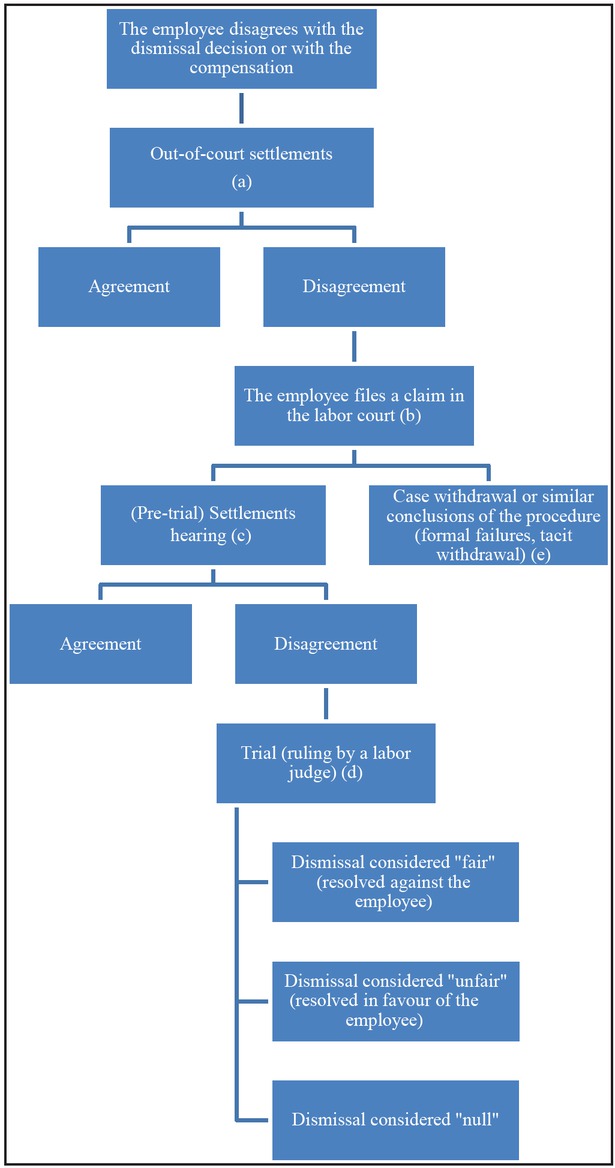
Figure 1
Layoff procedure in the Spanish labor jurisdiction.
Source: Authors’ own elaboration.
Notes:
a. Out-of-court settlements are resolved in Spain by the “MAC” units (“Mediation, Arbitration and Conciliation Units”). The majority of out-of-court settlements resolved with an agreement between the employer and the employee end up with the effective firing of the employee. Settlements ended without an agreement are the main group of dismissal conflicts which arrive to the labor courts. Following the data of the Ministry of Employment and Social Security, there was a total of 220,095 out-of-court settlements in 2014, of which 101,426 ended with agreement between the employer and the employee.
b. In 2014, the number of dismissals resolved at the labor court was 118,225. This amount is calculated by adding the number of pre-trial settlements with agreement, the dismissals finally ruled by a labor court, and the number of cases withdrawn (including tacit withdrawals and voluntary dismissal of action by the parties).
c. The number of pre-trial layoff settlements in 2014 was 48,508.
d. In 2014, the number of dismissals resolved at the trial level in the labor courts was 42,992, of which a 78% were dismissals ruled as “unfair” (in favor of the employee).
e. In 2014, 26,725 dismissals were withdrawn (thus, they were not resolved by a judge in a trial) as a result of formal failures, tacit withdrawals, and voluntary dismissal of action by the parties.
It is also important to bear in mind that there are two alternative ways to terminate an employment contract besides individual firings. Since 1984, Spanish policy-makers, facing strong opposition to change EPL under regular employment contracts, introduced employment flexibility at the margin by creating a wide array of “atypical” contracts.5 Regulation of these types of contracts changed several times and in fundamental ways, but segmentation between permanent and temporary employees, which began in the late 1980s, has prevailed since then. While regular employees are entitled the right to go to court to appealing the cause of the dismissal and may get higher severance payments in the case of unfair dismissals, temporary employees did not have the right to appeal the termination of their contracts. Hence, employers use fixed-term contract and other kinds of temporary contracts (nowadays amounting to more than 25% of employment) to buffer against negative shocks leading to downsizing of their labor force (Costain et al., 2010). Additionally, economic dismissals may be implemented collectively, and it is obliged to do so when they affect to more than 10% of the firm’s labor force in a given quarter. Firing costs under collective dismissals are typically higher than for individual dismissals/layoffs.
2.2. Some hypotheses on the effects of EPL reforms on litigation
Given the Spanish institutional framework, employers take three decisions when considering firings: (i) when to initiate a firing, (ii) whether to justify the firing as an economic dismissal or as a disciplinary layoff (notice that the employer could initiate a firing as a disciplinary layoff even if the true cause is economic and vice versa; we will refer to these cases as disguised dismissals), and (iii) under what circumstances to reach a settlement before the labor court ruling. Similarly, the dismissed employee also has to decide whether to reach a settlement or to litigate.6 Finally, judges rule those cases that are not settled following the EPL mandate. For employer and employee decisions, expectations about the sign of labor court rulings (fair or unfair) play a crucial role. For the employer, these expectations determine when a settlement is less costly, the relative cost of initiating the firing as a economic dismissal versus as a disciplinary layoff, and, hence, effective firing costs, which, themselves, determine when to initiate a firing. Similarly, the expectations of the fired employee on the labor court ruling determine his or her acceptance of a settlement.
There is a large literature on settlements and litigation, developed after the seminal work by Priest and Klein (1984) who argued that, because of selection effects, the percentage of litigated cases won by plaintiffs will not vary with legal standards. Thus, EPL reforms would not have any effect on the proportion of labor court ruling in dismissals/ layoff conflicts. However, a more formal analysis rejects the so-called “No Inference Hypothesis”: Klerman and Lee (2014) concluded that “even taking selection effects into account, one may be able to make valid inferences from the percentage of plaintiff trial victories, because selection effects are partial”. They also proved that, under plausible conditions, a change in the law ought to increase labor court rulings in favor of the party that wins more from it. Hence, changes in legal standards affect both the incentives to litigate and the expectations of the agents of outcomes of litigation, but not the extent to eliminate any effect on labor court rulings.
In the Appendix, we formally lay out a simple model of firing conflicts, similar to Klerman et al. (2018) but with some modifications to adapt it to the Spanish institutional context. From simple analysis of the comparative statics of the model, we conjecture the following effects of the Spanish labor market reforms on settlements and labor court rulings.
Proposition 1Reducing severance payments and red tape costs for fair economic dismissals leads to more firings initiated as economic dismissals and to less firings disguised as disciplinary layoffs, and diminishes effective firing costs of truthful dismissals. Assuming that judges’ behavior and employers’ and workers’ expectations on the probability of ruling economic dismissals as fair are unchanged, the incidence of settlements does not change and the proportion of labor court rulings declaring firings as fair increases.
Proposition 2Reducing severance payments and red tape for unfair dismissals leads to more firings disguised as disciplinary layoffs, and diminishes effective firing costs of truthful and untruthful dismissals. Assuming that judges’ behavior and employers’ and workers’ expectations on the probability of fair rulings are unchanged, the incidence of settlements does not change, and the proportion of labor court rulings declaring firings as fair decreases.
Proposition 3Widening the fair causes of economic dismissals yields more firings being initiated as economic dismissals, and to less disguised dismissals as disciplinary layoffs, decreases the incidence of settlements and effective firing costs for truthful economic dismissals, and increases the likelihood of a fair ruling. Settlements are less likely insofar as employers update upward their expectations on the probability of fair rulings, while the update in workers’ expectations is likely to be smaller because of asymmetric information about firm’s profits.
Proposition 4Lower firm profitability leads to more economic dismissals be initiated as such, and to less firings disguised as disciplinary layoffs, and lower effective firing costs. Settlements are less likely insofar as employers update upward their expectations on the probability of fair rulings, and worker’s update in their workers’ expectation is likely to be smaller because of asymmetric information about firm’s profits.
Proposition 5Worsening of local labor market conditions leads to less economic dismissals be initiated as such and to more disguised dismissals as disciplinary layoffs and raises effective firing costs. It also leads to less disciplinary layoffs, since workers shirk less when alternative employment opportunities decline. Settlements are unchanged insofar as updates of probabilities of a fair ruling are the same for employers and for workers.
In what follows, we turn to the data available to provide either confirmation or rejection of propositions above.
3. EPL reforms, settlements, and labor court rulings
3.1. Data
There are 345 labor courts operating in Spain. Geographical distribution is uneven and largely reflects population and firm density. Thus, there are 44 courts in the province of Barcelona, 43 in the province of Madrid, and only one or two in other 11 provinces.7 Each labor court is served by a single judge, and there are 348 court clerks.8
Statistical information about EPL enforcement is extremely scarce.9 With information on labor court activity provided by the Spanish General Council of the Judiciary (Consejo General del Poder Judicial, henceforth CGPJ), we constructed a new database that allows to identify some of the determinants of labor court rulings. Our database is composed of 154,962 observations over the period 2004Q1–2015Q2.
The unit of observation is the labor court. Data include labor court’s rulings on firing conflicts, i.e., if it was resolved in favor of the plaintiff (the employee) or the defendant (the employer) and refers to individual dismissals ruled by the first instance of the labor jurisdiction.10 Unfortunately, we cannot observe whether litigation was over an economic dismissal or a disciplinary layoff. Information on employer/employee’s characteristics is not available. As for labor courts’ characteristics, we observe the type of judge ruling on the dismissal conflict, that is, whether he or she is assigned to a particular court or appointed as a temporary replacement, reserve or substitute of the former. Additionally, we also compute a measure of congestion at labor courts.11
As for settlements, they take place at two stages. First, there is an out-of-court settlement stage that is compulsory at the so-called mediation, arbitration and conciliation units before the file of the claim in the labor court. Second, settlements may also occur at the labor courts before the judge’s ruling. For each labor court, we observe a settlement ratio computed as the proportion of settlements within all the firing cases brought at labor courts.
Since local labor conditions affect the number of firing conflicts and labor court rulings (see the Appendix), we also collect information on the provincial unemployment rate (in deviations with respect to the sample mean), the sectoral composition of activity in the province (relative employment weights of agriculture, industry, construction and services sectors), and the temporary employment rate (proportion of employees with fixed-term contracts out of the total number of employees), the presence of big firms, the incidence of collective dismissals (Expediente de Regulación de Empleo (EREs) in the Spanish legal terminology), and firm profitability. The presence of big firms in the province (per year) is calculated as the proportion of companies with more than 200 workers over the total number of companies according to the information collected by the Central Business Register (DIRCE) of the National Statistics Institute.12 As for the incidence of collective dismissals, we use the number of collective dismissal files and the number of workers affected, from data registered at the Ministry of Employment and Social Security. Firm profitability is measured by the lowest decile in the distribution of the return on assets (ROA) at each province using as a source the Bank of Spain Central Balance Sheet database. Conceivably, firms with lower profitability are most likely to initiate economic dismissals.
Table 1 provides the data definitions and sources. Table 2 displays the descriptive statistics before 2010, 2010–2012, and after 2012.13 The proportion of firings declared as fair by labor courts is on average 25.9% for the whole sample and decrease from 27.3% before 2010 to 25.8% in 2010–2012 and 22.7% after 2012, with noticeable differences across provinces (see Figure 3 and Table 3). Also interestingly, this proportion is negatively correlated with the local unemployment rate (see column 3 in Table 5). We interpret this correlation as an indication that the local unemployment rate affects directly labor court decisions (see Appendix).
Table 1
Definitions of variables and sources of data
| Variable | Definition | Scale/Unit | Period | Source |
|---|---|---|---|---|
| Court rulings | Percentage of labor court judgments ruling that the dismissal was fair or justified | % | By court, 2004–2015 | CGPJ |
| D1 (Reform 2010) | Period of enforcement of the 2010 labor market reform | Dummy | 2004–2015 | Self elaboration |
| D2 (Reform 2012) | Period of enforcement of the 2012 labor market reform | Dummy | 2004–2015 | Self elaboration |
| Unemployment rate | Percentage of total workforce which is unemployed and is looking for a paid job (in differences from the average) | % | By province, 2004–2014 | Spanish National Statistics Institute (INE) |
| Profitability | Return on assets (ROA) for the 10% of firms with a lower ROA | % | By province, 2004–2013 | Banco de España |
| Temporary employment rate | Percentage of total workforce which has a fixed-term contract | % | By province, 2004–2014 | Spanish National Statistics Institute (INE) |
| Log of the number of workers under collective dismissals | Logarithm of the number of workers affected by collective dismissals | Logarithm | By province, 2004–2014 | Ministry of Employment and Social Security |
| Proportion of companies with more than 200 employees | Proportion of companies with more than 200 employees over the total number of companies | % | By province, 2004–2014 | Spanish National Statistics Institute (INE) |
| Employment share of services | Percentage of total workforce working on services sector | % | By province, 2004–2014 | Spanish National Statistics Institute (INE) |
| Employment share of industry | Percentage of total workforce working on services sector | % | By province, 2004–2014 | Spanish National Statistics Institute (INE) |
| Employment share of construction | Percentage of total workforce working on services sector | % | By province, 2004–2014 | Spanish National Statistics Institute (INE) |
| Proportion of dismissal lawsuits analyzed (+) by | Percentage of labor court judgments ruling that the dismissal was fair or justified | % | By court, 2004–2015 | CGPJ |
| professional judges over total | by professional judges over all the dismissal lawsuits analyzed by all judges | |||
| Proportion of days with temporary | Proportion of days per 365-days a year with positions | Fraction | By court, 2004–2014 | CGPJ |
| positions at the labor courts per year Judicial congestion rate (dismissals lawsuits) | at the labor courts held by interim judges Ratio between the sum of pending cases in a labor court plus new cases and the cases resolved in the same quarter | Fraction | By court, 2004–2014 | CGPJ |
| Judicial congestion rate (pre-trial settlements) | Ratio between the sum of pending settlements in a labor court plus new settlements and the settlements resolved in the same quarter | % | By court, 2010–2015 | CGPJ |
| Out-of-court settlements ratio | Ratio of the number of out-of- court settlements divided by the sum of those settlements and the total number of dismissal lawsuits | % | By court, 2004–2015 | CGPJ |
[i] Source: Authors’ own elaboration.
Table 2
Descriptive statistics
| Variable | Before 2010 | 2010–2012 | After 2012 | ||||||||||||
|---|---|---|---|---|---|---|---|---|---|---|---|---|---|---|---|
| Obs | Mean | Std. Dev. | Min | Max | Obs | Mean | Std. Dev. | Min | Max | Obs | Mean | Std. Dev. | Min | Max | |
| Court rulings | 7,444 | 0.2730 | 0.1362 | 0 | 1 | 4,025 | 0.2582 | 0.1180 | 0 | 0.8182 | 3,390 | 0.2268 | 0.1144 | 0 | 1 |
| Unemployment rate (in differences) | 8,328 | –0.0517 | 0.0496 | –0.1364 | 0.1397 | 4,164 | 0.0570 | 0.0638 | –0.0859 | 0.2372 | 2,429 | 0.091 | 0.0658 | –0.0271 | 0.2711 |
| Profitability | 8,328 | 0.0398 | 0.0903 | 0 | 0.8100 | 4,164 | 0.0076 | 0.0338 | 0 | 0.3763 | 1,388 | 0.141 | 12527 | 0 | 13.5382 |
| Temporary employment rate | 8,328 | 0.3089 | 0.0811 | 0.1628 | 0.5949 | 4,164 | 0.2480 | 0.0619 | 0.1315 | 0.4863 | 2,429 | 0.2387 | 0.0611 | 0.1325 | 0.5088 |
| Log of the number of workers under collective dismissals | 6,940 | 7.9281 | 1.7189 | 2.8332 | 11.7512 | 4,164 | 9.2074 | 1.2555 | 5.464 | 11.2039 | 3,470 | 8.9239 | 1.3714 | 3.9890 | 10.9548 |
| Proportion of companies with more than 200 employees | 8,578 | 0.0017 | 0.0009 | 0 | 0.0040 | 4,164 | 0.0015 | 0.0008 | 0.0003 | 0.0032 | 2,776 | 0.0016 | 0.0008 | 0.0002 | 0.0032 |
| Employment share of services | 8,328 | 0.6685 | 0.0734 | 0.438 | 0.844 | 4,164 | 0.7400 | 0.0719 | 0.536 | 0.8890 | 2,429 | 0.7606 | 0.0705 | 0.584 | 0.888 |
| Employment share of industry | 8,328 | 0.1626 | 0.0635 | 0.044 | 0.369 | 4,164 | 0.1404 | 0.0553 | 0.032 | 0.3420 | 2,429 | 0.1367 | 0.0557 | 0.031 | 0.279 |
| Employment share of construction | 8,328 | 0.1206 | 0.0276 | 0.058 | 0.239 | 4,164 | 0.0773 | 0.0177 | 0.041 | 0.1670 | 2,429 | 0.0589 | 0.0117 | 0.033 | 0.109 |
| Proportion of dismissal lawsuits analyzed (+) by professional judges over total | 8,328 | 0.9023 | 0.1767 | 0 | 1 | 4,164 | 0.8036 | 0.2736 | 0 | 1 | 3,470 | 0.8474 | 0.2509 | 0 | 1 |
| Proportion of days with temporary positions at the labor courts per year | 8,232 | 0.0083 | 0.0408 | 0 | 0.5 | 4,116 | 0.0130 | 0.0516 | 0 | 0.2556 | 2,744 | 0.0056 | 0.0342 | 0 | 0.2556 |
| Judicial congestion rate (dismissals lawsuits) | 8,328 | 2.0486 | 0.4877 | 1 | 13 | 4,164 | 2.6038 | 0.8173 | 1.0444 | 8.1958 | 0 | ||||
| Judicial congestion rate (pre-trial settlements) | 8,328 | 15 | 0 | 15 | 15 | 4,164 | 6.6414 | 12.7790 | 0 | 285 | 3,470 | 6.4727 | 5.0171 | 0.544 | 45.5116 |
| Out-of-court settlements ratio | 8,328 | 0.5422 | 0.1822 | 0 | 0.9310 | 4,164 | 0.4444 | 0.1672 | 0 | 0.8662 | 1,388 | 0.6719 | 0.142 | 0 | 0.9021 |
[i] Source: Authors' own elaboration.
Table 3
Main descriptive statistics by province
| Court rulings | Unemployment ratea | Profitability | Temporary employment rate | Log number workers under collective dismissals | Proportion of companies with more than 200 employees | Out-of-court settlements ratio | |
|---|---|---|---|---|---|---|---|
| National (full period) | 0.2603 | 0.1630 | 0.0398 | 0.2805 | 8.5692 | 0.0016 | 0.5258 |
| Provincial deviations from the mean | |||||||
| ALMERIA | –0.0499 | 0.0651 | –0.0398 | 0.1884 | –2.2744 | –0.0003 | –0.1314 |
| CADIZ | 0.0138 | 0.1045 | –0.0398 | 0.0734 | –0.8296 | –0.0008 | 0.0163 |
| CORDOBA | 0.0464 | 0.0797 | 0.0112 | 0.1339 | –1.8571 | –0.0008 | –0.0626 |
| GRANADA | 0.0008 | 0.0719 | –0.0218 | 0.1137 | –1.7881 | –0.0008 | –0.0729 |
| HUELVA | –0.0256 | 0.0708 | 0.0082 | 0.1877 | –2.4510 | –0.0005 | –0.0397 |
| JAEN | 0.0378 | 0.0734 | 0.1524 | 0.0942 | –1.2823 | –0.0010 | –0.0181 |
| MALAGA | –0.0025 | 0.0671 | –0.0398 | 0.0617 | –0.7456 | –0.0008 | –0.1051 |
| SEVILLA | 0.0059 | 0.0594 | –0.0105 | 0.0997 | –0.5248 | –0.0002 | 0.0468 |
| HUESCA | 0.0138 | –0.0616 | –0.0013 | –0.0300 | –1.9673 | –0.0010 | –0.4078 |
| TERUEL | 0.0904 | –0.0592 | 0.0579 | –0.0414 | –1.7696 | –0.0008 | –0.4256 |
| ZARAGOZA | –0.0450 | –0.0350 | –0.0340 | –0.0355 | 0.6255 | 0.0001 | –0.3313 |
| ASTURIAS | 0.0599 | –0.0184 | –0.0168 | –0.0185 | 0.5581 | –0.0004 | –0.1168 |
| ILLES BALEARS | –0.0159 | –0.0128 | –0.0398 | –0.0033 | –1.1640 | –0.0004 | –0.2505 |
| LAS PALMAS | –0.0479 | 0.0682 | –0.0349 | 0.0565 | –0.8650 | 0.0000 | 0.0090 |
| SANTA CRUZ DE TENERIFE | –0.0740 | 0.0469 | –0.0268 | 0.0523 | –1.0567 | –0.0003 | 0.0172 |
| CANTABRIA | 0.0009 | –0.0396 | –0.0171 | –0.0321 | 0.0364 | –0.0004 | –0.1808 |
| AVILA | –0.1109 | 0.0036 | 0.1450 | –0.0120 | –2.4403 | –0.0012 | 0.0710 |
| BURGOS | 0.0685 | –0.0400 | –0.0141 | –0.0599 | –0.4829 | –0.0001 | 0.0105 |
| LEON | –0.0226 | –0.0167 | 0.0074 | –0.0229 | –0.6166 | –0.0010 | –0.1287 |
| PALENCIA | 0.1060 | –0.0307 | 0.0070 | –0.0552 | –1.2430 | –0.0006 | –0.1260 |
| SALAMANCA | 0.0079 | –0.0132 | 0.0365 | –0.0260 | –1.9131 | –0.0009 | –0.1264 |
| SEGOVIA | 0.0425 | –0.0445 | –0.0300 | –0.0474 | –2.6397 | –0.0009 | –0.0417 |
| SORIA | 0.0364 | –0.0647 | –0.0183 | –0.0622 | –2.4441 | –0.0006 | 0.0631 |
| VALLADOLID | 0.0287 | –0.0293 | 0.0131 | –0.0296 | 0.1799 | –0.0002 | –0.0310 |
| ZAMORA | –0.0164 | –0.0067 | 0.3171 | –0.0001 | –2.7065 | –0.0013 | –0.1014 |
| ALBACETE | –0.0105 | 0.0239 | 0.0635 | 0.0158 | –1.3802 | –0.0009 | –0.1099 |
| CIUDAD REAL | 0.0180 | 0.0287 | 1.4123 | 0.0313 | –2.0382 | –0.0011 | –0.0253 |
| CUENCA | 0.0355 | –0.0104 | 0.2768 | –0.0016 | –2.7461 | –0.0012 | 0.0532 |
| GUADALAJARA | –0.0221 | –0.0247 | 0.0173 | –0.0453 | –2.3618 | –0.0004 | –0.0141 |
| TOLEDO | –0.0784 | 0.0195 | 0.1394 | 0.0290 | –1.4898 | –0.0010 | –0.0018 |
| BARCELONA | –0.0314 | –0.0210 | –0.0398 | –0.0822 | 2.0148 | 0.0006 | 0.2197 |
| GIRONA | 0.0312 | –0.0114 | –0.0398 | –0.0461 | –0.6995 | –0.0006 | 0.0870 |
| LLEIDA | 0.0426 | –0.0583 | –0.0378 | –0.0818 | –1.6490 | –0.0008 | 0.1113 |
| TARRAGONA | 0.0388 | –0.0122 | –0.0398 | –0.0108 | –0.8174 | –0.0004 | 0.0428 |
| ALICANTE | –0.0915 | 0.0230 | –0.0379 | 0.0601 | –0.0219 | –0.0010 | –0.0450 |
| CASTELLON | 0.0361 | 0.0104 | –0.0379 | 0.0072 | –0.0495 | 0.0006 | 0.0519 |
| VALENCIA | –0.0322 | 0.0102 | –0.0021 | 0.0143 | 0.9955 | 0.0000 | –0.0730 |
| BADAJOZ | 0.0351 | 0.0639 | 0.0258 | 0.1115 | –1.5900 | –0.0009 | –0.0961 |
| CACERES | 0.0551 | 0.0350 | 0.0244 | 0.0670 | –2.0785 | –0.0011 | 0.1215 |
| A CORUÑA | –0.0189 | –0.0285 | 0.0163 | –0.0031 | –0.1954 | –0.0002 | 0.0172 |
| LUGO | 0.0170 | –0.0549 | 0.0226 | –0.0118 | –1.9468 | –0.0011 | –0.0427 |
| OURENSE | –0.0377 | –0.0228 | –0.0017 | –0.0188 | –1.9869 | –0.0008 | –0.0868 |
| PONTEVEDRA | 0.0148 | –0.0013 | –0.0015 | 0.0235 | 0.1738 | –0.0005 | 0.0079 |
| MADRID | 0.0421 | –0.0391 | –0.0398 | –0.0663 | 1.4811 | 0.0018 | 0.0787 |
| MURCIA | 0.0015 | 0.0148 | –0.0145 | 0.0802 | –0.6336 | –0.0001 | –0.0656 |
| NAVARRA | 0.0138 | –0.0608 | 0.0626 | –0.0328 | 0.6025 | 0.0010 | 0.0541 |
| ARABA/ALAVA | 0.0759 | –0.0559 | –0.0044 | –0.0537 | –0.0310 | 0.0006 | 0.0205 |
| GIPUZKOA | 0.0417 | –0.0756 | 0.1014 | –0.0405 | 0.3829 | 0.0000 | 0.0660 |
| BIZKAIA | 0.0111 | –0.0425 | –0.0398 | –0.0265 | 0.6434 | 0.0007 | –0.0242 |
| LA RIOJA | –0.0189 | –0.0416 | –0.0177 | –0.0561 | –1.0135 | –0.0009 | 0.0848 |
Source: Authors' own elaboration.
Table 4
Determinants of settlementsa
| 1 | 2 | 3 | 4 | 5 | 6b | |
|---|---|---|---|---|---|---|
| 2010 reform | –0.107*** (0.0188) | 0.0118 (0.0128) | 0.0148 (0.0209) | 0.0211 (0.0127) | –0.139*** (0.0372) | –0.129*** (0.0447) |
| 2012 reform | 0.208*** (0.0163) | 0.118*** (0.0172) | 0.261*** (0.0172) | 0.124*** (0.0183) | 0.244*** (0.0588) | 0.201*** (0.0463) |
| Unemployment rate | –1.274*** (0.132) | –0.467*** (0.166) | –0.849*** (0.156) | –0.696*** (0.156) | ||
| 2010 reform*Unemployment rate | 0.840*** (0.168) | 0.777*** (0.183) | ||||
| 2012 reform*Unemployment rate | –0.532** (0.222) | –0.375* (0.196) | ||||
| Profitability | 0.0106 (0.0157) | 0.439*** (0.0956) | 0.466*** (0.0893) | 0.475*** (0.0886) | ||
| 2010 reform*Profitability | –0.107 (0.132) | –0.135 (0.153) | ||||
| 2012 reform*Profitability | –0.699*** (0.197) | –0.625*** (0.155) | ||||
| Province fixed effects | YES | YES | YES | YES | YES | YES |
| Other controlsc | NO | YES | NO | YES | YES | YES |
| Observations | 13,880 | 10,976 | 13,880 | 10,976 | 10,976 | 8,192 |
| R-squared | 0.201 | 0.521 | 0.340 | 0.543 | 0.573 | 0.535 |
| # labor courts | 347 | 343 | 347 | 343 | 343 | 256 |
c Other controls include: temporary employment rate, sectoral distribution of employment, logarithm of the number of workers affected by collective dismissals, proportion of companies with more than 200 employees, proportion of dismissal lawsuits analyzed by professional judges, days of temporary positions at the labor courts per year, and judicial congestion rate.
Table 5
Determinants of labor court rulings declaring dismissals/layoffs as faira
| 1 | 2 | 3 | 4 | 5 | 6b | |
|---|---|---|---|---|---|---|
| 2010 reform 2012 reform | –0.0012 (0.00598) –0.0339*** (0.00526) | 0.0376*** (0.00807) –0.0065 (0.00605) | 0.0426*** (0.00479) –0.0088 (0.00590) | 0.0385*** (0.0080) 0.00003 (0.0065) | 0.0120 (0.0197) 0.00126 (0.0214) | 0.0288 (0.0187) 0.00138 (0.0278) |
| Unemployment rate | –0.467*** (0.0800) | –0.304** (0.128) | –0.386*** (0.133) | –0.312** (0.134) | ||
| 2010 reform*Unemployment rate | 0.137 (0.0836) | 0.0680 (0.0776) | ||||
| 2012 reform*Unemployment rate Profitability | –0.0036*** (0.0009) | –0.0530 (0.0570) | –0.0102 (0.0892) –0.0181 (0.0550) | –0.0161 (0.104) –0.0181 (0.0550) | ||
| 2010 reform*Profitability | –0.177** (0.0817) | –0.234*** | ||||
| (0.0813) | ||||||
| 2012 reform*Profitability | –0.0317 (0.150) | –0.0250 (0.151) | ||||
| Province fixed effects | YES | YES | YES | YES | YES | YES |
| Other controlsc | NO | YES | NO | YES | YES | YES |
| Observations | 14.181 | 10.202 | 12.825 | 10.202 | 10.202 | 7.586 |
| R-squared | 0.017 | 0.055 | 0.036 | 0.058 | 0.060 | 0.056 |
| # labor courts | 343 | 339 | 343 | 339 | 339 | 255 |
c Other controls include: temporary employment rate, sectoral distribution of employment, logarithm of the number of workers affected by collective dismissals, proportion of companies with more than 200 employees, proportion of dismissal lawsuits analyzed by professional judges, days of temporary positions at the labor courts per year, and judicial congestion rate.
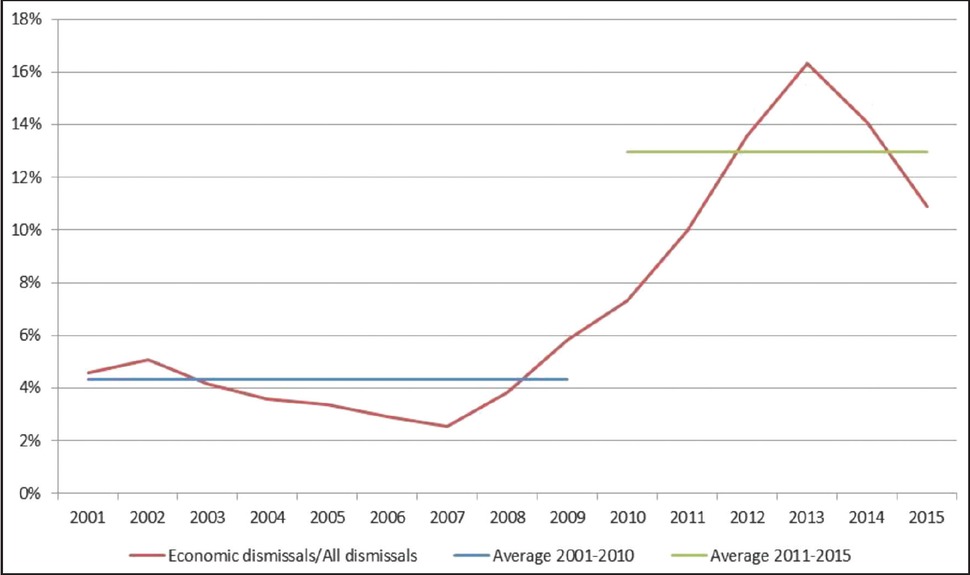
Figure 2
Proportion of economic dismissals over all dismissals.
Source: Spanish Ministry of Employment.
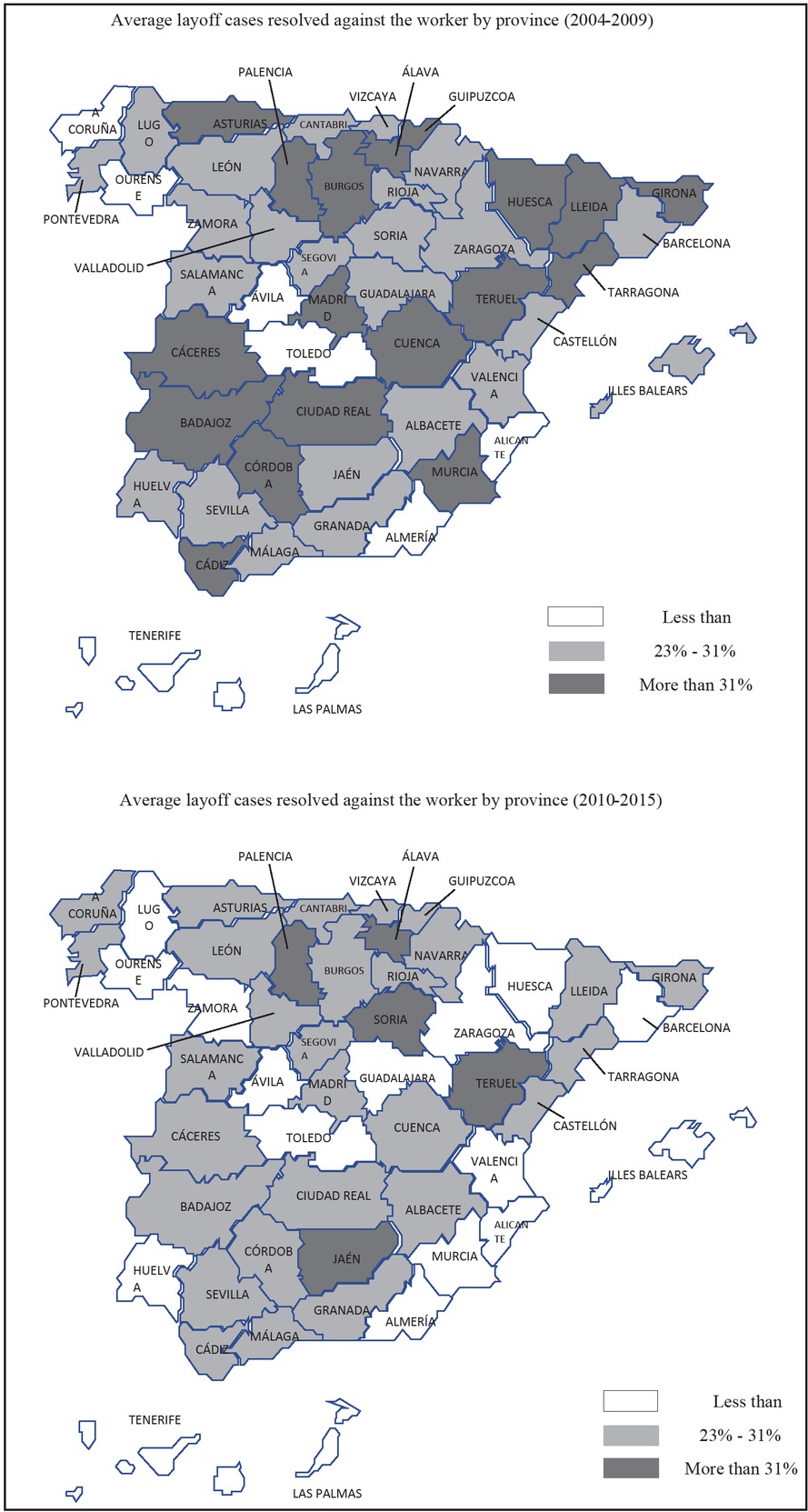
Figure 3
Percentage of labor court judgments ruling that the dismissal is fair.
Source: Authors’ own elaboration based on data provided by the CGPJ.
3.2. Empirical approach
Variation across time and labor courts with controls by labor court and provincial characteristics allows us to make inferences on the effects of EPL reforms on labor court rulings and on the incidence of settlements.
As discussed above, labor market reforms of 2010 and 2012 affected red tape costs and procedures of economic dismissals and disciplinary layoffs differently. Hence, the incidence of economic dismissals and disciplinary layoffs and the selection of both conflicts into settlements and litigation are likely to have changed as a result of the reforms. Given that we do not observe economic dismissals and disciplinary layoffs separately, we perform an event study (comparisons before and after) with a set of controls that proxy the incidence and composition (economic dismissals versus disciplinary layoffs) of firings. Thus, we regress the ratio of labor court rulings stating that the dismissal/layoff is fair and the proportion of settlements on time dummies that capture the entry into force of the EPL reforms and a group of relevant controls that vary by time (at the quarterly frequency), by labor court, and by province (also including fixed effects by province). All models are estimated both fitting a linear specification and odds-ratios (Bishop et al., 1975; Williamson et al., 1995).14 Errors in all models are clustered at the provincial level, and standard errors are robust to heteroskedasticity and autocorrelation.
Among the covariates, we specifically focus on the local (provincial) unemployment rate and the local (provincial) profitability of firms (the two variables that may directly influence judges’ decisions on economic dismissals according to our model), and interact both with the time dummies indicating the timing of the reforms. These interactions should capture by how much judges’ discretion on rulings changes with the EPL reforms.
Thus, we estimate
where Yist is, alternatively, the settlement ratio and the proportion of labor court rulings declaring the dismissal/conflict fair at labor court i province s, and time t; Xkist is the set of controls that includes the proportion of employees with temporary contracts, the sectoral distribution of employment (agriculture, manufacturing, construction, and services), the proportion of establishments with more than 200 employees, the number of employees affected by collective dismissals (in logs), the proportion of dismissal conflicts ruled by professional judges, days covered by temporary judges at the labor court per year, and the judicial congestion rate at labor court i, province s, and time t; and Ust and Πst are, respectively, the unemployment rate and the lowest decile of the distribution of firm profit rates15 at province s and time t. D1 and D2 are time dummies that take value one after the second quarter of 2010 and the first quarter of 2012, respectively, the dates at which reforms came into effect. Regressions also include fixed province effects, αs. Controlling by characteristics of labor courts (status of the judge, interim days at the labor court) should take care of changes that might have affected the rulings other than the EPL reforms.
3.3. Results
The main results are displayed in Tables 4 (settlements) and 5 (likelihood of a labor court ruling declaring the dismissal/layoff as fair).
While the 2010 reform led to some significant decrease in the likelihood of settlements, the 2012 reform had the opposite effect. Overall, the proportion of settlements is about 7% to 10% points higher after 2012 (columns 5 and 6). Settlements are less likely the higher the local unemployment rate and the lower firm profitability are. Interestingly, the association between the incidence of settlements and local unemployment became positive after the 2010 reform and negative again after the 2012 reform. Under our interpretation of the coefficients of these variables as the divergence between employer and employees expectations on labor court rulings, these results suggest that the reforms reduced this divergence both overall and, particularly, when local labor market conditions and firm profitability were worse.16
Another conclusion from the estimated changes in the likelihood of settlements is that dismissal conflicts being solved by labor court trials after the reforms are those in which employers’ expectations on the probability of a fair ruling increased by more and above dismissed workers’ expectations. We cannot see why this should happen in the case of disciplinary layoffs (whose regulation was unchanged). Thus, by joining this to the observation that the overall proportion of firings initiated as economic dismissals was higher after the reform, we conclude that, if anything, the proportion of economic dismissals out of all firing conflicts solved by labor courts ought to have increased. An increase in the weight of economic dismissals being solved by trial in the labor courts and the broadening of the definition of fair causes of economic dismissals should weight positively in the likelihood of firings being ruled as fair by the labor courts.
However, Table 5 shows that the proportion of dismissals/layoffs being ruled as fair increased immediately after the 2010 reform but was not very much changed with the 2012 reform. In fact, under the most complete specifications (columns 5 and 6), neither of the two reforms seem to have a significant effect on the rulings. An increase in the unemployment rate of 10% points is associated with a decrease in the proportion of fair rulings of approximately 3% to 5% points. As for firm profitability, there is no statistically significant association with judges’ rulings, once that other covariates controlling for incidence and composition of firings are included Nevertheless, after the 2010 reform, it seems that judges’ decisions took more into account the economic situation of the firm, so that lower profitability led to a higher probability of a fair ruling (effect that is not observed after the 2012 reform, somehow surprisingly).
To better gage the impact of the EPL reforms on labor court rulings, in Figure 4, we plot the observed probability of a dismissal/layoff being ruled as fair by the labor court and the change in that probability due to EPL reforms and their effects through interactions with the local unemployment and firm profitability (using estimates from column 5 in Table 5). While this marginal effect increased immediately after the 2010 reform (but only by about 2.5% points), after the 2012 reform, it decreased by 3% points (although this negative effect was vanishing gradually up to 2015). With these results we conclude that effective firing costs were not significantly reduced by the widening of the scope for economic dismissals associated with the Spanish EPL reforms of 2010 and 2012.
4. Concluding remarks
Labor courts’ intervention on dismissal cases is key for the determination of effective firing costs. Since judges often behave as socially motivated agents and have some discretion in the application of EPL, the parties (employers and dismissed employees) act strategically taking into account the procedural rules for the initiation and resolution of dismissal conflicts. As a result, there are several channels by which EPL affects effective firing costs and the consequences of EPL reforms may be different than intended.
We analyze two significant EPL reforms in 2010 and 2012 than changed both severance payments and procedural rules in Spain to make economic dismissals less costly. Even though the proportion of economic dismissals over all firings increased, the average probability that a dismissal was declared fair by a labor court did not increase significantly, despite the widening of the fair causes of economic dismissals. By controlling for local labor market conditions, diminishing firm profitability, and reduction of severance payments for unfair dismissals, we identify the effects of EPL reforms on labor courts’ ruling on firing conflicts. We conclude that the reduction of effective firing costs in Spain after 2010 took place mainly because of the lower severance payments for unfair dismissals and less so due to the extension of the fair causes of economic dismissals.
This conclusion has three implications for the policy debate on the need of introducing further labor market reforms. One is that the reduction in effective firing costs has been lower than the one intended by the legislated EPL reforms. Second, and similarly, the changes in the indicators about the stringency of EPL for regular contracts usually discussed in the debate (for instance the OECD indicators) overestimate the impact of the EPL reforms, since they are based on changes in legal costs and neglect the costs from enforcement (i.e., labor courts’ intervention). Finally, the reduction of effective firing costs for economic dismissals under the regular employment contract has not been as large as envisioned by the policy-makers. Given that the difference between these firing costs and termination costs of temporary contracts, which determines the proportion of employees with fixed-term contracts, is still very large, the high incidence of temporary employment observed in Spain would not be very much reduced by these reforms.
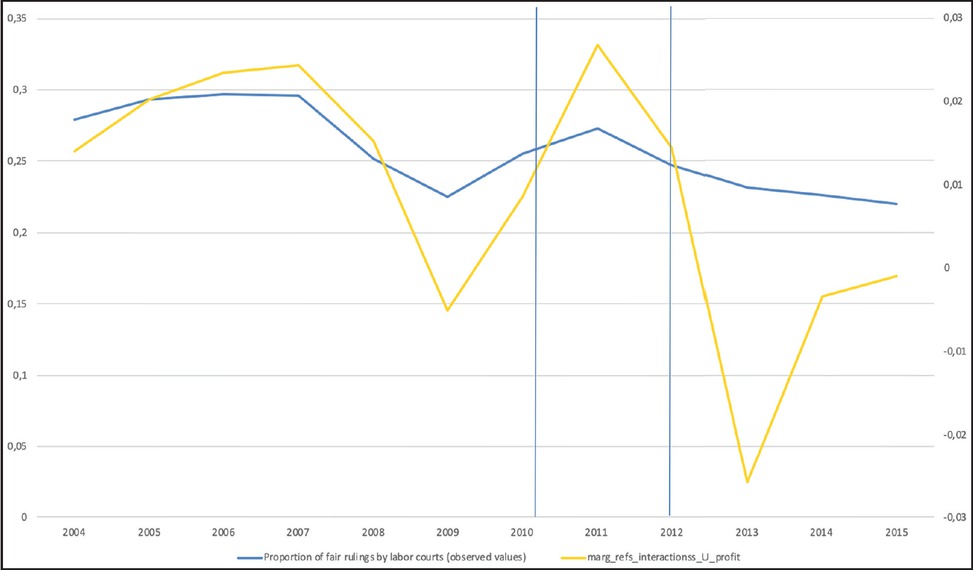
Figure 4
Marginal effect of reforms, unemployment, and profitability on labor court rulings declaring dismissals/layoffs as fair.
Note: Proportion of fair rulings by labor courts (observed values) is measured in left axis and marginal effect (from estimates in column 5 in Table 5) on the right axis.
Notes
Acknowledgments
This is a revised and extended version of a previous working paper under the title: “Employment protection legislation and labor court activity in Spain”. We are grateful to Justin McCrary, Borja Ruiz de la Cueva, Ildefonso Villán Criado, Ernesto Villanueva, Cristina Barceló, María Teresa Moyna López, Paulino Font, Pablo Gimeno, Mario Izquierdo, Mariusz Golecki, Marcel Jansen, Juan J. Dolado, Marina Mengotti, and participants at the V Annual Conference of the Spanish Association of Law and Economics, the XXXIX Conference of the Spanish Economic Association, the IZA/OECD Employment Seminar, the XI Spanish Labour Economics Conference, and seminars at the Banco de España and the University of Nuremberg. Patricia Festa Secanella provided excellent research assistance. We also thank anonymous referees and the editor for comments and suggestions. The views expressed are those of the authors and should not be attributed to the Banco de España.
Appendix
A.1
A theoretical model of effective firing costs
The model aims at showing how effective firing costs are affected by both severance payments established by EPL and costs associated with procedural rules.17 The most important message to be drawn is that, due to strategic behavior by employers and fired employees, the composition of firing cases (disciplinary layoffs versus economic dismissals), both initiated and terminated by labor courts’ rulings, is affected by relative severance payments and procedural costs in each case and by their expectations of the labor courts’ rulings. Hence, EPL reforms may affect effective firing costs by several channels, not only by changes in severance payments.
We set up the model to resemble the main features of EPL and labor courts in Spain as described earlier, but it can be adapted to similar cases of labor court interventions prevailing in other countries and to studies of the effects of EPL reforms changing the procedural rules for dismissals (as those that recently took place in Italy and France). The model is in the spirit of recent analysis in the literature about litigation and settlements (see Klerman et al., 2018), with some (non-substantial) shortcuts and modifications that we explain below.
The assumptions are as follows:
Agents’ actions: Employers (e), having decided to dismiss a worker (w), justify the dismissal as an economic dismissal (r) or as a disciplinary layoff (d). Upon firing, employers make an offer to the dismissed employees to settle the case before going to a labor court. There is sequential bargaining (employers’ proposals followed by workers’ counterproposals). If settlement is not reached, a labor court rules on the fairness of the dismissal/layoff, and severance payments are paid according to the ruling.18
Judges’ behavior: For dismissals {r,d} brought to a labor court, a judge rules if they are fair ( f ) or unfair (u). Judges observe the true profitability of the firm (π) and whether dismissed workers were shirking or not. Hence, they always rule untruthful dismissals/ layoffs as unfair. However, they are driven by a social motivation that generates some uncertainty about the likelihood of a fair ruling when the alleged cause of the dismissal is truthful.19 Inspired by some empirical findings discussed in Section 3, we assume that social motivation leads judges to rule dismissals as unfair with a higher likelihood when local labor market conditions (μ) worsen.20 Furthermore, following the spirit of the regulation of economic dismissals, we assume that the more likely they are to be ruled as fair, the lower the profitability of the firm (π) is. We denote the probability of a truthful economic dismissal being ruled as fair by the labor court by xr (π ,μ ), with The probability of a truthful disciplinary layoff being ruled as fair by the labor court does not depend on firm profitability but only on local labor market conditions: xd (μ ), with (dxd (μ ))/ dμ < 0. For untruthful dismissals, xd = xr = 0. There are red tape costs (court costs to be paid only by employers) that are higher for economic dismissals than for disciplinary layoffs (tj, j = {r,d}, with τr > d). Severance payments are as follows:
| Fair dismissal | Unfair dismissal | |
| Economic dismissals | cf | cu |
| Disciplinary layoffs | 0 | cu |
Agents’ expectations: For some dismissals to be settled at labor courts, we assume that employers and dismissed workers have divergent expectations on labor courts’ rulings. The expected probabilities that firings are ruled as fair are xij, where j denotes the type of dismissal (j = {r,d}) and i the agent holding that expected probability (i = {e,w}). Employers support their expectations on firm profitability, local market conditions, and employees’ shirking state.21 Workers hold their expectations knowing local market conditions, their shirking state, and the employer’s decision on whether to justify the dismissal as an economic dismissal or as a disciplinary layoff.22 In Klerman et al. (2018), each party’s expectations are the result of observing a signal about the merit of the dispute. We assume that parties know the merit of the dispute (whether truthful of disguised) but still the judge decision may vary with the local market state and firm profitability.
Table A1 gives what the firms expects to pay (FEP) and what the worker expects to get (WEG) if the dismissal conflict is solved by a judge.
A.2
Settlements
Settlements may arise after several rounds of proposals by the employers about severance payments and workers’ counterproposals.23 Notice that in the case of economic dismissals, the worker’s expectations of a fair ruling is also affected by the signal sent by the employer about firm’s profitability when justifying the dismissal as an economic dismissal. In this game, the highest severance payment that the employer is willing to offer is FEP + t i, while the lowest severance payment that the worker is willing to accept is WEG + t i.
Thus, we assume that in the settlement stage, all information about each party’s expectations is revealed (since it is a repeated game without a limitation in the number of proposals and counterproposals to be made). A settlement is reached whenever the employer’s expectation of a fair ruling is smaller than the worker’s expectation respectively).24 Upon settlement, effective firing costs are for economic dismissals and for disciplinary layoffs. Alternatively, if settlements are not reached and the case is expected to be solved by a labor court, employers’ expected firing costs are for truthful economic dismissals and for truthful disciplinary layoffs.
As for untruthful dismissals, since they are always ruled as unfair by judges and, hence, employers and workers expectations about a fair ruling are both nil, they will always be settled. Thus, effective firing costs are cu + t d in the case of untruthful disciplinary layoffs and cu + tr for untruthful economic dismissals.
A.3
The composition of firings
Employers’ decisions about dismissals to be initiated and the cause to be alleged for justifying them depend on expected effective firing costs. As for economic dismissals, employers will allege the true cause whenever
being that is, the employer expectations on reaching a settlement. This condition yields
where measures the employer expectations on diverging beliefs about the probability of a fair ruling of economic dismissals. Notice that if δr = 1 then βr (π, μ) > 0, and, alternatively, if On the contrary, economic dismissals are disguised as disciplinary layoffs when condition (1) is not satisfied. Thus, for given employer’s expectations on the likelihood of a settlement, truthful economic dismissals are more likely as the difference between red tape costs of economic dismissals and disciplinary layoffs is small, and the difference between severance payments between unfair and fair dismissals and the employer’s expected probability of a fair ruling is high. In addition, if employers expect that dismissed workers have a high expectation of a fair ruling, then settlements are more likely and expected firing costs at settlements are lower, and therefore, they will be more likely to initiate truthful economic dismissals as such.
For disciplinary reasons to be claimed as the cause of truthful disciplinary layoffs, it must happen that being This condition is always satisfied as it implies where as before is the corresponding employers’ expectation on the extent of divergent beliefs about the probability of a fair ruling of disciplinary layoffs.
Table A2 summarizes all the conditions determining the composition of dismissals, their resolution and the corresponding expected firing costs.
Table A2
Dismissals: initiation, settlements and effective firing costs
| Truthful dismissals | Disguised | ||
|---|---|---|---|
| Economic | Disciplinary | As economic | |
| Initiated | Always | ||
| Settlement | Always | ||
| Effective firing costs | |||
| If settled | |||
| At labor court | |||
Table A3 summarizes the propositions discussed in the main text.
Table A3
Effects of EPL reforms
| Economic | dismissals | Disciplinary | Settlements | Firing costs | Fair ruling | |
|---|---|---|---|---|---|---|
| Truthful | Disguised | |||||
| Severance payments/ | ||||||
| court costs | ||||||
| Fair dismissals ↓ | ↑ | ↓ | unchanged | unchanged | ↓ | ↑ |
| Unfair dismissals ↓ | ↓ | ↑ | unchanged | unchanged | ↓ | ↓ |
| Cause of economic dismissals ↑ | ↑ | ↓ | unchanged | ↓ | ↓ | ↑ |
| Downturns | ||||||
| Firm profitability ↓ | ↑ | ↓ | unchanged | ↓ | ↓ | ↑ |
| Local labor market conditions | ↓ | ↑ | ↓ | unchanged | ↑ | ↓ |
| ↓ |
[i] EPL, employment protection legislation.
A.4
Some information on the social motivation of judges acting in the labor jurisdiction
Information on the social motivation of judges is limited. We proxy it by gathering information on memberships of the associations of judges. While Spanish law prohibits a judge to join a political party or a trade union while he or she is on active duty, it allows association in professional groups, which happen to have some “ideological” orientations. Currently, the major associations in Spain are the “Asociación Profesional de la Magistratura” (APM), “Jueces para la Democracia” (JpD), “Asociación Francisco de Vitoria” (FV), “Foro Judicial Independiente” (FJI), and the “Asociación Nacional de Jueces”. APM is perceived as conservative. JpD is considered as leftist, and FV and FJI are considered as “moderate”.
Since we have not obtained information about the association of lower level judges to professional associations (and, therefore, no control has been included in the regressions), we have built this measure for Supreme Court justices. In this regard, we observed the relative weight of justices of different judicial associations at the fourth chamber of the Supreme Court (the one that settles employment and social security conflicts). This may be representative of the ideological orientation of first-instance labor courts for two reasons. First, the presence of the various associations in the Supreme Court may be the direct consequence of the presence of these associations at lower levels. Second, Supreme Court’s decisions (jurisprudence) are compulsorily followed by judges at lower levels for the interpretation of the law, so that the survival of lower court decisions depends partially on their consistency with the Supreme Court’s decisions. As shown in Figure A1, the relative weight of magistrates pertaining to leftist associations gradually increased at the expense of conservative and moderate associations in the central years of our research (from 2005 until 2011) and maintained their supremacy in the chamber until 2014. It is conceivable that this trend was associated with an increase in the propensity to rule dismissal cases in favor of the employee, counteracting therefore the impact of the widening of fair causes for economic dismissals. If this were the case, the impact of the EPL reforms on labor court rulings should be upgraded by the change in the social motivation of judges taking place through the higher weight of leftist judges.
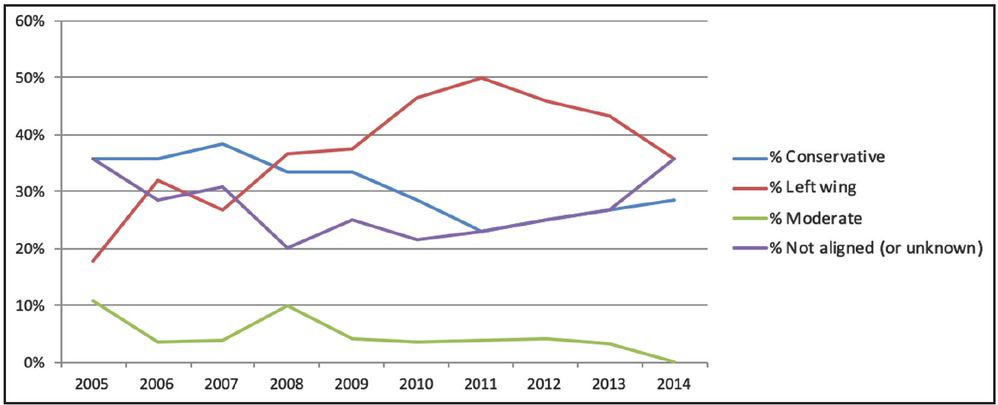
Figure A1
Proportion of magistrates belonging to professional associations.
Note: Magistrates of the fourth chamber of the Supreme Court.
Source: Authors’ own elaboration using Memorias del Tribunal Supremo.