
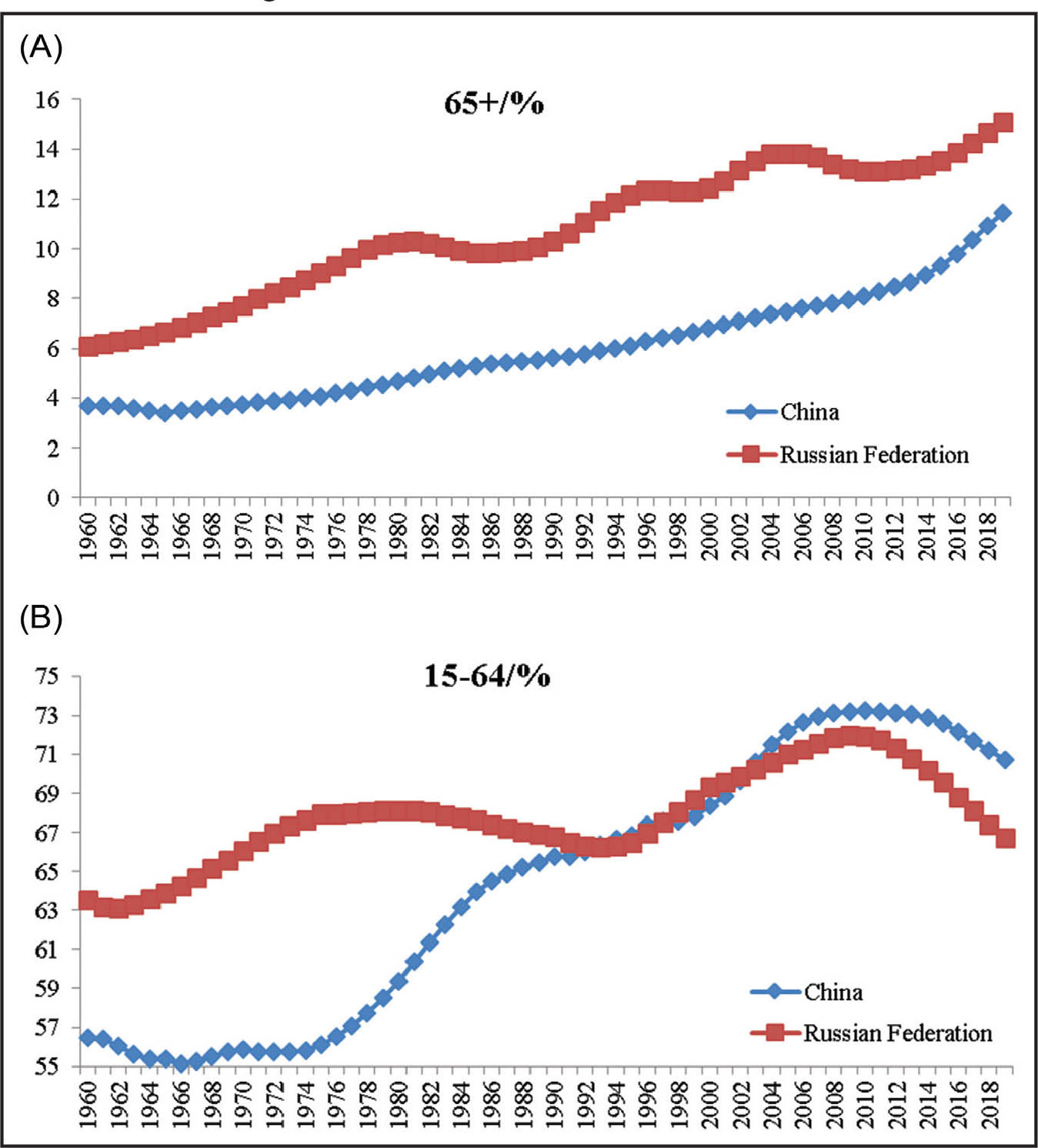
Figure 1
(A) Proportion of population aged 65+. (B) Proportion of population aged 15–64.
Source: International Labour Organization, ILOSTAT database. (https:/data.worldbank.org/indicator/SP.POP.1564.TO.ZS)
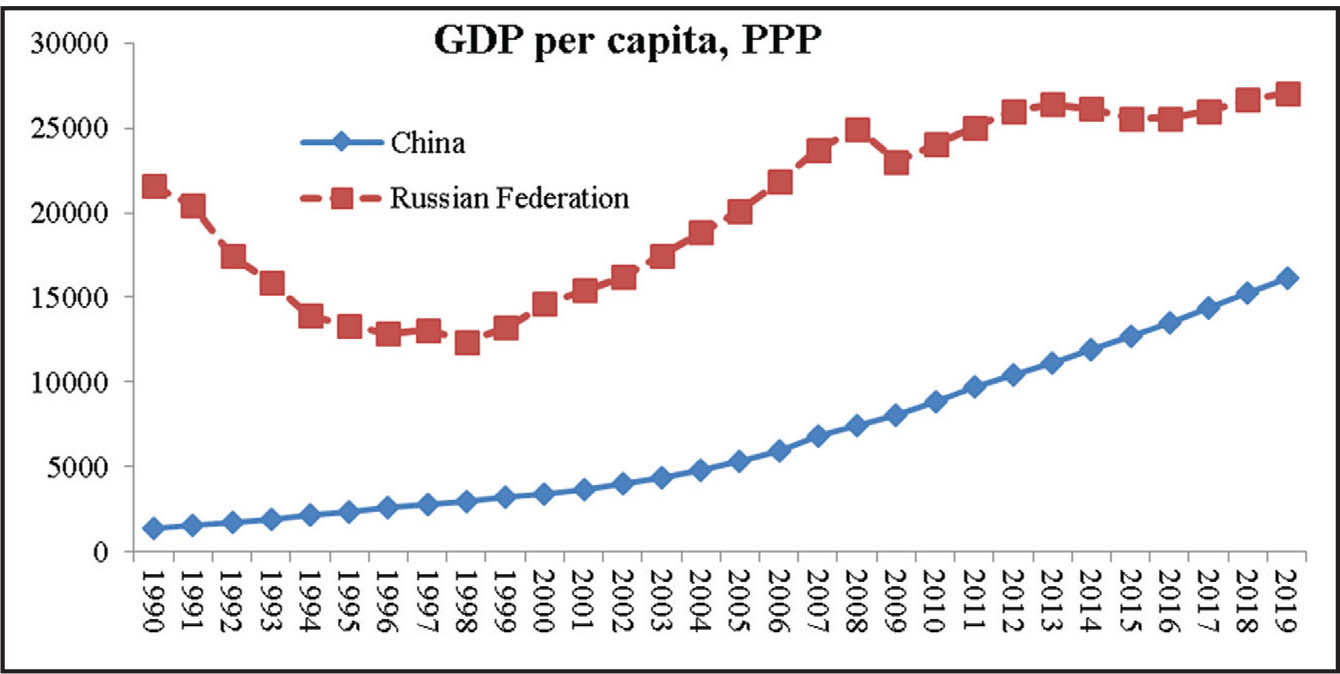
Figure 2
GDP per capita in China and Russia in constant Purchasing Power Parity (PPP).
Note: GDP per capita and Purchasing Power Parity (PPP) are expressed in constant 2017 international dollars.
Source: World Bank, International Comparison Program database. (http://data.worldbank.org/indicator/NY.GDP.PCAP.PP.KD)
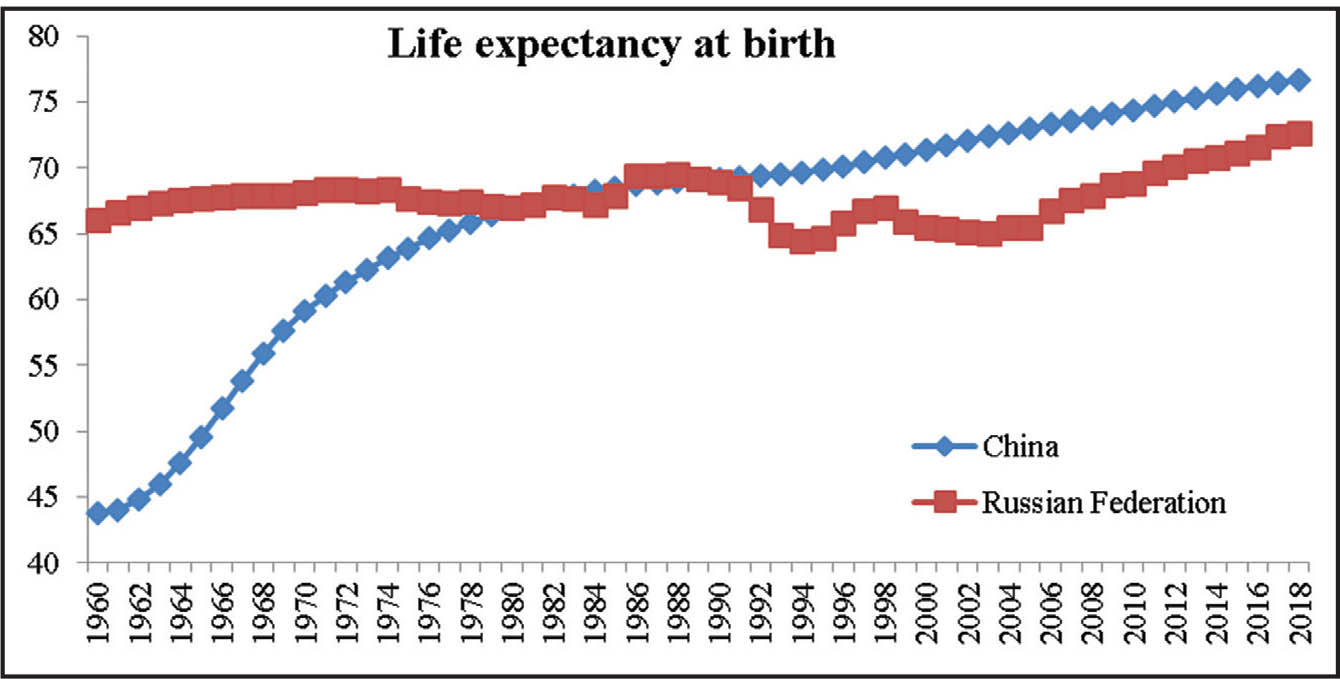
Figure 3
Life expectancy at birth in China and Russia, 1975–2018.
Source: World Bank, International Comparison Program database. (http://data.worldbank.org/indicator/SP.DYN.LE00.IN?)
Table 1
Older people in urban China and urban Russia in 2002, 2013, and 2018 by characteristics
| China 2002 | China 2013 | China 2018 | Russia 2002 | Russia 2013 | Russia 2018 | ||
|---|---|---|---|---|---|---|---|
| Gender, % | Female | 59.2 | 60.2 | 59.8 | 72.7 | 72.9 | 73.5 |
| Male | 40.8 | 39.8 | 40.2 | 27.3 | 27.1 | 26.5 | |
| Living arrangements, % | Living alone | 2.6 | 2.5 | 3.9 | 23.3 | 22.7 | 27.6 |
| Couples | 28.6 | 27.4 | 25.2 | 29.9 | 30.6 | 26.8 | |
| All other living arrangements | 68.8 | 70.0 | 70.9 | 46.8 | 46.7 | 45.7 | |
| Age, % | 55/60–70 | 73.2 | 69.9 | 69.1 | 58.6 | 60.1 | 60.3 |
| 70–75 | 26.8 | 30.1 | 31.0 | 41.4 | 39.9 | 39.8 | |
| Education, % | Low | 36.9 | 35.2 | 31.6 | 40.2 | 25.1 | 14.2 |
| Upper middle | 39.7 | 46.0 | 53.1 | 19.1 | 19.3 | 23.7 | |
| Polytechnic | 17.8 | 7.5 | 4.9 | 20.1 | 31.1 | 33.2 | |
| Higher | 5.6 | 11.3 | 10.5 | 20.7 | 24.6 | 28.9 | |
| City size, % | Large | 6.7 | 15.5 | 12.1 | 58.2 | 57.6 | 50.5 |
| Middle | 30.4 | 19.4 | 32.1 | 34.0 | 33.5 | 33.1 | |
| Small | 62.9 | 65.0 | 55.9 | 7.8 | 9.0 | 16.4 | |
| Health status, % | Healthy (good and very good) | 42.3 | 44.9 | 50.3 | 5.3 | 8.0 | 6.7 |
| Not good, not bad | 40.2 | 42.9 | 37.4 | 57.4 | 59.9 | 60.7 | |
| Not healthy (bad and very bad) | 17.5 | 12.2 | 12.3 | 37.4 | 32.1 | 32.3 | |
| Pensions | Percentage with a pension, % | 74.6 | 87.3 | 97.3 | 99.5 | 96.6 | 99.0 |
| Ln pension (in local currency, and 2013 prices), mean value | 9.3 | 9.7 | 9.7 | 8.5 | 9.3 | 11.8 | |
| Number of elderly respondents | 2424 | 3404 | 6885 | 1591 | 3233 | 3240 | |
[i] Note: The table refers to women >55 years old and men >60 years old, both being at most 75 years old.
[ii] Source: Authors’ calculations from the CHIP and the RLMS data.
Table 2
Employment rates for older people in urban China and urban Russia in 2002, 2013, and 2018 (%)
| China 2002 | China 2013 | China 2018 | Russia 2002 | Russia 2013 | Russia 2018 | ||
|---|---|---|---|---|---|---|---|
| Gender | Female | 5.47 | 9.48 | 10.37 | 15.57 | 23.93 | 25.97 |
| Male | 5.47 | 12.82 | 15.46 | 20.37 | 21.98 | 24.36 | |
| Living arrangements | Living alone | 12.70 | 6.10 | 13.58 | 10.62 | 19.99 | 22.68 |
| Couples | 6.82 | 14.84 | 16.92 | 16.89 | 18.57 | 23.51 | |
| All other living arrangements | 4.63 | 9.38 | 10.75 | 19.98 | 28.21 | 28.21 | |
| Age | 55/60–70 | 6.96 | 14.41 | 16.74 | 27.41 | 35.48 | 29.84 |
| 70–75 | 1.39 | 2.40 | 2.77 | 1.97 | 5.21 | 7.87 | |
| Education | Low | 1.92 | 10.59 | 12.75 | 6.34 | 10.01 | 17.35 |
| Upper middle | 6.13 | 11.56 | 11.98 | 16.75 | 25.85 | 22.75 | |
| Polytechnic | 8.58 | 6.30 | 7.80 | 34.80 | 25.05 | 25.59 | |
| Higher | 13.97 | 11.47 | 15.82 | 20.30 | 32.71 | 32.55 | |
| City size | Large | 14.72 | 4.93 | 6.37 | 19.31 | 24.31 | 27.03 |
| Middle | 5.16 | 9.19 | 14.95 | 14.01 | 23.02 | 24.38 | |
| Small | 4.62 | 12.71 | 12.28 | 11.23 | 19.00 | 17.39 | |
| Health status | Healthy (good and very good) | 7.55 | 15.65 | 16.32 | 23.00 | 43.65 | 42.67 |
| Not good, not bad | 5.05 | 7.34 | 9.63 | 32.97 | 28.43 | 28.78 | |
| Not healthy (bad and very bad) | 1.42 | 5.15 | 4.95 | 5.29 | 8.97 | 11.16 | |
| Employment rate by quantiles of pensions (from low to high) | First | 11.02 | 19.17 | 32.36 | 10.61 | 29.69 | 35.46 |
| Second | 3.17 | 20.47 | 19.92 | 20.55 | 26.49 | 27.68 | |
| Third | 4.09 | 18.85 | 13.67 | 25.49 | 19.88 | 26.65 | |
| Fourth | 3.65 | 5.90 | 3.84 | 9.17 | 15.78 | 11.57 | |
| Employment rate among elderly respondents | 5.47 | 10.81 | 12.42 | 16.88 | 23.40 | 25.51 | |
[i] Note: The table refers to women over 55 years old and men over 60 years old, with both being at most 75 years old.
[ii] Source: Authors’ calculations from the CHIP and the RLMS data.
[iii] CHIP, China Household Income Project; RLSM, Russian Longitudinal Monitoring Survey.
Table 3
Estimates of employment probabilities for older people in urban China and urban Russia
| China 2002 | China 2013 | China 2018 | Russia 2002 | Russia 2013 | Russia 2018 | ||
|---|---|---|---|---|---|---|---|
| Gender (male omitted) | Female | −0.53** (0.230) | −0.77*** (0.123) | −1.03*** (0.091) | −0.56*** (0.158) | −0.11 (0.119) | −0.165 (0.142) |
| Household structure (all other living arrangements omitted) | Living alone | 1.09** (0.451) | −0.30 (0.534) | 0.49** (0.217) | 0.62** (0.288) | −0.43 (0.273) | −0.15 (0.162) |
| Couples | 0.63*** (0.443) | 0.89*** (0.101) | 0.52*** (0.099) | 0.27** (0.105) | 0.26** (0.104) | 0.29*** (0.139) | |
| Age (55/60–70 omitted) | 70–75 | −1.46*** (0.301) | −1.98*** (0.204) | −2.13*** (0.176) | −1.78*** (0.217) | −1.88*** (0.143) | −1.28*** (0.218) |
| Education (lower education omitted) | Upper middle | 1.68*** (0.305) | 0.141* (0.134) | 0.02 (0.095) | 0.60** (0.240) | 1.27*** (0.311) | 0.06 (0.208) |
| Polytechnic | 2.29*** (0.317) | 0.69*** (0.228) | 0.47*** (0.141) | 0.91*** (0.179) | 1.57*** (0.299) | 0.42** (0.201) | |
| Higher | 2.49*** (0.326) | 0.061*** (0.176) | 0.96*** (0.155) | 1.54*** (0.301) | 1.60*** (0.327) | 0.89*** (0.204) | |
| City size (small omitted) | Large | 1.26*** (0.167) | 0.88*** (0.215) | 0.35** (0.167) | 0.66*** (0.156) | 0.01 (0.117) | 1.44*** (0.275) |
| Middle | 0.27 (0.255) | −0.18 (0.191) | 0.18** (0.088) | 0.71*** (0.248) | −0.05 (0.166) | 1.06*** (0.285) | |
| Health status (healthy omitted) | Relatively healthy (not good and not bad) | −0.31 (0.258) | −0.75*** (0.117) | −0.34*** (0.090) | −0.83*** (0.263) | −0.55*** (0.156) | −1.63*** (0.236) |
| Not healthy | −1.58*** (0.403) | −0.96*** (0.234) | −1.15*** (0.177) | −1.60*** (0.291) | −1.54*** (0.184) | −0.57*** (0.187) | |
| Log of pension | −0.087*** (0.022) | −0.030*** (0.009) | −0.048*** (0.0028) | −0.046*** (0.0028) | −0.032*** (0.0024) | −1.46*** (0.179) | |
| Yearly working hours/100 | 0.03*** (0.000) | 0.03*** (0.000) | 0.02*** (0.000) | ||||
| Rate of migrants in the city | −0.03* (0.015) | −0.01** (0.005) | −0.02*** (0.003) | ||||
| Constant | −2.50*** (0.358) | −0.85** (0.1779) | −0.06 (0.123) | −0.90* (0.507) | −1.54*** (0.427) | 12.308*** (2.109) | |
| Number of observations | 2,406 | 3,340 | 6,885 | 1,582 | 3,174 | 1,749 | |
| Pseudo R2 | 0.2156 | 0.1294 | 0.2352 | 0.1749 | 0.1730 | 0.1178 | |
Table 4a
Parsimonious specification
| China 2002 | China 2013 | China 2018 | Russia 2002 | Russia 2013 | Russia 2018 | ||
|---|---|---|---|---|---|---|---|
| Gender (male omitted) | Female | −0.29*** (0.029) | −0.40*** (0.040) | −0.51*** (0.032) | −0.344*** (0.051) | −0.272*** (0.030) | −0.26*** (0.034) |
| Age (40/45–55/60 omitted) | 55/60–70 | −1.44*** (0.054) | −1.60*** (0.057) | −1.68*** (0.046) | −0.151*** (0.051) | −0.326*** (0.031) | −0.30*** (0.037) |
| 70–75 | −2.92*** (0.143) | −2.83*** (0.110) | −3.20*** (0.095) | −0.422*** (0.125) | −0.781*** (0.105) | −0.62*** (0.120) | |
| Education (lower education omitted) | Upper middle | 0.31*** (0.061) | 0.06 (0.065) | 0.04 (0.051) | 0.085 (0.095) | 0.112** (0.049) | 0.06 (0.052) |
| Polytechnic | 0.78*** (0.064) | 0.65*** (0.091) | 0.45*** (0.077) | 0.518*** (0.093) | 0.227*** (0.049) | 0.12** (0.052) | |
| Higher | 1.14*** (0.082) | 0.96*** (0.074) | 1.13*** (0.057) | 0.248*** (0.093) | 0.570*** (0.050) | 0.38*** (0.052) | |
| Constant | 8.83*** (0.061) | 9.77*** (0.065) | 9.98*** (0.053) | 8.785 (0.163) | 9.797 (0.066) | 10.23*** (0.086) | |
| R2 | 0.267 | 0.341 | 0.352 | 0.102 | 0.178 | 0.145 | |
| Number of observations | 4,977 | 4,310 | 7,574 | 1,182 | 2,542 | 1,675 | |
Note: (1) Estimates based on samples of workers aged ≥40/45. The dependent variable is log earnings. The specification also includes two dummies for city size (with small city treated as omitted category). (2)
Source: Authors’ estimates from the CHIP and the RLMS data.
CHIP, China Household Income Project; RLMS, Russian Longitudinal Monitoring Survey.
Table 4b
Extended specification
| China 2002 | China 2013 | China 2018 | Russia 2002 | Russia 2013 | Russia 2018 | ||
|---|---|---|---|---|---|---|---|
| Gender (male omitted) | Female | −0.14*** (0.027) | −0.26*** (0.038) | −0.34*** (0.028) | −0.394*** (0.050) | −0.237*** (0.032) | −0.215*** (0.035) |
| Age (40/45–55/60 omitted) | 55/60–70 | −0.99*** (0.052) | −1.03*** (0.057) | −0.90*** (0.047) | −0.111** (0.052) | −0.284*** (0.030) | −0.272*** (0.036) |
| 70–75 | −2.33*** (0.132) | −1.90*** (0.109) | −1.11*** (0.180) | −0.404*** (0.130) | −0.713*** (0.095) | −0.547*** (0.115) | |
| Education (lower education omitted) | Upper middle | 0.21*** (0.056) | 0.02 (0.060) | 0.13*** (0.047) | 0.093 (0.091) | 0.099** (0.047) | 0.058 (0.050) |
| Polytechnic | 0.44*** (0.060) | 0.40*** (0.087) | 0.48*** (0.069) | 0.347*** (0.097) | 0.183*** (0.047) | 0.093** (0.040) | |
| Higher | 0.68*** (0.073) | 0.58*** (0.073) | 0.87*** (0.057) | 0.164* (0.091) | 0.455*** (0.052) | 0.368*** (0.062) | |
| Constant | 8.25*** (0.059) | 8.78*** (0.074) | 9.72*** (0.071) | 8.860 (0.176) | 9.684 (0.080) | 10.127*** (0.098) | |
| R2 | 0.396 | 0.436 | 0.305 | 0.1429 | 0.2557 | 0.2255 | |
| Observations | 4,977 | 4,310 | 6,531 | 1,182 | 2,542 | 1,675 |
Note: (1) Estimates based on samples of workers aged ≥40/45. The dependent variable is log earnings. The specification also includes two dummies for city size (with small cities as omitted category), three dummies for occupation (manual workers as omitted category), five dummies for economic sector (manufacturing as omitted category), and three dummies for ownership type (with others as omitted category). (2)
Source: Author’s estimates from the CHIP and the RLMS data.
CHIP, China Household Income Project; RLMS, Russian Longitudinal Monitoring Survey.
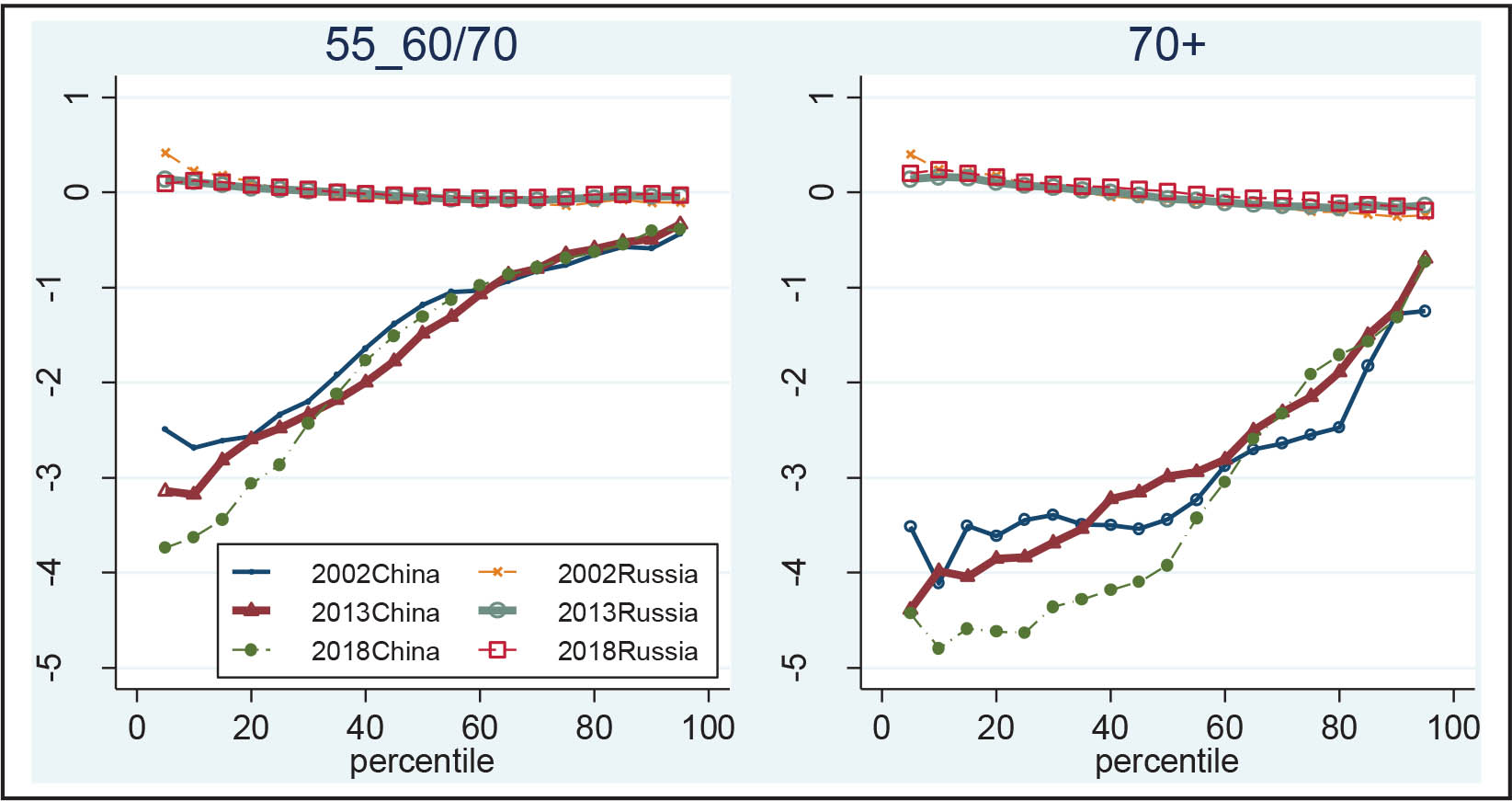
Figure 4
Quintile regression coefficients on age from earnings equations by percentiles.
Note: The estimates are from the specifications available in Table 4a.
Source: Authors’ estimates from the CHIP and RLMS. CHIP, China Household Income Project; RLMS, Russian Longitudinal Monitoring Survey