
I. Introduction
The Korea Financial Consumer Protection Act was enacted in 2020 after legislative initiatives and discussions that began in the National Assembly in 2011. At that time, the Korean financial market required enhanced protection for financial consumers and improvement of their financial literacy, as the existing financial and industrial policies were primarily oriented toward the interests of financial institutions.
Around the same period, other advanced economies had already implemented similar legislative frameworks. Japan enacted the Financial Instruments Sales Act in 2000 and the Financial Instruments and Exchange Act in 2006. The OECD established the High-Level Principles on Financial Consumer Protection in 2012, which were later expanded from ten to twelve principles in 2022. The United Kingdom also enacted the Financial Services and Markets Act in 2000 and the Financial Services Act in 2012, both aiming to strengthen consumer protection and regulatory accountability in the financial sector.
In general, the enactment and evolution of financial consumer protection laws vary according to the sophistication of the financial system, the degree of information asymmetry, and the occurrence of financial misconduct or crises. Depending on each country’s legal and regulatory structure, the approach may take the form of principle-based regulation, rule-based (list-type) regulation, or a hybrid model.
Despite the enactment of the Korea Financial Consumer Protection Act, issues related to effective financial consumer protection have persisted over the past three years. Continuous increases in misselling claims, the limited strategic response of financial institutions, and the stagnant financial literacy of consumers indicate that further improvements are required.
This paper aims to analyze the effectiveness of the current Korea Financial Consumer Protection Act and to propose enhanced regulatory tools and frameworks for protecting financial consumers by comparing advanced legislative cases, particularly those of the United Kingdom and Japan. As Whitford (1989) emphasized, effectiveness analysis is essential to achieving the intended legal objectives. Methodologically, this study adopts a gap analysis and a consumer-driven big data approach to assess the effectiveness of Korea’s current financial protection regime and to derive policy implications for future reform.
II. Legal Framework Comparison
Each country’s legal framework differs in terms of its background, implementation methods, and regulatory orientation. Each country’s Financial Consumer Protection Act (FCPA), in particular, reveals distinct legislative characteristics between Korea, the United Kingdom, and Japan. In Korea, the primary motivation for enacting the legislation stemmed from the need to address damages suffered by financial consumers and to comply with OECD recommendations. In contrast, in the United Kingdom and Japan, the legislative background is more strongly associated with the advancement of financial markets and the enhancement of financial consumer rights and interests.
Although the overall structure of the legal systems in these countries can be viewed as unified in terms of their fundamental characteristics, their regulatory approaches differ significantly. Korea’s disciplinary framework tends to specify detailed rules, while both the United Kingdom and Japan employ principle-based regulatory systems. The United Kingdom, for instance, adopts the “comply or explain” principle, which emphasizes flexibility and accountability rather than strict rule-based compliance. The key features of each country’s legal system are summarized in the Appendix (table A1).
Some observers (e.g., Cherednychenko, 2015) argue that principles-based consumer protection frameworks can be regarded as effective structures for safeguarding financial consumers and to achieve substantial consumer protection outcomes within complex financial markets.
The primary legislative framework for financial consumer protection, commonly referred to as the “Six Major Business Conduct Regulations” (suitability, propriety, duty to explain, prohibition of unfair business practices, prohibition of unfair solicitation, advertising regulations) varies across countries. The main features of these conduct regulations in each country are summarized in the Appendix (table A2).
In Korea, these regulations are designed to mitigate information asymmetry during the financial product sales process and to minimize incomplete or inappropriate sales, in contrast to practices in the United Kingdom and Japan. By adopting the Six Major Business Conduct Regulations, Korea aims to reduce consumer harm and encourage sound business practices through the implementation of principles such as suitability, propriety, and the duty to explain.
The principles of suitability, propriety, and the duty to explain are applied in a comparable manner in Korea, the United Kingdom, and Japan. Specifically, financial institutions are required to recommend suitable financial products and to conduct sales in accordance with the consumer’s financial competence. Additionally, they must provide comprehensive explanations during the sales process. This reflects a shared theoretical framework for financial consumer protection among the three countries.
Nevertheless, differences exist regarding fairness and advertising regulations. The United Kingdom and Japan employ a principles-based regulatory approach rather than prescribing detailed behaviors, thereby allowing greater market autonomy in implementation. Lee et al. (2011) have similarly noted this.
In terms of consumer rights protection, each of the three countries has implemented legislative measures addressing consumers’ interests in cases of business conduct violations, financial education obligations aimed at mitigating information asymmetry, and regulatory mechanisms for the protection of financial consumer rights, including requests for information. However, the regulatory frameworks of these countries differ. For example, regarding financial education and dispute resolution, South Korea adopts a prescriptive, list-based regulatory approach with active engagement by financial supervisor, whereas the United Kingdom and Japan rely on principles-based recommendations emphasizing market autonomy. Furthermore, supplementary mechanisms for safeguarding financial consumer rights, such as class action lawsuits, are observed only in the United Kingdom and Japan. A comparison across the three countries is provided in the Appendix (table A3).
III. Effectiveness Analysis and Results
Kim (2023) and Son (2021) emphasized that, to enhance the effectiveness of the FCPA in Korea, it is necessary to derive implications based on both the actual conditions of the financial sector and comparative analyses with advanced systems, such as those in the United Kingdom. Accordingly, this study aims to evaluate the effectiveness of the Korean Financial Consumer Protection Act by conducting a gap analysis that considers both international best-practices and the current domestic financial environment.
Gap analysis is a methodology used to identify and analyze the gap between the current state and the desired/future state of an organization, system, policy, or process. In other words, it examines where and why a system or process is not achieving its goals. By conducting gap analysis, organizations can systematically identify areas that require improvement and prioritize strategic actions.
A. Gap Analysis of the Six Major Conduct Regulations
First, the Suitability Principle emphasizes the rationality of financial product transactions and imposes an obligation to provide products that align with the specific needs of financial consumers. This principle requires differentiated suitability verification across various financial products, including deposits, guarantees, loans, investment products, and securities transactions. However, its practical application raises questions regarding rationality, particularly in the context of pressures faced by financial institutions to expand sales. Without a rigorous verification process, there is a risk that suitability assessments merely become a “simple pass-through” type of conformity check, failing to account for the intrinsic characteristics of individual products and the corresponding consumer needs.
Second, the Propriety Principle aims to enhance the appropriateness and transiency of financial instrument transactions by ensuring that financial products are provided in sizes suitable to the needs and propensities of financial consumers. This principle considers factors such as the expansion of sales by financial institutions, the spending capacity of consumers, and their risk tolerance and investment tendencies. However, the practical applicability of this principle remains questionable, as the notion of a universally “right-sized” financial product may not exist. Consequently, there is a risk that the principle may function merely as a “simple pass-through” compliance measure, failing to substantively address the alignment between products and consumer needs.
Third, the Principle of Explanation plays a critical role in financial consumer protection, particularly in the context of increasing complexity in financial products and the expansion of high-risk product sales due to intensified competition in a low-growth environment. Under these conditions, information asymmetry between financial institutions and consumers is likely to be significant, rendering thorough explanations essential during financial product transactions. As providers of financial products, financial institutions often prioritize competitiveness and sales expansion, employing strategies such as frequent new product launches and marketing campaigns. While product terms and conditions tend to be complex, marketing messages are often simplified, which may hinder consumer comprehension. This challenge is further compounded by demographic factors, such as an aging population, which may limit improvements in financial literacy and competence. Consequently, ensuring that consumers fully understand key product information — including standard terms, core product features, and post-sale communications (e.g., “happy calls”) — remains difficult. Empirical evidence underscores these concerns. According to the Korea Financial Supervisory Service (2024), incomplete sales were observed in 0.03 percent of insurance contracts, with a notable surge in incomplete sales related to derivative-linked bank products. These findings highlight the ongoing challenges in achieving effective disclosure and ensuring that consumers receive sufficient explanations prior to financial transactions.
Finally, the three principles concerning the prohibition of unfair business practices, including restrictions on unfair solicitation and advertisement regulations, exhibit small gaps among the three countries under comparison. In Korea, the enforcement of prohibitions against unfair business practices is strengthened through sub-regulations that monitor the signing of similar contracts within ±3 or ±6 months, thereby enhancing regulatory effectiveness via active oversight. However, the practical alignment of the “duty to explain” with actual consumer needs remains questionable. Although financial institutions and product providers may frame explanations to satisfy revenue-generating objectives, it is uncertain whether they consistently provide appropriate products and faithfully convey information to prevent consumer misunderstanding. This concern is particularly salient in the context of complex financial products and intensified market competition, where sales methods may inadvertently lead to consumer misconceptions. Consequently, the effectiveness of prohibitions against unfair solicitation appears limited, as compliance is often superficial and the potential for consumer misunderstanding remains high.
B. Gap Analysis of Consumer Rights Protection Systems
Financial education in Korea has primarily been implemented as involuntary programs led by the Financial Supervisory Service, including standardized youth education initiatives. While these programs aim to enhance financial literacy, they exhibit limitations in effectively improving the capabilities of financial consumers. Fundamentally, the overarching goal should be to strengthen financial competencies across all socioeconomic classes.
Mechanisms for addressing financial disputes in Korea have involved the introduction of a small-scale, binding dispute resolution system and complaint-handling procedures centered on the Financial Consumer Protection Agency. However, these processes must be structured to genuinely protect consumer rights and interests. Notably, punitive damages liability, which was initially considered, was not implemented, thereby placing the burden of proof on financial institutions, raising concerns about fairness in dispute resolution.
Consumer rights protections, including the right to withdraw subscriptions and terminate illegal contracts, have been expanded to enhance the effective safeguarding of financial consumers’ interests. Nevertheless, there is potential for abuse by both consumers and financial product providers. This concern is particularly pronounced given recent increases in financial market volatility and low economic growth, which have elevated transaction turnover rates and, consequently, the frequency of illegal contract usage and subscription withdrawals.
Administrative and judicial sanctions, such as business suspensions and license revocations, are intended to enforce the six core principles of consumer protection and ensure regulatory effectiveness. However, in practice, there are few instances of large-scale business suspensions or license revocations by financial regulators. As a form of warning regulation, the practical impact of these sanctions appears limited.
IV. Big Data Analysis of Korean FCPA Responses
This section of the paper analyzes the effectiveness of the Korean FCPA using big data methodologies. The primary dataset is derived from Google Trends, focusing on keywords such as “Financial Consumer Protection” and “Financial Complaint” before and after the enactment of the FCPA in 2020. To examine temporal patterns and causal relationships, trend analysis, and Vector Autoregression (VAR) models are employed.
Figure 1 shows the monthly search quantities for each term, from January 2018 through February 2025, encompassing periods before and after the January 2022 enactment of the FCPA. Figure 2 summarizes the pre- and postenactment search indexes for each term. The analysis indicates that public attention to financial consumer protection issues has intensified following the enactment of the FCPA. Specifically, the consumer protection index increased from 25.4 to 50.1, while the financial complaints index rose from 28.9 to 58.2. These findings suggest that the law has effectively heightened social awareness regarding financial consumer protection. However, the simultaneous increase in consumer interest in financial complaints implies that the practical effectiveness of the legislation may be limited. This observation highlights a gap between legislative intent and actual consumer outcomes, suggesting that the current regulatory framework may not sufficiently prevent consumer grievances.
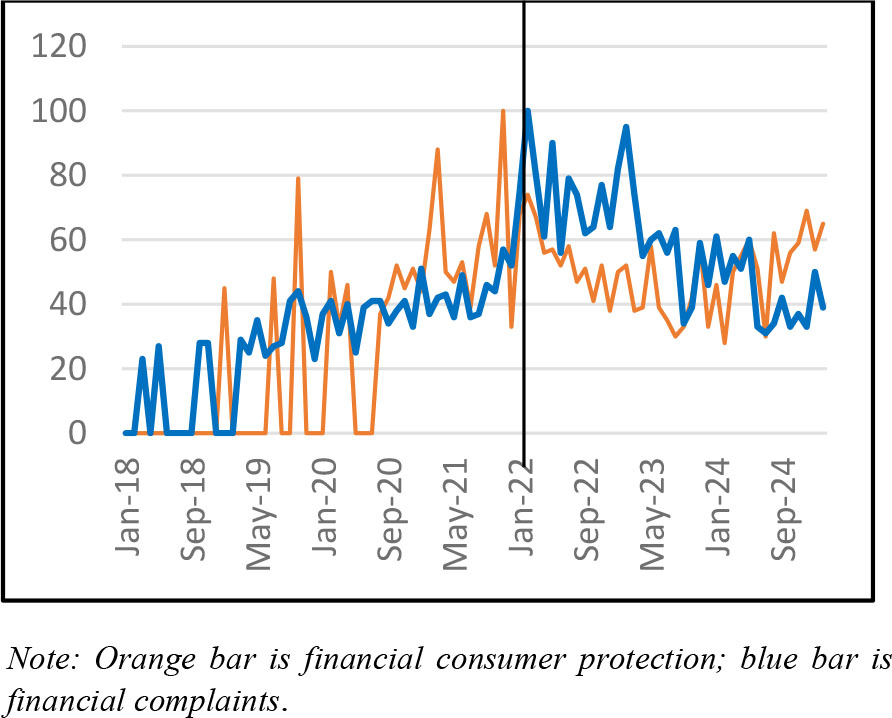
Figure 1.
Trends in Search Frequency
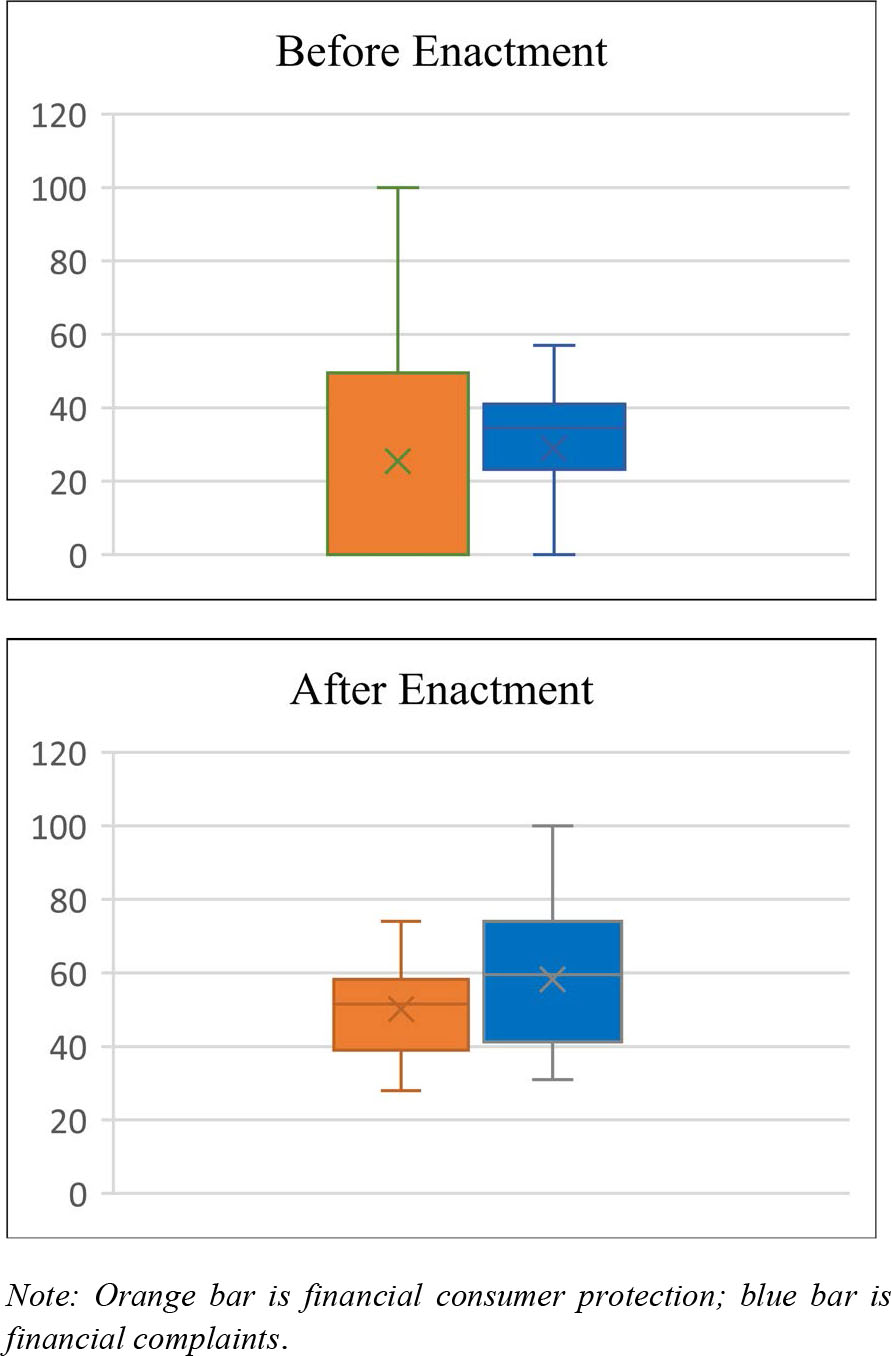
Figure 2.
Average Search Indexes before and after FCPA enactment
VAR analysis using Vector Error Correction (VEC) techniques is employed to examine the dynamic relationship between social interest in financial consumer protection and enactment of the FCPA, as well as the subsequent effect on financial complaints. The theoretical expectation is that increased social awareness regarding financial consumer protection would prompt legislative action, which in turn would reduce financial complaints. Estimation results for the pre-enactment period are reported in Table 1 and results for the post-enactment period are reported in Table 2. Results indicate that no significant dynamic relationship was observed either before or after the enactment of the FCPA. The coefficients measuring the autoregressive relationship between financial consumer protection and financial complaint were not statistically significant. This suggests that, in the case of Korea, the legislative process was primarily driven by OECD recommendations and notable financial accidents rather than an endogenous response to domestic social demand.
Table 1.
VEC Estimates for pre-Enactment Period
| Variable | Coeff. | S.E. | z | p>|z| |
|---|---|---|---|---|
| fin consumer L1 | .1630 | .1478 | 1.10 | 0.270 |
| fin consumer L2 | .1408 | .1513 | 0.93 | 0.353 |
| fin complaints L1 | .2090 | .2899 | 0.72 | 0.471 |
| fin complaints L2 | .6738 | .2939 | 2.29 | 0.022 |
| constant | −5.786 | 7.093 | −0.82 | 0.415 |
| Variable | Coeff. | S.E. | z | p>|z| |
|---|---|---|---|---|
| fin consumer L1 | .0112 | .0724 | 0.15 | 0.878 |
| fin consumer L2 | .1032 | .0737 | 1.40 | 0.162 |
| fin complaints L1 | .3828 | .1433 | 2.67 | 0.008 |
| fin complaints L2 | .2607 | .1452 | 1.80 | 0.074 |
| constant | 8.859 | 3.505 | 2.53 | 0.011 |
Table 2.
VEC Estimates for post-Enactment Period
| Variable | Coeff. | S.E. | z | p>|z| |
|---|---|---|---|---|
| fin consumer L1 | .2824 | .1539 | 1.84 | 0.066 |
| fin consumer L2 | .3174 | .1196 | 2.65 | 0.008 |
| fin complaints L1 | −.0640 | .1269 | −0.51 | 0.611 |
| fin complaints L2 | −.1148 | .1257 | .91 | 0.361 |
| constant | 30.730 | 9.889 | 3.11 | 0.001 |
| Variable | Coeff. | S.E. | z | p>|z| |
|---|---|---|---|---|
| fin consumer L1 | .0604 | .2113 | 0.29 | 0.775 |
| fin consumer L2 | −.0102 | .1642 | −0.06 | 0.951 |
| fin complaints L1 | .4386 | .1742 | 2.52 | 0.012 |
| fin complaints L2 | .2776 | .1726 | 1.61 | 0.108 |
| constant | 13.771 | 13.578 | 1.01 | 0.311 |
V. Discussion
This paper conducts a comparative analysis of the effectiveness of FCPAs in Korea, the United Kingdom, and Japan. Through an in-depth examination of detailed regulatory frameworks, policy directions and gap analysis, significant differences among the three countries are identified, offering implications for enhancing regulatory effectiveness. Furthermore, comparative analysis highlights a significant gap between Korea and countries such as the United Kingdom and Japan regarding detailed legislative provisions for financial consumer protection and the safeguarding of consumer rights. This finding underscores the need for more comprehensive and context-specific regulatory mechanisms in Korea to achieve effective consumer protection outcomes.
First, improving the effectiveness of the Six Major Conduct Regulations, to strengthen the current adequacy and suitability principle regulations—which are often implemented in a simple “pass-through” manner—it is necessary to establish pre- and post-verification processes, as exemplified by the United Kingdom. UK regulations (FSA 2012, ICOBS Handbook) allow for the systematic collection of customer financial knowledge and needs. If a financial institution fails to meet adequacy and suitability standards, active refusal requests and documentation of the entire process are mandated.
In Japan, under the Financial Instruments Sales Act, financial companies are required to prepare autonomous guidelines for each of the Six Major Conduct Regulations. This framework promotes voluntary market competition and a “comply or explain” regulatory approach, as stipulated in Article 9 of the Act. These measures aim to alleviate information asymmetry in financial products and services, thereby enhancing consumer financial capabilities. However, the current approach primarily strengthens compliance superficially. To genuinely enhance financial literacy, a transition is needed from mere “selling” of financial products through standard education to personalized “consulting” that strengthens financial competencies. The UK model, which emphasizes transitioning financial product providers into financial product advisors, offers a valuable reference for system redesign.
Second, protection of consumer rights through punitive measures and class actions, current small dispute settlement mechanisms for claims of twenty million won or less rely on conciliation under the Civil Code, which is insufficiently binding. In contrast, in countries such as the UK and Germany, dispute resolution outcomes are treated as legally binding settlements, and private litigation is suspended once a case is filed with the designated body. Despite existing consumer rights protections, issues such as misselling of derivatives in the banking sector and incomplete life insurance sales persist. Therefore, Korea requires stronger proactive regulatory measures, including the imposition of substantial penalties for violations of the six major conduct regulations. Such measures would incentivize financial institutions to actively protect consumer rights and interests.
Finally, for the protection of financially vulnerable groups the FSC of Korea reported that certain consumer segments, including the elderly, foreigners, and individuals with disabilities, remain vulnerable, particularly concerning investment products and incomplete life insurance offerings. For example, in the first half of 2024, complaints related to bank investment-type products accounted for 44.2 percent, and incomplete life insurance offerings accounted for 42.0 percent. While existing human rights laws prohibit discrimination based on sex and age, additional protections are necessary to address information asymmetry and financial capability. Designating financially vulnerable groups within each sector and implementing tailored protection mechanisms can enhance overall business processes. International practices, such as those by the OECD, the UK FSA, and Japan’s Financial Services Agency, demonstrate legislative and regulatory frameworks that consider digital accessibility and the needs of aging populations.
In light of accelerating demographic aging, regulatory strategies should focus on both financial institutions and consumers, particularly elderly consumers. Strengthening financial competencies, establishing complete and transparent sales processes, and developing specialized products and services for vulnerable groups are essential steps to achieve comprehensive financial consumer protection.
Appendices
Appendix
Table A1.
Comparison of Legal Frameworks
| Korea | UK | Japan | |
|---|---|---|---|
| Legislative Needs | Misleading financial products, OECD recommendations | Advancement of financial services, dual supervisory system | Advancement of financial markets, strengthening consumer rights |
| Legal System | Integrated Act | Integrated Act | Integrated Act |
| Discipline System | Detailed list-based regulation | Principles-based regulation | Principles-based regulation |
| Penalties | Fines, penalties, damages | Fines, penalties, damages | Administrative sanctions |
Table A2.
The Six Major Business Conduct Regulations
| Category | Korea | UK/Japan |
|---|---|---|
| Suitability Principle | When selling products, consider age, consumer needs, investment propensity | Same principles |
| Propriety Principle | Considering the consumer’s financial situation and investment experience, appropriate products must be offered for sale | Same principles |
| Duty to Explain | The core structure of the product, the risks, the coverage, must be explained in a way that can be understood | Same principles |
| Prohibition of Unfair Business Practices | Prohibition of forcing exchange of a contract for another product or to reduce or change the linkage/partnership service in general | No detailed regulation other than principled regulation |
| Prohibition of Unfair Solicitation | Prohibition of false or misleading information about the product, or failing to notify about important characteristics | No detailed regulation other than principled regulation |
| Advertising Regulation | Mandatory disclosure of product structure and risk factors in advertising | Non-principled disclosure regulation |
Table A3.
Consumer Rights Protection Systems
| Category | Korea | UK/Japan |
|---|---|---|
| Financial Education | Support for sound financial life, conduct education to strengthen consumers’ financial competence, and operate a comparative disclosure system | Promotion of financial education centered on private financial companies |
| Financial Dispute Settlement | Establishment of a “Financial Dispute Settlement Body” to manage financial disputes, securing one-sided binding force | Ombudsman, Dispute Resolution Bureau |
| Victim Relief Scheme | In the event of a consumer’s loss, obligation to compensate for damages | Punitive damages, class action lawsuits, and other severe damage suppression mechanisms |
| Protection of Consumer Rights and Interests | Consumers have right of withdrawal from subscription and right to terminate illegal contracts | Principles adoption only |
| Sanctions | Fines and penalties | Same principles |