
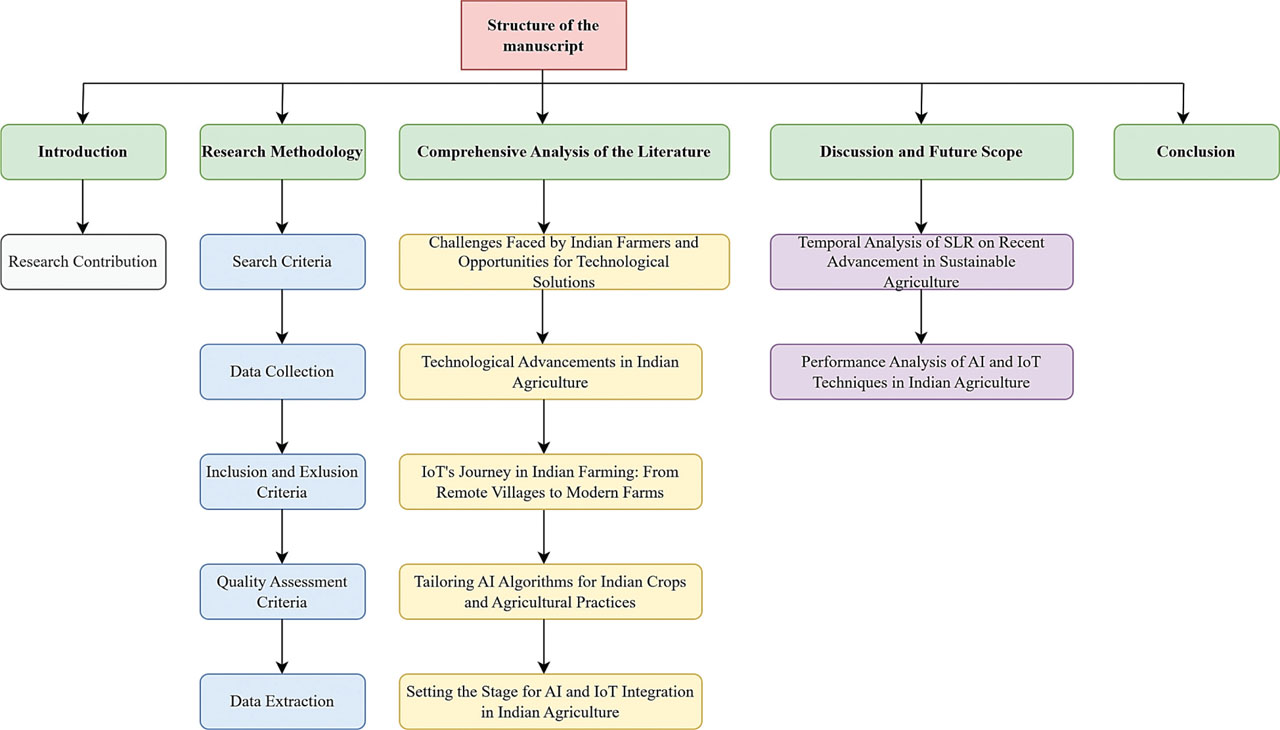
Figure 1:
Thematic Representation of Paper.
Table 1:
A comparative analysis of existing review studies on IoT and AI technologies in agriculture and the present study
| Ref. No. | Primary focus | Core theme | Technology emphasis | Approach type | Methodology | Key contributions | Strength | Limitations | Future scope identified |
|---|---|---|---|---|---|---|---|---|---|
| [7] | Smart waste management using IoT and AI | Sensor-based monitoring & automation | IoT, WSN, Cloud, AI | Technical review | Comparative literature synthesis of IoT frameworks | Highlights real-time monitoring & optimization | Strong technical depth | Limited focus on compost valorization | AI-driven predictive waste management |
| [8] | Organic waste management & composting technologies | Decentralized composting & circular economy | Composting units, bioconversion, anaerobic digestion | Environmental & process-oriented review | Analysis of composting techniques and case studies | Emphasizes nutrient recovery & methane reduction | Strong environmental relevance | Limited digital automation aspects | Smart composting integration C |
| [9] | Sustainable municipal solid waste systems | Policy, sustainability & environmental impact | Waste segregation systems, recycling tech | Policy + sustainability review | Review of global MSW strategies | Focuses on sustainability indicators | Strong sustainability & policy context | Less technological detailing | Circular economy models |
| [10] | Integrated smart city waste frameworks | Smart infrastructure + digital transformation | IoT, data analytics, smart bins, GIS | Integrated systems review | Review of smart city waste models & architecture | Connects smart technologies with urban governance | Holistic integration perspective | Limited experimental validation | Edge computing & AI-enabled automation |
| [11] | IoT-based Smart Irrigation System | Automation in agriculture | NodeMCU ESP8266, Soil moisture sensor, DHT11, Cloud (Blynk) | System implementation & applied review | Hardware-based IoT architecture with threshold-based control | Developed low-cost automated irrigation with cloud monitoring | Practical, affordable, suitable for small farmers | Limited AI integration, basic threshold logic, scalability not discussed | Integration of ML for predictive irrigation; scalability for large farms |
| [12] | Annual Technical Issue—Role of AI & Remote Sensing in Regenerative Farming) | Regenerative farming with AI & Digital tools | Sustainability & soil restoration | AI, ML, Remote sensing, IoT, DSS, GIS | Conceptual + technology synthesis review | Thematic review of digital agriculture technologies | Connects AI, IoT & regenerative agriculture; regional focus (West Bengal) | Strong sustainability perspective; integrates policy + tech | Mostly conceptual; lacks experimental validation |
| [13] | Global research trends in IoT agriculture | Research mapping & knowledge structure | IoT, ML, Blockchain, Robotics | Bibliometric review | Scopus & WoS data analysis using Bibliometrix & VOSviewer | Identifies top countries, themes, research gaps | Comprehensive trend analysis (1979–2025); highlights underexplored areas | No technical implementation details | Focus on data governance, interoperability, digital literacy research |
| [14] | Smart sensing technologies in agriculture | AI-integrated precision sensing | Optical, acoustic, electromagnetic, soil sensors; Edge AI; Blockchain | Systematic review (PRISMA-based) | Structured literature review (2020–2024) | Detailed classification of sensors + AI models (CNN, SVM, RF) | Strong technical depth; covers real-world challenges | High-level overview; cost-effectiveness limited discussion | Edge AI deployment, decentralized data governance, autonomous farming systems |
| Our Study | Application and impact of IoT and AI in Indian agriculture | Digital transformation of agriculture through smart farming, precision agriculture, and data-driven decision-making to improve productivity and profitability | IoT (sensors, smart irrigation, remote monitoring), AI (ML, predictive analytics, decision-support systems), IoT–AI integration for precision agriculture | SLR with analytical synthesis | Comprehensive review of existing research on challenges in Indian agriculture and technological solutions using IoT and AI; comparative analysis of technologies, applications, benefits, and emerging trends | Identifies key agricultural challenges in India and evaluates how IoT and AI technologies address them; explains individual roles of IoT and AI and highlights the benefits of their convergence in enabling smart and precision farming; outlines future research directions | Provides a holistic overview of IoT, AI, and their integration in agriculture; connects technological advancements with real agricultural challenges in India; highlights profitability and sustainability benefits | Limited empirical or field-level validation since the study is based mainly on literature review; technology adoption barriers such as cost, digital literacy, and infrastructure constraints may not be quantitatively analyzed | Development of integrated IoT–AI farming platforms, adoption of predictive analytics for crop management, expansion of smart sensing technologies, improved rural digital infrastructure, and research on scalable precision agriculture solutions |
Table 2:
Proposed RQs and its objectives
| Question No. | RQs | Research objective |
|---|---|---|
| RQ1 | What are the major challenges faced by the Indian agricultural sector, and what technological opportunities exist to address them? | To determine and evaluate the main obstacles that Indian agriculture faces, as well as to look at possible technical advancements that could promote efficient and sustainable farming methods. |
| RQ2 | How does the adoption of IoT technologies contribute to improving efficiency, productivity, and profitability in Indian agriculture? | To investigate how IoT-based technology, like sensors, smart irrigation systems, and remote monitoring, might improve agricultural output, profitability, and efficiency. |
| RQ3 | What role does AI play in enhancing decision-making, crop management, and profitability in the Indian agricultural sector? | To assess the ways in which AI-driven methods, such as ML, predictive analytics, and decision-support systems, enhance crop management and agricultural profitability in India. |
| RQ4 | How can the integration of IoT and AI technologies support intelligent, data-driven farming practices in India? | To examine the advantages and uses of combining IoT and AI technologies in order to create precision, data-driven, and intelligent farming systems for the Indian agriculture industry. |
| RQ5 | What are the future prospects, challenges, and research directions for the adoption of IoT and AI in the Indian agricultural sector? | To investigate potential future developments, new trends, and research avenues for IoT and AI technology adoption to promote India’s sustainable agricultural growth. |
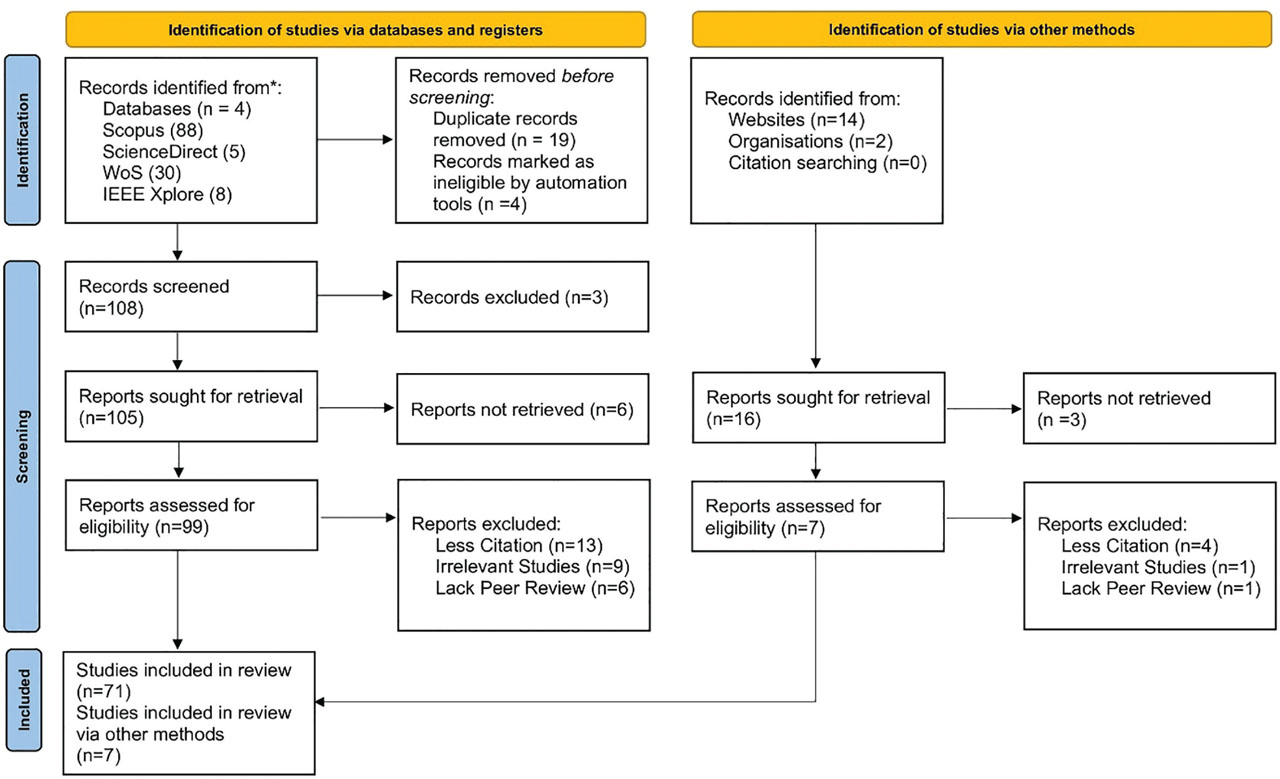
Figure 2:
PRISMA flow diagram for SLR on IoT and AI Technologies in Agriculture. AI, artificial intelligence; IoT, Internet of Things; SLR, systematic literature review.
Table 3:
Quality assessment criteria
| No | Criteria | Score |
|---|---|---|
| 1 | The search study must be relevant to address the formulated objectives of the study. | Yes = 1 |
| No = 0 | ||
| 2 | The research study must focus on challenges faced by Indian farmers in adapting AI and IoT technologies. | Yes = 1 |
| No = 0 | ||
| 3 | The research study must discuss existing IoT and AI applicability with respect to Indian agricultural challenges. | Yes = 1 |
| No = 0 | ||
| 4 | The research study must include the design of IoT architecture in agriculture. | Yes = 1 |
| No = 0 | ||
| 5 | The research study must include the design of AI based framework in agriculture. | Yes = 1 |
| No = 0 | ||
| 6 | The research study must include integration of AI and IoT for agriculture domain use. | Yes = 1 |
| No = 0 |
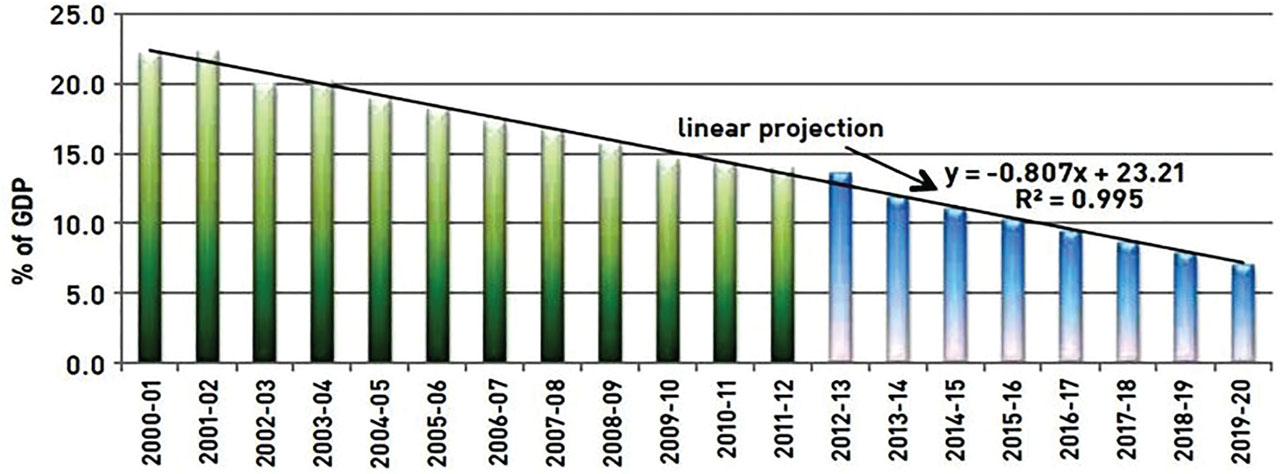
Figure 3:
Agricultural GDP percentage per year. Source: Fourth Semi-Annual Medium-Term Agricultural Outlook Report, September 2015, NCAER.
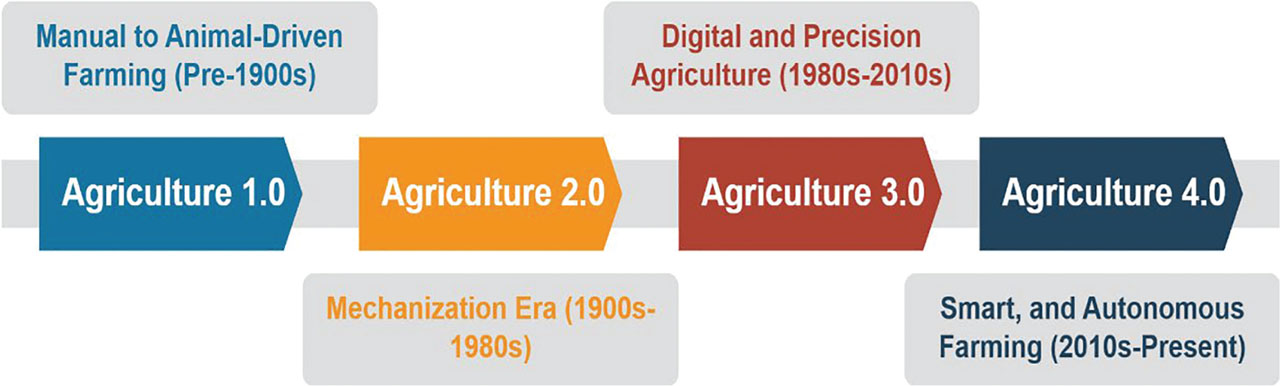
Figure 4:
Indian agricultural paradigm shift from agriculture 1.0 to agriculture 4.0.
Table 4:
Agricultural applications in India
| Agricultural application name | Technology used | Purpose |
|---|---|---|
| AI-powered sowing app [29] | AI and cloud-based predictive analytics | Suggesting farmers when to plant |
| Soilsens [30] | AI, cloud, IoT | Soil surveillance system |
| Jivabhumi [31] | Blockchain | To purchase farm products |
| Gramophone [32] | Agstack Technology | Image recognition tool for soil science |
| Gobasco [33] | AI, Bigdata | Agri rural commerce |
| CropIn [34] | AI | For future farming solutions |
| Intello Lab [35] | DL | For identification of animals faces and plant species |
| Agri-fintech [36] | AI, Bigdata, Blockchain | To provide financial services in Agri sector. |
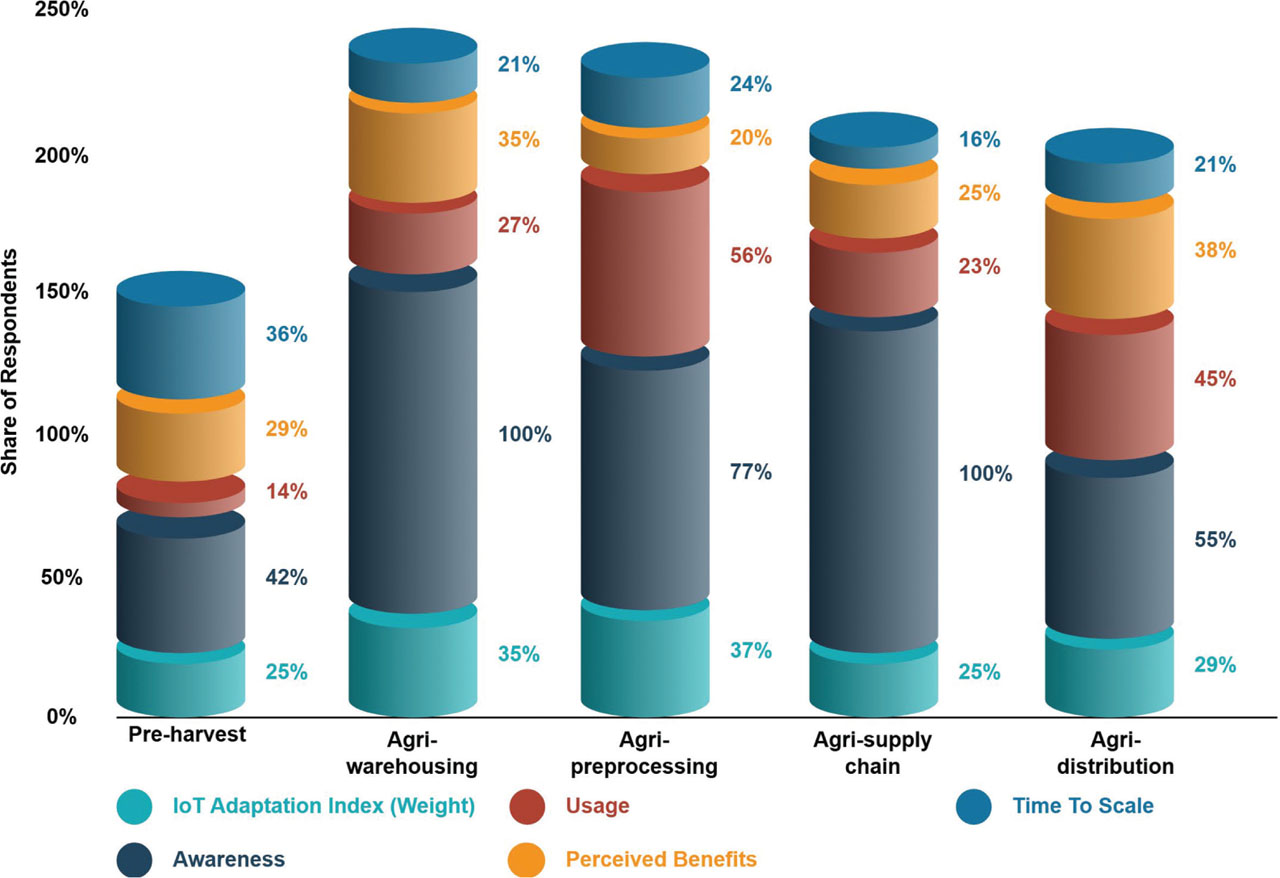
Figure 5:
IoT technology adoption in the agricultural sector in India in 2020. Source: NASSCOM (India). (April 29, 2021). Internet of Things technology adoption in agricultural sector in India in 2020 [Graph]. In Statista. Retrieved February 17, 2025, from https://www-statista-com.elibrary.siu.edu.in/statistics/1234515/india-iot-adoption-in-agricultural-sector/. IoT, Internet of Things.
Table 5:
Review of AI for Indian crops and agricultural practices
| S.No. | Agricultural application | AI-based framework or algorithm used |
|---|---|---|
| 1 | Irrigation automation | PLSR and other regression Algorithms [50], |
| Artificial Neural Network-based control system [51], | ||
| Fuzzy logic [52,53,54,55], | ||
| ANN (multilayer neural model), Levenberg Marquardt, Backpropagation [56], | ||
| ANN Feed Forward, Backpropagation [57], Smart Drip Irrigation [58, 59] | ||
| 2 | Crop management | Automatic weed identification using DL models [60,61,62,63], |
| Computer vision-aided system [64], | ||
| Fuzzy logic controller [65], | ||
| Chromatic aberration-based image segmentation [66], | ||
| YOLOv5 and computer vision system [67] | ||
| 3 | Soil health | Moisture analyzers and METTLER TOLEDO [68, 69], DL-based AI framework [70, 71] |
| 4 | Crop yield monitoring system | Hybrid AI [72], |
| ML [73–74] | ||
| 5 | Pest and plant management | AI and ML [75, 76], |
| AI-driven Farm Management System [77–78], | ||
| Deep Convolution Neural Network [79,80,81] | ||
| 6 | Smart greenhouse | CNN [82], ML [83], |
| Fuzzy Logic Controller [84] |
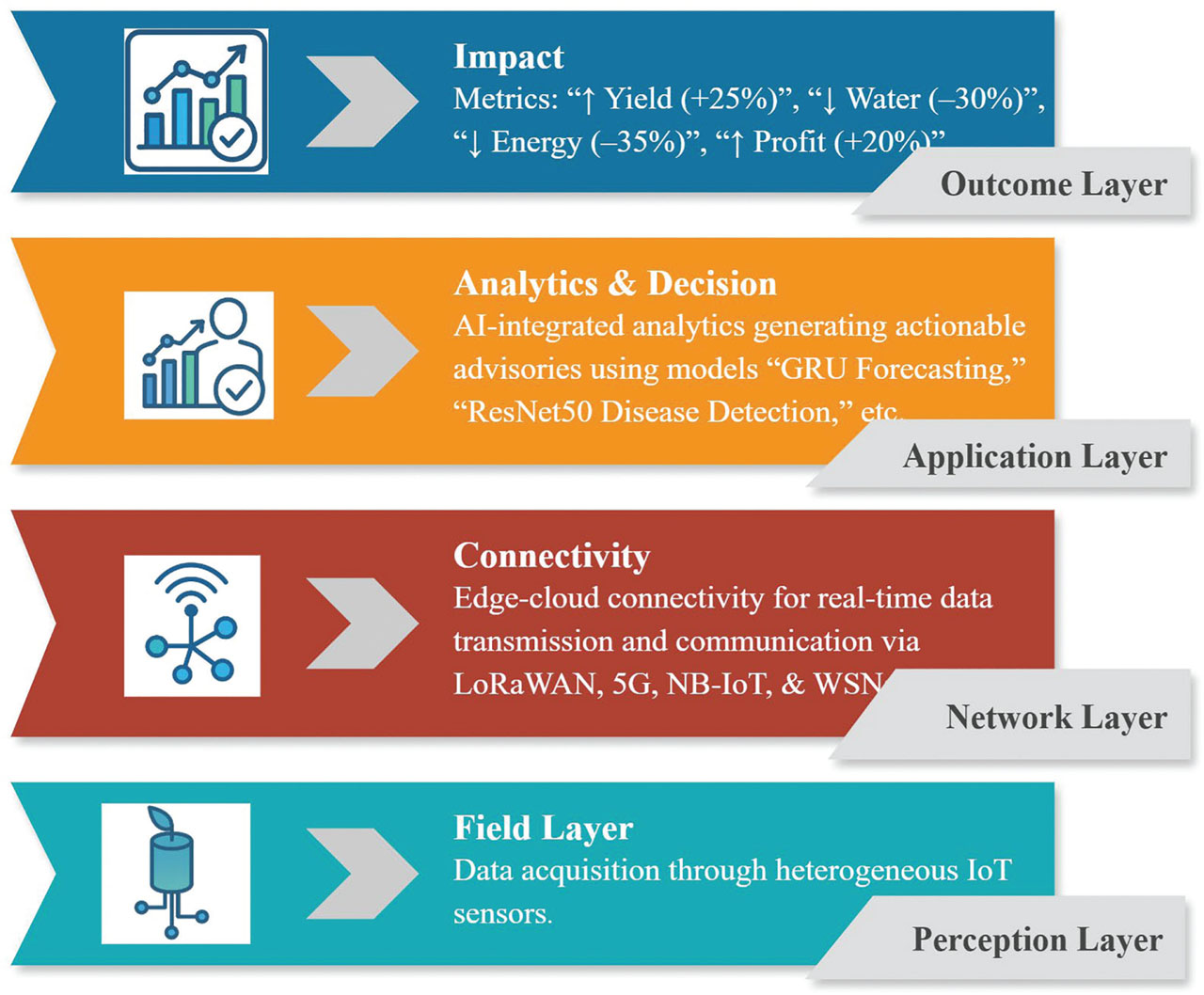
Figure 6:
End to end IoT-AI ecosystem in India. AI, artificial intelligence; IoT, Internet of Things.
Table 6:
Year-wise publication breakdown
| Year range | Number of articles | Percentage (%) |
|---|---|---|
| 2005–2009 | 3 | 3.1 |
| 2010–2015 | 6 | 6.3 |
| 2016–2019 | 9 | 9.4 |
| 2020–2022 | 23 | 24.0 |
| 2023–2025 | 55 | 57.2 |
Table 7:
Summary of existing AI and IoT techniques with performance analysis
| S.No. | Algorithm name | Performance evaluation | Gap analysis |
|---|---|---|---|
| 1 | GRU for weather forecasting and ResNet50—for crop disease prediction [39] | DL-based system achieved 94% accuracy in weather forecasting and 98% accuracy in crop disease prediction, demonstrating superior performance over traditional methods. | It lacks in sensor reliability, real-time scalability, generalization to new diseases, and user accessibility for farmers. |
| 2 | Fixed-effects panel data regression model [42] | A high model fit (R2 = 0.89, F = 74.6), confirming that fixed-effect panel regression effectively captures the key socio-economic and environmental factors influencing agricultural ecological efficiency in the Ganges Tributary Commercial Zone. | It needs a more comprehensive analysis of low-carbon farming practices across diverse regions. |
| 3 | IoT-based smart agriculture model featuring a wireless sensor network [41] | It reduces manual intervention, enhances real-time monitoring, and improves crop productivity through automated irrigation and environmental sensing. | Lacks integration of AI-driven analytics and scalability assessment, limiting the full potential of IoT-based smart agriculture systems in the long term. |
| 4 | IoT-enabled precision irrigation system [43] | It efficiently addresses water scarcity by producing 1 liter of water per hour, improving water usage, energy efficiency, and crop irrigation sustainability. | It lacks an assessment of long-term scalability, cost-effectiveness, and real-world performance in diverse agricultural environments and regions. |
| 5 | AI and IoT-based automatic irrigation system [51] | It predicts rainfall patterns and adjusts irrigation schedules based on soil moisture conditions, achieving 80% accuracy in a controlled environment. | It lacks an evaluation of the system’s performance under real-world, large-scale conditions and its long-term impact on water conservation and crop yield. |
| 6 | IoT-Based Smart Mushroom Cultivation Control System [55] | It achieved reliable environmental control for outdoor oyster mushroom cultivation, with ANFIS demonstrating superior dynamic performance over FIS and PID controllers in transient time, settling time, overshoot, and peak metrics. | It is for small-scale mushroom cultivation; its scalability and performance for large-scale production remain unexplored. |
| 7 | ANN-Based Smart Irrigation Scheduling System [57] | It achieved a 20.46% water saving and a 23.9% energy saving, with high accuracy validated by ROC analysis at a 95% confidence interval. | Further validation under diverse environmental conditions and larger-scale deployments to confirm its generalizability and robustness. |
| 8 | Deep Transfer Learning and ML-Based Rice Category Identification Model [60] | It achieved outstanding rice category identification performance, with MLP (30, 30) + VGG-19 reaching 99.72% accuracy and consistently high AUC values across models. | A noticeable number of rice images remained unclassified, indicating the need for model refinement and exploration of more robust architectures or ensemble methods. |
| 9 | YOLOv5 for oil palm tree detection YOLOv4 for loose fruitlet detection [61] | It achieved 97.79% mAP for tree detection using YOLOv5, 85.45% mAP for loose fruitlet detection using YOLOv4, and ready-to-harvest classification accuracies of 90.48% and 91.34% at thresholds zero and three, respectively. | It requires retraining for different environments and struggle with detecting small, occluded, or poorly visible loose fruitlets. |
| 10 | DarkNet53 deep learning model [62] | It achieved superior performance in weed identification with over 99% F1 score during validation and 96.6% accuracy in independent testing, outperforming other DL models. | A research gap in real-time deployment and validation of DL-based weed identification systems specifically tailored for sugarcane cropping under diverse field conditions. |
| 11 | AlexNet CNN-Based Model [64] | It achieved a peak accuracy of 99.16% in detecting seven types of paddy crop diseases, outperforming DenseNet and ResNet in polyhouse conditions. | It lacks extensive field validation beyond polyhouse environments and does not address real-time deployment challenges. |
| 12 | Real-Time Variable-Rate Chemical Spraying System for Paddy Disease Control [65] | It achieved a minimum of 33.88% reduction in chemical usage compared to constant-rate application, demonstrating significant efficiency in targeted agrochemical application. | The gap lies in the absence of automation in disease identification and lack of dynamic spray control |
| 13 | YOLOv5m for volunteer cotton detection in corn field [66] | It achieved a mAP of 79% at IoU 50%, classification accuracy of 78%, and an inference speed of 0.4 FPS on Jetson TX2. | Lack of automated, real-time detection and targeted spraying of volunteer cotton in corn fields leads to ineffective boll weevil control. |
| 14 | Extra Trees Regressor [70] | It outperformed all other models with the highest R-squared score of 0.9615 and the lowest MAE and RMSE, demonstrating superior accuracy and consistency in crop yield prediction. | Limited generalizability of existing crop yield prediction models across diverse agro-climatic zones and crop types due to insufficient integration of heterogeneous data sources. |
| 15 | ARIMA-SVM Hybrid Crop Price Prediction Model [72] | It outperformed standalone ARIMA and LSTM models with an average prediction accuracy of 95.65% and superior performance in risk prediction and overall model stability. | Lacks integration of external real-world factors like climate variability, policy changes, and global trade, limiting its robustness in a dynamic climate. |
| 16 | ResNet50, InceptionV2, MobileNetV1, Faster R-CNN, SSD MobileNetV1 [76] | It achieved high performance with map scores ranging from 70% to 99%, demonstrating robust accuracy across different plant parts, especially in focused images with minimal background noise. | Limited early-stage and mixed-symptom data, along with lack of multi-label classification, reduces real-world detection accuracy and applicability. |
| 17 | BR-TomatoCNN Deep Learning Model [80] | It achieved outstanding performance with up to 99.82% accuracy and an F1-Score of 1.00 across multiple experiments, demonstrating high robustness, efficiency, and generalization capability. | Lacks support for multi-label classification and underrepresented disease stages, limiting its applicability to real-world, complex tomato disease scenarios. |
| 18 | Smart Oyster Mushroom Cultivation using Automatic FLC [84] | It reduced actuator response time (0–45 s for temperature, 0–40 s for humidity) compared to traditional On-Off control (up to 1,000 s/1,400 s), enhancing efficiency and system responsiveness. | Lacks integration of advanced predictive models (e.g., neural networks) to further enhance control precision and system adaptability in varying environmental conditions. |